

Top 5 Enterprise Compliance Platforms: Features & Selection Guide (2026)
Regulatory scrutiny continues to intensify, with organizations expected to demonstrate not just compliance, but how controls are implemented, monitored, and evidenced over time. In large enterprises, this expectation collides with a more complex reality, multiple frameworks, overlapping regulations, and fragmented processes spread across teams and systems.

Audit findings increasingly reflect this fragmentation, particularly in environments subject to oversight from bodies such as the U.S. Securities and Exchange Commission and Financial Industry Regulatory Authority. Controls may exist, but they are tracked inconsistently. Evidence is stored across systems. Ownership is unclear when issues arise.
As compliance scope expands across jurisdictions and business units, manual coordination and point solutions begin to break down. The challenge shifts from managing individual requirements to maintaining consistent oversight across the organization.
Understanding how enterprise-level platforms address this shift is critical for compliance leaders accountable for sustaining regulatory alignment under ongoing supervisory scrutiny.
Key Takeaways
- Enterprise compliance breaks down when obligations, controls, and evidence are managed across disconnected systems; centralization is required for consistent oversight.
- The primary shift is from tracking compliance activities → enforcing structured workflows with clear ownership and accountability.
- Audit readiness depends on continuous evidence mapping and traceability, not periodic documentation efforts.
- Platforms must support multi-framework control reuse and cross-functional coordination to remain effective at scale.
- The long-term value of an enterprise compliance platform lies in its ability to connect compliance, risk, policy, and incident workflows into a single operational system.
What Is an Enterprise Compliance Platform?
An enterprise compliance platform is a system used to manage regulatory obligations, controls, and compliance activities across the organization within a structured, centralized environment where execution, ownership, and evidence are consistently enforced.
For compliance leaders, the platform functions as a system of record where obligations are mapped, controls are executed within defined workflows, evidence is continuously maintained, and compliance status remains audit-ready at any point in time.
Also Read: What is Enterprise Governance, Risk, and Compliance?
Key Features of an Enterprise Compliance Platform
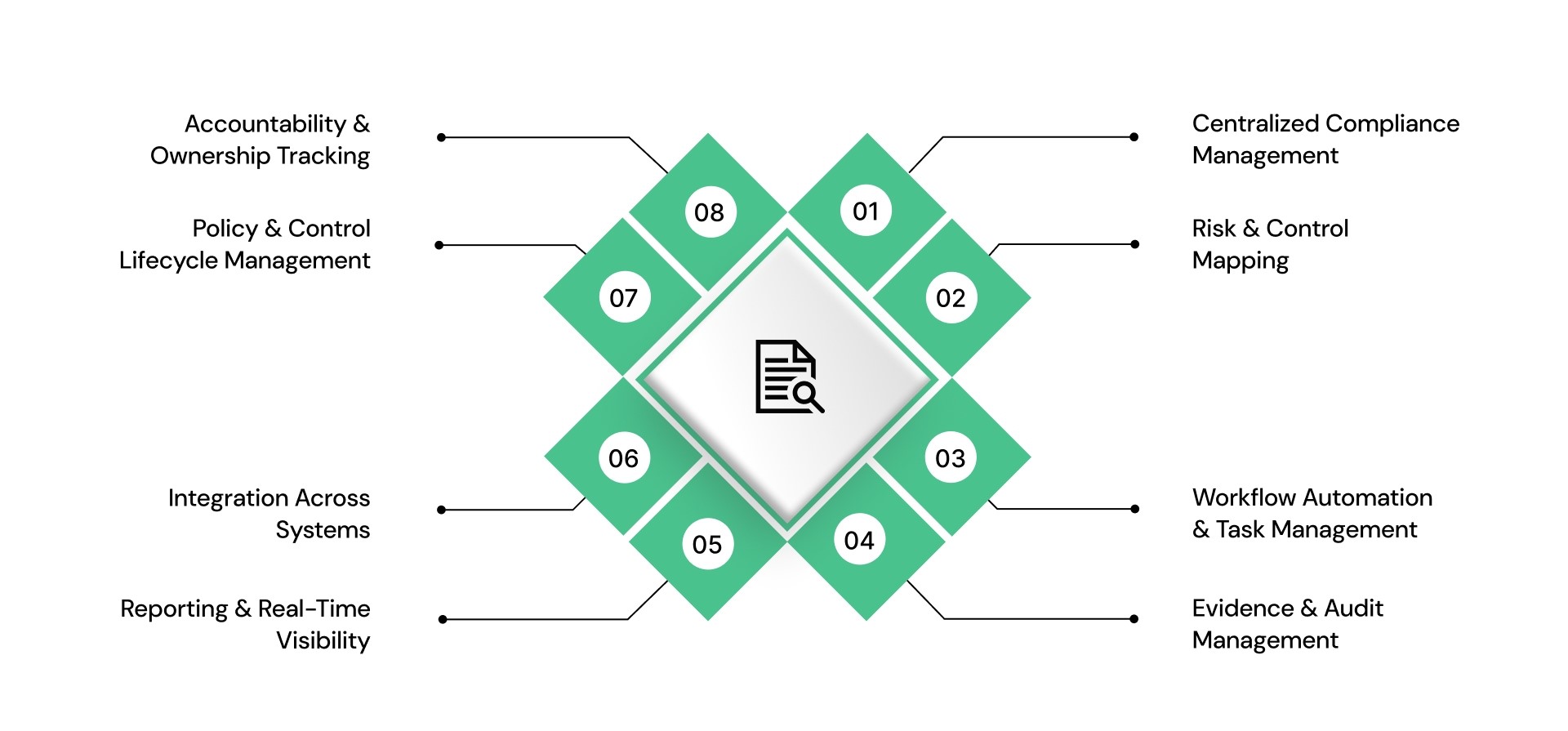
For enterprise teams, features are not evaluated in isolation, they are assessed based on how effectively they enforce structured execution across compliance activities. The objective is not just to track obligations, controls, and evidence, but to ensure they are consistently performed, owned, and auditable across the organization.
1. Centralized Compliance Management
An enterprise platform must provide a single system to manage all compliance obligations.
- Regulatory requirements mapped across frameworks (e.g., SOX, NIST, ISO)
- Central repository of controls and obligations
- Visibility across business units, entities, and geographies
This eliminates fragmentation and ensures teams are not operating on disconnected datasets.
2. Risk and Control Mapping
Compliance cannot operate separately from risk.
- Controls mapped to risks and regulatory requirements
- Ability to reuse controls across multiple frameworks
- Clear linkage between risk exposure and compliance activities
This allows organizations to prioritize control execution based on risk exposure, ensuring that compliance activity reflects actual business risk rather than static regulatory checklists.
3. Workflow Automation and Task Management
Enterprise compliance requires coordination across multiple teams.
- Task assignment with defined ownership
- Approval workflows and escalation paths
- Automated reminders for pending and overdue actions
In mature environments, workflow-driven systems enforce this structure by ensuring that compliance activities are assigned, tracked, and completed within defined accountability frameworks rather than relying on manual follow-ups.
4. Evidence and Audit Management
Audit readiness depends on how well evidence is maintained and linked to controls.
- Centralized evidence repository with version control
- Direct linkage between controls, actions, and supporting documentation
- Time-stamped audit trails of all activities
This ensures that compliance can be demonstrated clearly during audits, without reconstructing records manually.
5. Reporting and Real-Time Visibility
Leadership requires continuous insight into compliance posture.
- Dashboards showing control status, overdue items, and gaps
- Reports aligned with regulatory and audit requirements
- Visibility into trends across frameworks and business units
This shifts compliance from periodic reporting to continuous oversight, where leadership can identify control gaps, delays, and systemic issues early enough to act before audit exposure materializes.
6. Integration Across Systems
Enterprise compliance spans multiple operational systems.
- Integration with HR, ERP, security, and IT systems
- Automated data flow for evidence collection and control validation
- Reduction in manual data entry and duplication
In integrated environments, compliance does not operate as a standalone function. It becomes part of a coordinated governance system where data flows directly into control execution, evidence collection, and risk evaluation without manual intervention. Platforms like VComply connect compliance with risk, policy, and incident workflows, enabling a coordinated governance model rather than siloed processes.
7. Policy and Control Lifecycle Management
Compliance begins with policies and extends through control execution.
- Policy creation, approval, and distribution
- Mapping policies to controls and regulatory requirements
- Tracking employee acknowledgment and adherence
This ensures policies are not static documents but part of an enforceable compliance framework.
8. Accountability and Ownership Tracking
One of the most critical features in enterprise environments is ownership.
- Assignment of responsibility at the control and task level
- Tracking of who performed each action
- Visibility into pending, completed, and overdue responsibilities
This ensures compliance execution is system-driven and traceable, reducing dependency on informal follow-ups and minimizing the risk of unassigned or unverified control activities.
Also Read: Why a Compliance Management System is Important
Top 5 Enterprise Compliance Platforms
Enterprise platforms differ significantly in how they structure workflows, integrate across systems, and scale across regulatory frameworks. The distinction is not in feature availability, but in how effectively these capabilities translate into consistent, organization-wide execution.
1. VComply
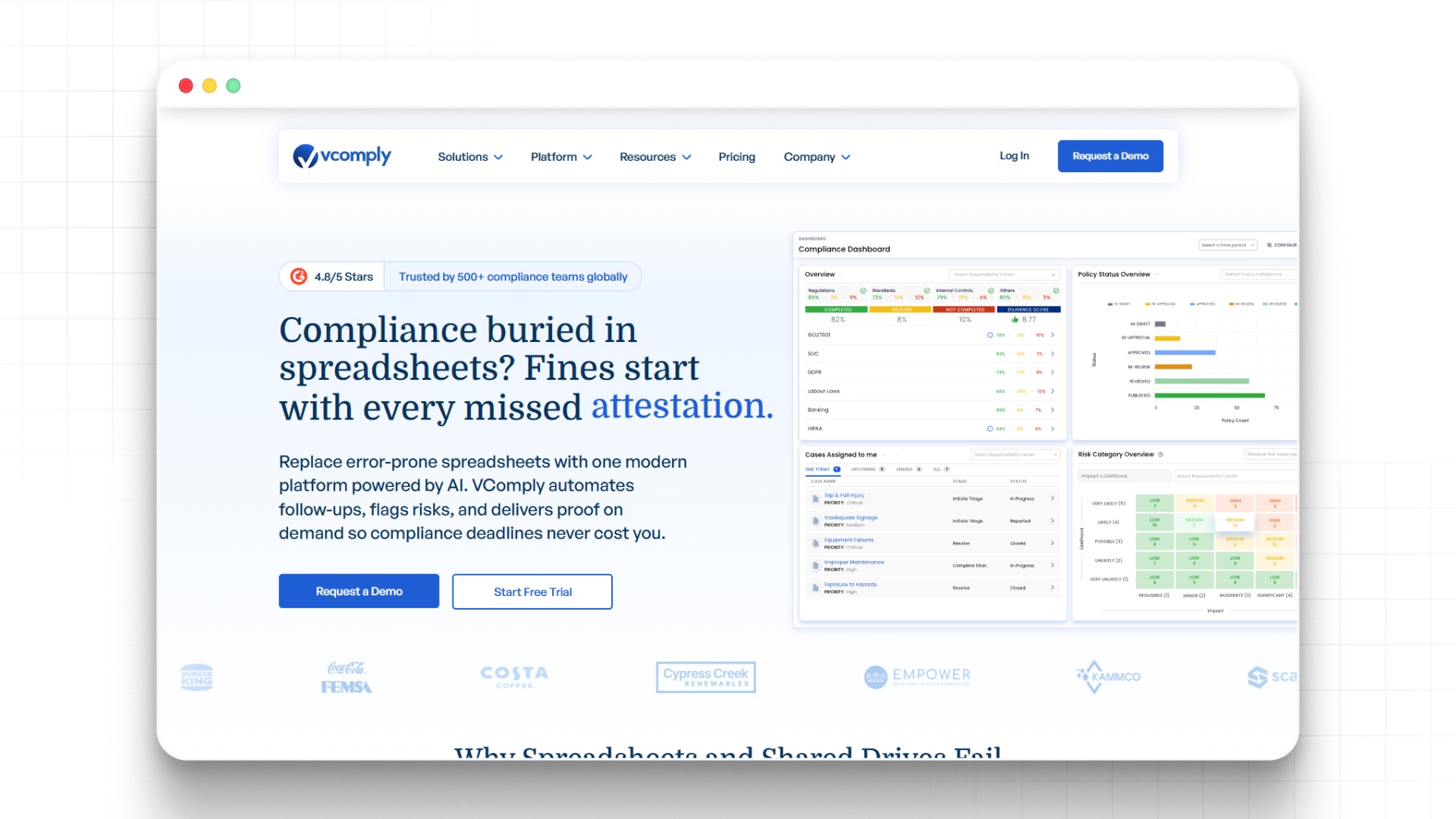
VComply is a unified and AI-powered GRC platform that brings compliance, risk, policy, and incident management into a single operational system. It is designed for organizations that need to move beyond fragmented tracking and establish consistent, workflow-driven execution across compliance programs.
- Centralized Control Management: Maintains a unified system of record for regulatory obligations, controls, and frameworks across the organization.
- Workflow-Driven Execution: Enforces task ownership, approvals, reminders, and escalations to ensure consistent compliance execution.
- Integrated Risk Management: Connects risk identification, assessment, and mitigation with compliance activities for aligned decision-making.
- Policy Lifecycle Governance: Manages policy creation, approval, distribution, versioning, and employee attestation within a structured system.
- Incident Case Management: Tracks incidents and issues through structured intake, investigation, and resolution workflows with full visibility.
- Automated Evidence Tracking: Collects, stores, and links evidence to controls with timestamps and audit trails for continuous readiness.
- Multi-Framework Mapping: Enables control reuse across frameworks to reduce duplication and maintain consistency.
- Real-Time Visibility: Provides dashboards and reports for monitoring compliance status, gaps, and overdue actions.
- Alerts and Integrations: Uses notifications and system integrations to reduce manual follow-ups and ensure timely execution.
Best For: Organizations managing compliance across multiple frameworks that require structured execution, clear ownership, and continuous audit readiness.
Operational Consideration: Particularly effective in environments where compliance execution is distributed across functions and requires a system that enforces consistency, rather than relying on manual coordination or disconnected tools.
G2 Rating: 4.6/5
Pricing: Custom pricing based on modules, starting at $1,000/mo.
Demo / Free Trial: Demo on request / 21-day free trial available
2. MetricStream
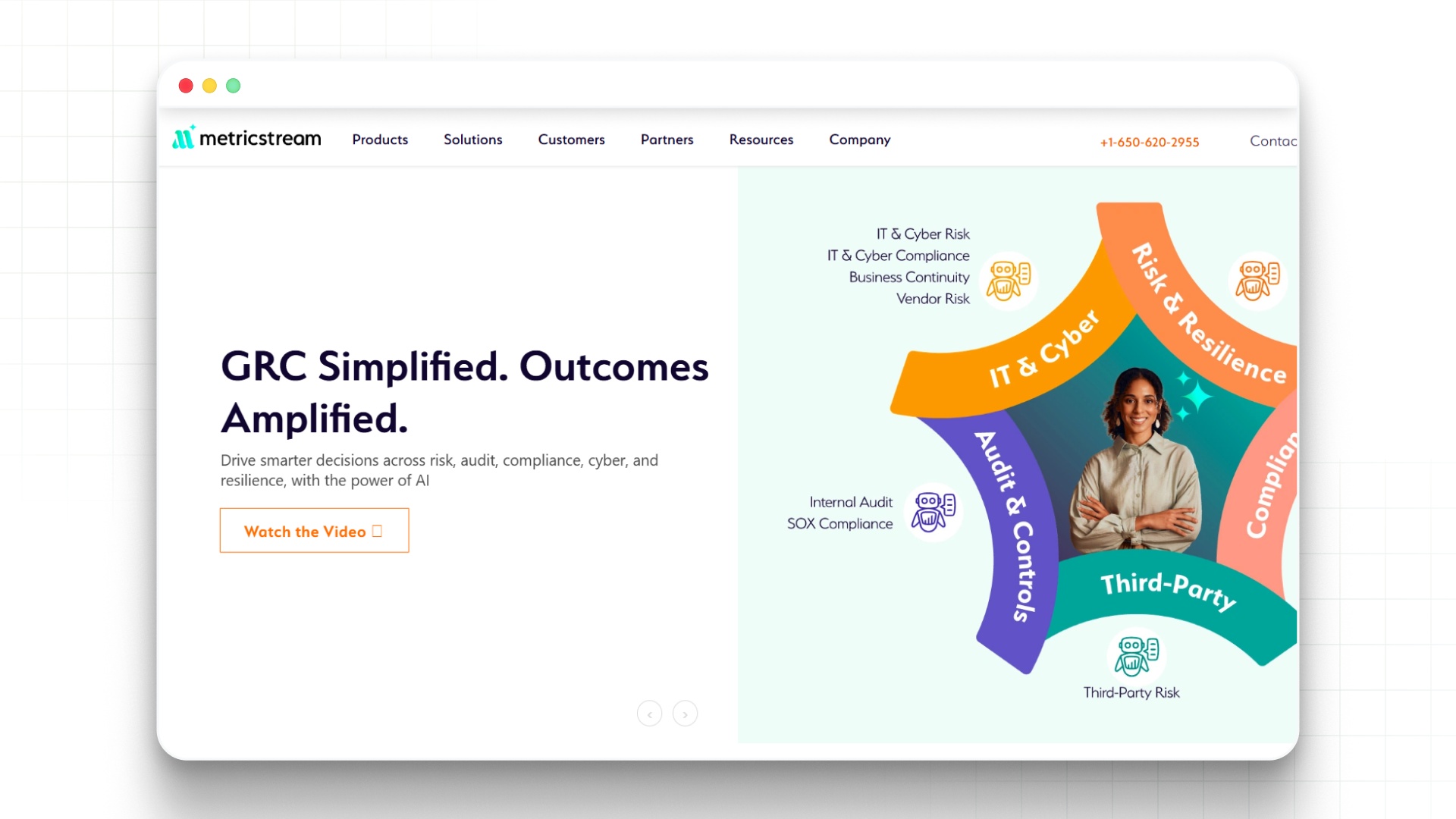
MetricStream is an enterprise-grade GRC platform designed to support large organizations managing complex risk, compliance, and audit programs across multiple business units and regulatory environments.
Key Features
- Unified GRC Modules: Integrates compliance, risk, and audit management within a centralized enterprise platform.
- Regulatory Change Tracking: Monitors regulatory updates and maps changes to obligations and controls.
- Integrated Audit Management: Supports audit planning, execution, findings, and remediation tracking within a single system.
- Risk Quantification Analytics: Assesses and models enterprise risk exposure using advanced analytical capabilities.
- Policy Document Management: Maintains policy libraries with version control, approvals, and distribution workflows.
- Third-Party Risk Oversight: Manages vendor risk assessments, due diligence, and ongoing monitoring processes.
- Enterprise Reporting Insights: Delivers dashboards and reports for organization-wide visibility into compliance and risk posture.
Best For: Large enterprises with mature GRC programs that require extensive configurability and support for complex, multi-layered governance structures.
Operational Consideration: Implementation and ongoing use typically require dedicated GRC resources, as configuration, customization, and maintenance can be resource-intensive over time.
Pricing: Custom enterprise pricing
Demo / Free Trial: Demo available on request
3. SAP GRC
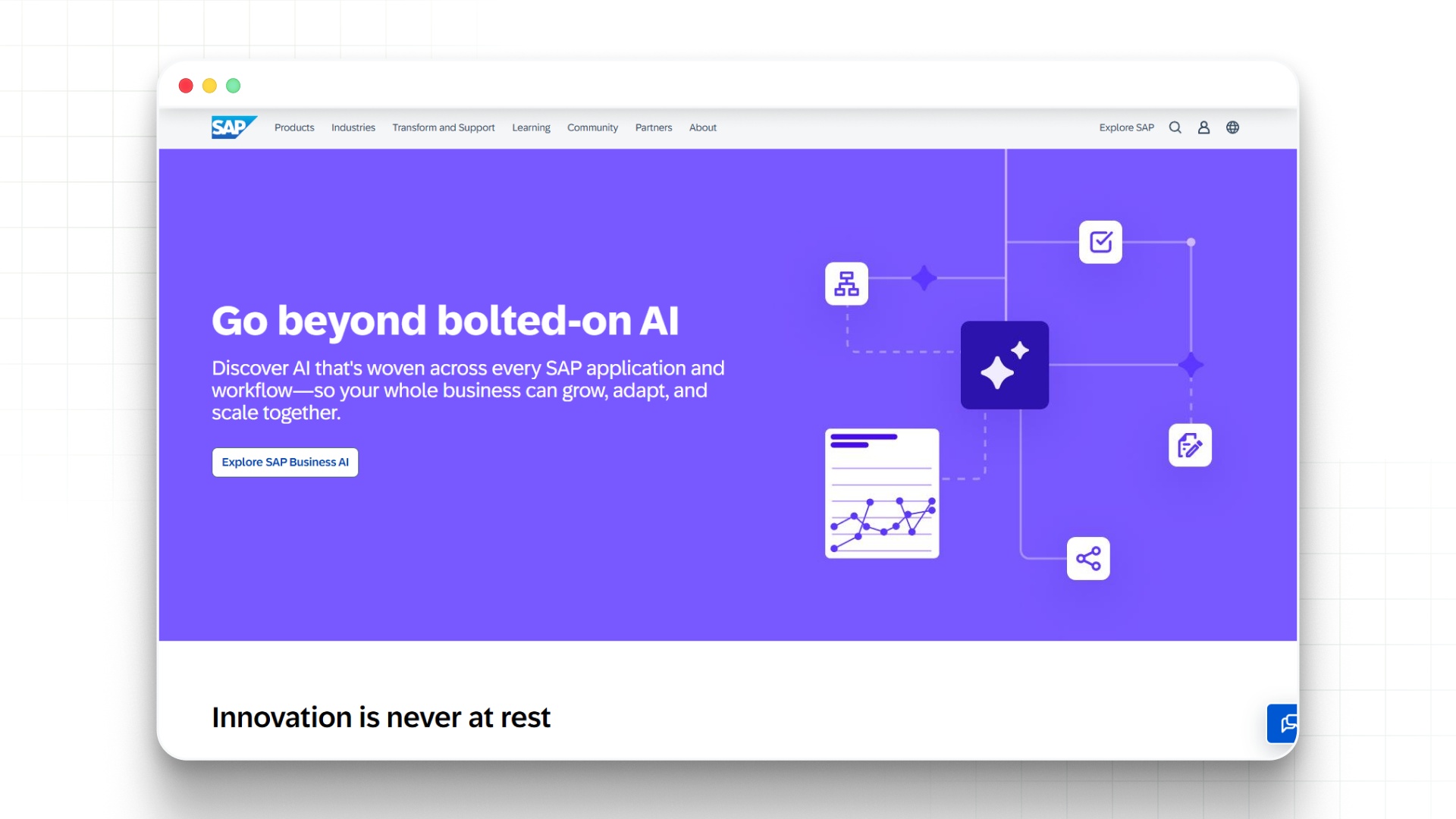
SAP GRC is a governance, risk, and compliance solution designed to operate within the SAP ecosystem, with a strong emphasis on financial controls, access governance, and internal control monitoring. It is commonly used by organizations that need to align compliance processes closely with financial systems and transactional data.
Key Features
- Access Control Management: Manages user access, roles, and segregation of duties (SoD) to prevent conflicts and unauthorized actions.
- Process Control Monitoring: Tracks internal controls across financial and operational processes with continuous monitoring capabilities.
- Risk Management Integration: Connects risk identification and assessment with business processes and financial controls.
- Automated Control Testing: Enables continuous testing of controls to detect failures and exceptions in real time.
- Audit Management Support: Facilitates audit planning, execution, and reporting within the SAP environment.
- Regulatory Compliance Reporting: Generates reports aligned with financial regulations and internal control requirements.
- SAP System Integration: Deep integration with SAP ERP and financial systems for seamless data flow and control validation.
Best For: Organizations heavily invested in SAP systems that require strong financial compliance, access governance, and internal control monitoring.
Operational Consideration: Most effective in SAP-centric environments; flexibility may be limited for organizations operating across diverse, non-SAP systems.
G2 Rating: 4.2/5
Pricing: Custom pricing; typically bundled within SAP enterprise solutions
Demo / Free Trial: Demo available
4. LogicGate
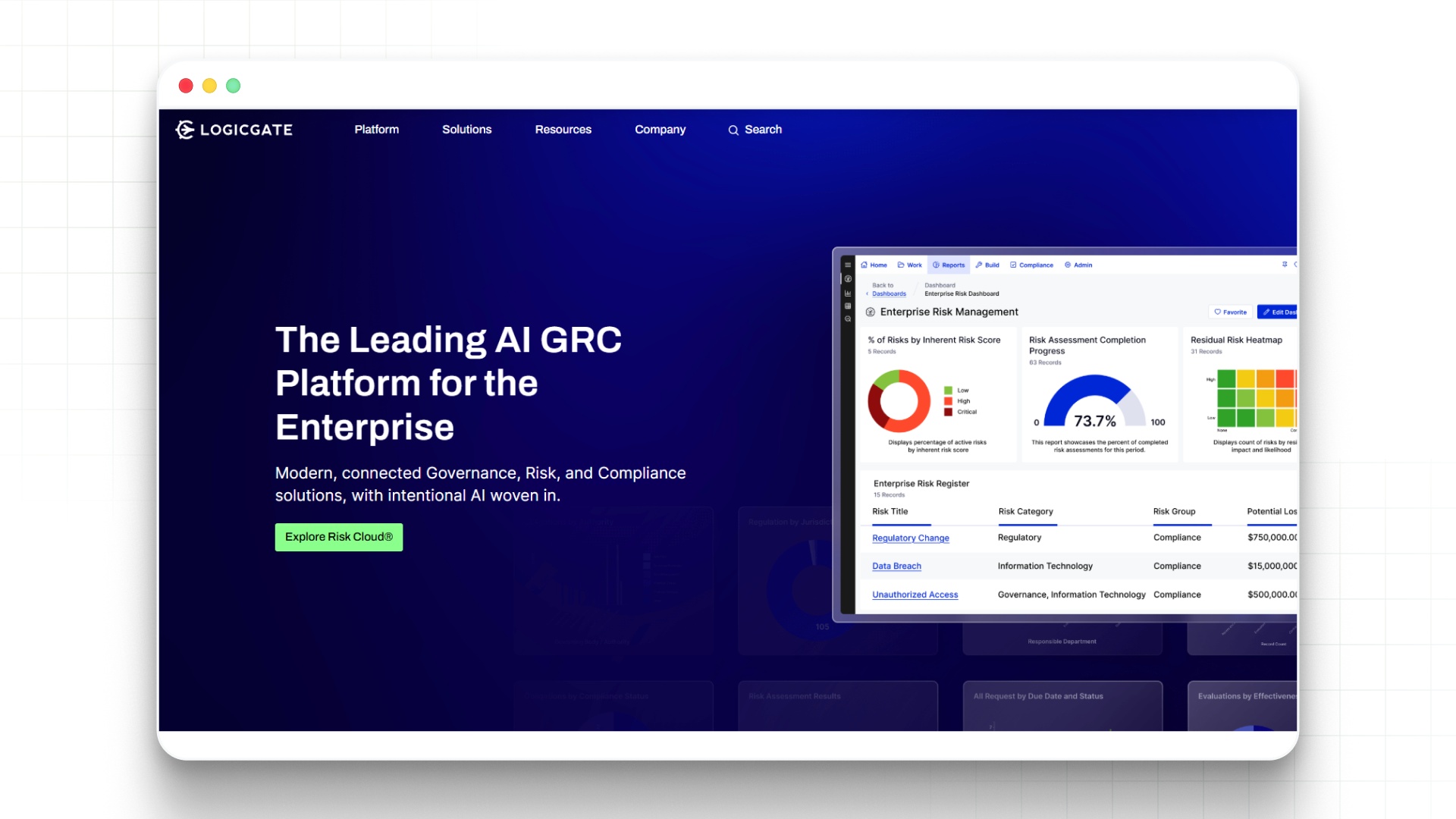
LogicGate is a configurable GRC platform built around a no-code architecture, allowing organizations to design and adapt compliance, risk, and audit workflows based on their specific operational requirements. It is commonly used by teams that need flexibility to build custom governance processes rather than relying on predefined structures.
Key Features
- No-Code Workflow Builder: Enables teams to design, modify, and automate compliance and risk workflows without engineering support.
- Custom Framework Mapping: Allows organizations to define control frameworks and map risks, controls, and requirements based on internal or regulatory needs.
- Pre-Built Applications: Provides ready-to-use modules for compliance, audit, and third-party risk that can be further customized.
- Centralized Risk Registers: Maintains risk inventories with scoring, prioritization, and linkage to controls and mitigation actions.
- Integration Capabilities: Connects with enterprise systems through APIs to support data flow and process automation.
- Dynamic Reporting Dashboards: Offers customizable dashboards for monitoring governance, risk, and compliance activities.
- Scenario Analysis Tools: Supports risk modeling and impact analysis for better decision-making.
Best For: Organizations that require highly customizable workflows and have the internal maturity to design and maintain their own governance structures.
Operational Consideration: Flexibility can introduce complexity; without strong process discipline, workflows may become inconsistent or difficult to standardize across teams.
G2 Rating: 4.6/5
Pricing: Custom pricing
Demo / Free Trial: Demo available
5. Riskonnect
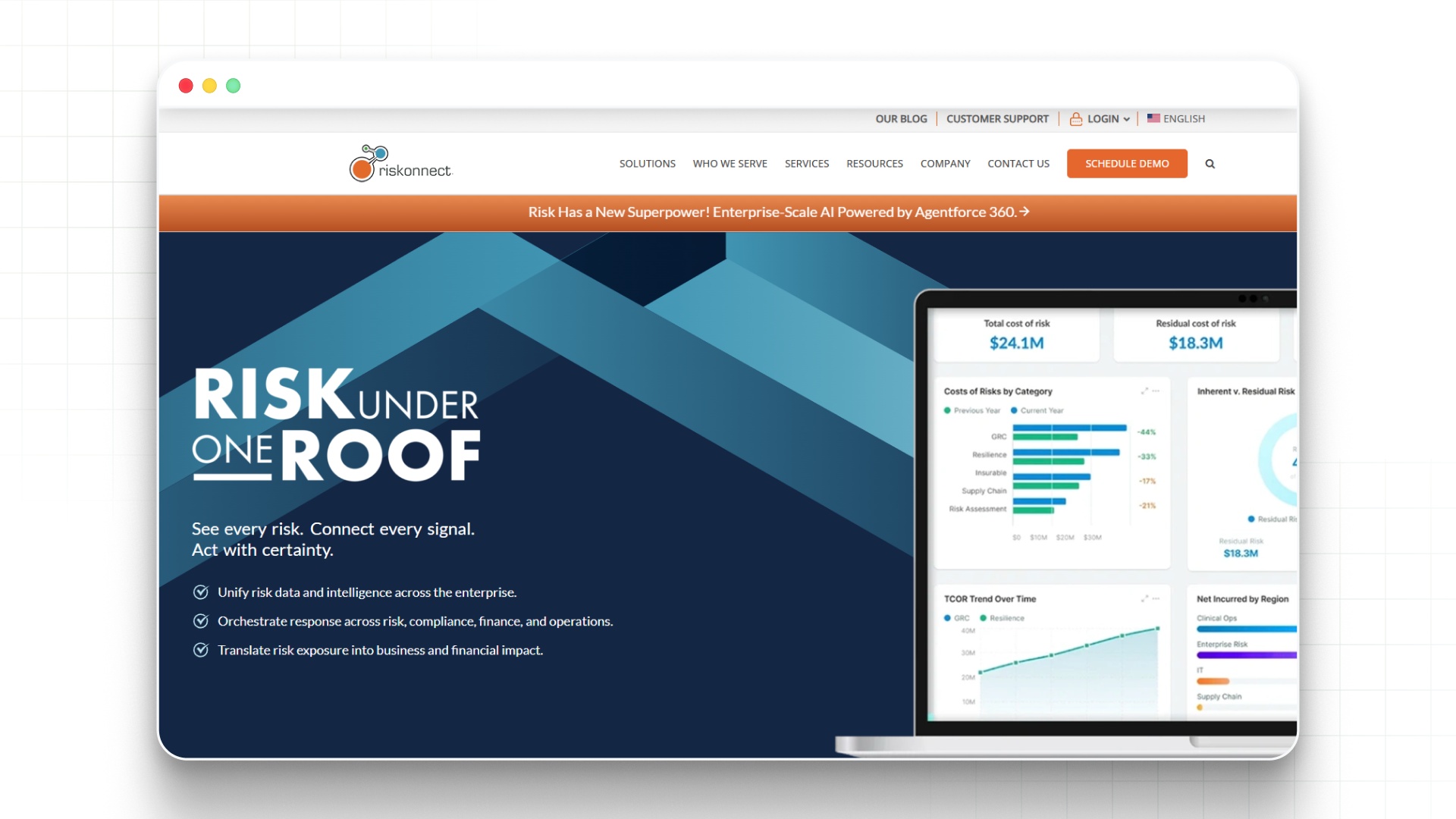
Riskonnect is an enterprise platform focused on integrating risk management, compliance, and resilience into a unified system. It is often used by organizations managing operational risk, incident response, and business continuity alongside compliance programs.
Key Features
- Integrated Risk and Compliance Management: Connects risk registers, compliance activities, and control frameworks within a single system.
- Incident and Event Management: Tracks incidents from reporting through resolution with structured workflows and visibility.
- Internal Audit Management: Supports audit planning, execution, findings, and remediation tracking.
- Third-Party Risk Management: Enables vendor risk assessments, monitoring, and due diligence processes.
- Business Continuity Planning: Supports resilience planning, crisis management, and recovery workflows.
- Real-Time Reporting and Dashboards: Provides visibility into risk exposure, incidents, and compliance status across the organization.
- Workflow Automation: Automates task assignments, escalations, and approvals across risk and compliance processes.
Best For: Enterprises that need to manage operational risk, resilience, and compliance within a single, integrated framework.
Operational Consideration: Particularly strong in risk and resilience use cases; organizations seeking highly compliance-centric workflows may require additional configuration.
G2 Rating: 4.3/5
Pricing: Custom enterprise pricing
Demo / Free Trial: Demo available on request
Benefits of Enterprise Compliance Platforms
For enterprise teams, the value of a compliance platform is measured by how effectively it replaces fragmented, manual coordination with structured, system-driven execution across functions.
1. Unified View of Compliance and Risk
Enterprise platforms bring obligations, controls, and risks into a single system. This eliminates duplicate tracking, aligns controls with regulatory requirements, and creates a consistent view across business units.
In fragmented environments, reporting often depends on reconciling data across systems, leading to delays and inconsistencies. Centralization removes this dependency and enables a single, reliable source of truth for compliance status.
2. Reduced Audit Friction
Audit readiness improves when control execution and evidence are continuously tracked. Evidence is already mapped to controls, activities are time-stamped and owned, and audit trails are readily available.
This eliminates the need for retrospective evidence collection, where teams reconstruct records under time pressure, a common source of audit gaps and inconsistencies.
3. Improved Accountability Across Teams
Compliance execution depends on multiple teams, and accountability must be clearly defined. Enterprise platforms assign ownership at the control level, track tasks with deadlines, and make responsibility visible across functions.
Without this structure, ownership often becomes implicit, increasing the risk of missed controls and unverified activities.
4. Scalable Compliance Operations
As organizations expand across geographies and regulatory frameworks, complexity increases. Enterprise platforms support multiple frameworks without duplicating controls, enable consistent processes across entities, and handle growing volumes of evidence and activities.
This prevents compliance programs from scaling through additional manual effort, which typically leads to inefficiencies and increased risk exposure.
5. Continuous Oversight Instead of Periodic Reviews
Regulatory expectations increasingly favor continuous monitoring over point-in-time validation. Enterprise platforms support this shift by tracking control performance in real time, highlighting gaps and overdue actions, and providing leadership with ongoing visibility.
In contrast, periodic review models often allow control failures to go undetected between audit cycles, increasing the likelihood of late-stage remediation.
Types of Enterprise Compliance Platforms
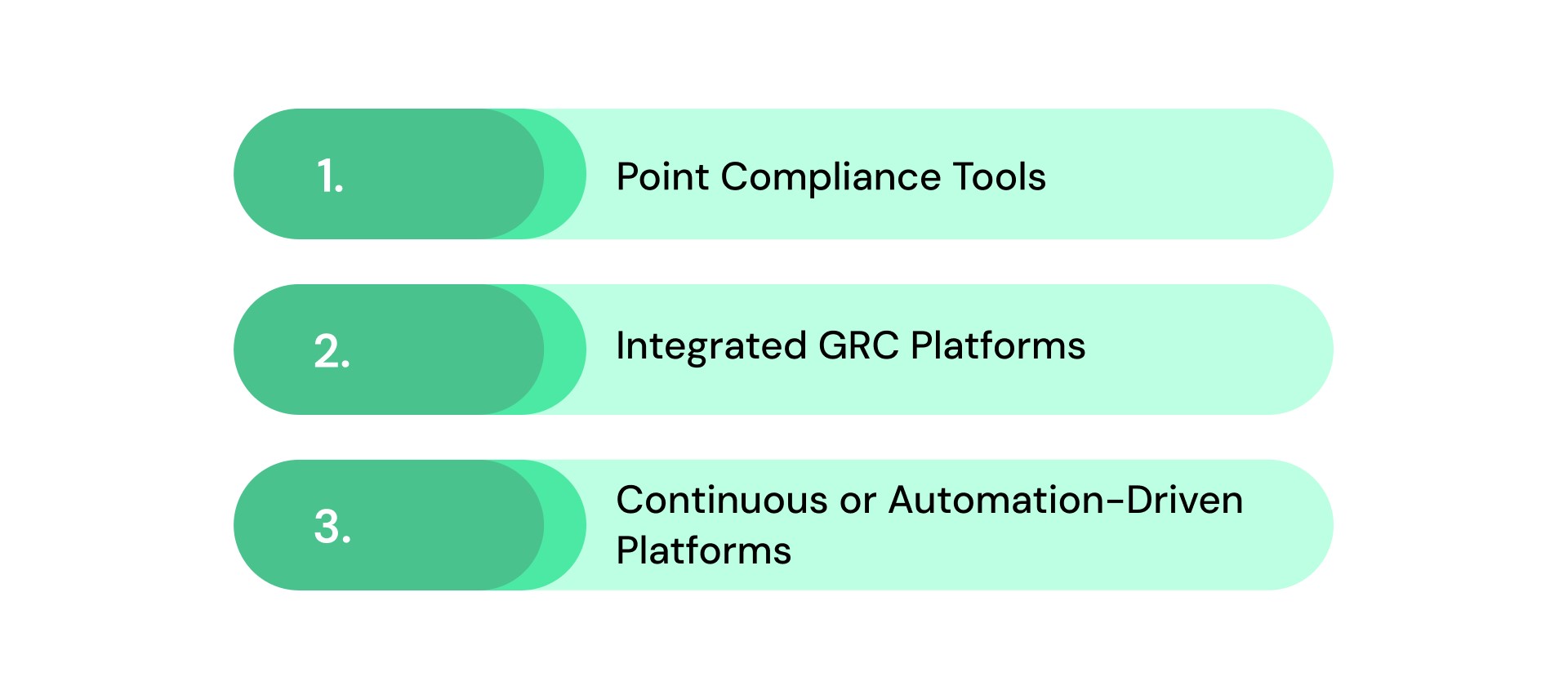
Not all platforms operate at the same level of maturity or serve the same operational need. The distinction is not just in feature sets, but in how compliance activities are structured, executed, and sustained across the organization.
1. Point Compliance Tools
These tools focus on a single function, such as policy management, audit tracking, or vendor risk.
While effective for targeted use cases, they often operate independently of broader compliance workflows. As organizations scale, this creates fragmentation, where controls, evidence, and ownership are distributed across multiple systems without a unified structure.
Over time, reliance on point tools increases coordination overhead and makes it difficult to maintain consistent oversight across frameworks and business units.
2. Integrated GRC Platforms
These platforms unify compliance, risk, audit, and policy management within a shared system and data model. They provide centralized visibility, standardized workflows, and the ability to manage multiple regulatory frameworks within a single environment.
For most enterprise organizations, this represents the baseline requirement. The value lies in connecting previously siloed functions and enabling consistent execution across teams.
However, effectiveness depends on how well workflows are structured and adopted. Without clear ownership and enforcement, even integrated systems can revert to fragmented usage patterns.
3. Continuous or Automation-Driven Platforms
These platforms emphasize automation and continuous monitoring through capabilities such as automated evidence collection, real-time control validation, and system-driven alerts.
They are designed to reduce manual effort and shift compliance from periodic validation to ongoing oversight. This is particularly relevant in environments with high regulatory scrutiny or frequent audits.
However, automation alone does not ensure control. Without alignment to governance workflows and accountability structures, automated signals may not translate into consistent execution or remediation.
10 Evaluation Criteria for Enterprise Compliance Platforms
Selecting an enterprise compliance platform requires evaluating how well a system aligns with operational realities, not just feature availability. The focus should be on how consistently the platform can support execution, ownership, and audit readiness across the organization.
1. Align with Compliance Scope
The platform should support multiple regulatory frameworks, cross-functional workflows, and varied control types without requiring duplication. In large enterprises, compliance rarely operates within a single framework, and misalignment at this level often leads to parallel processes and inconsistent execution.
2. Evaluate Workflow Structure
Compliance execution depends on clearly defined workflows. The platform must support task assignment, approvals, escalation paths, and enforcement of deadlines.
Without structured workflows, compliance activities tend to revert to manual coordination, increasing the risk of missed controls and incomplete execution.
3. Assess Integration Capabilities
Enterprise compliance does not operate in isolation. The platform should integrate with systems such as ERP, HR, security tools, and ticketing platforms.
Strong integrations enable automated evidence collection and real-time validation of controls, while weak integrations often result in duplicate data entry and fragmented visibility.
4. Consider Scalability Across Business Units
The system must support multiple entities, departments, and user roles while maintaining consistency in how controls and workflows are executed.
Scalability is not just about handling volume, it is about maintaining structure as complexity increases across geographies and regulatory requirements.
5. Evaluate Reporting and Visibility
Leadership requires continuous insight into compliance posture, not periodic summaries. The platform should provide real-time dashboards, audit-ready reports, and visibility into gaps, overdue actions, and trends.
Without this, oversight becomes reactive, often surfacing issues only during audits or reviews.
6. Understand Implementation and Adoption
Even well-designed platforms fail if they are not adopted consistently. Ease of use, clarity of workflows, and onboarding requirements determine whether teams integrate the system into daily operations.
Complex implementations without clear ownership often lead to partial adoption, where teams continue relying on legacy tools alongside the platform.
7. Look for Multi-Framework Control Mapping
The ability to map controls across multiple frameworks (such as SOX, NIST, and ISO standards) reduces duplication and ensures consistency in compliance execution.
This is particularly important in organizations operating across overlapping regulatory environments, where the same control may satisfy multiple obligations.
8. Evaluate Evidence Management Capabilities
A strong platform should support continuous evidence collection, centralized storage, and traceability across controls and activities.
Manual evidence handling introduces delays and increases the risk of missing or incomplete audit trails, particularly in large, distributed teams.
9. Assess Accountability and Ownership Tracking
The platform should clearly assign responsibility at the control and task level, track execution, and provide visibility into who performed each action.
Without enforced ownership, compliance execution often depends on informal coordination, increasing the likelihood of gaps.
10. Prioritize Continuous Monitoring
Platforms that support continuous monitoring of control performance enable early detection of gaps and reduce reliance on periodic reviews.
This is increasingly important in environments where regulatory expectations favor ongoing oversight rather than point-in-time validation.
Common Challenges with Enterprise Compliance Platforms
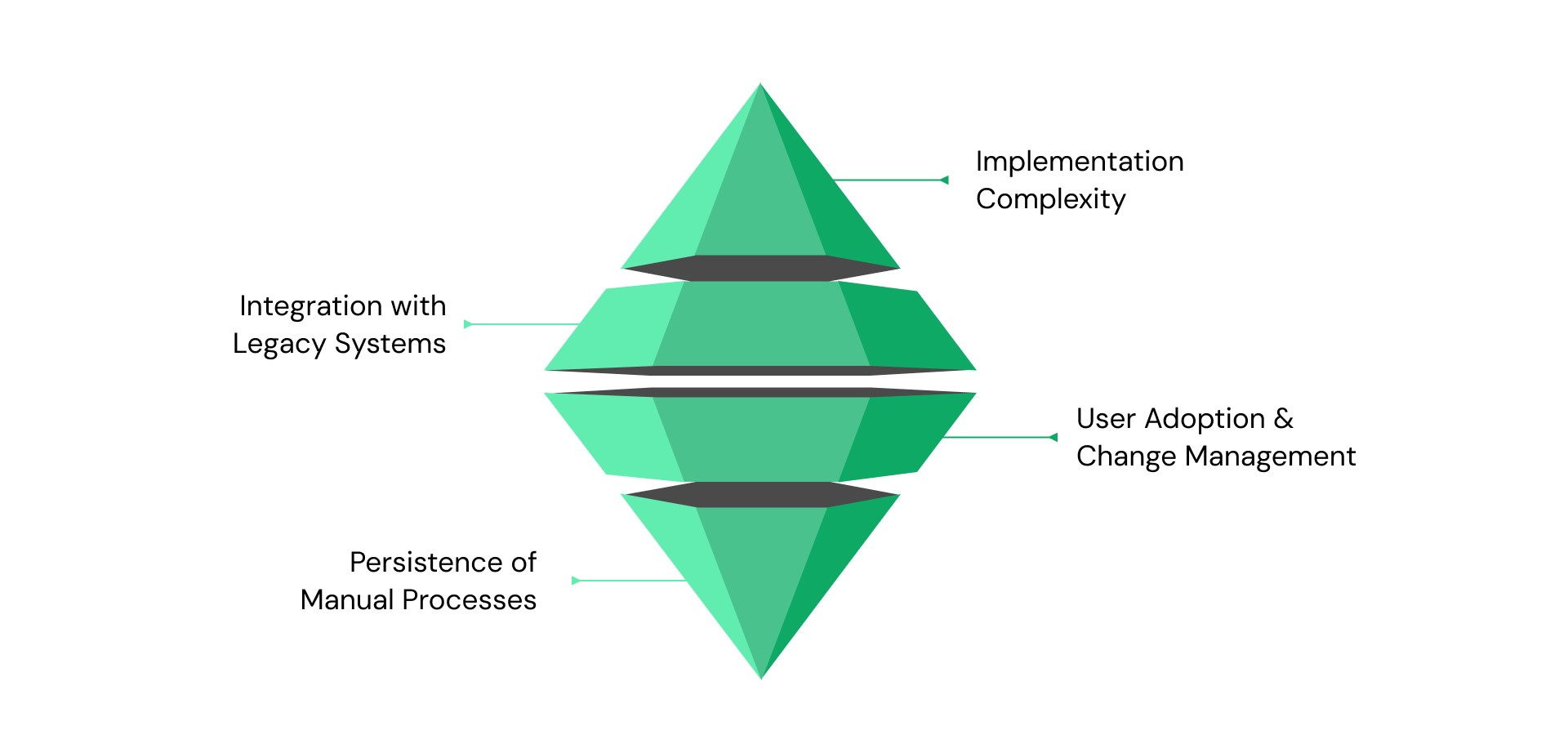
Even well-designed platforms can fall short if they are not aligned with how compliance operates in practice. The challenge is rarely the absence of capability, but the gap between system design and real-world execution.
1. Implementation Complexity
Enterprise platforms often require significant configuration to align with existing compliance structures, regulatory frameworks, and internal processes.
Without clear scoping and ownership, implementation can extend over long timelines, delaying value realization and increasing dependency on external support.
2. Integration with Legacy Systems
Many organizations operate with legacy systems that lack standardized data structures or integration capabilities.
This creates inconsistencies in data flow, limits automation, and often requires manual intervention to maintain alignment between systems, increasing both effort and risk.
3. User Adoption and Change Management
Introducing structured workflows often requires teams to shift away from informal or spreadsheet-based processes.
Resistance to change, unclear ownership, or insufficient training can limit adoption. When teams do not consistently use the platform, compliance execution becomes fragmented despite system availability.
4. Persistence of Manual Processes
Even after implementation, teams may continue to store evidence outside the system, track tasks independently, or bypass workflows.
This undermines centralization, weakens audit trails, and reintroduces the same visibility and accountability gaps the platform was intended to resolve.
Bring Structure to Enterprise Compliance Operations
As compliance expands across frameworks, teams, and geographies, the challenge shifts from managing requirements to maintaining consistent execution and visibility. Fragmented tools and manual coordination make it difficult to track ownership, validate controls, and demonstrate compliance under audit.
Enterprise compliance increasingly requires a system where obligations, controls, evidence, and workflows are connected and continuously monitored, rather than managed in isolation. Without this structure, gaps in execution and oversight tend to persist, regardless of the number of tools in place.
VComply’s GRCOps Suite brings compliance, risk, policy, and incident management into a unified operational layer, enabling organizations to structure workflows, enforce accountability, and maintain real-time visibility across governance activities.
- Workflow-Driven ComplianceOps: Assigns ownership, enforces approvals, and tracks execution across compliance activities.
- Integrated Risk, Policy, and Case Management: Connects risk assessment, policy lifecycle, and incident resolution within a single system.
- Centralized Evidence and Audit Trails: Maintains traceable, time-stamped records linked directly to controls for audit readiness.
- Real-Time Dashboards and Alerts: Provides continuous visibility into compliance status, gaps, and overdue actions.
Understand how GRCOps Suite connects compliance, risk, and policy into a unified governance system. Book a Demo.
Conclusion
Enterprise compliance is no longer defined by whether controls exist, but by how consistently they are executed, tracked, and evidenced across the organization. As regulatory expectations increase, fragmented tools and manual coordination make sustained oversight difficult.
Platforms like VComply address this by structuring compliance into workflow-driven systems that connect obligations, controls, and evidence with clear ownership and continuous visibility.
Organizations that adopt this approach are better positioned to reduce audit friction and maintain consistent control over compliance operations.
See how structured governance workflows can support scalable compliance operations across your organization. Start a 21-Day Free Trial.
FAQs
An enterprise compliance platform is a system that centralizes compliance activities such as obligation tracking, control management, and audit documentation across the organization. It enables teams to manage compliance consistently across multiple frameworks and business units.
GRC software is a broader category that includes governance, risk, and compliance. An enterprise compliance platform focuses specifically on managing compliance operations but often integrates with risk and governance functions within a unified system.
It should include centralized compliance management, workflow automation, control mapping, evidence tracking, audit trails, reporting, and integration with other enterprise systems. These features ensure compliance activities are structured and traceable.
Organizations operating across multiple regulations, frameworks, or geographies typically need an enterprise platform. It is especially relevant for compliance officers, risk managers, and audit teams responsible for maintaining organization-wide oversight.
Pricing varies based on scope, number of users, and modules required. Enterprise platforms typically use custom pricing models, with costs increasing as compliance scope and integrations expand.
Operationalizing compliance requires moving from manual tracking to structured systems that enforce workflows, ownership, and evidence management. Platforms like VComply support this by connecting compliance activities with risk, policy, and incident workflows, enabling consistent execution and visibility across the organization.