

Top Risk Management Tools and Techniques Organizations Will Rely On in 2026
You can no longer treat risk management as a once-a-year checklist, because in 2026, risks hit daily. From sudden regulatory shifts in healthcare and banking to supply-chain shocks in manufacturing and campus safety concerns in higher education, tomorrow’s threats don’t wait for your quarterly meeting.

Compliance officers, risk managers, CTOs, and CEOs face growing pressure not just to identify threats, but to predict and respond in real time. Adverse outcomes of AI are now among the fastest-rising risks, moving from #30 on the two-year outlook to #5 on the 10-year horizon. This highlights the urgency for proactive, continuous risk governance.
Traditional tools like spreadsheets and static risk registers collapse under this velocity and complexity, while continuous approaches drive faster, smarter decisions and stronger organizational resilience. This blog explores the top tools, proven techniques, and practical evaluation guidance needed in 2026.
Key Takeaways
- Risk management in 2026 must be continuous and embedded into daily operations, not treated as a periodic compliance task.
- Effective programs combine structured risk techniques with scalable tools to ensure accountability, visibility, and audit readiness assessment.
- Risk management tools surface trends and early warning signals, enabling proactive decisions rather than reactive responses.
- Choosing the right platform depends on industry fit, automation, ease of use, and scalable reporting capabilities.
- Strong risk programs align governance, technology, and executive oversight to reduce exposure and support confident decision-making.
Did you know?
The Global Risks Report 2026 by the World Economic Forum highlights that 50% of risk professionals expect a turbulent risk outlook over the next two years. This underscores why continuous, tech-enabled risk management like real-time monitoring, automated workflows, and centralized dashboards is no longer optional but essential for organizations in 2026.
What Risk Management Tools Do, and Why Techniques Make Them Effective

Risk management today is not about collecting risk data; it is about turning risk signals into timely, defensible decisions. Tools and techniques play distinct but interdependent roles. When used together, they help organizations move from reactive issue tracking to proactive, enterprise risk governance that scales across teams, locations, and regulatory environments.
Below is how tools and techniques work together to create measurable risk outcomes:
- Centralized Risk Visibility Across the Enterprise: Risk management tools bring risks from audits, operations, vendors, incidents, and regulations into a single system of record. This eliminates fragmented ownership and ensures leadership sees a consolidated risk picture instead of isolated departmental views.
- Automation That Sustains Risk Discipline: Automated workflows enforce consistency in assessments, reviews, and approvals. Without automation, even well-designed risk techniques degrade over time due to manual fatigue and missed follow-ups.
- Techniques That Drive Meaningful Prioritization: Risk techniques determine which risks demand attention first. They apply structured judgment to rank risks based on business impact, regulatory exposure, and operational criticality, something tools alone cannot infer.
- Decision Intelligence, Not Just Risk Tracking: Techniques transform raw risk data into insights leaders can act on. This prevents tools from becoming passive repositories and ensures risk conversations focus on outcomes, not documentation.
- Scalability Across Highly Regulated Industries: In healthcare, techniques help contextualize clinical and data-privacy risks within regulatory obligations. In manufacturing, they distinguish routine operational risks from safety-critical failures.
The table below shows how risk management tools and techniques complement each other:
| Aspect | Risk Management Tools | Risk Management Strategies |
| Primary Role | Enable structure, automation, and traceability | Enable judgment, prioritization, and decision-making |
| Core Value | Centralized data, workflows, and audit readiness | Contextual evaluation of risk severity and impact |
| Limitation Alone | Becomes a static risk repository | Fails to scale consistently across teams |
| Combined Outcome | Continuous, actionable, and defensible risk management | Informed decisions backed by evidence and execution |
Once the foundation of tools and techniques is clear, the next step is understanding how high-maturity organizations actually apply these principles in practice.
6 Risk Management Techniques Used by High-Maturity Organizations
High-maturity organizations do not manage risk reactively or in isolation. They apply structured techniques that embed risk thinking into everyday operations, decision-making, and governance.
Below are six techniques consistently used by organizations with resilient, audit-ready risk programs.
1. Continuous Risk Identification Across Departments
High-performing organizations treat risk identification as a living process, not a scheduled event. Continuous identification ensures emerging threats are recognized early and addressed before they escalate into compliance failures or operational disruption.
Below are the core elements that enable continuous, organization-wide risk identification:
- Multi-Source Risk Signals: Risks are surfaced through structured inputs such as audit observations, incident records, regulatory bulletins, vendor performance changes, and internal control exceptions, ensuring no single function operates in isolation.
- Department-Level Risk Contribution: Legal, compliance, operations, IT, finance, and procurement teams each contribute risk inputs relevant to their responsibilities, creating a comprehensive enterprise risk view.
- Early Detection of Emerging Risks: Continuous identification highlights patterns and recurring issues that may not meet escalation thresholds individually but indicate growing systemic exposure.
- Elimination of Siloed Risk Awareness: Centralized visibility allows risks identified in one department to be assessed for downstream impact across other functions and business units.
- Improved Responsiveness to Change: Ongoing identification enables organizations to adapt quickly to regulatory updates, vendor transitions, and operational changes without waiting for formal review cycles.
2. Standardized Risk Scoring Using Likelihood and Impact
Effective risk management requires consistent measurement of risk severity so that disparate risks are comparable and prioritized based on business impact. Standardized scoring enables organizations to evaluate risks objectively, align risk assessments with strategic goals, and communicate threat levels clearly across functions and leadership.
Below are key elements that make standardized risk scoring both practical and strategic:
- Consistent Scoring Frameworks Across Teams: Standardization ensures risk scores mean the same thing in IT, operations, finance, or compliance, reducing ambiguity and improving cross-functional alignment. Consistent frameworks also support more reliable trend analysis and performance benchmarking.
- Qualitative and Quantitative Scoring Methods: Qualitative scoring classifies risks on descriptive scales (e.g., high/medium/low), useful when numerical data is unavailable, while quantitative scoring uses numerical values like probability and impact derived from data models or historical records. Both methods provide structured evaluation contexts.
- Alignment With Business Objectives and Tolerance: Scoring should reflect the organization’s strategic priorities and tolerance for risk. For example, a data privacy risk with medium likelihood but high regulatory cost demands higher prioritization than a common operational issue with similar frequency. Alignment with business goals guides resource allocation and risk treatment decisions.
- Objective Criteria for Prioritization and Communication: Risk scores create an objective basis for comparing risks of different types and origins, facilitating transparent decision-making and consistent reporting to senior leadership and external auditors.
Standardized Risk Scoring Comparison:
| Scoring Aspect | Qualitative Scoring | Quantitative Scoring |
| Basis | Descriptive categories (e.g., high/medium/low) | Numeric values (probability, financial impact) |
| Use Case | Early stage assessment, limited data | Data-rich environments need precise prioritization |
| Output | Broad prioritization guidance | Measurable, comparable risk scores |
| Strength | Simplicity and speed | Objectivity and decision support |
| Best For | Emerging risks with uncertainty | Mature programs with historical data |
By embedding both qualitative and quantitative approaches within a standardized scoring model, organizations can improve risk visibility, ensure consistent prioritization, and make decisions that align with strategic imperatives and risk tolerance levels.
3. Risk Prioritization Based on Business and Regulatory Impact
In high-maturity risk programs, not all risks are treated equally. Prioritization involves distinguishing strategic threats from routine issues and ensuring the most consequential risks receive attention first.
Below are key elements that define effective risk prioritization in enterprise settings:
- Material Risk Definition and Thresholds: Organizations establish materiality criteria that distinguish significant risks from less pressing ones. Material risks generally affect mission-critical objectives, trigger regulatory action, or have meaningful operational consequences, preventing disproportionate focus on minor issues.
- Impact-Driven Ranking Based on Business Objectives: Risks are evaluated against strategic goals, whether protecting revenue streams, ensuring continuity of production, safeguarding patient safety, or maintaining campus operations. Those with the highest potential to disrupt these outcomes are prioritized higher in mitigation plans.
- Regulatory Impact Considerations: Regulatory penalties, legal exposure, or compliance failures impose direct obligations and reputational costs. Risk prioritization frameworks explicitly incorporate regulatory severity, ensuring that compliance-related threats are elevated appropriately in planning and resourcing.
- Executive Focus on Actionable Risk Intelligence: Prioritization outputs are translated into actionable insights for executives, enabling leadership to understand which risks must be mitigated now versus monitored over time, thus supporting governance and strategic decision-making.
4. Risk Mitigation Planning With Clear Ownership and Controls
Effective risk mitigation planning establishes a structured process that transforms risk assessments into accountable action and measurable outcomes. This discipline is essential in environments where failures can jeopardize revenue, endanger stakeholders, or lead to compliance violations. A strong mitigation strategy closes the gap between identification and sustained control execution.
Below are the foundational elements of disciplined mitigation planning:
- Mapping Risks to Controls With Purpose: Risk mitigation begins with linking each identified risk to specific controls designed to reduce its likelihood or impact. Controls may include policies, procedures, technical safeguards, or training programs. Mapping defines precisely how risks are being addressed and creates traceability for audits and oversight.
- Assigning Accountable Owners: Each risk and associated control is assigned to an accountable individual or team responsible for execution, escalation, and outcome reporting. Ownership ensures that mitigation actions are owned, visible, and integrated into operational workflows.
- Defining Remediation Timelines: Establishing clear deadlines for mitigation tasks ensures timely action and enables performance tracking. Timelines should be realistic, aligned to risk severity, and incorporated into automated monitoring systems that trigger reminders and escalation if milestones are missed.
- Structured Documentation for Compliance and Consistency: Comprehensive records of mitigation plans, decisions, and evidence strengthen governance and compliance validation, and support repeatable processes across business units.
- Feedback Loops for Continuous Improvement: Mitigation planning should include mechanisms to learn from outcomes, both successes and failures, to refine controls, timelines, and ownership models over time.
5. Continuous Monitoring Through KRIs and Alerts
Continuous monitoring ensures that risk signals are observed in near-real time rather than only during periodic reviews. By tracking metrics that change ahead of risk events, organizations can detect emerging issues and act before they escalate into compliance gaps, operational failures, or strategic disruptions. This approach supports resilient, forward-looking risk governance that crosses departmental boundaries.
Below are essential components of effective continuous monitoring using KRIs and alerts:
- Definition and Role of Key Risk Indicators: Key Risk Indicators (KRIs) are quantifiable, forward-looking metrics designed to provide early warning of risk exposure increasing beyond acceptable levels, enabling proactive interventions rather than reactive responses.
- Thresholds and Alert Mechanisms: KRIs must have clearly defined thresholds (e.g., green/amber/red) tied to risk appetite. When monitored metrics exceed these thresholds, automated alerts trigger escalation workflows to ensure timely assessment and mitigation.
- Early Warning Signals for Proactive Action: KRIs function as early warning signals that identify deviations in risk exposure, such as rising non-compliance indicators, process failures, or control breakdowns, before they manifest as incidents.
- Industry-Specific Monitoring Examples:
- Utilities: Frequency of safety stoppages or near-miss reports as leading indicators of operational hazards
- Finance: Trends in liquidity ratios or late settlements that indicate financial stress
- Higher Education: Increasing unresolved accreditation issues or policy violations that signal governance risk
- Integration With Dashboards and Decision Workflows: Centralized dashboards that combine KRIs with context (owner, trend, and escalation history) help executives and risk owners monitor risk posture continuously and make strategic decisions grounded in data.
6. Executive-Ready Risk Reporting and Communication
Effective risk reporting equips leadership with organized intelligence rather than raw data dumps. Boards and executives require structured insights that enable proactive governance, strategic decision-making, and regulatory accountability. Well-crafted reports elevate risk discussions beyond isolated incidents to enterprise-wide visibility and action.
Below are the essential components that make risk reporting and communication executive-ready:
- Executive Dashboards With Strategic Context: Dashboards synthesize key risk indicators, trends, and control performance into visual summaries that highlight risk priorities and emerging issues at a glance, making complex risk data accessible for strategic discussions.
- Narrative Reports Over Raw Data Tables: Narrative risk reports frame key findings in context, linking risk scores to business objectives, regulatory exposure, and mitigation progress. This helps executives interpret implications rather than sift through spreadsheets.
- Board-Level Visibility of Top Risks: Reporting should surface top enterprise risk management, escalation paths, and mitigation status directly to the board, supporting governance oversight and strategic prioritization of resources.
- Audit-Ready Documentation and Traceability: Reports must include evidence of assessments, control effectiveness, and remediation actions, providing an immutable audit trail that satisfies internal and external audit requirements without ad hoc reconstruction.
- Alignment With Governance Standards: Structured reporting practices, such as those outlined in principles like BCBS 239 for risk data aggregation and reporting, ensure that risk information supports consistent decision-making across risk, compliance, and governance functions.
With VComply’s Risk Ops, organizations gain centralized, real-time visibility into emerging risks across all departments. By collecting multi-source risk signals from audits, IT, vendors, and operations, RiskOps ensures you detect and respond to threats before they escalate, improving both operational resilience and regulatory compliance.
With techniques in place, organizations now turn to technology platforms that can operationalize these practices at scale.
Risk Management Platforms Organizations Are Evaluating for 2026
Risk management platforms vary widely in capability, scalability, and focus depending on organizational size and industry. Some enterprise-grade systems emphasize broad governance and regulatory depth, while others offer flexibility or privacy-centric workflows. Understanding these differences helps you align platform choice with your risk profile and operational needs.
Below are the leading risk management platforms organizations evaluate for 2026:
1. VComply
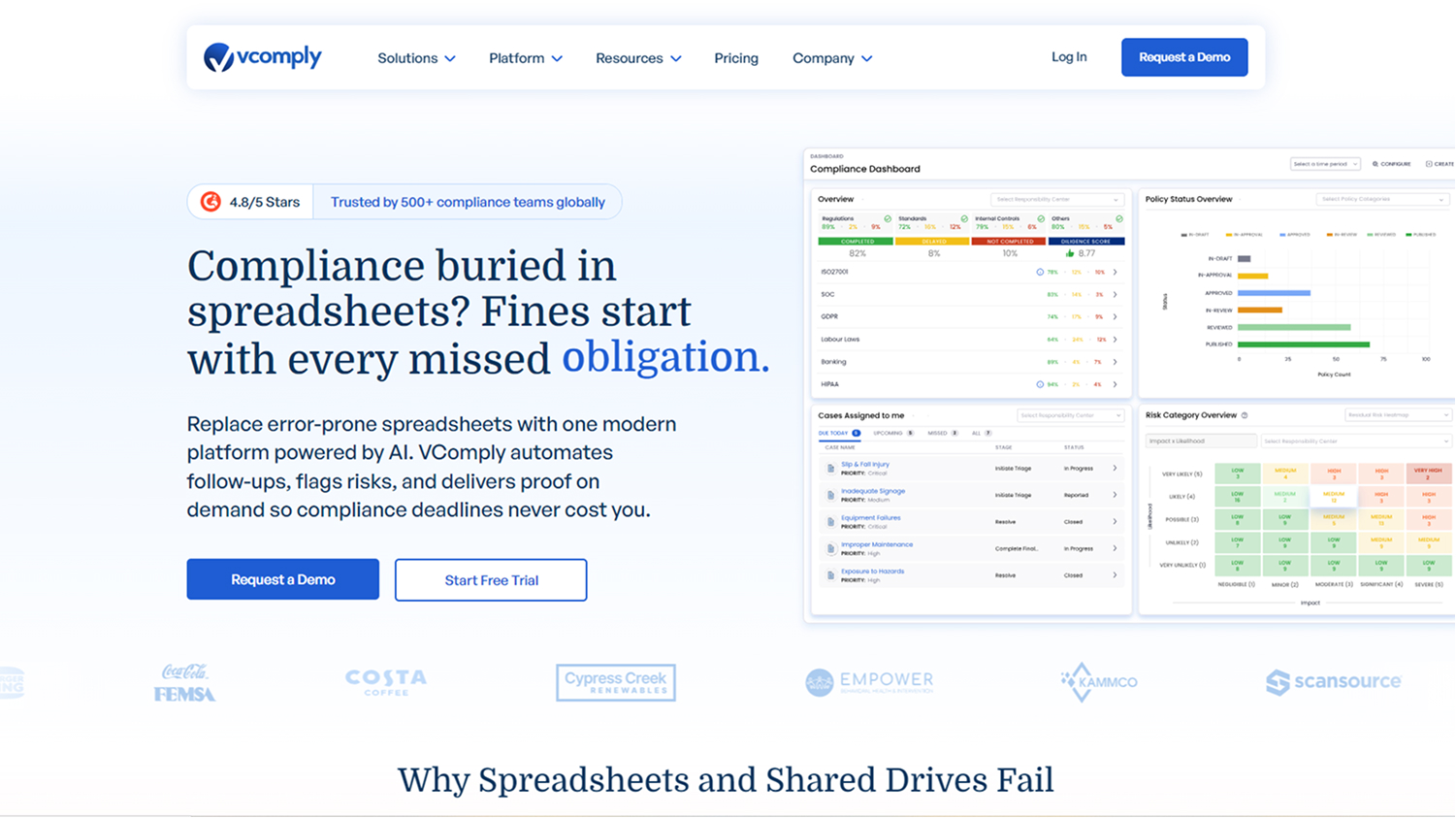
VComply is a cloud-based Governance, Risk, and Compliance (GRC) platform designed to unify risk, compliance, policy, and case management into a single operational framework. It provides real-time visibility, automated workflows, and contextual reporting that help regulated organizations manage risk across functions and satisfy audit requirements efficiently.
Below are key operational strengths and design elements that make VComply a practical choice for multi-industry risk programs:
- Unified RiskOps Architecture Across Silos: VComply consolidates risk, compliance, audit, and policy management into one platform, removing data fragmentation between risk registers, policy documents, and incident logs.
- Automated Risk Assessment and Workflow Execution: The platform streamlines the creation, scheduling, and execution of inherent and residual risk assessments through automated workflows that ensure assessments occur on time and with consistent methodology tailored to organizational requirements.
- Integrated Dashboard Visualizations for Strategic Insights: Dedicated dashboards and visual heat maps present risk performance metrics, such as risk ratings, control effectiveness, risk without controls, and audit results, enabling leaders to interpret risk data at a glance and support strategic decisions.
- Comprehensive Audit Trails and Accountability Tracking: By capturing detailed evidence, actions taken, and user activity logs, VComply ensures compliance and risk evidence is audit-ready. This enhances transparency and accountability while making internal and external audits more efficient.
- Cross-Functional Collaboration and Communication: The platform enables teams to communicate around risks, share risk evidence, and track tasks together. This connectivity establishes a risk-aware culture and breaks down operational silos.
- Regulatory and Framework Library for Faster Deployment: Pre-built regulatory frameworks and compliance libraries reduce setup time and help teams align risk controls to industry standards without building processes from scratch, facilitating faster operational onboarding.
- Scalability for Diverse Industry Requirements: Whether in healthcare, financial services, energy and utilities, manufacturing, or higher education, VComply’s configurable modules adapt controls, workflows, and reporting to industry-specific risk profiles and compliance obligations.
- Secure, Cloud-Based Infrastructure With Integration Support: The platform operates on a secure cloud environment with integrations across ecosystems, enabling organizations to connect risk and compliance workflows with existing tools while maintaining strong data security standards.
Pros:
- Centralizes risk, compliance, policy, and audits for enterprise-wide visibility
- Automates assessments and workflows, reducing manual effort and errors
- Provides customizable dashboards that support strategic oversight
- Maintains audit-ready evidence and real-time reporting across programs
Cons:
- May require initial configuration effort for highly customized enterprise use cases
- Organizations with extremely advanced analytics needs might supplement with third-party BI tools
Pricing: VComply’s pricing is tailored to organizational needs: Starter and Enterprise plans are customized, while the Pro plan starts at approximately $1,000/month, depending on modules, users, and regulatory scope.
G2 Rating: 4.6/5 on G2 from verified user reviews
Free Trial / Demo: A 21-day free trial is available, and a demo can be scheduled on request.
2. MetricStream
MetricStream is a comprehensive Governance, Risk, and Compliance (GRC) platform tailored for complex, highly regulated environments where risk decisions affect strategic outcomes. Its architecture supports wide-scale integration of risk, compliance, audit, third-party, and cyber risk processes, enabling organizations to consolidate risk data and drive governance across global operations.
Below are the defining capabilities and operational strengths of MetricStream’s enterprise-scale GRC solution:
- Integrated Enterprise GRC Framework: MetricStream unifies risk, compliance, audit, and third-party risk management into a single, connected framework that eliminates silos and enables consistent governance across business units and geographies.
- Strong Centralized Risk and Compliance Data Model: A common enterprise data model connects risk, control, compliance, and issue data to provide real-time insight into organizational risk exposure, enabling cross-functional collaboration and harmonized decision-making.
- Advanced Analytics and Real-Time Reporting: Customizable dashboards, heat maps, and analytics provide actionable insights into key risk indicators, control effectiveness, and compliance status.
- Scalable Architecture for Regulated Industries: Designed for large enterprises in sectors such as healthcare, financial services, energy, and manufacturing, MetricStream supports complex organizational structures, multi-entity reporting, and global compliance requirements.
- Predictive and Forward-Looking Risk Capabilities: By standardizing taxonomies and using AI-infused workflows, the platform enables risk teams to go beyond historical reporting and build predictive indicators to anticipate emerging exposures.
- Comprehensive Third-Party Risk Management Support: MetricStream’s integrated third-party risk capabilities allow continuous assessment and monitoring of vendor, supplier, and contractor relationships throughout the lifecycle, reducing extended enterprise exposure.
- Consistent Regulatory Compliance and Change Monitoring: With automated regulatory content feeds and compliance mapping, organizations can align internal controls with external requirements, maintain audit readiness, and respond effectively to regulatory changes.
- Global Multi-Language and Hierarchical Support: Features such as multi-language reporting and hierarchical organizational modeling help global enterprises maintain consistent risk management practices across regions and business units.
Pros:
- Provides deep coverage across risk, compliance, audit, and third-party domains with a unified GRC strategy
- Offers powerful analytics, dashboards, and real-time insights for informed decision-making
- Integrates predictive and AI-enhanced capabilities to support proactive risk management
Cons:
- Implementation and configuration may require substantial time and resources for complex deployments
- May introduce operational overhead for organizations without mature GRC governance processes
Pricing: Contact team for a custom quote. Costs vary by modules, seats, and implementation; enterprise plans can range from tens of thousands to $750,000–$1M+ annually, depending on scale and services.
G2 Rating: 3.9/5 on G2 across products and reviews
Demo is available on request; short-term trial options may be offered through special programs.
3. LogicGate

LogicGate Risk Cloud is a modern, no-code GRC platform that allows organizations to build, automate, and adapt risk and compliance workflows without heavy IT involvement. Its configurable architecture supports agile process design while integrating enterprise-wide risk, controls, and reporting into one unified platform.
Below are key operational strengths and functional elements that define LogicGate’s configurable workflow capabilities:
- No-Code, Drag-and-Drop Workflow Builder: LogicGate’s visual workflow design lets risk and compliance teams create, adjust, and link workflows without programming expertise. This helps organizations operationalize bespoke processes that reflect internal governance standards and changing risk scenarios quickly.
- Flexible Graph Database for Connected Risk Data: The platform uses a flexible graph database that connects risks, controls, assets, and incidents across workflows, enabling dynamic relationship mapping and adaptive risk models that grow with enterprise needs.
- Pre-Configured No-Code Solutions to Accelerate Time-to-Value: Pre-built templates and modules reduce setup effort while allowing customization, so teams don’t have to build workflows from scratch, yet retain flexibility for unique process logic.
- Automated Workflow Execution Across GRC Domains: Once configured, workflows automate assessments, control tests, escalations, and approvals across risk, compliance, and audit, improving consistency and reducing manual overhead.
- Native Integrations With Ecosystem Tools: LogicGate supports no-code connectors to collaboration and productivity platforms such as Jira, Slack, and Microsoft 365, enabling orchestration of risk workflows with broader enterprise systems.
- Adaptability for Complex Enterprise Use Cases: Organizations in financial services, healthcare, and other regulated sectors can configure workflows that reflect their unique risk definitions, control frameworks, and compliance requirements, scaling as programs mature.
- Custom Reporting and Calculation Fields: Built-in real-time dashboards and cross-workflow calculation fields provide insights tailored to configured processes, helping teams quantify risk outcomes and operational performance.
- AI-Infused Insight and Workflow Enhancements: Some configurations include AI-enhanced workflow tasks, such as automated evidence triggers and adaptive routing, accelerating execution and improving compliance accuracy.
Pros:
- Enables configurable, no-code workflows that business users can build and modify independently
- Offers connected risk data models that improve visibility across GRC domains
- Provides native integrations with enterprise tools for broader workflow orchestration
Cons:
- Requires clear internal process definitions before workflows can be configured effectively
- Initial setup and workflow refinement may demand significant governance planning
Pricing: Contact vendor for pricing
G2 Rating: 4.6/5 on G2 from verified user reviews
Demo available on request; no public free trial.
4. Diligent
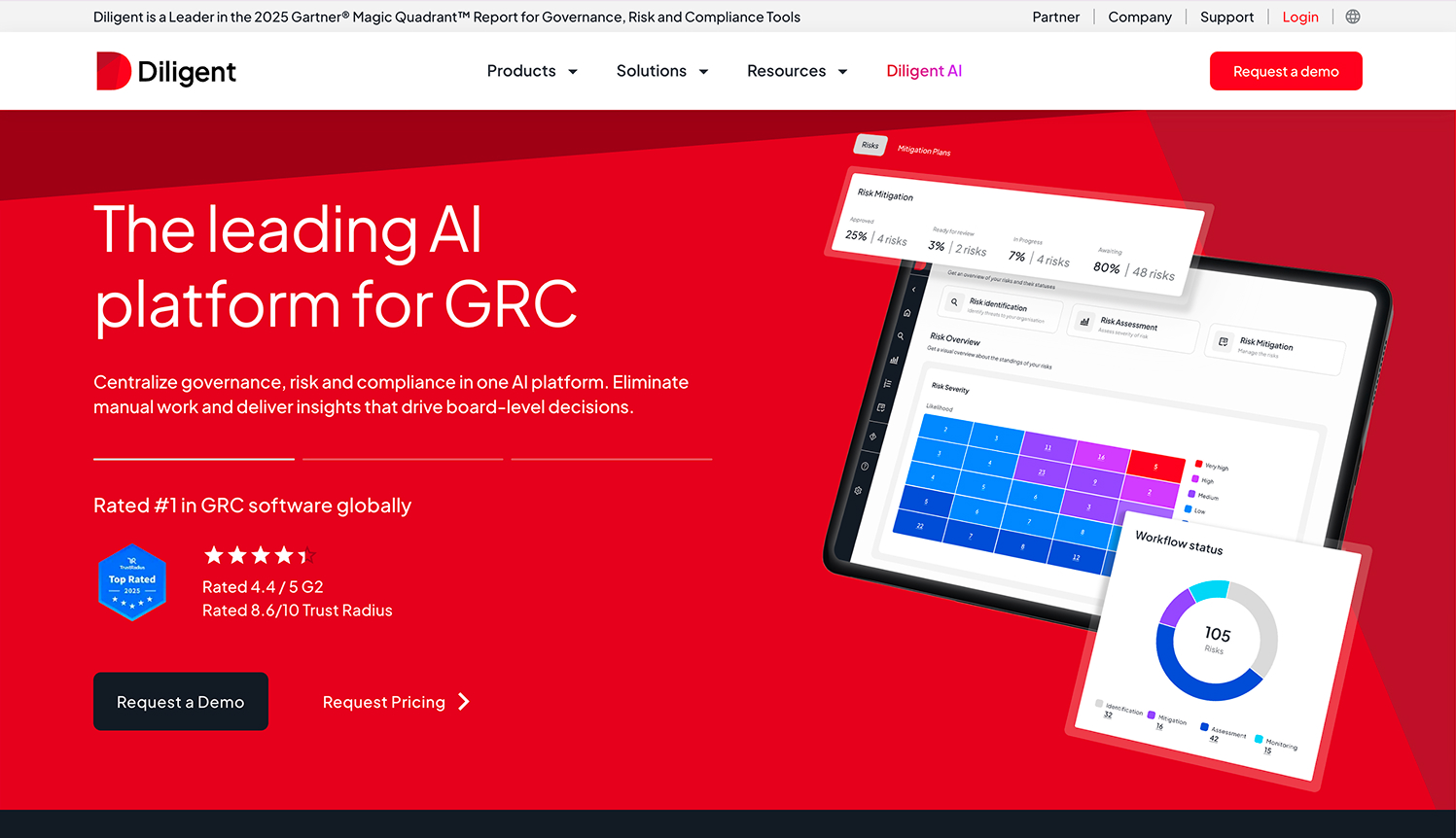
Diligent’s unified GRC platform is designed to give executives and board members a connected view of governance, risk, compliance, and audit activities within a single environment. It focuses on enhancing strategic visibility and governance oversight, helping leaders monitor enterprise-wide risk posture and make informed decisions while supporting continuous compliance.
Below are the core capabilities and strengths that define Diligent’s board-centric risk oversight approach:
- Unified Board and GRC Collaboration: Diligent centralizes board management with risk and compliance workflows, enabling leadership to access meeting materials, risk dashboards, and governance documents in one secure interface rather than fragmented systems. This establishes alignment between strategic oversight and operational risk functions.
- Real-Time Enterprise Risk Visibility: Embedded analytics and dashboards provide executives with up-to-date insights into risk exposure, regulatory compliance, and control performance across departments, supporting strategic decisions and timely interventions.
- Customizable Reporting for Governance Needs: The platform allows creation of board-ready reports and visualizations tailored to governance audiences, summarizing top risks, control gaps, and compliance status in formats aligned with executive and board review cycles.
- Integrated Audit and Compliance Coordination: Risk insights are connected with audit results and compliance evidence, enabling a complete governance narrative that blends risk assessments with control validation and audit findings.
- AI-Enhanced Insights and Trend Detection: With AI-powered analytics, the platform can surface patterns and correlations across risk data, aiding leadership in identifying emerging threats and compliance gaps before they affect strategic priorities.
- Security-First Architecture for Leadership Confidence: The platform operates with strong security controls and supports sensitive board communications, ensuring that confidential governance discussions and risk data remain protected.
- Third-Party Integration and Data Aggregation: Diligent integrates with enterprise systems (ERPs, HRIS, financial systems) to aggregate risk and governance data, reducing manual consolidation efforts and giving board members a comprehensive view of organizational risk.
- Scalability for Enterprise Governance Programs: It supports large, multi-entity organizations and complex governance structures, making it suitable for regulated industries where boards and executive committees require consolidated risk and compliance visibility.
Pros:
- Combines board governance with enterprise risk, compliance, and audit for executive oversight
- Provides board-ready insights and customizable governance reporting
- Integrates data from multiple enterprise sources to reduce manual work
Cons:
- Extensive governance-focused capabilities may exceed requirements for smaller risk teams
- Implementation can be resource-intensive for complex enterprise integration
Pricing: Contact vendor for pricing
G2 Rating: 4.3/5 on G2 from verified reviews
Demo available via vendor request; no standard public free trial is listed.
5. OneTrust
OneTrust provides an integrated platform for privacy, data protection, and third-party risk governance, designed to help organizations automate privacy compliance, manage sensitive data, and create trusted relationships across their extended ecosystems. Its capabilities extend from data discovery and consent management to continuous third-party risk monitoring in complex regulatory environments.
Below are the core capabilities that define OneTrust’s focus on privacy and data-centric risk:
- End-to-End Privacy Automation and Compliance: OneTrust enables organizations to automate privacy operations, including data discovery, mapping, impact assessments, and compliance documentation, ensuring scalable, audit-ready privacy programs aligned with regulations such as GDPR and CCPA.
- Comprehensive Data Governance Controls: The platform facilitates real-time visibility into data flows and sensitive assets, helping teams classify, monitor, and secure data in accordance with internal governance policies and regulatory obligations.
- Consent and Preference Management Across Channels: OneTrust’s consent management capabilities enable organizations to capture and manage user preferences consistently across digital touchpoints, reducing risk while enhancing compliance with data protection laws.
- Integrated Third-Party Risk Assessment: Through centralized vendor inventories and automated assessments, OneTrust supports continuous monitoring of third-party risk, including privacy and security exposures, with workflows to trigger reassessments and mitigation actions.
- Advanced Privacy Incident and Response Tracking: OneTrust allows organizations to manage privacy incidents, from detection through remediation, with structured workflows and documentation that support timely decision-making and audit readiness.
- AI and Ethical Data Usage Governance: The platform includes emerging features for responsible AI governance, enabling organizations to embed oversight, controls, and compliance into AI and data use workflows where privacy and ethical considerations intersect.
- Scalable Regulatory Framework Support: OneTrust supports a broad set of privacy and security frameworks with built-in templates and configurable controls, helping organizations maintain compliance as regulations grow globally.
- Cross-Functional Visibility of Data-Driven Risk: The solution connects privacy, security, and third-party risk data into unified dashboards, enabling risk and compliance teams to collaborate on mitigating data-centric exposures across departments.
Pros:
- Comprehensive coverage for privacy, data governance, and third-party risk management across functions
- Automates key privacy compliance workflows, reducing manual effort and enhancing audit readiness
- Scalable framework templates and regulatory content help future-proof compliance programs
Cons:
- Broad functionality can introduce complexity for organizations without mature privacy risk processes
- Implementation and configuration may require dedicated expertise and resources
Pricing: Contact vendor for pricing
G2 Rating: 4.4/5 on G2 from verified reviews
Free 14-day trial available for the GRC & Security Assurance Cloud (request via form); demos available on request.
6. ServiceNow

ServiceNow’s Integrated Risk Management (IRM) solution embeds risk management within broader enterprise workflows, allowing organizations to link IT, operational, compliance, and governance processes on a unified platform. Built on the Now Platform, ServiceNow provides real-time visibility, automated risk controls, and centralized data that support coordinated decision-making across functions.
Below are the key capabilities and operational strengths that define ServiceNow’s IT and operational risk integration:
- Unified Risk and Operational Data Model Across Functions: ServiceNow eliminates silos by housing risk, IT operations, and compliance data on a single platform, enabling consistent tracking of risks that span technology, business processes, and operational controls.
- Continuous Monitoring With Real-Time Insights: The platform’s continuous monitoring and real-time visibility into key risk indicators help teams identify IT and operational risk shifts quickly and respond before they escalate into service disruptions or compliance issues.
- AI-Enabled Risk Intelligence and Analytics: Embedded AI and analytics support real-time risk scoring, trend detection, and insight generation, helping leaders anticipate operational vulnerabilities and prioritize remediation activities.
- Integrated Workflows That Connect IT and Business Risk Tasks: Automated cross-domain workflows link IT risk events with operational and compliance tasks, reducing manual handoffs and ensuring timely execution of risk responses.
- Incident and Loss Capture With Root Cause Correlation: ServiceNow supports operational risk management features, such as capturing incidents, loss events, and root cause analysis, allowing organizations to refine risk controls and prevent recurrence.
- Role-Based Workspaces for IT and Operational Leaders: Configurable dashboards and role-specific interfaces present relevant risk insights to IT managers, risk professionals, and executives, improving visibility into risk exposure and status.
- Integration With IT Service Management and CMDB: By connecting to ServiceNow’s Configuration Management Database (CMDB) and IT Service Management modules, the platform aligns risk visibility with asset inventories, change processes, and service delivery systems.
- Audit-Ready Documentation and Compliance Traceability: ServiceNow captures risk evidence, control tests, and remediation activities in a structured repository that supports audit readiness and regulatory reporting without ad-hoc data assembly.
Pros:
- Offers integrated IT and operational risk insights on a unified platform for enterprise-wide governance
- Provides real-time monitoring and automated workflows that accelerate risk response
- Connects risk data with IT service and asset management for an enriched context
Cons:
- May require significant configuration and governance planning in complex environments
- Broad enterprise capabilities can lead to steeper learning curves for initial adoption
Pricing: Quote-based; enterprise GRC often starts at $50,000/year, varying by modules and scale.
G2 Rating: 4.4/5 on G2 across ServiceNow products
Demo available on request; no public free trial.
Common Misconceptions That Undermine Risk Management Programs
Even experienced leaders sometimes hold misconceptions about risk management that limit program effectiveness and strategic value. Misunderstandings can trap teams in outdated models, reduce cross-functional engagement, and weaken overall resilience, a serious concern in regulated sectors.
Below are widely held misconceptions that can derail risk programs and how to correct them:
- Risk Management Equals Compliance Checklists: A common myth is that risk management is merely ticking boxes to satisfy regulators. In reality, risk governance integrates strategy with continuous assessment and control execution, it identifies threats and opportunities that affect business objectives far beyond compliance alone.
- Risk Registers Alone Are Sufficient: Many organizations rely excessively on risk registers as the sole source of risk information, assuming documentation equals management. Registers are repositories of identified risks, but do not, by themselves, drive mitigation actions, accountability, or trend analysis needed for strategic decision-making.
- Only Large Organizations Need Risk Tools: A persistent belief is that risk programs and software are only for large enterprises. However, risk exists in organizations of all sizes; smaller entities can benefit equally from structured risk frameworks, especially as non-compliance costs can be disproportionately high for them.
- Risk Management Slows Innovation: Some leaders believe that managing risk restricts business creativity and agility. In fact, structured risk processes enable innovation by providing confidence to take calculated risks, allocate resources effectively, and avoid costly surprises, making innovative endeavors more sustainable.
VComply’s GRCOps Suite unifies governance, risk, compliance, and audit into a single framework, eliminating silos and ensuring consistent workflows. By centralizing risk and compliance data, GRCOps helps organizations improve decision-making, reduce manual effort, and maintain enterprise-wide audit readiness.
To avoid these pitfalls, organizations increasingly follow a structured, end-to-end risk lifecycle.
The End-to-End Risk Management Lifecycle Used by Modern Organizations
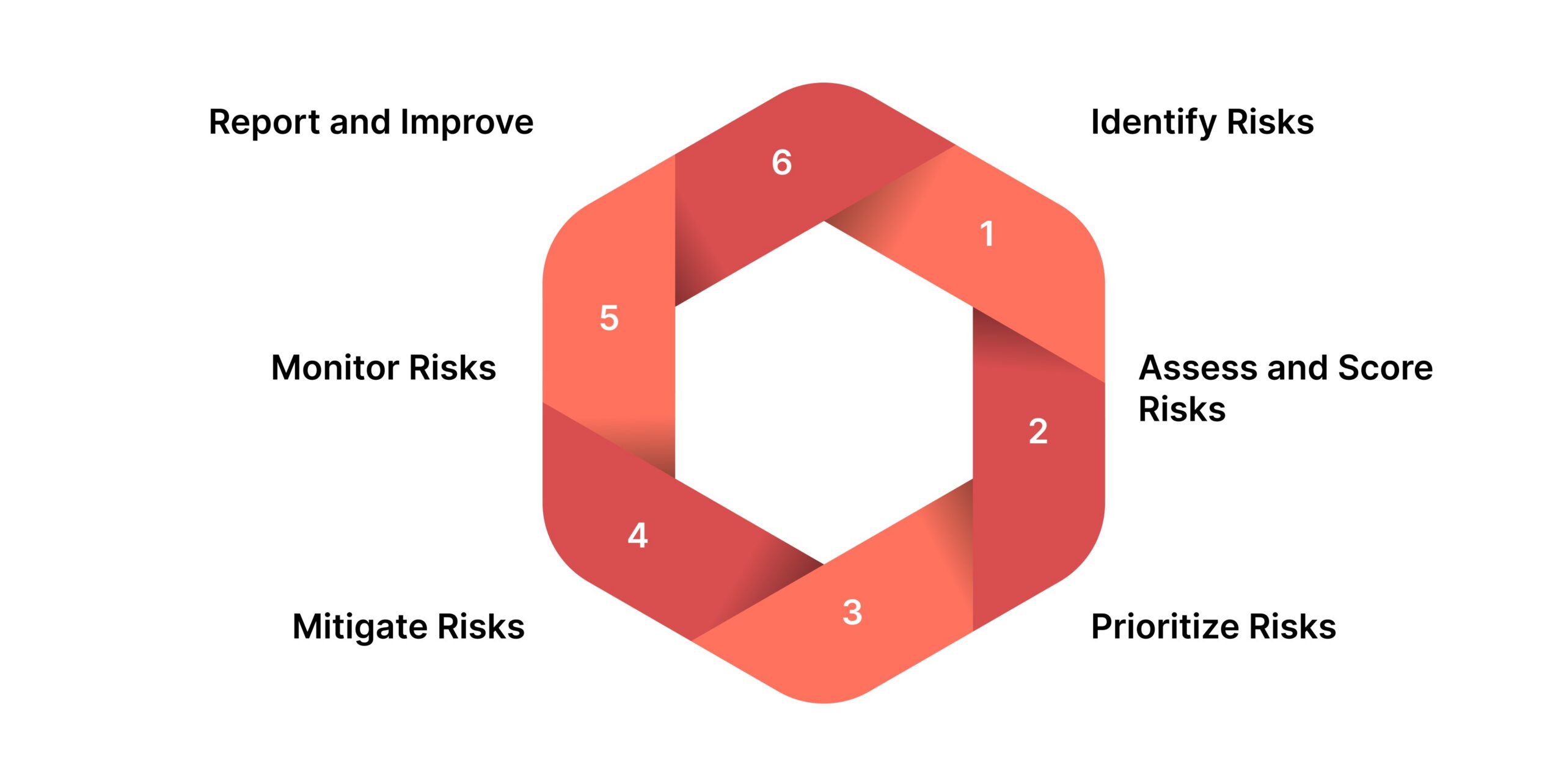
A strong risk program follows a systematic lifecycle that moves risk awareness into proactive governance and continuous improvement. Modern organizations, especially in regulated sectors like healthcare, finance, manufacturing, energy, and higher education, rely on repeatable steps that embed risk thinking into everyday operations rather than periodic check-ins.
Below is the structured lifecycle that organizations use to govern risk from start to finish:
- Identify Risks: The initial step is to comprehensively identify potential threats that could impact objectives, operations, compliance, or reputation. This involves scanning both internal environments (processes, systems, vendors) and external contexts (regulatory changes, market shifts).
- Assess and Score Risks: Once identified, each risk is evaluated for likelihood and impact using consistent methodologies. Assessment provides a foundation for prioritizing where risk exposure is greatest, and resources should be allocated.
- Prioritize Risks: Risk prioritization ranks risks based on business and regulatory impact, ensuring that material risks rise to the top and receive the appropriate level of attention and governance.
- Mitigate Risks: Mitigation involves designing and implementing controls, actions, or treatments that reduce the likelihood or impact of identified risks. This step translates strategy into operational tasks.
- Monitor Risks: Continuous monitoring tracks risk dynamics and the effectiveness of mitigation strategies over time. Feedback loops allow organizations to detect changes in risk exposure and adjust responses.
- Report and Improve: Risk reporting synthesizes findings into actionable insights for leadership and governance bodies. Ongoing improvement arises from analyzing outcomes, adjusting frameworks, and embedding lessons learned into future cycles.
Finally, applying risk techniques effectively requires measuring whether they are delivering real results.
How to Apply Risk Management Techniques and Measure What’s Working
Implementing risk management techniques without measurement is like setting a destination without tracking progress; you don’t know if you’re improving. Modern, mature programs tie execution to structured metrics and performance indicators that deliver evidence of operational performance and strategic alignment.
Below are practical application best practices paired with measurable success outcomes:
- Start With High-Impact Risks: Focus initial efforts on risks that could materially affect revenue, operations, compliance, or reputation. High-impact risks often have quantifiable indicators (such as financial exposure or safety incidents) that enable tracking whether mitigation efforts reduce exposure over time.
- Assign Ownership Aligned to Business Roles: Allocate risk tasks to specific roles, not generic teams, so accountability is clear. When owners are aligned with operational responsibility, tracking overdue actions, controlling execution, and task completion becomes measurable and supports governance reviews.
- Automate Follow-Ups and Reviews: Use risk platforms that trigger automated reminders and escalations for incomplete risk tasks, overdue controls, or upcoming review cycles. Automation reduces manual tracking and increases on-time mitigation, which is measurable as a percentage of on-time vs. overdue actions.
- Use Data, Not Intuition, to Guide Decisions: Build KPIs and KRIs into workflows so decisions are based on observed trends and thresholds. For example, a rising frequency of threshold breaches or control exceptions indicates a need to adjust mitigation strategies rather than relying on subjective judgment.
- Reduction in Overdue or Unresolved Risks: A key measure of program success is the decline in unresolved risk items over time. Consistent reduction in overdue risks demonstrates both accountability and improved control effectiveness.
- Time to Mitigation: Measuring the time between risk identification and mitigation completion shows whether workflows and task execution are efficient. Shorter remediation cycles reflect improved operational discipline and responsiveness.
- Audit Findings Over Time: Tracking audit findings related to risk controls across reporting cycles measures whether risk practices are maturing. Fewer repeat findings or control exceptions indicate stronger compliance and oversight.
- Executive Visibility and Decision Quality: Dashboards that highlight trends in KRIs and KPIs help leaders understand risk posture quickly. Success is seen when executives use these insights to guide strategic choices, allocate resources, and reduce uncertainty around major initiatives.
By institutionalizing these practices into daily workflows and tracking measurable metrics, rather than relying on anecdotal insights, organizations cultivate risk programs that are actionable, auditable, and aligned with business outcomes.

Wrapping Up
As organizations move deeper into 2026, risk management has become inseparable from day-to-day business execution. Regulatory volatility, operational interdependencies, third-party exposure, and technology-driven change demand programs that are continuous, measurable, and resilient. Organizations that embed risk into governance, operations, and decision-making are better positioned to protect value while enabling growth.
This is where VComply helps organizations operationalize risk management. By unifying RiskOps with compliance, policy, audit, and case management, VComply enables teams to move beyond static documentation to actionable workflows, real-time visibility, and audit-ready evidence.
If you are looking to strengthen your risk posture and manage uncertainty with confidence, explore how VComply can support your risk program. Start a 21-day free trial to see how modern risk management works in practice.
FAQs
Risk management tools centralize regulatory obligations across jurisdictions, allowing organizations to map country-specific laws to shared risks and controls. This helps teams manage overlapping requirements, maintain consistent documentation, and demonstrate compliance to regulators across regions without duplicating effort.
Risk management focuses on identifying and prioritizing potential threats to business objectives, while internal controls are the specific actions or mechanisms used to reduce those threats. Effective programs connect risks to controls so organizations can measure whether controls adequately address identified exposures.
Regulatory changes continuously redefine what organizations must monitor, control, and report, making static risk frameworks obsolete. As rules change, risk strategies must shift from periodic compliance checks to dynamic, process-driven governance that translates regulation into executable risk outcomes. Failure to adapt these strategies can result in compliance gaps, operational disruption, or penalties.
Risk management tools do not predict risks like a crystal ball, but they significantly enhance early detection and foresight by surfacing trends, patterns, and leading indicators that precede adverse events. Their real value lies in centralizing data and highlighting early warning signals, enabling risk teams to act proactively rather than reactively.
Documentation provides defensible evidence that risks are identified, assessed, and mitigated appropriately. Regulators and auditors rely on documented assessments, controls, and remediation records to validate compliance. Without structured documentation, organizations struggle to prove due diligence during audits or investigations.