

Effective Compliance Audit Strategies for Retail Stores
Retailers operate in one of the most complex compliance environments, covering safety, labor laws, payment security, data privacy, and more. And the cost of getting audits wrong is significant.

The average cost of non‑compliance reached $9.4 million per organization, compared to $3.5 million for compliance efforts.
For a multi-store retailer, even a single missed inspection, misplaced document, or unaddressed incident can trigger an audit failure, resulting in penalties, operational disruption, and brand damage.
That’s why compliance audits aren’t merely a checkbox but strategic tools that protect your business, build trust with customers, and keep your operations running smoothly across every location.
This article outlines proven strategies for conducting effective compliance audits in retail stores. Learn how to standardize processes, utilize automation, strengthen documentation, and become audit-ready year-round.
Key Takeaways
- Retail audits fail most often due to missing proof, not missing effort. Centralizing documentation solves half the audit problem instantly.
- Inconsistent store practices create hidden compliance gaps. Standardizing audit steps across locations brings control, clarity, and predictable outcomes.
- Real-time monitoring changes the audit game. When you can see overdue tasks or emerging risks immediately, you prevent issues instead of reacting to them.
- Internal audits are your strongest defense. Quarterly self-checks help identify and resolve problems early, building year-round audit confidence.
- Automation turns audits from stressful events into routine workflows. With VComply, stores stay prepared; no last-minute scrambling, no surprises during inspections.
What Is a Compliance Audit in Retail?
A compliance audit in retail refers to the systematic process of evaluating a retail business’s adherence to regulatory standards and internal policies. Unlike financial audits, which focus on verifying the accuracy of financial statements, compliance audits are about ensuring that the business follows the law and meets regulatory requirements.
For example, retailers must comply with PCI DSS (Payment Card Industry Data Security Standard) to protect customer data, or OSHA (Occupational Safety and Health Administration) standards for worker safety.

Why Compliance Audits Matter in Retail?
Operating across multiple states or regions only adds layers of complexity, with state-specific labor laws, consumer protection laws, and local safety standards that must be tracked and adhered to. A single misstep can lead to regulatory fines, legal action, or even forced store closures.
By conducting regular compliance audits, retailers ensure that:
- Regulatory obligations are met to avoid fines or legal action.
- Employees are protected through safety protocols and fair labor practices.
- Customer trust is maintained, particularly in areas such as data security and privacy.
- Operational disruptions are minimized by identifying risks before they escalate.
A thorough retail compliance audit provides business owners and managers with the confidence that every location is consistently upholding standards and that the company is well-prepared for any external inspection.
Also Read: How to Assess Compliance: 6 Steps to Take Today
Key Challenges Retailers Face During Compliance Audits
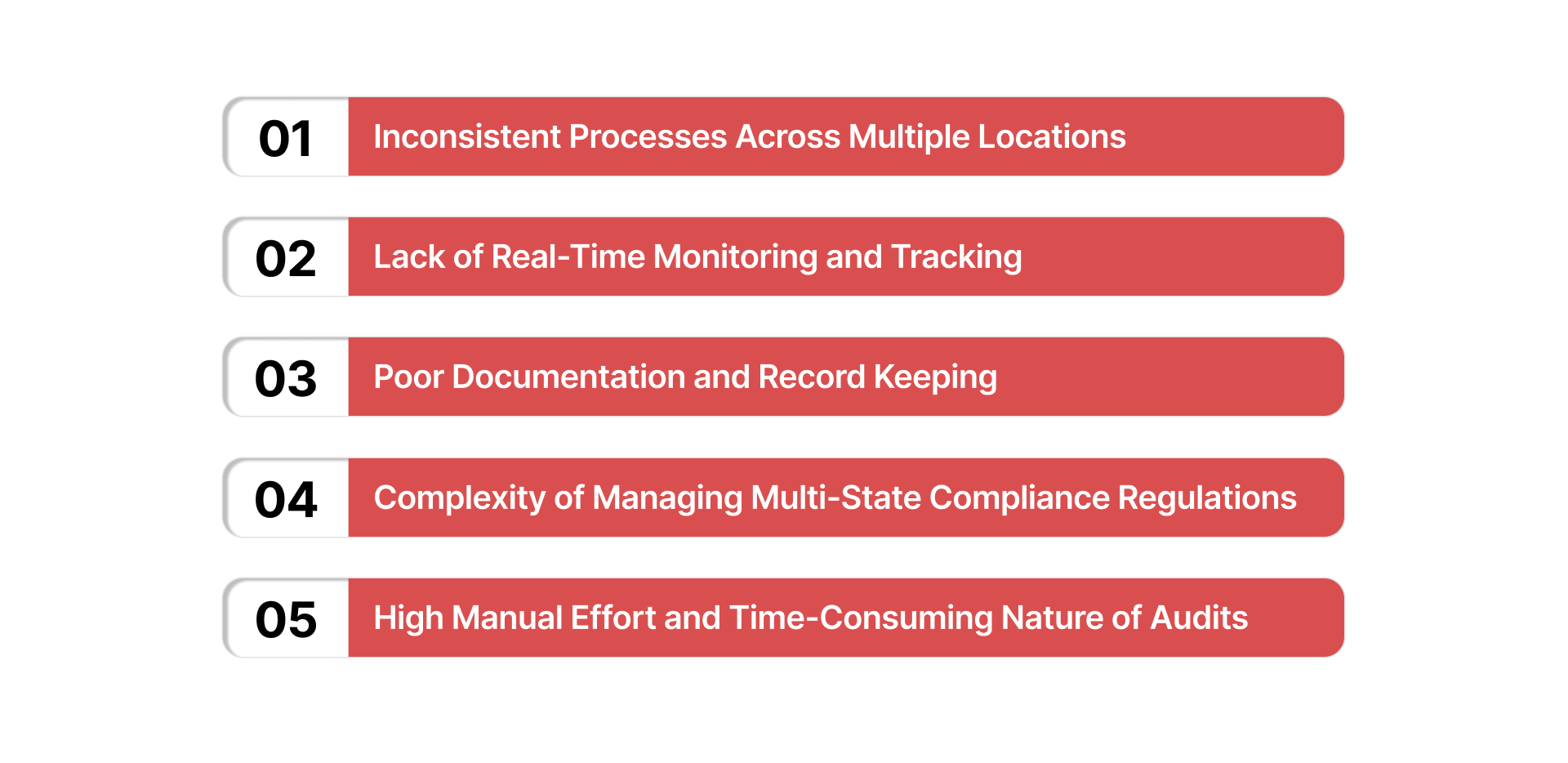
Compliance audits in retail are often viewed as a necessary evil. Still, the reality is that they present a unique set of challenges that can make the process overwhelming and time-consuming. Here are the most common hurdles that retailers face:
1. Inconsistent Processes Across Multiple Locations
When managing multiple retail locations, maintaining consistent audit procedures can become challenging. Each store may interpret policies differently, use various tools, or manage compliance checks in different ways. This inconsistency often leads to missed tasks, discrepancies in records, and confusion during audits.
Impact:
- Increased risk of non-compliance across locations.
- Difficulty in tracking and comparing compliance data.
- Additional time spent reconciling discrepancies during audits.
2. Lack of Real-Time Monitoring and Tracking
Many retailers rely on manual systems, such as spreadsheets and paper-based forms, to track compliance tasks. These outdated systems leave gaps in visibility and slow down the process of identifying non-compliance. Without real-time tracking, issues may go unnoticed until it’s too late.
Impact:
- Limited visibility into non-compliance risks before audits.
- Delayed identification of potential issues.
- Increased likelihood of missed deadlines or incomplete tasks.
3. Poor Documentation and Record Keeping
Retail teams often struggle with disorganized or incomplete records, particularly when managing hundreds or thousands of transactions, safety reports, and policy updates. Auditors require access to accurate and up-to-date records, as any missing documents can lead to delays, penalties, or failed audits.
Impact:
- Difficulty in accessing required documentation quickly.
- Increased audit preparation time.
- Higher chances of failing the audit due to incomplete or missing records.
4. Complexity of Managing Multi-State Compliance Regulations
Each state can have different labor laws, consumer protection standards, or health and safety regulations. Keeping track of these variations manually is nearly impossible, and small mistakes can lead to hefty fines.
Impact:
- Difficulty keeping up with changing local regulations.
- Increased risk of non-compliance in specific regions.
- Potential legal and financial consequences from failing to meet state-specific requirements.
5. High Manual Effort and Time-Consuming Nature of Audits
In many retail businesses, audits are still managed manually, involving the compilation of reports, verification of data, and cross-referencing of records. This labor-intensive process not only increases the chance for errors but also puts a strain on the team, especially during peak retail periods.
Impact:
- Increased workload for store managers and compliance teams.
- More time is spent managing audits than on running day-to-day operations.
- Increased risk of errors due to manual handling.
These challenges make it clear that traditional audit practices in retail need to evolve. To streamline the process, reduce risks, and ensure smooth, timely audits, retailers must modernize their compliance auditing processes.
With ComplianceOps, you can automate recurring compliance tasks like safety checks, policy reviews, and incident reports. Ensure your teams never miss a step and that every store is audit-ready, every time!
The Need for Automated Compliance Audit Processes
Retail compliance audits don’t have to be a time-consuming, stressful task. With the growing complexity of regulations and operational scale, manual audits are no longer sufficient.
Adopting automated compliance audit procedures transforms the way retailers handle audits by:
- Centralizing all audit-related data in one place makes it accessible and organized.
- Automating recurring tasks such as safety checks, documentation reviews, and incident reporting, ensuring nothing is missed.
- Providing real-time updates on task completion, overdue items, and compliance status so that retailers can act proactively.
- Generate automated reports that are always ready for review, reducing the time and effort spent on preparing for audits.
With automated systems in place, audit preparation time is reduced significantly, documentation is always up-to-date, and compliance risks are mitigated before they become an issue.
Best Practices for Conducting Compliance Audits in Retail Stores
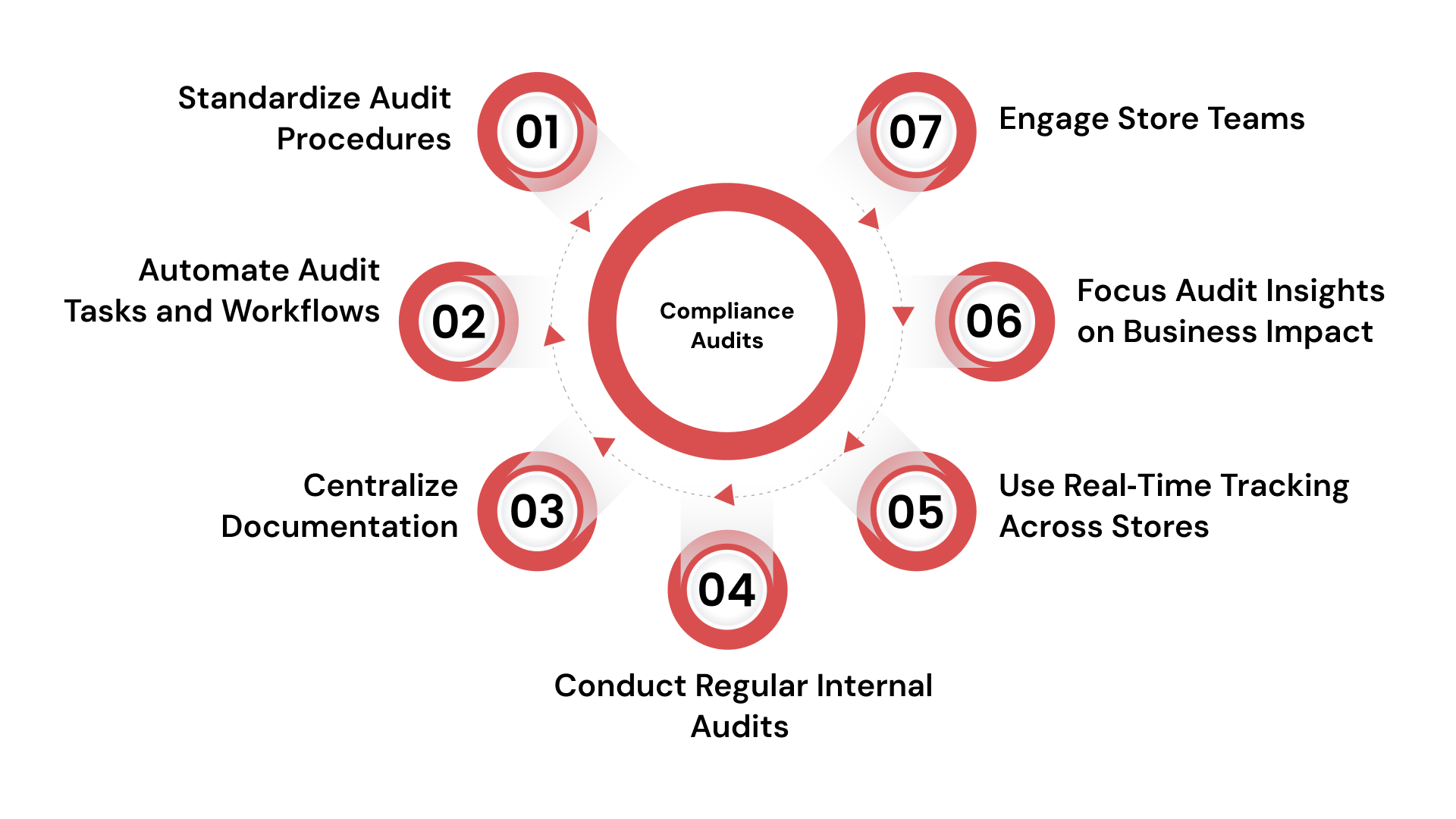
Retail chains increasingly adopt automated audit‑trail platforms, with the market hitting US $1.65 billion in 2024 and expected to grow at a 12.7% CAGR, showing the urgency of modern audit readiness.
Utilize these refined practices to ensure your audit process is both reliable and efficient across all locations.
1. Standardize Audit Procedures Across Locations
Create a single master audit checklist that all stores use, covering safety inspections, payment card checks, labor law logs, and documentation reviews. This ensures consistency, eliminates local variations, and provides comparable data across the network.
2. Automate Audit Tasks and Workflows
Replace manual checklists with scheduled automation (e.g., weekly inspections, monthly policy reviews). Automation ensures tasks aren’t missed, timestamps are captured, and reports are ready when auditors arrive.
3. Centralize Documentation for Rapid Retrieval
Store all compliance proof – inspection forms, training logs, vendor certificates – in one cloud‑based repository. This reduces audit-prep time, minimizes missing records, and gives you confidence in the completeness of your data.
4. Conduct Regular Internal Audits Without Waiting for Regulators
Instead of relying solely on annual external audits, conduct quarterly internal reviews to ensure ongoing accountability. Catch discrepancies early when they’re manageable, not when they trigger penalties or brand damage.
5. Use Real‑Time Tracking Across Stores
Set up dashboards that flag overdue tasks, unresolved incidents, or varying compliance scores by store. With near‑live visibility, you act pre‐emptively instead of reacting during an audit.
6. Focus Audit Insights on Business Impact
Don’t treat audits as just regulatory checkboxes. Link audit findings to store performance—such as how accurate records decreased inventory shrink or how compliance issues delayed openings. This makes audit results actionable for operations and leadership.
7. Engage Store Teams with Clear Roles and Feedback
Assign audit roles at each location and deliver feedback within 48 hours of an internal audit. When store teams see results and understand actions, compliance becomes part of daily operations, not a one‑off project.
All in all, compliance audits should be a smooth and well-organized process that protects the business, enhances operational efficiency, and ensures ongoing compliance across all locations.
With RiskOps, monitor real-time compliance status and identify potential risks before they turn into audit failures. Proactively manage compliance across all stores and ensure you meet regulatory standards!
The Role of Training and Accountability in Audit Success
Compliance audits are only effective when everyone in the organization understands their role and is held accountable for meeting compliance standards. Without consistent training and clear accountability measures, even the most streamlined audit processes can fail.
With high turnover in retail, training must be continuous, not one-off. New employees, seasonal workers, or those in different regions may not be fully aware of your compliance standards.
Impact:
- Reduced risk of non-compliance due to lack of awareness.
- Faster, more accurate audits because employees are consistently prepared.
- Improved employee confidence in handling compliance-related tasks.
Tracking Training Completion and Effectiveness
Tracking who has completed training, what topics they’ve covered, and whether it has been effective is just as important as delivering the training itself. With the right system in place, retailers can easily monitor training progress and pinpoint areas where further education is needed.
- Actionable Tip:Use a learning management system (LMS) integrated with your compliance tools. This will allow you to track employee progress, ensure that they’re up-to-date with their training, and generate reports on training effectiveness.
Assigning Clear Roles for Compliance Tasks
Without clear accountability, compliance tasks can slip through the cracks. Assigning specific roles for each store and ensuring task owners are held responsible for completing audit tasks ensures that nothing is overlooked.
- Actionable Tip:ComplianceOps helps assign tasks and track completions automatically, making it clear who’s responsible for each part of the audit process. This keeps everyone on track and minimizes the risk of missed tasks.
By focusing on consistent training and clear accountability, retailers can ensure that audits run smoothly and regulatory standards are met consistently across all locations.
Also Read: The Best Retail Compliance Software for 2025
How VComply Enhances Retail Compliance Audits?
VComply eases retail compliance audits by integrating automation, real-time tracking, and audit-readiness into one secure GRC ecosystem. With complex regulations across multiple locations, VComply ensures retailers remain compliant while saving time and reducing risk.
Key Features Supporting Retail Compliance Audits:
- ComplianceOps: Automates compliance tasks like safety checks, data protection, and labor law assessments across all stores. It tracks audit evidence in real-time and sends automatic alerts for any regulatory changes.
- RiskOps: Uses AI to continuously assess compliance risks and prioritize areas like payment security and employee compliance. It provides a centralized view of risk, allowing for proactive management before issues escalate.
- PolicyOps: Simplifies the creation, distribution, and tracking of updated policies. This ensures consistency across all locations and keeps everyone aligned with current regulations.
- CaseOps: Manages incidents from reporting to resolution, ensuring that compliance standards are met and documentation is handled efficiently for audits.
- Automated Reporting & Analytics: VComply’s automated reports and real-time dashboards offer immediate insight into compliance status across all locations, making audits faster and more accurate.
By using ComplianceOps, retailers can simplify audits, ensure year-round compliance, and mitigate the risks associated with manual tracking and inconsistent processes.
Take the first step toward seamless compliance audits. Start your 21-day free trial today!
Final Thoughts
Compliance audits in retail have moved far beyond a checkbox on a to-do list; they are now a strategic necessity for operational efficiency and regulatory stability. Manual methods simply can’t keep up with the demands of modern retail compliance.
But the future of retail compliance audits isn’t just about technology. It’s about balancing automation with human oversight. While algorithms and AI can handle the heavy lifting, human judgment is key to ensuring fairness, accountability, and proactive risk management.
Strengthen your retail compliance audits with VComply. Start a free demo to see how automation can simplify your audit process, reduce risk, and ensure compliance year-round.
FAQs
To ensure compliance year-round, implement automated workflows that track safety checks, policy updates, and training schedules. With tools like ComplianceOps, you can automate recurring tasks, monitor progress, and get real-time alerts when compliance is at risk.
Addressing non-compliance immediately is key. Use a tool like CaseOps to document and manage incidents, assign accountability, and track corrective actions. This ensures a clear resolution path and minimizes the chance of the same issues arising in the future.
Standardize your processes using ComplianceOps, which automates compliance tasks and ensures consistency. With a centralized system, you can track task completion across all locations, assign clear roles, and reduce human error or missed deadlines.
Using VComply’s cloud-based solutions, like RiskOps and GRCOps, can streamline compliance audits by automating routine tasks, providing real-time monitoring, and offering centralized access to compliance data. This reduces administrative workload and ensures audits are smoother and faster.
To reduce audit stress, implement regular internal audits and automated reporting. Tools like ComplianceOps provide detailed, real-time reports, making it easier for managers to stay on top of compliance tasks. With proactive monitoring, everyone will be more prepared and confident when audit time arrives.