

How to Structure Utility Risk Management so Risks are Measurable, Owned & Monitored
Utility risk programs often fail during execution, not design. Most organizations already have established frameworks, risk registers, and control libraries in place, but breakdowns occur when these elements are not operationalized across engineering, compliance, and field operations.

Risk ownership is often unclear, control testing is inconsistently documented, and audit evidence is scattered across systems and teams. As a result, risk data does not translate into actionable insight, and leadership lacks a consolidated view of exposure, control effectiveness, and remediation progress.
In energy and utilities, risks are directly tied to physical assets, grid reliability, and strict regulatory oversight from bodies such as NERC and FERC. When risk reporting is delayed, inconsistent, or disconnected from real-time operations, organizations struggle to demonstrate control effectiveness during audits and regulatory reviews.
This not only increases the likelihood of enforcement actions and financial penalties but also limits the organization’s ability to respond quickly to outages, safety incidents, and compliance gaps.
This guide explains how to build, measure, and monitor utility risk management programs using structured workflows, clear ownership models, and continuous monitoring practices.
Quick Look
- Utility risk management breaks down when risk data is fragmented across systems, ownership is unclear, and audit trails cannot be traced end-to-end, making it difficult to prove control effectiveness or respond to incidents in real time
- Effective programs unify infrastructure, regulatory, and operational risk into a single, continuously updated model that reflects how failures actually propagate across assets and processes
- Risk scoring must go beyond static ratings and incorporate asset criticality, outage impact, cascading failure potential, and regulatory exposure to reflect true business risk
- Continuous monitoring using KRIs, asset telemetry, and system data enables early detection of emerging risks rather than relying on periodic reviews
- Clear ownership across engineering, operations, and compliance teams ensures risks are actively managed, not just documented, with defined accountability for mitigation and reporting
- Centralized systems create a single source of truth for risk data, improving audit readiness, strengthening evidence trails, and reducing compliance gaps
What Is Utility Risk Management?
Utility risk management defines how organizations identify, assess, and mitigate risks across infrastructure, operations, and regulatory obligations. It connects governance, risk assessments, and compliance into structured workflows.
The model ensures risks related to grid operations, assets, vendors, and regulatory exposure remain visible, measurable, and aligned with operational reliability and audit requirements.
3 Reasons Why Risk Management in Utilities Requires a Different Operating Model

Utility environments combine physical infrastructure, regulatory oversight, and real-time system dependencies. This creates risk conditions that differ significantly from traditional enterprise environments.
The need for a different operating model becomes clear through the following factors:
1. Infrastructure-Centric Risk Exposure
Utility risk is tied to physical assets such as substations, pipelines, and transmission systems. Failures directly impact service continuity, safety, and regulatory compliance. Risk models must account for asset criticality, maintenance cycles, and failure probability.
2. Real-Time Operational Dependencies
Utilities operate through interconnected systems such as SCADA and grid monitoring platforms. Risks evolve continuously based on system conditions. Static risk assessments cannot capture these dynamic changes.
3. Regulatory Enforcement and Audit Scrutiny
Regulators require documented proof of control effectiveness, incident response, and risk mitigation. Utility organizations must maintain audit trails and compliance evidence aligned with frameworks such as NERC and EPA requirements.
5 Core Risk Categories Utilities Must Continuously Monitor
Utility risk management requires structured classification to make sure risks are consistently identified, measured, and reported.
The following categories define the core risk landscape:
1. Operational Risk
Operational risk includes failures in grid performance, maintenance processes, or human error. Examples include equipment failure, delayed maintenance, or operational misconfigurations that disrupt service delivery.
2. Regulatory Risk
Regulatory risk arises from non-compliance with standards such as NERC CIP or environmental regulations. These risks often result in penalties, audit findings, or corrective action requirements.
3. Infrastructure Risk
Infrastructure risk focuses on the integrity of physical assets. Aging equipment, deferred maintenance, or environmental exposure can increase failure likelihood and impact system reliability.
4. Cybersecurity and Technology Risk
Utilities rely on digital control systems. Cyber threats, system vulnerabilities, or unauthorized access can disrupt operations or expose sensitive infrastructure data.
5. Vendor and Third-Party Risk
Utilities depend on contractors and service providers. Weak vendor controls or a lack of oversight can introduce compliance and operational risks.
Also Read: Your Guide to Major Life Science Compliance Risks
Regulatory Requirements for Utility Risk Management
Utility risk programs must align with multiple regulatory bodies, each enforcing specific operational and compliance expectations.
The following regulatory frameworks shape risk management requirements:
1. NERC CIP Requirements
NERC Critical Infrastructure Protection standards require utilities to secure systems supporting grid reliability. Organizations must document access controls, incident response processes, and system monitoring practices.
2. FERC Oversight
FERC enforces reliability standards and monitors compliance across energy markets. Utilities must demonstrate governance structures, risk controls, and reporting mechanisms aligned with federal requirements.
3. EPA Compliance Obligations
Environmental regulations require utilities to manage risks related to emissions, waste handling, and environmental impact. Non-compliance can result in penalties and operational restrictions.
How to Build a Utility Risk Management Framework Step-by-Step
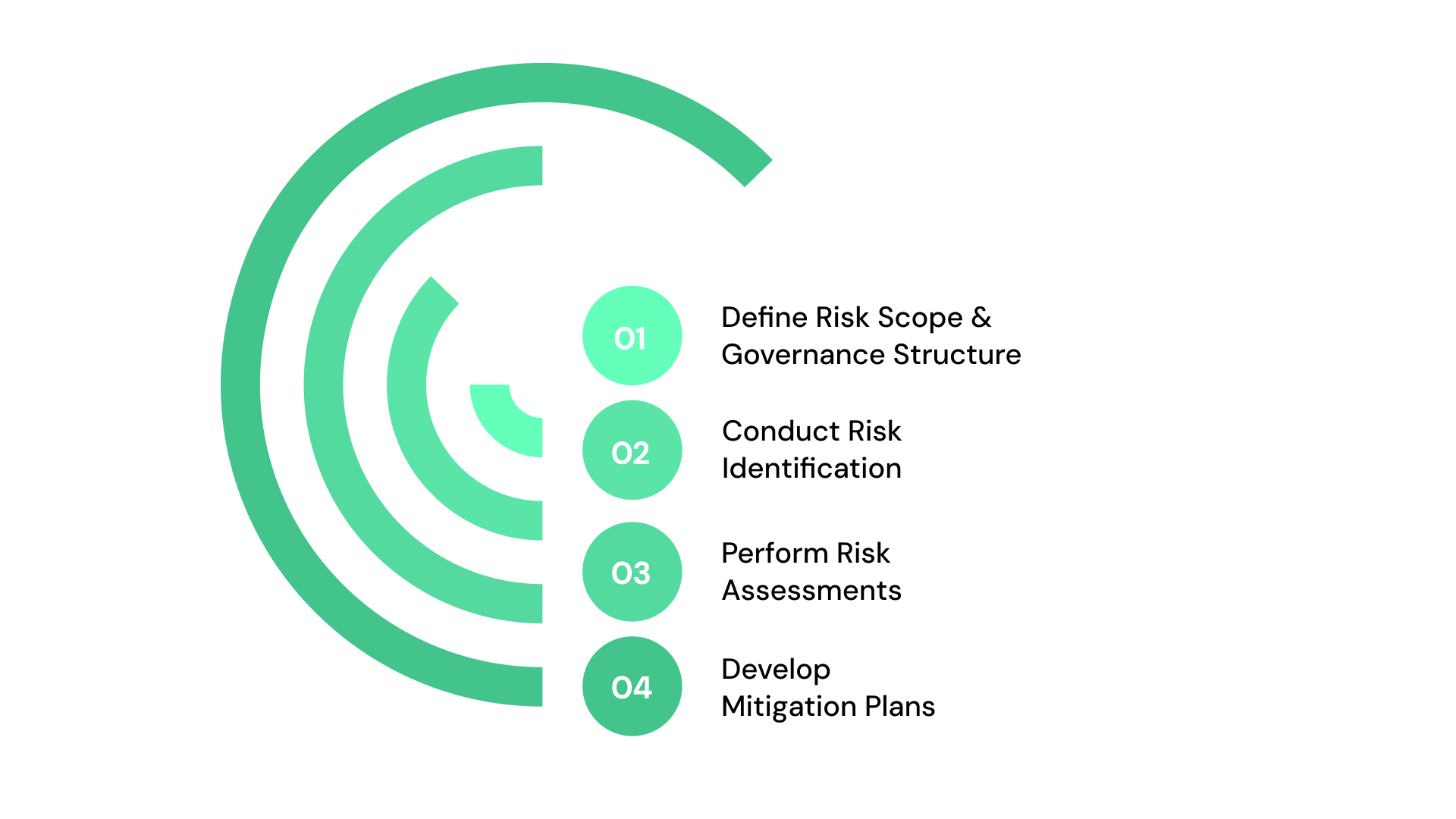
Building a structured model requires connecting governance, risk assessments, and operational workflows into a repeatable system.
Follow these steps:
1. Define Risk Scope and Governance Structure:
Define which assets, systems, and business units fall within the risk model. Establish governance roles and reporting structures.
- Identify critical infrastructure and operational systems
- Define governance roles across engineering and compliance
- Align with regulatory requirements
- Establish reporting hierarchy
- Document governance policies
2. Conduct Risk Identification
Identify risks across operations, systems, and vendors using structured methods.
- Review incident history
- Analyze system vulnerabilities
- Evaluate vendor dependencies
- Identify regulatory exposure
- Document risk categories
3. Perform Risk Assessments
Evaluate risks using consistent scoring models to determine severity.
- Assign impact scores based on outage or compliance impact
- Evaluate likelihood using historical data
- Apply the standardized scoring matrix
- Validate results with stakeholders
- Document findings
4. Develop Mitigation Plans
Define actions to reduce risk exposure and track execution.
- Assign remediation owners
- Define mitigation controls
- Set deadlines
- Monitor progress
- Update risk status
How to Identify Risks Across Grid Operations, Assets, and Vendors
Effective identification requires a structured, evidence-based approach that reflects how utility operations actually function across assets, systems, and third-party dependencies.
The following approach guarantees comprehensive and actionable risk coverage:
1. Map Operational Systems and Assets
Create a detailed inventory of critical systems, including generation units, transmission lines, substations, control systems (e.g., SCADA), and vendor-managed services. For each asset, document its function, interdependencies, and failure points. Identify how disruptions in one system could cascade across operations, affecting reliability or compliance.
2. Use Multiple Risk Inputs
Leverage diverse data sources to uncover risks grounded in real-world conditions. This includes historical incident reports, maintenance logs, audit findings, regulatory updates, and real-time system data. Integrating these inputs helps identify both recurring issues and emerging threats, enabling more accurate risk detection.
3. Categorize Risks Consistently
Apply a standardized risk taxonomy across all departments to secure uniform classification and reporting. Categorize risks into defined groups such as operational, regulatory, infrastructure, cybersecurity, and vendor risk. This consistency supports better aggregation, comparison, and prioritization of risks across the organization.
Also Read: Understanding Regulatory Compliance Management in the U.S.
How to Measure Utility Risk: Impact, Likelihood, and Risk Scoring Models

Risk measurement secures prioritization aligns with operational and regulatory impact. The following components define structured scoring:
1. Impact Assessment
Impact quantifies the severity of a risk event based on its potential consequences. In utility environments, this includes factors such as duration and scale of service disruption, number of customers affected, financial loss, safety implications, and regulatory penalties.
For example, a substation failure affecting a major transmission line would carry a higher impact score than a localized outage due to its broader operational and compliance implications.
2. Likelihood Assessment
Likelihood measures the probability of a risk occurring within a defined time frame. Utilities assess likelihood using historical incident data, asset condition reports, maintenance records, and real-time system indicators.
External factors such as weather patterns, cyber threat intelligence, and vendor reliability also influence likelihood scoring. A frequently failing asset or a system with known vulnerabilities would be assigned a higher likelihood rating.
3. Risk Scoring Models
Risk scoring models combine impact and likelihood to produce a prioritized risk rating. Utilities typically use a standardized matrix (e.g., a 1–5 scale for both impact and likelihood) to calculate a composite score.
This allows teams to categorize risks into tiers such as low, medium, high, or critical. High-scoring risks are escalated for immediate mitigation, while lower-scoring risks are monitored or addressed through routine controls.
How to Assign Risk Ownership Across Engineering, Compliance, and Operations
Ownership confirms risks are actively managed rather than documented. The following practices strengthen accountability:
- Define Clear Ownership Roles: Assign risks to functional owners responsible for mitigation and monitoring.
- Establish Escalation Mechanisms: Define escalation paths for high-risk issues for leadership visibility.
- Track Ownership and Progress: Monitor remediation status and make sure deadlines are met through structured reporting.
How to Monitor Utility Risk Continuously
Continuous monitoring makes risks remain visible as conditions change. The following mechanisms support ongoing oversight:
1. Key Risk Indicators (KRIs)
KRIs are quantifiable metrics that signal changes in risk exposure. In utility environments, these may include outage frequency, equipment failure rates, or abnormal system behavior. Tracking KRIs helps organizations detect emerging risks early and take corrective action before issues escalate.
2. System-Driven Inputs
Operational systems such as Supervisory Control and Data Acquisition, asset monitoring tools, and network sensors generate real-time data that reflects current system conditions. Integrating this data into risk monitoring processes allows organizations to continuously assess risk based on actual operational performance.
3. Risk Dashboards
Risk dashboards consolidate data from KRIs, system inputs, and mitigation activities into a single view. They provide visibility into risk trends, control effectiveness, and remediation progress, enabling leadership to make informed decisions and respond quickly to changing risk conditions.
Also Read: How to Develop Corporate Governance Policies
How to Integrate Compliance, Safety, and Operational Risk into One Model
Utilities often manage compliance, safety, and operational risk separately. This fragmentation limits visibility. Integration requires:
- Unified Risk Taxonomy: Establish a standardized set of risk categories that apply consistently across compliance, safety, and operational domains for uniform classification and reporting.
- Shared Data Models: Create aligned data structures that integrate risk, control, and audit information across teams, enabling consistent analysis and reducing duplication.
- Centralized Reporting: Implement a unified reporting system that provides leadership with a comprehensive view of risk exposure, mitigation status, and overall program performance.
Common Utility Risk Management Failures and How to Fix Them
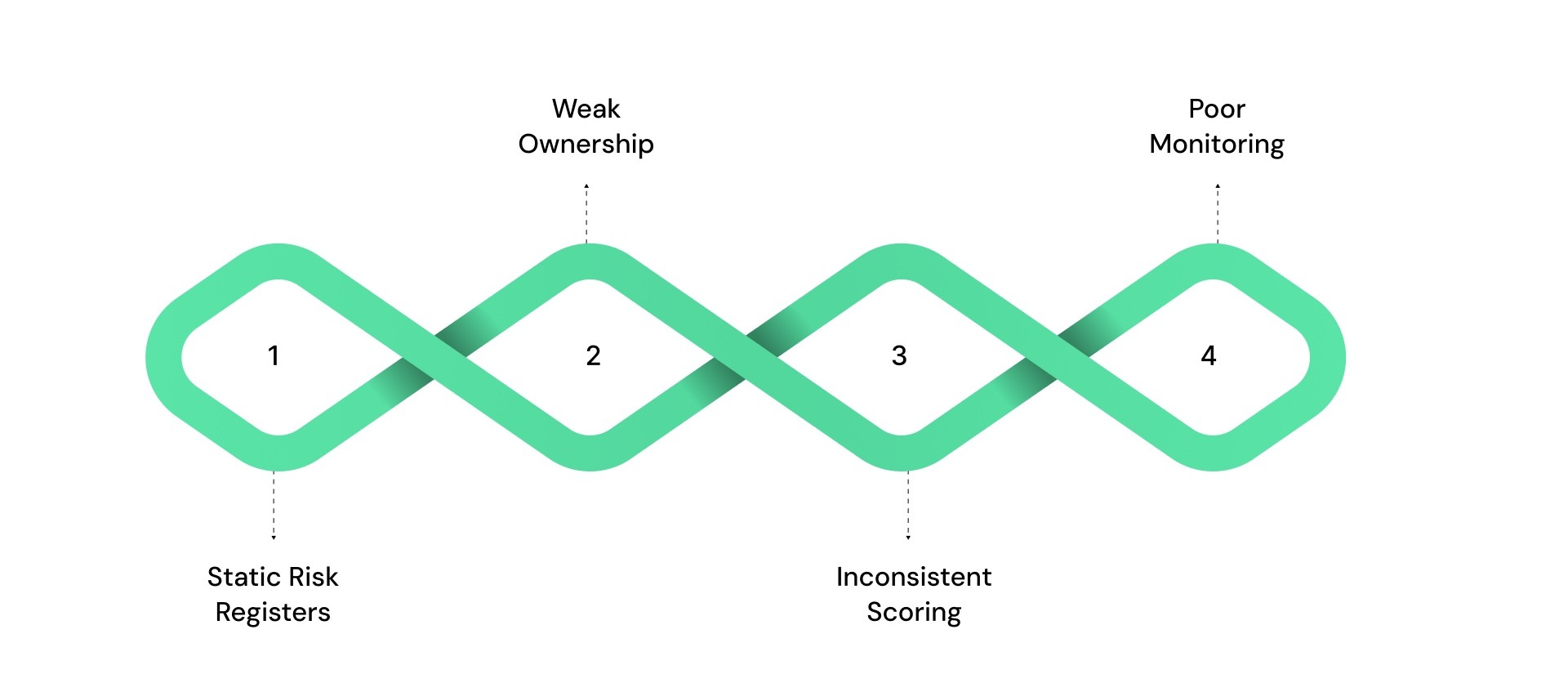
Execution gaps often weaken risk programs, especially when processes are not tied to real operational workflows or measurable outcomes.
1. Static Risk Registers
Risk registers are updated only during scheduled reviews, often quarterly or annually, which means new risks or changes in existing risks go unrecorded for long periods. This creates blind spots, especially when system conditions or regulatory requirements change between review cycles.
Solution: Implement event-driven updates where risks are automatically reviewed and updated based on triggers such as incidents, audit findings, system alerts, or regulatory changes. Integrate risk registers with operational systems to ensure updates reflect real-time conditions.
2. Weak Ownership
Risks are assigned to individuals or teams in documentation, but there is no mechanism to track whether mitigation actions are completed or whether owners are actively managing the risk. This leaves risks open without progress or accountability.
Solution: Assign clear, role-based ownership with defined responsibilities, deadlines, and escalation paths. Use systems that track task completion, send reminders, and provide visibility into ownership status for leadership review.
3. Inconsistent Scoring
Different departments use varying criteria to assess risk impact and likelihood, resulting in inconsistent prioritization. A risk considered high in one team may be rated medium in another, making it difficult to compare and prioritize risks across the organization.
Solution: Establish a standardized risk scoring framework with clearly defined impact and likelihood criteria. Ensure all teams use the same scoring matrix and provide training to maintain consistency in assessments.
4. Poor Monitoring
Risk monitoring depends on periodic reports or manual updates, which delay the detection of emerging issues. By the time risks are reviewed, conditions may have already changed, increasing exposure.
Solution: Implement continuous monitoring using key risk indicators (KRIs), system data feeds, and automated dashboards. Ensure that risk status is updated in near real time and that alerts are generated when thresholds are exceeded.
Best Practices for Strengthening Utility Risk Governance at Scale
To improve governance maturity, focus on:
- Standardized risk frameworks: Define a single risk taxonomy, scoring model, and assessment methodology that all departments must follow to eliminate inconsistencies in how risks are identified and evaluated
- Centralized risk visibility: Consolidate risk data from engineering, compliance, and operations into unified dashboards that provide real-time insights into risk exposure, mitigation status, and control effectiveness
- Continuous monitoring: Implement automated data feeds, KRIs, and system integrations (such as SCADA inputs) to detect changes in risk conditions and trigger updates without relying on periodic reviews
- Documented audit trails: Maintain time-stamped records of risk assessments, control activities, and remediation actions to ensure traceability and support regulatory audits

How to Operationalize Utility Risk Management Without Fragmentation
Fragmentation remains a primary challenge in utility risk programs, often caused by separate systems for engineering, compliance, and operations that do not share data or workflows.
To reduce fragmentation:
- Centralize risk data in a single system: Consolidate risk registers, control documentation, and audit evidence into one platform to eliminate duplicate records and version conflicts
- Standardize workflows across teams: Use consistent processes for risk identification, assessment, mitigation, and reporting so engineering, compliance, and operations follow the same structure
- Link risks to controls and evidence: Ensure every identified risk is tied to specific controls, mitigation actions, and supporting documentation to maintain traceability during audits
- Enable real-time cross-functional visibility: Provide shared dashboards that allow all stakeholders to view risk status, ownership, and mitigation progress without relying on manual updates
Operationalizing Utility Risk Management with VComply
Many utility organizations manage risk assessments, compliance obligations, and audit documentation across disconnected systems. As programs scale, tracking ownership, mitigation progress, and compliance evidence becomes increasingly difficult.
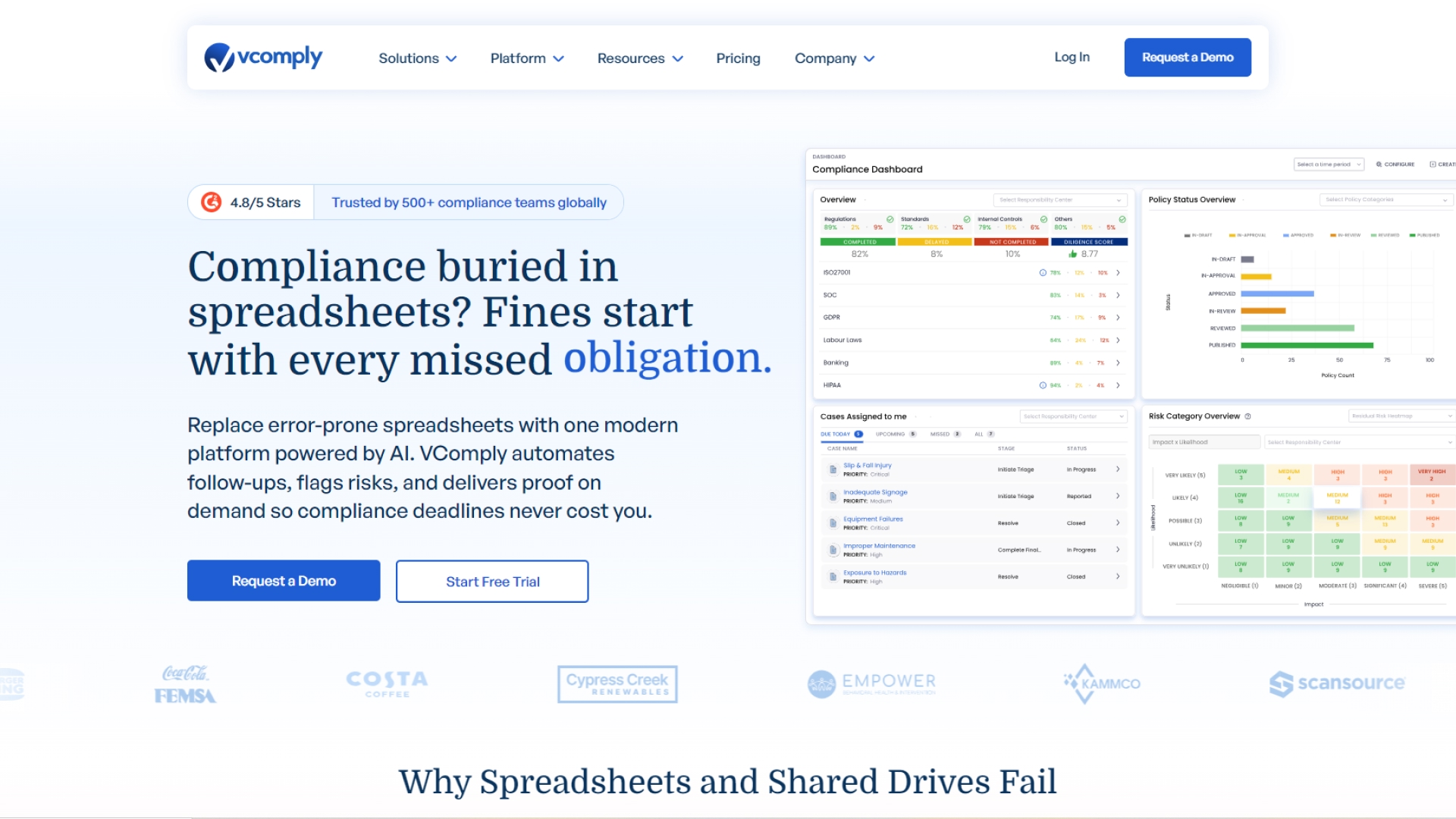
VComply provides a structured GRC environment that centralizes governance, risk management, and compliance workflows. This unified approach improves visibility, strengthens accountability, and supports consistent oversight across utility operations.
Within this environment:
- RiskOps tracks risk assessments, assigns ownership, and provides real-time risk dashboards
- ComplianceOps connects regulatory requirements with controls and maintains audit-ready evidence
- PolicyOps manages the policy lifecycle aligned with regulatory standards
- CaseOps tracks incidents and ensures structured resolution workflows
This integrated structure enables organizations to move from fragmented tracking to continuous risk oversight. Book a demo with VComply to learn more.
Conclusion
Utility risk management requires structured models that connect infrastructure risk, regulatory compliance, and operational oversight. Without consistent monitoring and accountability, risks remain fragmented and difficult to manage.
Centralized governance systems improve visibility, strengthen accountability, and support audit readiness across utility operations.
Explore how RiskOps structures utility risk monitoring and governance workflows. Start a 21-day free trial with VComply to review structured risk management in practice.
FAQs
Utility risk management is the process of identifying, assessing, and mitigating risks across infrastructure, operations, and regulatory obligations within utility organizations.
Utilities face operational, regulatory, infrastructure, cybersecurity, and vendor-related risks that impact reliability and compliance.
Utilities measure risk using impact and likelihood scoring models that prioritize risks based on operational and regulatory consequences.
Utilities improve visibility by centralizing risk data, using dashboards, and implementing continuous monitoring practices.
Organizations centralize risk tracking, compliance workflows, and audit evidence using structured platforms such as VComply to maintain consistent oversight.