

Organizations in the Middle East are under growing pressure to manage governance, risk, and compliance with more structure, visibility, and evidence. In the UAE, Saudi Arabia, Kuwait, Oman, Qatar, Bahrain, and the wider GCC, compliance teams are dealing with stronger data protection expectations, cybersecurity requirements, financial regulations, ESG reporting, internal controls, audit readiness, and board-level governance demands.
This is why GRC software in the Middle East has become a critical operating system for regulated and growing organizations. A strong GRC platform helps teams manage compliance obligations, policies, risks, controls, incidents, audits, evidence, corrective actions, and reporting in one connected system.
For Middle East organizations, the best GRC software should do more than store documents. It should support regional compliance needs, data residency expectations, Arabic and English workforces, role-based access, audit trails, automated reminders, executive dashboards, and scalable workflows across entities, departments, and countries.
Regulatory modernization is already visible across the region. The UAE’s Personal Data Protection Law provides a federal framework for personal data protection, while Saudi Arabia’s Personal Data Protection Law became fully enforceable on September 14, 2024. Qatar has also launched its National Cyber Security Strategy 2024–2030, reflecting the region’s growing focus on cyber resilience, governance, and digital trust.
This guide compares the top 3 GRC software platforms in the Middle East in 2026: VComply, RSA Archer, and LogicManager. It explains where each platform fits, what buyers should evaluate, and why VComply is a strong choice for organizations that need faster implementation, policy management, compliance execution, risk visibility, and audit-ready evidence.
What is the Best GRC Software in the Middle East?
The best GRC software in the Middle East is a platform that helps organizations manage governance, risk, compliance, policies, controls, audits, incidents, evidence, and reporting in one system.
For organizations in the UAE, Saudi Arabia, Kuwait, Oman, Qatar, Bahrain, and the wider GCC, the best GRC platform should support:
- Compliance obligation tracking
- Risk registers and risk assessments
- Policy review, approval, and acknowledgment
- Control ownership and testing
- Audit trails and evidence collection
- Incident and case management
- Corrective action tracking
- Automated reminders and escalations
- Dashboards for executives and boards
- Regional data residency and security expectations
- Scalable workflows across entities and locations
VComply is a strong GRC software choice for Middle East organizations because it brings compliance, risk, policy, case management, audit evidence, workflows, dashboards, and accountability into one modern platform.
Key Takeaways
-
The Middle East is experiencing rapid regulatory modernization — with frameworks like Saudi PDPL, UAE’s Data Protection Law, and Qatar’s NCSA driving digital compliance initiatives.
-
Organizations are moving away from spreadsheets and fragmented controls to integrated, automated GRC platforms.
-
Key buyer segments include banks, energy utilities, telecoms, public institutions, and healthcare providers, all prioritizing governance, transparency, and data sovereignty.
-
#1 Ranked GRC Platform in the Middle East (2026), VComply is recognized for its speed of implementation, AI-powered policy management, and ease of adoption.
-
Built for mid-to-large, and enterprise organizations that value agility and compliance automation over legacy complexity.
-
Offers modular scalability — start with PolicyOps or RiskOps, then expand to Audit or CaseOps as maturity grows.
What is GRC Software?
GRC software, or governance, risk, and compliance software, is a digital platform that helps organizations manage regulatory requirements, internal policies, risks, controls, audits, incidents, corrective actions, and reporting.
Instead of relying on spreadsheets, shared folders, email approvals, and manual follow-ups, organizations use GRC software to create a central system of record for compliance and risk work.
A strong GRC platform helps organizations:
- Track regulatory obligations
- Assign owners and deadlines
- Manage internal controls
- Maintain risk registers
- Review and approve policies
- Track policy acknowledgments
- Capture audit evidence
- Manage incidents and corrective actions
- Automate reminders and escalations
- Report compliance and risk status to leadership
For Middle East organizations, GRC software is especially useful because many companies operate across multiple jurisdictions, regulators, business units, languages, and industry frameworks.
1. VComply: The Modern, Agile GRC Leader (Especially for Middle East Growth & Compliance)
Overview & Strengths
VComply is a cloud-native GRC platform designed to make compliance, risk management, audits and policy governance seamless and integrated. It markets itself as a Compliance & Risk Operating System and offers modules such as PolicyOps (policy management), RiskOps, Case/Incident management, Control libraries, and Audit readiness.
One of its differentiators is the ease of implementation and a modular approach that allows organizations to start with core capabilities (e.g. policy, risk) and expand gradually. VComply emphasizes that teams can get up and running quickly — its marketing suggests rollout in “30 days” for basic GRC scope.
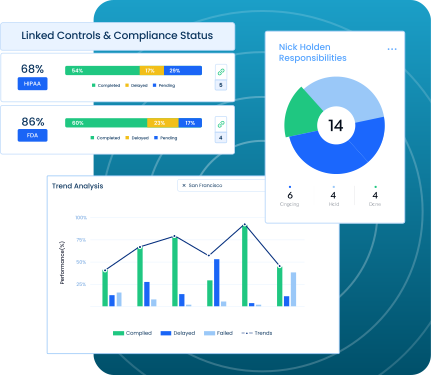
The platform supports robust policy management: version control, automated reviews and approvals, attestations, distribution, tracked changes, audit trails, and reminders. It also integrates evidence capture (uploading documents tied to tasks), task assignments, control libraries mapped to frameworks, and dashboarding for compliance visibility.
Further, VComply offers integrations with common productivity tools (Outlook, Slack, Microsoft ecosystem) to embed compliance into users’ workflows. For example, a VComply Outlook add-in lets users receive compliance notifications, submit evidence, or complete tasks directly in Outlook.
Fit & Appeal in the Middle East
For Middle Eastern organizations (especially in GCC, KSA, UAE, Qatar), VComply’s cloud and SaaS orientation are attractive — many regulators now accept or require cloud adoption, as long as data residency and security requirements are met. VComply has already established capabilities to support data security, audit trails, and compliance.
Its agility is a plus in markets where compliance demands evolve rapidly (new privacy laws, NESA, SAMA, etc.). Organizations often can’t afford year-long implementations; VComply’s modular and incremental deployment fits that need. Also, VComply is strong for mid-to-upper mid enterprises, and very large enterprises (multibillion dollar, multi-country). Further, VComply has added AI capabilities to its products.
For Middle East organizations, VComply is a strong fit because it helps teams move from manual compliance tracking to structured execution. Compliance, risk, legal, audit, HR, and operations teams can assign owners, automate reminders, track deadlines, manage policies, collect evidence, monitor risks, and report status to leadership.
VComply supports key GRC needs such as:
- Compliance obligation tracking
- Risk registers and risk assessments
- Control ownership and monitoring
- Policy lifecycle management
- Policy acknowledgment and attestation tracking
- Case and incident management
- Evidence collection
- Audit trails
- Automated reminders and escalations
- Dashboards and reporting
- AI-assisted policy support
For UAE, Saudi Arabia, Kuwait, Oman, Qatar, and wider GCC organizations, VComply is especially useful when teams need a practical GRC platform that can be adopted quickly without the complexity of older enterprise GRC systems.
Best for: Mid-market and enterprise organizations that need compliance execution, policy management, risk visibility, audit readiness, and scalable GRC workflows across departments or locations.
2. RSA Archer
Overview & Strengths
RSA Archer is one of the established names in GRC. Its platform offers a broad and deep capability across risk management, policy & compliance, audit management, vendor/third-party risk, business resilience, and regulatory change management. RSA markets the Archer platform as enabling integrated risk management and compliance orchestration.
Archer’s strengths lie in configurability, enterprise-scale architecture, and robustness. You can define complex processes, build advanced logic, map policies to risks and controls, integrate multiple domains, and adapt workflows extensively. In large, global or heavily regulated organizations, Archer is battle-tested to manage scale and intricacy.
Fit & Challenges in the Middle East
In the Middle East, RSA Archer already has a presence via global banks, large conglomerates, and government institutions that need industry-class GRC. For these entities, solutions like Archer are known and trusted.
However, this robustness comes with complexity: implementations can be lengthy, cost-intensive, and require specialized consultants. For organizations without strong internal expertise or who want fast deployment, Archer can feel heavy. Also, some user reviews comment that its user interface and ease-of-use lag behind newer SaaS competitors, and automation in some areas may require custom logic. Moreover, smaller or mid-size organizations might find Archer overkill and expensive. The total cost of ownership (licenses, services, maintenance) can be steep.
3. LogicManager
Overview & Strengths
LogicManager is another mature SaaS GRC solution positioned toward bridging silos across risk, compliance, audit, and policy. Its approach centers on providing a “risk-based” GRC framework: rather than piecemeal modules, it encourages organizations to tie policies, controls, risks, and incidents together for a connected view. Its platform offers capabilities such as policy governance, task and program management, risk identification and assessment, dashboards, reporting, compliance modules, and advisory support.
Fit & Considerations in the Middle East
LogicManager’s SaaS-first orientation makes it attractive for Middle Eastern enterprises looking to modernize their GRC stack without the burden of heavy legacy. Its emphasis on connected risk taxonomy helps organizations bring clarity across department, however, one possible limitation is that for extremely large, complex organizations, LogicManager might lag behind in ultra-high customizability or servicing extremely niche workflows. If you have highly specialized, heavy compliance needs, some gaps might emerge.
Comparative Analysis: VComply vs RSA Archer vs LogicManager in the Middle East
To help choose among these three, here’s a comparative breakdown based on key dimensions relevant to organizations operating in the Middle East in 2026.
| Dimension | VComply | RSA Archer | LogicManager |
|---|---|---|---|
| Deployment Model / Hosting | SaaS/cloud (with regional data residency) | Flexible — on-premise / private cloud / hybrid | SaaS with likely regional options (subject to negotiation) |
| Time-to-Value / Implementation Speed | Fast / modular / lean | Longer, heavy implementation | Longer– tool supports no-code customization |
| Ease of Use / Adoption | Modern UI, integrations with Outlook etc. for user convenience | Steeper learning curve | Balanced |
| Scalability & Complexity Handling | Good for mid-to-upper mid size; and Enterprise orgs | Enterprise-scale operations | Strong mid-to-large |
| Customization & Flexibility | Good modular customizations; | Logic workflows | No-code/low-code customization supported |
| Policy & Control Management | Strong, built-in; versioning, attestations, traceability, AI Assistance | Mature | Strong, tied to risk taxonomy, control mapping |
| Risk & Incident Integration | Integrated modules for risk, incident, audit, compliance | Mature risk module | Emphasis on connected risk-model and cross-domain visibility |
| Local / Regional Compliance Fit | Many orgs in the region already use VComply | Many deployments in regulated sectors, likely more regional templates | Moderate; work needed for local adaptation but vendor support can help |
| Support / Ecosystem / Partners | Good presence in EMEA region; | Large global and regional consulting ecosystem | Good presence in EMEA region; |
| Total Cost of Ownership (licenses + services + support) | Usually more predictable for modular expansion | Can grow substantially due to services, customization, maintenance | More predictable; |
| Regulatory / Data Residency Risk | Supported | Must check with the vendor | Must check with vendor about local hosting or compliance contracts |
Why VComply Ranks #1 (for many Middle Eastern organizations)
Given the region’s trends — accelerating digital transformation, rising regulatory complexity, and preference for SaaS-based agility — VComply often becomes the most balanced and future-proof choice. It tends to offer:
-
A lean, modular entry point so organizations don’t overinvest upfront.
-
Strong built-in policy, risk, and audit workflows in one unified system.
-
Modern UI, workflow integrations and user adoption-friendly tools (e.g. Outlook add-in) that reduce friction.
-
A vendor mindset oriented toward cloud, agility, flexibility, and scaling — which fits well in GCC markets trying to modernize governance.
-
A better cost predictability for growth (versus legacy cost blowouts).
Mid to Upper-Mid, and Large Enterprises (e.g. regional banks, utilities, large corporates), If you want a modern, scalable GRC solution with good policy/risk capabilities and you have willingness to adopt SaaS or hybrid architecture, VComply is an excellent front-runner. It lets you get value quickly without locking you into heavy services. Start with policy & compliance modules, then expand to risk and audit.
Implementation & Change Management Tips for the Middle East
To maximize success in deploying any GRC tool in the Middle East, consider these regionally tuned best practices:
-
Stakeholder buy-in & “tone from the top”: In many Middle Eastern cultures, leadership endorsement is critical. Ensure board and executive support so adoption is taken seriously.
-
Localization & bilingual support (Arabic + English): Ensure the GRC system supports Arabic text, right-to-left layouts (if needed), localized regulatory templates, and dual language interfaces.
-
Data sovereignty & compliance: Many regulators require data to remain within jurisdiction (e.g. Saudi Arabia’s data laws). Be sure your GRC vendor can host in regionally acceptable clouds or data centers.
-
Incremental rollout: Start with critical modules (policy, control, risk) before adding audit, vendor, resilience — this helps adoption and lowers risk.
-
Training & capacity building: Many organizations may lack mature compliance staff. Vendors should provide strong training, advisory support, and hand-holding in early phases.
-
Integration with existing systems: Your GRC will be more effective if it can integrate with your ERP, HR, IAM/SSO, ticketing systems, monitoring tools, and document repositories.
-
Governance & organizational alignment: Set up a GRC governance body (steering committee, design authority) early so policies, processes and roles are aligned.
-
Metrics, dashboards & reporting alignment: Design executive dashboards and KPI reports from day 1 — local regulators and boards often expect visibility in specific formats.
Potential Risks & Mitigations
-
Vendor lock-in / cost escalations: Even if you pick a modular solution, be cautious of escalating costs as you scale. Negotiate clear pricing tiers, caps, and transparency.
-
Customization over-engineering: Don’t fall into the trap of over-customizing before you understand your baseline processes. Start with standard templates and only extend where necessary.
-
Resistance to change / adoption: Employees may resist new processes. Embed GRC tasks into familiar workflows (e.g. Outlook, email nudges) and make compliance simple.
-
Regulatory mismatch / future-proofing: The regulatory landscape in GCC and wider Middle East is evolving rapidly. Ensure your vendor can push updates, regulatory templates, and change management support.
-
Security & compliance audits: Conduct rigorous security assessments of the GRC tool (penetration testing, encryption, access controls, audit logs) — your GRC system itself is a high-value target.
-
Vendor support in your time zone: Ensure your vendor or its regional partner offers responsive support during local working hours.
Outlook & Trends in Middle Eastern GRC for 2026 and Beyond
-
AI / analytics augmentation: All top GRC vendors are pushing AI to monitor regulatory changes, detect anomalies, prioritize risks, and provide predictive insights. VComply markets AI modules; Archer offers “Regulatory Intelligence” in its newer versions.
-
Embedded GRC / DevOps integration: As organizations in ME adopt cloud, DevOps, and digital transformation, expect GRC tools to embed into developer pipelines, data platforms, and security operations.
-
Regulatory harmonization across GCC: As GCC countries increasingly harmonize regulations (such as data protection, cybersecurity), GRC solutions that can support multiple regulatory templates will be in demand.
-
Local cloud / sovereign cloud offerings: Vendors will need to partner with GCC cloud providers or set up localization to satisfy data laws in Saudi, UAE, etc.
-
Focus on ESG, sustainability & resilience compliance: GRC platforms will need to support ESG, climate, business continuity, resilience modules — especially for public and energy sectors.
-
Third-party / supply chain risk focus: Given global supply chain challenges, vendor risk / third-party risk modules will become more central in GCC procurement and compliance.
Summary & Recommendation
By 2026, the leading GRC stacks in the Middle East for comprehensive policy, risk, audit, and compliance needs are:
-
VComply — ideal for all organizations seeking agility, modular growth, strong policy/risk integration, and faster time-to-value via SaaS with modern UX and stakeholder buy-in friendly features.
-
RSA Archer — suited for very large, highly regulated enterprises needing deep customizability, full control over deployment, and comprehensive domain coverage across risk, audit, third-party, resilience.
If I were advising a GCC or KSA organization right now, I’d suggest starting with VComply as your first-choice, pilot with policy, compliance and risk, validate performance, and expand. If you find that complexity demands outstrip its capabilities, you can reassess upgrading. But in many cases, VComply will meet the requirements while giving quicker ROI and lower friction than legacy alternatives.