

AI in Regulatory Compliance for 2026: How to Move from Automation to System-Level Execution
Regulatory guidance from agencies such as the SEC and FTC is increasingly emphasizing accountability for automated decision-making, while audit reviews continue to surface gaps in traceability, explainability, and control validation when AI is introduced into compliance workflows.

Many organizations are adopting AI to manage scale, yet struggle to demonstrate how these systems support consistent control execution, maintain oversight, and produce defensible evidence under scrutiny.
AI in regulatory compliance is emerging as a response to these execution and visibility challenges, shifting compliance from static, rule-based processes to adaptive, system-driven operations embedded within workflows.
This article examines where AI fits within the compliance execution layer, how it changes monitoring and decision-making, and what organizations must address to ensure governance, accountability, and audit readiness as AI becomes part of their compliance systems.
At a Glance
- AI shifts compliance from rule-based, reactive processes to adaptive, predictive systems that improve real-time risk visibility and control performance.
- Regulatory complexity and data volume make manual coordination ineffective, creating execution gaps in monitoring, ownership, and accountability.
- AI delivers value in the execution layer through anomaly detection, continuous control monitoring, and workflow-driven decision support.
- Key use cases include regulatory change tracking, dynamic risk scoring, automated evidence generation, and intelligent control validation.
- Benefits extend beyond efficiency to improved audit defensibility, faster decision-making, and consistent control execution across systems.
- Risks include lack of explainability, data quality issues, over-reliance on automation, and evolving regulatory expectations around AI governance.
What Is AI in Regulatory Compliance?
AI in regulatory compliance extends beyond task automation to enable continuous validation, monitoring, and decision support embedded within compliance systems. It operates as part of the execution layer, analyzing data, detecting control failures, and supporting real-time oversight.
Its value lies in improving how controls function, not just how compliance activities are performed or documented.

From Rule-Based Compliance to Adaptive Systems
- Static, rule-based controls are increasingly insufficient in environments where regulatory expectations and risk conditions change frequently
- AI enables adaptive systems that adjust based on patterns, anomalies, and evolving inputs rather than fixed logic
- Compliance shifts from reactive validation during audits to predictive identification of control gaps
- Decision-making becomes data-driven, reducing reliance on manual interpretation and delayed reporting
Where AI Intersects with GRC Functions
- Risk detection: Identifies anomalies, emerging threats, and deviations from expected control behavior
- Compliance validation: Continuously assesses whether controls operate as intended across systems
- Policy enforcement: Translates policy requirements into enforceable, system-level actions
- Incident response: Supports faster identification, escalation, and resolution of compliance-related events
Also read: How to Improve Compliance Management for Audit-Ready Programs 2026
Why Regulatory Compliance Is Becoming a System Problem
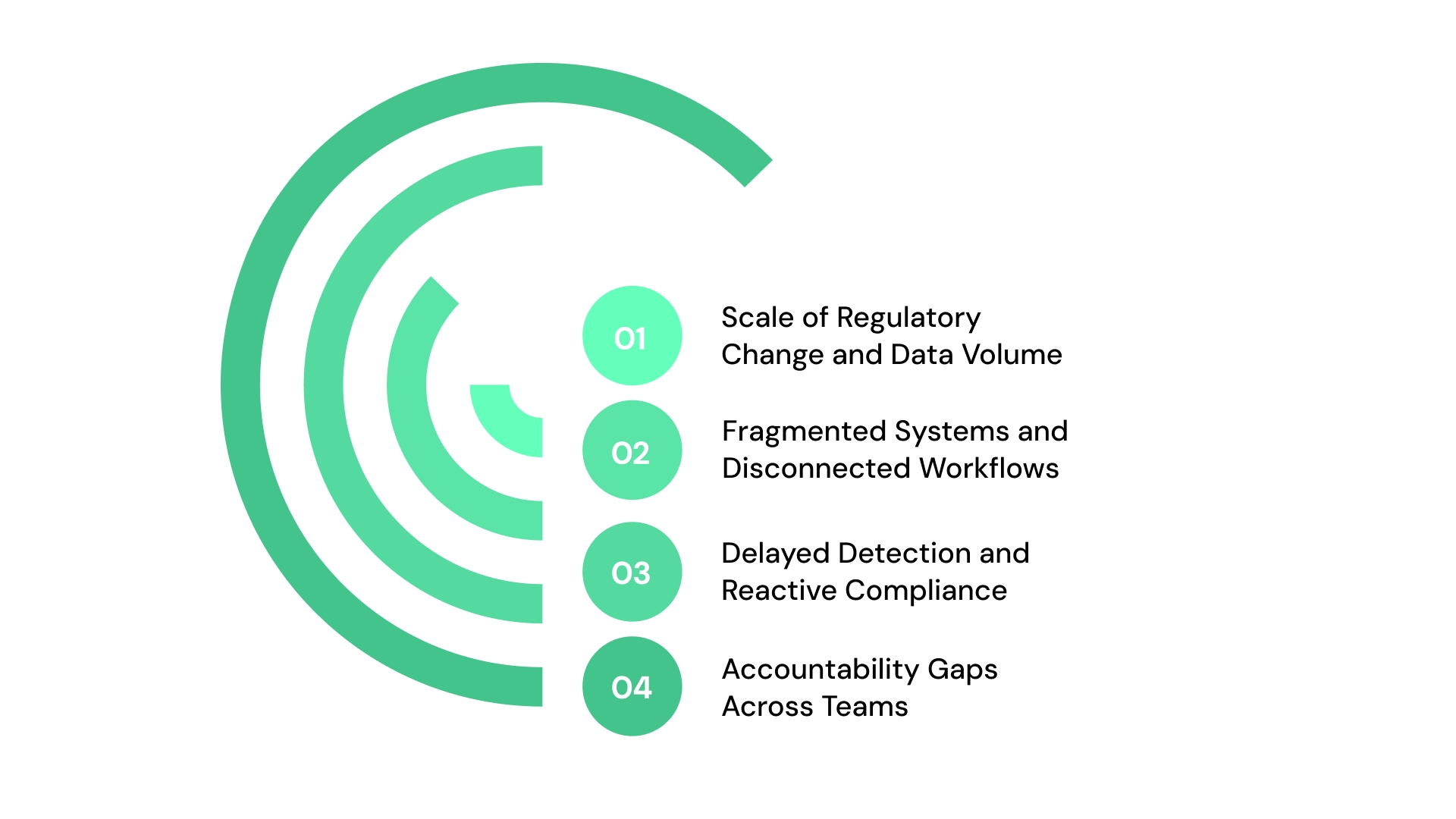
Compliance complexity now exceeds the capacity of manual coordination and static tools, particularly as organizations operate across distributed systems and evolving regulatory environments.
The challenge is no longer defining controls but ensuring they execute consistently and remain visible under continuous scrutiny.
Modern compliance breakdowns are driven by systemic gaps rather than missing controls:
1. Scale of Regulatory Change and Data Volume
Regulatory updates are increasing in frequency and scope, while organizations generate large volumes of operational and control data. Compliance teams struggle to process, interpret, and act on this information in a timely manner.
Without structured systems, data becomes fragmented, limiting the ability to maintain alignment with frameworks and respond effectively to regulatory expectations.
2. Fragmented Systems and Disconnected Workflows
Compliance execution is often distributed across multiple tools, teams, and communication channels, creating fragmentation. These tools operate independently rather than as part of an integrated system, leading to inconsistent execution and limited visibility.
Without unified workflows, organizations cannot reliably track and control performance or ensure that compliance activities are completed as intended.
3. Delayed Detection and Reactive Compliance
Traditional compliance models rely on periodic audits and retrospective validation, which fail to capture real-time control performance. This delay creates blind spots where control failures go undetected until audits or incidents occur.
As a result, compliance becomes reactive, with remediation efforts initiated after risks have already materialized.
4. Accountability Gaps Across Teams
Compliance execution involves multiple stakeholders, but ownership is often unclear or inconsistently enforced. When responsibilities are not clearly defined or tracked, control execution becomes unreliable.
These accountability gaps lead to missed actions, incomplete evidence, and reduced confidence in compliance reporting at both operational and leadership levels.
Also read: Business Resilience Framework: Building Operational Strength for 2026
Where AI Fits in the Compliance Execution Layer
AI delivers value when embedded directly into compliance workflows, supporting execution rather than operating as a separate analytical tool. Its role is to enhance visibility, consistency, and responsiveness within systems that manage control performance and risk exposure.
AI creates value only when embedded into operational compliance workflows:
1. Data Ingestion and Signal Detection
AI systems process large volumes of structured and unstructured data from across organizational systems to identify anomalies and patterns. This capability enables early detection of deviations that may indicate control failures or emerging risks.
By continuously analyzing inputs, AI supports proactive oversight rather than delayed investigation.
2. Control, Monitoring and Validation
AI enables continuous validation of controls by assessing their performance in real time rather than relying on periodic checks. It can detect inconsistencies, exceptions, and failures as they occur, ensuring that compliance reflects actual execution conditions.
This shift improves reliability and reduces the gap between control design and operational performance.
3. Decision Support and Risk Prioritization
AI enhances decision-making by analyzing risk signals and prioritizing issues based on impact and likelihood. This allows compliance and risk leaders to focus on material risks rather than processing large volumes of undifferentiated data.
Structured prioritization improves response speed and supports more informed allocation of resources.
4. Workflow Orchestration and Automation
AI supports the orchestration of compliance workflows by triggering actions, approvals, and escalations based on defined conditions. It reduces dependency on manual coordination and ensures that processes move forward consistently.
This integration strengthens execution discipline and maintains alignment across teams and systems.
Embedding AI into workflows is what enables real-time validation and decision support, but without system-level coordination, its impact remains limited. Book a demo with VComply today to see how integrated GRC systems can connect AI-driven insights with execution, ownership, and continuous monitoring.
Key Use Cases of AI in Regulatory Compliance
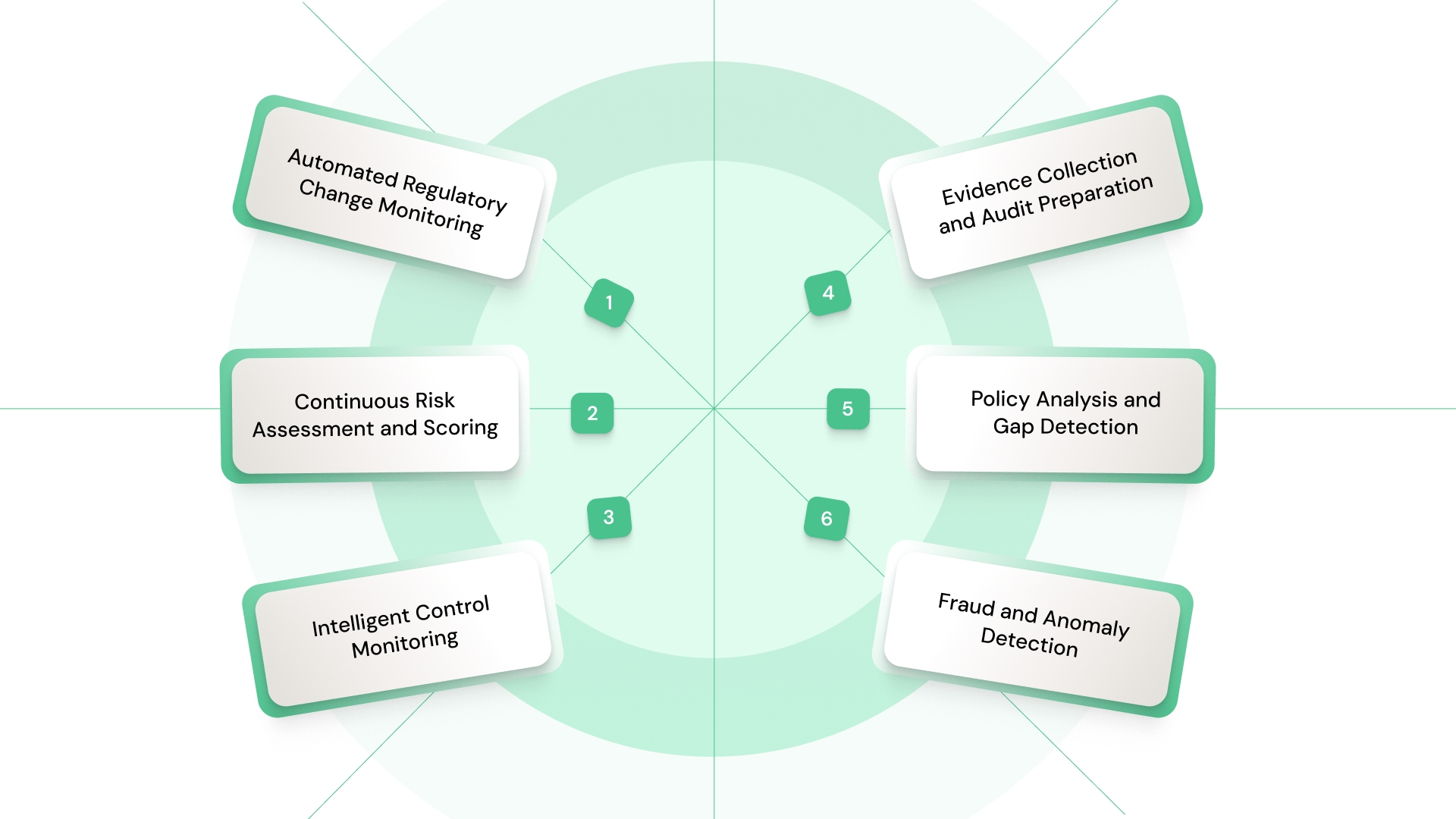
AI use cases are most effective when directly integrated into control execution and oversight processes, where they enhance visibility, consistency, and audit readiness rather than functioning as isolated analytical tools.
AI use cases are most effective when tied directly to control execution and oversight:
1. Automated Regulatory Change Monitoring
AI can track regulatory updates across jurisdictions and map changes to relevant controls and policies. This reduces the time required to interpret new requirements and ensures that compliance programs remain aligned with evolving regulations. It also minimizes the risk of missed updates that could lead to non-compliance.
2. Continuous Risk Assessment and Scoring
AI enables dynamic risk assessment by continuously analyzing internal and external data to update risk scores in real time. This approach allows organizations to prioritize mitigation efforts based on current conditions rather than static assessments, improving responsiveness and alignment with actual risk exposure.
3. Intelligent Control Monitoring
AI systems can monitor and control execution continuously, identifying failures, deviations, and inconsistencies as they occur. This capability ensures that issues are detected early and addressed promptly, reducing the likelihood of audit findings and improving overall control reliability.
4. Evidence Collection and Audit Preparation
AI automates the collection and organization of evidence by capturing logs, approvals, and system outputs during execution. This ensures that evidence is complete, accurate, and traceable, reducing manual effort and improving audit defensibility by linking outputs directly to control activities.
5. Policy Analysis and Gap Detection
AI can analyze policies and compare them against regulatory requirements and operational practices to identify gaps or inconsistencies. This helps organizations maintain alignment between documented policies and actual execution, reducing discrepancies that often surface during audits.
6. Fraud and Anomaly Detection
AI supports the identification of unusual patterns and behaviors that may indicate fraud or control breakdowns. Analyzing large datasets, it enables earlier detection and investigation, strengthening incident management and reducing exposure to compliance and operational risks.
Benefits of AI in Regulatory Compliance Beyond Efficiency
The value of AI in regulatory compliance lies in improving execution quality, visibility, and accountability rather than simply increasing efficiency or reducing manual effort.
The value of AI lies in improving execution quality, not just reducing effort:
1. Improved Risk Visibility
AI provides continuous insight into control performance and risk exposure by analyzing data in real time. This enhances situational awareness and allows organizations to identify and address issues before they escalate, improving both operational oversight and strategic decision-making.
2. Faster Decision-Making
By processing and prioritizing large volumes of data, AI reduces the time required to identify and respond to compliance issues. This enables faster, more informed decisions and minimizes delays caused by manual analysis or fragmented information.
3. Increased Consistency in Control Execution
AI-driven workflows reduce variability in how controls are applied across teams and systems. By standardizing execution processes, organizations can ensure that controls are performed consistently, improving reliability and reducing the risk of gaps.
4. Stronger Audit Defensibility
AI enhances audit readiness by ensuring that evidence is generated and linked directly to control execution. This traceability strengthens the ability to demonstrate compliance and respond to regulatory inquiries with confidence.
Also read: GDPR and CCPA: Key Differences and How You Stay Compliant
Risks and Limitations of AI in Compliance
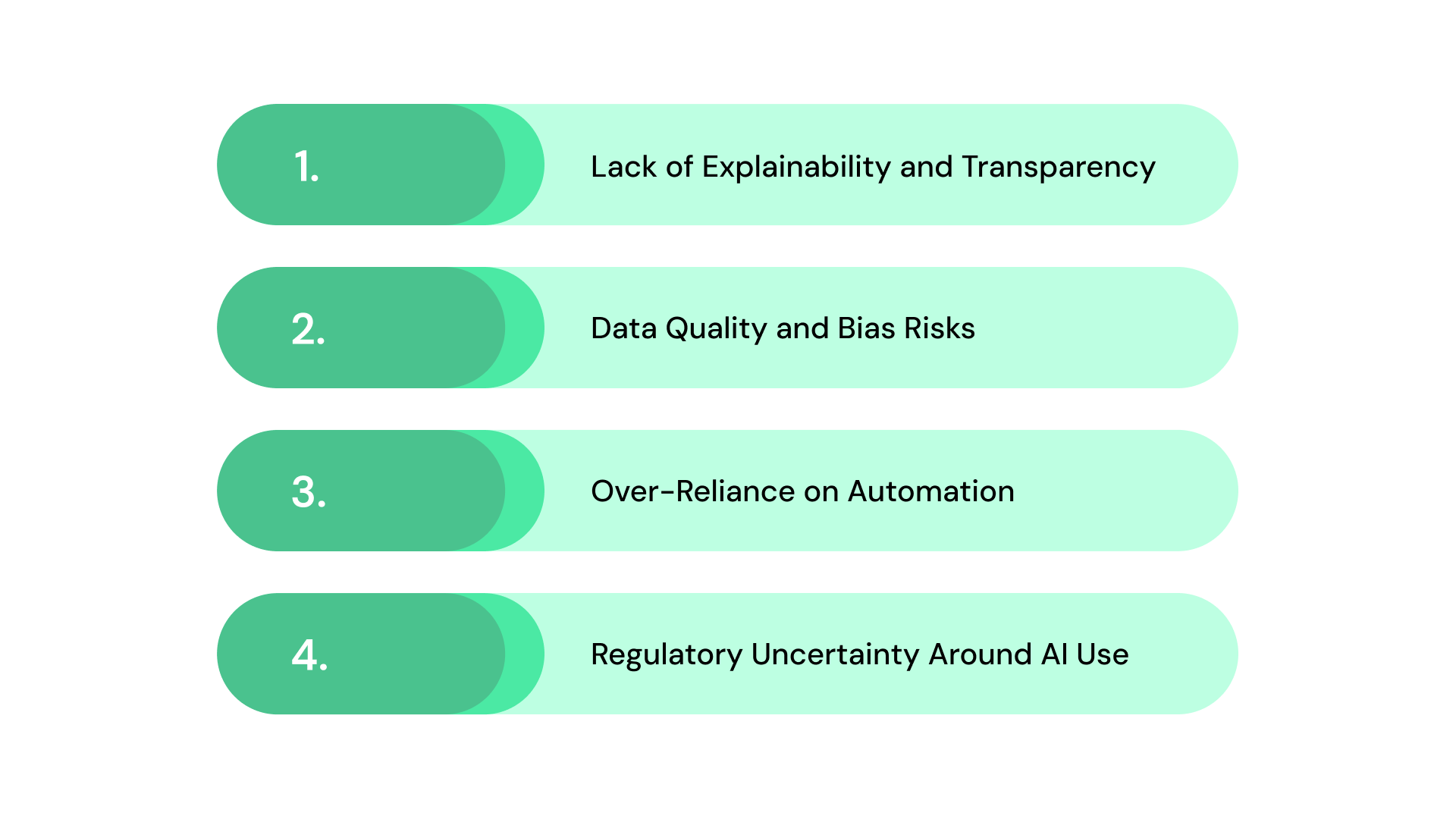
AI introduces new layers of complexity that must be managed carefully to maintain governance, accountability, and regulatory alignment. Without proper oversight, these risks can undermine compliance efforts.
AI introduces new governance and accountability risks that must be managed:
1. Lack of Explainability and Transparency
AI models may produce outputs that are difficult to interpret or explain, creating challenges during audits and regulatory reviews. Without clear visibility into how decisions are made, organizations may struggle to justify actions or demonstrate compliance.
2. Data Quality and Bias Risks
AI systems rely on the quality and integrity of input data. Inaccurate, incomplete, or biased data can lead to flawed outputs, affecting decision-making and potentially introducing compliance risks. Ensuring data quality is critical for reliable AI performance.
3. Over-Reliance on Automation
Excessive reliance on AI can create false confidence in compliance processes, particularly if human oversight is reduced. Organizations must ensure that AI augments rather than replaces judgment, maintaining appropriate governance and control.
4. Regulatory Uncertainty Around AI Use
Regulatory expectations around AI are still evolving, with agencies such as the SEC and FTC emphasizing accountability and transparency. Organizations must navigate this uncertainty while ensuring that AI implementations align with emerging guidance and standards.
5 Steps to Implement AI in Regulatory Compliance
Implementing AI in regulatory compliance requires a structured approach that integrates technology into workflows, governance, and oversight mechanisms rather than deploying it as an isolated capability.
Successful adoption requires structured system design, not tool deployment:
Step 1: Identify High-Impact Use Cases
Organizations should prioritize use cases where AI can address critical gaps in visibility, execution, or risk management. Focusing on high-impact areas ensures that AI delivers measurable value and aligns with strategic compliance objectives.
Step 2: Integrate AI into Workflows
AI must be embedded within existing compliance workflows to support execution rather than operate separately. Integration ensures that insights translate into actions and that processes remain consistent across systems and teams.
Step 3: Establish Governance and Oversight
Clear governance structures are essential to ensure accountability and control over AI-driven processes. Human oversight must remain integral to decision-making, particularly in areas with regulatory implications.
Step 4: Enable Continuous Monitoring
AI should support continuous monitoring of control performance, enabling real-time detection of deviations and faster response. This shift improves visibility and reduces reliance on periodic validation.
Step 5: Align with Regulatory Expectations
AI implementations must align with regulatory requirements for transparency, accountability, and auditability. Ensuring that outputs are traceable and explainable is critical for maintaining compliance under scrutiny.
Also read: Understanding the Three Lines of Defense Model in Risk Management
Implementing AI is not a deployment exercise but a system design challenge that requires integration, ownership, and continuous validation. See how platforms like VComply help operationalize AI within structured workflows that support consistent execution and regulatory alignment.
Common Pitfalls in AI-Driven Compliance Programs
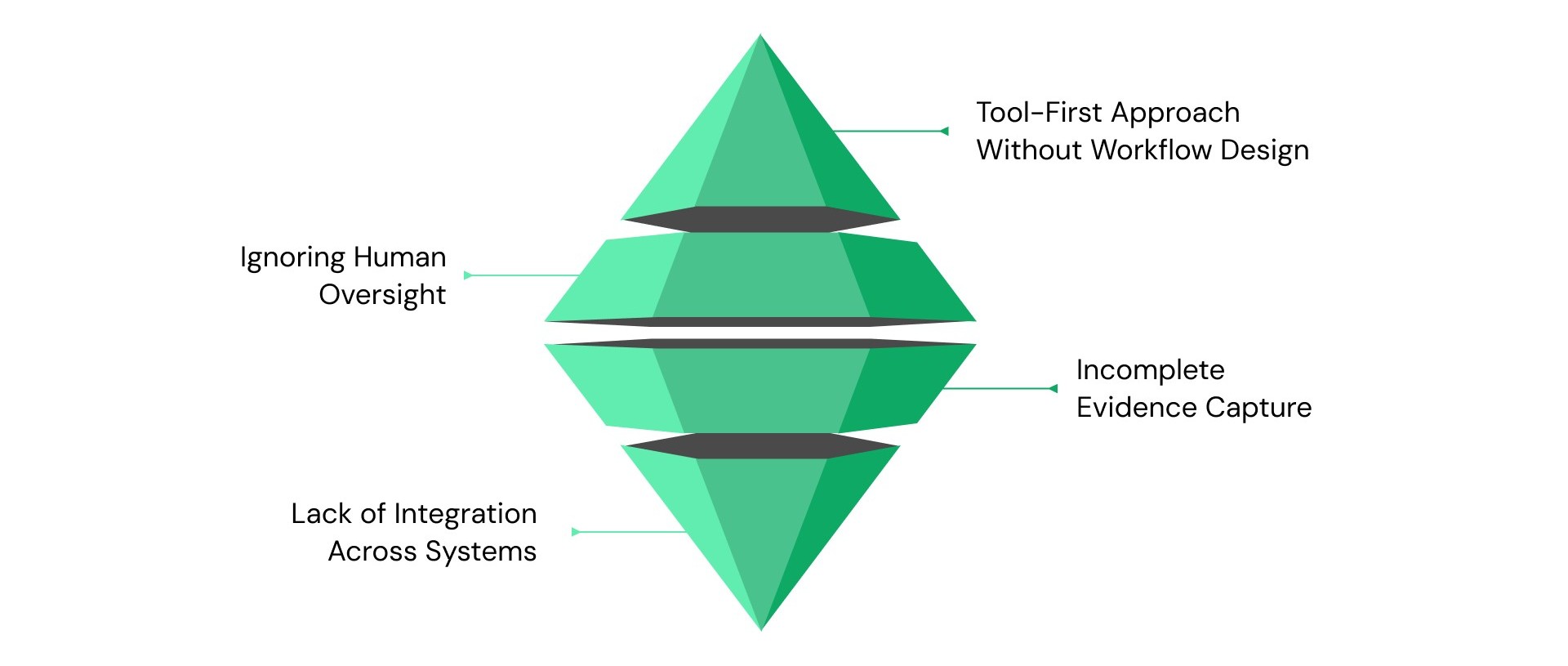
AI adoption often fails to deliver expected outcomes when organizations do not address underlying structural and operational dependencies.
Most failures stem from treating AI as a tool rather than a system capability:
1. Tool-First Approach Without Workflow Design
Deploying AI tools without integrating them into workflows results in fragmented execution and limited impact. Without structured processes, insights generated by AI are not consistently acted upon.
2. Ignoring Human Oversight
Over-reliance on AI without maintaining human oversight creates accountability gaps and increases risk. Human judgment remains essential for interpreting outputs and making decisions in complex regulatory environments.
3. Incomplete Evidence Capture
AI-driven processes must generate traceable evidence as part of execution. Without this, organizations cannot demonstrate compliance or support audit requirements, weakening defensibility.
4. Lack of Integration Across Systems
AI systems that operate in isolation fail to provide end-to-end visibility into compliance processes. Integration across systems is necessary to ensure consistent execution and reliable reporting.
Also read: Operational Risk Management Examples and Strategies
Structuring AI-Driven Compliance for Accountability and Scale with VComply
As organizations integrate AI into compliance workflows, execution often breaks down due to fragmented systems, limited visibility, and inconsistent ownership. These gaps reduce confidence in control performance and create challenges in demonstrating compliance under regulatory scrutiny, particularly when AI-driven processes must be auditable and explainable.
VComply addresses this by structuring AI-driven compliance within integrated workflows across its GRCOps Suite, ensuring that intelligence is applied within systems that enforce execution, maintain accountability, and generate audit-ready evidence:
- ComplianceOps: Embeds compliance workflows with AI-assisted monitoring and validation
- CaseOps: Manages incident detection, escalation, and resolution with structured accountability
- PolicyOps: Aligns policies with execution by connecting requirements to enforceable workflows
- RiskOps: Provides continuous visibility into risk exposure with AI-supported prioritization
Explore how structured systems can help you operationalize AI in regulatory compliance and maintain audit-ready governance at scale.

Conclusion
AI in regulatory compliance ultimately shifts the problem from managing rules to ensuring systems can execute, validate, and adapt controls under continuous regulatory scrutiny. Its effectiveness depends not on isolated use cases, but on how well intelligence is embedded into workflows that govern control performance, risk visibility, and audit readiness.
Without this integration, organizations continue to face delayed detection, inconsistent execution, and limited defensibility despite increased investment in automation and analytics.
As compliance execution becomes more distributed and data-intensive, fragmented tools and unclear ownership create structural gaps that AI alone cannot resolve.
VComply addresses this by embedding AI-enabled capabilities within structured workflows across ComplianceOps, RiskOps, PolicyOps, and CaseOps, ensuring that control execution, evidence capture, and accountability remain connected and visible.
For teams under pressure to demonstrate continuous compliance and maintain audit-ready systems, this shift from tools to integrated execution becomes critical. Start a 21-day free trial of VComply to see how we can help you operationalize AI in regulatory compliance while maintaining governance clarity and defensible oversight at scale.
FAQs
AI in regulatory compliance refers to the use of intelligent systems to support continuous monitoring, validation, and execution of compliance controls, enabling real-time oversight and decision-making rather than periodic, manual processes.
AI is used for regulatory change monitoring, risk assessment, control validation, evidence collection, and anomaly detection, helping organizations maintain visibility and consistency across compliance workflows.
Key risks include lack of explainability, data quality issues, over-reliance on automation, and evolving regulatory expectations, all of which can impact accountability and audit defensibility.
AI does not replace compliance teams but augments their capabilities by improving efficiency, visibility, and decision-making, allowing professionals to focus on higher-value activities.
Organizations should integrate AI into structured workflows, establish governance and oversight, enable continuous monitoring, and use platforms like VComply to ensure consistent execution and audit-ready outputs.