

GRC Framework Diagram: How to Understand, Design, and Operationalize GRC Systems
Audit and supervisory reviews increasingly show that while organizations can document governance, risk, and compliance structures, they struggle to demonstrate how these structures translate into consistent control execution and traceable oversight.

GRC framework diagrams are widely used to communicate architecture, yet they often fail to reflect ownership, workflow dependencies, and real-time monitoring, limiting their value during audits and leadership decision-making.
This disconnect creates gaps in accountability and reduces confidence in whether controls operate as intended across systems.
A GRC framework diagram must do more than illustrate components; it must represent how governance intent is executed, monitored, and validated in practice. When designed correctly, it becomes a decision tool that connects risk visibility, control performance, and audit readiness into a coherent system view.
This article examines how to interpret, design, and operationalize GRC framework diagrams so they support execution, not just structure, enabling more reliable oversight and defensible compliance outcomes.
Quick Look
- Most GRC framework diagrams fail because they represent structure without showing control execution, workflows, or accountability.
- Effective diagrams must connect governance intent to risk prioritization and actual control performance across systems.
- Missing elements like ownership, evidence flow, and monitoring loops create gaps in audit defensibility and decision-making.
- Static diagrams cannot support real-time visibility; operational systems are required for continuous monitoring and validation.
- Leaders should evaluate diagrams based on execution readiness, traceability, ownership clarity, and evidence linkage.
- Building a useful GRC framework diagram requires mapping controls to workflows, defining accountability, and integrating monitoring.
- Common failures stem from treating GRC as documentation rather than a system of execution and oversight.
What Is a GRC Framework Diagram?
A GRC framework diagram is a structural representation of how governance, risk, and compliance functions interact across systems, workflows, and oversight layers. It reflects how controls connect to risk signals, how policies translate into execution, and how monitoring supports audit validation.
Its value lies in illustrating relationships between execution, accountability, and visibility, not just organizing concepts into visual components.

How They Work
- Traditional diagrams present governance, risk, and compliance as isolated blocks without an execution context.
- Operational diagrams map controls to workflows, showing how tasks move across systems and teams.
- Accountability layers define ownership for each control and decision point.
- Monitoring elements illustrate how performance is tracked and validated continuously.
- The shift: from static representation to system-level execution visibility.
What Most Diagrams Miss
- Ownership is rarely defined, leaving ambiguity in who executes or validates controls.
- Evidence flow is not visualized, making audit traceability unclear.
- Workflow dependencies between teams and systems are omitted.
- Monitoring and feedback loops are absent or implied, not explicit.
- Result: Diagrams appear complete but fail to support execution or audit defensibility.
Also read: Review of The Top 3 Internal Audit Management Software Systems in 2025
Why Most GRC Diagrams Fail in Practice
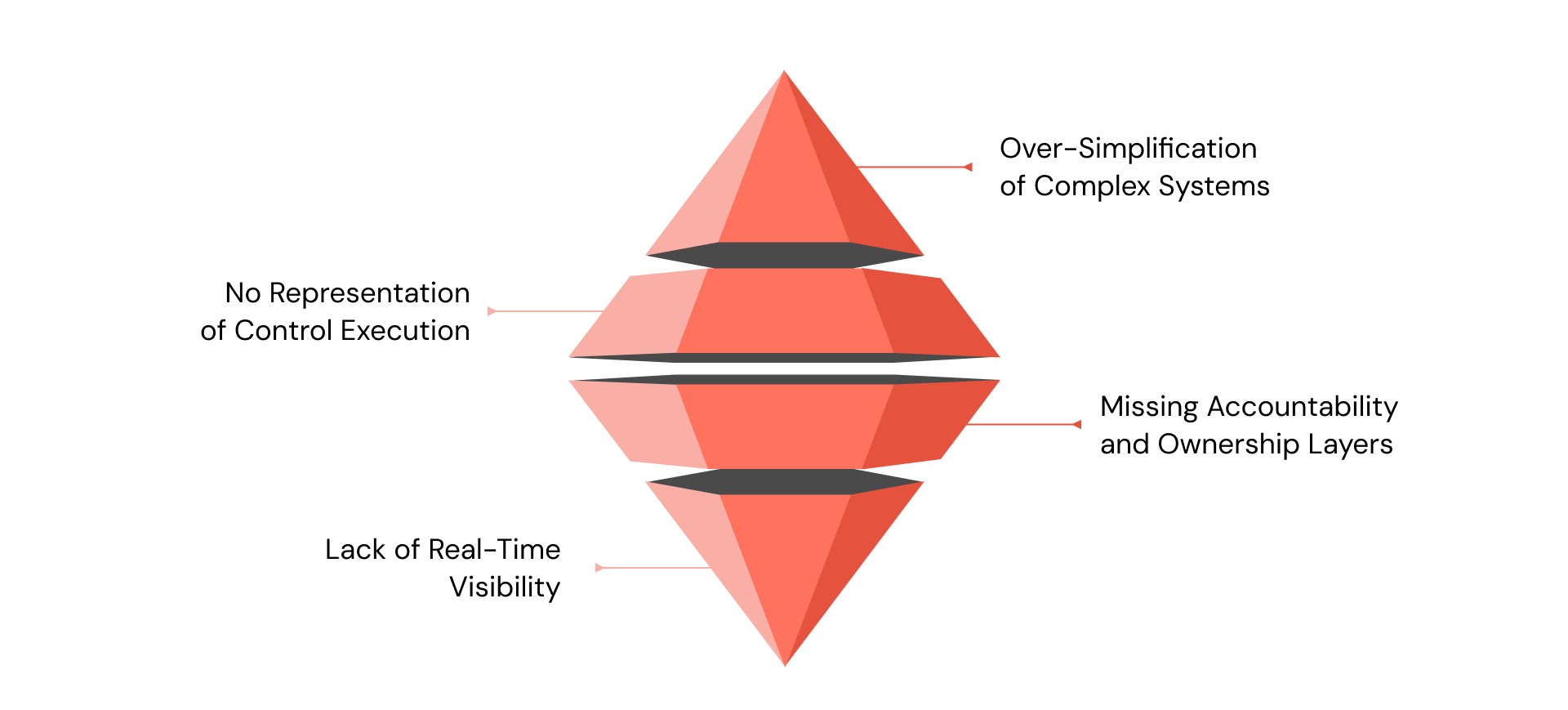
Even well-structured diagrams fail when they cannot reflect how controls operate within real environments. The issue is not conceptual accuracy but the absence of execution logic, which limits their usefulness for decision-making, audit validation, and risk visibility.
Most GRC framework diagrams fail not because they are incorrect, but because they are disconnected from execution:
1. Over-Simplification of Complex Systems
GRC diagrams often reduce complexity to improve readability, but in doing so, they remove critical operational dependencies. Interactions between systems, teams, and workflows are simplified or omitted, making it difficult to understand how controls function in practice.
This abstraction limits their ability to guide execution or support decision-making under real conditions.
2. No Representation of Control Execution
Many diagrams show controls as static elements without illustrating how they are performed. They do not capture approval flows, validation steps, or system interactions required for execution.
As a result, there is no clear path from policy to action, creating gaps between defined controls and actual performance.
3. Missing Accountability and Ownership Layers
Ownership is rarely embedded within diagrams, leaving unclear who is responsible for executing, monitoring, or validating controls. Without defined accountability, execution becomes inconsistent, and issues are not addressed systematically.
This lack of clarity directly impacts governance effectiveness and audit outcomes.
4. Lack of Real-Time Visibility
Most diagrams do not represent monitoring mechanisms or feedback loops. They fail to show how control performance is tracked, how deviations are detected, or how insights flow back into decision-making.
Without visibility layers, diagrams cannot support continuous oversight or reflect the current compliance posture.
Also read: Top 5 Policy Management Software in 2026 (Best Picks Ranked with Features & Pricing)
5 Core Components of a GRC Framework Diagram
A functional GRC framework diagram must illustrate how governance intent translates into measurable, enforceable control execution across systems. Each layer should connect logically, enabling visibility, accountability, and audit-ready outputs.
A functional GRC framework diagram must represent how governance intent translates into measurable control execution:
1. Governance Layer
This layer defines the organization’s regulatory alignment, policies, and oversight mechanisms. It includes board-level governance, internal policies, and regulatory requirements from sources such as NIST and COSO. While it establishes direction and expectations, it does not ensure execution, making its integration with operational layers critical.
2. Risk Layer
The risk layer identifies threats, vulnerabilities, and impact levels, determining which controls are necessary and how they should be prioritized. It connects business objectives with compliance requirements, ensuring that control efforts align with actual risk exposure rather than generic framework mapping.
3. Control Layer
This layer translates policies and risk decisions into actionable workflows. It includes approvals, validations, access reviews, and enforcement mechanisms embedded within systems. Control execution determines whether compliance holds in practice, making this layer central to operational reliability and audit readiness.
4. Monitoring and Reporting Layer
Monitoring ensures continuous visibility into control performance through dashboards, alerts, and reporting outputs. It captures deviations, tracks execution status, and supports audit validation through traceable data. Without this layer, organizations rely on periodic reviews rather than real-time oversight.
5. Technology and Integration Layer
This layer connects systems, tools, and data flows through integrations such as APIs and workflow engines. It ensures that governance, risk, and control activities are not siloed but operate as a unified system. Integration is essential for maintaining consistency, reducing manual effort, and enabling end-to-end visibility.
Defining layers is only effective when these components operate as a connected system rather than isolated elements. Without integration, execution and monitoring remain inconsistent across teams. Book a demo with VComply to understand how aligning these layers within structured systems improves control reliability and audit readiness.
4 Types of GRC Framework Diagrams
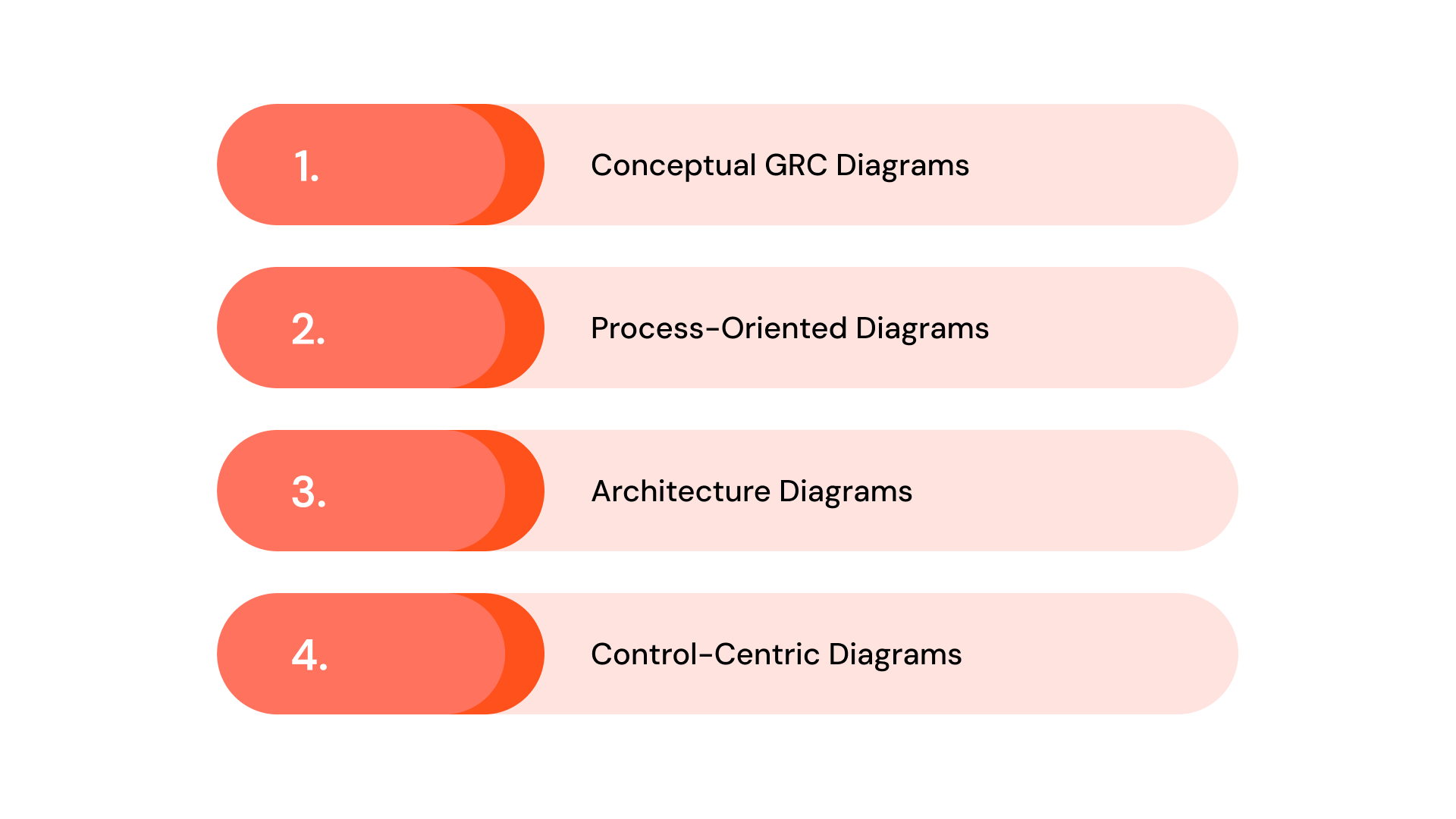
Different diagram types serve different communication and operational purposes, but only some support execution and oversight. Selecting the right type depends on whether the goal is understanding, designing, or validating compliance systems.
Different diagram types serve different purposes, but not all support execution:
1. Conceptual GRC Diagrams
Conceptual diagrams provide a high-level view of governance, risk, and compliance relationships. They are useful for aligning stakeholders and explaining structure, but lack execution detail.
Without workflows, ownership, or monitoring layers, they cannot support operational decision-making or audit validation.
2. Process-Oriented Diagrams
These diagrams map workflows and control flows across systems and teams. They show how tasks are executed, where dependencies exist, and how approvals move through the organization. This structure improves visibility into execution and helps identify breakdowns in control processes.
3. Architecture Diagrams
Architecture diagrams focus on system integrations, data flow, and technology layers supporting GRC processes. They highlight how tools interact, where data originates, and how it moves across systems. This perspective is critical for understanding scalability and ensuring consistent execution across environments.
4. Control-Centric Diagrams
Control-centric diagrams map controls to risks, frameworks, and validation mechanisms. They emphasize control coverage and alignment, but must include execution and evidence layers to be effective. Without these, they risk becoming documentation artifacts rather than operational tools.
Also read: 5 Essential Compliance Management Tools For Teams
Static Diagrams vs Operational Systems
The primary limitation of most GRC frameworks lies in their inability to bridge structure and execution. Diagrams provide visibility into design, but systems determine whether that design functions in practice.
The critical gap in most GRC frameworks is the disconnect between visual structure and operational execution:
1. Diagrams Show Structure, Not Execution
Diagrams organize governance, risk, and compliance elements into understandable formats, but they do not enforce execution. They lack the ability to track actions, validate performance, or generate evidence. This makes them insufficient for managing compliance in dynamic environments.
2. Systems Enable Execution, Monitoring, and Evidence
Operational systems embed controls into workflows, enforce execution steps, and capture evidence automatically. They provide real-time visibility into performance and enable continuous monitoring. Unlike diagrams, systems translate structure into measurable outcomes and defensible compliance.
Why This Distinction Matters for Audit and Risk
| Aspect | Static Diagrams | Operational Systems |
| Execution | Not enforced | Embedded in workflows |
| Monitoring | Not represented | Continuous and real-time |
| Evidence | Not generated | Automatically captured |
| Audit readiness | Limited | High, with traceability |
| Decision support | Conceptual | Data-driven and actionable |
How to Read a GRC Framework Diagram (What Leaders Should Look For)
Leaders must evaluate GRC framework diagrams based on their ability to represent execution and oversight, not just the completeness of structure. The focus should be on whether the diagram can support real-world decision-making and audit validation.
Leaders must evaluate GRC diagrams not for completeness, but for execution readiness:
1. Can You Trace Controls to Workflows?
A reliable diagram should allow leaders to trace each control to a specific workflow or system action. If controls exist without defined execution pathways, they remain theoretical. Traceability ensures that controls are actionable and can be validated in practice.
2. Is Ownership Clearly Defined?
Ownership must be explicitly mapped to controls, workflows, and monitoring activities. Without clear accountability, execution becomes inconsistent, and gaps remain unresolved. Leaders should be able to identify who is responsible for each element within the diagram.
3. Does It Show Monitoring and Feedback Loops?
Effective diagrams include mechanisms for tracking performance and feeding insights back into decision-making. This includes dashboards, alerts, and escalation paths. Without these elements, there is no visibility into whether controls are functioning as intended.
4. Can It Support Audit Evidence?
A diagram should indicate how evidence is generated, stored, and linked to control execution. If evidence flow is not represented, audit readiness becomes dependent on manual reconstruction. Traceability is essential for defensible compliance under regulatory scrutiny.
Also read: 11 Best GRC Tools and Platforms to Use in 2025
How to Build a GRC Framework Diagram for Your Organization
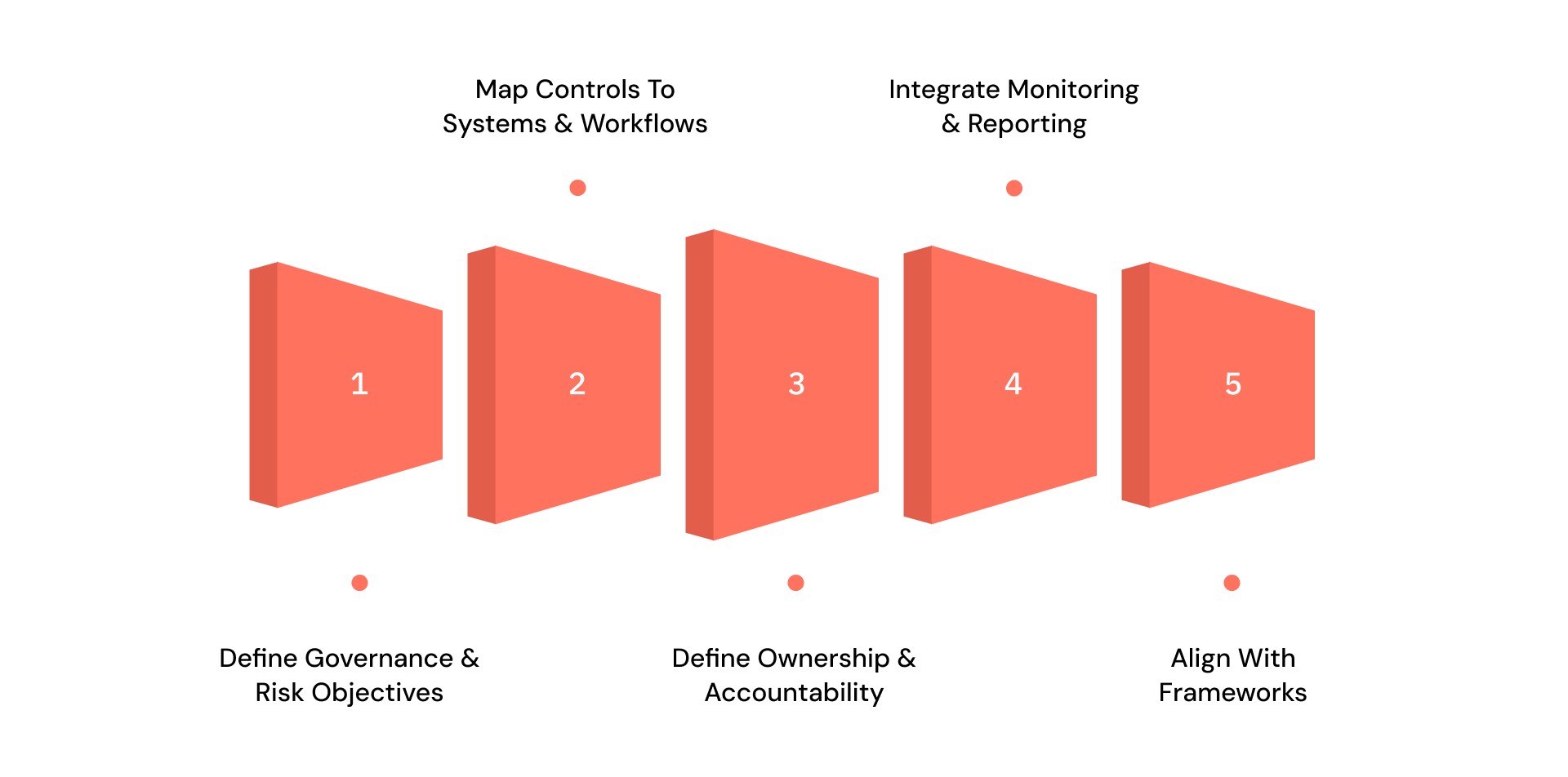
Designing an effective GRC framework diagram requires starting from execution realities rather than theoretical structures. The goal is to create a representation that reflects how controls operate within systems and workflows.
Effective GRC diagrams are designed backward from execution, not forward from theory:
Step 1: Define Governance and Risk Objectives
Start by identifying regulatory obligations, internal policies, and risk priorities. This ensures that the diagram reflects actual compliance requirements rather than generic frameworks. Alignment with sources such as NIST and COSO provides a structured foundation for decision-making.
Step 2: Map Controls to Systems and Workflows
Translate controls into executable actions within systems and workflows. Define how each control is performed, validated, and monitored. This step ensures that the diagram reflects operational reality and supports consistent execution.
Step 3: Define Ownership and Accountability
Assign clear ownership to each control, workflow step, and monitoring activity. This includes defining responsibilities for execution, validation, and escalation. Accountability ensures that controls are consistently applied and issues are addressed.
Step 4: Integrate Monitoring and Reporting
Embed monitoring mechanisms that provide real-time visibility into control performance. Include dashboards, alerts, and reporting outputs within the diagram. This ensures that oversight is continuous and supports audit validation.
Step 5: Align with Frameworks (NIST, COSO)
Map controls and processes to recognized frameworks to ensure regulatory alignment. This provides consistency across compliance efforts and supports audit defensibility. However, alignment must be tied to execution, not treated as a standalone objective.
Designing a GRC framework diagram around execution requires systems that enforce workflows, track ownership, and capture evidence continuously. Without this, diagrams remain disconnected from real operations.
Book a demo with VComply to learn how structured platforms can translate framework design into consistent, auditable execution.
Common Mistakes in GRC Framework Design
GRC frameworks often fail at the point where design must translate into execution. These failures create gaps in visibility, accountability, and audit readiness, even when frameworks appear complete.
Most GRC frameworks fail at the transition from design to execution:
1. Treating GRC as Documentation Instead of Systems
Organizations often treat GRC as a documentation exercise rather than an operational system. Policies and diagrams are created, but controls are not embedded into workflows or systems. This results in a disconnect between defined requirements and actual execution, limiting effectiveness and audit defensibility.
Tip to avoid: Design frameworks around execution workflows, not static documentation.
2. Ignoring Workflow Dependencies
Controls frequently depend on sequential actions across teams and systems, but these dependencies are not reflected in the framework. When workflows are not mapped, delays, missed steps, and inconsistencies occur, weakening control performance and increasing risk exposure.
Tip to avoid: Explicitly map end-to-end workflows and dependencies within the diagram.
3. Over-Reliance on Tools Without Integration
Organizations adopt multiple GRC tools without integrating them into a unified system. This fragmentation creates inconsistent data, limited visibility, and coordination challenges. Tools without integration fail to support end-to-end execution and monitoring.
Tip to avoid: Ensure all tools are connected through integrated workflows and shared data layers.
4. Lack of Continuous Monitoring
Many frameworks rely on periodic reviews rather than continuous monitoring, creating blind spots between reporting cycles. Without real-time visibility, control failures remain undetected until audits or incidents occur, increasing exposure.
Tip to avoid: Incorporate continuous monitoring and feedback loops into the framework design.
Also read: 6 Best OSHA Compliance and Safety Audit Software
Structuring GRC Systems for Execution and Visibility
As organizations scale, GRC frameworks often break down due to fragmented systems, inconsistent execution, and limited visibility into control performance. These gaps reduce confidence in compliance reporting and create challenges in demonstrating accountability during audits or regulatory reviews.
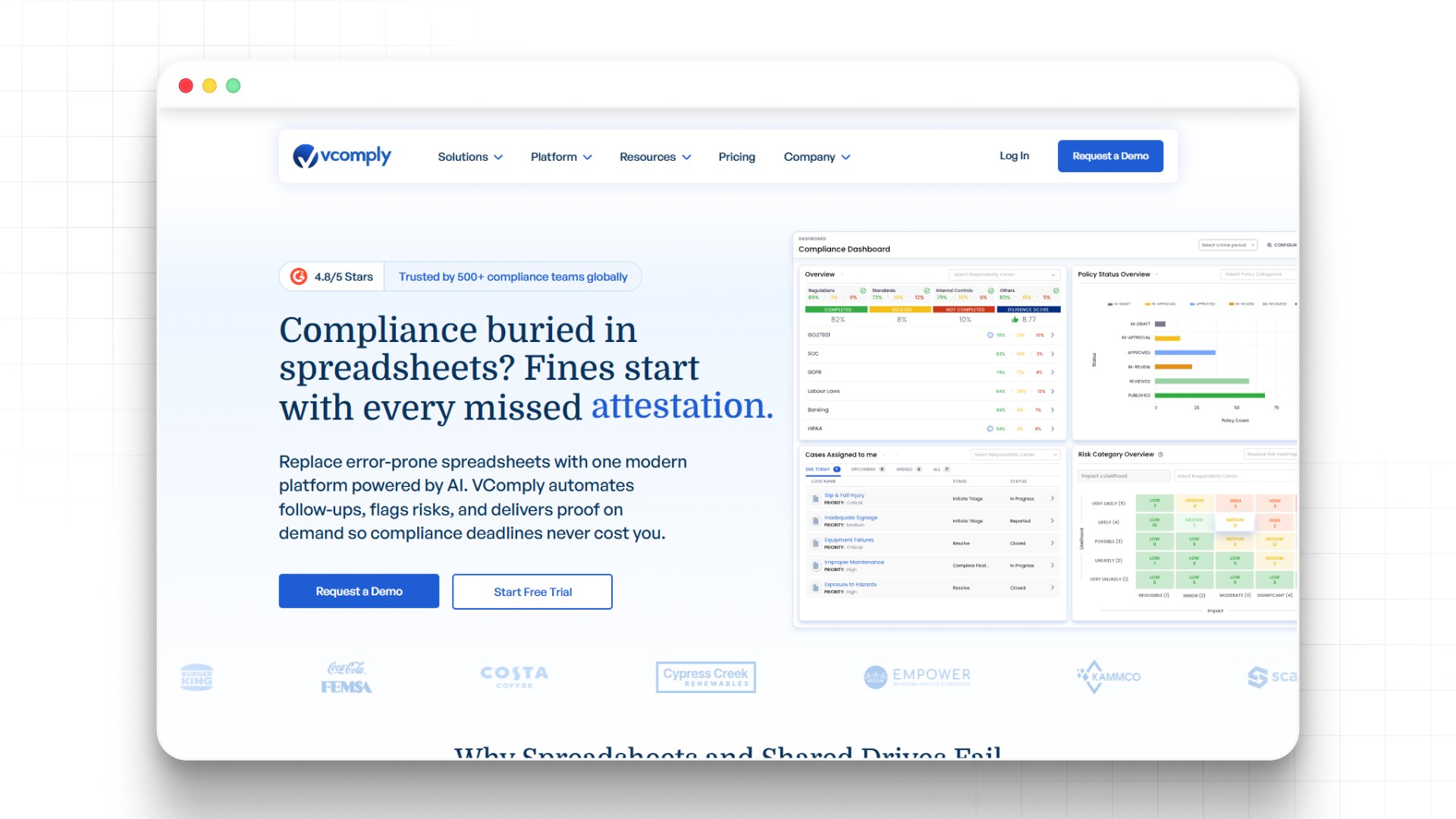
VComply addresses this by structuring GRC execution within integrated workflows across the GRCOps Suite, connecting policies, risks, and controls to actual system-driven actions, ownership checkpoints, and continuous monitoring, so that diagrams are not static representations but operational systems that enforce controls, maintain accountability, and generate traceable, audit-ready evidence.
- Workflow-driven control execution that ensures policies and risks translate into consistent, system-level actions
- Ownership mapping across controls, tasks, and approvals to eliminate accountability gaps
- Real-time monitoring of control performance with visibility into deviations and exceptions
- Integrated evidence capture that links execution directly to audit-ready records
- Cross-functional alignment between policy, risk, compliance, and incident workflows within a unified system
- Traceability across the full lifecycle—from governance intent to execution outcomes and audit validation
Explore how structured systems can help you move from static GRC framework diagrams to operational, audit-ready execution. Book a demo with VComply.
Wrapping Up
A GRC framework diagram only delivers value when it reflects how governance, risk, and compliance function as an integrated execution system, not just a visual structure.
Without visibility into workflows, ownership, and evidence flow, diagrams fail to support audit defensibility, risk clarity, and real-time decision-making under increasing regulatory scrutiny.
VComply addresses this by structuring GRC frameworks into operational systems across ComplianceOps, RiskOps, PolicyOps, and CaseOps, where controls are executed within workflows, ownership is clearly defined, and evidence is continuously captured.
See how structured systems can help you move from static GRC diagrams to consistent, audit-ready execution. Start a 21-day free trial of VComply.
FAQs
A GRC framework diagram represents how governance, risk, and compliance elements interact within an organization, but its value lies in showing how these elements connect to execution.
Effective diagrams illustrate workflows, ownership, monitoring, and evidence generation, enabling organizations to move beyond structure toward operational oversight and audit readiness.
A functional diagram should include governance, risk, control execution, monitoring, and technology layers. More importantly, it must show how these components interact through workflows, define ownership, and enable evidence generation.
Without these elements, diagrams remain conceptual and cannot support real-world compliance or audit requirements.
GRC diagrams provide a structured view of how compliance and risk management operate, supporting decision-making and oversight. When designed correctly, they help identify gaps in execution, improve visibility into control performance, and support audit defensibility by linking structure with measurable outcomes.
Creating an effective diagram requires starting with execution. Organizations must map controls to workflows, define ownership, integrate monitoring, and align with frameworks such as NIST and COSO. This approach ensures that the diagram reflects operational reality and supports consistent, audit-ready compliance.
VComply supports GRC frameworks by embedding governance, risk, and compliance processes into structured workflows across its GRCOps Suite. By connecting controls, ownership, monitoring, and evidence within a unified system, it ensures that frameworks are not just documented but executed consistently and visibly across the organization.