

What Is Compliance? Definition, Types, and Why It Matters for Your Organization
Compliance is the process of meeting your legal, regulatory, and internal policy obligations. Learn the types, who owns it, common failures, and how to build a program that holds up under audit.

Compliance is not a new concept, but it has never been more complex or more consequential than it is today. Regulatory frameworks have multiplied across every industry, enforcement has intensified, and the reputational cost of a public compliance failure can permanently alter how a business is perceived by customers, investors, and regulators alike. For organizations operating across multiple jurisdictions, managing compliance has become one of the most operationally demanding functions in the business. This guide cuts through that complexity, giving you a clear, practical understanding of what compliance is, why it exists, what it covers, and how to build a program that holds up when it matters most.
What is compliance?
Compliance is the ongoing process of operating in accordance with applicable laws, regulations, industry standards, and internal policies. It is how organizations demonstrate that their decisions, processes, and behaviors meet the obligations placed on them by regulators, governing bodies, and their own governance frameworks. Done well, compliance is not a cost center — it is the operational foundation that protects the business, builds trust with stakeholders, and enables sustainable growth.
This guide covers what compliance means in practice, the types every organization needs to understand, who owns it, why it fails, and how to build a program that actually works.
What Does Compliance Mean?
At its core, compliance means following the rules. But that deceptively simple definition obscures significant complexity.
Those rules come from multiple directions at once. A mid-market financial services company, for example, may simultaneously be subject to federal banking regulations, state-level consumer protection laws, SEC reporting requirements, GDPR if it handles EU customer data, SOX controls if it’s publicly traded, and its own internal code of conduct. Each of those creates obligations. Compliance is the work — the policies, controls, workflows, monitoring, training, and evidence — that demonstrates those obligations are being met.
There are two broad categories:
Regulatory compliance refers to adherence to external rules imposed by government agencies and regulatory bodies. These are mandatory. Failure to comply carries legal consequences — fines, sanctions, operating restrictions, or criminal liability.
Corporate compliance (also called internal compliance) refers to adherence to an organization’s own internal policies, codes of conduct, and governance standards. These may be voluntary, but in practice they are essential: they define how employees are expected to behave, how conflicts of interest are managed, and how ethical decisions are made.
Most compliance programs address both. The two are deeply interdependent — internal policies are typically built to embed and operationalize external regulatory requirements.
A Short History of Why Compliance Exists
Compliance as a formal discipline is largely a product of corporate failure.
The Foreign Corrupt Practices Act (FCPA) of 1977 in the US was a direct response to the Lockheed bribery scandal, in which the aerospace company paid foreign officials to secure defense contracts. For the first time, an American law criminalized the bribery of foreign officials — and compliance programs were born as the mechanism for enforcement.
The Enron and WorldCom collapses in 2001–2002 revealed systematic accounting fraud and triggered the Sarbanes-Oxley Act (SOX), which imposed strict financial reporting controls and internal audit requirements on public companies. Every company that has a SOX compliance program today can trace it directly to that failure.
The 2008 financial crisis produced Dodd-Frank, Basel III, and a wave of banking regulations that redefined risk management, capital adequacy, and consumer protection across the financial sector.
Since 2015, the compliance agenda has widened dramatically. GDPR (2018) redefined data privacy as a compliance obligation for any organization handling EU resident data. The #MeToo movement made workplace conduct policies and case management systems a board-level priority. ESG reporting obligations have moved from voluntary frameworks to regulatory mandates in the EU, the UK, and increasingly the US. AI governance is the next frontier, with the EU AI Act and emerging US frameworks placing new obligations on organizations deploying AI systems.
The pattern is consistent: a major failure or crisis exposes a gap, regulators respond, and the scope of compliance expands. That is why compliance programs that were adequate five years ago are often inadequate today.
Key Takeaways
- Compliance is the ongoing process of meeting your legal, regulatory, and internal policy obligations — not an annual audit exercise. Regulations evolve constantly, which means compliance programs that were adequate two years ago are often inadequate today.
- There are two core categories every organization must manage: regulatory compliance (externally imposed, legally mandatory) and corporate compliance (internally defined, ethics and culture-driven). Most failures happen at the intersection of the two — where written policy meets actual employee behavior.
- The cost of non-compliance consistently exceeds the cost of compliance. The average data breach costs $4.88 million. GDPR fines have exceeded €4 billion cumulatively. And regulatory penalties are almost always smaller than the reputational damage that follows.
- Compliance ownership is distributed — the CCO designs the program, but the business functions that generate the risk own the first line of defense. A compliance program that lives only inside the compliance team is not a compliance program. It is a documentation exercise.
- A mature compliance program has five non-negotiable characteristics: it is risk-calibrated, operationally embedded, evidence-complete, continuously monitored, and board-visible. A program missing any one of those five has a gap that will surface under audit or in a failure.
- Compliance technology only delivers value when it is adopted across the organization, not just used by the compliance team. The goal is to make compliance happen inside the workflows where work actually gets done — not in a parallel spreadsheet maintained by one department.
Types of Compliance
Regulatory compliance is the broadest category, adherence to the laws and regulations governing your industry and jurisdiction. This includes financial regulations (SOX, Dodd-Frank, Basel), healthcare regulations (HIPAA, ACA), data privacy laws (GDPR, CCPA), environmental regulations (EPA standards, ISO 14001), workplace safety (OSHA), and anti-bribery and corruption laws (FCPA, UK Bribery Act).
Policy compliance refers to adherence to an organization’s own internal policies — the code of conduct, HR policies, conflict of interest policies, information security policies, and acceptable use policies. This is the layer of compliance that defines organizational culture and ethics.
IT and cybersecurity compliance has grown into one of the highest-scrutiny areas of compliance work. Frameworks like ISO 27001, NIST CSF, SOC 2, and PCI DSS define security controls that organizations must have in place to protect data and systems. For companies handling payment card data, personal health information, or federal government data, cybersecurity compliance is non-negotiable.
HR and employment compliance covers wage and hour laws, anti-discrimination statutes, benefits administration requirements, background check regulations, and accommodation obligations. For US companies operating across multiple states, employment compliance has become increasingly complex as state-level laws diverge.
Environmental, Social, and Governance (ESG) compliance is the fastest-growing area. The EU’s Corporate Sustainability Reporting Directive (CSRD), the SEC’s climate disclosure rules, and the UK’s Streamlined Energy and Carbon Reporting (SECR) requirement are placing formal compliance obligations on companies that were previously operating on a voluntary basis. ESG is moving from discretionary reporting to regulated disclosure.
Financial compliance encompasses everything from tax filings and financial statement accuracy to anti-money laundering (AML) controls, know-your-customer (KYC) procedures, and insider trading policies. Finance and legal are traditionally the compliance-heaviest functions in most organizations.
Why Compliance Matters
The short answer: the cost of non-compliance is substantially higher than the cost of compliance.
According to the Global Survey on Occupational Fraud and Abuse, organizations lose an estimated 5% of annual revenues to fraud annually. The average cost of a data breach in 2024 was $4.88 million, according to IBM’s Cost of a Data Breach report. GDPR fines alone exceeded €4 billion cumulatively between 2018 and 2024. These are direct financial consequences.
But compliance failures are rarely just financial. The reputational damage from a public regulatory action, a data breach, or a workplace misconduct scandal often has a longer tail than the fine itself. Volkswagen’s emissions scandal didn’t cost the company just the €30+ billion in settlements — it permanently altered market perception of its brand. Wells Fargo’s fake accounts scandal cost billions in penalties, but the reputational damage was so severe that regulators imposed an asset cap that restricted the bank’s growth for years.
The affirmative case for compliance is equally strong. Organizations with mature compliance programs demonstrate higher governance quality to institutional investors. They win regulated contracts and enterprise deals that require compliance certifications. They attract and retain talent who want to work for organizations that operate with integrity. And they catch problems internally before those problems become public failures.
Key Components of a Compliance Program
A functional compliance program is not a policy document. It is an operational system with several interdependent components:
Policies and procedures. Documented rules that translate regulatory requirements and ethical standards into operational guidance for employees. Policies must be kept current, version-controlled, and distributed to the people they apply to — which is harder at scale than it sounds.
Risk assessment. The process of identifying and prioritizing the compliance risks the organization faces. A risk-based compliance program allocates resources to the areas of highest exposure, rather than treating all obligations equally.
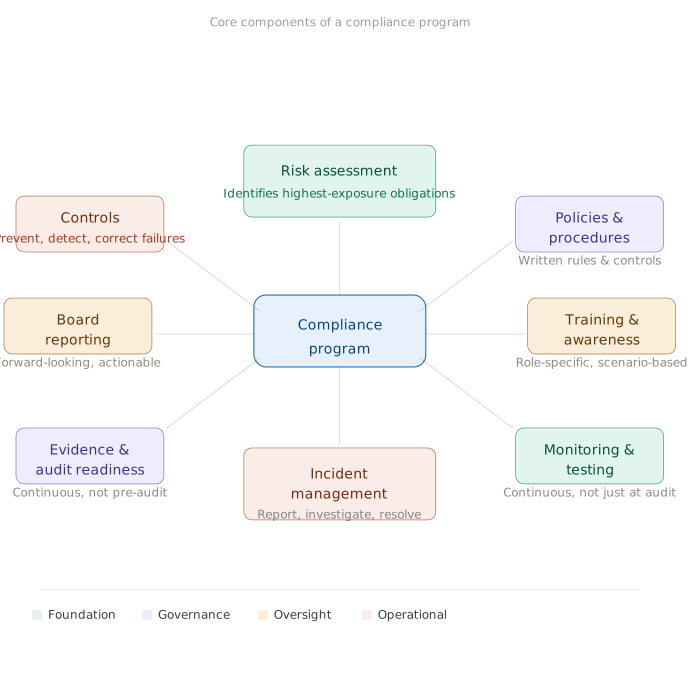
Controls. The specific mechanisms — technical, procedural, or supervisory — that prevent or detect compliance failures. Controls are the operational heart of compliance, and evidence that controls are operating effectively is what auditors look for.
Training and awareness. Employees at every level need to understand the compliance obligations relevant to their role. Effective training is not an annual checkbox exercise — it is role-specific, scenario-based, and reinforced through day-to-day management.
Monitoring and testing. Ongoing evaluation of whether controls are working. This includes automated monitoring, periodic audits, and testing of specific control areas. Monitoring is what closes the gap between policy and practice.
Incident management. A defined process for identifying, reporting, investigating, and resolving compliance issues and violations. This includes a safe and accessible reporting channel — often a whistleblower hotline or case management system — that allows employees to raise concerns without fear of retaliation.
Reporting and oversight. Regular reporting to senior leadership and the board on the state of the compliance program, key risk indicators, open issues, and remediation status. The board cannot govern what it cannot see.
Who Is Responsible for Compliance?
The formal answer is: the Chief Compliance Officer (CCO) or compliance function. But the practical answer is more distributed.
The CCO owns the program — its design, policies, monitoring, and reporting. Legal owns regulatory interpretation. Risk management owns the risk framework that compliance operates within. IT owns cybersecurity controls. HR owns employment policies and training delivery. Finance owns SOX and financial controls. Every business unit that generates regulatory exposure owns the first line of defense for their area.
This is the three lines of defense model that most mature compliance programs operate under. The first line is the business functions that own and manage risk in their operations. The second line is the compliance and risk functions that oversee and support the first line. The third line is internal audit, which independently tests and validates that the first and second lines are functioning correctly.
The board’s role is oversight — ensuring the compliance program is adequately resourced, that senior leadership is setting the right tone from the top, and that material compliance risks are being surfaced and addressed.
Common Compliance Failures and How to Prevent Them
The most common compliance failures are not caused by malicious intent. They are caused by complexity, inconsistency, and lack of visibility.
Policies exist but aren’t followed. Written policies that nobody reads, has been trained on, or can easily find. The fix is accessible, version-controlled policy management with evidence of distribution and acknowledgment.
Controls exist on paper but not in practice. A control that is designed but not actually operating is called a design-only control. Compliance programs that rely on documentation without testing or monitoring routinely fail audits because there’s no evidence the control works. The fix is ongoing monitoring with documented evidence.
Regulatory changes aren’t tracked. Most compliance programs are reasonably good at managing known obligations. They are poor at tracking regulatory change and updating their programs accordingly. The fix is a regulatory change management process that identifies relevant developments, assesses their impact, and translates them into policy and control updates.
Reporting is backward-looking. Compliance reports to the board that describe what happened last quarter are informative but not actionable. The fix is real-time dashboards and early warning indicators — metrics that show where the program is under pressure before a failure occurs.
The program is built for audit, not for operations. A compliance program designed to satisfy auditors rather than actually reduce risk will pass audits and fail in practice. The fix is embedding compliance workflows into the systems and processes where work actually happens, rather than maintaining parallel compliance documentation.
What Good Compliance Looks Like in Practice
A mature compliance program has a few distinguishing characteristics.
It is risk-calibrated — resources and controls are proportionate to the actual risk profile of the organization, not distributed uniformly across every theoretical obligation.
It is operationally embedded — compliance tasks happen inside the systems where work gets done, not in spreadsheets maintained by the compliance team. Policy attestations happen in the policy management system. Control testing happens through automated workflows. Incidents are logged and tracked in a case management system.
It is evidence-complete — every control has documented evidence that it operated. Every policy has documented proof of distribution and acknowledgment. Audit readiness is not a project that happens before an audit — it is a permanent state.
It is continuously monitored — rather than point-in-time annual audits, mature programs run continuous monitoring that surfaces anomalies and deviations in real time, enabling early intervention before issues become violations.
And it is board-visible — senior leadership and the board receive regular, meaningful reporting on compliance status, open issues, and key risk indicators. Compliance is on the agenda, not in the appendix.
Compliance vs. Risk Management: Understanding the Relationship
Compliance and risk management are closely related but distinct disciplines, and confusing the two creates gaps in both programs.
Risk management is the broader discipline. It covers the full universe of threats to the organization — strategic risk, operational risk, financial risk, reputational risk, and compliance risk. Its job is to identify what could go wrong, assess the likelihood and impact, and decide how to respond.
Compliance is a subset of that universe. It focuses specifically on the risk of failing to meet legal, regulatory, and policy obligations. Compliance risk is one category of operational risk, and it is the category where the consequences of failure are most externally visible — regulators, courts, and the public are all watching.
In practice, the two functions share significant infrastructure. They use the same risk registers, the same control frameworks, and the same governance reporting lines. Many organizations house them together under a combined Chief Risk and Compliance Officer. Others keep them separate but require them to operate from a common data model so that risk and compliance assessments do not produce contradictory conclusions about the same business area.
The critical integration point is the risk assessment. A compliance program that is not anchored to a formal risk assessment will over-invest in low-risk areas and under-invest in high-risk ones. Risk management provides the calibration that makes compliance proportionate and defensible. Compliance provides the regulatory intelligence that keeps risk management current with the external environment.
The organizations that do this well treat compliance and risk as two lenses on the same operational reality — not two separate programs competing for resources and board attention.
The Role of Technology in Modern Compliance
Manual compliance management — spreadsheets, shared drives, email chains, and periodic audit binders — was never efficient. At the pace regulatory requirements now change, it is no longer viable.
The compliance technology landscape has matured significantly in the last decade. Modern GRC platforms do several things that manual processes simply cannot: they maintain a live inventory of regulatory obligations and flag changes as they occur; they automate the workflow for policy distribution, acknowledgment, and version control; they track control testing and generate evidence automatically; they surface real-time dashboards on compliance status, overdue tasks, and open issues; and they maintain the audit trail that demonstrates the program was operating throughout the year, not just in the weeks before a review.
The practical impact is substantial. Compliance teams using integrated GRC platforms spend significantly less time on administrative coordination and significantly more time on the judgment-intensive work — assessing new regulatory requirements, investigating incidents, advising the business, and improving the program. The ratio shifts from reactive to strategic.
That said, technology is an accelerant, not a solution. A poorly designed compliance program implemented in software is still a poorly designed program. The sequence matters: define your obligations, build your policies and controls, assign ownership clearly, and then use technology to automate, monitor, and report. Technology applied to a broken process produces faster evidence of the broken process.
For mid-market organizations in particular, the right platform eliminates the resource gap that forces compliance teams to choose between breadth and depth. A team of five can run a compliance program with the visibility and evidence discipline of a team of fifteen, if the platform is doing the coordination work that would otherwise fall on people.
Compliance Across Industries: Where the Stakes Are Highest
Compliance obligations exist in every sector, but the intensity, complexity, and consequences vary significantly by industry. Understanding where the regulatory pressure is heaviest helps organizations calibrate their programs appropriately.
Financial services operates under the most dense regulatory environment of any industry. Banks, investment managers, insurance companies, and fintechs face overlapping obligations from the SEC, FINRA, OCC, CFPB, FinCEN, and state regulators simultaneously. Anti-money laundering (AML), know-your-customer (KYC), capital adequacy, consumer protection, and fiduciary duty requirements create a compliance surface area that demands dedicated infrastructure and continuous monitoring. A single AML violation can produce nine-figure fines.
Healthcare carries compliance stakes that are simultaneously financial and human. HIPAA governs the privacy and security of protected health information with civil and criminal penalties for violations. The False Claims Act creates liability for fraudulent billing to federal healthcare programs. The Anti-Kickback Statute restricts financial relationships between healthcare providers and vendors. For hospitals and health systems, a failed CMS audit can result in exclusion from Medicare and Medicaid — an existential consequence.
Higher education operates under a compliance framework that spans Title IX (campus harassment and discrimination), FERPA (student data privacy), Clery Act (campus crime reporting), accreditation standards, and federal research grant compliance requirements. Universities that receive federal funding face audit and enforcement exposure across all of these simultaneously.
Manufacturing and energy face environmental compliance obligations from the EPA and equivalent state agencies, workplace safety requirements from OSHA, export control restrictions under EAR and ITAR, and increasingly stringent ESG reporting requirements. Supply chain compliance — ensuring that tier-two and tier-three suppliers meet ethical sourcing and environmental standards — has become a material compliance obligation in its own right as regulators and investors scrutinize it more closely.
Technology companies face a compliance environment that is still taking shape but moving fast. GDPR, CCPA, and an expanding patchwork of state-level privacy laws govern data handling. The EU AI Act is creating the first formal compliance framework for AI systems, with risk-based obligations that will require significant program investment from companies deploying AI in high-risk contexts. Cybersecurity frameworks — SOC 2, ISO 27001, NIST CSF — have moved from competitive differentiators to commercial requirements as enterprise customers build compliance certifications into procurement criteria.
The common thread across all of these industries is that the regulatory surface area is expanding, not contracting. Organizations that build scalable, adaptable compliance infrastructure now are better positioned to absorb new obligations as they arrive — rather than rebuilding their programs from scratch each time the regulatory environment shifts.
Start your 21-day free trial and experience how VComply helps you with compliance maturity.
Building Your Compliance Program
Every organization that has a mature compliance program started somewhere. Most started with a spreadsheet, a regulatory deadline, or a near-miss that made leadership pay attention. The starting point matters less than the sequence you follow once you decide to build something that actually works.
Start with a risk assessment. Before writing a single policy or selecting a platform, you need to understand where your highest-exposure obligations are. A risk assessment maps the regulatory landscape your organization operates in, identifies the gaps between what is required and what currently exists, and produces a prioritized view of where the program needs to be built first. Without this step, compliance programs are built on instinct rather than evidence — and they consistently over-invest in visible, low-risk areas while leaving material exposures unaddressed.
Build policies and controls proportionate to that risk. Not every obligation warrants the same depth of control. A risk-calibrated program concentrates its most rigorous controls around the obligations where failure would be most consequential — financially, legally, or reputationally. Policies should be written in plain language that operational employees can actually follow, not dense legal prose designed to satisfy auditors. Controls should be specific, testable, and owned by someone with accountability for their operation.
Put training in the hands of the people who carry the risk. Compliance training that is generic, annual, and forgotten by Thursday is not compliance training — it is a checkbox. Effective training is role-specific, scenario-based, and delivered at the moment of relevance. A procurement manager needs to understand anti-bribery obligations in the context of vendor selection. A customer service representative needs to understand data handling requirements in the context of how they access and share customer records. The compliance function designs the program; the business delivers it as part of how work gets done.
Stand up monitoring before you need it. Most organizations build monitoring capability reactively — after an audit finding, after a near-miss, after a regulator asks why a particular control was not being tested. By then, the gap has existed for months or years. Continuous monitoring, built into the program from the start, surfaces control failures and behavioral deviations in real time, enabling intervention before a problem becomes a violation. It also generates the ongoing evidence record that makes audit readiness a permanent state rather than a pre-audit scramble.
Build your evidence archive as you go. Auditors do not take compliance programs on faith. They ask for evidence — documented proof that policies were distributed, that controls operated, that training was completed, that issues were investigated and resolved. Organizations that maintain their evidence archive continuously, as a byproduct of how they run the program, can respond to an audit request in hours. Organizations that rebuild their evidence retroactively under audit pressure spend weeks reconstructing what should have been captured automatically, and they frequently cannot close the gaps.
Report to the board in a way that makes compliance governable. The board cannot govern what it cannot see, and it cannot act on information that arrives too late. Compliance reporting to senior leadership and the board should be forward-looking as well as retrospective — not just what happened last quarter, but where the program is under pressure, what regulatory changes are on the horizon, and what investment decisions are needed to keep pace. A board that receives meaningful compliance reporting makes better governance decisions. A board that receives compliance information only when something has gone wrong is a board that manages crises rather than preventing them.
Technology accelerates all of this — but sequence comes first. A GRC platform that automates workflows, centralizes documentation, tracks obligations, and delivers real-time dashboards will dramatically compress the time it takes to build program maturity. It will reduce the manual coordination burden that keeps compliance teams permanently reactive. It will give leadership visibility that is simply impossible to produce from spreadsheets. But technology applied before the foundational work is done accelerates a broken process, not a working one. Define your obligations, design your controls, assign clear ownership, and then let the platform do the work of automating, monitoring, and reporting at scale.
Compliance is not a destination. The regulatory environment that your program is built for today will not be the regulatory environment you operate in three years from now. New laws will pass. Existing regulations will be reinterpreted. Your business will enter new markets, launch new products, and take on new risks that did not exist when your policies were written. AI governance obligations, supply chain transparency requirements, and evolving data privacy frameworks are already reshaping compliance programs across every industry, and the pace of change is not slowing down.
The organizations that manage compliance most effectively over time are those that have stopped treating it as a project with a finish line and started treating it as a continuous operational discipline, ne that is embedded in how decisions are made, how work gets done, and how accountability is maintained at every level of the organization. The compliance program is never finished. It is only ever more or less ready for what comes next.
FAQs