

Electric Cooperative Compliance in 2026: Requirements, Challenges, and the Role of Compliance Software
Electric cooperatives occupy a unique place in the U.S. energy system. They are utilities, community institutions, critical infrastructure operators, member-owned businesses, and increasingly, digital grid operators. Their compliance burden reflects that complexity.

Unlike investor-owned utilities, electric cooperatives are often deeply embedded in rural, regional, or underserved communities. Many operate with lean teams, wide service territories, aging infrastructure, and rising expectations from regulators, boards, members, lenders, insurers, and reliability authorities. At the same time, they face many of the same compliance pressures as much larger utilities: cybersecurity, reliability, workplace safety, vegetation management, environmental obligations, financial controls, board governance, incident response, supply chain oversight, and evidence retention.
What Is Electric Cooperative Compliance?
Electric cooperative compliance refers to the systems, processes, policies, controls, and evidence used by electric cooperatives to meet regulatory requirements, manage operational risks, protect grid reliability, document safety practices, maintain cybersecurity controls, and demonstrate accountability to boards, regulators, and members.
The result is a difficult compliance reality: electric cooperatives must prove they are reliable, safe, cyber-aware, financially responsible, operationally disciplined, and audit-ready, often without the large compliance departments found in major utilities.
This article explains the compliance landscape for electric cooperatives, the major challenges they face, the requirements they need to manage, and how compliance software can help cooperative teams move from manual tracking to structured, evidence-backed execution.
Why Electric Cooperative Compliance Is Different
Electric cooperatives are not just another type of utility. They are member-owned organizations built to serve communities, not maximize shareholder returns. In the U.S., electric cooperatives serve millions of people and maintain a large share of the nation’s distribution infrastructure, especially across rural and less densely populated areas. NRECA’s 2025 fact sheet reported hundreds of electric distribution cooperatives and generation and transmission cooperatives serving communities across the country.
That structure creates a distinct compliance environment.
Electric cooperatives must satisfy external regulatory requirements while also maintaining accountability to their members and boards. They may operate distribution systems, generation assets, transmission assets, substations, control systems, billing systems, member data, vegetation programs, safety programs, outage response processes, and vendor relationships. Some cooperatives are subject to NERC reliability standards, while others may have lower direct Bulk Electric System exposure but still face cybersecurity, safety, environmental, financial, and operational obligations.
This matters because compliance for cooperatives is rarely isolated in one department. It often cuts across operations, engineering, IT, cybersecurity, safety, finance, legal, HR, member services, field crews, procurement, and executive leadership.
A missed compliance task may not look dramatic at first. It could be an outdated policy, an incomplete safety training record, a missing inspection log, an expired certificate, a delayed evidence upload, or a vendor review that was never completed. But over time, these small gaps create risk. They weaken audit readiness, increase regulatory exposure, complicate board reporting, and make it harder to demonstrate that the cooperative is operating responsibly.
For electric cooperatives, compliance is not only about avoiding penalties. It is about protecting reliability, safety, public trust, and member confidence.
Key Highlights
The Core Compliance Requirements Electric Cooperatives Must Manage
Electric cooperative compliance is multi-layered. The exact obligations vary based on the cooperative’s size, assets, service territory, registration status, generation or transmission role, state requirements, and internal governance model. Still, most cooperatives must manage several common categories of compliance.
1. Reliability Compliance
For cooperatives that own or operate assets connected to the Bulk Electric System, NERC reliability standards can be a major compliance obligation. NERC states that Section 215 of the Federal Power Act requires the Electric Reliability Organization to develop mandatory and enforceable reliability standards.
These standards can cover areas such as system operations, protection systems, emergency preparedness, transmission planning, facility ratings, vegetation management, personnel training, modeling, and event reporting.
Even for cooperatives with limited direct NERC exposure, reliability obligations still matter. Distribution cooperatives must maintain service continuity, prepare for storms and extreme weather, manage outages, maintain infrastructure, coordinate with generation and transmission partners, and report performance to boards, state regulators, insurers, or funding partners.
Reliability compliance often requires evidence such as:
- Inspection records
- Maintenance logs
- Testing records
- Protection system documentation
- Training records
- Emergency response plans
- Event response documentation
- Asset condition reports
- Corrective action tracking
- Board or committee reporting
The challenge is that much of this evidence is operational. It may sit in field systems, spreadsheets, emails, PDFs, shared drives, contractor reports, or supervisor notes. Compliance teams need a way to connect reliability obligations with real proof of completion.
2. NERC CIP and Cybersecurity Compliance
Cybersecurity is now one of the most important compliance priorities for electric cooperatives. Grid operations rely on digital systems, remote access, operational technology, SCADA environments, vendor connections, cloud applications, identity systems, and connected field devices. That makes cooperatives part of the broader critical infrastructure cybersecurity landscape.
NERC Critical Infrastructure Protection standards apply to entities with Bulk Electric System cyber assets, but the cybersecurity expectations around cooperatives extend beyond formal CIP registration. FERC’s 2026 approval of CIP-003-11, for example, emphasized stronger baseline cybersecurity protections for low impact BES Cyber Systems, including remote user authentication, protection of authentication information in transit, and detection of malicious communications.
For electric cooperatives, cybersecurity compliance can include:
- Access control reviews
- Remote access procedures
- Multifactor authentication documentation
- Incident response plans
- Security awareness training
- Vendor access reviews
- Asset inventories
- Patch and vulnerability tracking
- Backup and recovery documentation
- Cyber event reporting processes
- Evidence of security control operation
The operational challenge is that cybersecurity evidence changes constantly. A policy may say access reviews happen quarterly, but the cooperative must prove they happened. A vendor may be authorized for remote access, but someone must document the approval, scope, expiration, and review. A security awareness program may exist, but completion records must be retained and easy to produce.
In 2026, cyber compliance is no longer only about having written controls. It is about showing that controls are assigned, performed, reviewed, and documented.
3. Workplace Safety and OSHA Compliance
Electric cooperatives operate in high-risk environments. Line crews, field technicians, substation personnel, vegetation crews, contractors, and operations teams face hazards related to electrical work, vehicles, confined spaces, heights, weather, energized equipment, chemicals, tools, and emergency restoration.
Safety compliance typically includes OSHA requirements, internal safety policies, training requirements, incident reporting, corrective action tracking, equipment inspection records, job briefings, and contractor safety oversight.
Common safety compliance areas include:
- Safety training records
- Incident and near-miss reporting
- Corrective and preventive actions
- PPE requirements
- Vehicle and equipment inspections
- Lockout/tagout documentation
- Electrical safety procedures
- Contractor safety records
- Tailboard meetings and job briefings
- OSHA logs and reporting
The compliance difficulty is not knowing that safety matters. Every cooperative knows that. The difficulty is keeping records complete, current, and retrievable across field teams, departments, and locations.
When safety records live in paper binders, scanned PDFs, or disconnected spreadsheets, leaders may not see gaps until an incident, audit, insurance review, or board inquiry forces the issue.
4. Environmental and Permitting Compliance
Electric cooperatives may need to manage environmental requirements tied to generation assets, substations, construction projects, fuel storage, emissions, waste handling, stormwater, wetlands, right-of-way maintenance, and vegetation management.
Environmental compliance may involve federal, state, and local obligations. Depending on operations, cooperatives may need to manage permits, inspections, reporting deadlines, monitoring records, spill response procedures, contractor documentation, and corrective actions.
Typical environmental compliance records include:
- Permit requirements
- Inspection schedules
- Environmental monitoring reports
- Spill prevention and response plans
- Waste disposal documentation
- Vegetation management records
- Emissions or discharge reports
- Contractor certifications
- Corrective action documentation
Environmental compliance is deadline-driven and evidence-heavy. Missing a reporting date or failing to retain inspection evidence can create unnecessary exposure. For smaller teams, the risk is often not deliberate noncompliance. It is fragmented ownership.
5. Vegetation Management and Wildfire Risk Compliance
Vegetation management has become a growing compliance and operational priority for utilities, especially in wildfire-prone regions. Electric cooperatives often operate long distribution lines across rural areas, forests, farms, and difficult terrain. That creates exposure to tree contact, access challenges, storm damage, and wildfire risk.
In 2026, wildfire mitigation planning is becoming more formal in some jurisdictions. For example, Texas regulators introduced wildfire mitigation plan guidance for electric utilities, including cooperatives and municipally owned utilities, requiring utility-specific plans tailored to service territory, equipment, and wildfire risk.
Vegetation and wildfire-related compliance can involve:
- Vegetation inspection schedules
- Right-of-way clearing documentation
- Contractor work records
- Hazard tree tracking
- Risk-based prioritization
- Wildfire mitigation plans
- Board reporting
- Field evidence and photographs
- Corrective action follow-up
- Community communication records
This is a strong example of where compliance becomes operational. The requirement is not just to write a plan. The cooperative must show that inspections occurred, risks were prioritized, work was assigned, evidence was captured, and mitigation activities were completed.
6. Governance, Board, and Member Accountability
Electric cooperatives are governed by boards and accountable to members. This creates compliance expectations around policies, governance documents, board approvals, conflicts of interest, financial controls, meeting records, delegations of authority, procurement rules, ethics, and member communications.
Governance compliance may include:
- Board policy review cycles
- Conflict of interest disclosures
- Code of conduct acknowledgments
- Delegation of authority records
- Procurement approvals
- Audit committee reporting
- Member complaint tracking
- Policy version control
- Board packet documentation
- Regulatory filing oversight
Governance risk often comes from outdated policies and unclear approval histories. If a board policy was revised, who approved it? When did it take effect? Who acknowledged it? Which version was active during a decision? Where is the evidence?
A cooperative’s governance program needs policy discipline, version control, approval tracking, and reliable records.
7. Financial, Grant, and Funding Compliance
Many electric cooperatives rely on loans, grants, federal programs, infrastructure funding, disaster recovery funds, or rural development financing. These arrangements can create reporting obligations, procurement requirements, documentation standards, audit conditions, and record retention expectations.
Financial and funding compliance may include:
- Grant reporting deadlines
- Procurement documentation
- Vendor records
- Cost allocation support
- Internal control evidence
- Audit documentation
- Board approvals
- Capital project tracking
- Contract compliance
- Insurance and risk records
The key challenge is that financial compliance often crosses finance, operations, procurement, engineering, and executive leadership. Without a central system, teams may struggle to prove that required steps were completed.
The Biggest Compliance Challenges Facing Electric Cooperatives
Electric cooperatives face the same pressure as larger utilities, but often with fewer resources. The compliance burden is growing, yet many cooperatives still rely on spreadsheets, email reminders, shared drives, and manual follow-ups.
Challenge 1: Compliance Ownership Is Distributed
Compliance is not owned by one person. Safety owns some records. Operations owns field inspections. IT owns cybersecurity evidence. Finance owns audit documentation. HR owns training records. Engineering owns asset documentation. Legal or leadership may own policies and governance records.
This distributed model is normal, but it creates a problem: if ownership is not formally assigned and tracked, tasks fall through the cracks.
A compliance manager may know that a requirement exists, but not whether the responsible team completed it. A department head may complete work, but not upload evidence. A field team may perform an inspection, but the proof may remain in a local file. When audit time comes, the organization spends weeks reconstructing what happened.
Challenge 2: Evidence Is Scattered
Electric cooperative compliance is evidence-heavy. But evidence often sits in many places:
- Email attachments
- Network drives
- Paper forms
- Field inspection apps
- Contractor reports
- HR systems
- Cybersecurity tools
- Ticketing systems
- Accounting systems
- PDFs and spreadsheets
- Board packets
- Individual desktops
Scattered evidence creates audit risk. If a cooperative cannot find proof quickly, completed work may appear incomplete. This is especially frustrating because many compliance failures are not failures of execution. They are failures of documentation.
Challenge 3: Manual Reminders Do Not Scale
Many compliance programs depend on one or two people remembering deadlines, sending reminders, chasing evidence, and updating spreadsheets. This works for a small number of tasks. It breaks down when the cooperative must manage dozens or hundreds of recurring obligations.
Manual tracking creates several risks:
- Missed deadlines
- Inconsistent follow-up
- No escalation path
- No reliable audit trail
- Overdependence on individual memory
- Difficulty onboarding new staff
- Poor visibility for leadership
A mature compliance program cannot depend on heroic follow-up. It needs structured workflows.
Challenge 4: Cybersecurity Expectations Are Rising
Cooperatives are increasingly expected to demonstrate cyber discipline, even if they are not large utilities. Remote access, vendors, operational technology, member data, and grid systems all create risk.
The challenge is that cybersecurity controls require ongoing evidence. It is not enough to write a policy. Cooperatives must show access was reviewed, training was completed, incidents were documented, vendors were assessed, vulnerabilities were addressed, and exceptions were approved.
Cyber compliance is continuous, not annual.
Challenge 5: Boards Need Better Visibility
Cooperative boards need enough information to govern effectively, but they do not need raw spreadsheets or technical details. They need reliable summaries:
- What is overdue?
- What risks are increasing?
- Which obligations are recurring?
- Are audits on track?
- Are corrective actions being closed?
- Are policies current?
- Are safety and cyber programs documented?
When compliance data is scattered, board reporting becomes manual and retrospective. Leaders may only learn about gaps after the fact.
Challenge 6: Regulations and Standards Keep Moving
Reliability, cybersecurity, safety, environmental, wildfire, and funding requirements continue to evolve. NERC and FERC actions, including updates to reliability and CIP standards, show that the electric sector’s compliance expectations are not static.
For cooperatives, the issue is not just monitoring change. It is operationalizing change. When a requirement changes, teams must update policies, assign tasks, communicate expectations, collect evidence, and prove implementation.

What an Effective Electric Cooperative Compliance Program Needs
A strong compliance program for an electric cooperative should be practical, not theoretical. It should help the cooperative prove that compliance work is assigned, completed, reviewed, and documented.
1. A Central Compliance Inventory
The cooperative should maintain a single inventory of compliance obligations, including regulatory requirements, internal policies, board requirements, permit conditions, safety tasks, cyber controls, audit findings, reporting deadlines, and recurring operational obligations.
Each item should have:
- Owner
- Due date
- Frequency
- Evidence requirement
- Status
- Related policy or control
- Escalation path
- Review history
2. Clear Ownership
Every compliance obligation should have a named owner. Department-level ownership is not enough. Someone must be accountable for ensuring the task is completed and evidence is attached.
Ownership should be visible to compliance leaders, department heads, and executives.
3. Evidence Requirements
Each obligation should clearly define what proof is required. For example:
- Completed inspection form
- Training completion report
- Signed policy acknowledgment
- Board approval record
- Vendor review document
- Screenshot of system setting
- Incident closure report
- Maintenance log
- Permit submission confirmation
Evidence should be connected directly to the obligation, task, policy, control, audit, or corrective action it supports.
4. Recurring Workflow Automation
Many cooperative compliance tasks repeat monthly, quarterly, annually, or on multi-year cycles. These should not be recreated manually every time.
Recurring workflows should automatically generate tasks, notify owners, remind responsible teams, escalate overdue work, and maintain history.
5. Policy and Procedure Control
Policies and procedures should not live in static folders without version control. Electric cooperatives need a controlled process for drafting, reviewing, approving, publishing, acknowledging, and retiring policies.
This is especially important for:
- Safety policies
- Cybersecurity policies
- Emergency response procedures
- Board governance policies
- Procurement policies
- Incident response procedures
- Vegetation management procedures
- Member data and privacy policies
6. Corrective Action Tracking
Audit findings, incidents, safety observations, cyber gaps, inspection deficiencies, and control failures should lead to documented corrective actions.
Each corrective action should have:
- Owner
- Due date
- Root cause
- Remediation steps
- Evidence
- Approval status
- Closure history
Without corrective action tracking, cooperatives may identify issues but fail to prove resolution.
7. Board and Executive Reporting
Compliance reporting should be built from live data, not reconstructed before each meeting. Boards and executives need dashboards that show risk, overdue obligations, audit readiness, policy status, incident trends, and corrective action progress.
Good reporting helps leaders govern. It also helps compliance teams secure resources before gaps become failures.
The Role of Compliance Software for Electric Cooperatives
Compliance software helps electric cooperatives move from manual coordination to structured execution. It does not replace judgment, expertise, or field work. It gives teams a system to manage the work, document the proof, and report status with confidence.
For electric cooperatives, compliance software should support five core outcomes.
1. Turn Requirements Into Assigned Work
A requirement is only useful if someone owns it. Compliance software allows cooperatives to create tasks from obligations, assign them to owners, set deadlines, attach evidence requirements, and track completion.
This is especially valuable for recurring tasks such as:
- Safety training
- Access reviews
- Policy reviews
- Permit reporting
- Inspection schedules
- Board approvals
- Vendor assessments
- Audit evidence collection
- Corrective action follow-up
2. Centralize Evidence
A compliance platform should act as a central evidence repository. Instead of searching through emails and folders, teams can attach evidence directly to the relevant obligation, control, audit, policy, or task.
This reduces audit preparation time and helps prevent evidence from being lost when staff change roles.
3. Automate Reminders and Escalations
Compliance software can send reminders before deadlines, notify owners when tasks are assigned, escalate overdue work, and create recurring workflows automatically.
This helps lean cooperative teams reduce manual follow-up and avoid dependence on one person’s memory.
4. Improve Audit Readiness
Audit readiness means being able to show what was required, who owned it, what was done, when it was done, what evidence exists, and who reviewed it.
Compliance software creates that trail. It helps cooperatives respond faster to internal audits, external audits, board requests, insurer reviews, regulatory inquiries, and funding documentation requests.
5. Connect Compliance Across Departments
Electric cooperative compliance crosses many functions. A good platform should allow operations, safety, IT, finance, HR, legal, and leadership to participate without losing structure.
That means role-based access, dashboards, notifications, evidence workflows, policy acknowledgments, and department-level reporting.
What Electric Cooperatives Should Look for in Compliance Software
Not every compliance tool is built for cooperative utility needs. Some platforms are too security-only. Others are too enterprise-heavy. Some are designed for checklist tracking but lack audit evidence structure.
Electric cooperatives should evaluate compliance software based on practical criteria.
| Capability | Why it matters for electric cooperatives |
|---|---|
| Obligation tracking | Helps manage NERC, safety, environmental, governance, cyber, and internal requirements |
| Recurring tasks | Supports monthly, quarterly, annual, and multi-year compliance cycles |
| Evidence management | Keeps proof linked to the right task, control, policy, or audit |
| Policy management | Supports version control, approvals, distribution, and acknowledgments |
| Audit readiness | Reduces last-minute evidence collection and manual reporting |
| Corrective actions | Tracks findings, incidents, deficiencies, and remediation work |
| Role-based access | Allows departments to participate while protecting sensitive records |
| Dashboards | Gives leadership visibility into overdue work, risk, and audit status |
| Framework mapping | Helps connect controls to standards, policies, and evidence |
| Workflow flexibility | Adapts to cooperative-specific processes without heavy customization |
| Board reporting | Supports clear governance oversight and accountability |
| Ease of adoption | Matters for lean teams with limited administrative bandwidth |
The best software is not simply the most complex platform. It is the one cooperative teams will actually use.

How VComply Supports Electric Cooperative Compliance
VComply is well suited for electric cooperatives because it focuses on compliance execution: turning obligations into assigned work, collecting evidence, automating reminders, managing policies, tracking corrective actions, and giving leaders real-time visibility.
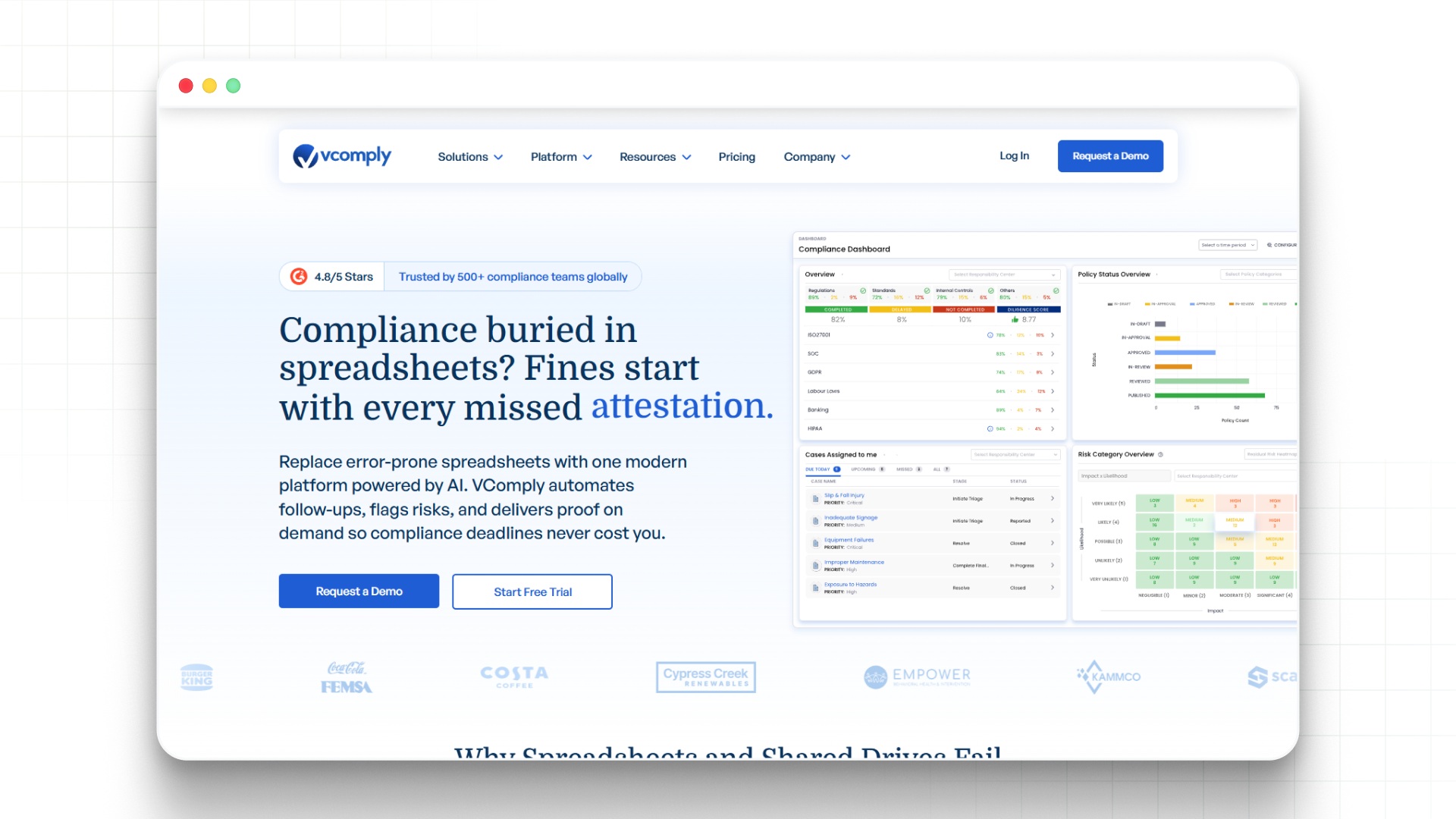
For electric cooperatives, VComply can support:
- NERC-related compliance task tracking
- Policy and procedure management
- Safety compliance workflows
- Evidence collection and audit readiness
- Cybersecurity control documentation
- Vendor and third-party compliance tasks
- Board policy reviews and approvals
- Incident and issue tracking
- Corrective action management
- Environmental and permit obligation tracking
- Recurring compliance calendars
- Department-level dashboards
- Executive and board reporting
The value is not just centralization. The value is accountability. VComply helps cooperatives know what needs to be done, who owns it, whether it is complete, what evidence supports it, and where gaps remain.
That is especially important for cooperatives operating with lean teams. Compliance staff should not spend most of their time chasing updates and rebuilding reports. They should be able to monitor the program, guide owners, escalate risks, and demonstrate readiness.
Explore our customer testimonial on electric cooperatives’ compliance execution
Start your 21-day free trial and experience how VComply helps you with compliance maturity.
A Practical Compliance Maturity Model for Electric Cooperatives
Electric cooperatives can assess their compliance maturity in four stages.
Stage 1: Manual Tracking
At this stage, compliance is tracked through spreadsheets, emails, shared drives, calendars, and individual knowledge. The cooperative may complete many tasks, but evidence is difficult to find and reporting is manual.
Common signs:
- No central inventory of obligations
- Evidence stored in multiple locations
- Manual reminders
- Limited visibility into overdue work
- Audit preparation takes weeks
- Policies lack clear version control
Stage 2: Centralized Documentation
The cooperative centralizes policies, procedures, and some evidence. This improves access but may not solve ownership, reminders, or workflow tracking.
Common signs:
- Shared repository exists
- Policy documents are easier to find
- Some evidence is centralized
- Task ownership remains manual
- Reporting still requires spreadsheet updates
Stage 3: Workflow-Based Compliance
Compliance obligations are assigned, tracked, and automated. Recurring tasks are generated automatically, owners receive reminders, evidence is attached, and dashboards show progress.
Common signs:
- Clear task ownership
- Automated reminders
- Evidence linked to obligations
- Audit history available
- Corrective actions tracked
- Leadership visibility improves
Stage 4: Continuous Audit Readiness
Compliance becomes part of daily operations. The cooperative has live evidence, current policies, recurring workflows, risk-based reporting, and board-ready visibility.
Common signs:
- Audits require less manual preparation
- Leaders can see program status in real time
- Evidence is current and traceable
- Policy reviews and acknowledgments are documented
- Findings and corrective actions are closed systematically
- Compliance supports reliability and operational discipline
Most cooperatives do not need to jump from Stage 1 to Stage 4 overnight. The first step is to move the highest-risk compliance areas into a structured system.
Where Electric Cooperatives Should Start
For many cooperatives, the best starting point is not a massive enterprise transformation. It is a focused compliance execution project.
Start with five practical steps.
1. Build a Compliance Obligation Inventory
List the cooperative’s major recurring obligations across reliability, safety, cybersecurity, environmental, governance, finance, and internal policies.
2. Identify Owners
Assign each obligation to a named owner. Avoid generic department ownership where possible.
3. Define Evidence
For each obligation, define what proof must be retained.
4. Automate Recurring Work
Move recurring tasks into a workflow system so reminders, due dates, escalations, and history are managed automatically.
5. Report to Leadership
Create simple dashboards for overdue work, upcoming deadlines, policy status, audit findings, corrective actions, and high-risk areas.
This approach creates immediate value without overwhelming the organization.
The Future of Electric Cooperative Compliance
Electric cooperative compliance will continue to become more connected, evidence-driven, and technology-enabled. Several trends are shaping the future:
- More cybersecurity scrutiny
- Greater expectations around remote access and vendor controls
- Rising wildfire and resilience planning expectations
- Increased board attention to operational risk
- More evidence-heavy audits and reviews
- Continued pressure on lean teams
- More overlapping obligations across safety, cyber, reliability, and governance
- Greater need for real-time reporting
The cooperatives that succeed will not be the ones with the most documents. They will be the ones that can prove compliance work is being performed consistently.
That means compliance programs must become more operational. Policies must connect to tasks. Tasks must connect to owners. Owners must attach evidence. Evidence must support audits. Findings must drive corrective actions. Leadership must see status before issues become failures.
FAQs