

Top GRC Challenges 2026 With Trending Solutions
Compliance demands are stacking up faster than most teams can handle. You’re expected to report, respond, and stay audit-ready all year. Most companies still run GRC on spreadsheets or outdated software. That leads to missed tasks, poor visibility, and late reports.

Regulators are tightening timelines. In 2025, SEC mandates and cross-border data laws will be tougher than ever before. CISOs, CFOs, and compliance leads all want answers. But scattered tools make coordination harder. And AI use adds new types of risks you must track.
Add to that staffing cuts and expanding responsibilities, and the system cracks. You aren’t alone. In this blog, we’ll break down the GRC challenges 2026 has brought to different industries. And we’ll share solutions that can help you fix what’s broken.
Key Highlights
- GRC challenges in 2026 are intensified by limited resources, tighter regulations, and increased cybersecurity risks.
- Automating compliance tasks and centralizing risk data can help teams overcome resource shortages and improve task tracking.
- Regulatory complexity demands real-time reporting, evidence collection, and alignment across multiple frameworks.
- Technological gaps hinder proactive GRC management, urging businesses to invest in modern, cloud-based platforms.
- To tackle these GRC challenges effectively, organizations must prioritize tools that offer real-time risk insights and predictive analytics.
What is GRC?
GRC stands for governance, risk, and compliance. Together, these three functions help you operate responsibly, manage threats, and stay audit-ready.
- Governance sets the structure. It defines who decides what, how policies are set, and how processes stay accountable.
- Risk management identifies and addresses anything that could disrupt your goals, whether it’s financial, reputational, or cybersecurity-related.
- Compliance means staying aligned with laws, standards, and industry-specific mandates like HIPAA, SOX, PCI DSS, or ESG reporting frameworks.
Go through our Free Downloadable HIPAA Compliance Checklist.
These pillars often live in separate teams. However, when teams lack communication, you get duplicated controls, blind spots, and missed deadlines.
That’s where compliance tools come in. They bring consistency, visibility, and automation across departments and business units.
When every part of GRC connects, your team can move faster with fewer surprises. However, most companies struggle to build that kind of integration. The reason? Core challenges that block efficiency, transparency, and control, starting with limited resources.
Let’s break down what’s holding teams back in 2025.
Get your free downloadable e-book on How to Set Up a Holistic GRC Program from Scratch?

Why GRC is Business-Critical in 2025?
GRC is becoming the control layer that shapes how your business competes. It determines how fast you can onboard vendors, adopt AI, or expand into regulated markets. In 2025, business performance will be directly tied to how strong and integrated your governance, risk, and compliance programs are.
Fragmented GRC leads to higher audit costs, slower decisions, and reactive compliance. GRC challenges 2025 are forcing financial institutions to rebuild this foundation. DORA (Digital Operational Resilience Act) demands 24-hour incident response and full traceability. Cross-border compliance with SEC and local regulators now requires shared taxonomies, centralized controls, and evidence-ready reporting.
Use Free Downloadable VComply’s Risk Register Template to map risks by impact, owner, and control gaps, essential for DORA and cross-border audits.
As businesses face increasing pressure to stay compliant and manage risks effectively, many find their GRC efforts hindered by common roadblocks. These hurdles can slow progress and increase vulnerability. Understanding these challenges is key to building stronger, more resilient programs.
Also Read: Understanding GRC Software Pricing in 2025
Top 7 GRC Challenges 2026 And How to Solve Those?
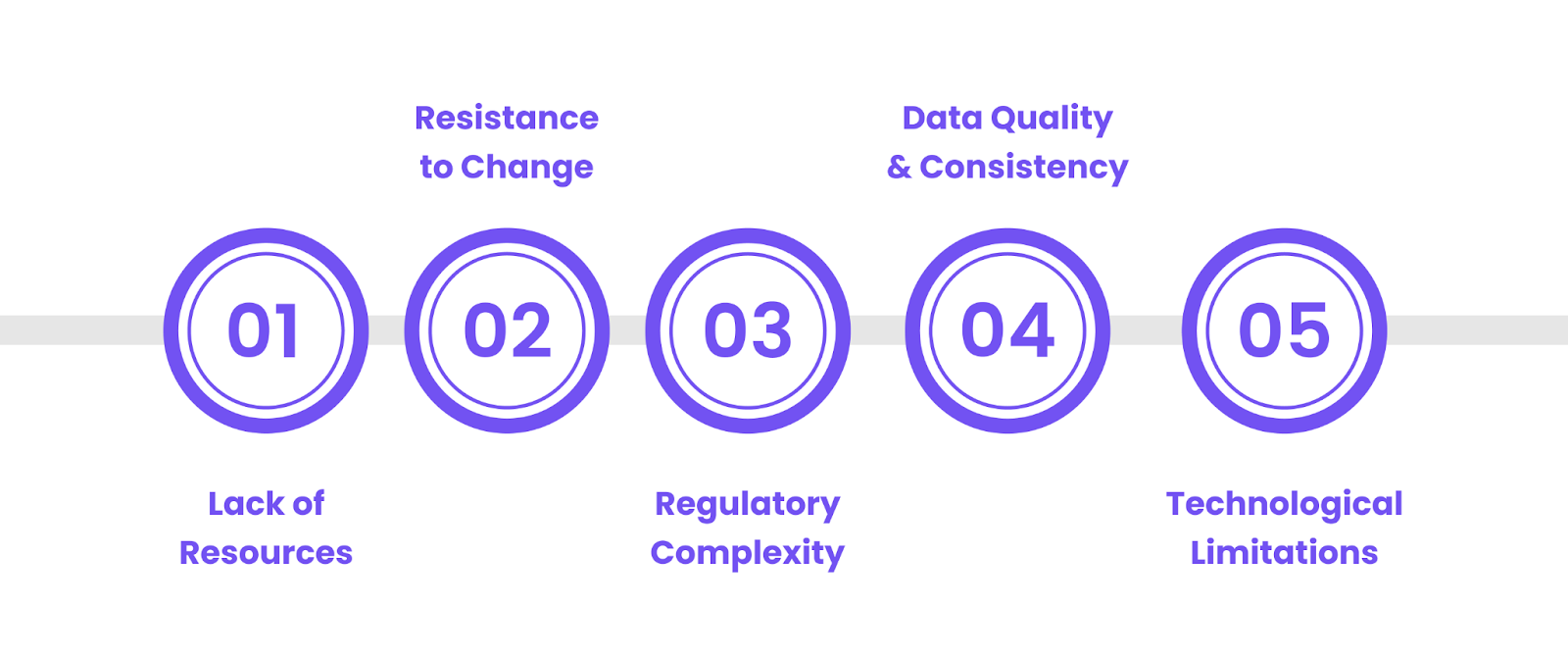
Despite growing investments in GRC, organizations continue to struggle with critical issues. Let’s explore the top five challenges you need to address in 2026 to keep your GRC strategy effective and future-proof:
1. Lack of Resources
Many organizations face a critical shortage of staff and budget dedicated to governance, risk, and compliance efforts. Non-profits, in particular, struggle to balance donor accountability with limited GRC personnel. This resource gap often causes delays in compliance activities and increases the risk of oversight.
Solution
Addressing this challenge requires prioritizing efficiency and smarter allocation rather than simply adding headcount.
Compliance Task Management
- Automate routine compliance tasks to reduce manual workload
- Assign clear ownership and deadlines for critical activities
- Track progress transparently to avoid missed deadlines
Risk Assessment Visibility
- Centralize risk data to provide a unified view across teams
- Use dashboards to highlight gaps and prioritize high-risk areas
- Improve communication between compliance, audit, and risk functions
Resource Optimization in Non-Profits
- Simplify monitoring of donor-related compliance responsibilities
- Free up your team to focus on strategic risk management
2. Resistance to Change
Adopting new GRC systems often meets pushback, especially in institutions with legacy processes and deeply embedded habits. In higher education, teams still rely on email threads and paper trails for policy approvals. This slows down compliance, increases risk exposure, and weakens institutional accountability.
GRC challenges 2026 highlight how outdated workflows can create friction, not just inefficiency. Without executive buy-in and training, change stalls, no matter how advanced your governance risk and compliance tools may be.
Solution
Policy Workflow Modernization
- Replace manual reviews with automated approval flows
- Track document versions and audit trails in real time
- Grant role-based access to eliminate bottlenecks across departments
Go through our Free Downloadable Different Policy Templates for a smoother workflow.
Driving User Adoption
- Start with low-friction workflows like policy reviews or risk reporting
- Provide easy-to-follow onboarding for both admins and contributors
3. Regulatory Complexity
Regulatory shifts in 2025 are no longer isolated. Global standards are converging, and cross-border operations must comply with overlapping rules. For financial services, DORA and ESG disclosures aren’t just checkboxes; they demand real-time reporting and system-level accountability.
Solution
Managing Overlapping Regulations
- Map internal controls to multiple regulatory frameworks (e.g., GDPR, SOX)
- Standardize documentation and evidence collection to avoid duplicate efforts.
- Use GRC tools that support regulatory content updates in real time
Cross-Border Risk Oversight
- Monitor risk exposure by geography, regulation, and business line
- Tag compliance tasks based on jurisdiction-specific requirements
- Localize training and controls while keeping global alignment
4. Data Quality and Consistency
In 2026, GRC success depends on decisions made from clean, consistent data. However, fragmented systems and manual entry continue to undercut trust in reporting. In manufacturing, for example, compliance data often lives in silos across production, QA, and supply chain systems.
This fragmentation adds friction to audits, inflates response times, and exposes businesses to hidden risks, further intensifying GRC challenges in 2026.
Solution
Operationalizing Risk Intelligence
- Feed high-quality data into risk heatmaps and control dashboards
- Align data sources with risk ownership to drive accountability
- Schedule automated exports for board reporting and executive reviews
Need a central solution? Use CaseOps to help businesses manage incident and risk response activities across functions with clarity and control.
5. Technological Limitations
Outdated systems can’t support the demands of today’s compliance and risk frameworks. Many energy and utility firms still rely on legacy software that lacks real-time dashboards, automated alerts, or third-party risk integrations.
This gap holds back proactive GRC management, leaving teams in reactive mode, one of the most pressing GRC challenges in 2026.
Solution
Breaking Free from Legacy Constraints
- Replace static spreadsheets with configurable GRC platforms
- Automate workflows for policy approvals, control testing, and evidence collection
- Use cloud-based tools that scale with operational expansion and regulatory shifts
Enabling Strategic Decision-Making
- Integrate risk data with operational KPIs to link compliance with business value.
- Enable real-time risk scoring to prioritize actions before issues escalate
- Adopt APIs for seamless sync with ERP, HR, and third-party tools
6. Cybersecurity Risks
Many organizations face growing threats around data privacy and cybersecurity, driven by increasing regulations like GDPR and evolving cyberattacks. GRC programs often struggle to keep pace with these risks, especially when security and compliance teams work in silos. This gap can expose businesses to costly breaches and regulatory penalties.
Solution
Strengthen Privacy and Security Posture
- Foster closer collaboration between cybersecurity and compliance teams to share insights and align risk assessments.
- Implement automated tools for real-time monitoring of privacy controls and security incidents.
- Use integrated risk platforms that track compliance with privacy regulations alongside cybersecurity metrics.
- Conduct regular training to keep employees aware of data protection policies and evolving threats.
7. Inconsistent Risk Culture Across the Organization
A widespread challenge is varying levels of risk awareness and accountability throughout different departments. When risk management is seen as the responsibility of only compliance teams, the broader organization misses critical early warnings. This fragmented culture results in unreported risks and delayed responses.
Solution
Building a Strong, Organization-Wide Risk Culture
- Embed risk awareness into everyday business processes with clear roles and responsibilities.
- Deploy communication campaigns and training to promote a risk-aware mindset at all levels.
- Use role-based dashboards and alerts to empower business units to identify and escalate risks.
- Encourage leadership to champion risk culture and link it to performance incentives.
Also Read: How Do Organizations Build an Effective Integrated Risk Management Framework?
As organizations face growing hurdles like resource constraints and resistance to change, the demand for smarter GRC solutions becomes impossible to ignore. Let’s explore the leading solutions helping companies overcome these challenges and build more agile, responsive GRC programs in 2026.
Read More: How to Build an Effective GRC Framework: A Practical Guide

Trending Solutions for GRC Challenges in 2026
Modern enterprises face complex demands that require more than basic compliance checklists. GRC solutions now focus on automation, real-time risk insights, and seamless integration with business systems. These capabilities help reduce manual workload, improve accuracy, and support faster decision-making.
Automation platforms provide customizable templates to speed up audit cycles, control testing, and compliance reporting. Automating routine tasks helps teams focus on critical risks.
AI-powered tools dynamically assess risks, prioritizing mitigation efforts before problems arise. Evidence mapping centralizes compliance data, saving time on manual collection.
Cloud-based GRC solutions integrate with platforms like Jira, Slack, ServiceNow, and Azure. This connectivity breaks down data silos and ensures a unified risk view.
- Role-Based Dashboards and Board-Ready Reports
Different users require customized views of GRC data. Role-specific dashboards display relevant KPIs, while board-ready reports clearly present compliance status and emerging risks.
- Predictive Analytics and Regulatory Intelligence Feeds
Predictive analytics paired with regulatory intelligence allows organizations to anticipate changes and adapt policies proactively.
These issues increase risk exposure. However, technology and innovation are reshaping how businesses tackle these obstacles. New GRC tools and approaches are designed to address these pain points directly.
How to Choose the Right Tool to Address GRC Challenges?
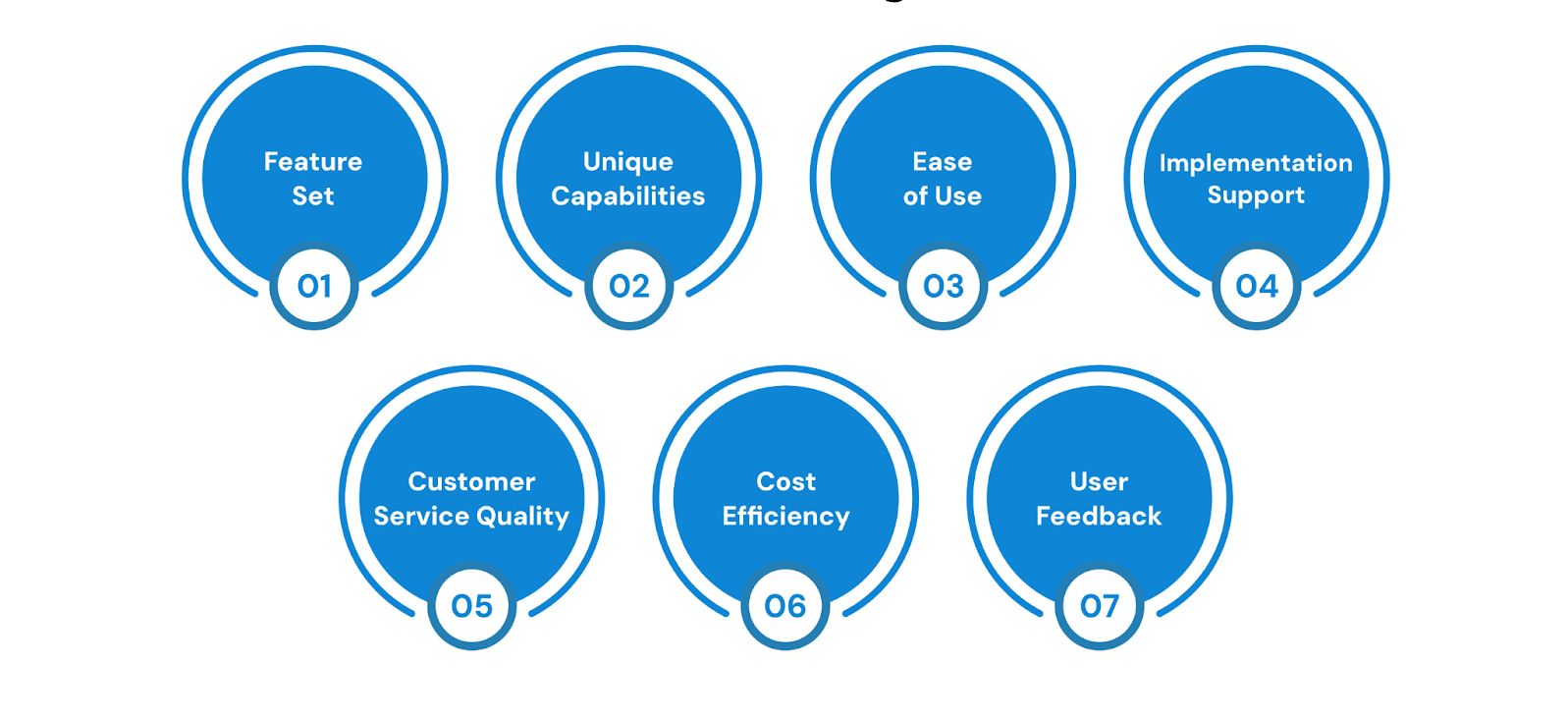
Selecting the right GRC tool is crucial for effective governance, risk management, and compliance programs. Your choice impacts how well your organization identifies risks, maintains regulatory compliance, and drives strategic decisions. Focus on these essential criteria to ensure you invest in a tool that fits your operational needs and business goals:
- Feature Set: Evaluate if the tool offers a comprehensive range of features covering risk assessments, policy management, compliance tracking, and audit management. A broader feature set allows for centralized control and better visibility.
- Unique Capabilities: Identify standout functionalities such as AI-driven risk scoring, automated evidence collection, or predictive analytics that can provide a competitive edge. These features often address specific challenges your industry faces.
- Ease of Use: A user-friendly interface reduces training time and increases adoption across departments. Look for customizable dashboards and role-based access that simplify user interactions.
- Implementation Support: Strong onboarding processes, including dedicated support teams and training materials, help reduce the time to value and minimize disruptions during deployment.
- Customer Service Quality: Responsive customer support is vital for troubleshooting and adapting the tool as your GRC requirements evolve. Check support channels, response times, and escalation procedures.
- Cost Efficiency: Assess the total cost of ownership against the benefits delivered. Consider licensing fees, scalability, and hidden costs such as customizations or integrations.
- User Feedback: Study reviews and case studies from organizations similar to yours. Real-world insights reveal how the tool performs under different operational pressures and compliance frameworks.
A careful evaluation aligned with your organization’s unique risk profile and compliance demands will guide you toward the most effective GRC tool.
Read More: Criteria for Choosing and Evaluating a GRC Tool for Your Business
Simplify GRC with VComply
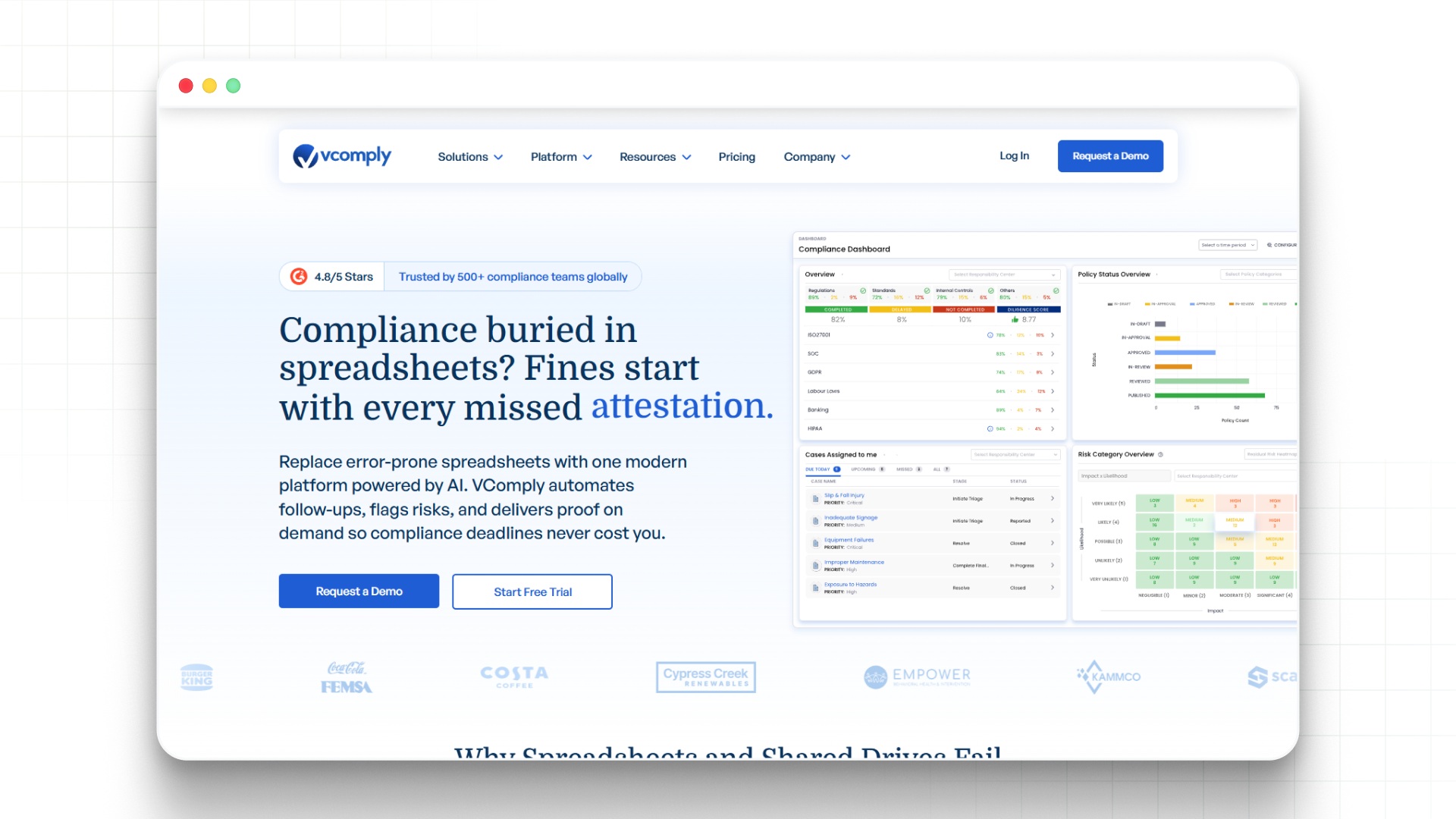
Among the many GRC platforms out there, VComply focuses on what matters most, helping teams manage real risks, stay compliant, and get work done without the clutter.
- Modular Workflows: VComply allows you to configure compliance, audit, policy, and risk workflows without code. Each module works together but can also scale independently.
- AI-Enabled Risk Intelligence: Real-time scoring, automated control testing, and evidence linking help you act before issues escalate. Risk management becomes proactive, not reactive.
- Third-Party Integration: Seamless sync with Jira, Azure, Slack, and ServiceNow means no double-entry. You stay aligned across IT, finance, HR, and compliance teams.
- Prebuilt Templates for Every Industry: From banking risk registers to university policy flows, VComply’s resource library is plug-and-play.
Board-Ready Reporting: Role-based dashboards and exportable reports help you brief leadership quickly, without the need to build from scratch every time.
Start your 21-day free trial and experience how VComply adapts to your GRC maturity.
Wrapping Up
When you’re facing mounting compliance pressures, inconsistent risk data, and limited resources, a strong GRC platform becomes essential. You can explore tools tailored to your industry needs or adopt a scalable solution like VComply to unify governance, risk, and compliance in one platform.
Your selection should depend on your sector, internal resourcing, and how much configuration you want versus out-of-the-box functionality.
Ready to realign your GRC approach with measurable business outcomes? Book a personalized demo with VComply and take the first step toward smarter compliance management.
FAQs
To ensure smooth adoption of new GRC systems, businesses should focus on clear communication and comprehensive training.
Start with low-friction workflows like policy reviews and risk reporting, gradually introducing users to the system’s full capabilities. Additionally, offering role-based dashboards and real-time feedback can help users see the immediate value of the new system.
AI-driven risk management tools provide several advantages, including real-time risk scoring and proactive identification of potential threats before they escalate.
These tools improve risk analysis accuracy, reduce human error, and enable more efficient decision-making by automating routine tasks.
SMEs can implement effective GRC practices by adopting scalable, cloud-based solutions that offer automation and integration without investment.
Focusing on high-priority risks and using prebuilt templates for compliance tasks can help organize processes. SMEs should also consider using outsourced GRC services or tools that provide centralized reporting and task management.
Data privacy is a critical component of GRC, as it directly impacts an organization’s compliance with regulations such as GDPR, CCPA, and others. Organizations can stay compliant by integrating data privacy management into their GRC framework, ensuring proper data handling.
Regular audits, employee training, and using GRC tools that update with evolving regulations help maintain ongoing compliance.