

ISO 27001 Information Security Policy: How to Structure and Implement It in 2026
Audit reviews of ISO 27001 programs increasingly highlight a disconnect between documented policies and actual control execution, with gaps in ownership, traceability, and audit evidence.

While organizations align policies with Annex A requirements, they often struggle to demonstrate how those policies translate into consistent, system-level enforcement. As expectations shift toward continuous validation, static documentation is no longer sufficient for defensible compliance.
An ISO 27001 information security policy must operate as a governance layer that connects risk priorities, control objectives, and execution across workflows and systems. Its value depends on how effectively it drives accountability, monitoring, and evidence generation within the ISMS.
This article examines how to structure and operationalize policies so they support consistent control performance, real-time visibility, and audit-ready outcomes.
At a Glance
- ISO 27001 information security policy operates as a governance layer, not an execution mechanism, requiring integration with controls and workflows.
- Policies fail when they are not mapped to execution pathways, ownership structures, and monitoring systems.
- Alignment with ISO/IEC 27001:2022 Annex A.5.1 ensures direction, but not enforcement or validation.
- Core components must include scope, risk alignment, accountability, and regulatory mapping to support audit defensibility.
- Effective implementation requires translating policy statements into system-driven controls and workflows.
- Evidence must be generated during execution, not reconstructed later, to meet audit and certification expectations.
What Is an ISO 27001 Information Security Policy?
An ISO 27001 information security policy defines governance intent for how information risk is managed across the organization, but it does not execute controls itself.
It establishes direction, accountability, and alignment with ISO/IEC 27001:2022 requirements, ensuring that policies guide how controls should function across systems, workflows, and oversight structures within the ISMS.

Under ISO/IEC 27001:2022 Annex A.5.1, organizations are required to maintain a formal, approved policy aligned with business objectives, communicate it across relevant stakeholders, and ensure periodic review and updates.
The policy must support risk-based decision-making, focus on governance direction rather than operational execution, and serve as the foundation for downstream control implementation and validation.
Also read: How to Improve Compliance Management for Audit-Ready Programs 2026
Why ISO 27001 Policies Fail in Practice

Even well-structured policies fail when they cannot translate governance intent into consistent execution across systems and teams. The issue is not policy design, but the absence of operational linkage between policy, controls, and monitoring.
Modern policy failures are driven by execution gaps rather than missing documentation:
1. Policy vs Execution Gap
Policies define expected outcomes but rarely specify how controls should execute within systems and workflows. This creates ambiguity in implementation, leading to inconsistent application across teams.
Without clear execution pathways, policies remain theoretical, limiting their effectiveness in maintaining compliance and supporting real-world control performance under audit conditions.
2. Lack of Ownership and Accountability
ISO 27001 policies often assign responsibility at a high level but fail to define ownership at the control or workflow level. This lack of clarity results in missed actions, delayed responses, and inconsistent enforcement.
Without explicit accountability mapping, organizations struggle to demonstrate who is responsible for execution, validation, and remediation during audits.
3. Evidence and Audit Readiness Gaps
Policies do not inherently generate evidence; execution does. When policies are not linked to systems that capture logs, approvals, and outputs, organizations must reconstruct evidence manually.
This leads to incomplete or inconsistent audit trails, weakening defensibility and increasing the effort required to respond to certification or regulatory reviews.
4. Fragmented Systems and Manual Processes
Policy enforcement is often distributed across disconnected tools, spreadsheets, and communication channels. This fragmentation reduces visibility into control execution and increases the risk of missed steps.
Without integrated systems, organizations cannot track policy adherence in real time or ensure consistency across environments, limiting oversight and decision confidence.
Gaps in execution, ownership, and evidence are rarely visible at the policy level but become critical under audit scrutiny. Addressing them requires structured systems that connect policy intent to real-world control execution. Book a demo with VComply to see how this shift changes compliance outcomes.
Also read: Business Resilience Framework: Building Operational Strength for 2026
Core Components of an ISO 27001 Information Security Policy
An effective ISO 27001 information security policy must connect governance intent with execution realities, ensuring that policies guide how controls operate and how compliance is validated across the organization.
A functional policy must define structure, accountability, and alignment with execution systems:
1. Policy Objectives and Scope
Defines what the policy governs, including data, systems, users, and processes within scope. It establishes boundaries for control application and ensures alignment with organizational risk exposure.
A clearly defined scope prevents ambiguity and ensures that policies are applied consistently across relevant environments and business functions.
2. Governance and Leadership Commitment
Reflects top management responsibility for information security, including approval, oversight, and resource allocation. Leadership commitment ensures policies are enforced across the organization and aligned with strategic objectives.
It also establishes accountability at the highest level, which is critical for audit validation and regulatory compliance.
3. Risk Alignment and Control Intent
Policies must reflect the organization’s risk landscape by defining how controls address identified threats and vulnerabilities. This alignment ensures that policies are not generic but tailored to business impact and risk priorities.
It also supports consistent decision-making by linking governance intent directly to control objectives.
4. Roles, Responsibilities, and Accountability
Defines who is responsible for policy enforcement, control execution, monitoring, and remediation. Clear ownership ensures that actions are taken consistently and that accountability is traceable.
Without this clarity, policies cannot be operationalized effectively, and gaps emerge during audits and incident response.
5. Compliance and Regulatory Alignment
Ensures policies align with ISO/IEC 27001 requirements and other applicable regulations. This includes mapping policy statements to specific controls and audit expectations. Alignment supports defensibility by demonstrating that governance structures reflect regulatory obligations and can be validated through evidence.
Types of ISO 27001 Policies Organizations Must Define
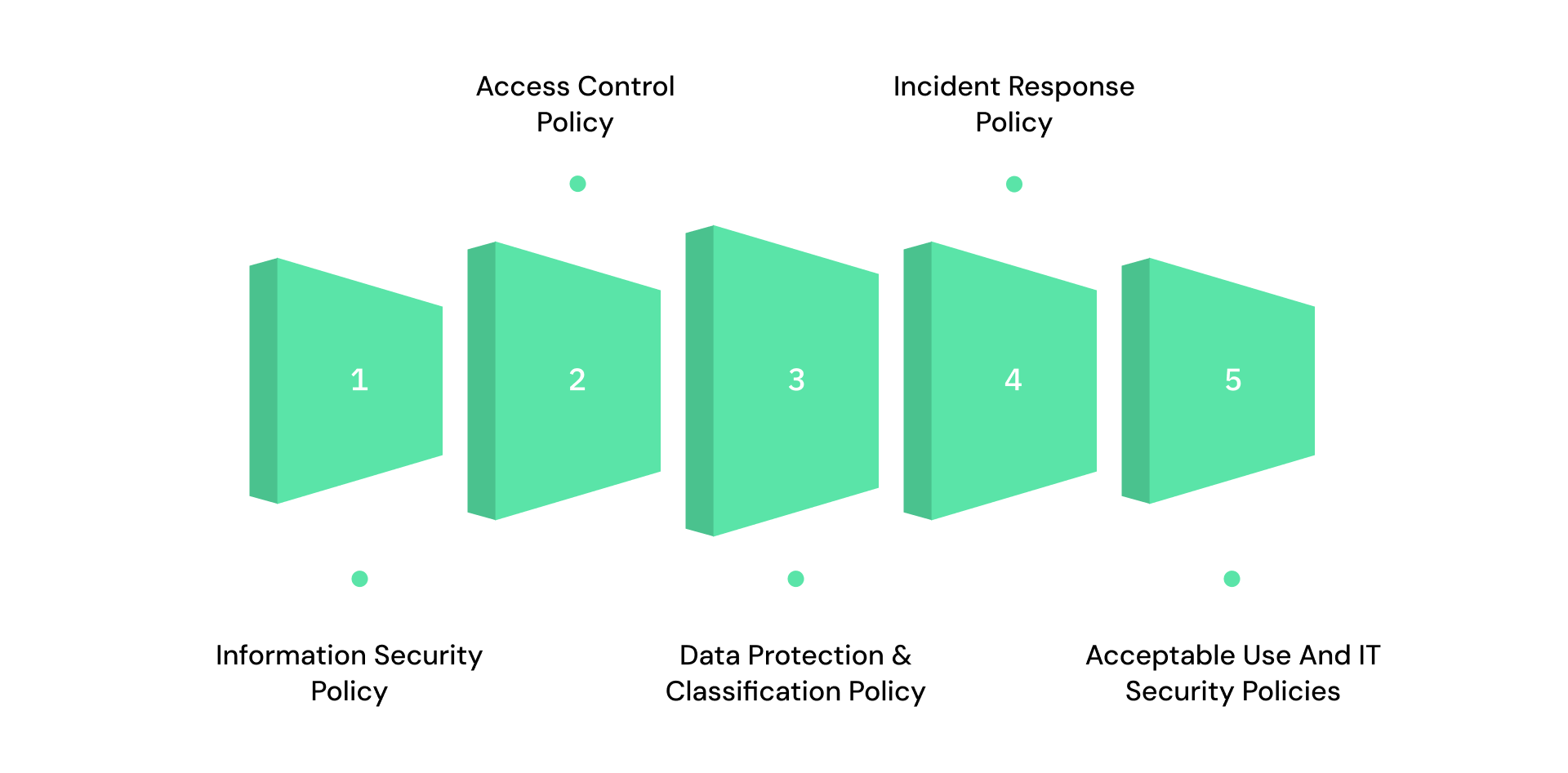
ISO 27001 requires a structured set of policies that collectively define how information security is governed, enforced, and monitored across the organization. Each policy serves a specific role but must operate within an integrated system.
These policies define governance coverage across key control areas:
1. Information Security Policy (Top-Level)
Acts as the overarching governance document that defines the organization’s approach to information security. It sets direction, establishes principles, and aligns security objectives with business strategy. All other policies derive from this layer, making it central to ensuring consistency across the ISMS.
2. Access Control Policy
Defines how access to systems and data is granted, managed, and revoked. It enforces principles such as least privilege and segregation of duties. Effective implementation requires integration with identity and access management systems to ensure consistent enforcement and monitoring of access-related controls.
3. Data Protection and Classification Policy
Establishes how data is classified, handled, stored, and protected throughout its lifecycle. It ensures that sensitive information is identified and safeguarded appropriately. This policy must align with regulatory requirements and be supported by controls that enforce classification and handling rules.
4. Incident Response Policy
Defines how security incidents are identified, escalated, and resolved. It outlines roles, communication protocols, and response procedures. Effective policies must integrate with incident management systems to ensure timely detection, response, and documentation of events for audit and compliance purposes.
5. Acceptable Use and IT Security Policies
Define expected user behavior and acceptable use of organizational systems and data. These policies reduce insider risk and ensure that users understand their responsibilities. Enforcement requires monitoring mechanisms and alignment with access and activity controls.
Defining multiple ISO 27001 policies creates coverage, but not necessarily consistency in how those policies are enforced across systems and teams. As policy layers expand, maintaining alignment between access, data protection, and incident response becomes increasingly complex.
Book a demo with VComply to unify policy execution and maintain consistent control performance across your ISMS.
Also read: GDPR and CCPA: Key Differences and How You Stay Compliant
5 Steps to Create an ISO 27001 Information Security Policy
Creating an effective ISO 27001 information security policy requires starting from execution requirements and building backward into the governance structure. The goal is to ensure that policies are actionable, enforceable, and auditable.
Effective policy design follows a structured, execution-driven approach:
Step 1: Define Risk and Regulatory Context
Identify applicable regulatory requirements, business risks, and operational priorities. This ensures that policies reflect actual exposure rather than generic standards. Aligning with ISO/IEC 27001 and organizational risk assessments provides a foundation for relevant and defensible policy design.
Step 2: Structure Policy Around Control Objectives
Define clear control objectives that translate policy intent into measurable outcomes. Avoid vague or high-level statements that cannot be enforced. Policies should provide direction that can be directly mapped to controls and workflows within systems.
Step 3: Define Ownership and Governance
Assign clear responsibility for policy enforcement, control execution, and monitoring. Define escalation paths and accountability structures. This ensures that policies are not passive documents but active components of governance and oversight.
Step 4: Map Policy to Controls and Workflows
Translate policy requirements into specific controls embedded within systems and workflows. Define how actions are performed, validated, and tracked. This step ensures that policies drive execution rather than remain disconnected from operations.
Step 5: Enable Monitoring and Evidence Capture
Implement mechanisms to monitor control performance and capture evidence automatically. This includes logs, approvals, and system outputs linked to policy requirements. Continuous monitoring ensures audit readiness and provides visibility into compliance status.
Without this level of structure, policies remain disconnected from execution and fail to deliver measurable compliance outcomes.
Also read: Understanding the Three Lines of Defense Model in Risk Management
Structuring ISO 27001 Policy Execution with VComply
As organizations scale their ISMS, policy execution often breaks down due to fragmented systems, unclear ownership, and limited visibility into control performance. These gaps make it difficult to demonstrate how policies translate into consistent execution and verifiable evidence, particularly under audit scrutiny where traceability and accountability are required.
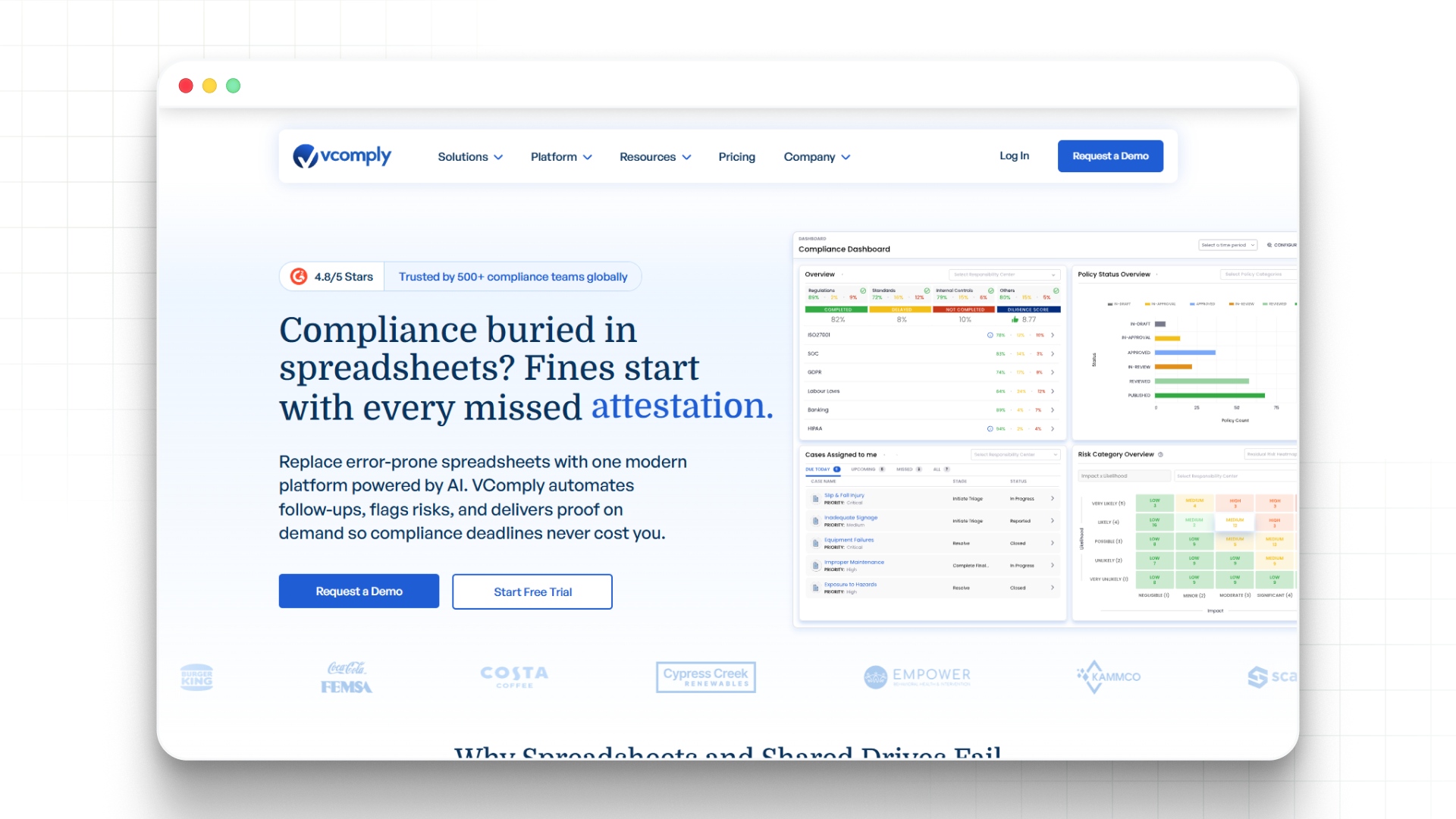
VComply addresses this by structuring ISO 27001 policy execution within integrated workflows across PolicyOps and ComplianceOps, ensuring policies are not isolated documents but part of a system that enforces, monitors, and validates control performance:
- Policy-to-workflow mapping ensures governance intent is translated into executable actions
- Ownership tracking defines accountability across controls and processes
- Real-time monitoring provides visibility into policy adherence and control performance
- Integrated evidence capture links execution directly to audit-ready records
- Framework alignment ensures consistency with ISO/IEC 27001 requirements
Book a demo with VComply to see how structured systems can help you operationalize ISO 27001 information security policy execution and maintain audit-ready governance.
Also read: Operational Risk Management Examples and Strategies
Wrapping Up
An ISO 27001 information security policy only delivers value when it extends beyond documented intent and functions as part of an execution system that connects governance, risk, and control performance.
As audit expectations emphasize traceability, accountability, and continuous validation, policies that are not linked to workflows, ownership, and evidence generation create gaps that limit defensibility and reduce confidence in compliance outcomes.
When policy execution depends on fragmented tools, manual processes, and unclear ownership, maintaining consistent control performance becomes difficult at scale.
VComply addresses this by structuring policies within integrated workflows across, ensuring alignment between policy intent, execution, and monitoring.
Start a 21-day free trial of VComply to understand how structured systems can help you operationalize ISO 27001 information security policy execution, strengthen audit readiness, and maintain clear governance visibility across your organization.
FAQs
An ISO 27001 information security policy defines how an organization governs information security in alignment with ISO/IEC 27001 requirements. Its role is to establish direction, accountability, and expectations for managing risk across systems and processes.
ISO 27001 requires a set of policies aligned with Annex A controls, including information security, access control, data protection, and incident response. These policies must collectively define how security is governed and enforced. More importantly, they must be connected to workflows and systems that ensure consistent execution and audit readiness.
Writing an effective policy requires aligning it with risk context, regulatory requirements, and control objectives. It should define scope, responsibilities, and expected outcomes while ensuring it can be mapped to executable controls. Policies must be designed to support monitoring and evidence generation, not just documentation.
Policies fail audits when they cannot demonstrate execution, ownership, and evidence. Common issues include unclear accountability, lack of traceability, and reliance on manual processes. Without integration into systems that enforce and monitor controls, policies remain theoretical and fail under audit scrutiny.
VComply supports ISO 27001 compliance by embedding policies into structured workflows that connect governance, risk, and control execution. It enables organizations to define ownership, monitor performance in real time, and generate audit-ready evidence.