

SAP GRC tools (Best Alternatives ) for 2026
Governance, risk, and compliance expectations are evolving rapidly. As regulatory demands expand and organizations operate across increasingly complex digital environments, leaders need GRC platforms that support clear oversight, consistent execution, and enterprise-wide visibility.

For many organizations, SAP GRC has long been part of their governance foundation. However, as operating models shift toward cloud ecosystems, distributed teams, and faster audit cycles, decision-makers are reassessing whether their current tools continue to align with their strategic and operational needs.
Selecting a GRC platform today is less about replacing technology and more about strengthening accountability, improving transparency, and enabling teams to respond confidently to emerging risks.
In this guide, we explore leading SAP GRC alternatives for 2026 and outline the capabilities organizations should prioritize when evaluating modern GRC solutions.
Key Takeaways
- Many enterprises are moving away from SAP GRC due to rigid workflows, high ownership costs, and slow adaptability in modern regulatory environments.
- Modern GRC expectations require flexible, cloud-ready platforms that integrate seamlessly with SaaS ecosystems and support practical oversight.
- VComply offers a scalable, modular alternative through ComplianceOps, RiskOps, PolicyOps, and CaseOps, designed to match the pace of enterprise governance.
- Teams gain faster time to value, easier adoption, stronger reporting visibility, and multi-framework support across HIPAA, ISO, SOX, GDPR, PCI DSS, and more.
- Organizations planning a migration from SAP GRC can follow a structured transition path to ensure continuity, accuracy, and smoother implementation using VComply.
Why Organizations Are Now Seeking SAP GRC
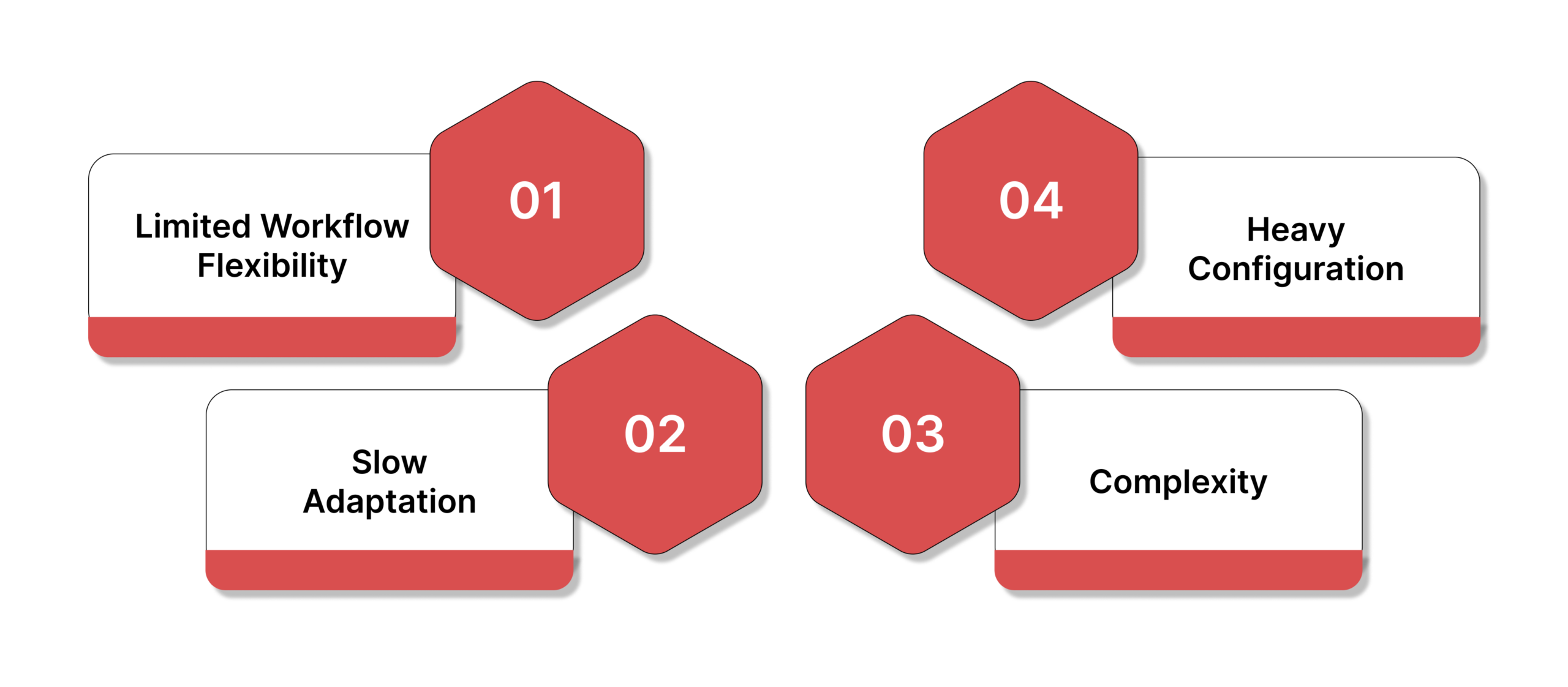
Organizations that once viewed SAP GRC as the gold standard are now discovering gaps that weren’t visible a decade ago. As regulatory environments become more dynamic and audit cycles accelerate, teams need platforms that can adapt in real time, not systems that require prolonged configuration or specialist intervention.
Here’s how these challenges show up across key areas.
- Limited Workflow Flexibility: Adjusting workflows to reflect new regulations or internal process changes often takes longer than expected, slowing compliance execution and response times.
- Slow Adaptation: Updates to regulatory frameworks or regional rules may require multiple configuration cycles, making it difficult to keep pace with evolving obligations.
- Complexity: The system’s layered design and technical interfaces can reduce adoption, especially for non-technical stakeholders across compliance, risk, and operations.
- Heavy Configuration: Even minor changes frequently depend on specialized expertise or IT support, limiting your team’s ability to act independently and quickly.
Also Read: A Complete Guide on Third-Party Risk Management
As compliance demands intensify, organizations are rethinking their SAP GRC strategy and exploring smarter, more agile alternatives.
SAP GRC Alternatives: Top 10 GRC Software for 2026
As organizations face growing regulatory complexity and evolving business risks, traditional platforms like SAP GRC can struggle to keep pace. Modern GRC alternatives offer greater flexibility, faster deployment, and seamless integrations.
Below, we explore the top 10 GRC software options for 2026:
1. VComply

VComply is a cloud-based Governance, Risk, and Compliance platform that centralizes compliance activities, risk management, policy governance, and incident management. It provides automation, real-time visibility, and structured workflows to simplify enterprise GRC operations.
Below are key features that define VComply’s GRC capabilities:
- Centralized Compliance Dashboard: A unified view of compliance tasks, audit status, risks, and key performance indicators in real time, helping teams monitor obligations without fragmented systems.
- Automated Workflows & Alerts: Task assignments, deadline reminders, and escalation notifications ensure nothing slips through the cracks, reducing manual follow-ups.
- Risk Identification & Scoring: Customizable risk registers, scoring models, and heatmaps allow you to assess, prioritize, and monitor risks with visual clarity.
- Central Evidence & Document Management: Upload, organize, and retrieve compliance evidence and control documentation from a single repository for audit readiness.
- Policy Lifecycle Management: Draft, review, approve, distribute, and track acknowledgments of policies with version control and automated workflows that reduce paperwork and increase compliance rates.
- Compliance Calendar & Scheduling: A dynamic calendar highlights upcoming audits, control tests, and compliance deadlines, helping teams stay proactive instead of reactive.
- Third-Party Risk Oversight: Structured evaluations and documentation optimize vendor risk assessments and help maintain a documented risk posture across partners.
Pros:
- Combines ComplianceOps, RiskOps, PolicyOps, and CaseOps in one platform, enabling unified workflows and automated evidence collection.
- User-friendly interface with real-time dashboards.
- Automated workflows reduce manual effort.
Cons:
- Some advanced features require a learning curve.
- Integrations with legacy systems may need configuration.
Pricing: Starter plans begin at $10,000, with Pro and Enterprise tiers available. Vendors provide custom quotes tailored to your organization’s size and requirements.
G2 Rating: 4.6/5 from verified users, consistently recognized as a high-performer in GRC and compliance categories.
21-day free trial offered (activation call required), with demos available upon request.
2. SmartSuite
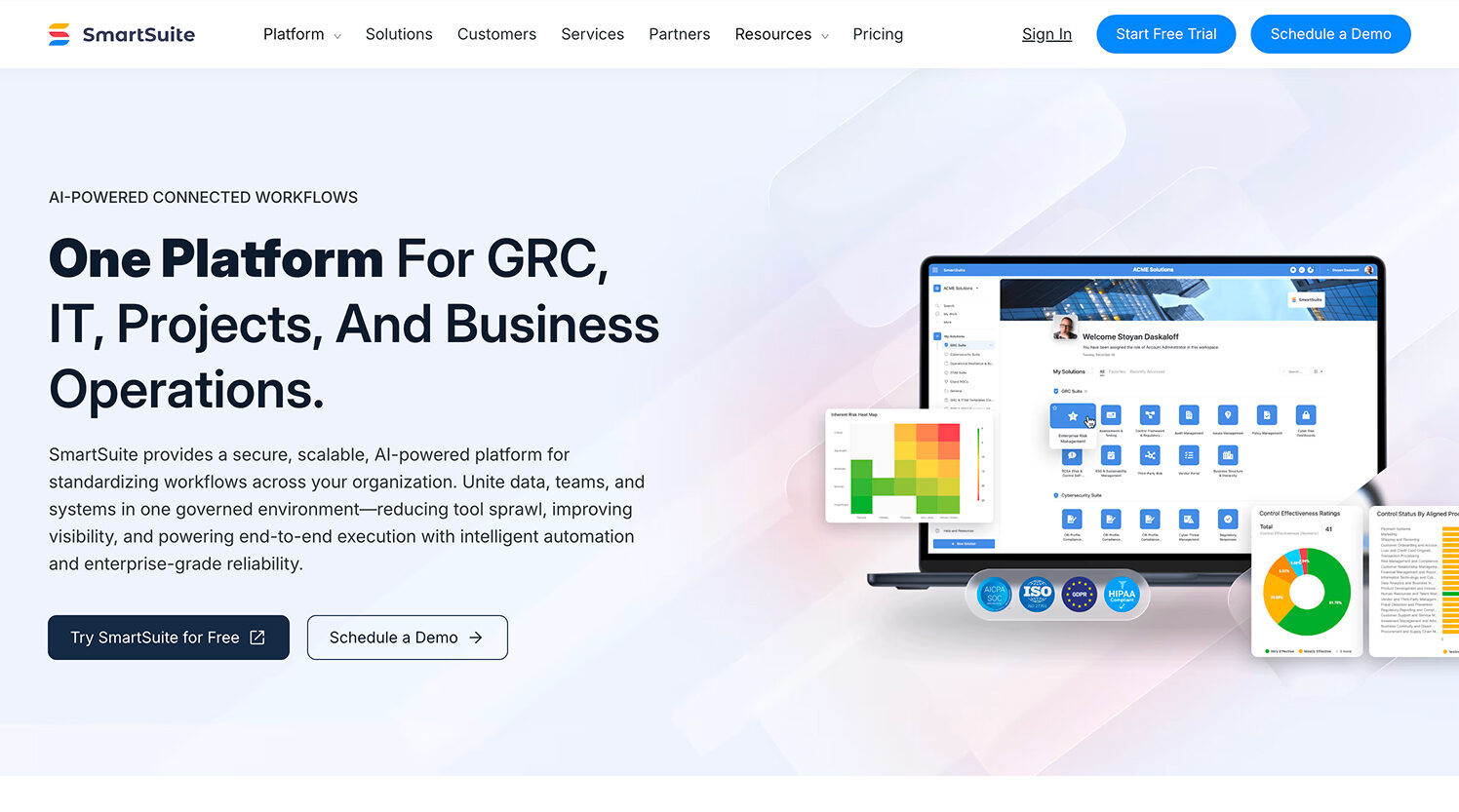
SmartSuite is a unified work and GRC platform that connects governance, risk, and compliance with real‑time visibility, automation, and customizable workflows.
Below are key features that define SmartSuite’s GRC capabilities:
- Unified GRC Workspace: Centralize governance, risk, compliance, audit, privacy, ESG, and third‑party risk within a single connected platform to eliminate data silos and fragmented oversight.
- Custom Risk Registers & Scoring: Build and maintain a centralized risk register, score risks, and monitor mitigation plans with visual dashboards that surface trends and exposures.
- Policy & Control Management: Establish, review, and update policies and controls in one place, assigning ownership and tracking approval workflows across teams.
- Automation & Workflow Orchestration: Use no‑code automation to trigger notifications, route tasks, and enforce repeatable processes that reduce manual effort and errors.
- Real‑Time Dashboards & Reporting: Create interactive dashboards and reports that visualize compliance health, risk indicators, and audit status at a glance for executive oversight.
- Linked Record Architecture: Connect risks, controls, evidence, and frameworks so data updates automatically propagate across related records, improving traceability and context.
Pros:
- Adapts to unique GRC processes without developers, reducing dependency on IT.
- Combines governance, risk, and compliance with broader work workflows to reduce tool sprawl.
Cons:
- Customization flexibility may require setup time for complex GRC models.
- The breadth of capabilities can be overwhelming for teams seeking a simpler, purpose‑built GRC tool.
Pricing: Plans start at $12 per user/month (Team), with higher tiers like Professional at $30 and Enterprise at $45 per user/month; solution‑based pricing and custom enterprise plans are also available.
G2 Rating: 4.8/5 on G2 across verified user reviews
14‑day free trial available (no credit card required), and a demo can be scheduled via the vendor.
3. Archer IRM

Archer IRM (formerly RSA Archer) is a mature integrated risk management platform that centralizes risk, audit, compliance, and incident data in one system.
Below are key features that define Archer IRM’s GRC capabilities:
- Centralized Risk & Compliance Repository: Provides a single source of truth for enterprise risks, controls, audit findings, and compliance requirements across functions.
- Configurable Risk Registers: Enables tailored risk categorization, scoring, and prioritization to reflect organizational risk models and decision‑making needs.
- Advanced Dashboards & Reporting: Real‑time analytic dashboards and customizable reports help identify trends, shifts in exposure, and control effectiveness.
- Audit & Compliance Management: Supports planning, evidence collection, execution, and reporting of internal and external audits while linking outcomes to remediation actions.
- Regulatory Mapping & Framework Alignment: Tracks compliance obligations against standards like ISO, NIST, GDPR, SOX, and more to maintain regulatory alignment.
- Incident & Operational Risk Workflows: Logs incidents, assigns remediation, and integrates operational risk insights into enterprise risk views.
Pros:
- Strong enterprise‑grade risk visibility with advanced analytics and reporting.
- Configurable for diverse risk domains and regulatory frameworks.
Cons:
- Steep learning curve and complex setup.
- Higher cost and resource requirements than lighter GRC tools.
Pricing: Contact the vendor for a quote, as costs vary by modules and deployment scope. Basic implementations typically start around $14,000–$55,000 annually, with full enterprise deployments costing significantly more.
G2 Rating: 3.6/5 from verified user reviews.
Demo available upon request; no standard free trial offered.
4. MetricStream
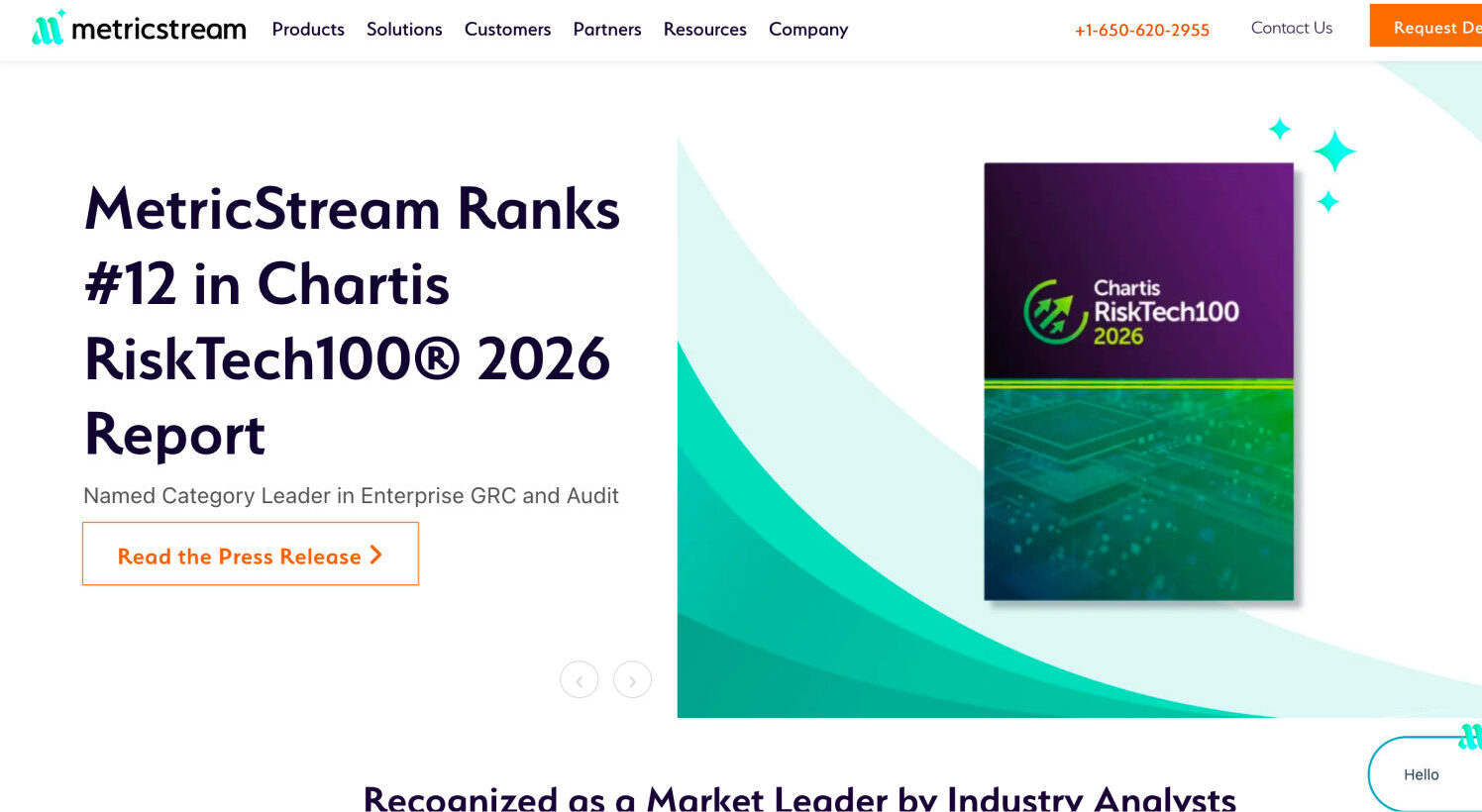
MetricStream is an enterprise‑grade GRC platform that unifies governance, risk, compliance, audit, cyber risk, third‑party risk, and resilience on a connected, AI‑infused framework.
Below are key features that define MetricStream’s GRC capabilities:
- Integrated Enterprise GRC Platform: Connects risk, compliance, audit, cyber, third‑party risk, and resilience programs in one unified framework for holistic governance oversight.
- AI‑Driven Risk Intelligence: Real‑time risk scoring, predictive insights, and dynamic analytics help teams anticipate exposures and support risk‑aware decisions.
- Regulatory & Policy Management: Centralized tracking of regulatory changes, policy mapping, control assessments, and automated compliance workflows.
- Advanced Audit Management: Optimizes internal audit planning, execution, workpaper automation, reporting, and follow‑up with continuous monitoring capabilities.
- Third‑Party Risk Oversight: End‑to‑end vendor and fourth‑party risk processes with due diligence, assessments, issue tracking, and performance monitoring.
- Low‑Code/No‑Code Configurability: A flexible platform that supports customization and configuration without heavy development effort, easing adaptation to organizational needs.
Pros:
- Enterprise‑scale GRC with broad coverage across risk, compliance, audit, and third‑party domains.
- AI‑infused analytics and connected insights support proactive risk decisions.
Cons:
- Implementation and customization often require significant time and resources.
- Designed for larger enterprises; smaller teams may find it complex.
Pricing: Contact the vendor for a custom quote, as costs depend on modules, seats, and implementation. Enterprise deployments typically start in the tens of thousands per year and can exceed $750,000–$1M annually, depending on scale and services.
G2 Rating: 3.9/5 across products, reflecting mixed feedback across modules.
Demo available upon request; limited short-term trial offers may be available through special programs, but no standard self-serve trial exists.
5. AuditBoard

AuditBoard is a leading AI‑enabled governance, risk, and compliance platform designed to unify audit, risk, compliance, and related workflows into a single system.
Below are key features that define AuditBoard’s GRC capabilities:
- Unified GRC Data Core: Connect risks, controls, audits, and compliance obligations across functions so teams work from a single source of truth with consistent, real‑time visibility.
- AI‑Driven Automation: Built‑in AI accelerates repetitive tasks, suggests mappings between controls and frameworks, and surfaces insights to reduce manual effort.
- Risk & Compliance Dashboards: Intuitive dashboards and analytics visualize risk exposures, control effectiveness, and compliance metrics to support decision‑making.
- Regulatory Change & Control Mapping: Continuous monitoring and impact analysis help teams stay aligned with evolving standards and regulatory changes.
- Audit Management & Reporting: Integrated audit planning, execution, and reporting features simplify internal audit cycles while linking findings to risk and remediation.
- Integration Ecosystem: APIs and prebuilt connectors sync AuditBoard with ERP, HR, collaboration, and ticketing systems to automate evidence collection and workflows.
Pros:
- Combines audit, risk, compliance, and extended governance functions into one platform, improving visibility and reducing silos.
- Reduces manual tasks and accelerates core workflows.
Cons:
- Setup and advanced modules often require significant time and training.
- Pricing can be high for smaller teams, with limited transparency publicly.
Pricing: Contact vendor for pricing (no public pricing tiers; typical enterprise spend often ranges from about $20,000–$88,000+ per year, depending on modules and scale).
G2 Rating: 4.7/5 on G2 based on user satisfaction and verified reviews.
Demo available on request via vendor sales; no publicly listed free trial.
6. Hyperproof

Hyperproof is an AI‑enabled Governance, Risk, and Compliance platform that centralizes compliance, risk, audit, control management, and trust operations in a single system.
Below are key features that define Hyperproof’s GRC capabilities:
- Automated Control Operations: Orchestrate and manage control sets at scale, reducing duplication and manual orchestration.
- Cross‑Framework Mapping: Connect a single control to multiple frameworks to minimize redundant work and maintain consistent compliance coverage.
- AI‑Powered Questionnaire Automation: Use built‑in AI to automate responses to security and compliance questionnaires, freeing up team effort.
- Real‑Time Risk Monitoring: Dashboards and alerts provide continuous insight into risk posture and control effectiveness.
- Third‑Party & Trust Center Automation: Manage vendor risk and trust operations with automated workflows and centralized documentation.
- Scalable Compliance Framework Library: Access a broad set of pre‑built frameworks to standardize and scale GRC efforts across varied regulatory regimes.
Pros:
- Built‑in AI reduces repetitive work and accelerates compliance workflows.
- An extensive library of frameworks helps reduce duplication and maintain consistency.
Cons:
- Pricing and setup can be high for smaller teams and complex deployments.
- Some advanced automation features may require time to configure and refine.
Pricing: Contact vendor for pricing (no public pricing tiers; reported starting around $12,000/year for basic use, with annual median contracts often $22,000–$54,000+ depending on size and modules).
G2 Rating: 4.5/5 on G2 from verified reviews, showing strong user satisfaction with compliance automation, integrations, and overall capability.
Demo available via vendor request; no standard free trial or free version is publicly offered.
7. OneTrust

OneTrust delivers a comprehensive GRC platform with integrated risk, compliance, audit, and third‑party oversight built on a single data model.
Below are key features that define OneTrust’s GRC capabilities:
- Unified Risk & Compliance Management: Centralizes governance, risk, audit, and compliance activities in one platform with shared data and workflows for consistent oversight.
- Framework & Evidence Automation: Pre‑built frameworks and control libraries speed setup and help automate evidence tasks across multiple compliance requirements.
- Dynamic Dashboards & Reporting: Real‑time visualizations surface risk trends, compliance status, and audit readiness across functions for deeper operational insight.
- Third‑Party & IT Risk Integration: Incorporates third‑party risk, IT risk, and security assurance into the broader GRC picture to reduce blind spots.
- Policy & Audit Workflows: Refines policy development, distribution, attestation tracking, and audit execution with built‑in process flows.
- AI & Regulatory Intelligence: Embedded AI and regulatory content help translate evolving regulations into practical control and compliance requirements.
Pros:
- Combines risk, compliance, audit, and third‑party oversight on one platform.
- Embedded AI and pre‑built frameworks accelerate compliance management.
Cons:
- Enterprise scale and breadth can be complex to configure for smaller teams.
- Pricing and implementation effort are often higher than those of lightweight GRC tools.
Pricing: Contact vendor for pricing (tailored quotes depend on users, inventory size, and modules chosen). Estimated ranges start around $10,000/year and can exceed $200,000+/year for full enterprise deployments.
G2 Rating: 4.4/5 on G2 from verified user reviews across OneTrust products.
14‑day free trial available for the GRC & Security Assurance Cloud (request via form), and demo available on request from the vendor.
8. ZenGRC
ZenGRC is a unified Governance, Risk, and Compliance platform designed to optimize audits, risk assessments, vendor management, and multi‑framework compliance.
Below are key features that define ZenGRC’s GRC capabilities:
- Centralized Risk & Compliance Repository: Brings risk, compliance data, controls, and audit artifacts together in one system for consistent oversight and traceability.
- AI‑Enhanced Intelligence: Built‑in intelligence automates control mapping, assessments, and framework scoping to reduce repetitive work and accelerate program delivery.
- Audit & Assessment Management: Create, run, and track audits and assessments with automated evidence workflows and audit trails to accelerate audit cycles.
- Risk Visualization & Heatmaps: Real‑time risk dashboards and visual tools help teams monitor trends, assess impact, and prioritize remediation.
- Vendor & Third‑Party Risk Management: Centralized vendor profiles, questionnaires, and risk evaluations help manage third‑party exposures and compliance obligations.
- Cross‑Framework Control Mapping: Reuse controls across multiple compliance frameworks and standards to avoid duplication and improve efficiency.
Pros:
- Embedded intelligence reduces manual tasks and speeds up compliance and control processes.
- Covers risk, compliance, audit, and vendor oversight in one platform.
Cons:
- Comprehensive features can take time to configure and learn.
- Costs aren’t always clearly published, which can slow evaluation.
Pricing: Contact vendor for pricing
G2 Rating: 4.4/5 on G2 based on 102+ verified user reviews.
Demo available via vendor request; free trial is typically provided through guided proofs-of-concept (not a standard self‑serve trial).
9. LogicGate

LogicGate’s Risk Cloud is a modern, AI‑infused Governance, Risk, and Compliance platform built on a no‑code cloud architecture.
Below are key features that define LogicGate’s GRC capabilities:
- AI‑Powered Workflow Automation: LogicGate uses Spark AI and automation tools to ease control gap analysis, reduce manual work, and accelerate evidence gathering and remediation workflows.
- No‑Code, Flexible Architecture: A graph database and drag‑and‑drop builder lets you configure risk assessments, compliance processes, and audits without heavy IT dependency.
- Enterprise Risk Management: Centralize risk data, customizable risk assessments, and quantitative insights (including Monte Carlo‑based risk analysis) for more informed decisions.
- Regulatory & Controls Compliance: Automate regulatory compliance workflows, evidence collection, and cross‑framework control mapping to stay audit‑ready across multiple standards.
- Policy & Governance Tools: Define, link, and manage organizational policies with workflows tied to controls and compliance obligations.
- Real‑Time Dashboards & Reporting: Built‑in analytics and visual dashboards give teams up‑to‑date views of risk exposures, control efficacy, and compliance metrics.
Pros:
- Automated control gap analysis and Spark AI reduce manual effort and speed compliance cycles.
- Flexible no‑code architecture makes it adaptable to evolving GRC needs without IT bottlenecks.
Cons:
- Enterprise‑grade configurability may require planning and expertise to optimize workflows.
- Designed for enterprise programs, smaller teams may find pricing and scale less accessible.
Pricing: Contact vendor for pricing
G2 Rating: 4.5/5 on G2 from verified user reviews.
Demo available via vendor request; no standard self‑serve free trial is publicly offered.
10. Diligent

Diligent delivers a comprehensive GRC solution with integrated governance, risk, compliance, audit, board management, and ESG capabilities.
Below are key features that define Diligent’s GRC capabilities:
- Unified GRC & Board Management: Combines governance, risk, compliance, audit, and board workflows in a single platform, aligning operational and executive oversight.
- AI‑Powered Risk Intelligence: Embedded AI evaluates trends, quantifies risk, and supports predictive insights to inform strategic decisions.
- Continuous Monitoring & Analytics: Real‑time monitoring of controls, compliance status, and risk indicators helps reduce blind spots and surface emerging issues.
- Regulatory Change & Compliance Automation: Tracks regulatory updates and maps changes to internal controls to strengthen compliance workflows.
- Audit Management & Reporting: Automates audit planning, execution, and reporting with templates and evidence linking for audit readiness.
- Third‑Party & ESG Oversight: Integrates third‑party risk evaluation and environmental, social, and governance metrics into enterprise risk views.
Pros:
- Deep, integrated GRC coverage that combines governance, risk, compliance, audit, and ESG in one platform.
- AI‑enhanced intelligence and automation support proactive risk management and reduce manual workload.
Cons:
- Enterprise scale and complexity can require significant time and expertise to configure.
- Pricing and deployment effort may be high for smaller teams.
Pricing: Contact vendor for pricing
G2 Rating: 4.3/5 on G2 based on 145 verified reviews.
Free trial available on request through sales teams (trial needs to be arranged) and demo available via vendor contact.
Now, let us see why VComply is the smarter choice as the top GRC software for 2026.
Top Reasons Enterprises Prefer VComply Over SAP GRC
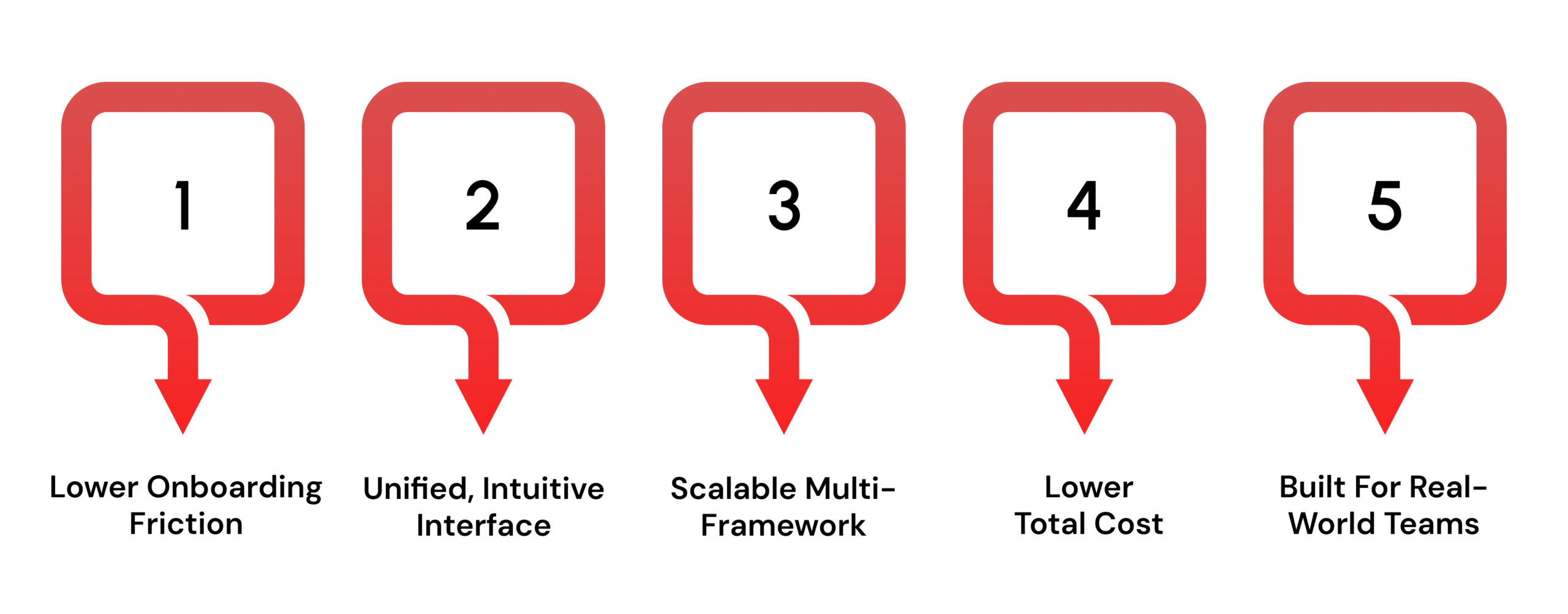
Below are the top reasons many enterprises choose VComply instead of staying with SAP GRC or similar legacy tools:
- Lower Onboarding Friction: You can deploy VComply in weeks, not months, enabling faster framework mapping, workflow activation, and quicker audit readiness.
- Unified, Intuitive Interface: You manage compliance, risk, policies, and incidents in a single platform, reducing tool sprawl and simplifying collaboration across teams.
- Scalable Multi-Framework Support: You can manage SOX, HIPAA, GDPR, PCI DSS, ISO, and multiple frameworks simultaneously using built-in controls, without rebuilding programs.
- Lower Total Cost: You avoid expensive consulting, modular add-ons, and heavy maintenance, resulting in a lower long-term cost compared to legacy GRC stacks.
- Built for Real-World Teams: With no-code workflows, automated alerts, and clean dashboards, both technical and non-technical users can adopt the platform easily and consistently.
Finding it hard to stay ahead of audits and regulatory demands? Simplify governance and risk management with VComply’s RiskOps and ComplianceOps to automate workflows, track controls in real time, and stay audit-ready all year.
With these advantages in mind, organizations are now seeking expert guidance to ensure a seamless migration from SAP GRC to VComply.
Expert Guidance for a Smooth GRC Migration from SAP GRC

Below are the key steps that support a smooth migration.
- Prepare and Normalize Existing Data: Start by reviewing your current controls, risks, policies, and case records to confirm accuracy and eliminate outdated content before migrating.
- Map Responsibilities and Ownership: Assign module owners for compliance, risk, policies, and incidents so each function leads its own transition activities.
- Define Migration Milestones: Outline timelines for discovery, configuration, testing, and rollout.
- Align Controls With Updated Workflows: Review how your teams operate today and adjust control structures, approval paths, and reporting needs to match your current governance model.
- Invest in User Enablement and Change Readiness: Support team adoption with training sessions, guided walkthroughs, and communication plans that explain why the migration is happening.
- Use VComply Implementation Support: Collaboration with VComply’s onboarding team helps streamline configuration and establish best practices for ongoing governance.
Read Next: Establishing Effective Third-Party Risk Management (TPRM) Policies
With the right migration approach, you can experience the full potential of your modernized GRC strategy. Start a free trial with VComply to see how it can help your organization.

Wrapping Up
Choosing a modern GRC platform is no longer just about replacing outdated technology. It is about equipping your teams with tools that match the speed, transparency, and accountability your regulatory scene now demands.
With purpose-built modules for compliance, risk, policy, and incident management, VComply helps you maintain operational readiness throughout the year. The platform strengthens visibility, reduces manual effort, and enables stronger collaboration across functions.
To see how VComply can modernize your entire GRC ecosystem, book a personalized demo and experience the platform in action.
FAQs
Modern cloud GRC platforms focus on agility, usability, and fast deployment, while SAP GRC relies on heavier configurations and longer implementation cycles. Cloud platforms provide practical updates, easy integrations, and intuitive workflows that help you adapt to developing regulations faster.
You have likely outgrown SAP GRC if scaling requires heavy customization, reporting takes too long, integrations feel limited, or teams rely on manual workarounds. When governance becomes slower, less visible, or harder to operationalize across departments, it signals a need for a more flexible, modern GRC environment.
Look for cloud native architecture, flexible workflow builders, practical dashboards, multi-framework support, intuitive user experience, and strong API connectivity. Prioritize automation, evidence collection, cross-functional collaboration features, and tools that reduce manual tasks while improving visibility for leadership.
Yes, most modern GRC platforms are designed for hybrid and multi-cloud environments. They integrate with identity systems, security tools, productivity suites, and operational platforms across distributed ecosystems.
Modern platforms use REST APIs, native connectors, and webhook-based automation to sync data with HR systems, ticketing tools, SIEMs, and identity platforms. This helps you streamline evidence collection, automate workflows, share context between teams, and align compliance activities directly with operational processes.