

Retail Compliance Guide: Standards That Reduce Operational Risk
Operational disruptions in retail strike when compliance gaps remain hidden, leaving store operations, e-commerce channels, and payments vulnerable.

Given that U.S. retail trade sales rose 4.8% year-on-year in August 2025, even a small compliance failure can put growth at risk. Implementing clear standards and controls around licensing, customer data, payment flows, and vendor oversight ensures those risks are contained. By focusing on “retail compliance” as a strategic operational tool, you can protect revenue, sustain trust, and streamline audit readiness across your channels.
Key Takeaways
- Retail compliance helps prevent operational disruptions by keeping pricing, labeling, employee practices, and customer interactions aligned with U.S. regulations.
- Key risk areas include data security gaps, inconsistent store processes, vendor failures, and rising payment fraud across retail channels.
- Compliance standards across consumer protection, labor laws, cybersecurity, sustainability, and supplier management set the foundation for stable operations.
- Strong controls, timely audits, clear policies, and structured incident handling reduce failures and help retail teams protect revenue and customer trust.
What Retail Compliance Means Today?
Retail compliance in the U.S. reflects a combination of regulatory expectations, operational standards, and controls that keep store, e-commerce, and payment environments stable. Modern retail operations demand consistent documentation, accurate disclosures, safe payment handling, and verifiable privacy safeguards to meet federal and state requirements. Retailers managing physical locations and online channels face overlapping obligations that intensify pressure on risk and compliance teams. Mastering these retail compliance requirements reduces unnecessary operational risk and helps maintain customer trust as regulations evolve.
Once the expectations are clear, the next step is recognizing the operational risks that tend to appear when those expectations aren’t met.

Core Operational Risks Retailers Must Control
Retailers face several operational risks that directly affect revenue, customer confidence, and compliance posture.
Here are the core risks commonly seen in the U.S. retail industry, including those linked to store operations, e-commerce flows, logistics, and payments:
- Regulatory non-compliance creates disruptions when pricing accuracy, product labeling, or store licenses fall short of state expectations. These issues trigger enforcement actions and force teams to divert time and budget toward corrective efforts.
- Data privacy and payment security gaps expose retailers to breaches that place customer information at risk. These incidents often escalate into chargebacks, fraud losses, and PCI DSS violations.
- Operational process weaknesses around inventory, returns, and logistics create inconsistencies that damage customer satisfaction. These inconsistencies commonly reflect missing retail compliance standards and limited visibility across workflows.
- Vendor and supplier failures introduce downstream compliance issues when documentation, safety standards, or delivery timelines are not met. These gaps increase operational risk and weaken supply-chain stability.
Also read: The Best Retail Compliance Software for 2025: Why VComply Leads a Changing Industry
Seeing how these risks unfold sets the stage for the practical compliance controls that help retail teams manage them with confidence.
Key Areas of Retail Compliance

Retail compliance in the U.S. spans multiple operational layers that influence how safely and legally retailers operate across stores, e-commerce platforms, and payment systems. Here are the core areas retailers must master to reduce operational risk and maintain a compliant, trustworthy presence in competitive markets:
1. Consumer Protection and Fair Trade Laws
Consumer protection requirements ensure pricing accuracy, honest advertising, safe products, and transparent customer interactions across all retail environments. These rules protect customers from deceptive practices and help prevent disputes that disrupt store operations and e-commerce workflows. Retail compliance regulations strengthen brand credibility when pricing, labeling, and disclosures stay aligned with federal and state expectations.
2. Labor Laws and Workplace Safety
Labor laws require retailers to maintain safe conditions, fair pay structures, and documented employee rights across their stores and fulfillment centers. Violations in this area often create operational slowdowns, high turnover, and legal exposure that directly raise risk. Compliance in the retail industry improves when training, scheduling, and workplace safety protocols follow OSHA and state labor standards consistently.
3. Supply Chain and Vendor Management
Vendor performance has a direct impact on operational reliability, product quality, and regulatory adherence. Retailers depend on suppliers to meet ethical sourcing, product safety, and documentation requirements that reduce downstream operational risk. Regulatory compliance with retail industry standards becomes easier to maintain when vendor contracts, certifications, and audits follow a structured, repeatable process.
4. Environmental Compliance and Sustainability
Environmental regulations require retailers to manage waste, follow recycling rules, and adopt sustainable practices that meet federal and state expectations. These requirements help control long-term operational risks tied to fines, supply disruptions, and compliance investigations. Retail compliance standards remain stronger when teams track environmental obligations across warehouses, stores, and distribution networks.
5. Data Protection and Cybersecurity Compliance
Data protection rules serve as a safeguard against breaches, fraud, and operational downtime across online and in-store systems. Retailers handling customer information must follow privacy laws, secure payment systems, and maintain incident-response readiness. Retail regulatory compliance strengthens when cybersecurity controls protect sensitive data throughout the entire customer journey.
Once the broader compliance areas are understood, it becomes easier to identify the controls that keep daily operations steady and predictable.
Compliance Controls Retailers Should Implement Immediately
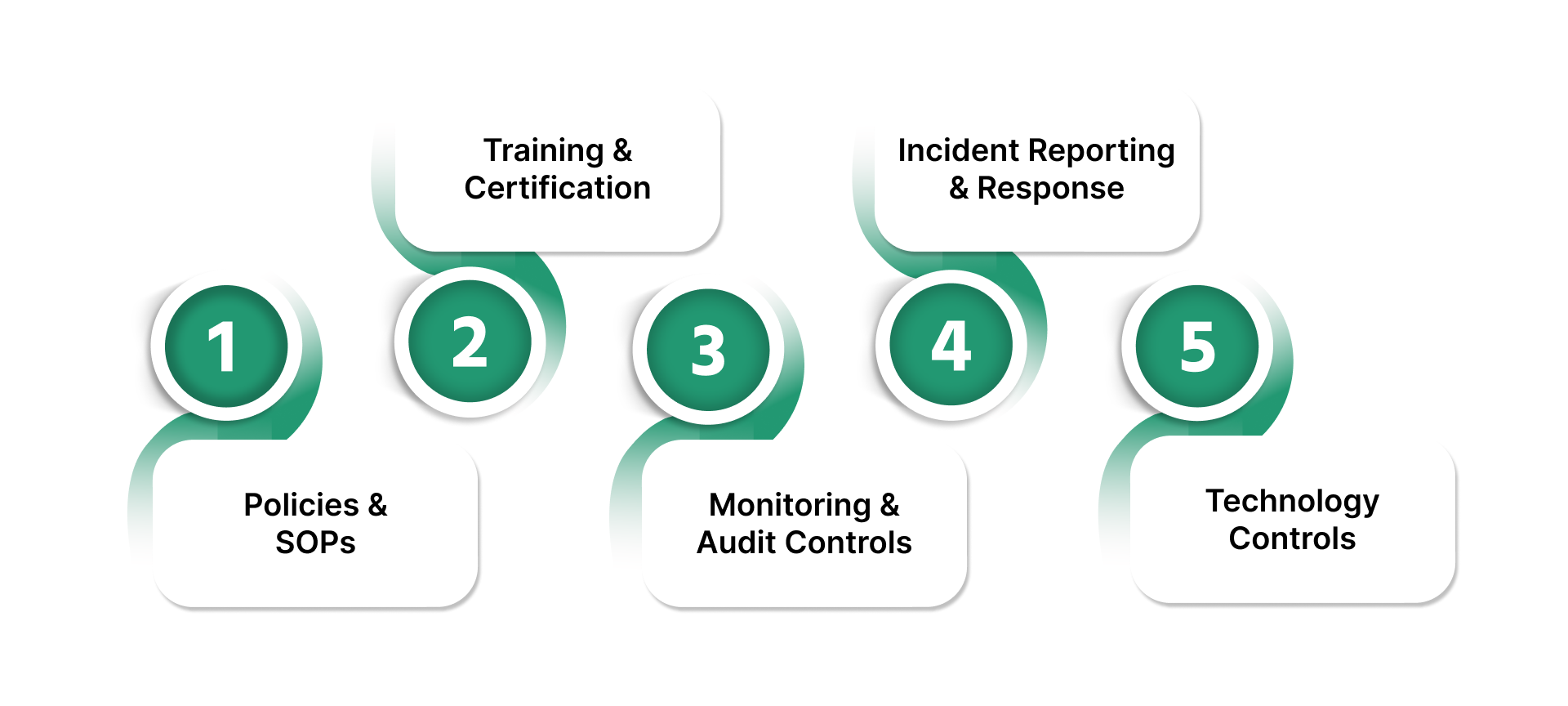
Retailers lower operational risk when internal controls guide actions, maintain consistency, and prevent lapses across stores, fulfillment teams, online channels, and payment systems. Here are the essential compliance controls that strengthen daily retail operations in the U.S.:
1. Policies & SOPs
Clear, documented policies outline expectations for pricing accuracy, returns, inventory handling, data usage, and payment acceptance. These policies reduce ambiguity and help teams maintain consistent adherence across all locations. Retail regulatory compliance improves substantially when updated SOPs are accessible, acknowledged, and enforced.
2. Training & Certification Controls
Training programs ensure employees understand safety rules, privacy standards, operational procedures, and payment security requirements. Strong certification controls prevent knowledge gaps from turning into operational failures. Compliance in retail industry settings strengthens when training renewals follow structured cycles.
3. Monitoring & Audit Controls
Routine monitoring identifies deviations before they become liability concerns. Audit controls verify store processes, e-commerce workflows, and payment operations through documented evidence. Retail compliance requirements become easier to manage when monitoring insights guide rapid adjustments.
4. Incident Reporting & Response Controls
Structured incident reporting helps store teams, e-commerce units, and payment specialists escalate issues immediately. Rapid response procedures minimize downtime and reduce the impact of operational disruptions. These controls build trust and ensure that retail efforts remain consistent.
5. Technology Controls
Technology platforms automate workflow approvals, policy distribution, task assignments, and audit trails across multiple retail locations. Centralized systems like Vcomply simplify documentation and ensure every operational change is traceable. Retail regulatory compliance strengthens when dashboards alert managers about overdue actions or potential risks.
Also read: Retail Safety Training for Store Workers: A Comprehensive Guide
With the right controls in place, the real value appears when compliance prevents issues that would otherwise cause operational setbacks.
Operational Challenges That Complicate Retail Compliance
Retailers face recurring operational challenges that make retail compliance harder to maintain across store locations, e-commerce channels, and payment systems. Here are the challenges commonly experienced by retail teams that influence compliance with retail execution and increase operational risk:
- Constant regulatory updates create uncertainty when federal, state, and industry rules shift faster than internal processes. This dynamic environment makes it difficult for compliance managers to maintain consistent documentation and timely policy updates.
- Store and e-commerce operations often work in silos, generating gaps in pricing accuracy, data privacy steps, and customer-handling requirements. These inconsistencies weaken retail compliance standards and expose retailers to avoidable risk.
- High employee turnover limits how effectively compliance training is retained across shifts and locations. This leads to operational errors that impact safety, customer trust, and audit readiness.
- Third-party vendors add complexity when supplier documentation fails to meet retail regulatory compliance expectations. These gaps introduce downstream risks that affect inventory reliability, product safety, and customer experience.
- Payment systems face rising fraud attempts that require stronger monitoring and PCI DSS controls. These incidents strain teams who must address both operational continuity and regulatory reporting.
Recognizing these challenges highlights why preventing failures requires a structured approach rooted in consistent compliance practices.
How Compliance Prevents Retail Failures?
Compliance acts as a safeguard that protects retailers from operational failures, financial loss, and reputational damage.
Here are clear ways consistent compliance practices reduce failures across store operations, e-commerce flows, and payment environments:
- Fraud incidents decrease significantly when PCI DSS controls catch unusual activity before transactions escalate. This early detection helps retailers avoid chargebacks, customer disputes, and payment interruptions.
- Store shutdowns become less likely when safety protocols, pricing accuracy checks, and labor-law compliance remain consistent. This steady performance allows retail compliance standards to hold firm during inspections or audits.
- E-commerce disruptions reduce when privacy notices, secure checkout systems, and data-handling rules stay aligned with U.S. regulations. These controls prevent privacy violations that damage customer trust and create operational delays.
- Vendor-related failures decline when supplier documentation, product safety assurances, and sourcing rules follow a structured review. This helps retailers avoid risky shipments, compliance violations, and brand damage.
- Operational inconsistencies fade when workflow automation, audit trails, and policy management are centralized through platforms like VComply. This structure ensures required tasks stay on track and incidents get resolved before they grow into failures.
The protective effect of compliance becomes even stronger when supported by tools designed to keep tasks, records, and oversight organized across all channels.

Strengthen Retail Compliance with VComply
VComply helps retail teams reduce operational risk by centralizing compliance workflows, documentation, audits, and corrective actions across every store and online channel.
Here are the capabilities that support stronger, faster, and more reliable retail compliance:
- Automated workflows ensure compliance tasks never slip through gaps across store, e-commerce, and payment operations. These automated assignments reduce manual follow-up and help teams maintain consistent adherence to retail compliance standards.
- Centralized policy management keeps every retail location aligned with accurate procedures, updated documents, and controlled acknowledgments. This prevents outdated instructions from causing operational inconsistencies or regulatory violations.
- Audit-ready evidence collection stores compliance proofs, reports, and logs in one secure location. This prepares retailers for inspections, state audits, and payment security checks without last-minute scrambling.
- Risk registers highlight emerging operational risks across pricing, privacy, inventory, safety, and payments. These insights help retail leaders prioritize corrective action before issues impact sales or customer trust.
- Incident and case management provides a structured response path for safety issues, payment anomalies, privacy concerns, and vendor problems. This ensures retail compliance requirements stay intact even when unexpected events occur.
- Vendor compliance tracking helps retailers monitor supplier certifications, safety documents, and sourcing rules. This reduces downstream risk and strengthens regulatory compliance across the entire supply chain.
Start a free trial today and see how VComply simplifies retail compliance while reducing operational risk across every channel.
Wrapping Up
Retailers protect their operations, customers, and revenue when compliance becomes a consistent, structured part of daily decision-making. Strong standards, clear controls, and proactive oversight help reduce risk across stores, e-commerce channels, and payment systems. VComply supports these efforts by centralizing workflows, automating audits, and strengthening policy management. Retail teams can streamline compliance, reduce operational risk, and move forward confidently with VComply’s purpose-built platform.
Book a demo today and explore how VComply helps retail teams automate compliance, strengthen controls, and reduce operational risk with clarity and speed.
Frequently Asked Questions
Retail compliance refers to the laws, standards, and operational controls retailers must follow to stay legally compliant, protect customers, and avoid penalties. It covers areas like consumer protection, data privacy, workplace safety, payments, and vendor management. Strong compliance helps retailers reduce operational risk and maintain customer trust.
Compliance reduces disruptions caused by pricing errors, unsafe working conditions, payment issues, or privacy violations. These disruptions often lead to fines, downtime, and customer dissatisfaction. A strong compliance structure creates stability across stores and digital channels.
Retailers typically need to follow FTC rules, state consumer protection laws, PCI DSS requirements, ADA accessibility standards, and OSHA safety regulations. E-commerce teams also manage data privacy laws like CCPA. Each regulation affects a different part of retail operations, from pricing to payment security.
Most retailers benefit from conducting audits quarterly or semi-annually, depending on their operational size. High-risk areas like payments or data security often require more frequent review. Regular audits help catch issues early before they affect customers or regulators.
Non-compliance can lead to fines, legal action, customer complaints, and operational delays. Payment violations may trigger chargebacks or card-processing restrictions. Long-term issues can damage brand reputation and erode customer trust.
Compliance standardizes how tasks are executed, preventing mistakes and inconsistencies across staff, stores, and digital platforms. Clear controls protect payment data, ensure accurate pricing, and maintain safe working conditions. This reduces unexpected failures that disrupt daily operations.