

HIPAA Encryption Requirements 2026: A Practical Compliance Guide
Every day, the risk of a devastating data breach feels closer to home than it did last year. For compliance officers, risk managers, and CISOs in healthcare, finance, higher education, manufacturing, and utilities, that’s not just a number; it’s a reality check: patient and employee data is both a regulatory and existential business risk.

In 2024 alone, U.S. healthcare organizations reported hacking and IT incidents that exposed at least 259 million protected health records, with the average breach affecting more than 140,000 records, a stark reminder that attackers aren’t slowing down.
Encryption today is a foundational compliance control and a strategic risk management tool that influences breach impact, audit outcomes, and even legal liability. This blog will explain what HIPAA encryption requirements mean in practice, so you can align security with governance and operational goals.
Key Takeaways
- HIPAA encryption is risk-based but often expected in practical scenarios such as cloud systems, mobile devices, vendor data sharing, and off-site backups.
- Data at rest and data in transit require different encryption approaches using recognized standards and secure transmission protocols.
- Encryption reduces breach impact and may support HITECH safe harbor, but it must be combined with access controls and risk management.
- Effective compliance requires governing encryption across legacy systems, vendors, and non-production environments with proper documentation.
- VComply enables centralized governance of HIPAA encryption through integrated compliance, risk, policy, and incident management.
Did you know?
A peer-reviewed research review published in Cluster Computing analyzed 99 healthcare security studies and found that encryption is one of the most consistently recommended controls for protecting electronic health records and ePHI. The findings reinforce why HIPAA encryption requirements are treated as a foundational safeguard, not just a technical preference, in modern healthcare compliance programs.
HIPAA Encryption Requirements Explained
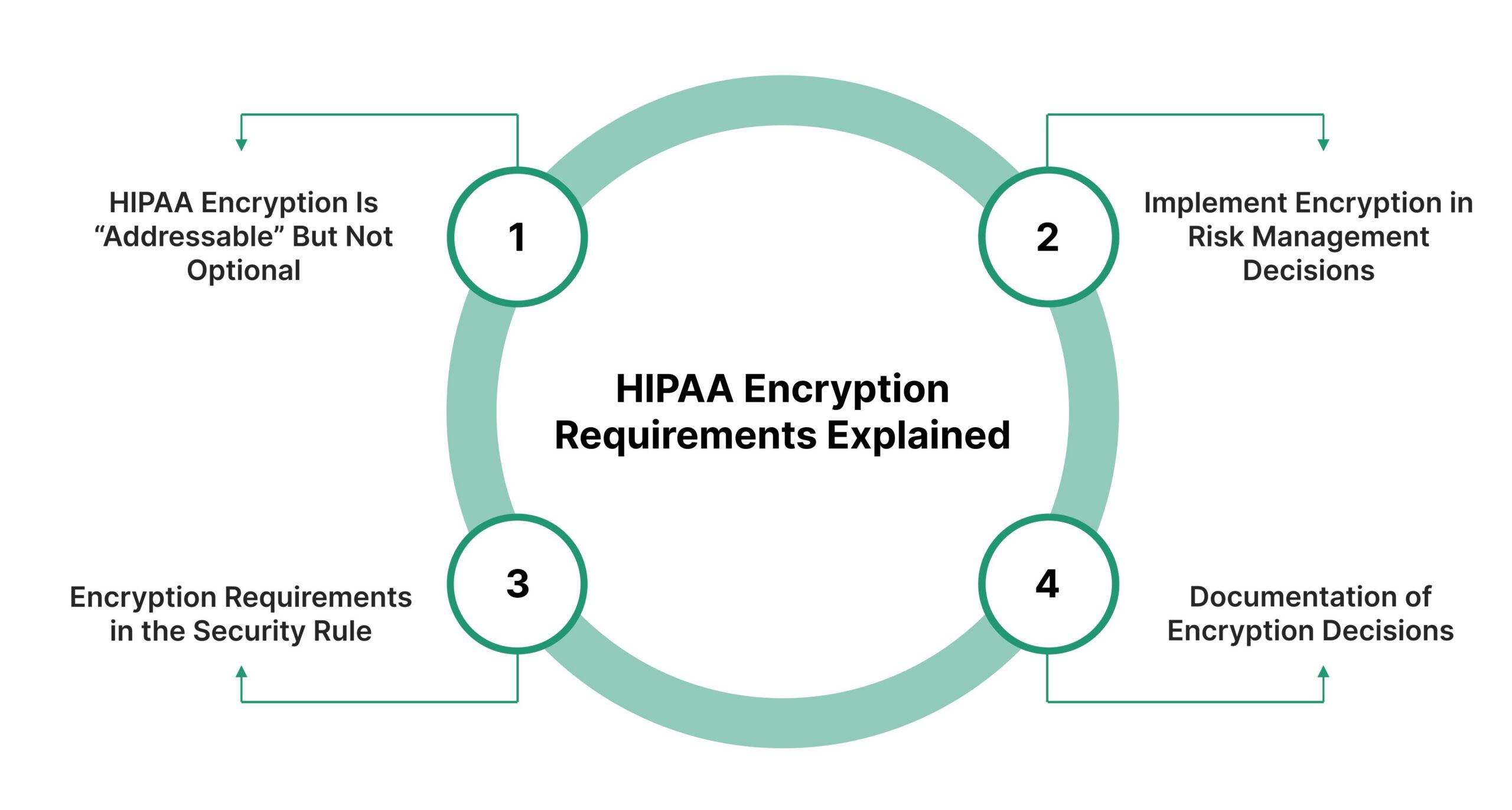
Understanding what HIPAA expects regarding encryption removes compliance uncertainty and supports stronger risk management. While encryption is often discussed as a technical control, the HIPAA Security Rule frames it as a risk-based safeguard that organizations must thoughtfully consider and address.
Below are key aspects of HIPAA’s encryption expectations:
- HIPAA Encryption Is “Addressable” But Not Optional: Covered entities and business associates must assess whether encryption is reasonable and appropriate to protect ePHI. If deemed inappropriate after risk analysis, alternative measures achieving equivalent protection must be documented and implemented.
- Implement Encryption in Risk Management Decisions: Encryption decisions must be part of your formal risk assessment and mitigation strategy, demonstrating how the choice supports confidentiality, integrity, and availability of ePHI.
- Encryption Requirements in the Security Rule: The HIPAA Security Rule’s technical safeguards include implementation specifications to encrypt ePHI at rest and in transit whenever appropriate to protect against unauthorized access.
- Documentation of Encryption Decisions: If your organization chooses not to encrypt, you must document why it’s not reasonable and detail equivalent protections you do implement.

HIPAA Encryption: Definition, Controls, and Risk Scenarios
Encryption is the process of transforming electronic protected health information (ePHI) into scrambled, unreadable data using an algorithm, so that only authorized users with a decryption key can read it.
If ePHI is accessed without authorization but remains encrypted, it is considered unsecured only until decrypted, making the data unintelligible to attackers without the key.
Difference between encryption, access control, and authentication
- Encryption protects information itself by scrambling its contents.
- Access Control determines who can view or modify ePHI based on roles and permissions.
- Authentication verifies identity (e.g., passwords, MFA) before granting access.
Together, these controls layer security: authentication confirms identity, access control limits privileges, and encryption protects the data even if those controls fail.
Encryption does not stop all attacks, but it ensures that stolen or intercepted ePHI remains unreadable and unusable. When ePHI is encrypted, even if a hacker bypasses authentication or access controls, the data itself remains protected unless the decryption key is compromised.
Example: Encrypted Vs Unencrypted Laptop
- Encrypted Laptop: If lost or stolen, ePHI stored locally remains scrambled, and attackers cannot read patient records without the key.
- Unencrypted Laptop: Loss or theft immediately exposes readable patient data, triggering breach reporting requirements and significant compliance risk.
Below are high-risk scenarios where encryption is non-negotiable:
- Mobile Devices and Laptops: Encryption protects ePHI on portable devices if they are lost or stolen outside secure networks.
- Cloud Applications and Storage: Encryption prevents unauthorized access to ePHI in cloud or shared environments, even during misconfigurations.
- Remote Access and Public Networks: Encrypting data in transit (TLS or VPNs) protects ePHI when accessed over public or remote networks.
- Vendor and Partner Data Sharing: Encryption safeguards ePHI during transfers between covered entities and business associates.
- Off-Site and Cloud Backups: Encryption secures backup and archived ePHI if storage media or cloud copies are compromised.
ComplianceOps helps you map HIPAA encryption requirements directly to controls, link them to formal risk assessments, and maintain auditor-ready documentation that clearly shows decision rationale, ownership, and evidence long before an OCR review begins.
Now, the next question is where those requirements must be applied across systems, data states, and workflows.
Where HIPAA Requires Encryption to Be Applied
Both stored and transmitted electronic Protected Health Information (ePHI) face unique attack surfaces, so HIPAA’s security expectations address where encryption must be applied, not just whether it should exist.
Below are the two foundational encryption domains under HIPAA.
1. Encrypting ePHI at Rest
Electronic Protected Health Information does not only live inside primary applications. It accumulates silently across systems, devices, and repositories over time.
Below are the primary contexts that define ePHI at rest:
Full Disk Encryption
Full Disk Encryption (FDE) secures all stored electronic Protected Health Information (ePHI) on a device by encrypting the entire storage medium at the hardware or system level.
Below are key principles and operational considerations for full disk encryption:
- Comprehensive Device Coverage: Applies to laptops, desktops, tablets, and mobile devices that store ePHI.
- Protection Against Physical Access: Data remains unreadable if devices are lost, stolen, or decommissioned.
- Limits of Partial Encryption: File-level encryption leaves metadata and temporary files exposed.
- Authentication Integration: Strong credentials or pre-boot authentication prevent unauthorized system access.
Also Read: What to Expect from an OCR HIPAA Investigation
Virtual Disk and Database Encryption
Virtual disk and database encryption are critical for protecting ePHI stored in cloud environments, virtual machines (VMs), or hosted systems, such as SaaS platforms and electronic health records (EHR) solutions.
Below are essential considerations for virtual disk and database encryption:
- Virtual Machine Disk Encryption: Secures VM storage volumes and snapshots.
- Container and Volume-Level Encryption: Protects data in cloud and hybrid infrastructures.
- Database Encryption At Rest: Safeguards structured ePHI in EHRs and analytics systems.
- Key Separation: Encryption keys are managed outside the data environment.
- Scalability and Consistency: Encryption must work across on-prem, cloud, and hybrid systems without disrupting performance.
Off-Site and Cloud Backups
Backup copies of ePHI are essential contingency controls under HIPAA’s Security Rule, ensuring data can be restored following system failures, disasters, or data corruption.
Below are critical considerations for off-site and cloud backup encryption:
- Backup Media Exposure Risks: Off-site media is vulnerable to loss or theft.
- Disaster Recovery Requirements: HIPAA requires retrievable, exact, encrypted copies of ePHI.
- Cloud Backup Encryption: Data should be encrypted before transmission and while stored.
- Key Management Integrity: Secure key storage ensures backups remain protected yet recoverable.
2. Encrypting ePHI in Transit
Data in transit refers to ePHI that is actively moving between systems, devices, or networks, not merely stored.
Below are core concepts related to ePHI in transit:
End-to-End Encryption
End-to-end encryption (E2EE) protects ePHI by encrypting data at the source and ensuring it remains unintelligible until it reaches the recipient’s device or system. Below are critical components of end-to-end encryption in a HIPAA context:
- Cryptographic Protection From Origin To Destination: E2EE ensures that only the sending and receiving endpoints hold the decryption keys; intermediate servers, network nodes, or service providers cannot decrypt the content in transit. This greatly reduces the chance of unauthorized disclosure.
- Email and Messaging Safeguards: When ePHI is sent via email, traditional transmission protocols like TLS may encrypt data during transfer but decrypt it at mail servers. End-to-end encryption ensures content remains encrypted throughout the entire journey.
- Portal and API Implementations: Portals and APIs handling sensitive patient identifiers or clinical data should implement E2EE to minimize exposure to intermediate service layers or network nodes that could otherwise access plaintext ePHI.
Secure Network Connections (VPNs and IPSec)
To protect ePHI in transit across untrusted or public networks, organizations often rely on secure network tunnels such as Virtual Private Networks (VPNs) that use strong encryption protocols.
Below are key elements of secure network connections for HIPAA compliance:
- Virtual Private Networks For Remote Workforce Access: A HIPAA-aligned VPN encrypts network traffic between remote users and corporate or clinical networks, reducing the likelihood of ePHI interception over public or home internet connections.
- IPsec Tunneling For Persistent Site-to-Site Protection: Internet Protocol Security (IPsec) is a protocol suite that encrypts and authenticates data at the network layer, creating a cryptographically secure link between sites, data centers, or cloud segments.
- Hybrid Cloud Connectivity and Encryption Consistency: In hybrid cloud environments, where ePHI moves between private infrastructure and public cloud services, secure network connections ensure encryption continuity across boundaries.
- Authentication and Access Controls Within Secure Tunnels: Encryption alone is insufficient; secure network solutions should integrate strong authentication (e.g., multi-factor) and access control policies to verify that only authorized systems and users can initiate or maintain encrypted sessions.
Logging and audit trails further support HIPAA’s accountability expectations.
Also Read: HIPAA Right of Access in 2025: What Compliance Leaders Need to Know
After identifying where encryption must be applied, it’s essential to understand which standards and protocols are considered acceptable under HIPAA.
HIPAA-Acceptable Encryption Standards and Protocols
HIPAA does not prescribe specific encryption technologies, but compliance generally aligns with standards established by authoritative bodies such as the National Institute of Standards and Technology (NIST), which inform acceptable cryptographic methods.
Below are commonly recognized encryption standards and protocols relevant to HIPAA.
AES Encryption Standards (128-bit, 192-bit, 256-bit)
The Advanced Encryption Standard (AES) is widely recognized as a strong cryptographic method for protecting ePHI because it has been vetted and standardized by U.S. federal authorities.
Below are key aspects of AES encryption and its role in HIPAA compliance:
- AES As An Industry-Recognized Cryptographic Standard: AES, established by NIST, is the U.S. federal standard for encrypting electronic data. It is a symmetric block cipher designed to securely encrypt fixed-size data blocks and resist modern cryptanalytic attacks when properly implemented.
- AES-128, AES-192, and AES-256 Explained: These AES variants differ by key length—128, 192, or 256 bits. Longer keys increase cryptographic strength by making brute-force attacks significantly more difficult.
- Why AES-256 Is Commonly Preferred For ePHI: AES-256 provides the strongest protection in the AES family and is widely used to secure sensitive ePHI, including clinical records and financial health data under HIPAA.
- Performance Versus Security Considerations: AES-256 adds more computational overhead than shorter keys. Organizations balance this by using hardware acceleration to maintain performance while meeting security requirements.
Encryption Protocols Used to Protect Data in Motion
When ePHI moves between systems, it must be protected by widely accepted encryption protocols that secure the communication channel itself.
Below are the key encryption protocols and practices for data in transit:
- Transport Layer Security (TLS) Protocols: TLS is the dominant protocol securing web-based communications and other client-server exchanges, ensuring that ePHI transmitted over HTTPS and similar channels is encrypted end-to-end at the network layer.
- Internet Protocol Security (IPsec): IPsec is a suite of protocols that encrypts and authenticates IP packets across networks, making it suitable for secure communications between hosts, gateways, or hybrid infrastructure segments.
- Secure Key Storage And Handling Practices: Secure handling of cryptographic keys is fundamental: generate keys using strong entropy sources, store them in isolated key management systems, rotate keys regularly to limit exposure, and separate key storage from encrypted data to reduce compromise risk.
- Mutual Authentication Extensions (e.g., mTLS): Mutual TLS (mTLS) enhances TLS by requiring both client and server to verify each other’s certificates before establishing a session.
Defining acceptable encryption standards is only part of the equation; understanding what those safeguards actually protect, and where their limits lie, is equally important.
What HIPAA-Compliant Encryption Protects And Its Limits
Encryption significantly strengthens the confidentiality of electronic Protected Health Information (ePHI) by making intercepted or accessed data unreadable to unauthorized actors.
Below are the core protections and limitations of HIPAA-compliant encryption.
Threats Encryption Significantly Reduces
Encryption transforms electronic Protected Health Information (ePHI) into an unreadable format that significantly mitigates key exposure risks.
Below are key threats that proper encryption reduces:
- Mitigating Risks From Lost Or Stolen Devices; Encryption renders the contents of devices, including laptops, smartphones, and removable media, unreadable without valid keys. If hardware is lost or stolen, encryption ensures that ePHI cannot be accessed directly from the storage medium.
- Preventing Unauthorized Access to Data Content: Even when attackers bypass network defenses or gain system access, encrypted ePHI remains indecipherable without cryptographic keys.
- Reducing Breach Notification Liability Under HITECH Safe Harbor: Under HIPAA’s Breach Notification Rule, encrypted data that is acquired but remains unreadable, undecipherable, or unusable generally does not constitute a reportable breach.
For many covered entities and business associates, this “safe harbor” can meaningfully reduce regulatory reporting obligations and associated compliance costs after an incident.
Also Read: 2025 HIPAA Compliance Updates: What Healthcare Organizations Need to Know
Risks Encryption Alone Cannot Solve
Encryption protects ePHI confidentiality, but many compliance failures stem from how systems are accessed and managed rather than whether the data is unreadable.
Below are key risks that encryption alone cannot address:
- Insider Misuse and Privilege Abuse: Encryption does not prevent authorized users from misusing ePHI once they have legitimate access rights. Individuals with elevated privileges, whether negligent or malicious, can access, copy, or exfiltrate sensitive data despite encryption controls.
- Weak Access Controls That Permit Unrestricted Access: If user accounts are granted excessive permissions or lack granular role-based restrictions, encryption will not stop unauthorized internal access.
- Poor Identity and Password Practices: Encryption does not govern how identities are authenticated. Weak, reused, or default passwords allow attackers to penetrate systems and access decrypted ePHI if they compromise credentials.
VComply Risk Ops helps you identify where encryption lowers risk and where it doesn’t by tying encryption controls to enterprise risk assessments, tracking residual risk, and prioritizing remediation before gaps turn into incidents or audit findings.
Recognizing both the protections and limitations of encryption helps explain why regulatory changes under HITECH significantly raised the stakes for getting it right.
How HITECH Raised the Stakes for Encryption
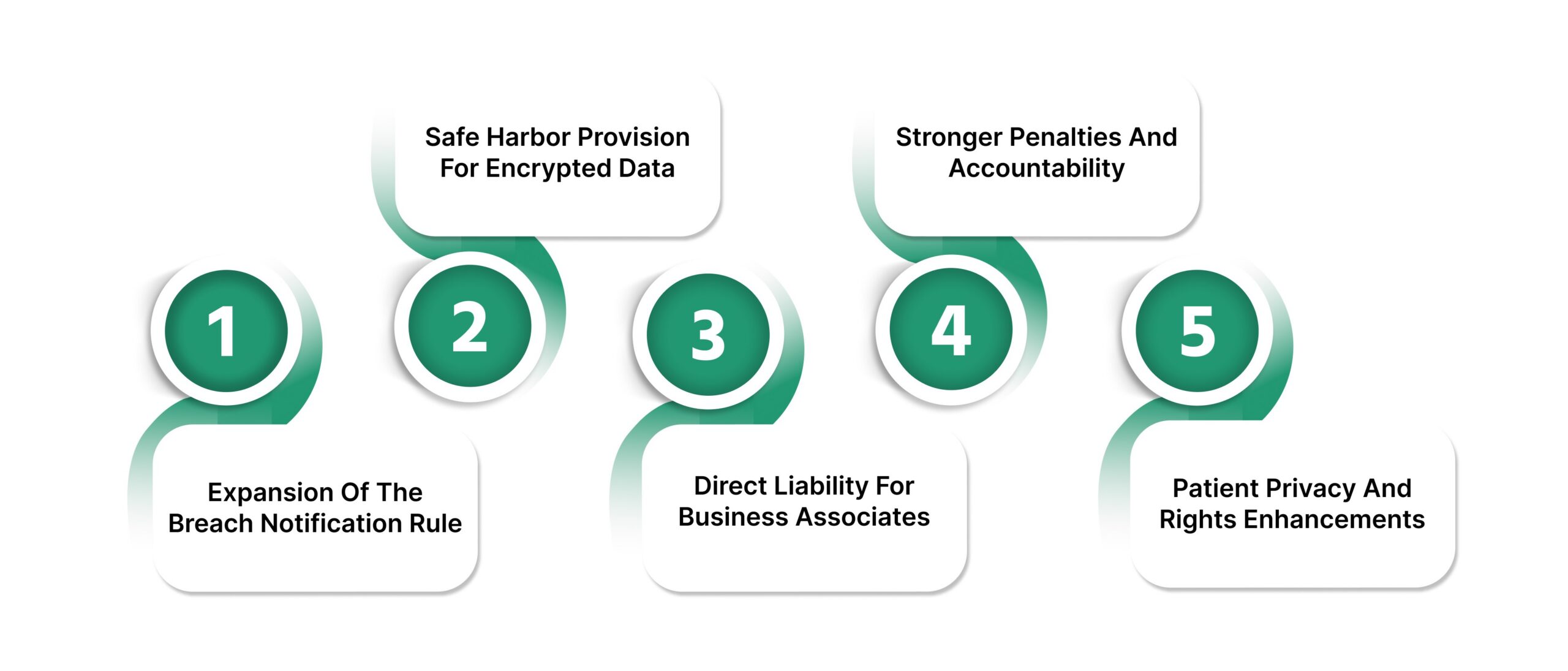
The Health Information Technology for Economic and Clinical Health (HITECH) Act significantly strengthened HIPAA by expanding breach notification obligations, extending compliance requirements to vendors, and enhancing enforcement mechanisms.
Below are key regulatory enhancements introduced by HITECH:
- Expansion Of The Breach Notification Rule: HITECH introduced formal breach notification requirements for unsecured ePHI, mandating disclosures to affected individuals, HHS, and sometimes the media when data is unreadable or compromised.
- Safe Harbor Provision For Encrypted Data: Properly encrypted ePHI that meets federal standards generally qualifies for safe harbor, reducing breach notification obligations and regulatory exposure.
- Direct Liability For Business Associates: HITECH made business associates and subcontractors directly liable under HIPAA, extending enforcement beyond contractual obligations.
- Stronger Penalties and Accountability: The Act expanded civil and criminal penalties for non-compliance and positioned encryption as a key control to demonstrate due diligence and reduce enforcement risk.
- Patient Privacy And Rights Enhancements: HITECH strengthened individual rights around access, disclosure, and transparency, reinforcing encryption as a core privacy safeguard.
Also Read: What are the Penalties for HIPAA Violations in 2025?
Now, the next step is addressing the common encryption failures that often undermine HIPAA compliance.
Common HIPAA Encryption Failures and How to Prevent Them
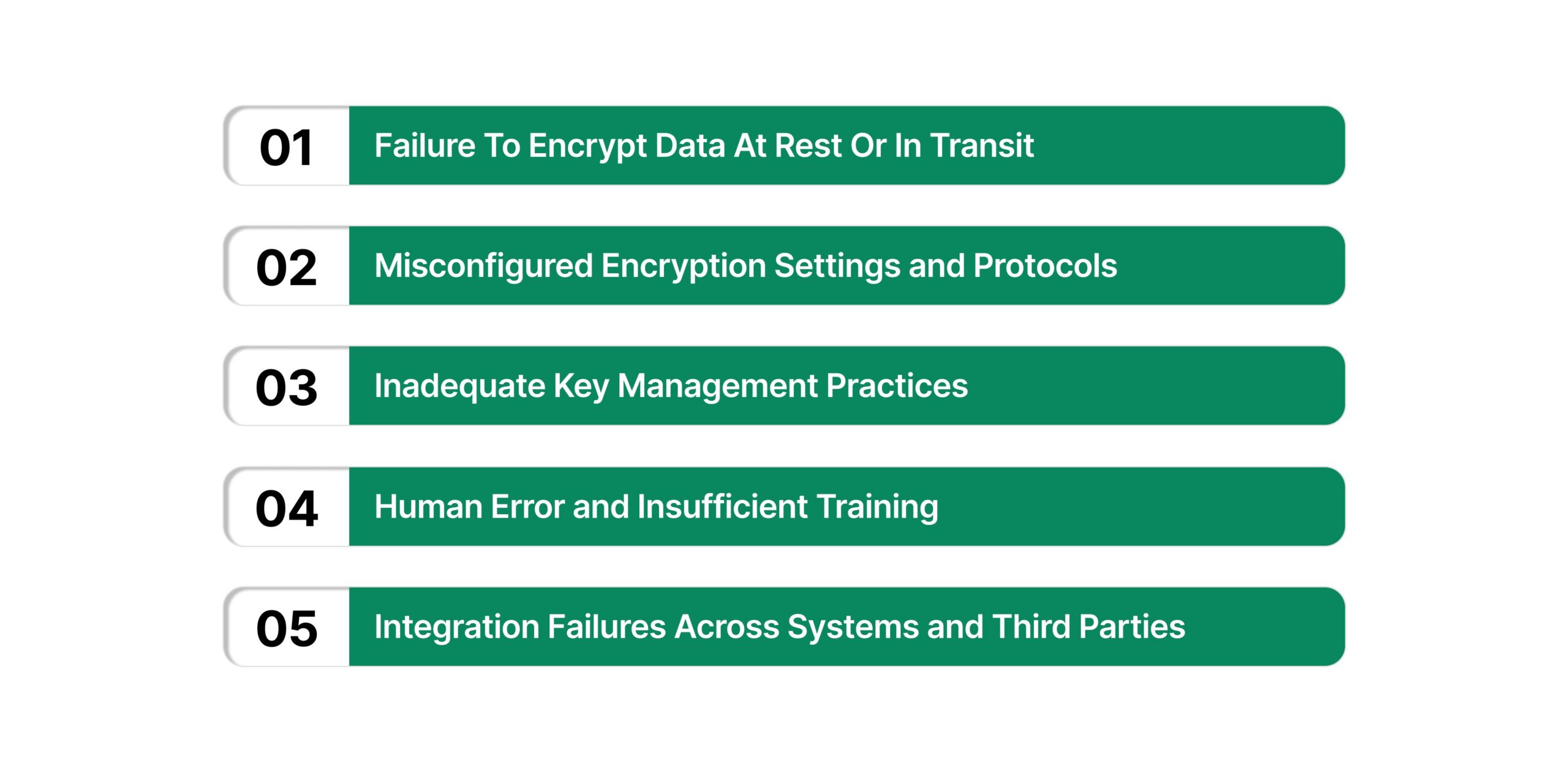
Despite strong encryption standards, compliance gaps persist because technical controls alone do not prevent misconfigurations, human errors, or integration shortcomings.
Below are frequent encryption-related failures and their prevention strategies:
- Failure To Encrypt Data At Rest Or In Transit; Many organizations neglect to apply encryption across all ePHI repositories and communications, including backups, mobile devices, emails, and cloud storage.
Prevention: Develop and enforce comprehensive encryption policies that mandate cryptographic protections for all storage and transmission of ePHI, regularly audit plans, and update encryption implementations to meet current standards.
- Misconfigured Encryption Settings and Protocols: Encryption tools with incorrect configurations, such as outdated cipher suites, expired certificates, or weak defaults, can render protection ineffective or open to downgrade attacks.
Prevention: Regularly validate encryption configurations, use automation for certificate renewals, and enforce strong cipher suites. Integrate configuration management into your compliance monitoring to detect deviations quickly.
- Inadequate Key Management Practices: Poor handling of cryptographic keys, including storing keys alongside encrypted data, failing to rotate keys periodically, or not securely retiring old keys, undermines encryption strength.
Prevention: Employ centralized key management solutions that isolate keys from data, enforce lifecycle controls (generation, rotation, revocation), and log all key operations for audit evidence.
- Human Error and Insufficient Training: Staff may inadvertently disable encryption, misuse secure channels, or bypass protected workflows due to a lack of understanding about encryption policies.
Prevention: Implement role-based training focused on encryption best practices, role responsibilities, and practical scenarios where encryption misuse leads to exposures. Document training and assess comprehension regularly.
- Integration Failures Across Systems and Third Parties: Encryption gaps often emerge where systems interface, or where vendors handle ePHI without aligned controls, resulting in data flow that lacks consistent protection.
Prevention: Conduct system integration reviews and require vendor attestations or contractual encryption obligations. Test data flows end-to-end to confirm that ePHI remains encrypted throughout the process.
VComply’s GRCOps Suite brings compliance, risk, policy, and incident teams into a single governance framework, giving you unified visibility into where encryption applies, who owns it, how risks are tracked, and whether controls remain effective as systems and vendors change.
Today, organizations need a centralized way to govern controls, risk, and accountability at scale. This is where VComply comes in.
How VComply Helps Govern HIPAA Encryption at Scale
Managing HIPAA encryption controls, risk assessments, and compliance documentation across complex environments requires a unified platform designed for governance and operational excellence. VComply’s cloud-based GRC solution provides visibility, automation, and evidence management tailored for regulated industries.

Below is how VComply can strengthen your HIPAA encryption governance program:
- Map Encryption Controls to HIPAA Requirements: VComply lets you document and align encryption requirements with HIPAA controls and internal policies, creating institutional clarity on safeguard expectations. You can define controls, link them to risk assessments, and track implementation status.
- Centralized Risk Assessments and Documentation: With RiskOps and Compliance Ops, you can assess risks associated with unencrypted data, classify risk severity, and document mitigation plans in one place. Automated workflows reduce manual tracking and produce structured documentation that supports board reporting and audit readiness.
- Track Encryption Exceptions And Remediation Plans: VComply enables you to record when encryption controls are assessed as not feasible, document risk-accepted exceptions, and track remediation actions. Dashboards and heat maps help you visualize unresolved issues and prioritize follow-up tasks across controls.
- Manage Vendor Compliance And BAAs: Using VComply’s integrated compliance and risk registers, you can maintain records of third-party encryption obligations, Business Associate Agreements (BAAs), and third-party risk assessments.
- Maintain Audit-Ready Evidence Across Industries: VComply automates evidence collection and organizes documentation, including encryption policies, risk findings, and control tests, so you can readily respond to audit requests.
- Support Compliance, Risk, Policy, and Incident Teams Together: VComply’s GRCOps suite unifies ComplianceOps, RiskOps, PolicyOps, and CaseOps into a collaborative environment. This enables teams to manage encryption governance, integrate policy updates, monitor risks, and resolve incidents with consistent processes and a single source of truth.
To see how VComply can help you govern HIPAA encryption requirements, manage risk, and maintain audit-ready compliance at scale, book a demo with VComply and explore its capabilities in action.
Final Thoughts
Encryption is no longer a narrow technical control confined to IT teams. Under HIPAA, it functions as a risk-reduction mechanism, a compliance safeguard, and a regulatory differentiator that can materially influence breach outcomes, enforcement actions, and organizational trust.
This is where VComply, a US-based GRC software company, plays a critical role. VComply helps organizations operationalize HIPAA encryption requirements by connecting controls to regulations, risks to remediation, vendors to accountability, and evidence to audits, all within a single, centralized GRC platform.
If you are looking to strengthen HIPAA encryption governance, reduce audit friction, and stay prepared as regulatory expectations change, start your 21-day free trial with VComply and see how unified GRC management works in practice.
FAQs
HIPAA does not explicitly mandate separate key storage, but regulators expect reasonable safeguards. Storing encryption keys separately from encrypted data significantly reduces compromise risk. During audits, this practice demonstrates stronger security design and aligns with NIST guidance commonly used to evaluate HIPAA compliance.
HIPAA does not automatically exempt internal networks from encryption. If internal traffic carries ePHI and is vulnerable to interception, misconfiguration, or unauthorized access, encryption may be considered reasonable and appropriate. Risk assessments should justify whether internal transmission encryption is required.
Tokenization can reduce exposure to ePHI by replacing sensitive values with non-sensitive tokens. However, HIPAA still requires safeguards for systems that map tokens back to original data. Tokenization may complement encryption, but does not automatically replace encryption requirements without documented risk analysis.
Encryption controls should be reviewed as part of periodic risk assessments and whenever systems, vendors, or data flows change. HIPAA expects ongoing evaluation, not one-time implementation. Annual reviews are common, but higher-risk environments may require more frequent validation and documentation.
If reporting or analytics databases contain ePHI or can be linked back to individuals, encryption expectations still apply. HIPAA focuses on data sensitivity, not purpose. Organizations must assess whether these datasets pose confidentiality risks and apply encryption where reasonable and appropriate.