

Policy Management Systems Explained Through Ownership, Versioning, and Audit Readiness
Policy management often looks complete until someone asks for proof. Policies are written, approved, and stored, but when audits begin, it becomes difficult to confirm who acknowledged them, which version was in use, or whether they were actually followed.

Most teams depend on shared drives, emails, and multiple tools, which leads to inconsistencies and gaps in tracking. Over time, this creates a disconnect between what is documented and what is happening in practice. Compliance then becomes something that is assumed rather than demonstrated. To avoid this, policy management needs to move beyond storage and be structured around ownership, version control, and traceability.
Quick Look
- Policy management fails at execution, not documentation, with gaps in ownership, version control, and control linkage break enforcement.
- Version control is governance, not admin; without traceable updates and approvals, audit defensibility weakens.
- Policy effectiveness is measured through execution signals, not document existence—look at acknowledgments, exceptions, and control outcomes.
- Traceability underpins audit readiness; policies must link to controls, tasks, and evidence without manual reconstruction.
- Failures are systemic, not isolated, recurring exceptions and inconsistent execution signals structural gaps.
- Scalable policy management requires systemization, an integrated lifecycle, ownership, and monitoring enable continuous governance.
What Is Policy Management
Policy management is the structured process of creating, approving, distributing, enforcing, and reviewing organizational policies in alignment with regulatory requirements and internal controls. It connects policies to workflows, ownership, and evidence, ensuring consistent execution.

Breakdowns occur when policies remain static documents without clear ownership, version tracking, or integration into operational processes, making enforcement inconsistent and audit validation difficult.
Also read: Best Policy Management Software for Colleges and Universities in 2025
Why Policy Management Fails Even When Policies Are Documented

Documented policies create a false sense of compliance when they are not connected to execution mechanisms such as ownership, validation, and tracking. Failures emerge in operational layers where enforcement depends on manual coordination instead of structured systems.
The breakdown becomes visible across the following execution gaps:
1. Lack of Ownership and Accountability
Policies are often assigned at a departmental level without defining task-level ownership. This creates ambiguity in execution, where responsibilities are assumed but not enforced.
Without defined owners, deadlines, and escalation paths, policy adherence becomes inconsistent, especially across cross-functional processes where accountability is shared but not clearly assigned.
2. Version Control Breakdown
Policies are updated periodically, but version tracking is not maintained systematically. Teams may operate using outdated documents, creating compliance gaps between documented intent and actual execution.
Without centralized version control, organizations cannot demonstrate policy evolution, approval history, or alignment with regulatory updates during audits.
3. Weak Policy Distribution and Acknowledgment
Policies are distributed through emails or shared folders without structured acknowledgment tracking. This makes it difficult to confirm whether employees have reviewed and understood the requirements.
Without attestation tracking, organizations cannot prove policy awareness, which is a critical expectation in regulatory audits and internal governance reviews.
4. Policies Not Linked to Controls
Policies often exist independently of control frameworks, which creates a disconnect between documented intent and measurable execution.
Without linking policies to controls, organizations cannot validate whether requirements are being implemented consistently or tested regularly.
The 6 Core Components of a Policy Management System That Actually Works
A policy management system only works when it translates policy intent into enforceable execution across teams, controls, and audit workflows. The difference between documentation and governance lies in whether policies are tied to ownership, validation cycles, and measurable outcomes.
The system becomes reliable when each component directly supports traceability, accountability, and audit readiness:
1. Policy Lifecycle Embedded Into Operational Workflows
Policies must move through defined lifecycle stages, but more importantly, each stage must trigger operational actions. Creation should define scope and control relevance, approval should validate feasibility, and distribution must align with roles.
If lifecycle stages are not tied to execution workflows, policies remain static documents instead of active governance instruments used across teams.
2. Centralized System With Enforced Version Control
A centralized repository is not just storage; it must enforce version discipline. Every policy update should trigger controlled workflows for approval, replacement of prior versions, and communication to impacted stakeholders.
Without enforced version control, teams operate on conflicting guidance, and organizations cannot demonstrate which version was active during a specific audit period.
3. Ownership Defined at Policy, Control, and Task Levels
Ownership must exist beyond policy authorship. Each policy should map to control owners responsible for execution and validation, along with task owners responsible for day-to-day adherence.
When ownership is limited to documentation, enforcement weakens. Accountability only works when responsibility is distributed across lifecycle stages, control execution, and monitoring.
4. Policy-to-Control-to-Evidence Traceability
Policies must connect directly to controls, and controls must generate evidence during execution. This creates a traceable chain from regulatory requirement to policy, from policy to control, and from control to verifiable proof.
Without this linkage, audits rely on interpretation instead of validation, which increases risk and makes compliance difficult to demonstrate consistently.
5. Continuous Attestation and Exception Tracking
Policy acknowledgment should not be a one-time activity. Systems must track attestations continuously, especially after updates, role changes, or regulatory shifts.
At the same time, exceptions and violations must be logged, reviewed, and resolved within defined workflows. This ensures that policy compliance is actively monitored rather than assumed.
6. Real-Time Visibility Into Policy Execution and Gaps
Leadership requires visibility into which policies are acknowledged, which controls are failing, and where exceptions are increasing. This requires dashboards that combine policy, control, and risk data.
Without real-time visibility, compliance becomes reactive. Issues are identified during audits instead of during execution, when corrective action is still manageable.
At this stage, the gap is no longer about missing policies but about structuring execution across the lifecycle, ownership, and validation. See how PolicyOps structures policy lifecycle, version control, and attestation workflows into a single system, ensuring policies remain enforceable across teams.
Also read: Best Policy Management Software for 2025
How to Build a Policy Lifecycle Framework

Policy lifecycle frameworks ensure that policies remain active governance tools rather than static documents.
Each stage must be structured with clear inputs, outputs, and accountability:
1. Policy Creation
Policies should be drafted based on regulatory requirements, risk exposure, and operational needs.
This stage defines scope, applicability, and expected outcomes, ensuring alignment with compliance objectives.
2. Policy Approval
Approval workflows must include stakeholders from compliance, legal, and operational teams.
This ensures that policies are validated for accuracy, feasibility, and regulatory alignment before implementation.
3. Policy Distribution
Policies must be distributed through controlled systems that ensure accessibility and visibility.
Distribution mechanisms should ensure that relevant stakeholders receive policies based on roles and responsibilities.
4. Policy Attestation
Employees must acknowledge policies through structured attestation workflows. This creates documented proof of awareness and supports accountability during audits.
5. Policy Review and Updates
Policies must be reviewed periodically to reflect regulatory changes and operational feedback.
Regular updates ensure that policies remain relevant and aligned with current requirements.
How to Map Policies to Regulatory Requirements and Control Frameworks
Mapping policies to regulations ensures that compliance requirements are embedded into operational execution.
Follow these steps to establish structured mapping:
1. Identify Applicable Regulations and Frameworks
Determine all relevant regulations, such as SOX, HIPAA, or NIST, based on industry and operations.
- List applicable frameworks
- Define the scope by business unit
- Prioritize high-risk areas
- Assign regulatory ownership
2. Break Policies Into Control Requirements
Translate policy statements into specific, testable control requirements.
- Define control objectives
- Identify control activities
- Assign control owners
- Establish validation frequency
3. Align Controls With Operational Workflows
Embed controls into daily workflows to ensure consistent execution.
- Map controls to tasks
- Define execution steps
- Assign responsibilities
- Integrate into systems
4. Define Evidence Requirements
Specify evidence needed to validate each control.
- Standardize documentation formats
- Define acceptable evidence
- Link evidence to controls
- Store centrally
Also read: Top 5 Compliance and Policy Management Software Solutions
How to Assign Ownership, Version Control, and Accountability Without Creating Bottlenecks

Ownership and version control fail when they introduce friction instead of enabling execution. Over-assignment, unclear escalation paths, and rigid approval layers slow down policy updates and enforcement.
The goal is to create accountability that is traceable but not restrictive, ensuring policies move through lifecycle stages without delays or dependency bottlenecks.
Effective systems balance control with execution through the following structures:
1. Role-Based Ownership
Ownership should be assigned based on functional roles tied to policy impact, not just policy authorship or department heads. Each policy must map to control owners responsible for enforcement and reviewers responsible for updates.
When ownership reflects actual execution responsibility, policies remain active and enforceable. This reduces dependency on specific individuals and ensures continuity during team changes or organizational restructuring.
2. Version Control With Structured Approval Workflows
Version control must include defined approval layers that validate policy updates without creating unnecessary delays. Each change should trigger a controlled workflow that captures approvals, timestamps, and impacted stakeholders.
Without structured workflows, updates either bypass governance or become delayed due to excessive approvals. A balanced approach ensures policy accuracy while maintaining operational speed and audit traceability.
3. Escalation Paths That Prevent Execution Delays
Escalation mechanisms must activate when approvals, attestations, or reviews are delayed beyond defined timelines. These paths should be pre-configured based on policy criticality and risk exposure.
Without escalation, delays remain invisible until audits or incidents surface them. Structured escalation ensures accountability is enforced without requiring constant manual follow-ups from compliance teams.
4. Automated Tracking Without Manual Follow-Ups
Tracking policy workflows manually introduces delays and inconsistencies across teams. Automated notifications, reminders, and status tracking ensure that policy-related actions move forward without continuous intervention.
Automation reduces reliance on individual discipline and creates a system-driven execution model where ownership, deadlines, and updates remain visible and actionable across the organization.
Also read: Understanding Digital Records Management Policies
How to Measure Policy Effectiveness Using Clear Metrics and Audit Signals
Policy effectiveness cannot be inferred from documentation completeness. It must be measured through execution data that reflects whether policies are understood, followed, and validated through controls.
Measurement frameworks must connect policy activity with operational outcomes, ensuring that compliance is continuously evaluated rather than assumed.
Focus on measurable signals that indicate real policy performance:
1. Policy Acknowledgment Coverage and Timeliness
Track not only whether employees acknowledge policies, but also how quickly acknowledgments occur after distribution or updates. Delays often indicate communication gaps or a lack of prioritization.
High acknowledgment rates with delayed timelines signal weak enforcement. Effective systems measure both completion and timeliness to ensure policies are actively recognized and not passively ignored.
2. Exception Frequency and Policy Deviation Patterns
Policy exceptions must be tracked as structured data points rather than isolated incidents. Recurring exceptions often indicate that policies are impractical or not aligned with operational workflows.
Analyzing deviation patterns helps identify systemic issues instead of treating each exception as an isolated failure, enabling organizations to refine policies based on actual execution challenges.
3. Control Alignment and Validation Outcomes
Policies must map to controls that are tested regularly. Measuring control effectiveness provides direct evidence of whether policies are being enforced in practice.
If controls consistently fail validation, the issue lies in execution or policy design. This metric ensures that policy effectiveness is evaluated through measurable outcomes rather than documentation completeness.
4. Audit Findings Linked to Policy Gaps
Audit findings should be analyzed to determine whether issues stem from policy gaps, execution failures, or lack of evidence. This creates a feedback loop between audits and policy improvement.
Tracking remediation timelines further ensures that identified gaps are resolved systematically, strengthening policy governance over time.
7 Common Policy Management Failures That Disrupt Compliance Execution

Policy failures rarely originate in documentation. They emerge when execution mechanisms fail to enforce, validate, or track policy adherence across teams. These failures create gaps that remain hidden until audits or incidents expose them.
The most common breakdowns occur in the following areas:
1. Policies Without Embedded Execution Workflows
Policies are documented but not integrated into workflows, leaving execution dependent on manual interpretation. This results in inconsistent application across teams.
Without embedded workflows, policies lack enforceability, making compliance dependent on individual judgment rather than structured processes.
2. Outdated Policies Actively Used in Operations
Version control failures lead to outdated policies being used in daily operations. Teams may not be aware of updates or may continue using older versions stored locally.
This creates regulatory misalignment and increases audit risk, as organizations cannot demonstrate adherence to the most current requirements.
3. No Proof of Policy Acknowledgment
Organizations distribute policies but do not track acknowledgments systematically. This makes it impossible to prove that employees are aware of policy requirements.
During audits, this gap raises concerns about governance effectiveness and weakens accountability across teams.
4. Policies Not Linked to Control Frameworks
Policies exist independently of controls, which prevents measurable validation of compliance. Without this linkage, organizations cannot test whether policies are enforced consistently.
This disconnect reduces traceability and increases reliance on assumptions instead of verifiable data.
5. Fragmented Systems for Policy Management
Policy data is stored across multiple tools, creating inconsistencies and reducing visibility. Teams must manually reconcile information, which introduces errors and delays.
Fragmentation prevents leadership from obtaining a unified view of compliance status and risks.
6. Lack of Continuous Monitoring
Policies are reviewed periodically instead of being monitored continuously. This delays detection of issues and allows gaps to persist between audit cycles.
Without continuous monitoring, compliance becomes reactive rather than proactive.
7. Delayed Policy Updates and Reviews
Policies are not updated in line with regulatory changes or operational feedback. This creates misalignment between documented requirements and actual practices.
Delayed updates weaken governance and increase the likelihood of audit findings.
How to Fix Policy Management Gaps Without Increasing Operational Overhead
Most policy management gaps result from fragmented systems and manual coordination, not lack of effort. Fixing these gaps requires structural alignment rather than additional resources or tools.
Focus on system-driven execution instead of manual oversight:
Centralize Policy Lifecycle, Ownership, and Reporting
A single system should manage policy creation, approval, distribution, and tracking. This eliminates duplication and ensures consistency across teams.
Centralization creates a unified source of truth, improving visibility and reducing time spent reconciling data from multiple tools.
Standardize Policy Execution Across Departments
Policies should follow consistent formats, workflows, and validation cycles across teams. This removes ambiguity and ensures uniform execution.
Standardization improves audit consistency and reduces variability in how policies are interpreted and applied.
Automate Tracking, Notifications, and Escalations
Automation ensures that policy workflows progress without manual intervention. Reminders, alerts, and escalation paths maintain accountability.
This reduces operational overhead while improving consistency and ensuring deadlines are met without continuous follow-ups.
Link Policies to Controls and Evidence
Policies must connect directly to controls that generate evidence during execution. This creates traceability from requirement to validation.
Linkage ensures audit readiness by making compliance measurable and verifiable at any point in time.
5 Best Practices to Maintain Continuous Policy Governance Across Functions

Sustaining policy governance requires systems that adapt to operational changes while maintaining consistency in execution. Governance must be continuous, not periodic.
The following practices ensure long-term policy effectiveness:
1. Continuous Monitoring Instead of Periodic Reviews
Policies should be monitored through ongoing control validation and tracking mechanisms rather than scheduled reviews.
Impact: Issues are identified early, reducing audit risk and improving control reliability across workflows.
2. Shared Visibility Across Compliance, Risk, and Operations
All stakeholders must operate with the same data through centralized dashboards and reporting systems.
Impact: Improves coordination, reduces silos, and enables faster, more informed decision-making.
3. Risk-Based Policy Prioritization
Policies should be prioritized based on risk exposure and regulatory impact rather than treated equally.
Impact: Ensures resources are focused on high-impact areas, improving overall governance effectiveness.
4. Feedback Loops From Audits and Incidents
Audit findings and incidents must feed back into policy updates and workflow improvements.
Impact: Reduces recurring issues and strengthens policy relevance over time.
5. Strict Version Control and Change Tracking
Every policy update must be tracked, approved, and communicated systematically across teams.
Impact: Ensures consistency, prevents outdated usage, and supports audit traceability.
Sustaining these practices across functions requires a system that connects policy governance with broader risk and compliance workflows.
Understand how the GRCOps Suite integrates policy, risk, compliance, and incident workflows to maintain continuous governance across functions.
Also read: Understanding the Concept and Meaning of Corporate Policy Management
How to Choose the Right Policy Management Software Based on Your Compliance Maturity
Policy management tools must align with organizational complexity and regulatory exposure. Selecting the wrong system creates either unnecessary complexity or insufficient control.
Evaluate tools based on your maturity stage:
1. Early Stage Organizations
Focus on centralized policy storage, basic lifecycle management, and acknowledgment tracking.
These capabilities establish foundational governance without introducing unnecessary complexity.

2. Growing Organizations
Require control mapping, version tracking, attestation workflows, and reporting capabilities.
At this stage, policy management must support audit readiness and cross-functional coordination.
3. Scaling Organizations
Need integrated GRC systems that connect policies with risk, compliance, and incident management.
These systems provide the visibility, automation, and scalability required for complex regulatory environments.
Operationalize Policy Management Through Structured PolicyOps Systems
Policy management breaks when lifecycle activities, ownership, and control validation remain disconnected across tools and teams. This fragmentation reduces traceability, delays enforcement, and creates gaps that surface during audits.
VComply’s PolicyOps structures policy management as an operational system, connecting lifecycle stages, ownership, and enforcement workflows into a unified model:
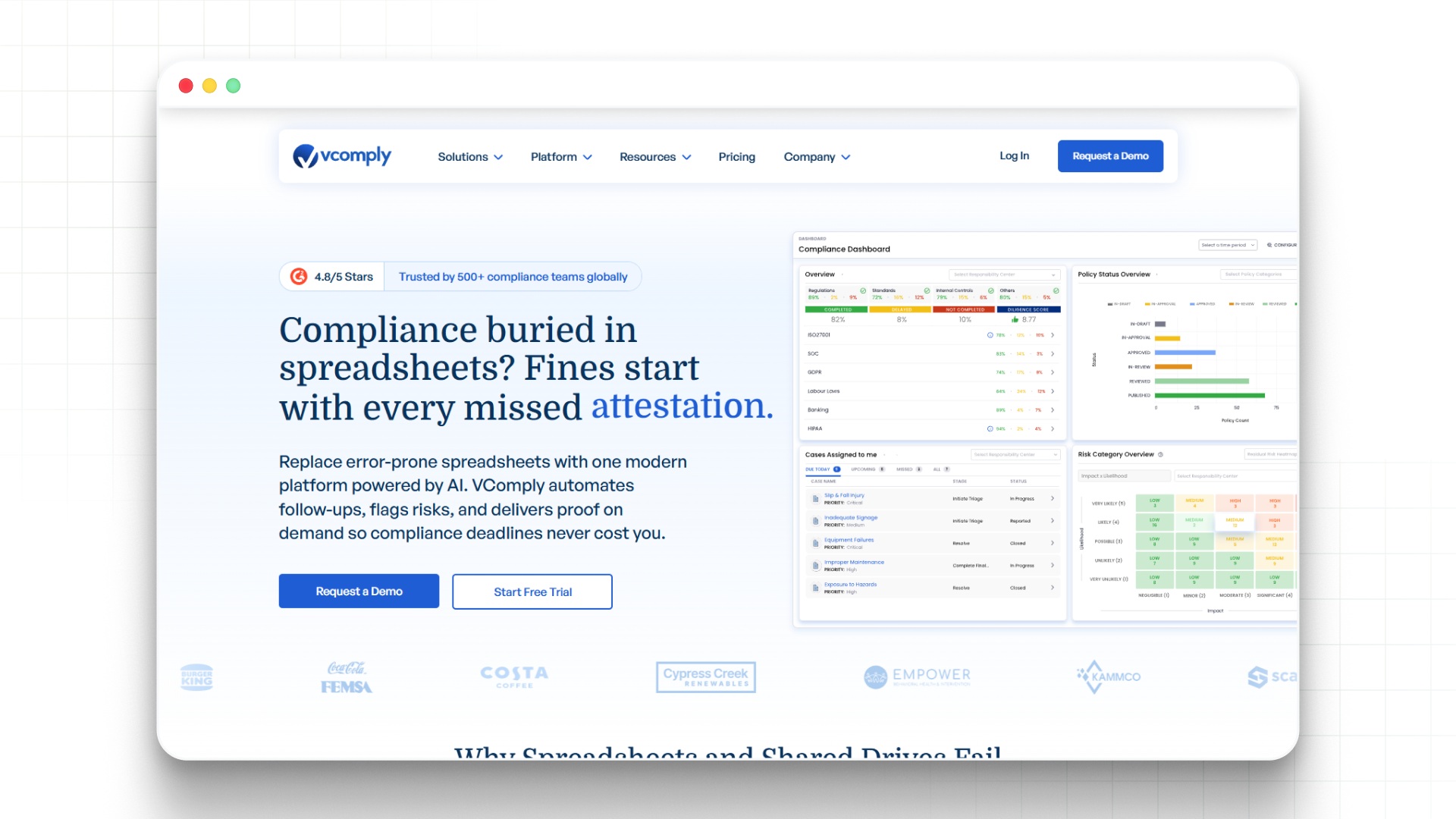
- Centralized lifecycle management with version control and approval workflows
- Ownership mapping across policy creation, enforcement, and review
- Attestation tracking to ensure policy awareness and accountability
- Policy-to-control mapping for consistent enforcement across systems
- Integrated evidence capture to support audit validation
Book a Demo with VComply to see how policies move beyond documentation and operate as enforceable, measurable components of governance.
Final Thoughts
Policy management depends on execution, not documentation. Organizations that connect ownership, version control, and enforcement into structured systems achieve stronger accountability and audit readiness.
Platforms like VComply enable organizations to move from fragmented policy tracking to integrated governance systems that connect policies with controls, risks, and evidence. Policies lose effectiveness when they remain isolated from workflows and control validation.
PolicyOps embeds policies into execution systems, ensuring they are applied, monitored, and evidenced consistently. Start a 21-day free trial of VComply to see how structured policy management improves visibility, accountability, and audit readiness across your organization.
FAQs
Policy management involves creating, maintaining, and enforcing policies aligned with regulatory requirements. It ensures that policies are operationalized through workflows, controls, and evidence tracking.
Failures occur when policies are not connected to execution mechanisms such as ownership, version control, and monitoring. This creates gaps between documentation and actual compliance.
Key features include lifecycle management, version control, ownership tracking, policy-to-control mapping, and real-time reporting dashboards.
Organizations track compliance through acknowledgment rates, exception monitoring, control validation, and audit findings linked to policy execution.
Policies should be reviewed periodically based on regulatory updates, risk changes, and audit findings to ensure continued relevance and effectiveness.
Organizations can operationalize policy management by using structured systems like VComply that connect policies, controls, ownership, and evidence into a unified workflow.