

Why VComply Is a Better Alternative to PowerDMS for Policy Management & Compliance
Organizations today are under pressure to manage policies, track compliance activities, maintain audit readiness, and demonstrate accountability across departments. The challenge is no longer just documenting policies.

Teams are expected to operationalize compliance, maintain visibility into execution, and respond quickly during audits, investigations, and regulatory reviews. This is where compliance management platforms play an increasingly important role.
Two platforms frequently evaluated by compliance and policy management teams are VComply and PowerDMS. While both platforms support policy and compliance management, they are designed with different operational priorities, implementation approaches, and long-term scalability considerations.
This comparison breaks down the differences between VComply and PowerDMS across policy management, compliance operations, workflow automation, audit readiness, reporting, user experience, scalability, and AI capabilities.
Quick Comparison: VComply vs PowerDMS
| Feature | VComply | PowerDMS |
|---|---|---|
| Policy Lifecycle Management | Advanced end-to-end lifecycle workflows | Strong document-centric policy management |
| Compliance Workflow Automation | Built-in operational workflows and accountability tracking | Limited workflow depth outside policy management |
| Compliance Task Management | Native compliance operations management | Primarily focused on policy acknowledgment workflows |
| Real-Time Audit Readiness | Centralized evidence and live status visibility | More documentation-focused |
| Risk Management | Integrated RiskOps capabilities | Limited native risk management |
| Incident & Case Management | Included through CaseOps | Limited |
| AI Capabilities | AI-assisted policy generation and compliance support | Limited AI functionality |
| Cross-Functional Compliance Management | Strong multi-team operational support | Better suited for document governance use cases |
| Reporting & Dashboards | Real-time operational dashboards | Reporting focused primarily on policy activity |
| Scalability | Designed for growing compliance operations | Commonly used in smaller policy-centric environments |
| Industry Coverage | Healthcare, energy, manufacturing, finance, education, multi-site enterprises | Public safety, healthcare, accreditation-heavy environments |
| Implementation Flexibility | Highly configurable workflows | More structured around predefined policy processes |
Platform Overview
VComply
VComply is a Governance, Risk, and Compliance (GRC) platform designed to help organizations operationalize compliance through centralized workflows, accountability tracking, policy management, risk oversight, audit readiness, and real-time visibility.
The platform is built around the idea that compliance execution matters more than static documentation. Instead of treating policies as isolated documents, VComply connects policies to tasks, controls, evidence, owners, escalations, audits, incidents, and operational workflows.
Core modules include:
- PolicyOps
- ComplianceOps
- RiskOps
- CaseOps
- Audit and evidence management
- AI-powered policy support
- Workflow automation
- Real-time dashboards
VComply is commonly used by organizations looking to move beyond spreadsheets, email-based tracking, and fragmented compliance processes.
PowerDMS
PowerDMS is widely known as an accreditation-focused platform. It is commonly used by healthcare organizations, law enforcement agencies, public safety organizations, and accreditation-driven institutions.

The platform is particularly recognized for:
- Document management
- Policy acknowledgment tracking
- Accreditation management
- Training documentation
- Policy version control
PowerDMS is often selected by organizations prioritizing centralized document governance and policy distribution.
Detailed Comparison
1. Policy Management Capabilities
VComply
VComply provides a complete policy lifecycle management system designed to support modern compliance operations.
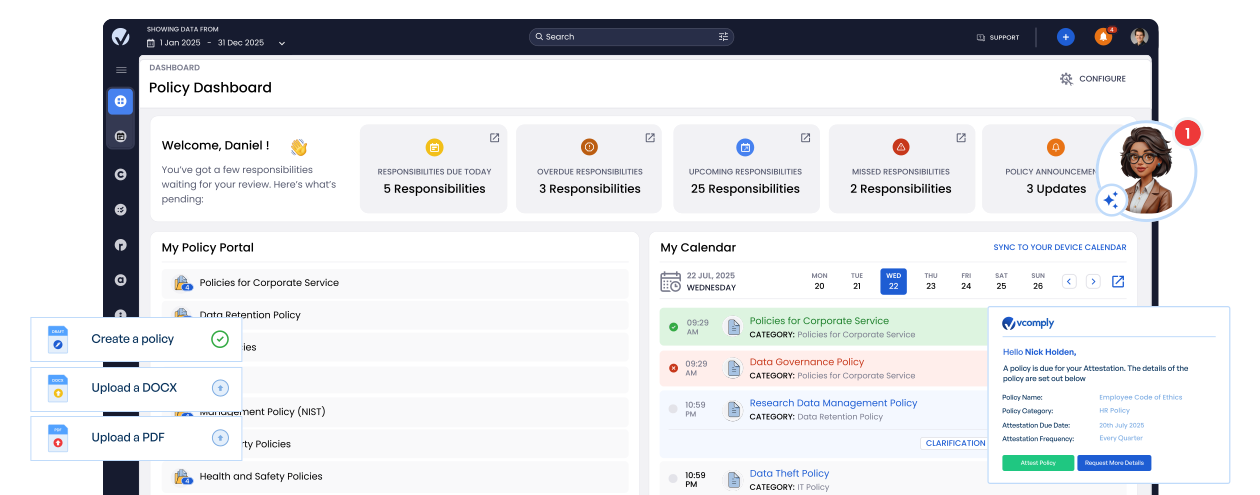
Key capabilities include:
- Policy drafting workflows
- Multi-stage reviews and approvals
- Version control
- Automated review reminders
- Policy attestations
- Role-based distribution
- Audit trails
- Linked evidence and controls
- Policy-to-compliance mapping
- AI-assisted policy drafting and updates
- AI Policy Intelligence
A major advantage of VComply is that policies are operationally connected to compliance workflows rather than existing as standalone documents. Refer to this video for more information on VComply PolicyOps.
For example:
- Policies can trigger recurring compliance tasks
- Evidence can be linked directly to controls
- Teams can track ownership and accountability
- Managers can monitor completion status in real time
- Escalations can be automated
This helps organizations operationalize policy execution.
PowerDMS
PowerDMS has strong capabilities for document governance and policy acknowledgment management.
Core strengths include:
- Centralized policy repository
- Electronic signatures and acknowledgments
- Policy distribution
- Version tracking
- Accreditation document management
- Training documentation
PowerDMS performs well for organizations focused heavily on policy distribution and accreditation readiness.
However, the platform is generally more document-centric than operationally workflow-centric.
Organizations looking for broader compliance execution management may eventually require additional systems to manage:
- compliance workflows
- operational controls
- risk programs
- issue management
- audit coordination
- corrective actions
2. Compliance Operations Management
VComply
This is one of the biggest differentiators.
VComply is designed not only for policy management, but also for ongoing compliance execution.
The platform allows organizations to:
- Assign recurring compliance obligations
- Automate reminders and escalations
- Track evidence collection
- Monitor completion status
- Maintain compliance calendars
- Centralize obligations
- Coordinate cross-functional teams
- Manage audit readiness continuously
Instead of waiting for audits to discover gaps, organizations can maintain live operational visibility.
This is especially important for:
- Healthcare systems
- Financial services organizations
- Manufacturing companies
- Energy and utility providers
- Multi-site enterprises
PowerDMS
PowerDMS supports compliance documentation and accreditation management but is less focused on broader operational compliance workflows.
While teams can manage:
- documents
- policies
- acknowledgments
- training records
many organizations still rely on external systems or spreadsheets for:
- recurring compliance tasks
- corrective actions
- operational evidence management
- enterprise-wide compliance coordination
3. Audit Readiness
VComply
VComply emphasizes continuous audit readiness.
The platform enables organizations to:
- Maintain centralized evidence repositories
- Link evidence directly to controls
- Track completion status in real time
- Maintain historical audit trails
- Monitor overdue activities
- Prepare audit reports quickly
- Reduce manual evidence collection
This becomes especially valuable when organizations face:
- overlapping frameworks
- compressed audit timelines
- customer security reviews
- regulator requests
- recurring internal audits
Instead of scrambling before audits, compliance teams can maintain ongoing readiness.
PowerDMS
PowerDMS supports audit preparation primarily through:
- policy documentation
- acknowledgment tracking
- accreditation workflows
- document version control
While helpful for documentation audits, organizations with broader operational compliance requirements may require additional systems to support enterprise-wide audit coordination.
4. Workflow Automation
VComply
Workflow automation is a major strength.
VComply supports:
- recurring workflows
- approval chains
- escalation logic
- task dependencies
- automated reminders
- compliance calendars
- evidence requests
- corrective action tracking
- issue management
This helps reduce administrative overhead while improving accountability.
The platform is especially useful for organizations trying to replace:
- spreadsheets
- email follow-ups
- manual tracking
- disconnected systems
PowerDMS
PowerDMS includes workflow support primarily within:
- policy review
- approvals
- document acknowledgments
- accreditation workflows
The workflow depth outside policy operations is comparatively more limited.
5. Risk Management
VComply
VComply includes integrated RiskOps capabilities.
Organizations can:
- identify risks
- assess impact and likelihood
- assign mitigation plans
- track remediation progress
- monitor risk ownership
- maintain risk registers
- generate risk dashboards
This creates a more unified GRC environment.
PowerDMS
PowerDMS is not primarily positioned as a full-scale risk management platform.
Organizations typically require separate systems for:
- enterprise risk management
- operational risk tracking
- mitigation planning
- risk analytics
6. Incident and Case Management
VComply
Through CaseOps, VComply supports:
- incident management
- issue tracking
- investigations
- corrective actions
- CAPA workflows
- root cause documentation
- remediation tracking
This helps organizations centralize operational compliance activities.
PowerDMS
PowerDMS is less focused on integrated incident and case management workflows.
Organizations requiring structured investigation management often use external systems.
7. Reporting and Visibility
VComply
VComply emphasizes operational visibility.
Dashboards provide insights into:
- overdue tasks
- compliance status
- audit readiness
- policy acknowledgment progress
- risk exposure
- evidence completion
- corrective action status
- workflow bottlenecks
Leadership teams gain real-time visibility into compliance execution.
PowerDMS
PowerDMS reporting is generally centered around:
- policy acknowledgments
- accreditation tracking
- document activity
- training records
The platform is effective for document governance visibility but may provide less operational compliance visibility across enterprise workflows.
8. AI Capabilities
VComply
VComply includes AI-enabled capabilities that support:
- policy drafting
- policy updates
- policy summaries
- compliance support
- framework mapping
- AI-assisted compliance workflows
AI features are increasingly important as compliance teams manage growing volumes of obligations and documentation.
PowerDMS
PowerDMS currently offers comparatively fewer AI-driven compliance capabilities.
Organizations seeking AI-assisted compliance operations may require additional tools or integrations.
9. Scalability and Enterprise Readiness
VComply
VComply is designed for organizations managing:
- multiple departments
- multiple facilities
- multiple frameworks
- distributed compliance teams
- operational compliance programs
The platform scales effectively across:
- healthcare systems
- financial institutions
- manufacturers
- energy organizations
- education systems
- enterprise environments
PowerDMS
PowerDMS is widely used in:
- healthcare
- public safety
- accreditation-heavy environments
It performs strongly in document governance use cases but may require additional operational tooling as compliance programs become more complex.
10. User Experience and Adoption
VComply
VComply is designed to simplify operational compliance management through:
- centralized dashboards
- configurable workflows
- task-based accountability
- automation
- visibility into execution
The platform is particularly valuable for organizations trying to reduce fragmented compliance processes.
PowerDMS
PowerDMS offers a familiar document-centric experience that works well for policy distribution and accreditation management.
Organizations with broader operational requirements may eventually require more advanced workflow coordination capabilities.
Which Platform Is Better?
The answer depends on what organizations are trying to achieve.
Choose VComply if your organization needs:
- End-to-end policy management
- Workflow automation beyond document management
- Continuous audit readiness
- AI-powered workflows and intelligence
- Integrated policy, risk, and compliance workflows
- Real-time operational visibility
- Centralized evidence management
- AI-assisted compliance support
- Cross-functional accountability
- Scalable enterprise compliance operations
VComply is better suited for organizations looking to operationalize compliance execution across departments and frameworks.
Choose PowerDMS if your organization primarily needs:
- Policy distribution
- Document governance
- Accreditation management
- Policy acknowledgment tracking
- Training documentation management
PowerDMS remains a strong option for organizations focused primarily on document-centric policy management workflows.
Final Verdict
Both VComply and PowerDMS support compliance and policy management initiatives, but they are built with different priorities.
PowerDMS is well established as a policy and accreditation management platform, particularly within healthcare and public safety sectors.
VComply, however, delivers a broader operational compliance platform that connects policy management with workflows, accountability, evidence management, risk oversight, audit readiness, and compliance execution.
For organizations trying to move beyond spreadsheets, fragmented systems, manual follow-ups, and siloed compliance processes, VComply provides stronger operational depth and greater long-term scalability.
Instead of simply storing policies, VComply helps organizations operationalize compliance across the business.
Frequently Asked Questions
VComply is generally better suited for organizations looking for broader compliance operations management, including workflow automation, audit readiness, risk management, and operational accountability.
PowerDMS focuses primarily on policy management, accreditation, and document governance. Organizations often use separate systems for enterprise risk management.
VComply provides stronger capabilities for continuous audit readiness through centralized evidence tracking, operational workflows, accountability management, and real-time visibility.
VComply is generally more scalable for organizations managing cross-functional compliance operations across multiple frameworks, departments, and locations.
Yes. VComply includes AI-assisted policy drafting, policy support capabilities, and workflow enhancements designed to help compliance teams manage growing operational complexity.