

10 Best Governance Risk and Compliance Software for Australian Businesses
GRC software is a centralized platform that streamlines governance, risk, and compliance management through automation and real-time monitoring. It consolidates policies, risk assessments, and compliance tracking into one system, reducing manual effort and improving accuracy. By integrating workflows and reporting, it enables organizations to stay compliant, manage risks effectively, and make informed decisions.

Australian organizations are facing stronger expectations around governance, risk management, compliance, operational resilience, cybersecurity, third-party oversight, privacy, audit readiness, and board accountability. For banks, insurers, superannuation funds, healthcare providers, universities, manufacturers, government agencies, and growing enterprises, GRC can no longer be managed through spreadsheets, email reminders, shared folders, and manual evidence collection.
This is why GRC software in Australia has become a practical requirement for organizations that need to manage risks, obligations, controls, policies, audits, incidents, corrective actions, and evidence in one connected system. A modern GRC platform helps teams assign ownership, automate reminders, track risk treatments, collect proof, maintain audit trails, and give executives real-time visibility into compliance and risk status.
The need is especially clear in regulated sectors. APRA’s CPS 230 operational risk management standard came into effect on 1 July 2025, requiring APRA-regulated entities to take a more structured approach to operational risk, critical operations, service provider management, and business continuity. Some non-significant financial institutions have transitional relief for certain business continuity and scenario analysis requirements until 1 July 2026.
At the same time, cyber resilience remains a regulatory priority. APRA’s 2025–26 Corporate Plan highlights work with regulatory peers to strengthen cyber incident response protocols, information sharing, and simulation exercises.
This guide compares the best governance, risk, and compliance software in Australia for 2026, including VComply, Sentrient, Protecht, CGR, Workiva, CAMMS, AuditBoard, Ideagen, and other leading platforms. It also explains what Australian buyers should look for when choosing a GRC system for compliance execution, operational risk, policy management, audit readiness, and regulatory reporting.
At a glance:
- Australian businesses face increasing regulatory and operational demands across privacy, cybersecurity, ESG, financial services, workplace obligations, and third-party risk.
- In 2026, GRC software is becoming essential for organizations that need centralized visibility into policies, risks, controls, incidents, obligations, and audit evidence.
- APRA’s CPS 230, which became effective on 1 July 2025, has increased focus on operational risk, critical operations, business continuity, and service provider risk for APRA-regulated entities.
- GRC platforms help reduce manual tracking by automating reminders, workflows, control testing, reporting, and evidence collection.
- Successful adoption depends on stakeholder engagement, process mapping, integration planning, data migration, and ongoing training.
- Implementing GRC software effectively improves accountability, simplifies audits, supports board-level reporting, and strengthens risk and compliance management across the organization..
What is GRC Software?
GRC software, or governance, risk, and compliance software, is a digital platform that helps organizations manage regulatory obligations, enterprise risks, internal controls, policies, audits, incidents, corrective actions, and reporting.
Instead of tracking GRC work through spreadsheets, emails, shared drives, and disconnected tools, organizations use GRC software to create one system of record for risk and compliance activity.
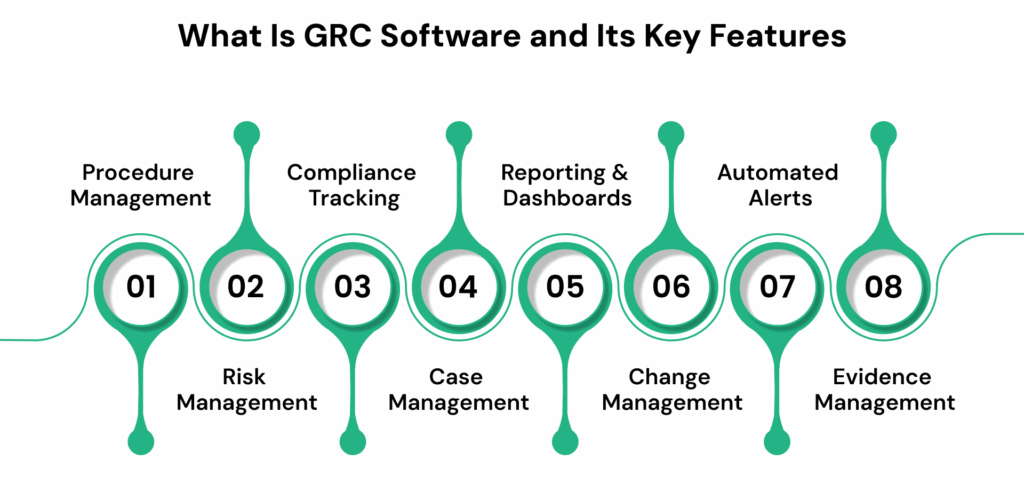
A strong GRC platform helps teams:
- Identify and assess risks
- Maintain risk registers
- Track compliance obligations
- Assign owners and deadlines
- Manage controls and testing
- Review, approve, and distribute policies
- Track employee acknowledgments
- Capture audit evidence
- Manage incidents and corrective actions
- Report risk and compliance status to leadership
For Australian organizations, GRC software is especially useful because compliance expectations often span APRA, ASIC, AUSTRAC, privacy obligations, workplace health and safety, cyber risk, operational resilience, ESG, and industry-specific requirements.
What is the Best GRC Software in Australia?
The best GRC software in Australia is a platform that helps organizations manage governance, risk, compliance, policies, controls, audits, incidents, evidence, and reporting in one system.
For Australian organizations, the best GRC platform should support:
- Risk registers and risk assessments
- Compliance obligation tracking
- APRA CPS 230 and operational risk workflows
- Policy review, approval, and acknowledgment
- Control ownership and monitoring
- Third-party and service provider oversight
- Incident and case management
- Corrective action tracking
- Audit trails and evidence collection
- Automated reminders and escalations
- Dashboards for executives, boards, auditors, and compliance teams
VComply is one of the best GRC software options for Australian organizations because it connects compliance tasks, risk registers, policies, controls, incidents, evidence, reminders, dashboards, and accountability in one practical platform.
Best GRC Software in Australia: Quick Comparison
Here’s a quick comparison of top GRC software in Australia.
| GRC Software | Best For | Australia Fit |
|---|---|---|
| VComply | Compliance execution, risk registers, policy management, evidence, incidents, audits, and dashboards | Strong fit for Australian organizations that need practical workflows, accountability, audit trails, and compliance visibility |
| Sentrient | Compliance training, policy management, incident reporting, and workplace compliance | Good fit for Australian businesses focused on HR, safety, training, and workplace compliance |
| Protecht | Enterprise risk management, compliance, operational resilience, and audit | Strong Australian presence and fit for larger risk-led programs |
| CGR | Governance, risk, compliance, audits, and regulatory tracking | Good fit for mid-sized and large organizations needing structured compliance oversight |
| Workiva | Enterprise reporting, audit, ESG, controls, and financial reporting | Strong fit for large organizations with complex reporting and assurance needs |
| CAMMS | Strategy, risk, compliance, audit, and performance management | Good fit for public sector and enterprise risk programs |
| AuditBoard | Internal audit, SOX, controls, and enterprise risk | Strong for audit-heavy teams and large enterprises |
| Ideagen | Quality, risk, audit, and regulated industry compliance | Good fit for organizations with quality, safety, and operational risk needs |
Why GRC Is Essential for Australian Businesses
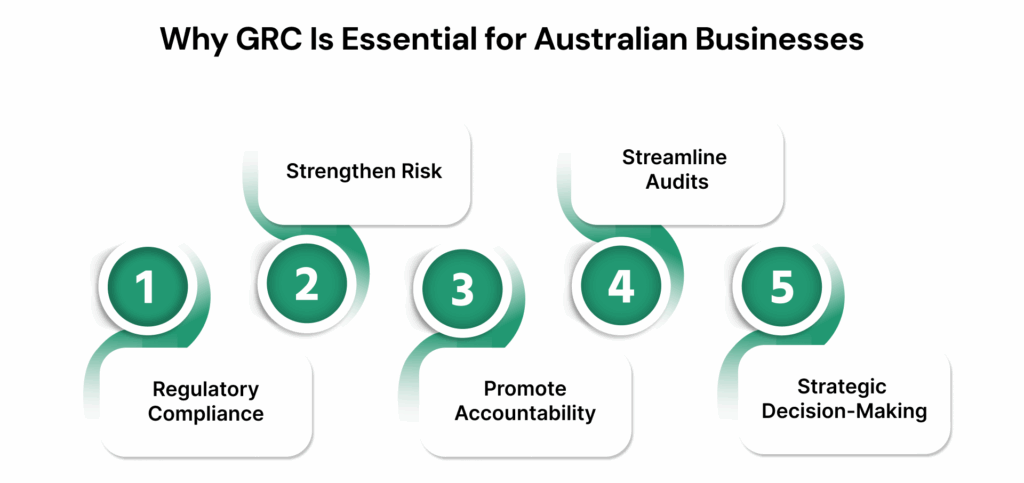
Australian organizations face strict regulatory requirements, industry standards, and operational risks. Governance, risk, and compliance software helps businesses stay compliant, reduce risk, and maintain operational efficiency.
Australian organizations face strict regulatory requirements, evolving cybersecurity expectations, industry standards, and operational risks. In 2026, GRC software is becoming more important because businesses need a clearer way to connect obligations, controls, policies, risk owners, incidents, and evidence across the organization.
1. Ensure Regulatory Compliance
Australian businesses must comply with laws and regulatory expectations across areas such as the Corporations Act, Privacy Act, ASIC obligations, APRA standards, workplace laws, and industry-specific rules. GRC software centralizes obligations, automates monitoring, and maintains audit-ready records so teams can reduce the risk of missed deadlines, incomplete evidence, and compliance gaps.
2. Strengthen Operational Resilience
Operational resilience is now a major governance priority, especially for financial services and APRA-regulated organizations. APRA’s CPS 230 requires regulated entities to effectively manage operational risks, maintain critical operations through disruptions, and manage risks arising from service providers.
GRC software helps organizations document critical processes, assign risk owners, monitor incidents, test controls, track business continuity actions, and maintain visibility into third-party dependencies.
3. Improve Third-Party Risk Management
Australian businesses rely heavily on vendors, service providers, technology platforms, outsourcing partners, and cloud systems. In 2026, third-party risk is not just a procurement issue. It is a governance and compliance issue.
GRC software helps teams maintain vendor records, assess supplier risks, track contracts, monitor controls, document due diligence, and manage corrective actions when vendor risks are identified.
4. Promote Accountability and Transparency
Role-based access, task ownership, workflow tracking, and documented approvals help organizations show who owns each risk, policy, control, obligation, or issue. This level of transparency builds confidence with regulators, boards, investors, auditors, and internal leadership teams.
5. Streamline Audits and Reporting
Organized compliance data, policies, risks, evidence, and control records make audits faster and easier to manage. Dashboards and automated reporting reduce the need for manual status updates and help leadership see where risks, overdue tasks, and compliance gaps require attention.
6. Support Strategic Decision-Making
Real-time insights into risks, compliance gaps, incidents, third-party exposure, and operational performance help leadership make better decisions. GRC software gives boards and executives clearer visibility into what is working, what is overdue, and where resources should be focused.
Also read: Understanding GRC Technology and Its Importance
For Australian organizations, the value of governance, risk and compliance software is in turning regulatory requirements into work that can be assigned, monitored and evidenced. A GRC platform can connect obligations under frameworks such as APRA prudential standards, ASIC requirements, the Privacy Act 1988, the Australian Privacy Principles, workplace health and safety requirements and industry standards such as ISO 27001 to specific controls, policies, risk owners, assessments and review dates. Instead of treating each requirement as a separate compliance exercise, teams can maintain a centralized obligations register, map requirements to controls, assign accountability and retain evidence showing that required activities were completed. This gives compliance and risk teams a clearer way to identify gaps while giving executives and boards better visibility into the organization’s overall compliance position.
Key Australian Compliance Areas Managed by GRC Software
Australian organizations use GRC software to manage obligations across financial services, privacy, cyber resilience, workplace safety, operational risk, third-party risk, internal audit, and sector-specific regulations.
| Australian Compliance Area | What GRC Software Helps Manage |
|---|---|
| APRA CPS 230 | Operational risk, critical operations, service providers, business continuity, scenario analysis, evidence, and reporting |
| APRA CPS 234 | Information security controls, cyber risk, incident response, accountability, and evidence |
| ASIC obligations | Governance, conduct, controls, reporting, breach management, and board oversight |
| AUSTRAC AML/CTF | AML policies, risk assessments, training, controls, issue tracking, and evidence |
| Privacy Act and data governance | Privacy policies, breach response, access controls, data handling tasks, and accountability |
| Workplace health and safety | Incidents, inspections, corrective actions, training, evidence, and reporting |
| Third-party risk | Supplier due diligence, contracts, risk reviews, performance monitoring, and remediation |
| Internal audit | Audit planning, evidence, findings, issue tracking, and corrective actions |
| Policy management | Policy reviews, approvals, version control, acknowledgments, and attestations |
| ESG and governance | Governance controls, reporting tasks, evidence, ownership, and review workflows |
Top 10 GRC Software for Businesses in Australia
Choosing the right governance, risk, and compliance software can transform how Australian organizations manage policies, monitor risks, and maintain compliance. Here are some leading solutions available in the market:
1. VComply

VComply is an AI-powered all-in-one GRC platform that centralizes compliance, risk management, and audit workflows. It automates reminders, tracks obligations, and maintains audit-ready records, helping teams reduce errors and stay accountable.
- Compliance Management: Centralize all compliance programs in one platform, automate reminders, and maintain detailed records to reduce manual processes and stay audit-ready.
- Risk Management: Streamline risk workflows with a single system to conduct assessments, prioritize mitigation efforts, and monitor inherent and residual risks across your organization.
- Policy Management: Simplify policy creation, approval, and distribution while tracking changes and attestations automatically. Assign access and notifications to ensure accountability and transparency.
- Case & Incident Management: Automate case intake, track progress, and resolve incidents efficiently. Set due dates, trigger reminders, and centralize documentation for complete oversight.
- Dashboards & Reporting: Visualize compliance and risk data through interactive GRC dashboards. Customize reports for executives, auditors, and internal teams without relying on spreadsheets.
- Workflow Automation: Automate tasks, alerts, approvals, and notifications to reduce human error and ensure timely action across compliance, risk, and policy activities.
- Integrations & Security: Connect seamlessly with your existing tools and tech ecosystem while maintaining enterprise-grade data security and encryption standards.
- 24/7 Support: Access dedicated support around the clock to guide implementation, address issues, and ensure smooth platform adoption.
Best For
VComply is best for Australian mid-market and enterprise organizations that need practical GRC software focused on compliance execution, risk visibility, policy governance, audit readiness, and accountability.
Why VComply Stands Out
VComply does not only store compliance records. It helps teams prove that the right work was assigned, completed, reviewed, escalated, and supported with evidence. This is especially valuable for Australian organizations preparing for audits, board reporting, regulatory reviews, and operational risk expectations.
Pricing: Governance, Risk, and Compliance suite pricing starts at $1,000 per month.
Trial/Demo: Free demo available; 21-day trial available on request.
2. Sentrient

Sentrient provides risk and compliance oversight with real-time dashboards and reporting. It supports incident management, policy tracking, and regulatory updates, ensuring organizations remain compliant across operations.
Key Features:
- Compliance Oversight: Monitor all regulatory obligations and ensure tasks are completed on time across departments.
- Risk Assessment: Identify, evaluate, and prioritize operational and regulatory risks with structured workflows.
- Policy Management: Create, update, and distribute policies while tracking employee acknowledgment.
- Audit Readiness: Maintain a centralized record of compliance activities for faster and smoother audits.
- Reporting & Dashboards: Generate real-time insights on compliance status, risks, and operational gaps.
Best fit for: Medium to large Australian businesses seeking an integrated compliance and training management system that ensures ongoing regulatory alignment.
Pricing: Custom pricing based on organization size and requirements.
Trial/Demo: Free demo available on request. No free trial offered.
3. Protecht

Protecht offers enterprise GRC solutions with modules for risk management, compliance, and internal audit. It provides automated workflows, risk assessments, and reporting tools to help organizations mitigate operational and strategic risks.
Key Features:
- Risk Register: Centralize all risks in one platform and track mitigation actions effectively.
- Compliance Management: Automate regulatory tasks, alerts, and reporting to ensure adherence.
- Incident & Case Management: Log, track, and resolve compliance incidents with full accountability.
- Policy Management: Streamline policy creation, approval, distribution, and attestation tracking.
- Analytics & Reporting: Visualize risks and compliance metrics through customizable dashboards.
Best fit for: Enterprises and government organizations managing complex risk and compliance frameworks across multiple departments.
Pricing: Custom pricing.
Trial/Demo: Demo available on request. Doesn’t offer a free trial.
4. CGR

CGR focuses on simplifying governance, risk, and compliance processes through workflow automation and centralized reporting. Its tools support regulatory compliance, risk tracking, and internal audits for enterprise and mid-market businesses.
Key Features:
- Regulatory Tracking: Keep up with changing laws and regulations to avoid non-compliance.
- Risk Monitoring: Evaluate operational, financial, and strategic risks and assign ownership.
- Policy Control: Manage policies centrally and track employee compliance and acknowledgment.
- Audit Trail: Record all compliance actions and generate audit-ready evidence quickly.
- Dashboards & Reporting: Access comprehensive insights into compliance performance and risk exposure.
Best fit for: Mid-sized to large enterprises in Australia looking for a scalable and easy-to-implement GRC solution.
Pricing: Custom pricing.
Trial/Demo: Free demo available. No option for a free trial.
5. Workiva

Workiva is a cloud-based GRC platform that integrates risk, compliance, and reporting processes. It enables streamlined audit management, regulatory reporting, and collaborative risk assessments, improving transparency and efficiency.
Key Features:
- Document Management: Centralize policies, contracts, and regulatory filings in a secure platform.
- Control Monitoring: Track compliance controls, responsibilities, and deadlines across teams.
- Risk Assessment: Identify, assess, and mitigate risks with integrated reporting tools.
- Workflow Automation: Streamline compliance and risk workflows with notifications and task tracking.
- Analytics & Reporting: Generate interactive dashboards and audit-ready reports for stakeholders.
Best fit for: Large organizations with complex reporting needs seeking integrated risk, compliance, and ESG management in one cloud platform.
Pricing: Custom pricing.
Trial/Demo: Free demo available on request. You can also view their demo video.
6. Pirani
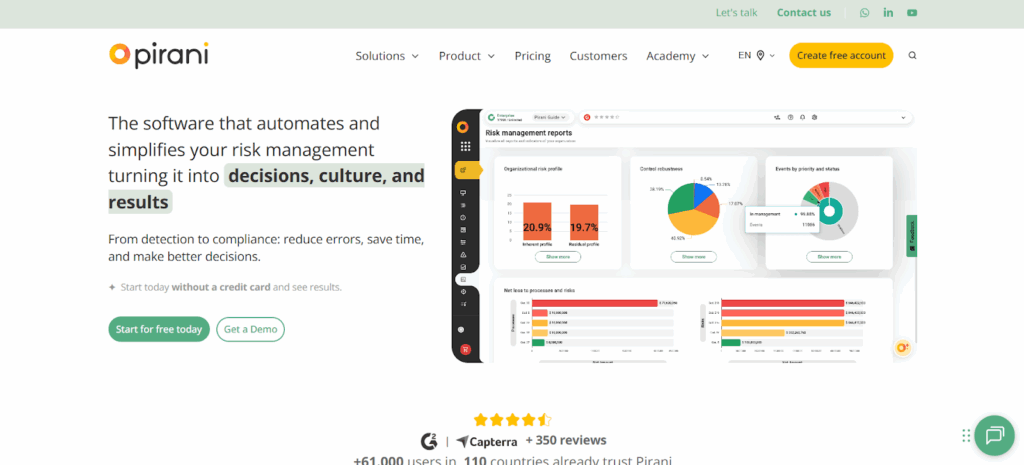
Pirani provides GRC tools for compliance tracking, policy management, and risk monitoring. Its platform helps organizations automate processes, maintain evidence, and gain actionable insights to stay ahead of regulatory requirements.
Key Features:
- Compliance Tracking: Monitor regulatory obligations, deadlines, and task completion across the organization.
- Risk Management: Identify, evaluate, and mitigate operational and strategic risks systematically.
- Policy Management: Create, approve, distribute, and track policies with audit trails and employee acknowledgments.
- Incident & Case Management: Capture, track, and resolve compliance incidents efficiently.
- Reporting & Dashboards: Generate real-time insights and customized reports for compliance performance and risk oversight.
Best fit for: Small to medium-sized organizations in Australia seeking an affordable, easy-to-use GRC solution with strong automation and reporting capabilities.
Pricing: Offers separate plans for risk management, compliance, audit, and more. Plans start at $304/month.
Trial/Demo: Free plan available; full-featured demo offered on request.
7. AuditBoard

AuditBoard focuses on internal audit, risk management, and compliance. Its platform provides workflow automation, centralized documentation, and dashboards to simplify audits and enhance organizational accountability.
Key Features:
- Risk Register: Centralize all organizational risks and track mitigation efforts in one platform.
- Control & Compliance Monitoring: Automate compliance tracking and ensure tasks are assigned and completed.
- Policy Management: Streamline document creation, approval, distribution, and attestations.
- Audit Management: Maintain audit-ready evidence and streamline internal and external audits.
- Analytics & Reporting: Visualize risk and compliance data through customizable dashboards and reports.
Best fit for: Enterprise compliance, audit, and risk teams looking for an integrated platform to streamline internal audits, SOX compliance, and risk assessments with strong collaboration and reporting tools.
Pricing: Custom pricing.
Trial/Demo: Free demo available upon request. No free trial.
8. Ideagen

Ideagen delivers GRC solutions for risk, compliance, and audit management. It offers real-time monitoring, reporting, and workflow tools to help organizations reduce operational risk and demonstrate compliance.
Key Features:
- Regulatory Compliance: Track obligations, maintain documentation, and ensure adherence to changing regulations.
- Risk Assessment: Identify, assess, and mitigate risks with structured frameworks and workflows.
- Policy Management: Centralize policies, automate approvals, and track employee acknowledgment.
- Incident & Case Management: Log, monitor, and resolve incidents with full accountability.
- Dashboards & Reporting: Access real-time insights and generate audit-ready reports for stakeholders.
Best fit for: Regulated industries such as financial services, healthcare, aviation, and manufacturing that need scalable GRC software with deep document control, quality management, and audit tracking capabilities.
Pricing: Custom pricing.
Trial/Demo: You can request a product demo. Doesn’t offer a free trial.
9. MetricStream

MetricStream is a comprehensive GRC platform with modules for risk management, compliance, audit, and policy management. It provides enterprise-grade automation, reporting, and analytics to support strategic decision-making.
Key Features:
- Risk Management: Identify, evaluate, and monitor risks across business units with a centralized system.
- Compliance Monitoring: Track regulatory obligations and automate compliance tasks and alerts.
- Policy Management: Create, review, approve, and distribute policies with full audit trails.
- Incident & Case Management: Capture, investigate, and resolve compliance events efficiently.
- Reporting & Analytics: Generate dashboards, KPIs, and audit-ready reports for decision-making.
Best fit for: Large enterprises and multinational organizations managing complex governance, risk, and compliance frameworks across multiple business units or jurisdictions.
Pricing: Custom pricing.
Trial/Demo: Free demo available on request. Doesn’t offer a free trial.
Also read: Top MetricStream Alternative and Competitor 2026
10. Vanta

Vanta specializes in automated compliance monitoring for cybersecurity and operational risks. It continuously tracks controls, manages evidence, and ensures organizations meet regulatory and industry standards efficiently.
Key Features:
- Automated Compliance Monitoring: Track regulatory obligations and internal controls with minimal manual effort.
- Security & Risk Management: Identify and mitigate operational and cybersecurity risks in real time.
- Policy & Documentation Management: Centralize policies, ensure employee acknowledgment, and maintain version history.
- Continuous Auditing: Maintain up-to-date audit trails and streamline external compliance assessments.
- Analytics & Insights: Gain actionable insights through dashboards and compliance performance reports.
Best fit for: Fast-growing startups and SaaS companies aiming to achieve and maintain SOC 2, ISO 27001, and other security compliance certifications through automated evidence collection and continuous monitoring.
Pricing: Custom pricing.
Trial/Demo: Free demo available on request; no free trial options.
Each of these GRC tools offers unique strengths, giving businesses the insight needed to choose a solution that streamlines governance, risk, and compliance processes effectively.
Selecting GRC Software Solutions for Australia
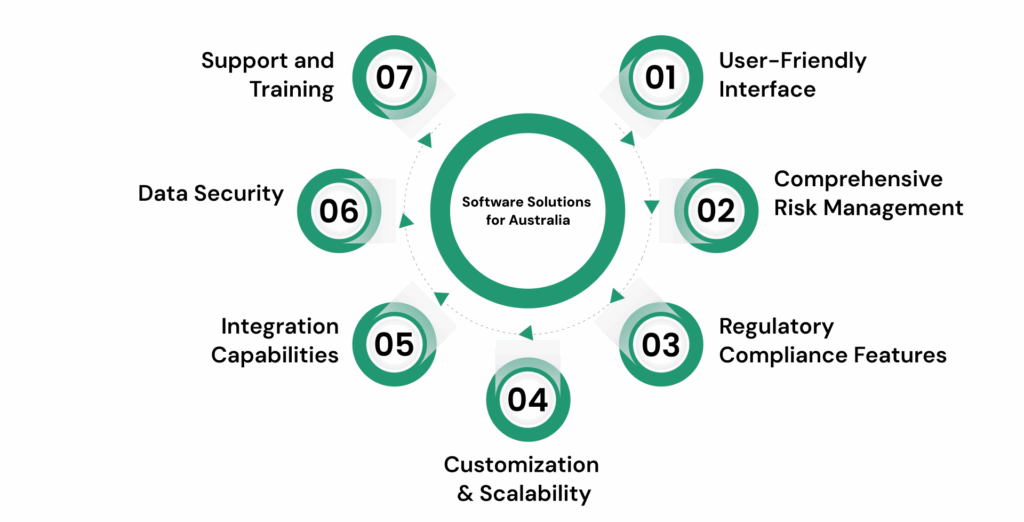
Choosing the right GRC software is crucial for Australian businesses aiming to streamline operations, ensure compliance, and mitigate risks effectively. With a plethora of options available, it’s essential to focus on key factors that align with your organization’s specific needs.
Key considerations for selecting GRC software:
- User-Friendly Interface: Opt for software with an intuitive design that simplifies navigation and reduces the learning curve for your team.
- Comprehensive Risk Management: Ensure the platform offers robust tools for identifying, assessing, and mitigating various risks, including operational, financial, and compliance-related risks.
- Regulatory Compliance Features: Choose software that helps track and adhere to Australian regulations, including industry-specific standards, to avoid penalties and reputational damage.
- Customization and Scalability: Select a solution that can be tailored to your organization’s unique processes and can scale as your business grows.
- Integration Capabilities: Ensure the software can seamlessly integrate with your existing systems, such as ERP and HR platforms, to facilitate data flow and reduce manual entry.
- Data Security: Prioritize platforms that offer strong encryption, access controls, and compliance with data protection laws to safeguard sensitive information.
- Support and Training: Consider vendors that provide comprehensive support, including training resources and responsive customer service, to assist with implementation and ongoing use.
Focusing on these elements allows you to select software that not only fits current needs but also supports long-term compliance goals.
Also read: Understanding GRC Software Pricing in 2025
The best GRC software for Australian businesses should also make it possible to connect risks, obligations and controls instead of managing them as separate records. For example, an operational risk can be linked to the controls designed to reduce it, the regulatory obligation requiring those controls, the policies supporting them, the responsible owner and the evidence demonstrating that the control has been performed. When a regulation changes, a control fails or an incident occurs, compliance teams should be able to see which areas of the organization may be affected and initiate corrective actions without rebuilding the relationship manually. This connected approach is particularly useful for organizations managing operational resilience, third-party risk, regulatory change, internal controls and multiple compliance frameworks across business units.
Common Challenges in Implementing GRC Software
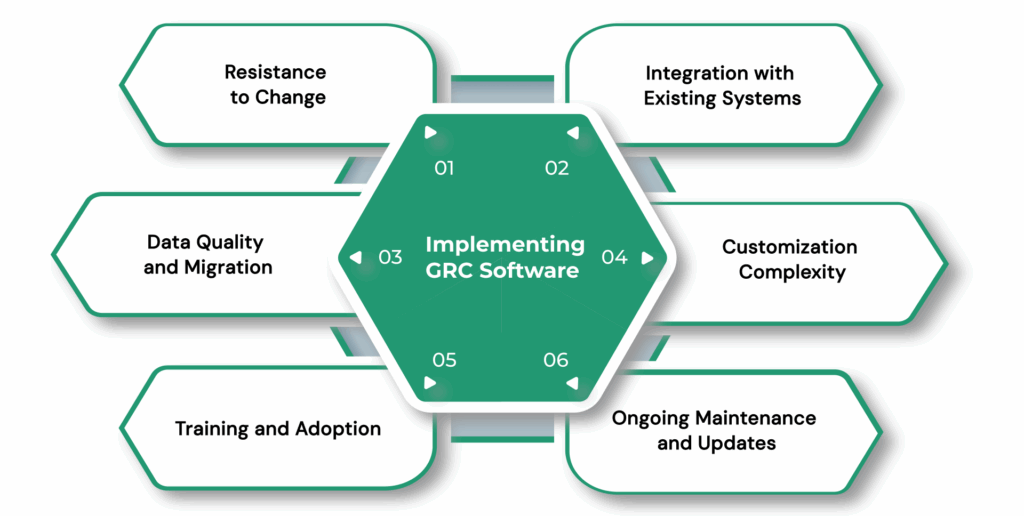
Implementing GRC software can bring significant benefits, but organizations often face obstacles that can slow adoption or reduce effectiveness. Here’s a quick look at some major challenges:
- Resistance to Change: Employees may be accustomed to existing processes, like spreadsheets or manual workflows, making adoption of new software difficult. Early engagement and clear communication are key to overcoming hesitation.
- Integration with Existing Systems: Connecting GRC software to ERP, HR, finance, or other legacy systems can be complex. Without seamless integration, data silos and manual workarounds may persist, reducing the platform’s value.
- Data Quality and Migration: Migrating historical compliance and risk data to a new system requires accuracy and completeness. Poor data quality can lead to gaps in risk visibility and flawed reporting.
- Customization Complexity: Tailoring workflows, dashboards, and reporting to match organizational needs can be time-consuming. Over-customization may also complicate upgrades or limit scalability.
- Ongoing Maintenance and Updates: Regulations and business processes change continuously. GRC software requires regular updates and monitoring to remain effective and compliant.
Understanding these challenges is the first step toward a smoother implementation and helps organizations plan strategies to overcome common obstacles.
Best Practices for Successful GRC Software Implementation
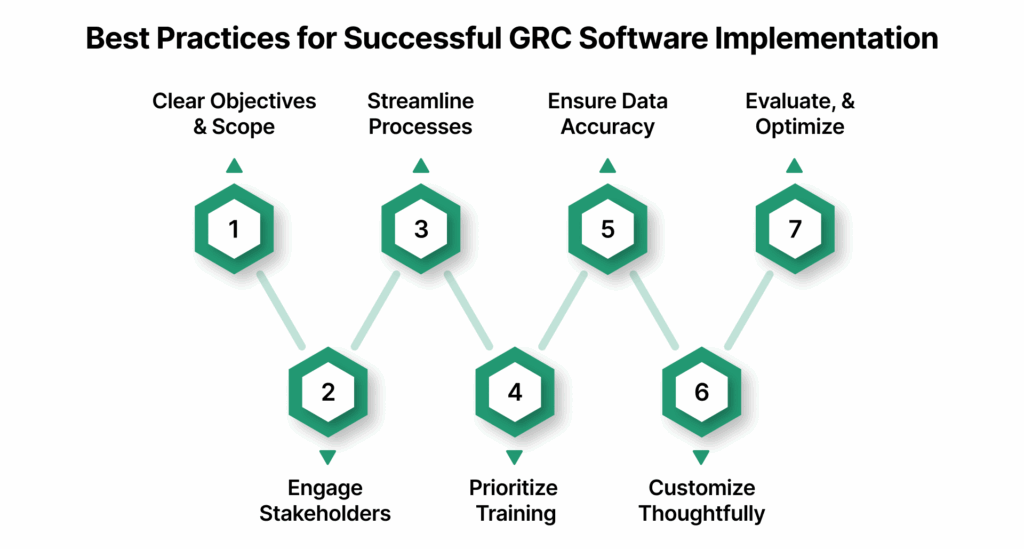
Implementing GRC software effectively requires more than just installation. Following best practices ensures the platform drives compliance, risk management, and operational efficiency from day one.
1. Define Clear Objectives and Scope
Establish what you want the GRC software to achieve, such as improved policy management, automated risk tracking, or audit readiness. Clear objectives help prioritize features and guide rollout.
2. Engage Stakeholders Early
Involve compliance officers, IT, finance, and operational teams from the start. Early engagement ensures workflows reflect real business processes, clarifies responsibilities, and builds buy-in across departments.
3. Map and Streamline Processes
Document existing compliance and risk workflows to identify gaps and redundancies. Use the software to automate repetitive tasks and ensure consistent execution across the organization.
4. Prioritize Training and Change Management
Provide hands-on, role-specific training and communicate the benefits of the software. Encourage adoption by highlighting how it reduces manual effort and improves transparency.
5. Ensure Data Accuracy and Migration Readiness
Audit and clean existing compliance, risk, and policy data before migration. Accurate, complete data ensures reports, dashboards, and alerts are reliable from day one.
6. Customize Thoughtfully
Tailor dashboards, workflows, and reporting to your organizational needs without overcomplicating the system. Balanced customization ensures the software remains scalable and easier to maintain.
7. Monitor, Evaluate, and Optimize
Continuously track adoption, workflow efficiency, and compliance metrics. Adjust processes, dashboards, and notifications to keep the system aligned with evolving regulatory requirements.
Also read: Optimizing the Organization’s Compliance Metrics, Dashboards, & Training
Taking a structured, thoughtful approach to implementation ensures your GRC platform becomes a true enabler of risk management and compliance excellence.
Final Thoughts
Governance, risk, and compliance software is essential for Australian businesses aiming to streamline operations, maintain regulatory adherence, and manage risk proactively. Choosing the right platform, following implementation best practices, and leveraging comprehensive features allows organizations to reduce manual effort, improve accountability, and gain real-time insights into compliance and risk performance.
For businesses seeking a trusted, all-in-one solution, VComply provides a powerful GRC platform that centralizes compliance, risk, and policy management while keeping your organization audit-ready and secure.
Start your 21-day free trial today to see how VComply can simplify your GRC processes and enhance operational efficiency.
FAQs
It ensures regulatory compliance, strengthens risk management, improves transparency, simplifies audits, and provides real-time insights for informed decision-making, helping Australian organizations operate safely and efficiently.
Focus on usability, comprehensive risk tools, regulatory compliance features, scalability, integration with existing systems, data security, and vendor support to select software aligned with your organization’s needs.
Challenges include resistance to change, integration with legacy systems, data migration issues, complex customization, inadequate training, and ongoing maintenance to stay aligned with evolving regulations.
Define objectives, engage stakeholders early, map workflows, train teams, ensure accurate data migration, customize thoughtfully, and monitor adoption to optimize GRC software effectiveness.
Yes, many platforms are scalable and user-friendly, enabling small and medium-sized businesses to manage compliance, risk, and policies efficiently without overcomplicating workflows.
Costs vary based on organization size, required features, and vendor. Many providers offer customized pricing, so requesting a quote is recommended for an accurate estimate.