

10 Best Compliance Softwares for Nonprofits Evaluated on Execution, Visibility & Audit Readiness
Nonprofit compliance rarely breaks because teams lack intent. It breaks when grant obligations, reporting requirements, and audit evidence are tracked across spreadsheets, emails, and disconnected systems. As funding complexity increases, these gaps begin to surface during audits, board reviews, and donor reporting cycles.

Choosing compliance management software starts with understanding the work your team needs to coordinate. Regulatory obligations, security certifications, policy acknowledgments, investigations, and risk assessments require different capabilities.
This guide compares ten platforms by their primary use cases and the workflows buyers should evaluate. It helps teams distinguish broad compliance operations from security automation, audit management, privacy, and enterprise GRC.
Start with the shortlist below, then review the options that match your requirements, team size, and operating environment.
At a Glance
- Tools like VComply support structured execution by linking controls, evidence, and ownership within a single system
- Audit readiness depends less on documentation storage and more on traceable evidence tied directly to controls and activities
- Nonprofits managing multiple grants should prioritize systems that connect reporting obligations with task ownership and deadlines
- Lower-cost tools often support documentation but struggle with cross-program visibility and real-time compliance tracking
- Selecting the right software depends on operational maturity, not just pricing or feature volume
Why Compliance Software Matters for Nonprofits
Nonprofits operate under layered regulatory expectations, including grant conditions, financial reporting standards, and sector-specific requirements. Without structured systems, compliance becomes reactive and difficult to validate.
The need becomes clearer across the following operational pressures:
1. Managing grant compliance across multiple funding sources
Each grant introduces distinct reporting obligations, timelines, and documentation requirements. Without centralized tracking, teams rely on manual coordination, increasing the risk of missed deliverables and inconsistent reporting.
2. Maintaining audit-ready documentation at all times
Audits require traceable evidence tied to specific controls and activities. When documentation is scattered across systems, retrieval becomes time-consuming and increases the likelihood of incomplete submissions.
3. Ensuring accountability across distributed teams
Compliance activities span finance, operations, and program teams. Without defined ownership and escalation paths, tasks remain untracked, creating gaps in execution and oversight.
4. Providing leadership with real-time compliance visibility
Board members and leadership teams require accurate insights into compliance status. Fragmented tools prevent clear reporting, making it difficult to assess risk exposure and program performance.
Also read: 11 Best GRC Tools and Platforms to Use in 2025
Key Features to Look for in Compliance Software for Nonprofits
Selecting software based on feature lists alone often leads to poor adoption. The evaluation should focus on how features support execution, reduce manual work, and strengthen audit readiness.
Focus on capabilities that directly support operational consistency:
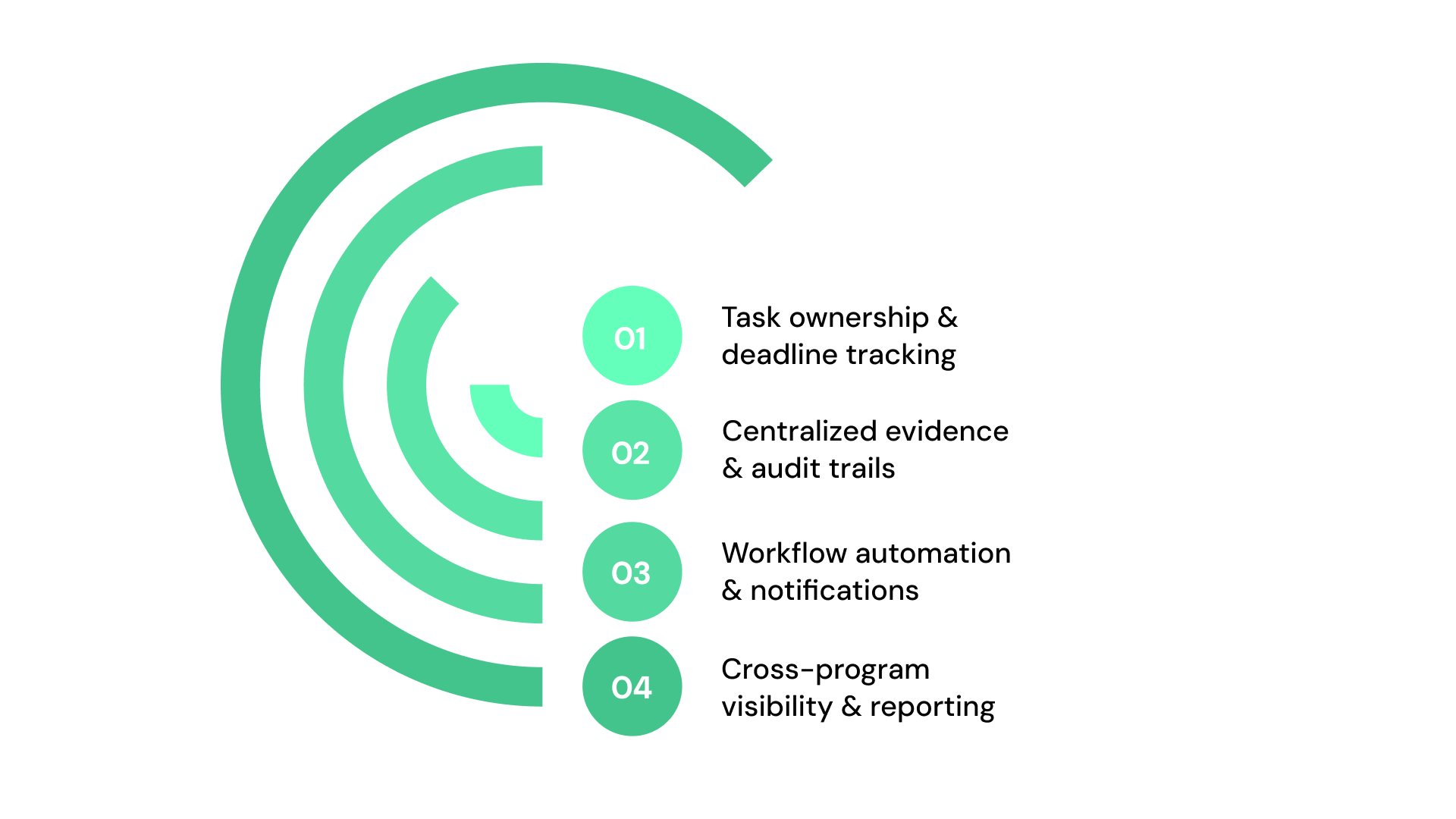
1. Task ownership and deadline tracking
Every compliance activity must have a defined owner, due date, and escalation path. This ensures accountability across teams and prevents delays in reporting or control execution.
2. Centralized evidence and audit trails
Documentation should be stored in a structured system where evidence is directly linked to controls. This allows faster retrieval during audits and improves traceability.
3. Workflow automation and notifications
Automated reminders reduce reliance on manual follow-ups. This helps teams stay aligned with reporting deadlines and reduces administrative overhead.
4. Cross-program visibility and reporting
Dashboards should provide leadership with a unified view of compliance status across grants and programs. This supports better decision-making and risk monitoring.
Also read: 6 Best OSHA Compliance and Safety Audit Software
10 Compliance Software for Nonprofits That Strengthen Ownership, Evidence, and Audit Trails
Nonprofits evaluating compliance software are not comparing features; they are comparing execution models. The real question is whether a system can connect obligations, ownership, and evidence in a way that holds up during audits.
The tools below differ in how they structure workflows, enforce accountability, and maintain audit trails. As you evaluate them, focus on how each platform supports consistent execution across grants, programs, and reporting cycles.
1. VComply
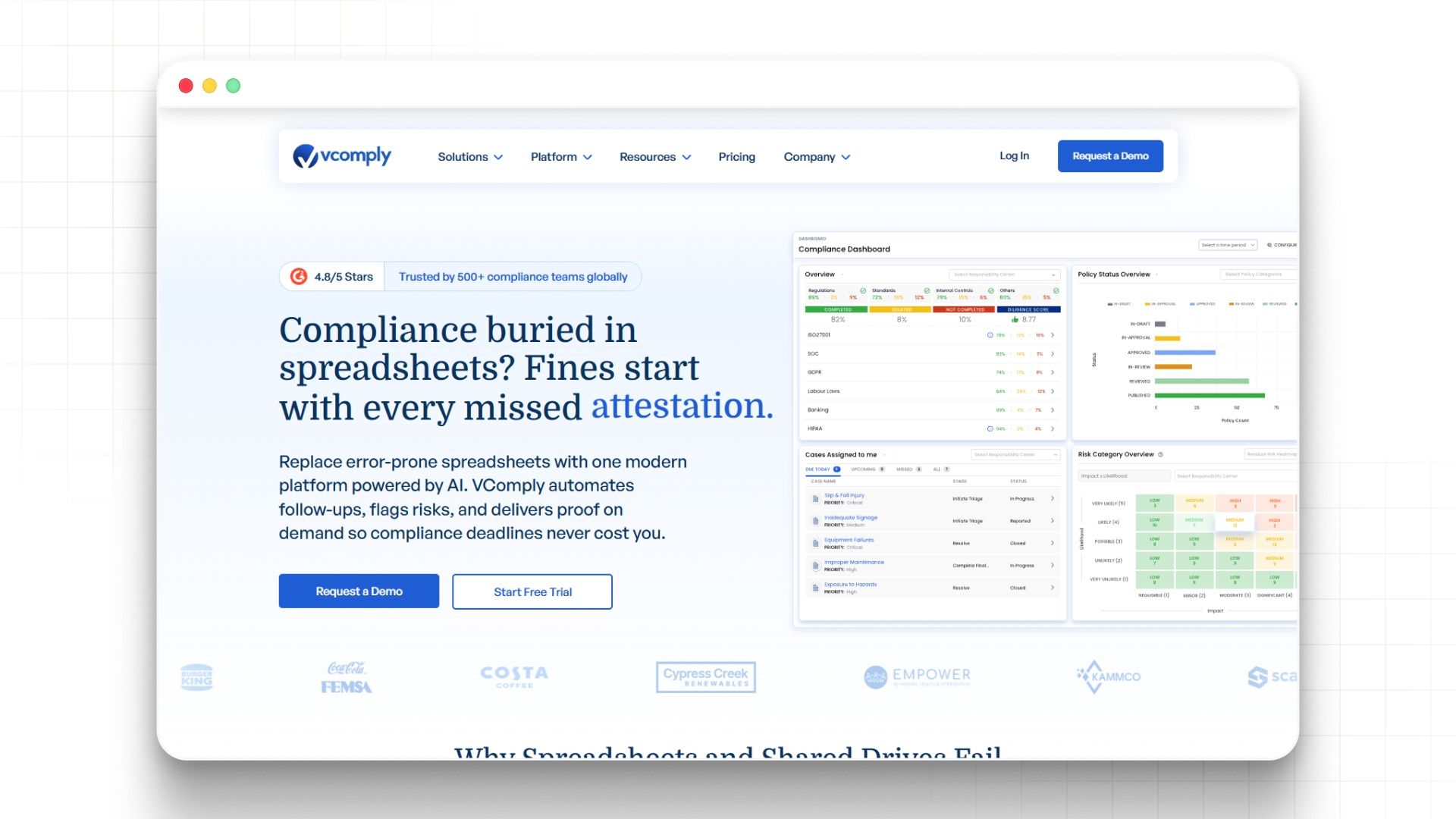
VComply provides a structured GRC system that centralizes compliance, risk, policy, and incident workflows into one environment. It enables nonprofits to move from fragmented tracking to controlled execution, where every obligation is assigned, monitored, and supported by audit-ready evidence across programs.
Key features:
- ComplianceOps workflow tracking: Assigns tasks with ownership, deadlines, and escalation paths
- Structured audit evidence: Links documentation directly to controls and activities
- Policy lifecycle management: Tracks approvals, distribution, and attestations
- Integrated risk visibility: Connects compliance activities with risk assessments
- CaseOps incident tracking: Ensures issues are logged, assigned, and resolved
VComply helps nonprofits coordinate compliance responsibilities across finance, operations, HR, and program teams. Organizations can turn grant conditions, reporting obligations, and internal policies into assigned activities with deadlines, supporting evidence, and clear review steps.
Its connected modules bring compliance, policies, risks, and cases into one platform, helping lean teams maintain oversight as programs and funding requirements grow.
| Feature | What VComply Provides | How It Helps Nonprofits |
|---|---|---|
| Obligation Management | Organize requirements and connect them to controls and activities. | Track applicable grant conditions, reporting commitments, and organizational obligations. |
| Ownership and Deadlines | Assign responsible people, due dates, and recurring schedules. | Clarify responsibilities across finance, operations, and program teams. |
| Reminders and Escalations | Automate follow-up on upcoming and overdue work. | Reduce manual chasing before reporting deadlines. |
| Linked Evidence | Attach documentation to the activity or control it supports. | Retrieve supporting records for audits and funder reviews. |
| PolicyOps | Manage policy reviews, approvals, distribution, and attestations. | Keep organizational policies current and track acknowledgments. |
| RiskOps | Connect risks with assessments, controls, and mitigation work. | Maintain visibility into risks affecting programs and operations. |
| CaseOps | Record concerns, assign investigations, and track corrective actions. | Coordinate responses to incidents and compliance issues. |
| Assessments and Follow-Up | Identify gaps and assign remedial work. | Turn review findings into accountable improvements. |
| Dashboards and Reporting | Show status across programs, departments, and locations. | Give leadership a current view of overdue activities and unresolved gaps. |
Best for: Nonprofits managing multiple grants and audits
G2 rating: 4.6 
Pricing: Custom pricing
Free trial/demo: Demo available
2. Compliancy Group
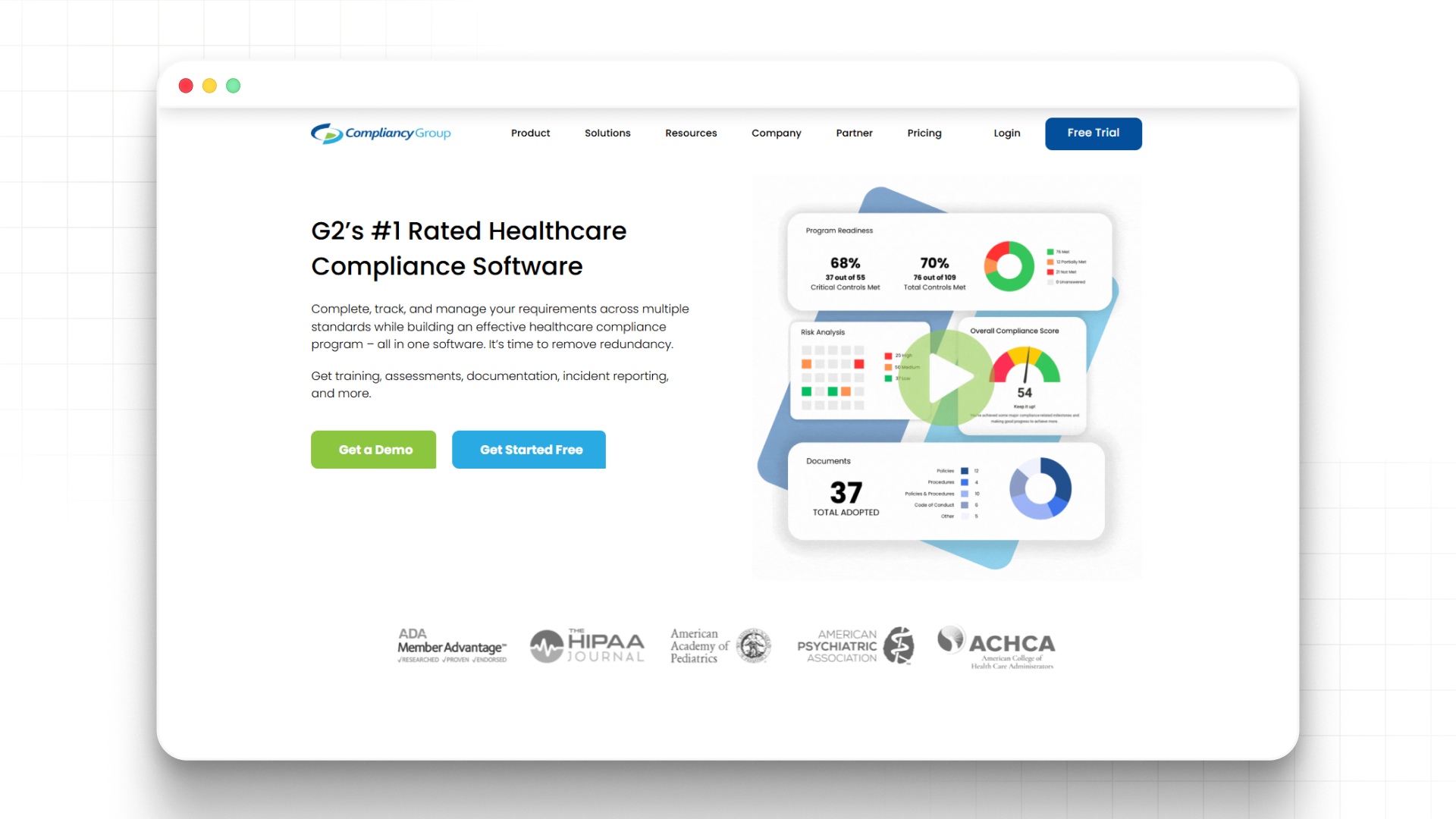
Compliancy Group focuses on guided compliance execution, helping nonprofits follow structured steps to meet regulatory requirements. It simplifies implementation by breaking compliance into manageable workflows, though it is more prescriptive and less flexible for organizations managing diverse or evolving compliance obligations.
Key features:
- Guided compliance workflows: Step-by-step regulatory tracking
- Policy management tools: Maintains documentation and version control
- Risk assessment support: Identifies compliance gaps
- Audit preparation tools: Supports documentation readiness
Best for: Healthcare-focused nonprofits
G2 rating: 4.7
Pricing: Subscription-based
Free trial/demo: Demo available
3. ZenGRC
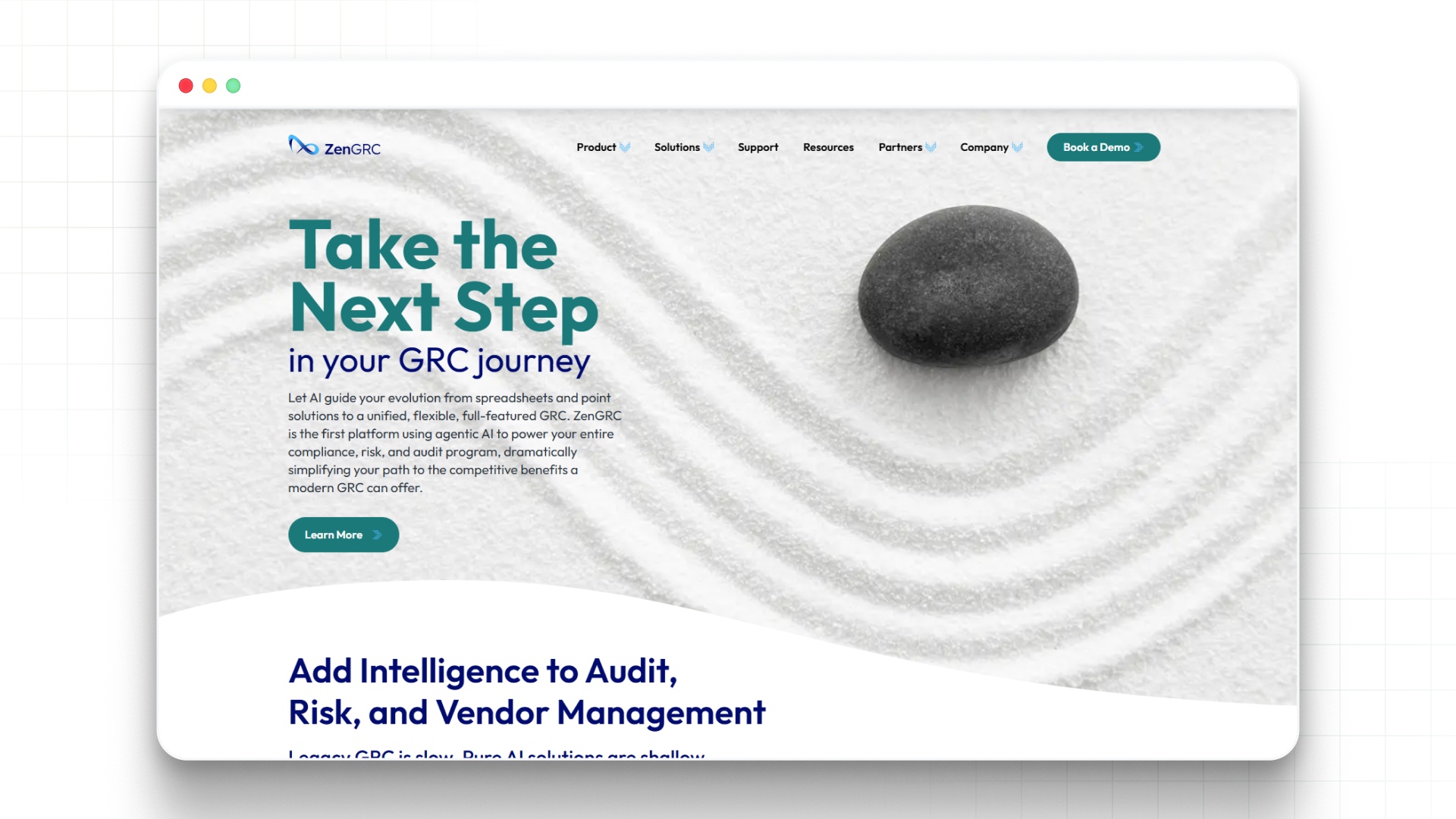
ZenGRC provides a structured system for managing compliance frameworks, audits, and evidence within a centralized platform. It is particularly useful for nonprofits handling multiple standards, though effectiveness depends on how well teams maintain control mapping and documentation consistency.
Key features:
- Framework mapping: Connects controls across standards
- Audit workflow tracking: Manages audit timelines
- Evidence collection: Centralizes documentation
- Compliance dashboards: Track control status
Best for: Nonprofits managing multiple compliance frameworks
G2 rating: 4.4
Pricing: Custom pricing
Free trial/demo: Demo available
4. Hyperproof
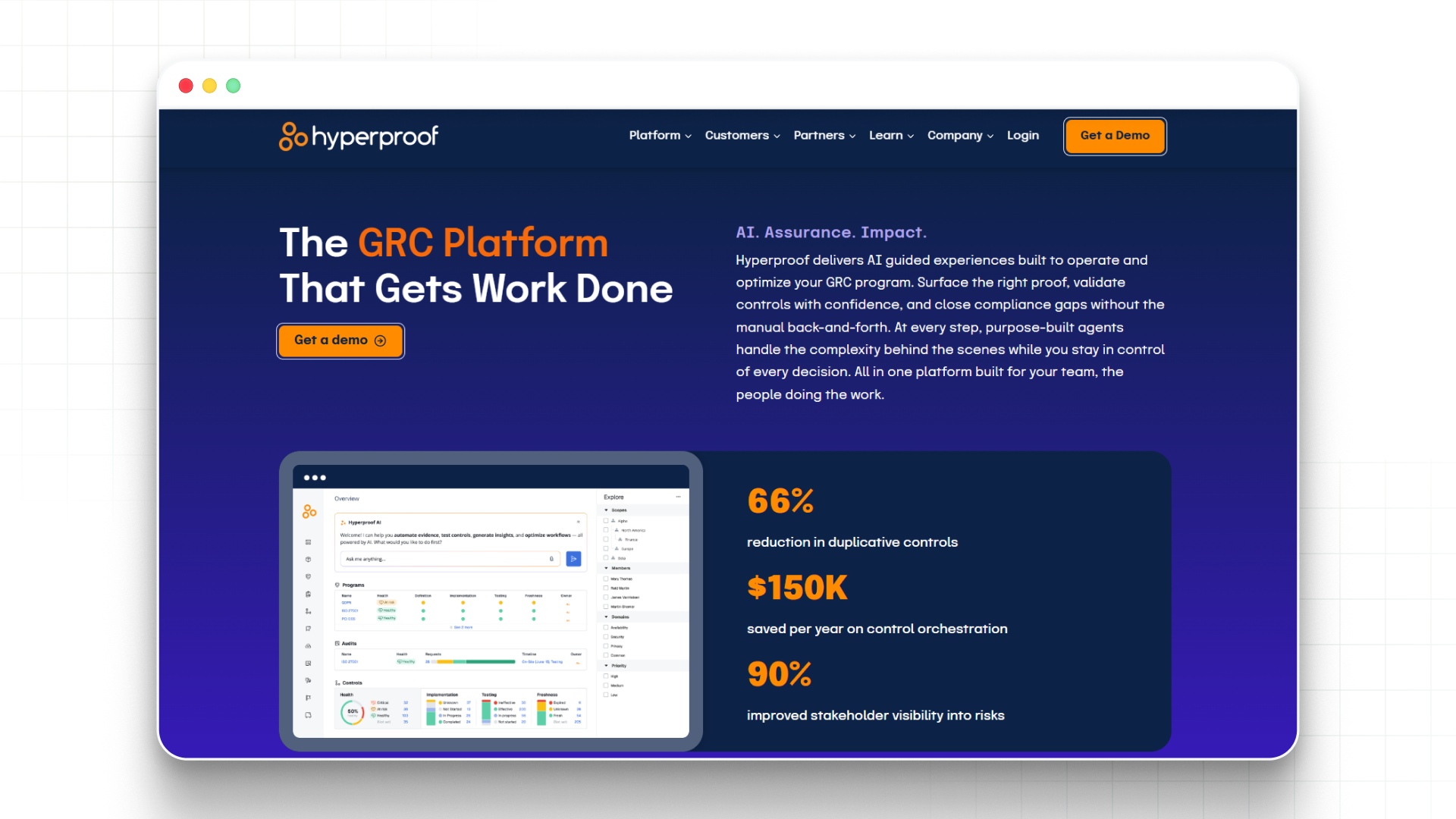
Hyperproof emphasizes continuous compliance by integrating with existing systems and automating evidence collection. It reduces manual tracking by maintaining real-time visibility into control performance, though organizations still need disciplined workflows to ensure consistency across programs.
Key features:
- Continuous monitoring: Tracks compliance status in real time
- Evidence automation: Pulls data from integrated systems
- Task tracking: Assigns ownership and deadlines
- Control mapping: Links controls to requirements
Best for: Nonprofits requiring ongoing compliance monitoring
G2 rating: 4.5
Pricing: Custom pricing
Free trial/demo: Demo available
5. LogicGate
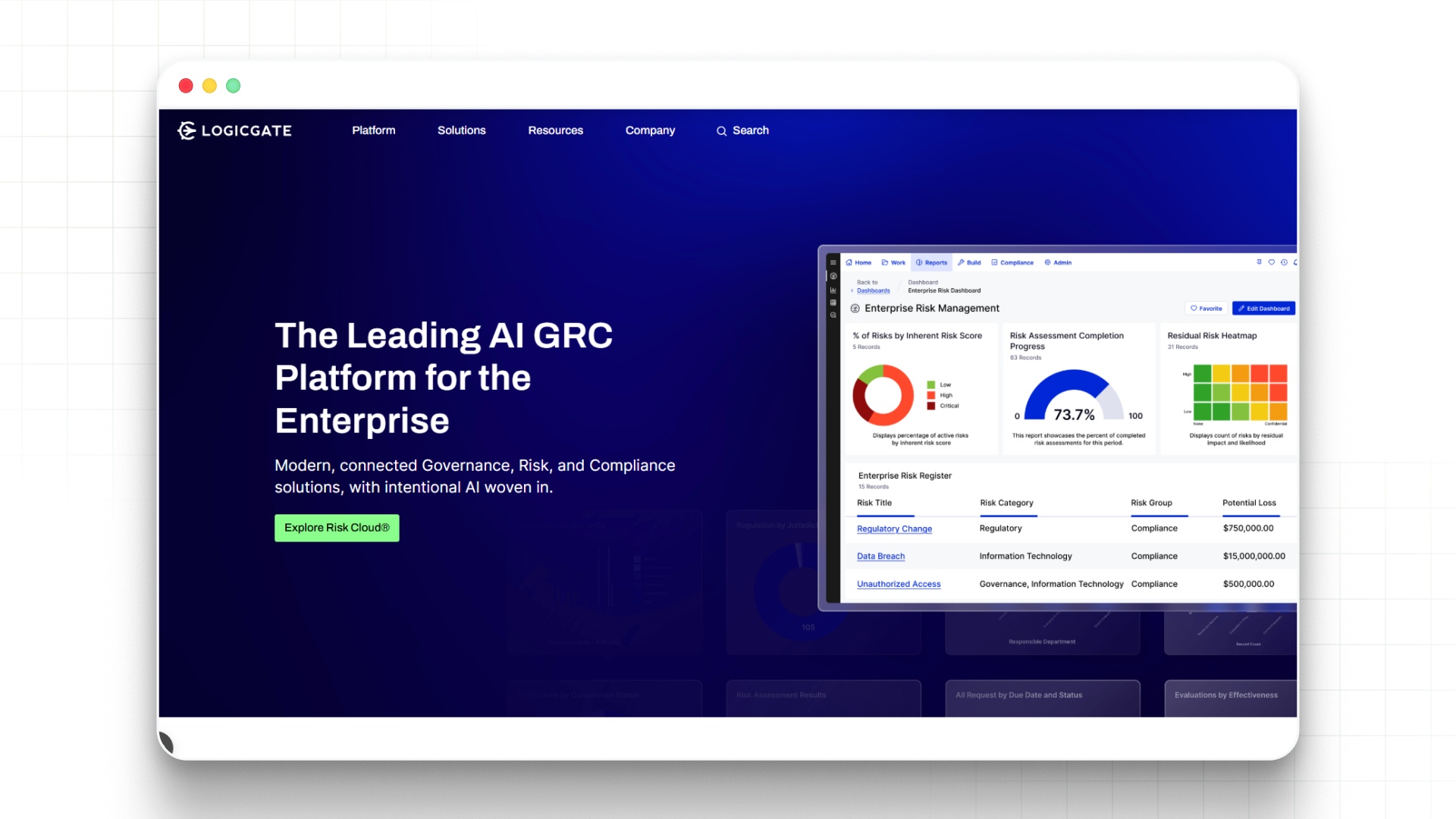
LogicGate offers a flexible, no-code platform that allows nonprofits to design compliance workflows based on internal processes. It supports customization but requires clear governance structures to avoid inconsistent execution across teams.
Key features:
- No-code workflow builder: Customizes compliance processes
- Risk tracking: Connects risk with compliance activities
- Process automation: Reduces manual tracking
- Reporting dashboards: Provides operational insights
Best for: Nonprofits needing customizable workflows
G2 rating: 4.6
Pricing: Custom pricing
Free trial/demo: Demo available
6. Onspring
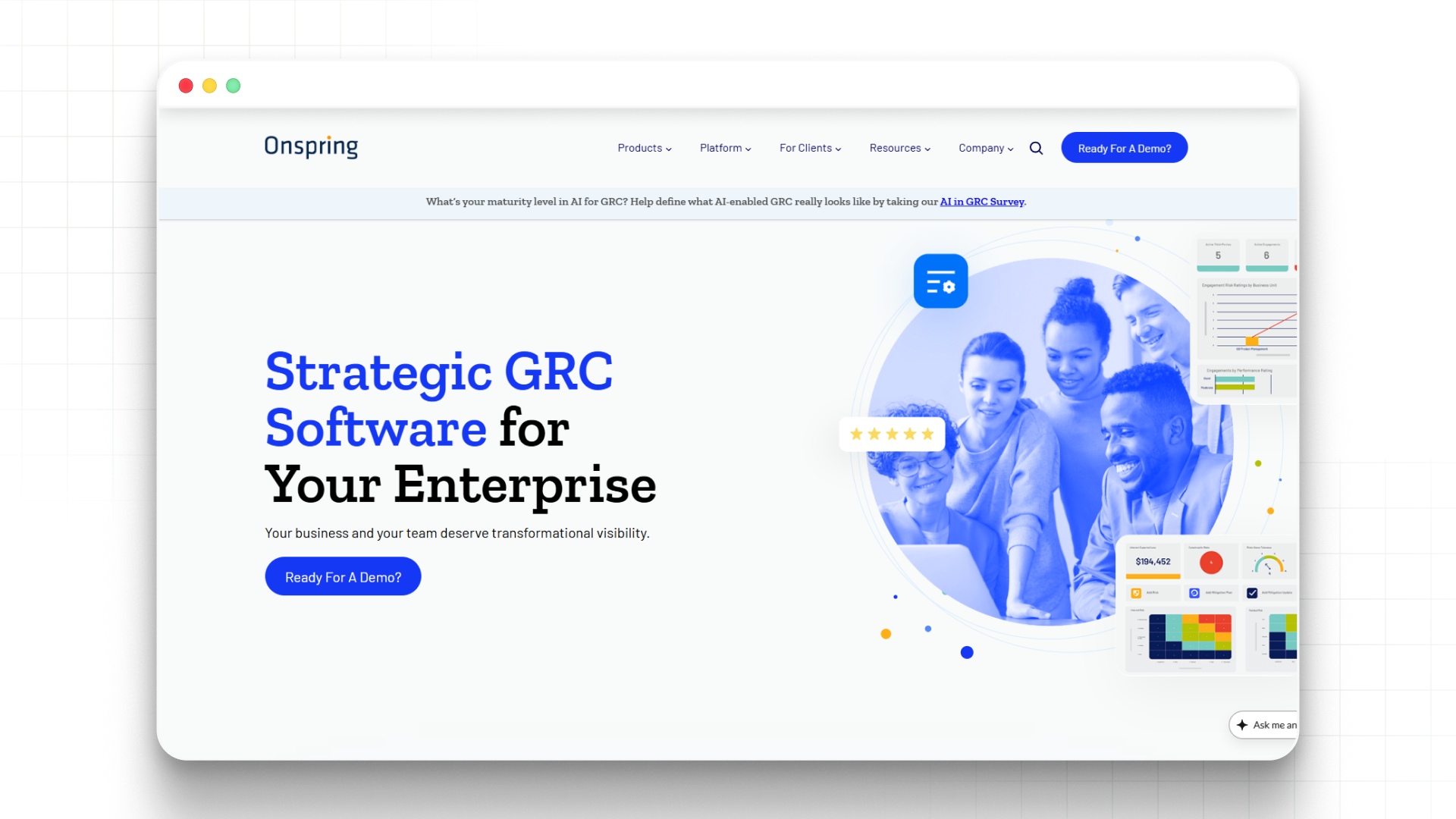
Onspring provides configurable compliance and audit management tools with strong reporting capabilities. It supports structured tracking of regulatory requirements, though implementation success depends on how well workflows are defined across teams.
Key features:
- Compliance tracking: Manages regulatory obligations
- Audit workflows: Tracks audit processes
- Data reporting: Provides customizable dashboards
- Integration capabilities: Connects with systems
Best for: Mid-sized nonprofits with reporting needs
G2 rating: 4.7
Pricing: Custom
Demo/free trial: Demo available
7. NAVEX One Compliance Essentials
NAVEX One Compliance Essentials bundles policy management, training, and incident reporting into a single compliance solution. It supports foundational compliance programs but may require additional systems for organizations needing deeper control tracking and audit-level visibility.
Key features:
- Policy management: Tracks policies and procedures
- Training programs: Supports compliance awareness
- Incident reporting: Manages case workflows
- Compliance dashboards: Provides oversight
Best for: Nonprofits building structured compliance programs
G2 rating: 3.8
Pricing: Custom pricing
Free trial/demo: Demo available
8. Workiva
Workiva focuses on financial reporting, internal controls, and audit collaboration. It is well-suited for nonprofits with complex reporting requirements, particularly those managing large funding structures and board-level disclosures.
Key features:
- Financial reporting: Supports regulatory reporting
- Control management: Tracks internal controls
- Collaboration tools: Enables cross-team workflows
- Audit readiness: Maintains structured documentation
Best for: Large nonprofits with complex reporting needs
G2 rating: 4.5
Pricing: Custom pricing
Free trial/demo: Demo available
9. MetricStream
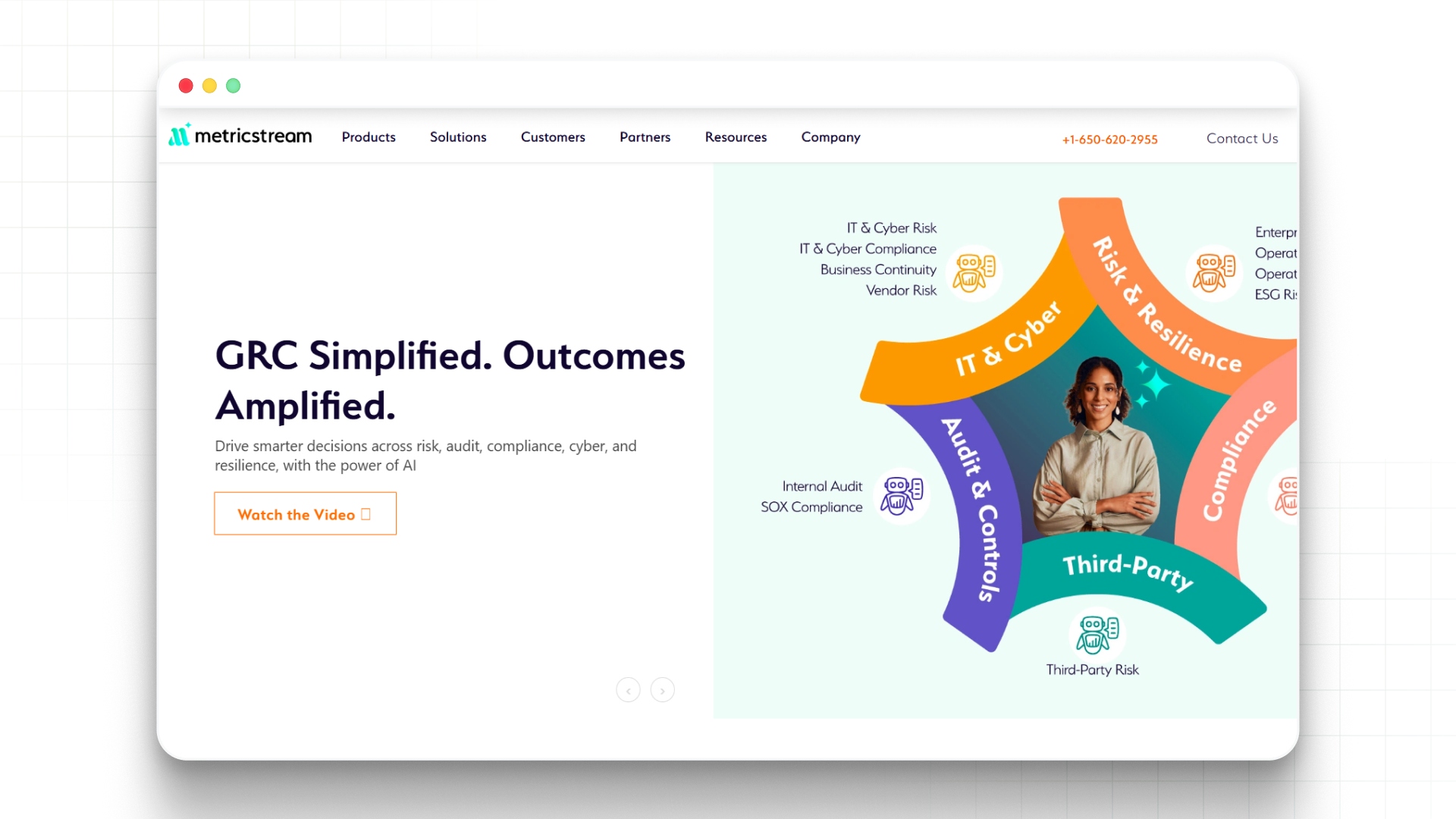
MetricStream is an enterprise-grade Governance, Risk, and Compliance (GRC) platform designed to help large organizations manage risk, compliance, internal audits, and third-party governance in a unified system. It is widely used by global enterprises operating in highly regulated environments.
Key Features
- Enterprise risk management with risk registers, scoring, and mitigation tracking
- Internal audit management for planning, execution, and reporting
- Regulatory compliance tracking across multiple jurisdictions
- Third-party risk management with vendor assessments and monitoring
- Advanced analytics and executive dashboards for risk visibility
Best For
Large enterprises that require a comprehensive, scalable GRC platform with strong audit, risk, and regulatory capabilities.
G2 Rating: 3.9/5
Pricing: Custom enterprise pricing
Demo / Free Trial: Demo available on request
10. SafetyCulture
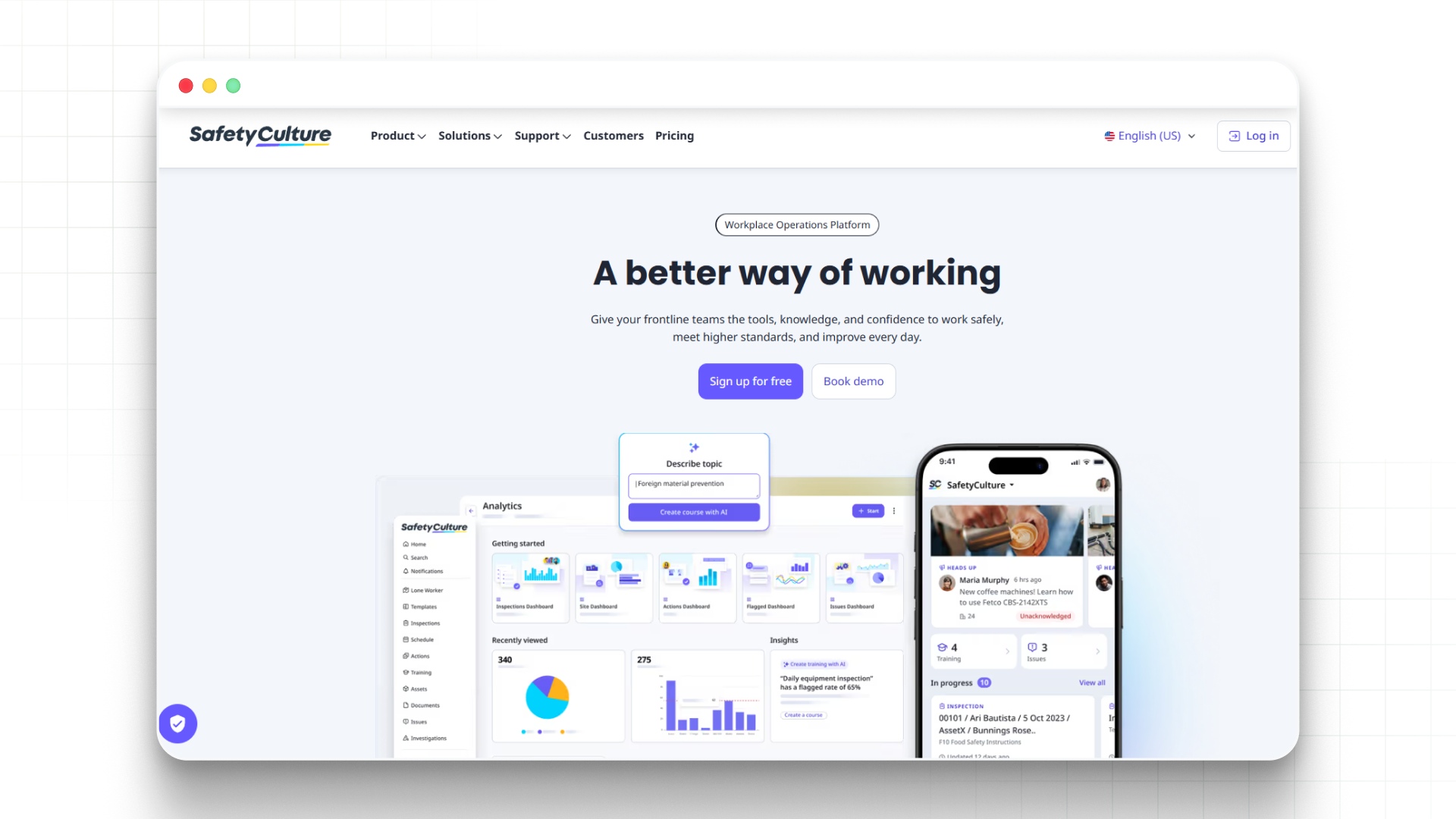
SafetyCulture focuses on inspections, checklists, and operational compliance workflows. It is particularly useful for nonprofits with field programs, though it is less suited for managing complex regulatory frameworks or multi-layered compliance structures.
Key features:
- Inspection tracking: Standardizes audits and checklists
- Mobile data capture: Enables real-time reporting
- Issue tracking: Manages corrective actions
- Workflow automation: Improves execution
Best for: Nonprofits with field operations
G2 rating: 4.7
Pricing: Free, paid and custom plans available
Free trial/demo: Available
Also read: 5 Essential Compliance Management Tools For Teams
How to Choose the Right Compliance Software for Nonprofits
Tool selection should reflect how your compliance program actually operates today, not how you want it to operate in theory. Most mismatches happen when organizations overbuy capability or underestimate execution complexity.
Use the following model to align software choice with operational reality:
1. Early-stage nonprofits managing basic compliance
At this stage, compliance is often handled by a small team managing grant requirements, filings, and documentation manually. The primary risk is not non-compliance, but missed obligations due to a lack of structured tracking.
What you should prioritize is control over obligations, not system sophistication.
You need tools that:
- Centralize all compliance obligations, deadlines, and supporting documents in one place
- Provide a simple task assignment without requiring workflow configuration
- Allow quick document retrieval during audits or donor reviews
- Require minimal onboarding or IT involvement
Decision signal:
If your team still relies on spreadsheets and email reminders, choose a system that replaces tracking first, not one that introduces complex automation.
2. Growing nonprofits managing multiple grants and audits
As the number of grants increases, compliance becomes multi-threaded. Different programs introduce different reporting timelines, audit expectations, and documentation standards. At this stage, breakdowns occur due to a lack of ownership clarity and inconsistent execution.
Your focus should shift from tracking to enforcing accountability and consistency.
You need tools that:
- Assign ownership with deadlines, reminders, and escalation paths
- Link each obligation to required evidence and documentation
- Maintain structured audit trails showing what was done, when, and by whom
- Provide visibility across programs without requiring manual consolidation
Decision signal:
If audit preparation requires chasing teams for documentation, your current system lacks execution control. Prioritize platforms that enforce workflows, not just record them.
3. Scaling nonprofits requiring centralized governance
At scale, compliance is no longer isolated to finance or operations. It intersects with risk, policies, incidents, and board-level reporting. The challenge shifts from execution gaps to a lack of unified visibility and governance control.
Your focus should move toward system-level integration and decision visibility.
You need platforms that:
- Connect compliance, risk, and policy workflows within a single system
- Provide real-time dashboards for leadership and board reporting
- Standardize controls across programs while allowing flexibility where required
- Support audit readiness continuously, not just during audit cycles
Decision signal:
If leadership cannot answer “Are we compliant across all programs right now?” without manual reporting, you need a unified GRC system, not another point tool.
Common Compliance Gaps in Nonprofits and How Software Addresses Them
Compliance gaps in nonprofits are often operational, not intentional. These gaps emerge when systems do not support consistent tracking, documentation, and reporting.
The most common breakdowns include:
1. Fragmented grant tracking: Grant requirements are often managed in separate files or systems, creating inconsistencies in reporting.
Solution: Centralize grant obligations within a single system that links requirements, tasks, and documentation.
2. Inconsistent documentation for audits: Teams store evidence across multiple locations, making retrieval difficult during audits.
Solution: Use structured repositories that tie evidence directly to controls and activities.
3. Missed reporting deadlines: Manual tracking increases the likelihood of missed deadlines and delayed submissions.
Solution: Implement automated reminders and escalation workflows.
4. Lack of visibility across programs: Leadership lacks a unified view of compliance status across initiatives.
Solution: Use dashboards that aggregate compliance data across teams and programs.
Also read: Top 5 Policy Management Software in 2026 (Best Picks Ranked with Features & Pricing)

Conclusion
Platforms such as VComply provide a more integrated approach by connecting compliance, risk, policies, and incidents into one system. This structure improves visibility, strengthens accountability, and reduces operational gaps across teams. For example, a nonprofit preparing a quarterly grant report can assign the reporting activity to a program manager, set its deadline, and collect supporting records from finance and operations. The team can retain evidence of review and submission alongside the activity.
If documentation is missing or work becomes overdue, reminders and escalations help keep the process moving. Leadership can review outstanding responsibilities across programs without consolidating separate spreadsheets.
This approach is particularly useful when staff share compliance duties alongside their primary roles. Keeping requirements, ownership, and evidence together also preserves continuity when employees change roles or leave.
Book a VComply demo to explore a workflow built around your nonprofit’s reporting, policy, and audit needs.
Explore how ComplianceOps supports structured compliance workflows and audit readiness. Start a 21-day free trial with VComply to evaluate how centralized systems improve nonprofit compliance execution.
FAQs
Nonprofits must meet requirements related to financial reporting, grant compliance, and governance standards. These may include IRS regulations, donor reporting obligations, and sector-specific compliance frameworks.
Nonprofits track grant conditions, reporting deadlines, and required documentation across programs. Structured systems help ensure all obligations are completed accurately and on time.
You should look for task ownership tracking, centralized documentation, workflow automation, and reporting dashboards. These features support consistent execution and audit readiness.
Low-cost tools can support basic tracking but often lack automation and visibility. As compliance complexity increases, limitations become more apparent.
You need structured documentation, clear audit trails, and real-time visibility into compliance activities. Systems that link evidence to controls reduce audit preparation time.
Organizations can centralize workflows, automate tracking, and maintain structured audit trails using platforms like VComply, which connect compliance, risk, and policy management in one system.