

Top 10 Best GRC Software
Managing governance, risk, and compliance isn’t just another line item on your to-do list; it’s a boardroom priority and an operational imperative. As regulatory frameworks grow more complex and the pace of change accelerates, you can no longer afford to juggle spreadsheets, siloed documentation, and manual checklists.

According to recent market research, more than 72% of organizations report increased regulatory workload, driving widespread adoption of integrated GRC systems to reduce manual effort and enhance accuracy. If you are a compliance officer, risk manager, CTO, or CEO in a US-based enterprise, you know how critical it is to unify compliance, audit, policy, and risk workflows under one platform.
In this blog, we will explore the top 10 best GRC software tools and how they compare to help you make an informed decision.
Key Takeaways
- Choose a GRC platform based on integration, regulatory coverage, automation, and fit; no one tool suits all.
- Unified GRC operations like VComply strengthen compliance, risk, policy, and incident management.
- Evaluate implementation time, ROI, and feature coverage for informed decisions.
- Industry needs matter: financial, healthcare, and manufacturing require tailored controls, policies, and incident management.
- Use scorecards, demos, and shortlisting criteria to select a tool that delivers real value.
How We Selected And Evaluated These Top GRC Softwares

Choosing the best GRC software requires more than scanning feature checklists or vendor claims. Our evaluation focuses on practical outcomes, how well each platform supports daily compliance work, scales across teams, and delivers measurable value to leadership.
Below are the key criteria we used to evaluate and compare each GRC platform:
- Compliance Framework Coverage and US Alignment: Assessed native support for major US and global frameworks and how easily teams can map controls without heavy customization.
- Risk Identification and Continuous Assessment: Evaluated how effectively each tool surfaces emerging risks, assigns ownership, and updates risk scores over time.
- Audit Readiness and Evidence Handling: Reviewed the ability to collect, organize, and retrieve audit evidence without manual intervention or data gaps.
- Policy and Incident Workflow Management: Examined how policies, exceptions, and incidents move through review, approval, and resolution workflows.
- Integrations and Identity Management: Considered available integrations, data connectors, and SSO support to reduce operational friction.
- Usability For Day-To-Day Teams: Measured how intuitive the platform is for non-technical users managing compliance tasks.
- Implementation Effort and Time To Value: Analyzed setup complexity and how quickly teams can achieve operational benefits.
- Reporting and Executive Visibility: Evaluated dashboard clarity and the ability to deliver actionable insights to leadership.
Now, let us walk through a practical, step-by-step guide to choosing the right policy management features within your GRC software.
Step-by-Step Buying Guide for Policy Management in GRC Software
Selecting the right GRC platform starts with strong policy management. Here’s a concise step-by-step guide:
- Define Your Policy Needs: Identify which regulations, frameworks, and internal policies the platform must support.
- Assess Compliance Framework Support: Ensure the software covers frameworks like SOX, HIPAA, ISO 27001, or GDPR relevant to your industry.
- Check Workflow Automation: Look for automated policy creation, review, approval, distribution, and attestation tracking.
- Evaluate Integration Capabilities: Confirm seamless connection with ERP, HR, identity, and audit systems for centralized management.
- Review Audit Readiness Features: Ensure easy evidence collection, version control, and reporting for internal and external audits.
- Test Usability: Choose a platform intuitive for teams to adopt quickly without heavy training.
- Consider Scalability: Pick software that can grow with your organization and handle multiple frameworks and departments.
- Pilot and Compare: Run demos, trial periods, and scorecards to evaluate fit, automation, and reporting capabilities.
- Plan Implementation: Define timelines, roles, and integration plans to accelerate time-to-value.
- Measure ROI Post-Deployment: Track efficiency gains, audit prep time reduction, and policy adherence improvements.
Now, the next step is a clear comparison matrix to see how each top GRC software stacks up in terms of features, usability, and compliance coverage.
Comparison Matrix
This comparison matrix helps you quickly narrow down GRC platforms based on organizational fit and operational scope. Instead of reading full product descriptions, you can scan how each tool aligns with your company’s size, maturity level, and need for centralized GRC execution.
Below is a simplified snapshot to help you shortlist the most relevant options:
| Product Name | Best For | Core Strengths | GRC Coverage |
| VComply | Mid-market to enterprise organizations seeking unified governance | Unified GRCOps, automated compliance frameworks, audit readiness, risk visibility dashboards | Full |
| Drata | High-growth SaaS and security-driven teams | Continuous control monitoring, security integrations, and fast SOC readiness | Partial |
| Vanta | Startups and cloud-first companies | Compliance automation, security posture visibility, and rapid certification support | Partial |
| MetricStream | Large, complex enterprises | Deep risk libraries, enterprise GRC depth, extensive configurability | Full |
| ConductorOne | Identity-centric organizations | Access governance, identity risk insights, permissions lifecycle control | Partial |
| Pathlock | ERP-heavy environments | Access controls, segregation of duties, ERP risk governance | Partial |
| Archer | Legacy enterprise environments | Broad GRC modules, mature risk taxonomy, enterprise scalability | Full |
| NAVEX One | Ethics-driven compliance programs | Policy management, whistleblower systems, ethics reporting | Partial |
| OneTrust | Privacy-focused organizations | GDPR and privacy automation, data governance workflows | Partial |
| ZenGRC | Small to mid-sized compliance teams | Ease of use, fast deployment, foundational GRC controls | Partial |
Also Read: Understanding the Purpose of a Policy Summary
With the comparison matrix in view, let’s explore the top 10 GRC software delivering the best GRC solutions in detail.
Top 10 GRC Software
Ranking GRC platforms requires looking beyond surface-level capabilities to understand how well each solution delivers measurable outcomes, adapts to organizational complexity, and scales as regulatory demands increase.
Each ranking reflects how effectively the platform balances operational control, governance maturity, and long-term adaptability, rather than focusing solely on isolated feature depth.
Below are the top GRC software platforms ranked based on practical performance, scalability, and suitability for modern compliance and risk programs.
1. VComply – Best GRC Software For Unified Operations

VComply stands out as a comprehensive GRCOps platform designed to centralize compliance, risk, policy, case, and audit processes in one intuitive interface, especially for organizations with complex regulatory environments in the US. Its unified approach eliminates the need for separate tools, helping you drive consistency, visibility, and accountability across teams.
Below are the detailed strengths and practical fit that make VComply the top-ranked GRC software:
- Product Positioning And US Readiness: A unified governance, risk, and compliance operations platform tailored to regulatory demands in US industries, enabling you to manage frameworks, controls, and evidence in one system.
- Automated Compliance And Audit Readiness: Built-in framework libraries, automated workflows, and centralized evidence management keep your compliance program organized and ready for audit requests without manual tracking.
- Centralized Risk Assessment and Workflows: Consolidates risk registers, automated risk scoring, and mitigation plans so you can assess and respond to risks proactively with real-time visibility.
- Policy and Incident Management Integration: Simplifies policy drafting, approval, version control, and incident tracking within the same platform, reducing fragmentation and improving governance oversight.
- Executive Dashboards And Visual Reporting: Custom dashboards provide leadership with at-a-glance insight into compliance status, risk heatmaps, and key performance metrics to support strategic decisions.
- Typical Buyer Profile and Scalability: Ideal for mid-market to enterprise organizations that want a full-spectrum GRC system without stitching together multiple tools, offering strong functionality without overly complex setup.
- Potential Limitation: May be less suitable for extremely large global enterprises requiring deep hierarchical segmentation and complex global governance structures.
Pricing: VComply offers custom pricing for its Starter and Enterprise plans, based on organizational needs. The Pro plan starts at around $1,000 per month, depending on selected modules, users, and regulatory scope.
G2 Rating: 4.6/5 on G2 from verified user reviews, recognized as a high‑performer across compliance and GRC categories.
Free Trial / Demo: A 21-day free trial is available, and a demo can be scheduled on request.
2. Drata – Strong Continuous Monitoring And Automation

Drata has built a reputation as a modern GRC and continuous compliance platform with powerful automation and real-time monitoring at its core, particularly appealing to security and compliance teams focused on operational efficiency and audit reliability.
Below are the detailed aspects that define Drata’s strengths, target buyers, and integration capabilities:
- Product Positioning And Focus: Positioned as a security-centric GRC and trust automation solution, Drata emphasizes continuous control monitoring, automated compliance, and real-time risk visibility to help teams move beyond static compliance checks.
- Limitations To Consider: Some users report that Drata’s user interface can feel dense or slower, and upfront configuration, especially for legacy systems or custom environments, may require more technical effort than expected.
- Integrations and Automation Capabilities: Drata connects with hundreds of systems, including cloud providers (AWS, Azure), identity providers (Okta), development tools (GitHub, GitLab), and HR systems, enabling continuous control testing and evidence collection without heavy manual processes.
- Continuous Monitoring And Evidence Collection: With real-time control verification and automated evidence gathering, Drata helps you maintain an up-to-date compliance status, reducing blind spots and preparing your organization for audits more efficiently than periodic manual checks.
- Scalability and Framework Support: Designed to grow with your compliance needs, Drata supports multiple compliance frameworks simultaneously and offers features like Adaptive Automation for deeper custom control tests.
Pricing: Contact vendor for pricing (no transparent public pricing; custom quotes based on organization size, frameworks, and modules).
G2 Rating: 4.8/5 on G2 from 1,125+ reviews
Demo available (contact sales to schedule); free trial not publicly listed.
3. Vanta – Security Posture And Compliance Automation Focus
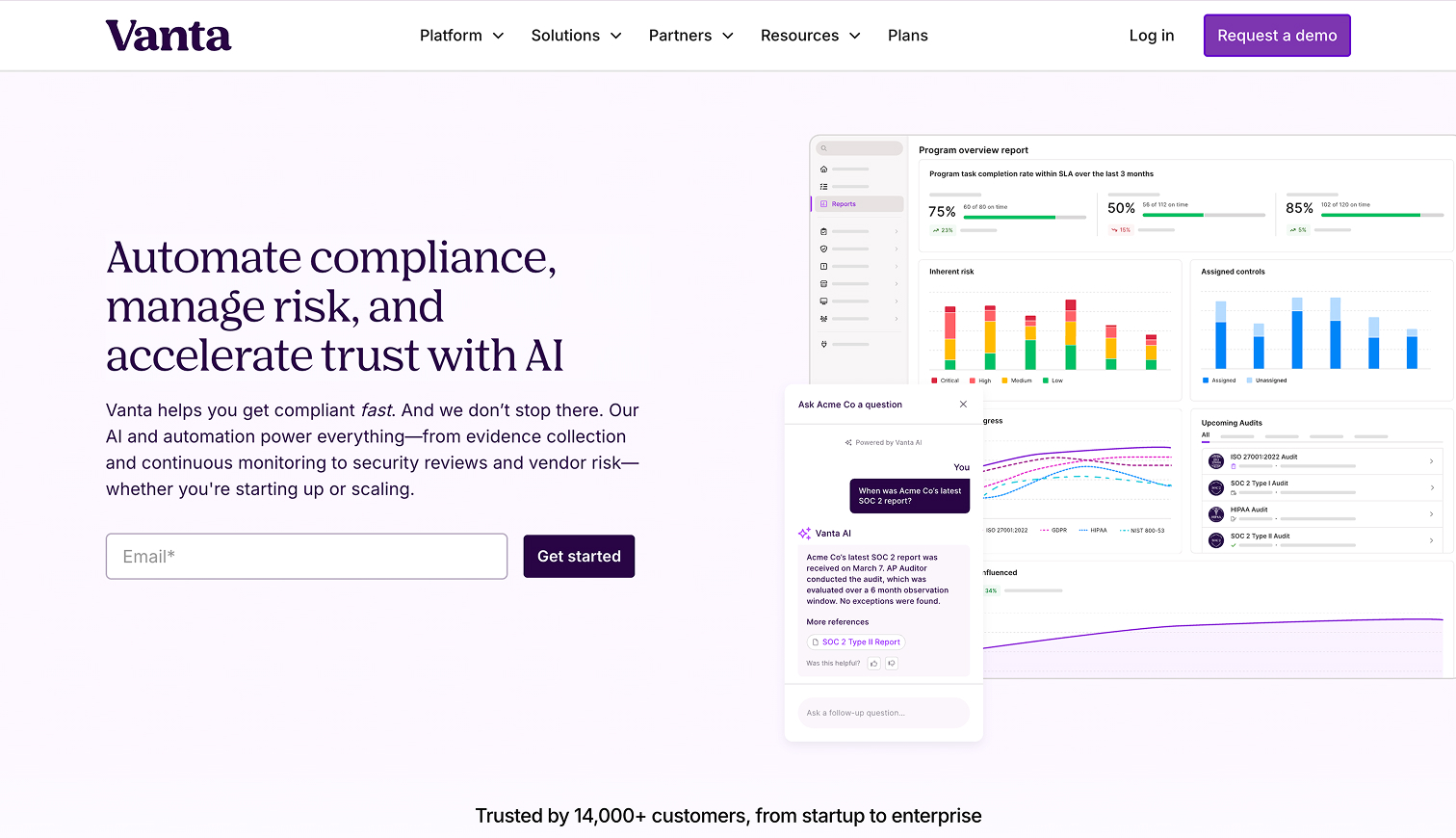
Vanta is known for helping organizations strengthen their security posture while automating compliance workflows, making it easier to track controls and reduce manual overhead. Its automated evidence collection and integration-rich platform aims to simplify preparing for audits and maintaining control adherence throughout the year.
Below are the key details that define Vanta’s positioning, ideal users, and operational strengths:
- Product Positioning And Core Focus: A security and compliance automation platform that emphasizes continuous monitoring, simplified risk tracking, and simplified certification readiness for standards like SOC 2, ISO 27001, and HIPAA.
- Typical Buyer Profile and Strengths: Suited for technology companies and security teams that want to automate control evidence collection, monitor security posture continuously, and reduce the burden of manual compliance tasks without building internal tooling.
- Limitations and Considerations: Users sometimes find that Vanta’s workflow customization is less flexible for complex enterprise processes compared to broader GRC platforms, which may limit fit for organizations with extensive policy and risk workflows.
- Framework Support and Certification Assistance: Supports major compliance frameworks and guides you through certification readiness steps with built-in control mappings and automated checks, making it easier to prepare for assessments and external audits.
- User Experience and Onboarding: Known for its intuitive interface and guided setup, Vanta helps teams get started quickly, though deeper customization may require support involvement for nonstandard environments.
Pricing: Contact vendor for pricing (Vanta’s plans like Essentials, Plus, Professional, and Enterprise are custom‑quoted; exact pricing isn’t publicly listed).
G2 Rating: 4.6/5 on G2 based on 2,143+ reviews
Free demo available (request through sales); no publicly listed self‑serve free trial.
4. MetricStream – Enterprise GRC With Deep Risk Libraries
MetricStream is recognized for delivering a strong enterprise-grade GRC platform with an emphasis on comprehensive risk libraries and configurable governance models that support complex organizational structures. It is frequently chosen by large corporations with mature compliance functions and diverse regulatory requirements.
Below are the in-depth details that define MetricStream’s positioning, implementation characteristics, and enterprise strengths:
- Product Positioning and Core Strength: Positioned as a comprehensive enterprise GRC solution, MetricStream excels in delivering extensive risk taxonomies and governance frameworks ideal for complex, highly regulated industries.
- Configurability For Enterprise Risk And Compliance Models: Offers deep customization options for risk categories, control frameworks, and approval hierarchies, enabling large organizations to map sprawling risk scopes to central governance processes.
- Rich Risk Libraries And Control Frameworks: Includes out-of-the-box catalogs for operational, financial, and compliance risk domains, helping risk teams accelerate adoption with predefined structures that still allow tailoring for specific business units.
- Target Buyer Profile And Scalability: Best suited for global enterprises and regulated conglomerates with dedicated GRC teams that require granular control, advanced analytics, and detailed workflow configuration.
- Advanced Reporting, Dashboards, and Analytics: Strong visualization and reporting capabilities support deep drill-downs into risk heatmaps, control performance trends, and compliance gaps across business functions.
- User Community and Knowledge Resources: Backed by a large enterprise user community and extensive documentation that supports advanced use cases, though the depth of detail can elevate the learning curve for new users.
Pricing: Contact vendor for pricing (custom quote model based on modules, seats, and implementation; enterprise costs often start around tens of thousands per year and can exceed $750,000–$1M annually depending on scale and services).
G2 Rating: 3.9/5 on G2 across products and reviews, reflecting mixed ratings across different modules/reviews.
Demo available via vendor request; limited trial offers (often short‑term and by request) may be available through special programs, but aren’t standard self‑serve trials.
5. ConductorOne – Identity-Aware GRC With Focused Access Controls
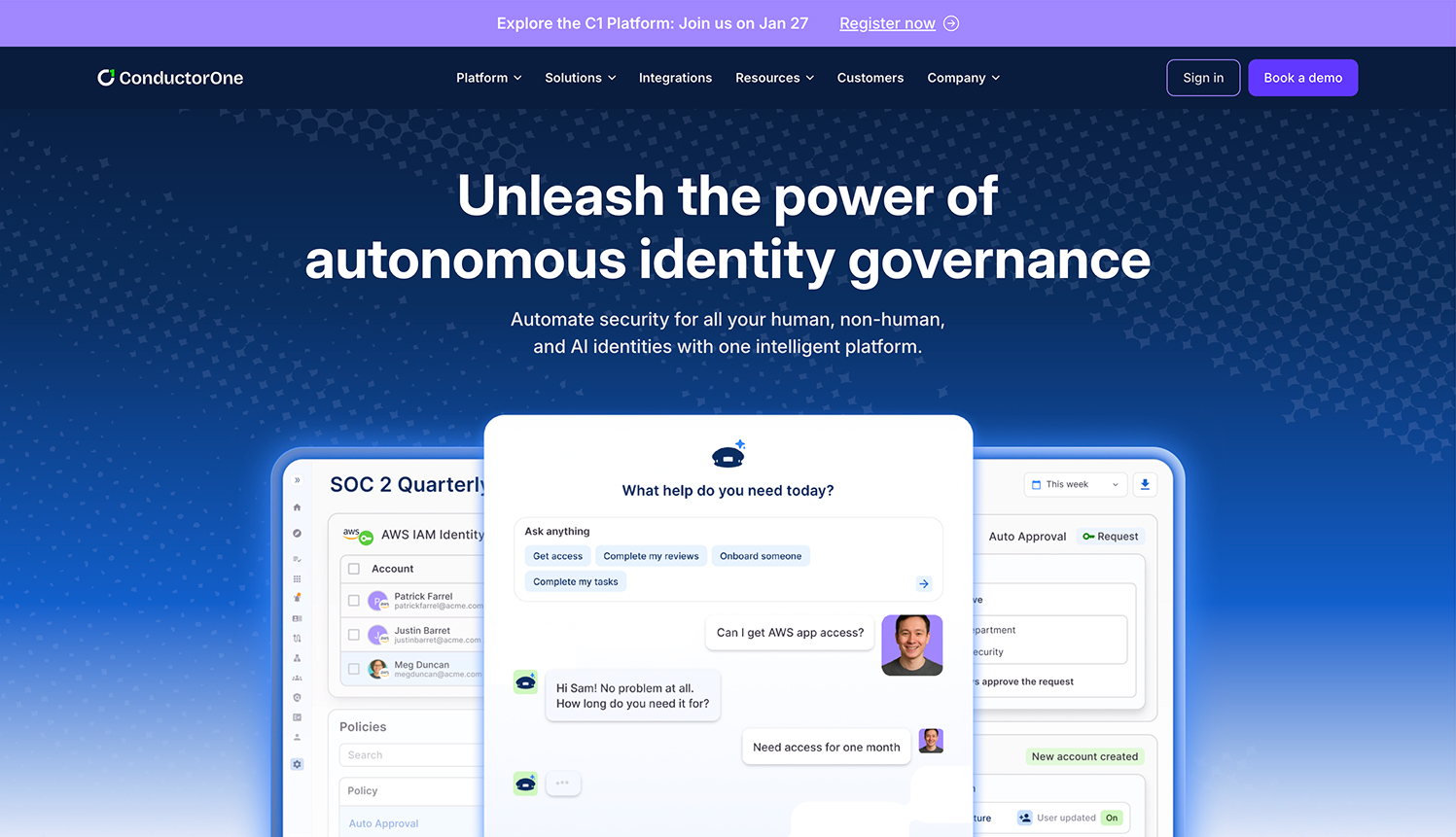
ConductorOne has emerged as a niche GRC platform that blends governance, risk, and compliance with identity-centric access controls and entitlement management. This helps organizations secure user privileges and enforce controls tied to identity risk.
Below are the detailed aspects that define ConductorOne’s positioning, strengths, and ideal buyer fit:
- Product Positioning And Differentiation: Positioned as an identity-aware GRC solution, ConductorOne bridges access governance with compliance oversight, prioritizing identity risk, permission management, and policy enforcement tied to user privileges.
- Strengths in Identity Risk and Access Management: Excels at automating access reviews, entitlement audits, and role-based policy enforcement, making it easier to maintain least-privilege principles and reduce identity-related compliance gaps.
- Access Policy Automation and Review Workflows: Supports automated certification campaigns, scheduled access reviews, and policy-based provisioning rules that help you ensure consistent control enforcement across systems.
- Integration With Identity And Cloud Services: Provides connectors to identity providers, cloud directories, and HR systems, enabling deeper visibility into user roles and privileges across your technology stack.
- Identity-Centered Risk Insights And Reporting: Offers dashboards and reports focused on identity risk metrics, such as inactive privileged accounts, stale credentials, and orphaned access, giving you targeted insights to act upon.
- Scalability and Enterprise Readiness: While strong in identity governance, ConductorOne may require complementary tools for broader GRC functions such as audit trail management or policy lifecycle governance, positioning it as part of a layered GRC strategy.
Pricing: Contact vendor for pricing (no public pricing available; enterprise pricing is custom-based on deployment and modules).
G2 Rating: 4.8/5 on G2 from verified user reviews
Free trial available (vendor offers trial access; request details through sales) and demo available on request.
6. Pathlock – Risk-Focused Controls And Compliance Visibility
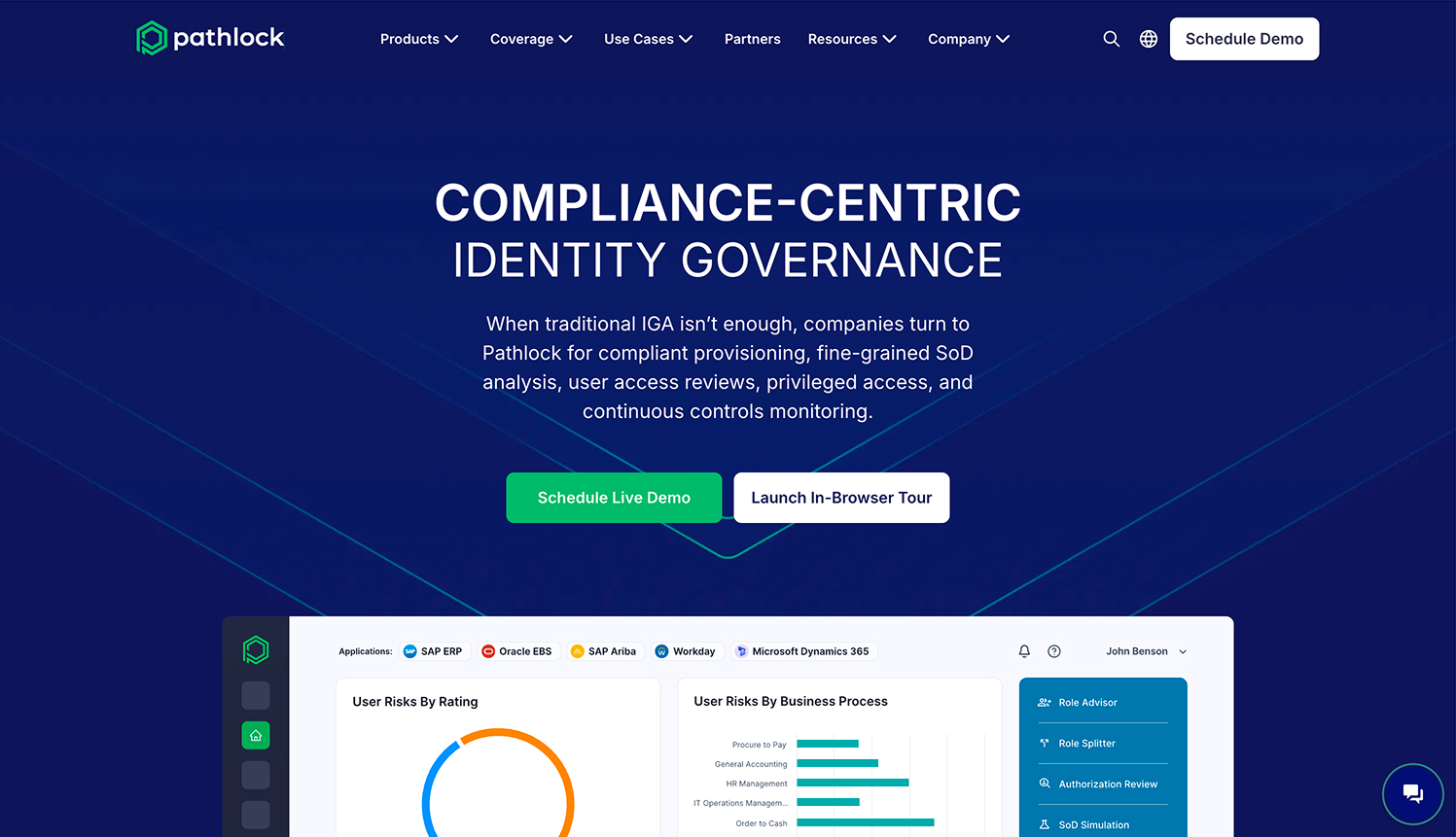
Pathlock (formerly known as Greenlight) specializes in controls assurance and risk transparency, helping organizations strengthen internal control environments and maintain visibility across key risk areas. Its strong focus on control validation, compliance reporting, and real-time risk insights makes it a good choice for teams that need targeted governance capabilities tied to internal controls and operational risk.
Below are the core aspects that define Pathlock’s positioning and ideal buyer fit:
- Product Positioning And Core Focus: Positioned as a controls-centric GRC tool, Pathlock helps organizations validate control design effectiveness, monitor compliance status, and improve risk awareness with granular control insights.
- Control Assurance and Monitoring Capabilities: Offers strong features to automate control testing against rule sets, identify control gaps, and generate evidence trails that support internal oversight and external assurance programs.
- Real-Time Risk Visibility And Alerts: Provides risk dashboards that surface anomalies and control failures in near-real time, helping you prioritize remediation actions and reduce exposure before it impacts business operations.
- Compliance Reporting And Documentation: Enables detailed compliance reports, audit trail logs, and control histories that help document regulatory readiness and support audit responses without extensive manual tracking.
- Integration With Enterprise Systems: Connects with ERP systems, identity platforms, and key data sources to pull transaction logs, user activity data, and control status information, enabling more comprehensive risk views.
- Analytics and Trend Insights: Includes analytics dashboards that highlight control performance trends over time, enabling leadership to track improvements, recurring issues, and compliance maturity progression.
Pricing: Contact vendor for pricing (no public list pricing available; customized quotes based on deployment and modules).
G2 Rating: 4.3/5 on G2 from verified user reviews
Demo available via vendor request; no standard free trial is publicly offered.
7. Archer – Legacy Enterprise GRC With Broad Capabilities

Archer has long been regarded as a foundational enterprise GRC platform, combining comprehensive risk, compliance, and audit modules with deep configurability. Its ability to support complex governance frameworks makes it a go-to choice for organizations with mature GRC programs. However, legacy architecture and customization complexity can extend implementation timelines.
Below are the key details that define Archer’s positioning, typical strengths, and notes for consideration:
- Product Positioning and Enterprise Legacy Strength: A well-established enterprise GRC solution known for supporting large, complex governance programs with a modular architecture that spans risk, compliance, audit, third-party risk, and regulatory change management.
- Extensive Module Ecosystem: Offers a wide range of pre-built modules, including operational risk, policy management, vendor risk, and compliance management, which allows you to tailor the platform to diverse governance needs without piecing together separate tools.
- Scalability For Complex Organizational Structures: Designed to support multinational enterprises and diversified business units, with configurable workflows, hierarchical role mapping, and regulatory content libraries that accommodate global compliance requirements.
- Custom Workflow And Configuration Capabilities: Enables deep customization of risk models, approval rules, and data schemas to match intricate business processes, though this flexibility can increase administrative overhead and require dedicated internal GRC administrators.
- Integration and Data Consolidation: Connects with ERP, identity, and security tools to pull risk signals and compliance data into Archer’s centralized repository, helping consolidate fragmented data sources.
- Reporting and Metric Consolidation: A strong reporting engine supports detailed dashboards, scorecards, and board-level reports that bring together risk exposures, control performance, and compliance status across domains.
Pricing: Contact vendor for pricing (no public pricing available; deployment costs vary widely by modules and scope).
G2 Rating: 3.6/5 on G2 based on verified user reviews
Demo available via vendor contact; no standard free trial publicly offered.
8. NAVEX One – Policy, Ethics, and Comprehensive Reporting
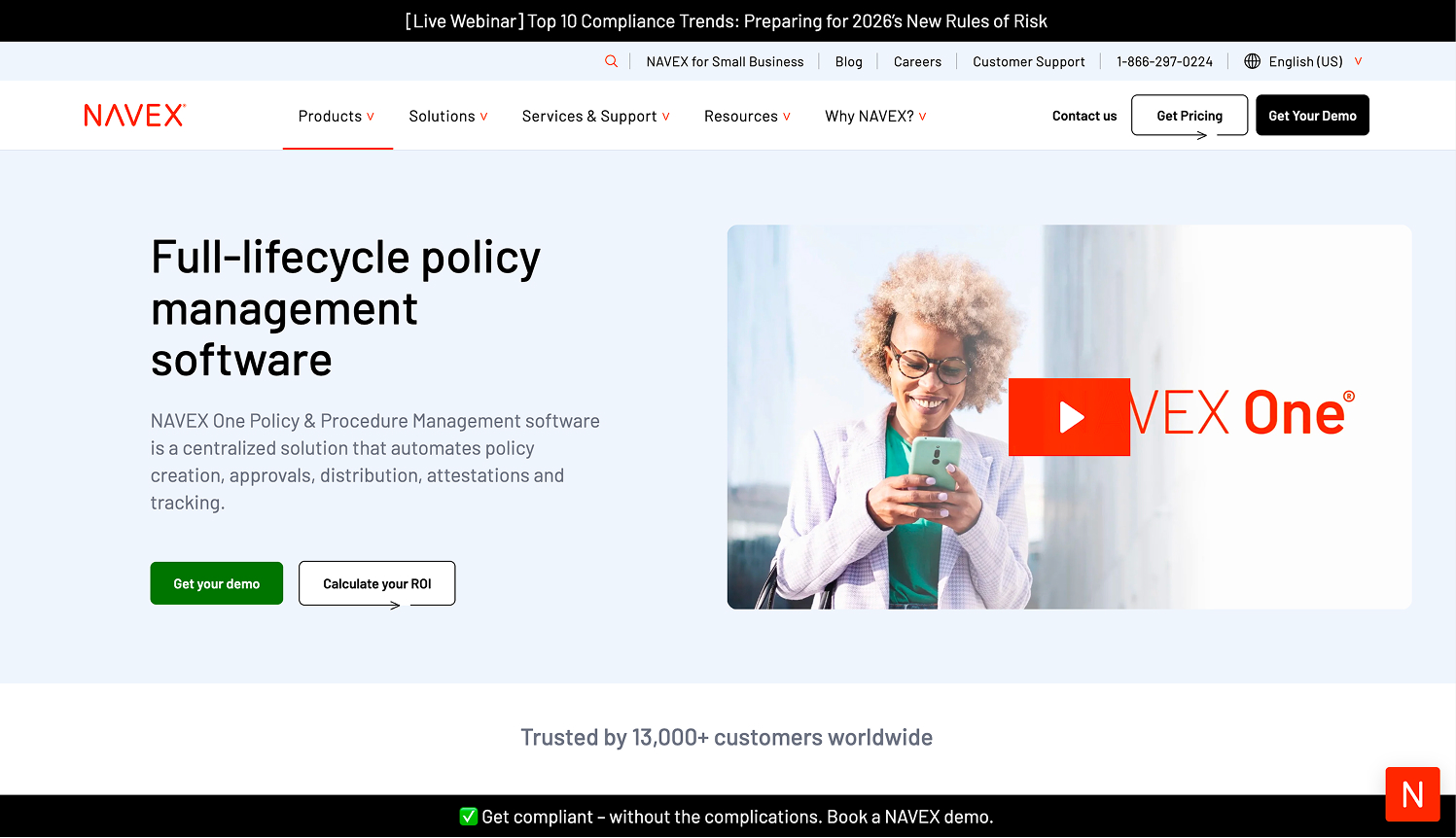
NAVEX One is a GRC solution centered on policy management, ethical compliance, and enterprise-level reporting. This helps organizations build trust, reinforce ethical culture, and document compliance efforts across distributed teams.
Below are the detailed aspects that define NAVEX One’s positioning, ideal buyers, and considerations:
- Product Positioning And Core Capabilities: Positioned as an ethics-centric GRC platform, NAVEX One unifies policy lifecycle management, training, incident reporting, and enterprise governance dashboards to support broad compliance goals.
- Policy Lifecycle Management Strengths: Offers strong tools for policy creation, version control, automated distribution, and attestation tracking, helping you ensure staff acknowledgment and adherence to changing requirements.
- Advanced Reporting And Audit Trails: Comprehensive reporting engines produce executive-ready dashboards and compliance reports, combining policy attestations, training completions, and incident metrics in a unified view.
- Training and Awareness Integration: Includes or integrates with awareness-building modules for compliance training, enabling you to align procedural policies with workforce behaviors and reduce compliance risk through education.
- Limitations and Considerations: While strong in policy and ethics governance, its broader GRC capabilities may be less feature-rich for detailed risk quantification or real-time risk scoring compared to platforms with deeper operational risk engines.
- Configurable Reporting For Compliance Insight: Allows you to tailor dashboards and exports that map compliance activities to organizational risk appetite and key risk indicators, helping leadership understand patterns and emerging issues.
Pricing: Contact vendor for pricing (custom quotation required; pricing details aren’t publicly listed).
G2 Rating: 3.8/5 on G2 (based on 78+ verified reviews)
Demo available via vendor request; no standard free trial is listed.
9. OneTrust – Privacy-First GRC With GDPR And Data Protection Strengths

OneTrust is best known as a privacy-centric GRC platform that helps organizations manage data protection, privacy risk, and cross-border compliance, particularly around GDPR, CCPA, and changing privacy requirements. Its privacy-first approach makes it a go-to choice for compliance teams dealing with data subject rights, consent tracking, and privacy impact assessments.
Below are the key details that define OneTrust’s positioning, ideal buyer fit, and considerations:
- Product Positioning and Core Focus: Positioned as a privacy and data governance-oriented GRC solution, OneTrust emphasizes frameworks that help you operationalize privacy requirements alongside traditional compliance obligations.
- Ideal Buyer Profile and Use Cases: Best suited for organizations with extensive privacy requirements, such as enterprises operating in multiple jurisdictions, large user-data footprints, or regulated data environments like healthcare and consumer services.
- Privacy And Data Protection Capabilities: Provides strong tools for data mapping, consent management, DPIAs (Data Protection Impact Assessments), and subject rights workflows, helping you stay aligned with GDPR and regional privacy laws.
- Limitations on Full-Spectrum GRC Coverage: While exceptional for privacy and data governance, OneTrust may require additional modules or integrations for comprehensive risk quantification, continuous monitoring, or audit management found in broader GRC suites.
- Reporting and Compliance Documentation: Equipped with advanced reporting that provides compliance artifacts, risk heatmaps, and rights exercise logs that help demonstrate adherence during internal assessments or external audits.
- Scalability and Modular Architecture: The modular design allows you to adopt privacy functions first and expand into broader operational governance needs over time, although this may increase the total cost of ownership if multiple modules are needed.
Pricing: Contact vendor for pricing (module‑based pricing tailored to your needs).
G2 Rating: 4.4/5 on G2 from verified reviews across OneTrust product categories.
Free 14‑day trial available for the GRC & Security Assurance Cloud (request via form), and demo available on request.
10. ZenGRC- Simple, Scalable GRC For Growing Teams
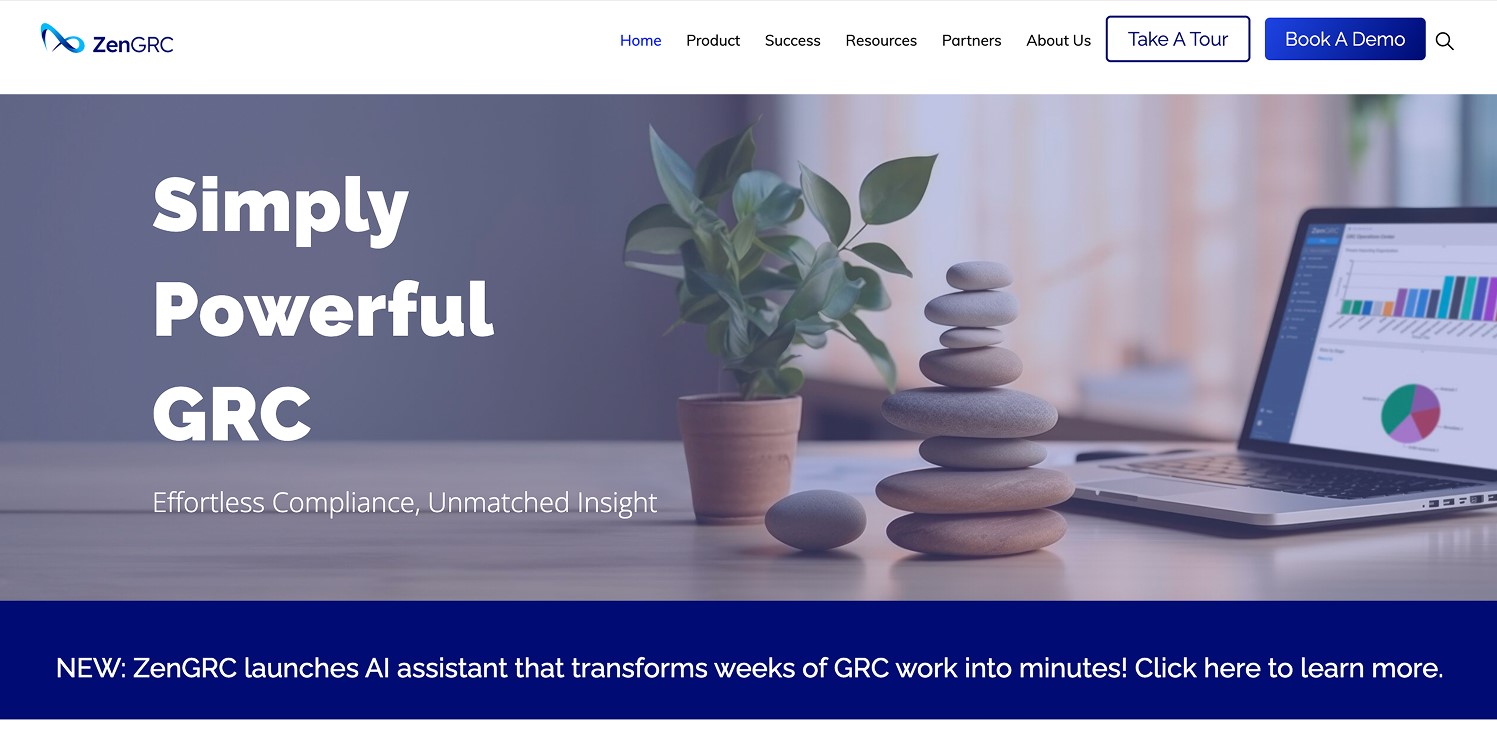
ZenGRC is a user-friendly GRC platform focused on delivering essential compliance and risk management capabilities with quick implementation and straightforward workflows. It appeals to organizations needing a practical GRC foundation without overwhelming complexity, helping you establish consistent controls and reporting with limited resources.
Below are the defining characteristics of ZenGRC’s positioning and best-fit buyer profile:
- Product Positioning And Core Value: Positioned as a simplified GRC solution, ZenGRC focuses on delivering essential governance, risk, and compliance functionality that works well for teams prioritizing ease of use and speed of deployment.
- Ease of Setup and Adoption: Known for rapid onboarding, intuitive configuration, and clear workflows that help teams begin managing controls and assessments quickly, reducing strain on limited compliance resources.
- Reporting and Dashboards for Core Metrics: Offers clean dashboard views and simple reporting tools that focus on high-level risk and compliance summaries, making it easier for small teams to communicate status to leadership.
- Limitations on Advanced Functions: While strong in foundational GRC capabilities, ZenGRC may lack deeper analytics, advanced incident management, or extensive workflow customization required by larger enterprises or complex operational ecosystems.
- Scalability and Growth Path: Designed to help organizations grow with their GRC maturity, offering a clear upgrade path while maintaining the ease of use that makes it attractive to growing compliance teams.
Pricing: Contact vendor for pricing (ZenGRC uses custom quotes with all‑inclusive licensing; typical benchmarks suggest starting around ~$2,500/month for foundational features, with higher tiers for professional and enterprise deployments).
G2 Rating: 4.4/5 on G2 from 100+ verified reviews
Free trial available (contact vendor or sales for access) and demo available on request.
Also Read: Your Guide to Major Life Science Compliance Risks
Now that we’ve ranked the top 10 GRC software, it’s time to consider implementation and how quickly your team can realize value from each GRC platform.
Implementation And Time-To-Value Considerations
The speed and quality of GRC platform implementation directly impact ROI, user adoption, and how quickly your organization begins to see measurable compliance and risk management improvements. Proper planning ensures smoother deployment, faster time-to-value, and minimizes disruption to ongoing operations.
Below are key aspects to guide effective implementation and accelerate value realization:
- Typical Implementation Phases and Duration: Most deployments follow planning, configuration, pilot testing, full rollout, and optimization phases.
Estimated durations vary by platform complexity: small to mid-market organizations may take 4–8 weeks, while enterprise-scale rollouts can extend 3–6 months or longer, depending on integration needs and workflow customizations.
- Common Blockers And Mitigation Strategies: Typical obstacles include legacy system integration challenges, data quality issues, lack of executive sponsorship, and unclear workflow ownership.
Mitigation strategies involve pre-migration data audits, phased integration, executive alignment meetings, and defined governance processes to address bottlenecks.
- Staff Roles to Involve During Rollout: Effective implementation requires cross-functional participation from security teams, IT/operations, compliance officers, risk managers, and legal advisors.
Each role ensures controls, workflows, and reporting align with organizational standards, regulatory obligations, and risk appetite.
- Change Management Checklist Items: Key items include user training programs, creation of operational playbooks, ongoing governance review schedules, and communication plans.
Regular feedback loops and iterative improvements help teams adopt new workflows confidently and sustain long-term compliance and risk management improvements.
Optimize your compliance workflows with VComply’s ComplianceOps. Centralize policy management, framework tracking, and audit readiness to make compliance effortless and actionable.
Once implementation and ROI are clear, it helps to see how each GRC platform performs across different industries and use cases.
Industry Use Cases And Mapping

Understanding how GRC platforms apply to specific industries helps you evaluate practical benefits and match features to your organization’s regulatory and operational challenges. This section highlights how top tools address sector-specific risks, compliance obligations, and operational workflows across US industries.
Below are key industry use cases and feature mappings:
- Financial Services
- Challenges: Compliance with SOX regulations, managing third-party/vendor risk, and preparing for frequent audit cycles.
- Feature Mapping: Platforms provide automated control frameworks, continuous risk monitoring dashboards, task reminders for compliance deadlines, and centralized audit evidence repositories, helping financial institutions reduce audit prep time and improve oversight.
- Healthcare
- Challenges: Adherence to HIPAA and patient-data privacy regulations, managing access controls, and ensuring data integrity across multiple systems.
- Feature Mapping: GRC tools enable policy enforcement, automated audit evidence collection, access reviews, and incident response workflows, helping healthcare providers maintain compliance while safeguarding sensitive patient information.
- Energy And Manufacturing
- Challenges: Managing operational risk, compliance with safety and environmental standards, and incident reporting.
- Feature Mapping: Platforms support incident management workflows, root-cause analysis, real-time audit trails, and regulatory reporting dashboards, allowing organizations to mitigate operational risks and ensure adherence to safety and environmental regulations.
Also Read: Are You Audit-Ready? A Deep-Dive Guide for Internal Compliance Leaders
Now, let us have a look at a sample audit readiness scorecard that can help evaluate their effectiveness in practice.
Sample Audit Readiness Scorecard
An audit readiness scorecard provides a quick snapshot of your organization’s compliance maturity and operational efficiency, helping you identify gaps and prioritize tool selection. By comparing key metrics across platforms, you can assess which GRC solution will most effectively accelerate audit preparation and risk management.
Below is a compact example illustrating how scores inform decision-making:
- Control Coverage (%): Measures the proportion of critical controls mapped and monitored within the platform. A higher percentage indicates broader compliance visibility and reduces manual tracking efforts.
- Evidence Automation (%): Represents the extent to which audit evidence is collected automatically. Platforms with higher automation reduce time spent compiling documentation and improve reliability for audits.
- Time To Produce Audit Pack (Days): Estimates the duration required to compile a complete audit package. Shorter timelines suggest more efficient workflows, integrated evidence collection, and user-friendly reporting features.
- Risk Visibility Score: Evaluates how effectively the platform surfaces and monitors risks across business units. Higher scores reflect real-time dashboards, alerts, and actionable risk insights for management.
- Incident Closure SLA: Tracks the average time to resolve incidents or cases. Faster closure indicates strong incident workflows, escalation paths, and operational oversight, reducing regulatory exposure.
Example Scorecard Snapshot:
| Metric | Organization A | Organization B | Notes |
| Control Coverage (%) | 85% | 95% | Organization B’s platform offers broader coverage and pre-mapped frameworks. |
| Evidence Automation (%) | 60% | 90% | Automation in Organization B reduces manual effort for audit prep. |
| Time To Produce Audit Pack (Days) | 15 | 5 | Faster generation improves audit readiness and executive reporting. |
| Risk Visibility Score | 70 | 92 | High visibility enables fast risk management. |
| Incident Closure SLA | 7 days | 2 days | Efficient incident handling ensures compliance gaps are addressed quickly. |
This example shows how platforms like VComply, with high automation and risk visibility scores, can accelerate audit readiness and reduce operational strain, helping organizations make informed GRC tool choices. Book a demo with VComply to see how it fits your needs.
Now, let’s explore some common implementation pitfalls and ensure successful deployment.
Common Implementation Pitfalls And How To Avoid Them

Even the most capable GRC platforms can underdeliver if implementation challenges aren’t proactively addressed. Awareness of common pitfalls and practical mitigation strategies ensures faster adoption, smoother workflows, and quicker realization of compliance and risk management benefits.
Below are frequent implementation challenges and how to avoid them:
- Lack of Executive Sponsorship: Without executive backing, initiatives may stall due to insufficient resources or competing priorities.
- How To Fix It: Engage leadership early by demonstrating ROI, compliance risk reduction, and operational efficiency gains. Regularly update executives with dashboards and metrics to maintain buy-in and accountability.
- Over-Customization That Delays Rollout: Excessive tailoring of workflows, controls, or dashboards can extend implementation timelines and complicate maintenance.
- How To Fix It: Focus on out-of-the-box features first, adopt standard frameworks, and implement customizations in phased stages only when operationally necessary. Maintain documentation for all deviations from standard configurations.
- Fragmented Data Sources: Disconnected systems lead to incomplete risk visibility and manual effort in consolidating evidence.
- How To Fix It: Conduct a data source audit pre-implementation, prioritize integrations with key ERP, HR, identity, and security systems, and use the platform’s connectors to centralize data for continuous monitoring and reporting.
Awareness of common implementation pitfalls leads naturally to the resources and questions you need to select the right GRC vendor.
Vendor Selection Resources And Questions To Ask
Selecting the right GRC platform often involves multiple demos, vendor discussions, and careful evaluation of security and compliance capabilities. This appendix provides a compact, FAQ-style guide to help you ask the right questions during procurement and ensure the solution aligns with your organization’s operational and regulatory needs.
Below are key questions to guide your evaluation:
- Essential Questions For Demos
- How Do You Automate Evidence Collection? Assess how the platform automatically gathers audit evidence from systems, reducing manual work and improving reliability.
- How Long Before We Can Run An Audit Pack? Understand expected timelines from configuration to producing a full audit package, including automation levels and reporting readiness.
- Which Compliance Frameworks Are Pre-Built? Confirm the availability of pre-mapped frameworks like SOX, HIPAA, PCI, GDPR, ISO 27001, and whether additional frameworks can be customized.
- Security And Compliance Questions
- Do You Maintain SOC 2 Type II, ISO 27001, Or Similar Evidence? Ensure the vendor follows recognized security standards and can provide attestation reports for assurance.
- How Do You Handle Data Residency And Encryption? Verify where data is stored, encryption protocols in transit and at rest, and compliance with regional regulations such as GDPR and US federal data guidelines.
These questions help shortlist vendors effectively, clarify operational capabilities, and validate security posture, making your procurement process more informed and aligned with organizational goals.
Read Next: How to Build a Risk Register That Actually Guides Decisions
Armed with key vendor questions and resources, you’re ready to make an informed choice and conclude your GRC platform evaluation.

Final Thoughts
Choosing the right GRC platform requires more than just comparing features; it’s about how well the tool integrates with your existing systems, supports your compliance frameworks, and adapts to your organization’s scale. No single platform fits every scenario, so careful evaluation based on risk coverage, automation, and usability is essential.
For organizations looking to optimize compliance, risk, policy, and incident management, VComply stands out as a unified GRCOps platform built for US enterprises. Automated audit readiness, centralized dashboards, and end-to-end workflow management help compliance officers, risk managers, and executives gain full visibility across all governance processes.
Take the next step toward efficient GRC management. Start a free trial today with VComply and see firsthand how unified GRCOps can save time, reduce risk, and enhance audit readiness.
FAQ
GRC software provides a broad view of governance, risk, and compliance, connecting audits, policies, incidents, and controls, while risk management tools primarily focus on identifying, scoring, and mitigating risks. GRC platforms integrate risk within broader compliance and operational workflows.
While GRC software significantly reduces manual effort, it may not eliminate all human involvement. Automated evidence collection, dashboards, and control monitoring strengthen compliance, but teams still need oversight for judgment-based decisions, complex audits, and exception handling.
Modern GRC platforms help you monitor vendor compliance, assess third-party risk scores, and enforce contractual obligations. They centralize vendor audits, track certifications, and flag potential breaches. Automated workflows assign remediation tasks and provide dashboards for executive visibility.
GRC platforms often use user-based, module-based, or subscription pricing, with tiers for small, mid-market, or enterprise organizations. Costs vary by number of users, features, and integrations. Some vendors offer flexible packages allowing incremental adoption of modules, while others bundle all functions into enterprise plans.
GRC tools track regulatory updates across frameworks, map changes to affected controls, and automatically notify relevant teams. Centralized repositories allow you to update policies and procedures consistently. Dashboards highlight compliance gaps and remediation status.