

Conflict of Interest: Meaning, Types, Examples, and How to Manage It
A conflict of interest occurs when personal interests or relationships interfere with professional responsibilities, potentially compromising objectivity and fairness. These conflicts can arise in both business and personal contexts, each bringing distinct challenges and implications. Recognizing and managing them is essential to maintain trust and ethical decision-making.

Key Takeaways
-
A conflict of interest happens when private interests could interfere with professional duties.
-
The most common types include actual, potential, perceived, financial, personal, professional, informational, and organizational conflicts.
-
Common workplace examples include hiring a relative, accepting vendor gifts, holding shares in a supplier, working for a competitor, using confidential information, or influencing a decision that benefits a friend or family member.
-
The goal is not to eliminate every possible conflict. The goal is to identify, disclose, review, manage, and document conflicts before they affect decisions.
-
A strong conflict of interest program needs a clear policy, simple disclosure process, independent review, recusal rules, documented decisions, training, and audit-ready records.
What Is a Conflict of Interest?
At its core, a conflict of interest arises when personal interests, relationships, or obligations clash with professional responsibilities, leading to a situation where impartiality and objectivity may be compromised.
With a deeper understanding, conflicts of interest can be categorized into business and personal contexts, each presenting unique challenges and implications.
Conflict of Interest in the Workplace
A conflict of interest in the workplace occurs when an employee’s private interest overlaps with their job responsibilities.
This often happens when employees have influence over:
Hiring or promotions
Vendor selection
Contract approvals
Procurement decisions
Expense approvals
Investigations
Performance reviews
Financial reporting
Board or committee decisions
Access to confidential information
For example, if an HR leader is involved in hiring a family member, the hiring decision may be questioned even if the relative is qualified. If a finance employee uses non-public company information to make a personal investment decision, the issue may go beyond internal policy and create legal risk. If a vendor offers gifts during a contract renewal, the gift may influence, or appear to influence, the decision.
Main Types of Conflict of Interest
| Type | Meaning | Example |
|---|---|---|
| Actual conflict of interest | A private interest is currently interfering, or likely interfering, with professional duties. | A manager approves a contract for a company owned by their spouse. |
| Potential conflict of interest | A situation could become a conflict in the future. | An employee joins the board of an organization that may later bid for company work. |
| Perceived conflict of interest | Others could reasonably believe a conflict exists, even if no improper action occurred. | A team believes a promotion was influenced by a personal friendship. |
| Financial conflict | A person’s financial interest could affect their professional judgment. | An executive owns shares in a supplier under review. |
| Personal or relational conflict | Family, friendship, romantic, or social relationships affect objectivity. | A supervisor manages the performance review of a close friend. |
| Professional conflict | Outside roles, board seats, advisory work, or dual duties create competing obligations. | An employee consults for a company in the same market. |
| Informational conflict | Access to confidential information creates risk of personal or third-party benefit. | An employee shares acquisition information with a friend before public disclosure. |
| Organizational conflict | A company, board, department, or partner has competing duties or loyalties. |
Also Read: Identifying Ethical Challenges in Business: Bribery, Conflict of Interest, Honesty and Integrity
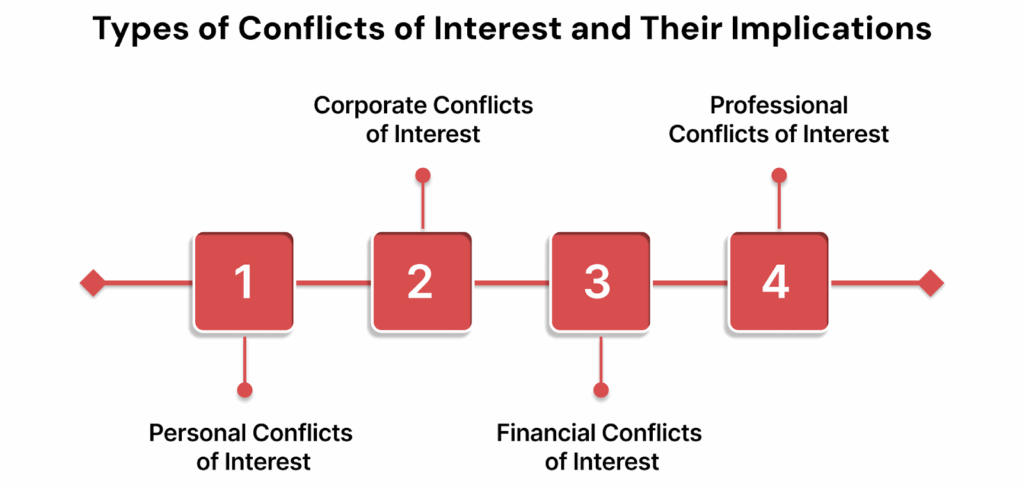
Conflicts of interest can manifest in diverse ways, often overlapping across personal, corporate, financial, and professional domains. Addressing these conflicts requires a nuanced understanding of their specific nature and impact.
Additionally, distinctions between actual, potential, and perceived conflicts of interest provide further clarity on how to approach and resolve these issues effectively.
1. Personal Conflicts of Interest
Personal conflicts arise when relationships or personal interests interfere with an individual’s ability to make impartial decisions. These situations often involve conflicts of interest, which can create the appearance of favoritism or improper influence.
Examples:
- Nepotism: A manager hires a family member without disclosing the relationship.
- Undisclosed Relationships: An employee awards a contract to a vendor owned by a close friend.
- Favoritism: Assigning promotions based on personal connections rather than merit.
Personal conflicts can damage team morale, lead to accusations of unfairness, and undermine organizational ethics.
2. Corporate Conflicts of Interest
Corporate conflicts arise when an employee or decision-maker’s personal gain conflicts with the company’s objectives. These are often referred to as corporate conflicts of interest and can result in reputational harm and regulatory scrutiny.
Examples:
- Misaligned Priorities: A board member pushes for a merger with a company where they have investments.
- Undisclosed Side Projects: An executive is working part-time for a competitor without informing their employer.
Addressing these issues ensures alignment between individual actions and corporate goals, safeguarding organizational integrity.
3. Financial Conflicts of Interest
Financial conflicts occur when personal financial gain influences professional responsibilities, leading to ethical breaches or even legal consequences.
Examples:
- Insider Trading: Using confidential company information to buy or sell stocks for personal benefit.
- Kickbacks: Accepting personal rewards from a vendor in exchange for awarding a contract.
Managing financial conflicts of interest is critical to maintaining regulatory compliance and organizational trust.
4. Professional Conflicts of Interest
Professional conflicts arise when individuals hold dual roles or affiliations that create competing priorities, compromising their objectivity.
Examples:
- Legal Professionals: A lawyer representing two opposing clients in a case.
- Board Memberships: A board member voting on a decision that benefits another organization to which they are affiliated.
Resolving professional conflicts requires clear boundaries and adherence to ethical guidelines to prevent compromised judgment.
The Importance of Recognizing and Addressing Conflicts of Interest
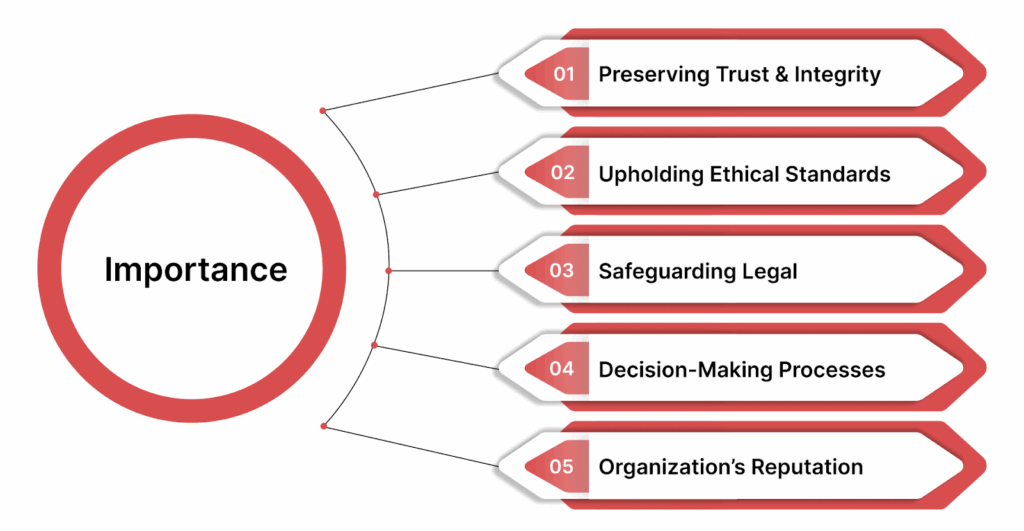
Conflicts of interest, whether real or perceived, can have far-reaching consequences for any organization. Recognizing and addressing these conflicts early is crucial for maintaining a strong ethical foundation and protecting the organization’s reputation.
Here’s why it matters:
1. Preserving Trust and Integrity
At the heart of any successful organization lies trust. When employees or stakeholders perceive that decisions are influenced by personal interests, even if no wrongdoing occurs, trust begins to erode.
The perception of bias can be just as damaging as actual misconduct, leading to a breakdown in relationships and collaboration. By addressing COIs promptly, organizations can reassure their teams and clients that decisions are made fairly and without favoritism, reinforcing integrity across all levels.
2. Upholding Ethical Standards
Every organization has ethical guidelines that dictate how individuals should conduct themselves. Ignoring conflicts of interest undermines these standards, sending a message that ethical conduct is negotiable.
Proactively managing COIs helps ensure that the organization adheres to its values, setting a positive example for employees and stakeholders alike. It also creates a culture where ethical behavior is prioritized, encouraging a more transparent and accountable environment.
3. Safeguarding Legal and Regulatory Compliance
Failure to properly handle conflicts of interest can lead to legal issues, especially if it results in breaches of regulatory frameworks or industry standards.
As highlighted earlier, while many countries have regulatory frameworks addressing COIs, enforcement remains a challenge. By staying vigilant and adhering to compliance requirements, organizations can avoid the risk of legal repercussions, fines, or reputational damage.
4. Enhancing Decision-Making Processes
When conflicts of interest are left unchecked, they can distort decision-making processes. Whether in procurement, hiring, or contract approvals, COIs introduce bias that may compromise the quality of decisions.
Addressing conflicts ensures that decisions are based on merit, data, and the organization’s long-term goals, ultimately leading to better outcomes and more effective strategies.
5. Protecting the Organization’s Reputation
A single unresolved conflict of interest can spiral into a major crisis. News of COIs can spread quickly, damaging public perception and resulting in lost business, customer distrust, or even regulatory penalties.
By taking proactive steps to address COIs, organizations not only protect their internal culture but also safeguard their reputation in the eyes of the public, clients, and industry peers.
Also Read: Understanding the Importance and Implementation of a Business Code of Conduct
Common Conflict of Interest Examples
1. Hiring a family member
A department head recommends their sibling for a role without disclosing the relationship. Even if the sibling is qualified, the hiring process may appear unfair.
2. Awarding business to a friend’s company
A manager approves a contract with a vendor owned by a personal friend. If the relationship is not disclosed, the decision can raise questions about favoritism.
3. Accepting gifts from vendors
A vendor offers expensive tickets, travel, meals, or personal benefits to an employee involved in contract renewal. Even if the employee says the gift did not influence them, the timing creates risk.
4. Holding shares in a supplier or competitor
An employee involved in procurement, pricing, strategy, or contract decisions owns stock in a company affected by those decisions.
5. Outside employment
An employee works part-time for a competitor, supplier, customer, or business partner. This can create loyalty, confidentiality, and time-allocation concerns.
6. Using confidential information
An employee learns about a merger, acquisition, contract award, investigation, or product launch before it is public and uses that information for personal benefit.
7. Board or committee conflicts
A board member votes on a decision that benefits another organization where they hold a role, investment, or personal relationship.
8. Internal investigation conflicts
A manager is assigned to review a complaint involving someone they supervise closely, personally know, or may have reason to protect.
9. Research or grant conflicts
A researcher, reviewer, or committee member evaluates funding, data, or outcomes where they have a financial, academic, or personal stake.
10. Performance incentive conflicts
Employees are rewarded for outcomes that may encourage unethical conduct, misreporting, aggressive sales behavior, or customer harm.
The Wells Fargo case is a useful example of how incentive structures can create conflicting priorities between employee goals, organizational targets, customer interests, and ethical conduct. The company later reached a $3 billion settlement with the DOJ and SEC related to its sales practices.
Key Indicators to Watch for Potential Conflicts of Interest
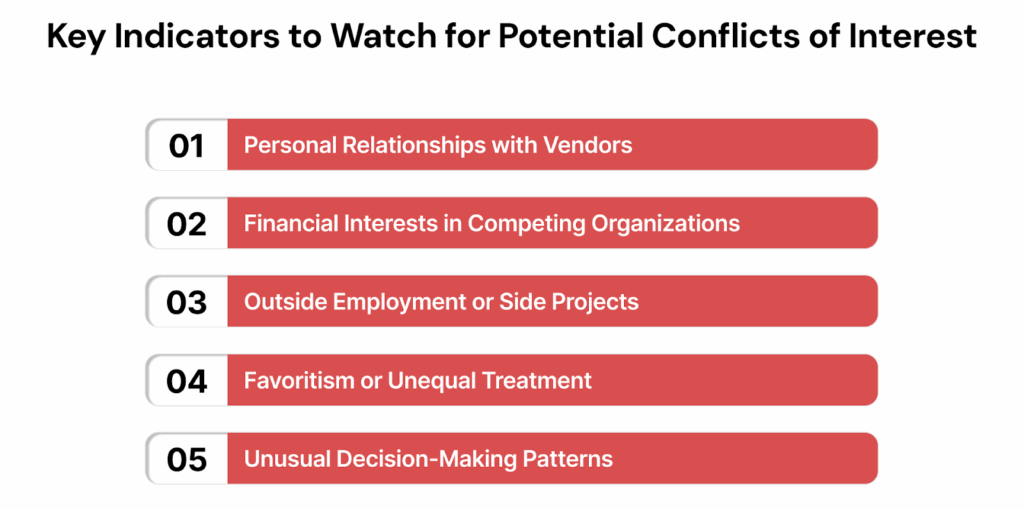
Recognizing the signs of potential conflicts of interest is essential for addressing them before they escalate into ethical or legal issues.
Below are key indicators that suggest a conflict may exist:
1. Personal Relationships with Vendors or Clients
- One of the most common red flags is when an employee has close personal or familial ties with a vendor, contractor, or client. While these relationships may be legitimate, they raise questions about impartiality when it comes to business decisions.
- If an employee is involved in approving contracts, negotiating terms, or making purchasing decisions for a vendor with whom they have a personal connection, it’s a potential conflict of interest.
2. Financial Interests in Competing Organizations
- Employees who hold financial stakes, such as stock or investment interests, in competing companies or organizations might be swayed in ways that aren’t aligned with their role.
- This financial interest can create a situation where their personal financial goals conflict with their responsibilities to the organization, leading to biased decision-making or a lack of objectivity.
3. Outside Employment or Side Projects
- When an employee works for or runs a side business that competes with their employer, it can create a direct conflict of interest.
- This is especially true if the employee uses insider information, resources, or time during work hours for their personal ventures.
- It’s essential to assess whether any external work or side project could compromise the employee’s loyalty and decision-making within the organization.
4. Favoritism or Unequal Treatment
- If an employee is showing favoritism towards a specific individual, department, or group, it can be a sign of an underlying conflict of interest.
- This behavior may manifest as biased decision-making, unequal distribution of opportunities, or preferential treatment in promotions or pay raises.
- Such actions can undermine morale and create an unhealthy work environment, which may escalate into more significant conflicts if not addressed.
5. Unusual Decision-Making Patterns
- If decisions are consistently made that benefit a particular individual or group without clear, justifiable reasons, it could indicate a hidden conflict of interest.
- For instance, awarding contracts or approving deals that disproportionately benefit one party or seem to go against the organization’s best interests might be a sign that a conflict is influencing decision-making.
Proactively addressing these signs ensures that potential conflicts are managed before they damage trust, disrupt operations, or lead to reputational harm. Regular audits, clear policies, and open communication are key tools for identifying and mitigating conflicts early.
What Should a Conflict of Interest Policy Include?
A conflict of interest policy should explain what employees must disclose, when they must disclose it, who reviews it, how decisions are made, and what records must be kept.
A strong policy should include:
1. Clear definition
The policy should define conflict of interest in plain language. Employees should not need legal training to understand it.
2. Scope
The policy should explain who it applies to. This may include employees, executives, board members, contractors, consultants, volunteers, and relevant third parties.
3. Types of conflicts covered
The policy should cover actual, potential, and perceived conflicts. It should also include financial, personal, professional, informational, and organizational conflicts.
4. Practical examples
Employees need examples that match real workplace situations. Procurement, hiring, vendor gifts, outside employment, board roles, investigations, and confidential information should be included.
5. Disclosure requirements
The policy should explain when and how employees must disclose conflicts. Disclosure should happen during onboarding, annually, when circumstances change, and before high-risk decisions.
6. Review process
The policy should identify who reviews disclosures. Depending on risk, this may be a manager, HR, compliance, legal, an ethics committee, audit committee, or board.
7. Recusal rules
The policy should explain when a person must step away from a decision, meeting, vote, investigation, or approval process.
8. Documentation requirements
Every disclosure, review, decision, mitigation step, and follow-up action should be documented.
9. Non-retaliation language
Employees should know they will not be punished for making a good-faith disclosure.
10. Consequences for non-disclosure
The policy should explain that hiding a conflict, providing false information, or ignoring mitigation requirements can lead to disciplinary action.
11. Annual attestation
Employees in high-risk roles should regularly confirm that they have disclosed relevant conflicts or that they have no conflicts to report.
12. Review and update cycle
The policy should be reviewed at least annually or when business structure, regulations, risk exposure, or operating models change.
How to Manage and Investigate a Conflict of Interest
A conflict of interest should be handled through a documented workflow, not an informal email chain. The goal is to identify the issue early, assess the risk objectively, decide the right response, and keep a clear record of every action taken.
Managing a conflict is the first step. Investigating it becomes necessary when the conflict was not disclosed, may have influenced a decision, involves sensitive relationships or financial interests, or raises concerns about policy violations.
Step 1: Identify the conflict
Start by defining the nature of the conflict.
Identify:
- The private interest involved
- The professional duty affected
- The decision, approval, contract, hiring process, investigation, or activity at risk
- The individuals or third parties involved
- Whether the conflict is actual, potential, or perceived
For example, a conflict may involve a manager approving a vendor owned by a relative, an employee accepting benefits from a supplier, or a board member voting on a matter that affects another organization where they hold a role.
Step 2: Require early disclosure
Employees should disclose conflicts before they participate in a decision or activity. Early disclosure allows the organization to manage the issue before it affects judgment, outcomes, or trust.
Disclosures should capture:
- Who is involved
- What relationship, financial interest, outside role, or personal interest exists
- Which business decision or responsibility may be affected
- Whether the person has already participated in the decision
- Any supporting documents or context
Late disclosure does not automatically mean misconduct occurred, but it does increase compliance risk and may require further review.
Step 3: Assess the severity
Compliance, legal, HR, management, or an ethics committee should assess the disclosure based on risk and impact.
Key questions include:
- Could the conflict affect a decision?
- Could it appear to affect a decision?
- Is money, employment, confidential information, family, vendor influence, or board involvement connected to the issue?
- Is the person in a high-risk role?
- Has the decision already happened?
- Was the conflict disclosed before or after the decision?
- Is independent review needed?
This assessment determines whether the matter can be managed through basic documentation or whether a formal investigation is required.
Step 4: Decide whether an investigation is needed
Not every conflict of interest needs a full investigation. Some can be managed through disclosure, documentation, and recusal.
An investigation may be needed when:
- The conflict was hidden or disclosed late
- A decision may already have been influenced
- Financial benefit may have occurred
- A vendor, contract, hiring decision, promotion, grant, or board vote is involved
- Confidential information may have been misused
- There is a complaint, whistleblower report, or employee concern
- The conflict involves senior leadership or a high-risk function
- Policy violations may have occurred
The purpose of the investigation is not to assume wrongdoing. It is to establish facts.
Step 5: Gather relevant evidence
If an investigation is required, collect relevant information in a discreet and structured way.
Evidence may include:
- Emails and messages
- Contracts and vendor records
- Meeting notes or approval records
- Procurement documents
- Hiring or promotion records
- Expense reports
- Gift and hospitality records
- Conflict disclosure forms
- Board or committee minutes
- System access logs
- Prior policy attestations
The evidence review should focus on whether the private interest affected, or appeared to affect, a business decision.
Step 6: Conduct objective interviews
Interview relevant individuals professionally and without bias.
This may include:
- The person who disclosed the conflict
- The person suspected of having a conflict
- Managers or approvers involved in the decision
- Procurement, HR, finance, legal, or compliance personnel
- Witnesses or employees who raised concerns
Questions should be direct and fact-based. The goal is to understand what happened, when it happened, who knew about it, and whether the conflict influenced the decision.
Step 7: Review applicable policies and standards
Compare the evidence against the organization’s conflict of interest policy, code of conduct, procurement policy, gifts and hospitality policy, outside employment policy, board governance rules, or any relevant industry requirements.
The review should determine:
- Was disclosure required?
- Was disclosure made on time?
- Did the person participate in a decision they should have avoided?
- Was recusal required?
- Were approvals handled properly?
- Was there any personal, financial, or professional benefit?
- Were records complete and accurate?
This step helps separate poor judgment, process gaps, and actual policy violations.
Step 8: Decide the response
Once the facts are clear, decide the appropriate response.
Possible actions include:
- No action beyond documentation
- Disclosure to relevant stakeholders
- Recusal from a decision, vote, review, or approval
- Reassignment of responsibilities
- Independent review of the affected decision
- Restriction of system or information access
- Divestment of a financial interest
- Termination of an outside role or conflicting agreement
- Vendor or contract review
- Additional training
- Policy update or control improvement
- Disciplinary action if the conflict was concealed or policy was breached
The response should match the severity of the conflict and the level of risk created.
Step 9: Document the decision
Every conflict review should leave a clear audit trail.
Document:
- What was disclosed or reported
- Who reviewed the matter
- What evidence was considered
- Which policies applied
- What decision was made
- Why that decision was made
- What mitigation steps were required
- Whether follow-up monitoring is needed
This documentation protects the organization and shows that the issue was handled fairly and consistently.
Step 10: Monitor ongoing conflicts
Some conflicts do not end after one review. Outside employment, board roles, investments, family relationships, vendor connections, and advisory positions may need periodic monitoring.
Compliance teams should set review dates, require updated disclosures, and confirm that mitigation steps remain in place.
Step 11: Report trends to leadership
Conflict of interest data can reveal broader compliance risks.
Compliance teams should track:
- Number of conflict disclosures
- Types of conflicts reported
- High-risk departments or roles
- Vendor-related conflicts
- Hiring or promotion-related conflicts
- Late or incomplete disclosures
- Unresolved cases
- Repeat issues
- Policy exceptions
- Disciplinary outcomes
- Overdue reviews
These trends help leadership identify weak controls, training gaps, and areas where policies need to be strengthened.
By following these steps, you can effectively and ethically address conflicts within your organization. Next, let’s look at some practical tips for managing these conflicts.
Practical Tips for Addressing and Managing Conflicts of Interest
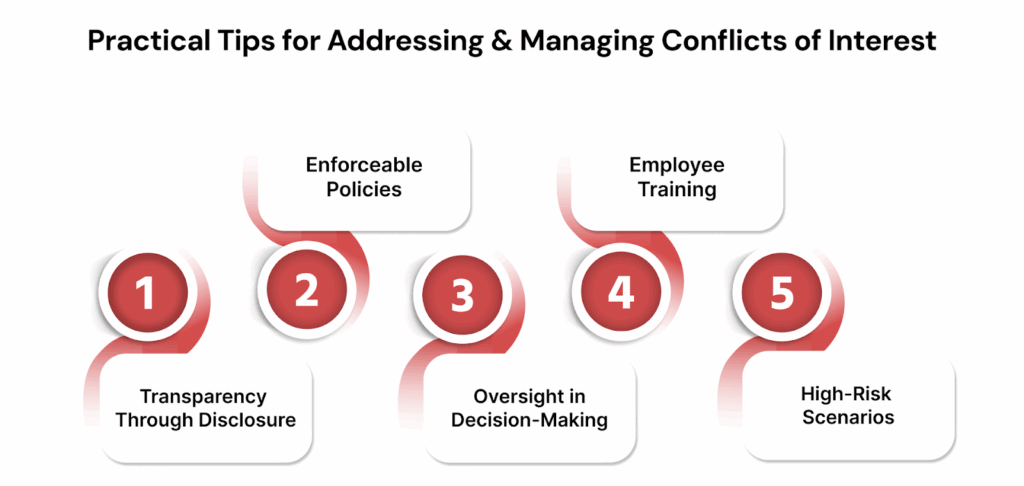
Effectively managing conflicts of interest requires clear guidelines, transparency, and a proactive approach. These actionable tips help organizations and individuals manage conflicts in an ethical and efficient manner.
Here are the practical tips for addressing and managing conflicts of interest.
1. Transparency Through Disclosure
Openly declaring personal or financial interests that might influence decisions is essential to maintaining trust.
- Mandatory Disclosure Policies: Implement policies requiring employees to report relationships or financial ties during key processes like procurement and hiring.
- Foster a Culture of Transparency: Encourage employees to disclose potential conflicts of interest as a standard practice, promoting accountability and trust. Create an environment where proactive declarations are viewed as a positive step toward maintaining ethical standards.
2. Clear and Enforceable Policies
Well-documented, specific guidelines help prevent ambiguities that can lead to lapses in judgment.
- Define Scenarios: Clearly outline what constitutes a conflict of interest in business and professional contexts.
- Set Rules: Include limits on accepting gifts, engaging in dual employment, or handling personal relationships.
- Update Regularly: Revise policies to address emerging risks, like remote work dynamics or new regulatory requirements.
3. Recusal and Oversight in Decision-Making
When conflicts are unavoidable, stepping aside ensures impartiality.
- Recusal: Individuals should abstain from participating in decisions where they have a vested interest.
- Third-Party Oversight: Use independent committees or auditors to ensure transparency in high-risk situations.
4. Employee Training and Awareness
Knowledge is key to identifying and effectively managing conflicts.
- Interactive Training: Provide workshops and simulations to help employees recognize actual conflicts of interest and learn resolution strategies.
- Tailored Modules: Customize training for roles such as HR or procurement, focusing on scenarios relevant to their responsibilities.
- Continuous Education: Offer refresher courses to keep employees updated on policies and new risks.
5. Ethical Safeguards for High-Risk Scenarios
For complex or high-stakes conflicts, additional safeguards are critical.
- Ethics Screens: Restrict access to sensitive information for individuals with potential conflicts of interest.
- Blind Trusts: Manage financial interests without the individual’s direct oversight.
By creating transparency and implementing clear policies, organizations can establish a strong ethical foundation for sustained success.
Real-World Example of Conflict of Interest
One well-documented real-world example of a conflict of interest occurred in the case of Wells Fargo, a major American bank and financial services company. In the mid-2010s, Wells Fargo employees were found to have created millions of unauthorized bank and credit card accounts to meet aggressive sales targets.
The conflict of interest arose because employees were incentivized through remuneration and bonuses to push sales, leading some to prioritize personal and corporate sales goals over ethical banking practices and customer interests.
This case highlights how financial incentives can create conflicting loyalties between an employee’s duty to customers and their desire to meet performance goals.
The scandal severely damaged Wells Fargo’s reputation and led to regulatory actions, including a $3 billion settlement with the U.S. Department of Justice and the Consumer Financial Protection Bureau in 2020.
This example illustrates the dangers of unmanaged conflicts of interest where personal or organizational gain comes at the expense of ethical standards and stakeholder trust.
Simplify Conflict of Interest Management with VComply
VComply streamlines conflict of interest management in 2025 with specialized features, enabling organizations to draft, approve, distribute, and track policies on conflicts of interest across teams more easily.
Conflict of interest management fails when disclosures sit in emails, spreadsheets, shared drives, or disconnected HR records. VComply helps organizations manage conflicts through a more controlled compliance workflow:
PolicyOps can centralize conflict of interest policies, manage reviews, route approvals, distribute updated policies, and track employee acknowledgments.
ComplianceOps can assign ownership, set recurring attestations, automate reminders, and track evidence tied to conflict disclosures and mitigation steps.
CaseOps can help teams document, investigate, review, and resolve conflict-related concerns through a structured case workflow.
RiskOps can connect conflict patterns to broader operational, vendor, financial, and governance risks.
Together, these workflows help compliance teams move from “we have a policy” to “we can prove the policy is understood, followed, reviewed, and enforced.”
Use VComply’s Conflict of Interest Policy Management Template to create and share clear, consistent policies. This ready-to-use template streamlines communication, establishes clear expectations, and makes your guidelines easily accessible throughout your organization.
Start your Free Demo with VComply today! Take the first step toward a more streamlined and accountable workplace.
Final Thoughts
If left unaddressed, conflicts of interest can erode trust, disrupt decision-making, and tarnish reputations. Understanding the various types of actual, potential, and perceived conflicts of interest is the first step in creating a culture of integrity and accountability.
Organizations that prioritize addressing conflicts of interest are better positioned to maintain ethical standards, safeguard their reputations, and build trust with stakeholders.
Equip your organization with the right tools to effectively manage conflicts of interest, ensure compliance, and promote transparency. Explore VComply’s 21-day free trial today and take the first step toward building a more ethical and accountable workplace.
Frequently Asked Questions
A conflict of interest occurs when a person’s personal, financial, or professional interests interfere with their duty to act objectively. It can affect decision-making, create bias, or damage trust in an organization.
The conflict of interest meaning is a situation where someone’s private interests could influence, or appear to influence, their professional responsibilities. It does not always mean wrongdoing occurred, but it does mean the situation needs to be disclosed and managed.
Common conflict of interest examples include hiring a relative, awarding a contract to a friend’s company, accepting gifts from vendors, investing in a competitor, using company information for personal gain, or working a second job that competes with the employer.
A conflict of interest in the workplace happens when an employee’s personal interests, relationships, outside employment, or financial ties could affect their professional judgment. It often appears in hiring, procurement, vendor management, promotions, investigations, and financial approvals.
A conflict of interest policy is a formal document that explains how employees must disclose, avoid, and manage conflicts. It usually includes definitions, examples, disclosure procedures, recusal rules, investigation steps, documentation requirements, and consequences for violations.
The main types of conflict of interest include actual conflict of interest, potential conflict of interest, perceived conflict of interest, personal conflict, financial conflict, professional conflict, and corporate conflict.