

Regulatory Gap Analysis: A Governance Framework for Risk and Compliance Teams
Supervisory bodies increasingly expect organizations to demonstrate structured oversight across regulatory obligations, not just policy documentation. Enforcement actions often cite failure to monitor control effectiveness, incomplete remediation tracking, or unclear accountability for compliance gaps.

You may have documented policies aligned with SOX, HIPAA, NIST, or PCI DSS, yet still lack visibility into whether controls operate consistently. When regulatory requirements expand or business models shift, undocumented gaps surface quickly during audits or examinations.
In this guide, you will examine how to conduct regulatory gap analysis methodically, measure gap severity, prioritize remediation, and operationalize oversight across your organization.
At a Glance
- Regulators increasingly expect evidence of control oversight, not just documented policies. Gap analysis demonstrates whether controls operate as intended.
- Compliance gaps often exist between written policy and operational execution. Regulatory gap analysis exposes these weaknesses before audits or examinations.
- Spreadsheet-driven programs struggle to track ownership, remediation, and evidence, creating visibility gaps for leadership.
- Gap severity should be measured using impact, likelihood, and materiality thresholds to prioritize remediation effectively.
- Cross-framework mapping reduces duplication across standards such as SOX, HIPAA, NIST, and PCI DSS.
- Sustainable programs require centralized oversight, clear ownership, and continuous monitoring of remediation progress.
What Is Regulatory Gap Analysis?
Regulatory gap analysis is a structured evaluation that compares applicable legal and regulatory requirements against your current policies, controls, and operational practices. The objective is to identify deficiencies, partial implementations, or undocumented controls that create compliance exposure.
It differs from a periodic audit because it emphasizes forward-looking remediation planning and risk-based prioritization. When conducted properly, it provides leadership with defensible evidence of oversight maturity.

When Should You Conduct a Regulatory Gap Analysis?
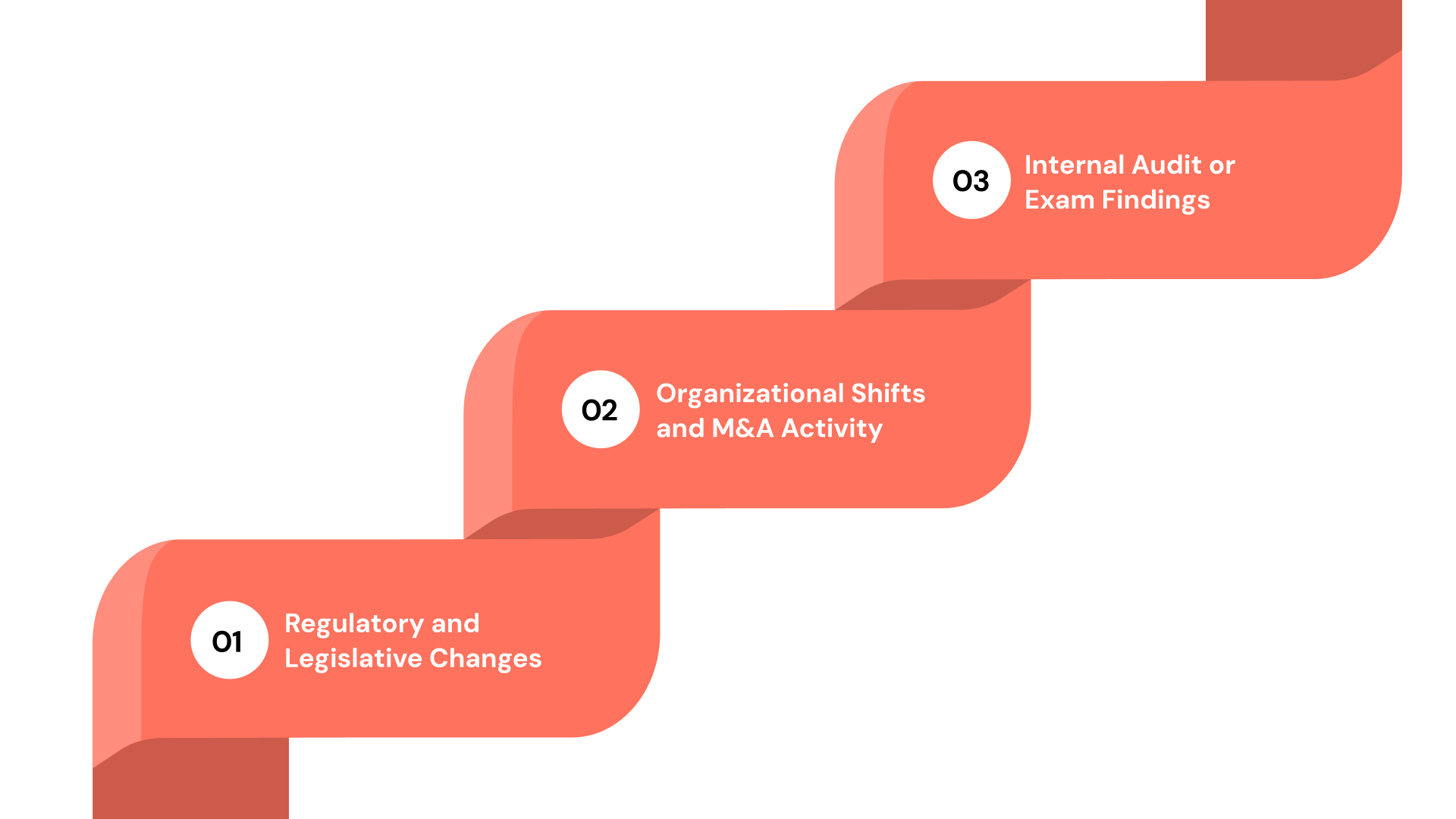
Waiting for an annual review cycle to identify compliance deficiencies often leaves the organization exposed to unnecessary risk for extended periods. Strategic leaders trigger a gap analysis whenever internal or external events shift the risk profile of the business or its regulatory environment.
You should initiate a formal analysis during the following critical events:
1. Regulatory and Legislative Changes
New laws or updates to existing frameworks, such as the transition to NIST CSF 2.0 or new SEC disclosure rules, require immediate assessment. You must determine if current controls satisfy new requirements or if entirely new processes must be implemented to maintain compliance.
2. Organizational Shifts and M&A Activity
Merging with another entity or expanding into new geographic markets introduces a different set of regulatory obligations that may conflict with existing ones. A gap analysis ensures that the consolidated organization meets the highest standard of compliance required across all its operational jurisdictions.
3. Internal Audit or Exam Findings
If an internal audit or a preliminary regulatory exam identifies a deficiency, a targeted gap analysis helps determine the systemic root cause. This prevents the same issue from recurring by identifying whether the gap is in policy design or operational execution.
Explore how RiskOps provides real-time visibility into emerging regulatory exposure, gap severity, and remediation progress across business units. Book a demo with VComply to review structured risk oversight in action.
The 7-Step Regulatory Gap Analysis Process You Can Operationalize Immediately
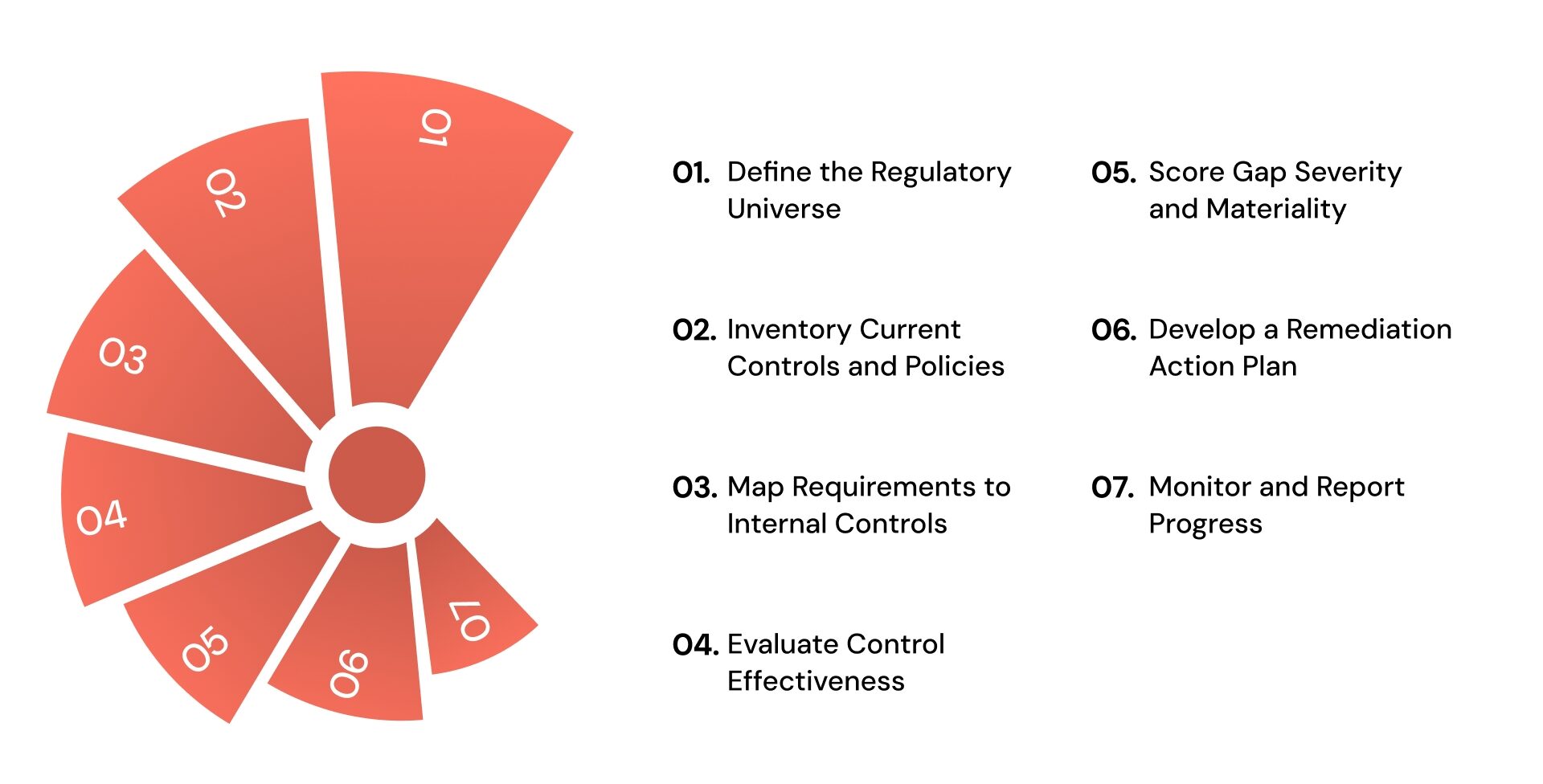
A successful gap analysis requires a disciplined approach that moves from broad scoping to granular remediation and continuous monitoring of control effectiveness.
The following steps provide a repeatable framework for your compliance and risk teams:
Step 1: Define the Regulatory Universe
Identify every federal, state, and industry-specific regulation that applies to your current business operations and data types. This ensures that the scope of your analysis is comprehensive and covers all potential areas of legal and operational exposure.
- Catalog active regulations (e.g., SOX, HIPAA, PCI DSS).
- Identify pending legislation that may impact the organization.
- Consult with legal teams to verify jurisdictional requirements.
Step 2: Inventory Current Controls and Policies
Gather all existing documentation, including policy manuals, standard operating procedures, and technical control configurations that are currently in place. This serves as your baseline for comparison against the target state of compliance required by the regulatory bodies.
- Access centralized policy repositories.
- Review recent control testing results.
- Interview department heads to verify manual procedures.
Step 3: Map Requirements to Internal Controls
Create a cross-walk that links specific regulatory clauses directly to the internal controls designed to satisfy those requirements. This mapping reveals whether a requirement is fully met, partially addressed, or entirely missing from your current governance structure.
- Use a matrix to align clauses with controls.
- Identify “many-to-one” mapping opportunities for efficiency.
- Flag requirements that have no associated controls.
Step 4: Evaluate Control Effectiveness
Perform testing or walkthroughs to determine if the mapped controls are actually functioning as intended and producing the required evidence. A policy that exists on paper but is not executed in practice constitutes a significant gap in your compliance posture.
- Review evidence of task completion.
- Test technical controls for configuration drift.
- Verify that escalation paths are active and understood.
Step 5: Score Gap Severity and Materiality
Assign a numerical score to each identified gap based on the potential impact of non-compliance and the likelihood of a failure. This allows you to differentiate between minor administrative oversights and high-risk deficiencies that could lead to enforcement actions.
- Apply a standard risk-scoring matrix.
- Consider financial, legal, and reputational impact.
- Determine the materiality of each deficiency.
Step 6: Develop a Remediation Action Plan
Define specific tasks, assign owners, and set deadlines for closing the identified gaps according to their prioritized risk scores. A clear plan ensures accountability and provides a roadmap for returning the organization to a state of full compliance.
- Assign tasks within a GRC system.
- Establish interim compensating controls if needed.
- Set realistic milestones for complex remediation.
Step 7: Monitor and Report Progress
Track the status of remediation tasks and provide regular updates to executive leadership and the board on the organization’s compliance health. Continuous monitoring ensures that gaps do not reopen and that new requirements are integrated into the governance framework.
- Automate status reporting for stakeholders.
- Verify that remediation has been successfully tested.
- Update the risk register with new findings.
Mapping Regulatory Requirements to Internal Controls with a Repeatable Framework
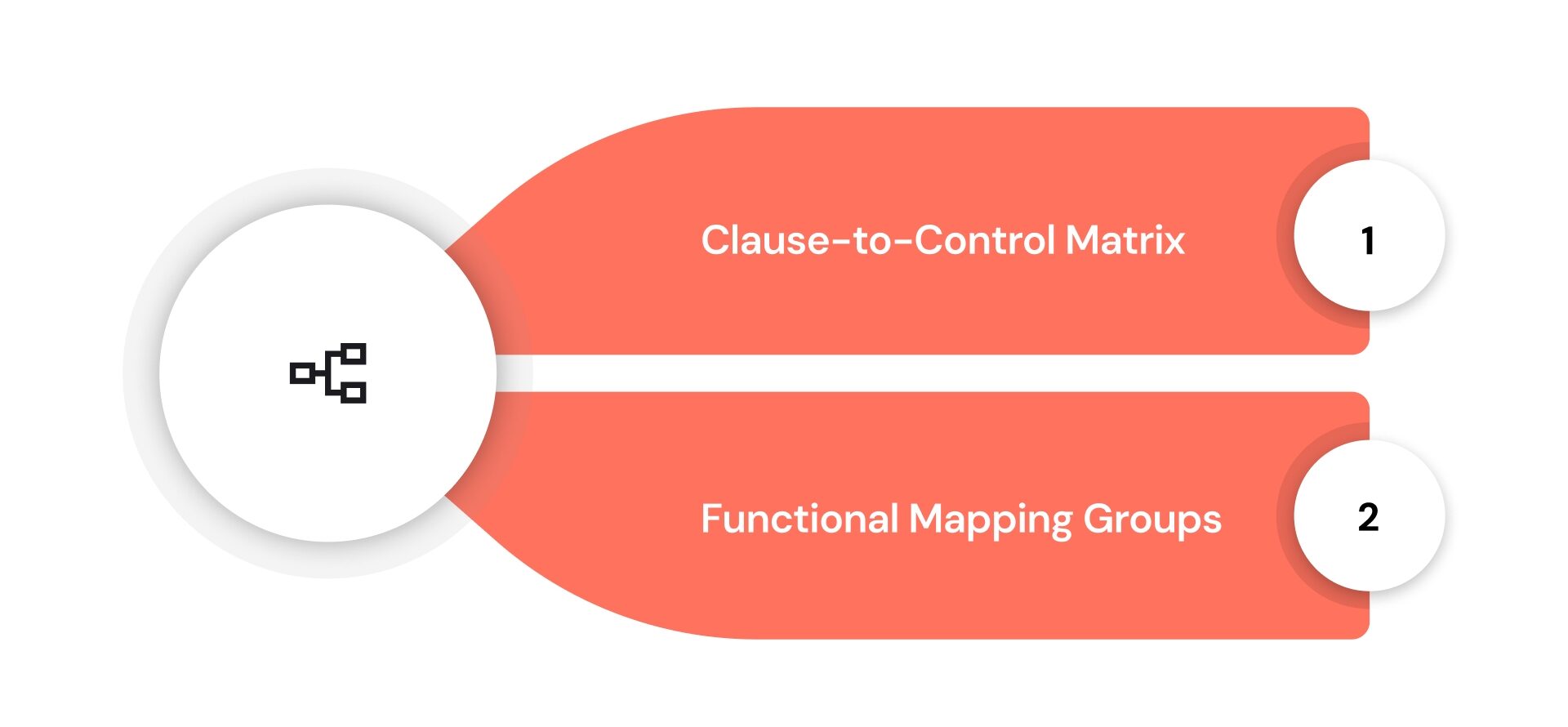
The mapping phase is the most critical part of the gap analysis because it translates abstract legal language into actionable internal tasks.
Use these approaches to ensure your mapping is defensible and efficient:
1. Clause-to-Control Matrix
Create a document that lists the specific regulatory requirement in one column and the corresponding internal control ID in the next. This provides a direct audit trail that demonstrates exactly how your organization satisfies every part of the governing mandate.
2. Functional Mapping Groups
Group requirements into categories like “Identity and Access Management” or “Data Privacy” to simplify the mapping process across different frameworks. This allows you to satisfy multiple regulations with a single set of core controls, reducing redundant work for your teams.
Measuring the Size and Severity of Compliance Gaps
Not all gaps carry the same level of risk; therefore, you must use a standardized scoring model to guide your remediation efforts.
Common scoring methods include:
1. Impact vs. Likelihood Scoring
Evaluate each gap by the probability of a control failure and the severity of the consequences if that failure occurs. High-impact gaps in areas such as data encryption or financial reporting should always receive immediate attention and increased resource allocation.
2. Materiality Thresholds
Define what constitutes a “material” gap for your specific organization based on your industry, size, and the nature of the data you process. This helps leadership focus on significant issues rather than getting bogged down in minor administrative corrections that do not impact risk.
Prioritizing Remediation Using Risk-Based Weighting
Prioritization involves more than just looking at severity; it requires evaluating the resources needed and the strategic importance of the business process. High-risk gaps that impact core revenue-generating systems or involve sensitive patient data must be addressed before low-risk documentation updates.
By applying a risk-based weighting system, you ensure that your compliance budget and manpower are directed where they provide the most protection. This strategic alignment helps your organization close the most dangerous gaps quickly, significantly reducing the window of potential exposure.
See how ComplianceOps assigns remediation ownership, tracks deadlines, and maintains audit-ready documentation within a single governance system. Start a 21-day free trial with VComply to evaluate structured compliance execution.
Documentation and Evidence: What Auditors Expect to See
When auditors arrive, they will look for proof that your gap analysis was a rigorous, documented process rather than a superficial exercise.
Maintain these records to ensure a defensible audit trail:
1. Historical Gap Reports
Keep copies of past gap analyses to show auditors that your organization consistently monitors its environment and takes corrective action when needed. This demonstrates a mature governance culture that values continuous improvement and proactive risk management rather than just meeting minimum requirements.
2. Remediation and Testing Logs
Store evidence of the remediation work performed, including before-and-after testing results that prove the gap was successfully closed and the control is now effective. Auditors need to see the “closed-loop” process where an identified issue was tracked through to a verified solution.
Regulatory Gap Analysis vs. Internal Audit vs. Risk Assessment
While these terms are often used interchangeably, they serve different functions within a comprehensive Governance, Risk, and Compliance (GRC) program.
| Feature | Regulatory Gap Analysis | Internal Audit | Risk Assessment |
| Objective | Identify missing or weak controls. | Verify control execution and accuracy. | Identify and quantify potential threats. |
| Timing | Proactive / Trigger-based. | Periodic / Scheduled. | Continuous / Ongoing. |
| Scope | Specific regulations or frameworks. | Entire control environment. | Enterprise-wide threats. |
| Outcome | Remediation roadmap. | Audit report and findings. | Risk register and appetite. |
Cross-Framework Mapping: Handling Multiple Regulations Simultaneously
Most organizations must comply with a mix of SOX, HIPAA, NIST, and PCI DSS, which often leads to redundant testing and documentation. By using a “Common Control” framework, you can map one internal activity to multiple regulatory requirements at the same time.
For example, a strong access control policy might satisfy requirements across NIST, HIPAA, and SOC 2 simultaneously. This unified approach reduces the administrative burden on your team and ensures that your compliance posture remains consistent across all frameworks.
Common Regulatory Gap Analysis Mistakes and Solutions

Many teams fail to derive value from a gap analysis because they treat it as a technical project rather than a governance process.
Avoid these common pitfalls to ensure your analysis is effective:
1. Focusing Solely on Technical Gaps
Teams often overlook administrative and physical controls, focusing only on software configurations while neglecting policies or physical security requirements.
Solution: Ensure your gap analysis scope includes all three domains: administrative, technical, and physical controls to achieve a holistic view of compliance.
2. Ignoring Third-Party Risks
Many organizations forget that their regulatory obligations often extend to their vendors and cloud service providers who handle sensitive organizational data.
Solution: Incorporate vendor risk assessments into your gap analysis to verify that third-party controls align with your internal regulatory requirements and standards.
How to Operationalize Regulatory Gap Analysis Across Departments
Compliance is a shared responsibility that requires active participation from IT, HR, Legal, and Finance departments to be truly effective.
Establish these operational models to ensure cross-functional success:
1. Ownership and Accountability Models
Assign clear ownership for every identified gap to the department head responsible for that specific business process or technical system. This prevents “not my problem” syndrome and ensures that remediation tasks are performed by those with the expertise and authority to execute them.
2. Review and Escalation Cadence
Set a regular schedule for reviewing remediation progress and establish a formal escalation path for overdue tasks that impact high-risk areas. This keeps the gap analysis process moving and ensures that leadership is aware of any roadblocks that require additional resources.
Systems That Strengthen Regulatory Gap Visibility
When your organization grows beyond a certain size, managing the complexity of multiple regulations using spreadsheets and manual emails becomes a liability. These manual methods lead to version control errors, missed evidence, and a lack of real-time visibility for the executive team.
Centralized systems allow you to automate the mapping of requirements, assign tasks to owners, and collect evidence in a single repository. This transition to a structured system ensures that your gap analysis is a dynamic, defensible process that scales with your business.
Reporting Gap Analysis Results to Executive Leadership and the Board
When presenting results to the board, focus on risk and impact rather than technical details or a long list of minor deficiencies. Use visual heatmaps to show where the most significant gaps exist and provide a clear remediation timeline that includes the resources required.
Leadership needs to understand how these gaps affect the organization’s strategic objectives and its overall risk appetite. High-level summaries should emphasize the progress made since the last assessment to demonstrate that the compliance program is maturing and providing value.
Operationalizing Governance with VComply

Fragmented tracking systems weaken visibility and slow remediation cycles. As regulatory obligations expand, manual coordination increases administrative burden and creates blind spots across departments.
VComply centralizes regulatory gap analysis within a unified governance framework. It connects compliance obligations, risk scoring, policy oversight, and remediation tracking in one structured environment.
Within this system:
- ComplianceOps tracks regulatory obligations, assigns remediation tasks, and maintains audit-ready documentation.
- RiskOps quantifies gap severity and provides real-time dashboards for executive oversight.
- PolicyOps links regulatory requirements to policy lifecycle management and attestation tracking.
- CaseOps structures incident or compliance issue resolution workflows with defined accountability.
This integrated model supports continuous regulatory oversight rather than periodic review cycles.
Conclusion
Regulatory gap analysis strengthens governance discipline when executed with a defined scope, measurable scoring, and documented remediation workflows. Without structured monitoring, gaps remain invisible until surfaced by auditors or regulators.
Centralized systems support continuous tracking, accountability, and defensible oversight. By aligning compliance, risk, policy, and incident workflows, you reduce fragmentation and strengthen your regulatory posture.
Explore how ComplianceOps structures regulatory gap analysis workflows. Book a demo to review how VComply supports disciplined regulatory oversight across your organization.
FAQs
While the term “gap analysis” may not appear in every law, many U.S. regulations like SOX and HIPAA mandate that organizations perform regular risk assessments and internal control evaluations. A gap analysis is the primary method used to satisfy these requirements and prove “reasonable care” to regulatory bodies.
Most organizations should conduct a comprehensive gap analysis annually, but targeted assessments should occur whenever there is a major regulatory change or business shift. Continuous monitoring through a GRC system allows you to perform “micro-assessments” as the environment changes rather than waiting for a yearly cycle.
The Chief Compliance Officer or Risk Manager typically owns the gap analysis process, but the actual remediation tasks must be owned by the functional department heads. IT, HR, and Finance leaders must be accountable for closing the specific gaps identified within their respective domains.
Organizations reduce overhead by centralizing regulatory requirements, control mapping, and remediation tracking instead of relying on spreadsheets and email threads. Platforms such as VComply provide one structured approach by connecting compliance obligations, risk scoring, and remediation workflows within a single oversight system.