

How Privacy Compliance Actually Works Across Data Flows, Controls, and Evidence
Privacy compliance failures rarely stem from missing policies; they surface when organizations cannot demonstrate how personal data moves, who controls it, and how those controls are enforced across systems.

Regulatory scrutiny around laws such as CCPA increasingly focuses on execution, where incomplete data mapping, inconsistent access controls, and weak evidence trails expose gaps between stated policies and actual operations.
This disconnect makes privacy compliance a coordination challenge across legal, security, and operational teams rather than a documentation exercise. The discussion that follows examines how privacy compliance works across data flows, controls, and evidence, outlining the components, measurement approaches, and execution gaps that determine whether organizations can sustain audit readiness.
This guide explains how privacy compliance operates across data flows, controls, and evidence, focusing on execution, traceability, and audit readiness.
Quick Look
- Privacy compliance fails at the data layer when organizations cannot trace how personal data moves, transforms, and is accessed across systems and vendors.
- Data mapping is not documentation; it is an operational requirement that links systems, owners, processing purposes, and regulatory obligations into a structured model.
- Control effectiveness depends on validation frequency, not documentation completeness. Untested controls create a false sense of compliance.
- Evidence must be generated during processing activities, not reconstructed later, to ensure audit defensibility and regulatory alignment.
- Measurement requires combining risk scoring, control testing outcomes, and response SLAs to evaluate compliance performance continuously.
- Scalable privacy compliance requires integrating data, controls, incidents, and policies into a single system to maintain traceability and visibility.
What Is Privacy Compliance
Privacy compliance is the structured process of ensuring that personal data is collected, processed, stored, and shared in accordance with applicable regulations and internal policies. It connects data flows, control mechanisms, ownership, and evidence into a unified system.

Breakdowns occur when data flows are not mapped, controls are not validated consistently, and evidence is not generated during execution, making it difficult to demonstrate compliance during audits or investigations.
Also read: Best Policy Management Software for 2025
The 5 Core Components of a Privacy Compliance Program
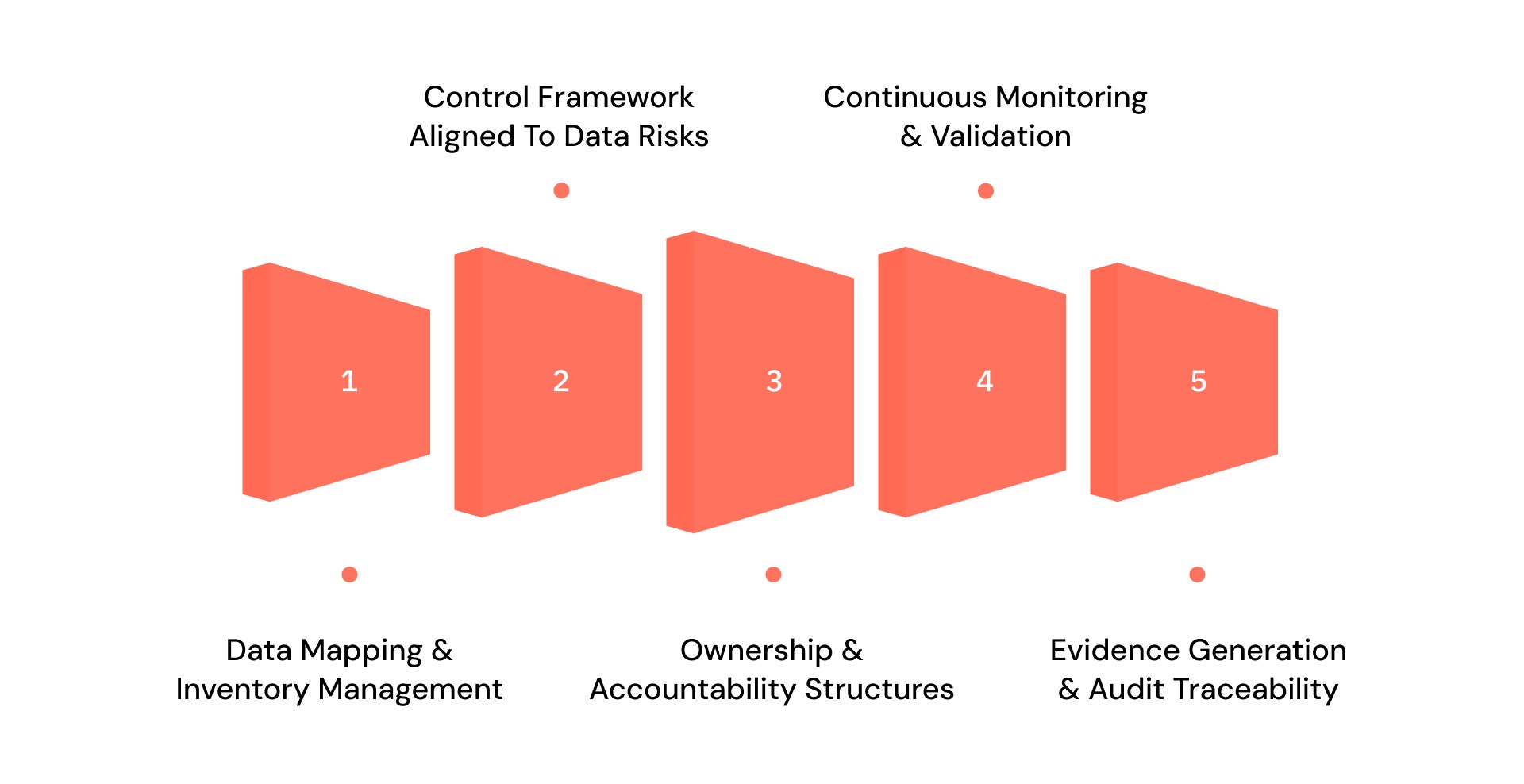
Privacy compliance becomes reliable only when data visibility, control execution, and evidence generation operate as a connected system rather than isolated activities. Programs that fail typically separate documentation from execution, which weakens traceability and audit readiness.
A structured program is built on the following components:
1. Data Mapping and Inventory Management
Organizations must maintain a continuously updated inventory of personal data across systems, vendors, and workflows. This includes identifying data sources, processing purposes, storage locations, and access points.
Without accurate data mapping, compliance teams cannot determine regulatory scope, assess risks, or validate whether controls are applied consistently across all data processing activities.
2. Control Framework Aligned to Data Risks
Privacy controls must align with specific risks associated with data types, processing activities, and regulatory obligations. Controls should address access management, encryption, consent tracking, and data retention.
When controls are not mapped to data risks, organizations implement generic safeguards that fail to address actual exposure, which increases compliance gaps during audits.
3. Ownership and Accountability Structures
Every data flow, control, and compliance task must have clearly assigned owners with defined responsibilities and escalation paths. Ownership should reflect operational roles rather than hierarchical titles.
Without accountability, compliance execution becomes inconsistent, and tasks are delayed or overlooked, especially in cross-functional processes involving multiple teams.
4. Continuous Monitoring and Validation
Controls must be tested regularly to confirm they operate as intended. Monitoring should include automated alerts, exception tracking, and validation cycles based on risk levels.
Without continuous validation, organizations assume compliance based on documentation rather than verified execution, which increases exposure to regulatory findings.
5. Evidence Generation and Audit Traceability
Evidence must be generated during data processing activities and linked directly to controls and workflows. This includes logs, consent records, access trails, and audit histories.
When evidence is not captured in real time, organizations struggle to demonstrate compliance, leading to delays and inconsistencies during audits or investigations.
Importance of Privacy Compliance
Privacy compliance directly impacts regulatory exposure, operational risk, and customer trust. It is not limited to legal adherence but extends to how organizations manage data responsibly across systems and processes.
Its importance becomes clear across the following areas:
1. Regulatory Enforcement and Financial Risk
Regulators evaluate how organizations manage personal data, not just whether policies exist. Non-compliance can result in fines, corrective actions, and operational restrictions.
Strong compliance programs reduce enforcement risk by ensuring that data processing activities are documented, controlled, and verifiable at any point.
2. Operational Risk Reduction
Untracked data flows and weak controls increase the likelihood of breaches, unauthorized access, and data misuse. These risks often originate from gaps in execution rather than intent.
Structured compliance reduces operational risk by enforcing consistent controls and monitoring across all data processing activities.
3. Customer Trust and Brand Integrity
Customers expect organizations to handle their data responsibly. Failures in privacy compliance can damage trust and impact long-term relationships.
Demonstrating compliance through transparent practices and audit readiness strengthens credibility and supports customer confidence.
4. Audit Readiness and Internal Oversight
Privacy audits require clear evidence of how data is handled, controlled, and monitored. Organizations with structured systems can provide this evidence without delays.
Audit readiness ensures that compliance is continuous rather than reactive, reducing the burden on teams during reviews.
As these pressures increase, the challenge shifts from understanding privacy obligations to executing them consistently across systems and teams. Explore how ComplianceOps helps translate privacy requirements into structured workflows with clear ownership, control validation, and audit-ready evidence.
Also read: Top 5 Policy Management Software in 2026 (Best Picks Ranked with Features & Pricing)
How to Map Personal Data Across Systems, Vendors, and Workflows

Data mapping is the foundation of privacy compliance because it determines regulatory scope, control requirements, and risk exposure. Without structured mapping, organizations cannot validate how data flows across systems.
Effective mapping requires the following steps:
1. Identify Data Sources and Collection Points
Organizations must identify where personal data enters the system, including applications, forms, integrations, and third-party sources.
This step ensures visibility into all entry points and prevents blind spots that could lead to unmonitored data processing activities.
2. Trace Data Movement Across Systems
Data flows must be tracked as they move between systems, departments, and vendors. This includes transfers, transformations, and storage.
Tracing movement ensures that organizations understand how data is used and where controls must be applied.
3. Map Processing Purposes and Legal Basis
Each data flow must be linked to a specific purpose and legal basis, such as consent, contractual necessity, or regulatory requirement.
This alignment ensures that data processing remains compliant with applicable regulations and avoids unnecessary data usage.
4. Assign Ownership to Data Flows
Ownership must be assigned to individuals responsible for managing and validating each data flow. This ensures accountability for compliance execution.
Without ownership, data mapping becomes outdated and unreliable, reducing its value for compliance and audits.
How to Identify Applicable Privacy Regulations Based on Your Data Footprint
Regulatory applicability depends on the type of data processed, geographic scope, and industry requirements. Organizations must evaluate their data footprint to determine which regulations apply.
This involves the following:
1. Analyze Data Types and Sensitivity
Different regulations apply based on whether data includes personal, financial, or health information. Sensitive data categories require stricter controls.
Understanding data types ensures that organizations apply the correct regulatory requirements and safeguards.
2. Evaluate Geographic Exposure
Regulations depend on where data subjects are located and where data is processed. Organizations operating across regions must consider multiple frameworks.
This ensures that compliance programs address all applicable jurisdictions without gaps.
3. Map Industry-Specific Requirements
Industries such as healthcare and finance are subject to additional regulations that define specific compliance obligations.
Mapping these requirements ensures that organizations meet both general and sector-specific standards.
Also read: Understanding Digital Records Management Policies
How to Measure Privacy Compliance Using Risk Scores, Control Tests, and Response SLAs
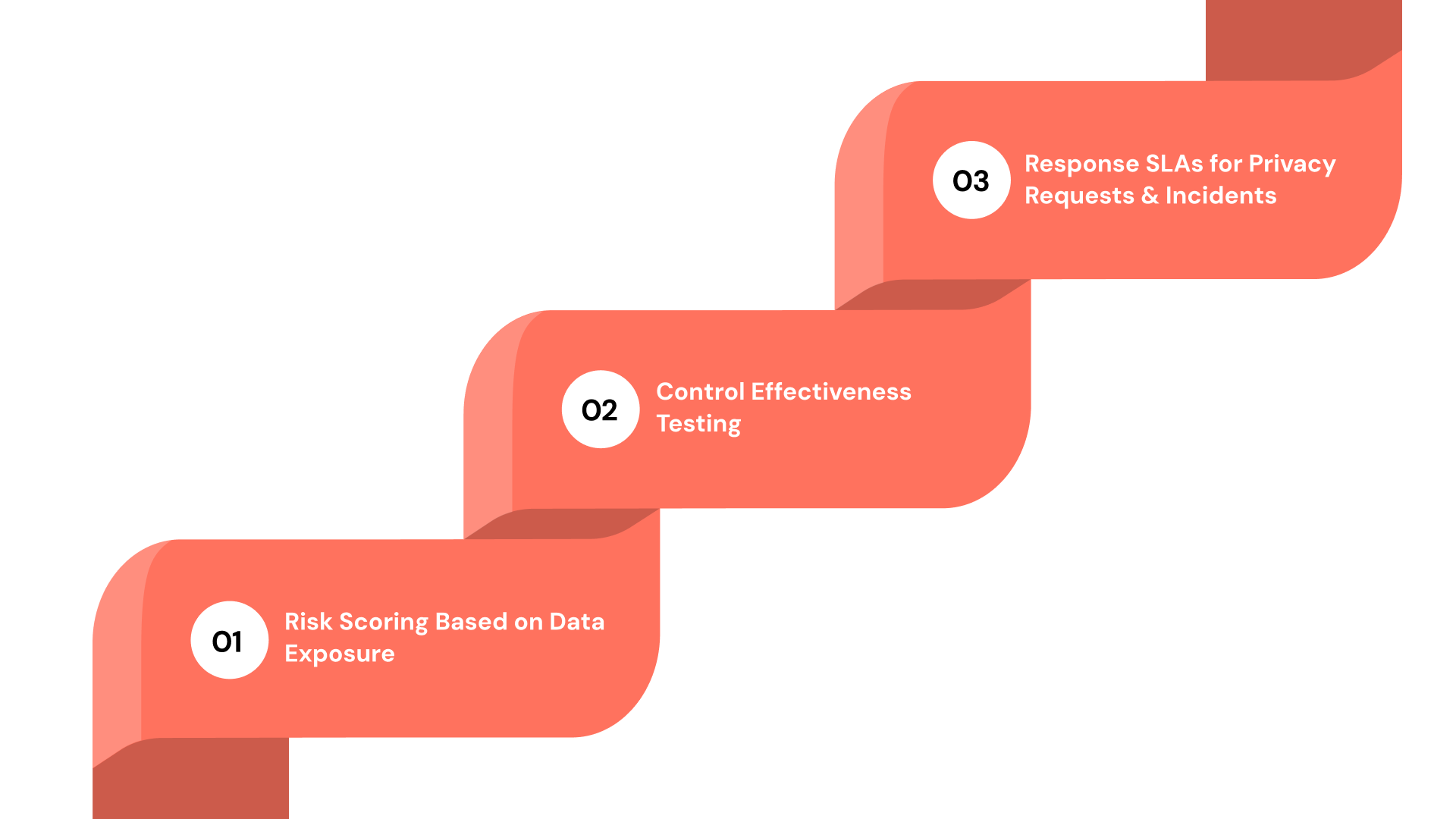
Measurement transforms privacy compliance into a structured, data-driven system. Without defined metrics, organizations rely on assumptions rather than validated performance.
Focus on the following measurement areas:
1. Risk Scoring Based on Data Exposure
Assign risk scores based on data sensitivity, volume, and processing complexity to prioritize compliance efforts.
- Define risk criteria for data types
- Assign scores to data flows
- Prioritize high-risk areas
- Update scores periodically
2. Control Effectiveness Testing
Test controls regularly to confirm they operate as intended and address identified risks.
- Define testing frequency
- Document expected outcomes
- Record test results
- Track failures and remediation
3. Response SLAs for Privacy Requests and Incidents
Measure how quickly organizations respond to data subject requests and incidents.
- Define SLA timelines
- Track response times
- Identify delays
- Improve response workflows
Measurement becomes difficult to sustain when data, controls, and response workflows are tracked across disconnected tools. Evaluate how the GRCOps Suite connects risk scoring, control validation, and compliance tracking into a unified operational layer.
How to Build Audit-Ready Evidence for Privacy Compliance
Audit readiness depends on whether evidence is generated as part of execution, not assembled during audits. Regulators and auditors expect traceability across data flows, controls, and actions, with verifiable timestamps and ownership. Evidence must answer three questions: what happened, who performed it, and whether it aligned with defined controls.
To achieve this, evidence generation must be embedded into workflows, standardized across systems, and continuously validated rather than periodically compiled:
1. Embed Evidence Capture Directly Into Data Processing Workflows
Evidence should be generated automatically when a control is executed, not manually documented afterward. This ensures accuracy and eliminates reliance on memory or retrospective reconstruction.
For example, when access is granted to sensitive data, the system should log the request, approval, timestamp, and justification as part of the workflow. This creates a verifiable record without additional effort.
Without embedded capture, evidence becomes inconsistent, incomplete, and difficult to validate during audits, increasing both effort and risk exposure.
2. Standardize Evidence Formats Across Systems and Controls
Different teams often generate evidence in inconsistent formats, which complicates audit validation and slows review processes. Standardization ensures that every control produces comparable and structured outputs.
Define templates for logs, consent records, access approvals, and exception documentation. Ensure each format includes required fields such as timestamps, owners, control references, and validation status.
Standardized evidence improves audit efficiency because reviewers can quickly validate compliance without interpreting varied formats or missing information.
3. Link Evidence to Specific Controls and Data Flows
Evidence must not exist in isolation. Each record should map directly to a control and the underlying data flow it governs, creating a clear chain from requirement to execution.
For example, a consent record should link to the data processing activity it authorizes, the control that enforces consent validation, and the system where the data resides.
This linkage enables auditors to trace compliance end-to-end without relying on explanations, reducing ambiguity and strengthening defensibility.
4. Maintain Version History and Evidence Integrity Over Time
Evidence must reflect historical accuracy, not just the current state. Systems should maintain version history for logs, consents, and control validations, including changes, approvals, and timestamps.
This ensures that organizations can demonstrate what was true at any given point, which is critical during investigations or retrospective audits.
Without a version history, organizations cannot prove compliance during past periods, even if current processes are aligned, which weakens audit outcomes.
Also read: Best Policy Management Software for Manufacturing Organizations
Common Privacy Compliance Gaps That Surface During Audits and Investigations

Privacy compliance gaps rarely originate from missing policies. They emerge when execution lacks consistency, traceability, or validation across data flows and controls. These gaps often remain hidden until audits or incidents force organizations to demonstrate compliance under scrutiny.
The most critical failures appear in the following areas:
1. Incomplete or Outdated Data Flow Mapping
Organizations often document data flows during initial compliance efforts but fail to update them as systems, vendors, and processes evolve.
This results in blind spots where personal data is processed without visibility or control coverage. During audits, these gaps surface as unidentified processing activities, which indicate weak governance and incomplete regulatory alignment.
2. Controls Defined but Not Consistently Executed
Controls may exist in documentation but are applied inconsistently across teams, systems, or geographies. This creates variability in how compliance is enforced.
For example, access controls may be strictly enforced in one system but loosely applied in another. Auditors identify these inconsistencies as systemic weaknesses rather than isolated issues.
3. Lack of Real-Time Visibility Into Privacy Compliance Status
Compliance data is often spread across tools, requiring manual consolidation to assess status. This delays issue detection and limits leadership visibility.
During audits, organizations struggle to provide a unified view of compliance posture, including overdue tasks, control failures, and risk exposure, which signals operational fragmentation.
4. Evidence Not Generated During Execution
Teams frequently attempt to collect evidence after activities are completed, especially during audit preparation. This leads to incomplete or reconstructed documentation.
Auditors recognize this pattern through missing timestamps, inconsistent records, and a lack of traceability, which reduces confidence in the organization’s compliance program.
5. Weak Incident and Exception Tracking
Privacy incidents, access violations, or policy exceptions are not always tracked in structured workflows. Instead, they are handled through emails or informal processes.
This prevents organizations from demonstrating how issues were identified, escalated, and resolved, which is a key expectation during regulatory reviews.
Best Practices to Maintain Continuous Privacy Compliance Across Teams and Systems
Sustaining privacy compliance requires systems that operate continuously, not periodic reviews or audit-driven efforts. Execution must remain consistent even as data flows, systems, and regulations evolve.
The following practices ensure long-term stability and audit readiness:
1. Implement Continuous Data Flow Monitoring With Change Detection
Data environments change frequently due to new integrations, vendors, or process updates. Continuous monitoring ensures these changes are identified and evaluated in real time.
This includes tracking new data sources, modified workflows, and changes in processing purposes, with automated alerts for deviations from approved configurations.
Impact: Prevents untracked data processing, reduces compliance blind spots, and ensures controls remain aligned with current operations.
2. Create Unified Visibility Across Compliance, Risk, and Security Functions
Privacy compliance intersects with multiple teams, but fragmented visibility creates gaps in coordination and decision-making.
Centralized dashboards that combine data mapping, control status, risk scores, and incident tracking enable all stakeholders to operate with the same information.
Impact: Improves response time, strengthens cross-functional alignment, and enables proactive risk management instead of reactive fixes.
3. Align Privacy Controls With Risk Prioritization Models
Not all data flows carry the same level of risk. Applying uniform controls across all activities leads to inefficient resource allocation.
Integrating risk scoring into compliance workflows ensures that high-risk data processing receives more frequent validation and stricter controls.
Impact: Focuses resources on critical areas, reduces exposure to high-impact failures, and improves overall compliance efficiency.
4. Integrate Incident Response Into Compliance Workflows
Privacy incidents must be treated as part of compliance execution, not separate operational events. Structured workflows should capture detection, escalation, investigation, and resolution steps.
Each incident should generate evidence, update risk assessments, and inform control improvements.
Impact: Strengthens accountability, reduces repeat incidents, and ensures regulatory expectations for incident handling are consistently met.

5. Maintain Strict Version Control for Policies, Controls, and Evidence
Regulatory requirements and internal processes evolve, but outdated documentation often remains in circulation without proper tracking.
Version control ensures that updates are approved, communicated, and implemented consistently across all systems and teams.
Impact: Prevents misalignment between policy and execution, supports audit traceability, and ensures teams operate on current requirements.
Also read: Creating a Policy Management Roadmap for Nonprofit & NGOs
Streamline Privacy Compliance Across Data, Controls, and Evidence with VComply
Privacy compliance breaks when data flows, controls, and evidence are managed across disconnected systems, creating gaps in traceability and accountability.

VComply provides a structured system that connects compliance, risk, policy, and incident management into a unified workflow.
- Use ComplianceOps to map regulatory requirements to controls and workflows
- Apply RiskOps to prioritize data risks based on exposure and impact
- Manage policies and consent frameworks through PolicyOps
- Track incidents and data breaches using CaseOps
- Leverage the GRCOps Suite for centralized visibility across all compliance activities
This structure ensures that privacy compliance operates as a continuous system with full traceability. Book a demo with VComply to learn more.
Conclusion
Privacy compliance becomes enforceable only when data flows, controls, and evidence remain connected across systems and teams. Organizations that treat compliance as a documentation layer struggle to demonstrate execution, especially when data mapping, access control, and response workflows operate in isolation.
Sustained audit readiness depends on whether you can trace every data obligation to a control, validate that control through execution, and support it with verifiable evidence.
When privacy compliance spans multiple systems, vendors, and regulatory expectations, fragmented processes create gaps in visibility, accountability, and response timelines.
VComply structures this through integrated workflows that connect data controls, ownership, and evidence into a unified system of record, enabling consistent execution across teams.
Start a 21-day free trial of VComply to evaluate how ComplianceOps supports continuous privacy compliance by aligning controls with workflows, tracking ownership, and maintaining audit-ready evidence without relying on manual coordination.
FAQs
Privacy compliance ensures that personal data is handled according to regulatory requirements through structured workflows, controls, and evidence generation. It connects data mapping, control validation, and monitoring into a unified system that supports audit readiness and reduces regulatory risk.
Programs fail when data flows are not mapped, controls are not validated consistently, and evidence is not generated during execution. These gaps create disconnects between policies and actual practices, which become visible during audits or investigations.
Organizations measure compliance using risk scores, control testing outcomes, and response SLAs for data requests and incidents. These metrics provide visibility into performance and help identify gaps in execution and control effectiveness.
Audits require logs, consent records, access trails, and documentation linked to controls and data flows. Evidence must be generated during execution and stored systematically to ensure traceability and validation during reviews.
Organizations can implement structured systems that connect data mapping, controls, ownership, and evidence into unified workflows. Platforms like VComply provide centralized visibility and automation to maintain consistent compliance execution.
Privacy compliance should be monitored continuously through control validation and data tracking, with periodic reviews aligned to regulatory updates and risk changes. Continuous monitoring ensures issues are identified and addressed before audits.