

Operational Security Controls: Types, Examples, and How They Strengthen Governance Systems
Audit findings and regulatory reviews continue to highlight a recurring issue: organizations often have well-documented security controls, yet struggle to demonstrate how those controls are executed consistently in practice.

Gaps in evidence, inconsistent procedures across teams, and unclear ownership frequently surface under frameworks such as NIST and ISO 27001, where control effectiveness depends on repeatable execution rather than policy intent.
For compliance, risk, and security leaders, the challenge is not defining controls but ensuring they operate reliably across workflows, teams, and systems, with sufficient traceability to withstand scrutiny.
Operational security controls sit at the center of this execution layer, translating governance requirements into day-to-day actions that shape how risks are managed and incidents are prevented.
This article examines how operational security controls function, how they differ from other control types, and how organizations can structure them to improve visibility, accountability, and overall control maturity.
An Overview
- Operational security controls translate governance requirements into repeatable workflows that can be observed, measured, and audited.
- Failures typically occur at the execution layer, where controls are defined but not consistently performed or documented.
- Effective controls bridge policy intent (administrative) and system enforcement (technical) through structured procedures.
- Core control types include access reviews, incident response workflows, monitoring activities, and change management processes.
- Control effectiveness depends on traceability, ownership, and consistent execution across teams and systems.
- Common gaps include inconsistent application, lack of evidence, and fragmented workflows across tools.
What Are Operational Security Controls?
Operational security controls represent the point where governance expectations are translated into repeatable actions. Their effectiveness determines whether defined policies and technical safeguards actually function under real-world conditions, particularly in environments subject to audit and regulatory scrutiny.
Definition in a Governance Context
Operational security controls are process-embedded actions that ensure security policies and technical safeguards are executed consistently.
Within frameworks such as NIST SP 800-53, they fall under management and operational families that govern procedures, responsibilities, and execution discipline.
Unlike policies, they are observable and measurable through workflows, making them central to audit evidence and control validation.

Where Operational Controls Sit Within Security Frameworks
Operational controls are embedded across major frameworks as execution mechanisms:
- NIST SP 800-53: Control families such as Incident Response (IR), Contingency Planning (CP), and Awareness & Training (AT)
- ISO 27001 Annex A: Operational controls within domains like access control, operations security, and supplier relationships
- Governance role: Translate control objectives into enforceable, repeatable processes
- Audit relevance: Serve as evidence of control execution rather than intent
What Makes a Control “Operational”
Operational security controls are defined by how they are executed within workflows:
- Execution-driven: Focused on actions performed, not policies written
- Repeatable: Applied consistently across incidents, users, and systems
- Human + process integration: Requires coordination between teams and systems
- Traceable: Generate logs, approvals, and evidence for audit review
Also read: Differences and Methods in Substantive and Control Testing in Auditing
How Operational Security Controls Differ from Administrative and Technical Controls
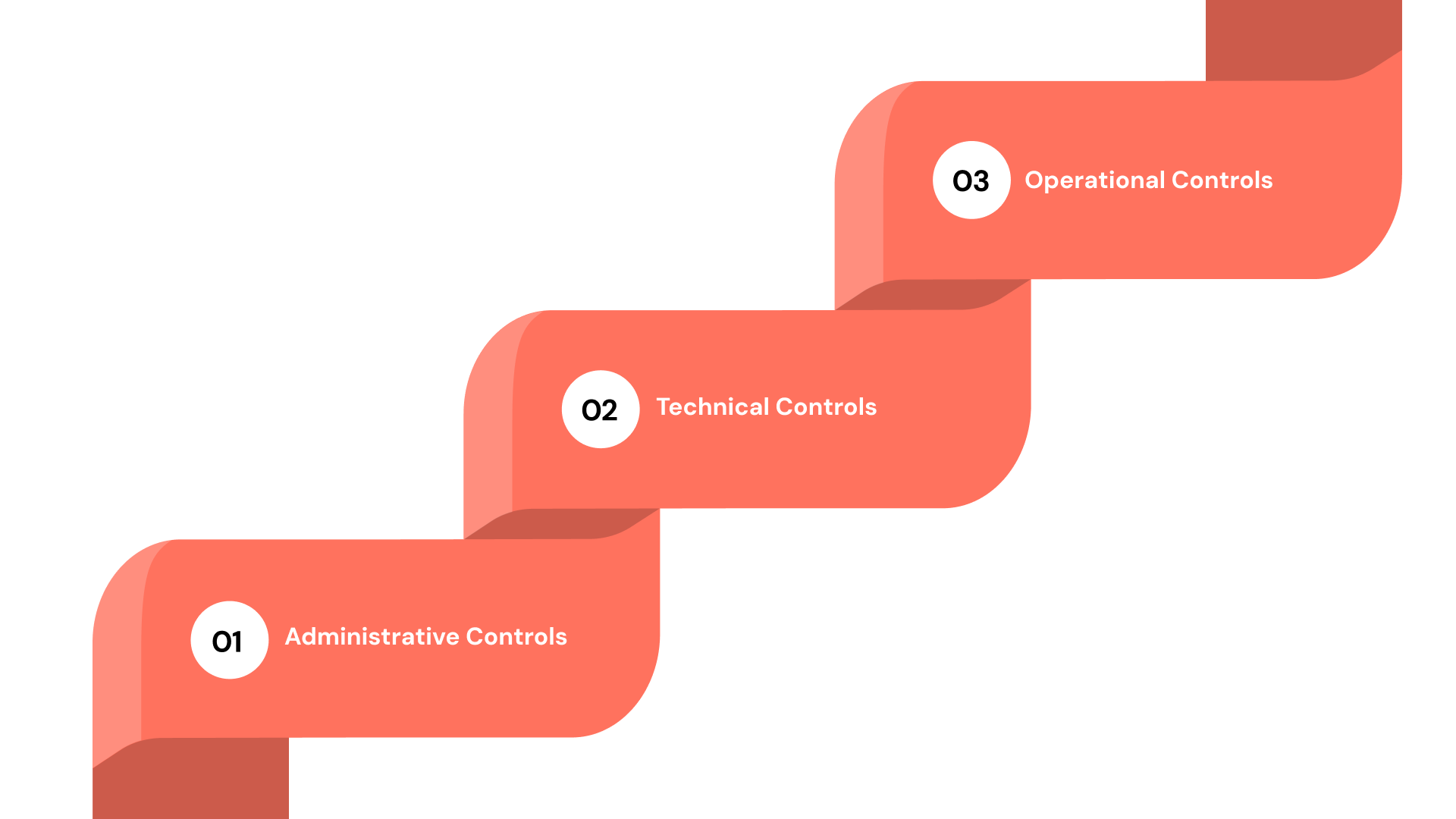
Security control frameworks are often well-defined, but their effectiveness depends on how clearly organizations distinguish between intent, enforcement, and execution. Without this distinction, control failures are misattributed, and remediation efforts remain misaligned.
The differences across control types define where breakdowns occur and how they should be addressed:
These distinctions clarify how security controls function across governance layers:
1. Administrative Controls
Administrative controls define the governance layer, establishing expectations, policies, and procedures that guide organizational behavior. They include policy documentation, risk assessments, and compliance requirements.
While essential for direction, they do not ensure execution, which often creates a gap between defined expectations and actual practice during audits.
2. Technical Controls
Technical controls rely on system-level enforcement, including firewalls, access restrictions, encryption, and monitoring tools. These controls automate enforcement and reduce human dependency, but they operate within predefined configurations.
Their effectiveness depends on how well they are implemented, monitored, and integrated into broader operational processes.
3. Operational Controls
Operational security controls ensure that administrative intent and technical enforcement are consistently applied through procedures and workflows. They involve human actions, approvals, and coordination across teams.
This layer determines whether controls are executed correctly and whether deviations are detected and addressed in real time.
Why the Distinction Matters for Audit and Risk
Audit findings frequently trace back to failures in operational execution rather than gaps in policy or technology. When controls are defined but not consistently applied, organizations face increased risk exposure and limited audit defensibility.
Understanding these distinctions allows leaders to focus remediation efforts where failures actually occur.
Also read: Understanding GRC Technology and Its Importance
Why Operational Security Controls Matter in Regulated Environments
In regulated environments, the effectiveness of security controls is judged not by their existence but by their execution. Supervisory bodies and audit frameworks increasingly require demonstrable evidence that controls operate consistently across scenarios.
The importance of operational security controls becomes evident in the following areas:
1. Control Execution as Audit Evidence
Operational security controls provide the evidence required to demonstrate compliance. Audit frameworks such as NIST and ISO 27001 require organizations to show how controls are executed, not just documented. Without consistent execution and traceability, organizations struggle to validate compliance during regulatory reviews.
2. Bridging Policy and Real-World Execution
A common gap in governance is the disconnect between written policies and actual practices. Operational controls bridge this gap by embedding procedures into workflows, ensuring that policies are consistently applied. Without this bridge, organizations face inconsistencies that weaken control effectiveness.
3. Impact on Risk Visibility and Decision-Making
Operational controls directly influence how risks are identified, monitored, and managed. When execution is inconsistent, organizations lose visibility into control performance, creating blind spots that affect decision-making and risk prioritization.
4. Role in Incident Prevention and Response
Operational controls play a critical role in incident detection, escalation, and response. They ensure that procedures are followed, responsibilities are clear, and actions are documented, improving both response effectiveness and post-incident analysis.
Types of Operational Security Controls with Examples
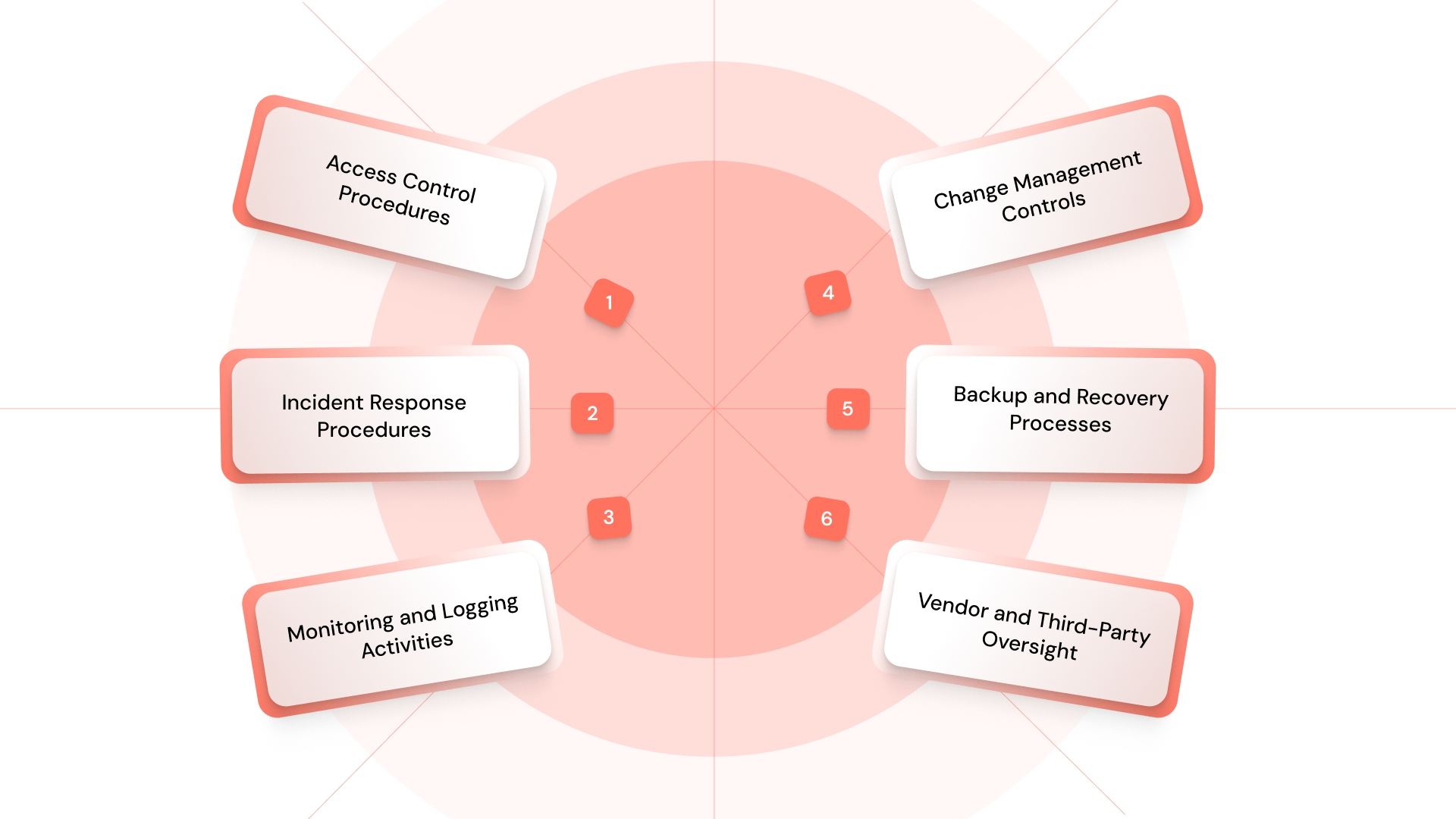
Operational security controls vary across functions, but their value lies in how they are executed within workflows. Each control type reflects a specific area where governance expectations must translate into consistent action. The following categories illustrate how these controls operate in practice:
The most common operational security controls include:
1. Access Control Procedures
Access control procedures ensure that user access is granted, reviewed, and revoked in alignment with policy and risk exposure.
- User onboarding and offboarding workflows
- Periodic access and privilege reviews
- Role-based access validation
- Escalation for unauthorized access requests
- Documentation of approvals and changes
Example: Quarterly access reviews to validate privileged accounts
Operational implication: Prevents privilege creep
Risk tie: Reduces unauthorized access risk
2. Incident Response Procedures
These controls define how incidents are identified, escalated, and resolved across teams.
- Incident detection and classification workflows
- Escalation paths and response ownership
- Coordination between IT, security, and compliance teams
- Documentation of response actions
- Post-incident review processes
Example: Defined escalation matrix for security incidents
Operational implication: Ensures timely response
Risk tie: Limits incident impact and recovery time
3. Monitoring and Logging Activities
Monitoring controls ensure continuous visibility into system activity and anomalies.
- Log collection and review procedures
- Alert triage and investigation workflows
- Anomaly detection processes
- Periodic log audits
- Documentation of monitoring outcomes
Example: Daily review of security logs for anomalies
Operational implication: Enables early detection
Risk tie: Reduces undetected threat exposure
4. Change Management Controls
Change management controls govern how system changes are approved and implemented.
- Change request submission and approval workflows
- Version control and documentation
- Testing and validation procedures
- Rollback and contingency planning
- Post-change review
Example: Approval workflows for production system changes
Operational implication: Reduces unintended disruptions
Risk tie: Prevents configuration-related vulnerabilities
5. Backup and Recovery Processes
These controls ensure data availability and business continuity.
- Scheduled backup processes
- Backup validation and testing
- Restoration procedures
- Documentation of recovery outcomes
- Periodic recovery drills
Example: Monthly backup restoration testing
Operational implication: Ensures recovery readiness
Risk tie: Minimizes data loss impact
6. Vendor and Third-Party Oversight
Third-party controls ensure external entities meet security and compliance expectations.
- Vendor access monitoring
- Periodic security reviews
- Contractual compliance checks
- Risk assessments
- Incident reporting requirements
Example: Quarterly vendor access audits
Operational implication: Maintains third-party accountability
Risk tie: Reduces external risk exposure
Managing multiple operational security controls across functions requires more than isolated procedures. A centralized approach can help standardize execution across access control, incident response, and change management workflows. Book a demo with VComply to learn more.
Also read: Understanding Business Associate Agreement (BAA) in HIPAA Policies
How Operational Security Controls Function in Practice
Operational security controls do not operate in isolation; they depend on coordination across teams, systems, and processes. Their effectiveness is determined by how consistently they are executed and how well they are integrated into organizational workflows:
1. Control Execution Across Teams
Operational controls require coordination between IT, security, compliance, and business teams. Each team plays a role in executing, validating, and monitoring controls, making cross-functional alignment essential for consistent performance.
2. Workflow Dependency and Coordination
Controls often depend on sequential workflows, where one action triggers another. Delays or failures in these dependencies can disrupt execution, highlighting the need for clearly defined processes and accountability.
3. Documentation and Evidence Capture
Every control execution must generate traceable evidence, including logs, approvals, and records. This documentation supports audit requirements and enables organizations to validate control effectiveness.
4. Where Breakdowns Typically Occur
Breakdowns often arise from missed steps, inconsistent execution, or unclear ownership. These failures reduce control reliability and create gaps that become visible during audits or incidents.
Also read: Understanding the NIST Cybersecurity Framework
Measuring the Effectiveness of Operational Security Controls
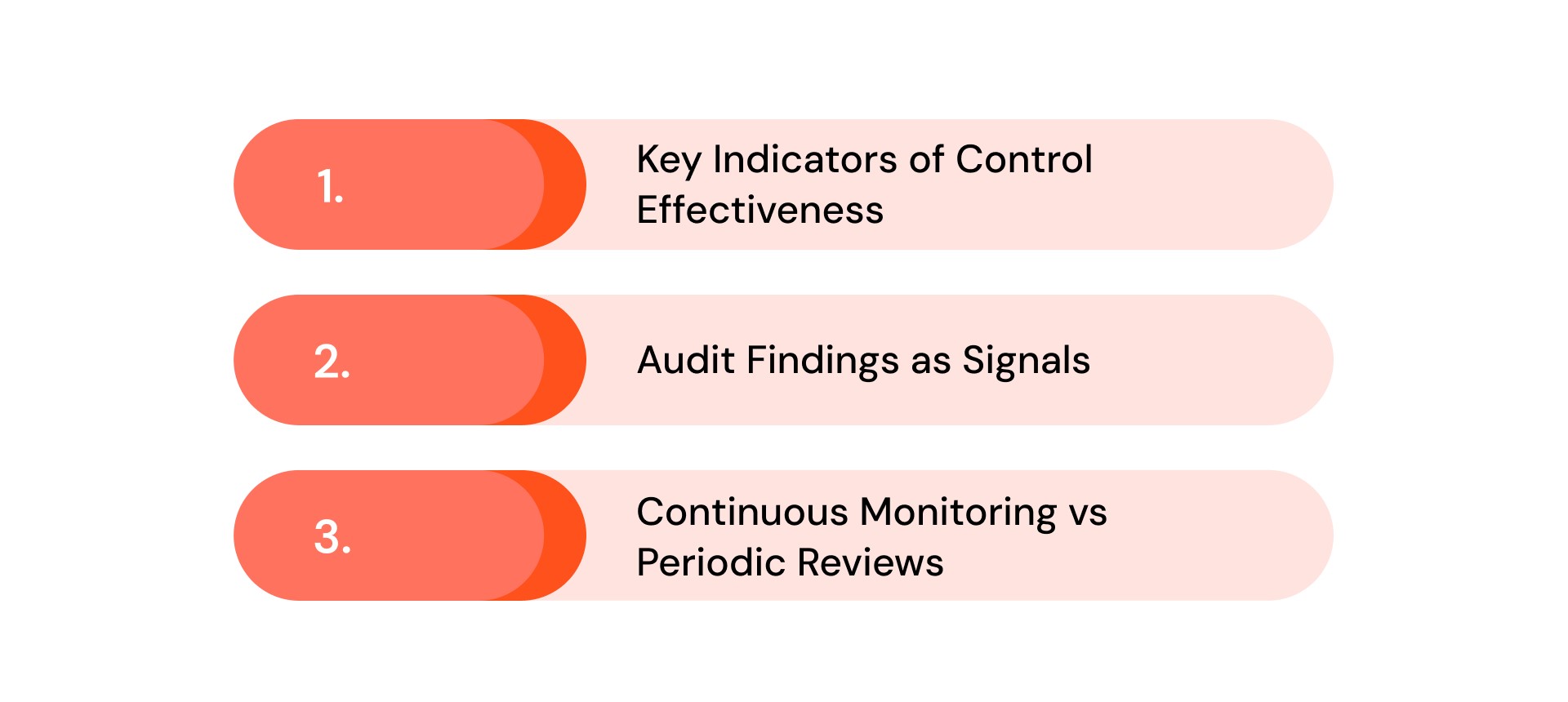
Defining controls is not sufficient; organizations must continuously evaluate whether they operate as intended. Measurement provides visibility into performance and highlights areas requiring improvement:
1. Key Indicators of Control Effectiveness
Metrics such as completion rates, exception rates, and adherence to timelines provide insight into how consistently controls are executed and where deviations occur.
2. Audit Findings as Signals
Recurring audit findings often indicate systemic weaknesses in control execution. These signals help organizations prioritize remediation efforts and improve control maturity.
3. Continuous Monitoring vs Periodic Reviews
Continuous monitoring provides real-time visibility into control performance, while periodic reviews offer structured evaluation. A combination of both ensures sustained effectiveness and timely identification of gaps.
Common Gaps in Operational Security Controls
Operational security controls rarely fail at the design level—they fail in execution, consistency, and traceability. These gaps typically surface during audits or incident reviews, where organizations are required to demonstrate not just control presence, but control performance over time:
1. Controls Defined but Not Executed
In many environments, controls exist as documented procedures but are not consistently embedded into daily workflows. Execution depends on manual follow-through, which introduces variability.
- Control steps are skipped during high-pressure situations
- Procedures are not integrated into operational systems
- Teams rely on memory instead of structured workflows
- No mechanism exists to enforce execution consistency
Implication: Controls cannot be relied upon during incidents
Audit impact: Failure to demonstrate control operation, not just existence
2. Inconsistent Application Across Teams
Operational controls often vary by team, location, or function, especially in distributed environments. This inconsistency creates uneven control coverage and complicates oversight.
- Different teams interpret procedures differently
- Execution varies across regions or business units
- No centralized standard for control performance
- Limited visibility into cross-functional execution
Implication: Control effectiveness becomes unpredictable
Audit impact: Inability to demonstrate uniform control application
3. Lack of Evidence and Traceability
Even when controls are executed, organizations frequently lack the evidence required to validate them. Without traceability, control performance cannot be proven.
- Missing logs, approvals, or execution records
- Evidence stored across disconnected systems
- No clear audit trail linking actions to controls
- Manual documentation prone to gaps
Implication: Execution cannot be validated post-incident
Audit impact: Weak audit defensibility and increased scrutiny
4. Fragmented Tools and Processes
Operational controls are often managed across multiple systems, creating silos that reduce coordination and visibility.
- Control execution spread across email, spreadsheets, and tools
- No centralized view of control status or performance
- Delayed or missed handoffs between teams
- Limited ability to track control dependencies
Implication: Breakdowns occur at workflow boundaries
Audit impact: Difficulty demonstrating end-to-end control execution
Gaps in execution, traceability, and ownership often indicate deeper structural issues in how controls are managed. Implementing structured control management systems can improve consistency, visibility, and audit defensibility. Book a demo with VComply to learn more.
Best Practices for Implementing Operational Security Controls
Improving operational security controls requires more than defining procedures, it requires structuring execution so that controls are consistently applied, monitored, and validated.
Organizations that achieve this move from reactive compliance to controlled, repeatable governance:
1. Standardize Control Workflows
Controls must be embedded into repeatable workflows rather than left as standalone instructions.
- Define step-by-step execution procedures for each control
- Integrate controls into operational systems and tools
- Ensure consistent application across teams and functions
- Establish checkpoints to validate execution at each stage
Outcome: Reduces variability and strengthens control reliability
2. Define Ownership and Accountability
Control effectiveness depends on clear ownership at every stage of execution and validation.
- Assign responsible owners for each control
- Define escalation paths for control failures
- Track accountability for execution and remediation
- Ensure visibility into ownership across teams
Outcome: Improves accountability and reduces execution gaps
3. Align Controls with Risk and Compliance Objectives
Controls must directly support risk management priorities and regulatory obligations to remain relevant and effective.
- Map controls to specific risks and regulatory requirements
- Prioritize controls based on risk exposure
- Continuously review control relevance and performance
- Align control outcomes with audit and compliance expectations
Outcome: Ensures controls deliver measurable governance value
Also read: Healthcare Compliance Program: Understanding the Purpose and Creation
Operationalizing Security Controls Across Workflows
Operational security controls often break down when execution depends on fragmented tools, manual coordination, and inconsistent oversight. As organizations scale, maintaining visibility into control performance becomes increasingly difficult, particularly when controls span multiple teams, systems, and regulatory requirements.
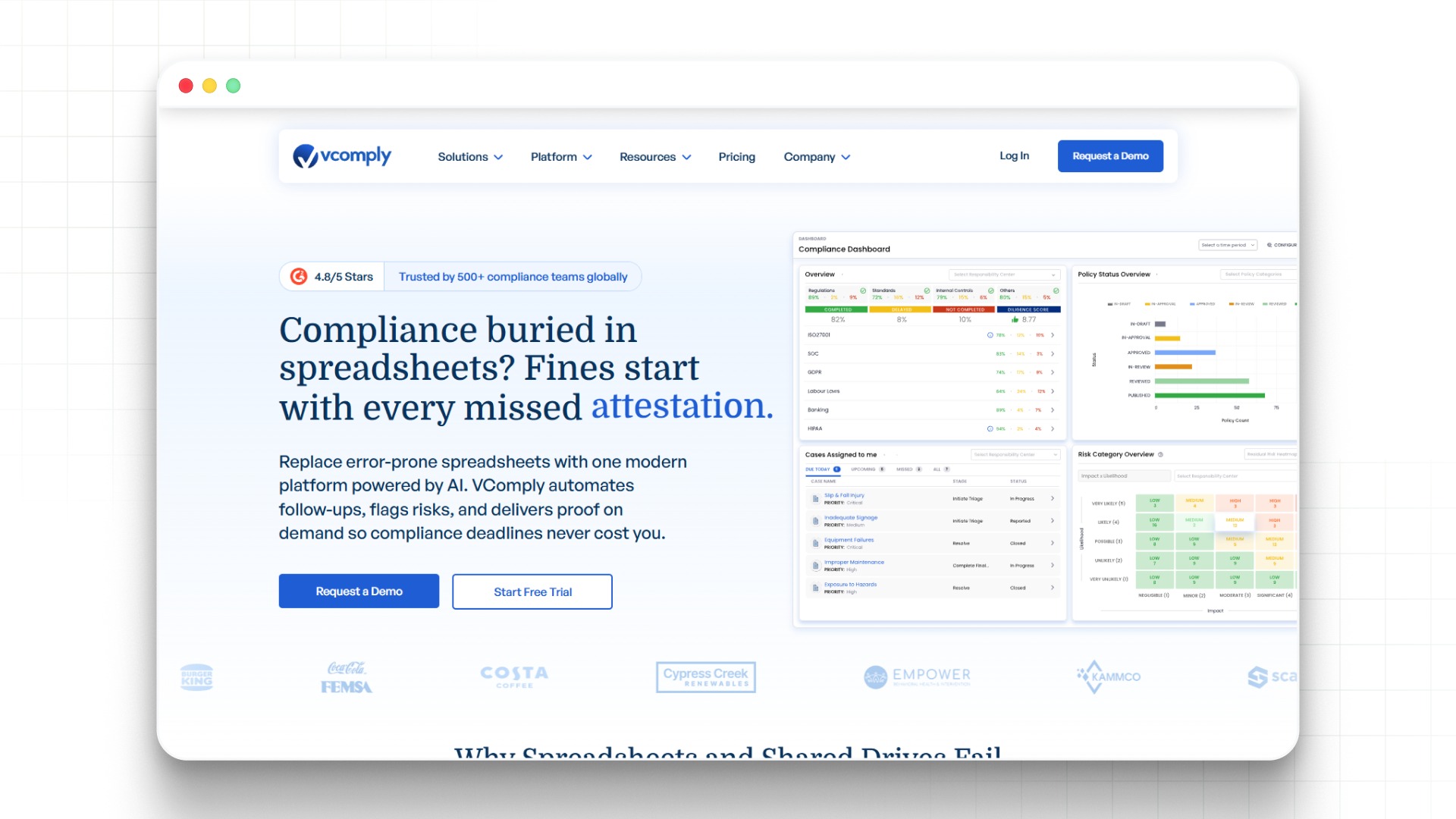
VComply addresses this by structuring control execution through integrated workflows that align risk, compliance, and operational activities within a unified system.
- Centralized control tracking with defined ownership and accountability
- Workflow-driven execution to ensure consistency across teams
- Real-time visibility into control performance and exceptions
- Integrated evidence capture for audit readiness
- Alignment with risk and compliance frameworks for end-to-end governance
Explore how structured workflows can help standardize control execution and improve visibility across your governance processes. Book a demo with VComply now.

Conclusion
Operational security controls determine whether governance frameworks hold under real-world conditions or break down during audits and incidents. Their effectiveness depends on consistent execution, clear ownership, and the ability to demonstrate performance through traceable evidence.
When controls are fragmented across teams or tools, organizations lose visibility into how risks are managed, making it difficult to validate compliance or respond with confidence under scrutiny.
Strengthening these controls requires moving beyond documentation toward structured, repeatable execution embedded within operational workflows. In many organizations, the challenge lies in coordinating control execution across functions while maintaining visibility and accountability.
VComply’s GRCOps Suite addresses this by structuring operational security controls within unified workflows that connect risk, compliance, and incident management. By centralizing control execution, capturing evidence in real time, and aligning activities with governance requirements, teams can reduce inconsistencies and improve audit readiness.
Start a 21-day free trial of VComply to explore how GRCOps enables consistent control execution and strengthens visibility across your governance processes.
FAQs
Examples include access reviews, incident response procedures, log monitoring, change management workflows, and vendor oversight processes. These controls focus on execution and ensure that security policies and technical safeguards are consistently applied.
Operational controls rely on human processes and workflows, while technical controls are system-enforced mechanisms. Operational controls ensure that technical and administrative controls are executed effectively.
Failures often result from inconsistent execution, lack of documentation, or unclear ownership. Even well-defined controls can fail if they are not implemented and monitored consistently.
Organizations can improve effectiveness by standardizing workflows, defining accountability, and using structured systems to monitor execution and capture evidence. Platforms like VComply support consistent control management and audit readiness.