

How ISO 42001 Compliance Tools Help You Manage AI with GRC Integration
As AI systems move from pilot to production in highly regulated environments, the pressure mounts to govern model behaviour, mitigate ethical risks, and preserve stakeholder trust.

Across financial services, healthcare, and public sector organisations, the absence of a structured AI-management framework often results in uncontrolled drift, opaque decision logic, and audit risk at scale. A recent U.S. survey found that 62 % of adults believe government oversight of AI is too lax, underscoring how critical accountability has become. Understanding how ISO 42001 compliance tools integrated into a GRC platform translate into operational controls and continuous monitoring enables your team to move from reactive firefighting to proactive AI governance.
Key Takeaways
- ISO 42001 sets a structured AI Management System that governs model design, testing, deployment, monitoring, and retirement across the full lifecycle.
- Compliance tools centralize AI assets, risks, controls, evidence, workflows, and vendor oversight so teams avoid governance gaps and inconsistent decision tracking.
- GRC software integration connects ISO 42001 controls with enterprise risk, policy libraries, monitoring reports, and audit documentation for cleaner, faster certification readiness.
- A practical rollout path begins with AI discovery, gap assessment, control mapping, workflow assignments, lifecycle monitoring, and preparation of audit-ready evidence.
What is ISO 42001?
ISO/IEC 42001 is the international standard that defines how organizations build and operate an Artificial Intelligence Management System (AIMS). It sets structured requirements for governing AI across design, development, deployment, and ongoing oversight so risks are identified, monitored, and controlled throughout the lifecycle. The standard follows the Plan-Do-Check-Act model used in other ISO frameworks, helping teams rely on repeatable processes instead of reactive fixes. By adopting ISO 42001, your organization gains a clear baseline for ethical, transparent, and accountable AI systems that stand up to regulatory and audit expectations.
Who Must Adopt ISO 42001 Now?
Organizations using AI in regulated, high-impact environments face growing pressure to formalize oversight under ISO 42001.
Here are the groups that face the strongest adoption urgency:
- Financial institutions confront increasing model-risk scrutiny where AI governance tools help maintain fairness, transparency, and traceability across decision engines.
- Healthcare and health-tech providers manage clinical-grade AI where ISO 42001 controls ensure safety, accountability, and continuous performance monitoring.
- Government agencies and public-sector teams manage AI systems influencing eligibility, benefits, and safety decisions, requiring validated policies and audit-ready documentation.
- Large enterprises scaling AI across departments benefit from AI compliance automation that standardizes risk assessment and minimizes inconsistent oversight.
- Vendors delivering AI-enabled products or embedded models strengthen customer trust by demonstrating AIMS certification readiness supported through structured governance.
Also read: 5 Essential Compliance Management Tools For Teams
Understanding who needs the standard is only one part of the picture, and the next step is grasping which ISO 42001 requirements organizations must map before any real progress can begin.

Core ISO 42001 Requirements To Map
The ISO 42001 framework outlines foundational requirements that organizations must map to structured processes and documented controls.
Here are the areas that typically form the baseline for compliance:
- Governance expectations define leadership accountability, requiring teams to operationalize policies that align AI risk with organizational objectives.
- Risk assessment processes cover AI-specific concerns such as fairness, drift, explainability, and data provenance across the model lifecycle.
- Documentation requirements mandate complete traceability, including policies, procedures, model records, training logs, and performance evidence for audits.
- Operational lifecycle controls guide design, testing, deployment, and monitoring activities tied directly to AI model registry management.
- Continuous improvement obligations require ongoing evaluation of controls, incidents, and audit findings to adjust the AIMS effectively.
Once these requirements are visible, the conversation shifts toward the tools needed to manage them consistently, which is where ISO 42001 compliance technology becomes essential.
Why AI Oversight Needs ISO 42001 Compliance Tools?
AI oversight becomes unmanageable without technology that centralizes risk, controls, and lifecycle evidence under a single governance layer.
Here are the reasons compliance tools are essential for operationalizing the standard:
- Centralized dashboards consolidate AI assets, risks, and ISO 42001 controls, reducing fragmented oversight and reactive issue handling across teams.
- Automated evidence collection supports audit-ready documentation by mapping activities directly to policies and required control outcomes.
- Integrated workflows assign owners, deadlines, and review cycles that strengthen accountability and reduce compliance drift.
- Built-in policy automation ensures updates, reviews, and acknowledgments are completed consistently across departments and user groups.
- AI vendor risk management capabilities extend oversight into third-party systems and embedded models that influence critical decisions.
Also read: 11 Best GRC Tools and Platforms to Use in 2025
Seeing how these tools stabilize oversight helps clarify how the standard influences everyday AI workflows, especially for teams managing active models.
What ISO 42001 Means For Daily AI Operations
Implementing ISO 42001 reshapes routine AI processes by embedding structured governance into every model-related activity.
Here are the operational changes most teams experience:
- Model design processes require clear definitions of purpose, acceptable use, performance thresholds, and human-in-the-loop procedures.
- Testing workflows incorporate fairness checks, robustness validation, bias reviews, and stress conditions aligned with ISO 42001 controls.
- Deployment protocols mandate documentation, risk acceptance, fallback mechanisms, and approval paths linked to established governance policies.
- Monitoring tasks track anomalies, data quality issues, ethical drift, and real-world impacts through automated alerts and dashboards.
- Decommissioning workflows include structured retirement steps, archiving, asset logging, and justification records maintained for audit purposes.
Download the compliance checklist to map your AI controls faster and verify where your program stands today.
These operational shifts set the stage for a closer look at how compliance tools support each phase of the AI lifecycle, turning expectations into traceable actions.
How ISO 42001 Tools Automate AI Lifecycle Governance?
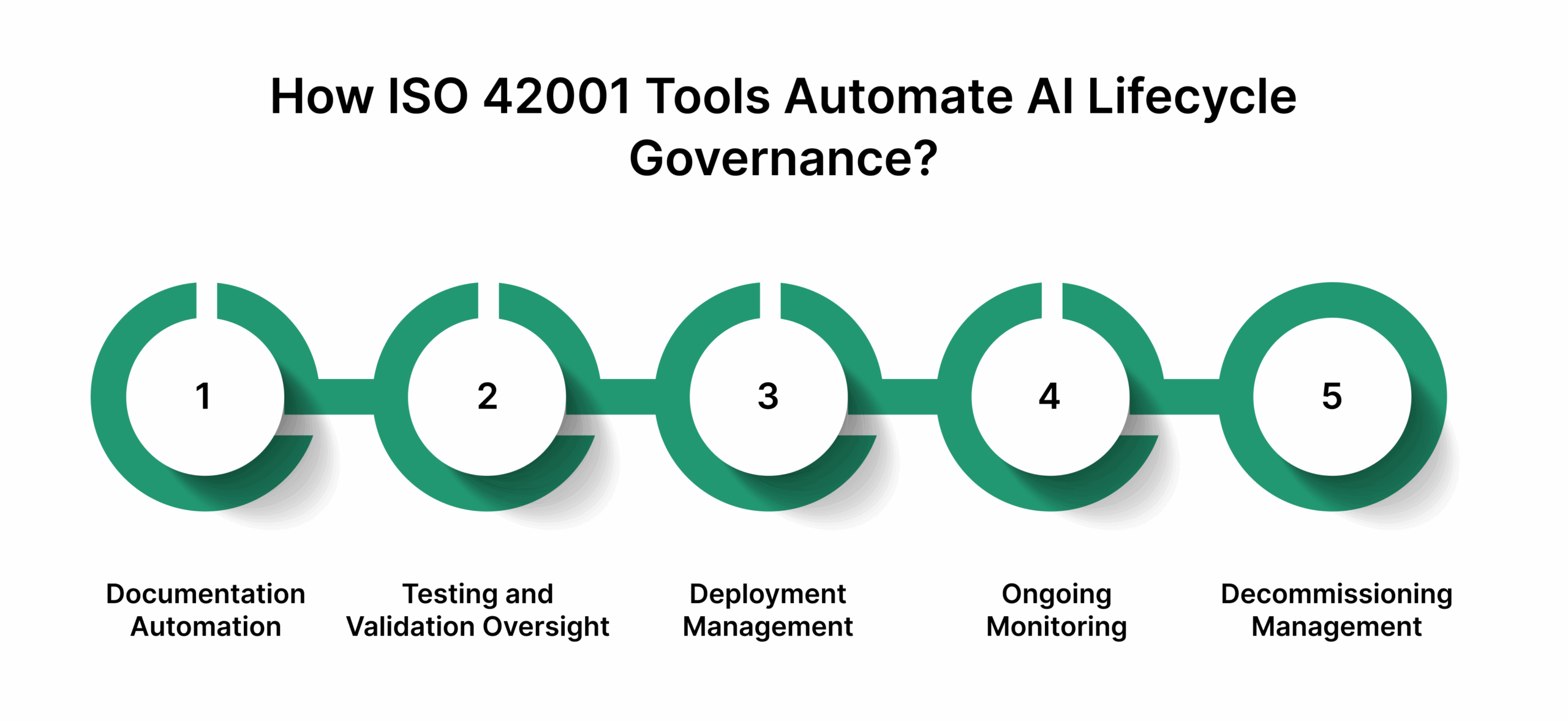
Lifecycle governance becomes easier to operationalize when supported by compliance tooling that connects every decision, record, and control.
Below are the core lifecycle areas strengthened through automation:
-
Model Design and Documentation Automation
Design stages benefit from automated templates that guide teams through purpose statements, data requirements, and risk considerations. Integrated workflows allow subject-matter experts to review design assumptions and attach supporting evidence directly into the AI model registry. Lifecycle continuity improves when each design decision becomes part of a traceable, audit-friendly record.
-
Testing and Validation Oversight
Testing cycles run more efficiently when compliance tools standardize fairness checks, robustness validations, and data-quality assessments. Automated prompts ensure teams complete required ISO 42001 controls before advancing to deployment. Validation results remain stored in a centralized repository that strengthens transparency, repeatability, and audit reliability.
-
Deployment and Change Management
Deployment becomes more controlled when tools link approvals, risk sign-offs, and fallback configurations to predefined workflows. Integrated change-management features help teams track iterations, updated datasets, and retraining activities. Every deployment action becomes part of the required documentation trail that auditors expect.
-
Ongoing Monitoring and Review
Ongoing performance tracking benefits from automated alerts that highlight drift indicators, unexpected behavior, or ethical-impact risks. Monitoring dashboards aggregate signals from model operations, allowing teams to evaluate incidents quickly and adjust controls as needed. Structured review cycles help organizations maintain continuous compliance instead of relying on annual assessments.
-
Retirement and Decommissioning Management
Retirement workflows ensure outdated or unstable models follow formal shutdown procedures that comply with ISO 42001 expectations. Automated steps help teams archive artifacts, store evidence, and record risk justifications for future reference. This alignment reduces operational blind spots and ensures lifecycle completeness.
Once lifecycle tasks are structured and automated, organizations start to see the benefits of pairing ISO 42001 with a GRC platform that connects risks, controls, and workflows in one system.
Where Does GRC Integration Strengthen ISO 42001 Controls?
Integrating ISO 42001 into a GRC platform reinforces governance by linking risks, policies, and controls across all AI activities.
Here are the areas where GRC adds measurable strength:
- Unified risk registers merge AI-specific risks with enterprise risk frameworks, improving alignment and board-level reporting.
- Policy-to-control mapping ensures every Annex A requirement connects directly to documented procedures and automated workflows.
- Issue and incident management workflows centralize AI-related findings, corrective actions, and recurring problem trends.
- Third-party oversight expands through AI vendor risk management, capturing model disclosures, fairness claims, and contractual obligations.
- Cross-framework harmonization supports ISO 42001 vs NIST AI RMF alignment to simplify audits and reduce duplicated assessments.
Also read: Best 10 GRC Software for Compliance Officers in 2025
With control alignment established, the next priority is ensuring evidence and documentation stay audit-ready, which is where integrated GRC software plays an important role.
How Does GRC Software Integration Improve AI Audit Readiness?
Audit readiness improves when ISO 42001 evidence is continuously collected, structured, and tied directly to lifecycle events.
Here are the ways integrated GRC platforms streamline audit preparation:
- Automated control testing records outcomes, exceptions, timestamps, and owners, reducing manual evidence gathering across teams.
- Centralized documentation folders maintain policies, training logs, impact assessments, and performance records in one searchable space.
- Pre-built audit-pack exports compile artifacts mapped to ISO 42001 controls and Annex A requirements with minimal reviewer effort.
- Continuous monitoring reports highlight model performance, drift alerts, and data-quality signals required during surveillance audits.
- Role-based access controls maintain integrity by ensuring auditors view only approved evidence and controlled documentation.
Even with strong tooling, some teams still stumble during implementation, making it important to recognize the missteps that commonly disrupt ISO 42001 adoption.
Common Mistakes When Implementing AI Compliance Tools
Teams often face predictable challenges when rolling out ISO 42001 compliance tools alongside broader AI governance programs.
Here are the issues most likely to disrupt adoption:
- Hidden AI systems remain undetected because organizations overlook embedded models in tools, APIs, or vendor platforms.
- Over-reliance on ISO 27001 processes creates blind spots around explainability, autonomy, fairness, and other AI-specific risks.
- Weak ownership models emerge when engineering, legal, product, and compliance teams fail to coordinate responsibilities.
- Impact assessments stall when teams lack structured playbooks for identifying ethical, societal, and operational risks.
- Compliance drift develops when monitoring activities focus solely on launch rather than lifecycle-long oversight.
Also read: Criteria for Choosing and Evaluating a GRC Tool for Your Business
Acknowledging these challenges helps shape a practical plan of action, setting up a clear and steady path for starting ISO 42001 with GRC support.
A 6-step start plan for ISO 42001 + GRC integration
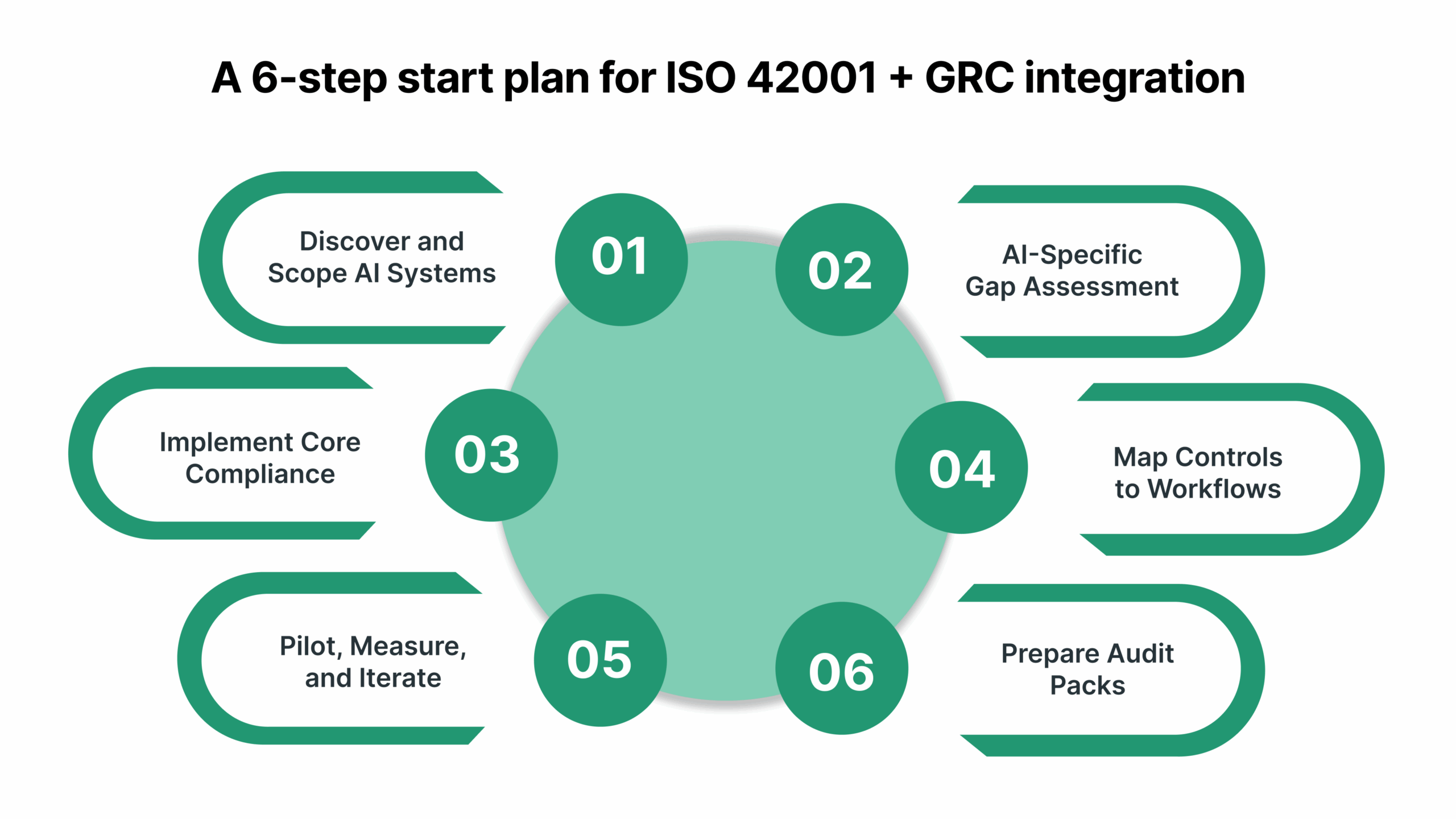
A structured rollout path helps organizations implement ISO 42001 controls while maximizing the advantages of GRC integration.
Below is the six-step plan that strengthens readiness:
Step 1: Discover and Scope AI Systems
Discovery begins with identifying AI models, embedded tools, and automated decision systems across your organization. A complete scope clarifies which models fall under AIMS requirements and which require separate documentation. This step reduces blind spots and ensures every relevant system is governed correctly.
Step 2: Conduct an AI-Specific Gap Assessment
Gap assessments evaluate current processes against ISO 42001 controls and highlight areas lacking structured oversight. Mapping findings to Annex A provides a clear picture of policy, risk, and lifecycle gaps. This analysis becomes the foundation of your implementation roadmap.
Step 3: Implement Core Compliance and GRC Tooling
Tool setup includes establishing an AI model registry, configuring policies, and enabling evidence-collection workflows. Integrating with existing GRC systems ensures governance extends across risk, compliance, security, and vendor oversight. Early tooling alignment prevents inconsistent documentation later.
Step 4: Map Controls to Workflows and Assign Ownership
Control mapping verifies that each ISO 42001 requirement has associated tasks, responsible owners, and review cycles. Ownership distribution encourages collaboration between engineering, legal, product, and compliance teams. Workflow clarity reduces delays and avoids duplicated effort.
Step 5: Pilot, Measure, and Iterate
Pilot programs help validate assumptions, identify operational bottlenecks, and confirm risk controls function as expected. Monitoring insights highlight where performance, data quality, or governance issues require refinement. This iterative approach aligns perfectly with the PDCA model built into ISO 42001.
Step 6: Prepare Audit Packs and Set Surveillance Cadence
Audit packs compile evidence for certification bodies and streamline the review process. Establishing an ongoing cadence for surveillance activities ensures compliance remains active rather than episodic. This discipline supports long-term governance maturity and sustained certification readiness.
With a structured roadmap in place, organizations often look for a platform capable of carrying this work reliably, which brings the focus to how VComply supports ISO 42001 programs.
Unlock Reliable AI Governance with V-Comply
V-Comply automates controls to enforce ISO 42001 compliance tools inside your GRC platform and turn AI risk into a controlled, auditable practice.
Here are key capabilities designed specifically for your ISO 42001 + GRC integration journey:
- Unified dashboards to help manage AI model registries to control libraries and task workflows so evidence aligns directly with ISO 42001 controls.
- Automated reminders and escalation workflows assign ownership for AI lifecycle checkpoints, design, deployment, and monitoring, ensuring nothing slips between teams.
- Risk assessment modules support AI-centric risk scenarios (bias, drift, third-party models) and integrate those into your overall enterprise GRC risk register.
- A comprehensive compliance library and documentation repository captures model cards, audit logs, vendor evidence, and policy-version history, aligning with audit expectations.
- Built-in vendor/third-party risk workflows help you extend governance beyond internal systems, mapping external AI use back to your GRC framework.
To take the next step, start a free trial with V-Comply and explore how its platform supports ISO 42001 readiness across your AI footprint.

Wrapping Up
Establishing control over AI systems becomes far more achievable when ISO 42001 requirements are supported by the right governance structure and operational workflows. Organizations gain clarity, accountability, and audit confidence when each stage of the AI lifecycle is tied to documented controls, continuous monitoring, and evidence-ready processes.
A stronger path forward becomes possible when VComply connects ISO 42001 controls with enterprise-wide GRC practices, transforming fragmented oversight into a unified governance layer. Teams responsible for AI governance benefit from mapped controls, automated workflows, and fully traceable audit records that help maintain long-term readiness.
Explore how VComply operationalizes ISO 42001 governance, automates control tracking, and strengthens AI compliance across your organization. Book a personalized demo today.
FAQ
ISO 42001 provides a structured framework for governing AI systems through an Artificial Intelligence Management System (AIMS), ensuring organizations manage risks, document controls, and maintain transparent, ethical, and accountable AI operations.
ISO 27001 focuses on information security risks, while ISO 42001 addresses AI-specific risks such as model drift, fairness, explainability, and lifecycle governance, making it the first ISO standard dedicated entirely to responsible AI oversight.
Smaller organizations working with AI, especially those offering AI-enabled services or selling models to regulated clients, benefit from compliance because it strengthens trust, contract eligibility, and governance maturity.
Any system that uses machine learning, automated decision-making, predictive models, or embedded AI logic is typically in scope, including internal tools, customer-facing features, and third-party or vendor-supplied AI modules.
Timelines depend on AI maturity, documentation quality, and governance structure, but most organizations require several months to complete discovery, mapping, integration, control assignments, monitoring setup, and audit preparation.