

Master International Trade Compliance and Slash Audit Risks Now
A single audit, an incorrect HS classification, or incomplete documentation can quickly expose global trade operations to penalties, delays, and regulatory scrutiny. For organizations moving goods across borders, audit readiness is no longer optional.

Enforcement agencies increasingly assess whether compliance controls are structured, documented, and consistently applied, rather than relying on intent or past outcomes.
International trade compliance extends beyond regulatory adherence. It is a risk management function that safeguards the business from financial loss, operational disruption, and reputational harm. This guide examines international trade compliance end-to-end, highlights common failure points, and outlines how organizations can build a practical, audit-ready compliance framework that operates effectively in real-world trade environments.
Key Takeaways
- International trade compliance fails most often due to classification errors, poor documentation, and unclear ownership, not lack of intent.
- Audit risk increases when trade data and evidence are spread across systems, teams, and third parties.
- Strong compliance programs rely on defined controls, accountable owners, and continuous monitoring, not one-time checks.
- Brokers and forwarders do not transfer liability; oversight and evidence remain the company’s responsibility.
- VComply’s Compliance Ops solution helps organizations operationalize trade compliance with centralized controls, ownership, and audit-ready documentation.
What is International Trade Compliance?
International trade compliance is the process of making sure every cross-border transaction follows the laws of all countries involved, from the point a product is designed to the moment it reaches the customer. It’s not a one-time check; it’s an ongoing system of rules, controls, and decisions that must work correctly for every shipment.
At its core, every compliant shipment comes down to five things.
- The product must be legal to trade and not restricted by licenses, sanctions, or end-use rules.
- Everyone involved, customers, suppliers, and banks, must be approved and continuously screened.
- The product must be identified correctly with an accurate HS code.
- Its value and country of origin must reflect economic reality and be fully supportable.
- Finally, all of this must be provable through clear, accessible records, because in trade compliance, if you can’t prove it, it didn’t happen.
Also Read: Global Trade and Import Export Compliance Management Software Tools
Mastering these definitions sets the foundation. Let’s break down the specific US federal regulations that compliance officers must operationalize daily.
Core U.S. Regulations Governing International Trade Compliance
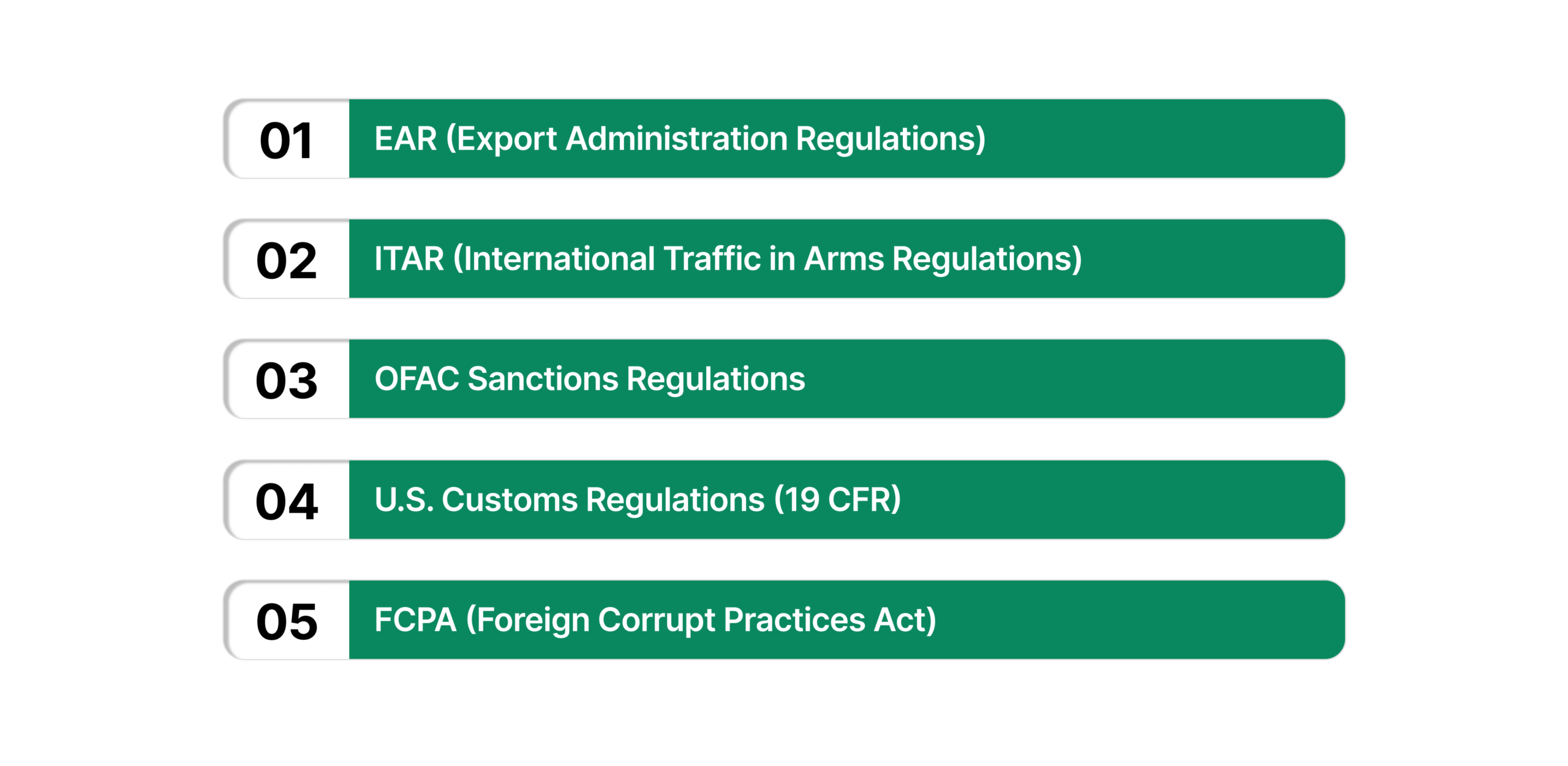
Five federal agencies enforce distinct rules covering exports, imports, sanctions, and documentation. Each targets specific risks with mandatory processes, penalties, and exemptions. US exporters ignore anyone at multimillion-dollar peril.
Here’s a detailed description of who regulates what and why:
1. EAR (Export Administration Regulations) – Bureau of Industry & Security (BIS)
The Export Administration Regulations (EAR), enforced by the U.S. Department of Commerce’s Bureau of Industry and Security (BIS), control the export, re-export, and transfer of commercial and dual-use items, including software and technology.
EAR applies not only to U.S. companies, but also to foreign businesses using U.S.-origin items or technology, or products that contain U.S. content, an area where many companies underestimate their exposure.
Non-compliance with EAR can result in civil penalties up to $1 million per violation and criminal fines up to $1 million with 20 years imprisonment.
To comply with EAR, businesses must:
- Classify products using the correct ECCN
- Determine if an
- Perform end-use and end-user checks
2. ITAR (International Traffic in Arms Regulations)
The International Traffic in Arms Regulations (ITAR) are enforced by the U.S. Department of State’s Directorate of Defense Trade Controls (DDTC). ITAR governs the export and handling of defense articles, defense services, and related technical data listed on the U.S. Munitions Import List (USML).
Unlike EAR, ITAR controls are very strict and focus heavily on access to information, not just physical shipments.
To comply with ITAR, companies must:
- Register with DDTC (if applicable)
- Control access to technical data, including by foreign employees
- Obtain licenses before exporting or sharing covered items or data
3. OFAC Sanctions Regulations
OFAC regulations are enforced by the U.S. Department of the Treasury’s Office of Foreign Assets Control (OFAC). These rules restrict or prohibit trade with sanctioned countries, entities, and individuals, and apply to goods, services, payments, and financial transactions.
OFAC rules apply even when a U.S. company is indirectly involved, such as through intermediaries or banks.
To comply with OFAC, businesses must:
- Screen all parties against sanctions lists
- Monitor changes to sanctions programs
- Block or reject prohibited transactions
4. U.S. Customs Regulations (19 CFR)
U.S. Customs regulations are enforced by U.S. Customs and Border Protection (CBP) and govern imports into the United States. These rules focus on the accuracy of information declared to customs.
CBP compliance covers:
- HS classification
- Customs valuation
- Country of origin
- Duty payment and recordkeeping
Importers are legally responsible for the accuracy of declarations—even if a customs broker files them.
5. FCPA (Foreign Corrupt Practices Act)
The Foreign Corrupt Practices Act (FCPA) is enforced by the Department of Justice (DOJ) and the Securities and Exchange Commission (SEC). It prohibits bribery of foreign officials and requires accurate books and records.
FCPA risks often arise in trade through:
- Customs brokers and agents
- Facilitation payments
- Inaccurate recording of fees or commissions
To comply, companies must:
- Control third-party behavior
- Maintain transparent records
- Enforce anti-bribery policies
Knowing exactly which regulations apply reveals a critical truth: these rules don’t just impact shippers; specific roles across your organization bear direct accountability.
Who Needs To Understand International Trade Compliance?
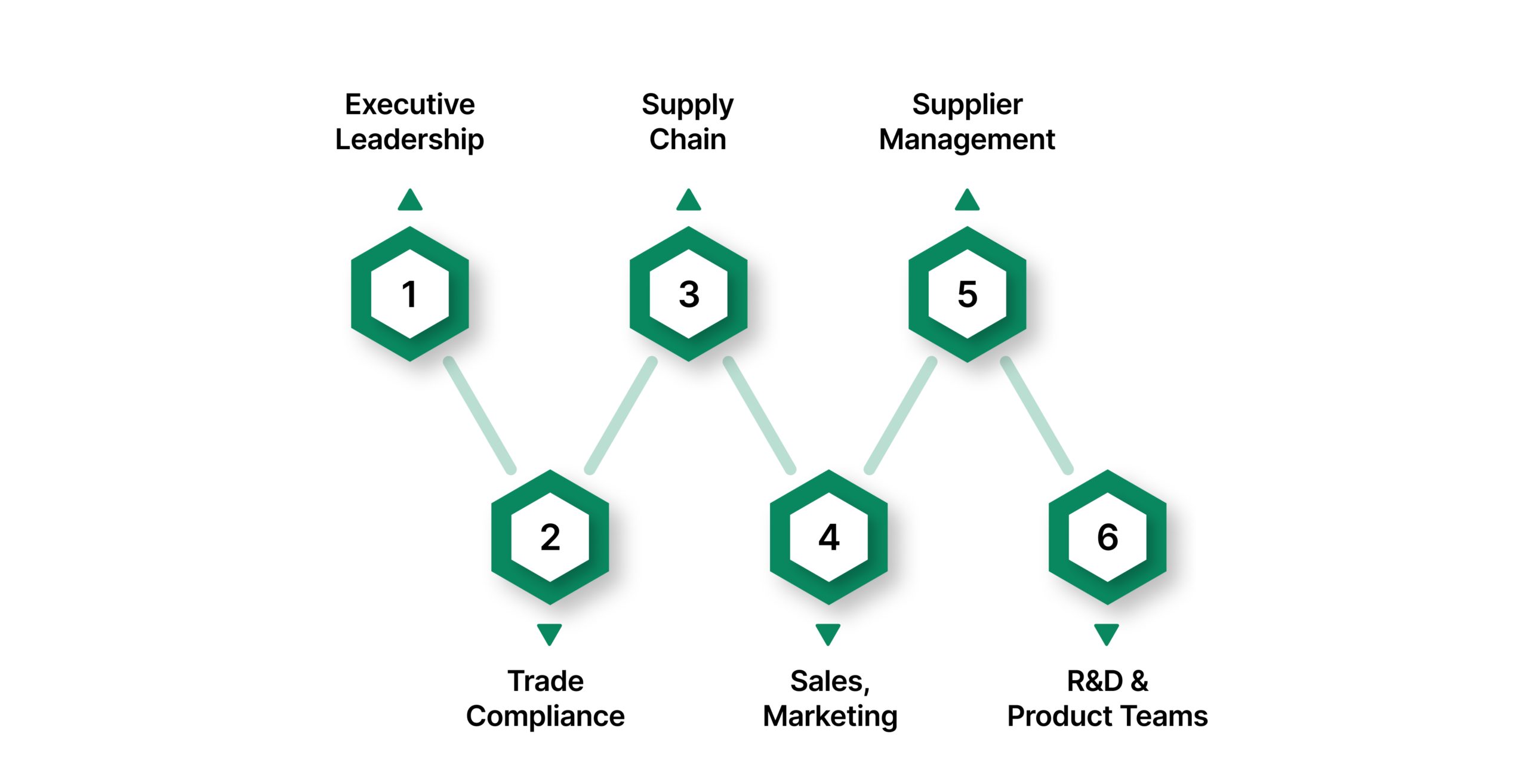
International trade compliance is not just a legal or customs function. Any role that influences products, partners, pricing, or shipments plays a part in compliance risk. When one group lacks awareness, violations usually follow.
Here’s the list of groups that should be aware of international trade compliance:
1. Executive Leadership (CEO, CFO, COO)
Leaders set the tone and approve budgets, systems, and risk tolerance.
They must understand:
- Financial impact of penalties, back duties, and shipment delays
- Personal liability and enforcement trends
- Why compliance investment prevents larger losses later
2. Trade Compliance & Legal Teams
This group owns interpretation and governance.
They are responsible for:
- Interpreting regulations (EAR, ITAR, OFAC, customs rules)
- Creating policies and internal controls
- Managing audits, disclosures, and regulator communication
3. Supply Chain & Logistics Teams
These teams execute compliance in real time.
They must understand:
- HS classification and origin requirements
- Required documents for each shipment
- Broker and forwarder oversight
4. Sales, Marketing & Customer Teams
Commitments made here create legal obligations.
They influence:
- Where products are sold
- Who they are sold to
- How products are described
5. Procurement & Supplier Management
Compliance begins before a product is made.
They must manage:
- Supplier origin declarations
- Use of controlled parts or technology
- Contractual compliance obligations
6. Engineering, R&D & Product Teams
Design decisions affect regulation exposure.
They impact:
- Export control classification (ECCN / ITAR)
- Technical data sharing
- Software and encryption controls
When many teams touch trade decisions, small gaps add up, and those gaps are exactly what regulators look for when they decide who to audit and why.
What Triggers Trade Audits (And Why Companies Fail Them)
Trade audits are rarely random. Regulators use data, patterns, and past behavior to identify companies that present a higher compliance risk. Most audits begin long after shipments have cleared, often when errors have quietly repeated for years.
Here are common triggers that put companies on the audit radar:
- Repeated Data Inconsistencies: Using different HS codes, values, or origin claims for the same product signals poor data governance. Repeated mismatches across entries are one of the fastest ways to trigger an audit.
- Unusual Duty or License Patterns: Sudden drops in duty payments, heavy use of license exceptions, or frequent corrections stand out in customs data. These patterns suggest misclassification or improper license use.
- Sanctions and Screening Red Flags: Missed or outdated denied-party screening raises immediate concerns. Even indirect links to high-risk countries or parties can prompt deeper regulatory review.
- Third-Party Errors (That Still Count as Yours): Broker or forwarder mistakes are legally attributed to the importer or exporter. Poor oversight of third parties often leads to systemic filing errors.
- Tips, Disclosures, and Shared Intelligence: Whistleblower tips, partner disclosures, or data shared between agencies often trigger audits. One issue can quickly expand into multi-agency enforcement.
Audit failures don’t end with citations; these penalties hit your business, career, and freedom immediately.
What Are The Consequences Of Non-Compliance?
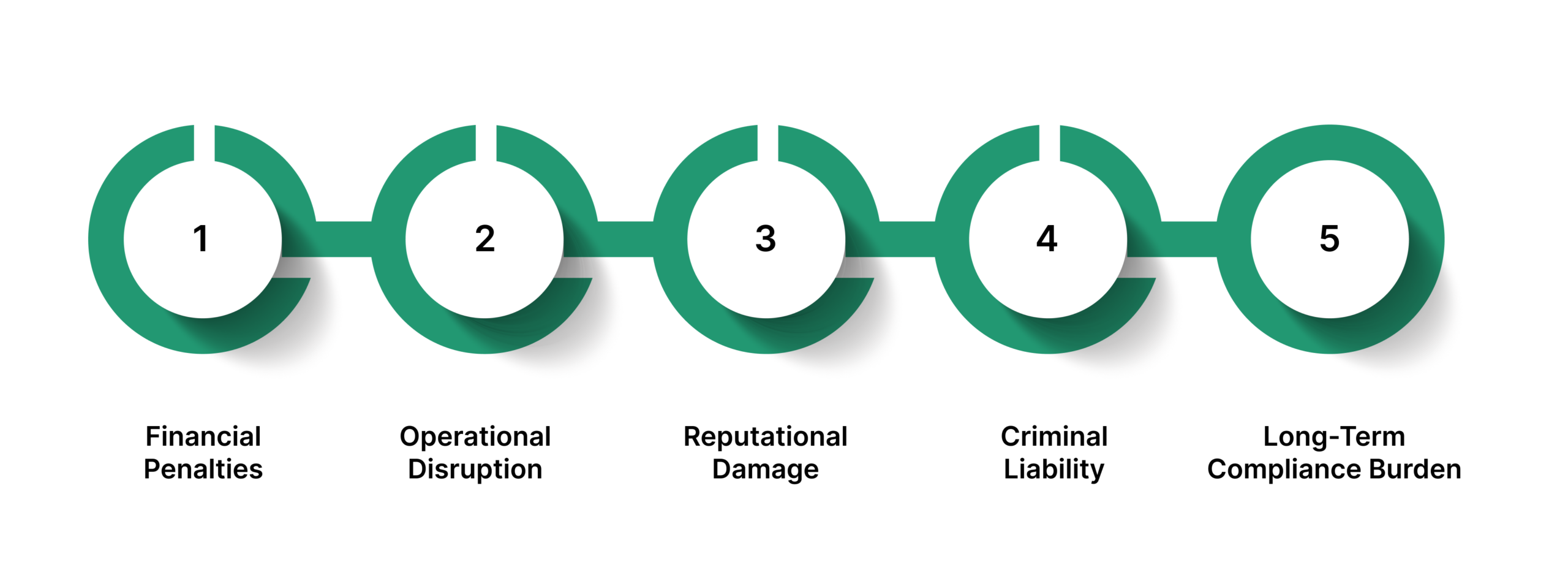
Failing to meet international trade compliance requirements can be costly, operationally disruptive, and reputationally damaging. Penalties go beyond fines and can affect your ability to trade globally.
Here are some consequences that your organization can face for non-compliance:
- Financial Penalties: Companies can face civil fines, back duties, and interest, while serious violations may lead to criminal fines or imprisonment for responsible individuals.
- Operational Disruption: Shipments may be delayed, seized, or rejected, and licenses or certifications like AEO/CTPAT can be revoked, halting trade with key partners.
- Reputational Damage: Non-compliance harms trust with customers, investors, and partners, and public enforcement cases can damage your brand and market position.
- Legal and Criminal Liability: Executives and employees may face personal civil or criminal liability, while third-party oversight failures can also create legal exposure.
- Long-Term Compliance Burden: Companies may need enhanced controls, ongoing audits, and monitoring programs, which increase operational costs and scrutiny.
Now that we understand the consequences of non-compliance, the next step is knowing what makes a trade compliance program strong, effective, and audit-ready.
What Are The Key Elements Of International Trade Compliance?
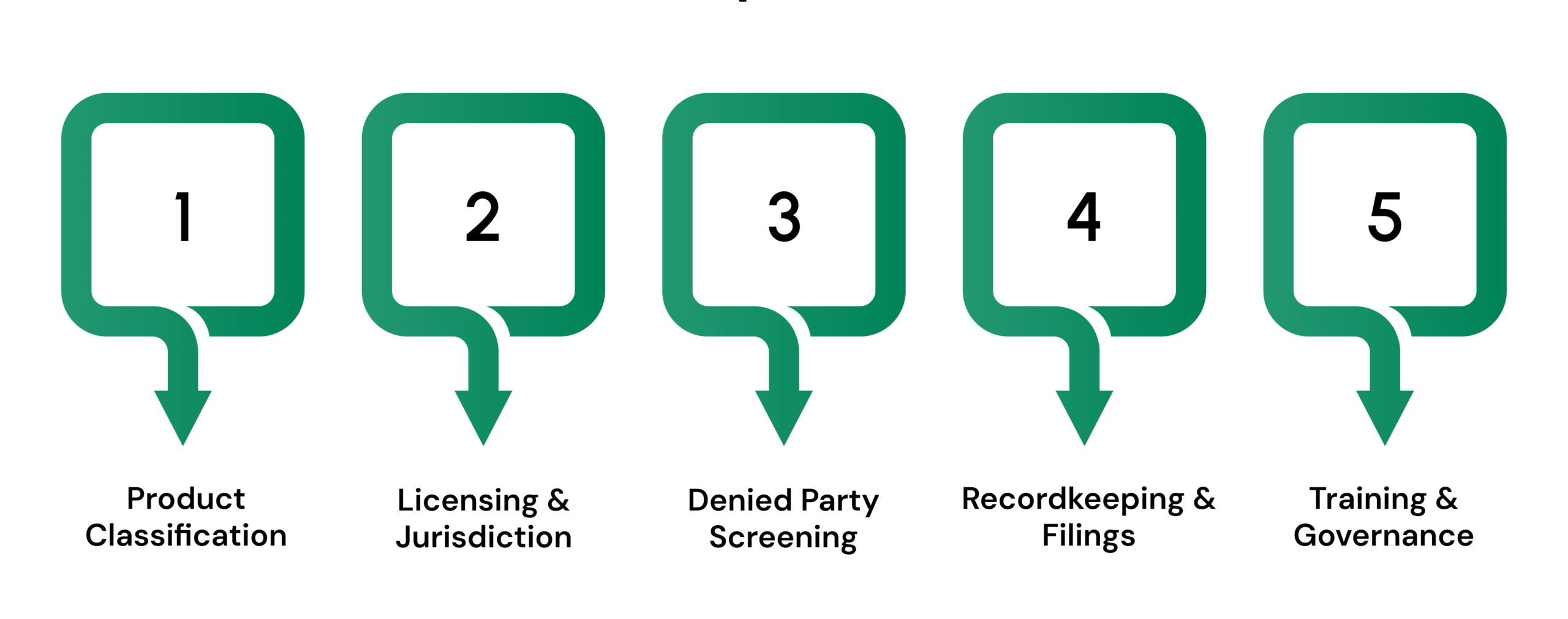
International trade compliance is built on five tightly connected elements: knowing what you ship, where it goes, who is involved, which license applies, and how you prove it later. Each has specific US requirements and failure patterns.
Here’s the detailed description of the key elements:
1. Product Classification (HTS & ECCN)
Correct classification determines duties, license needs, and enforcement risk.
- HTS codes (10‑digit) classify imports for CBP and set duty rates and trade remedy exposure.
- ECCN codes on the Commerce Control List determine EAR controls, license requirements, and whether an item is “EAR99.” Misclassification is one of the top drivers of BIS enforcement actions and duty disputes at CBP.
2. Licensing & Jurisdiction (EAR vs ITAR)
You must decide which rulebook applies and whether a license is required before shipping.
- Jurisdiction: Determining EAR vs ITAR vs purely commercial is the first decision; defense‑related hardware, components, and technical data often fall under ITAR.
- Licensing: BIS licenses (EAR) are filed via SNAP‑R, while ITAR licenses and registrations go through DDTC systems such as DECCS; each requires item details, end‑use, and end‑user justification.
3. Sanctions & Denied Party Screening
Every party in the transaction, buyer, end‑user, bank, freight forwarder, must be screened.
- OFAC lists: US persons must not transact with Specially Designated Nationals or blocked entities; screening is expected at onboarding and on an ongoing basis.
- Other lists: BIS Entity List, Military End User List, and various foreign sanctions lists also affect whether exports are permissible or need a license, especially for high‑risk destinations.
4. Documentation, Recordkeeping & Filings
Agencies expect complete, accurate, and retrievable documentation for years after the shipment.
- Core documents: Commercial invoice, packing list, certificate of origin, transport documents, and any license or license exception citation must align.
- Filings & retention: AES/EEI filings must meet timing and value thresholds, and export and import records typically must be retained for at least five years for potential BIS, DDTC, OFAC, or CBP audits.
5. Internal Controls, Training & Governance
Compliance is not just paperwork; it is a controlled process tied to governance and internal accountability.
- Written policies and procedures: Clear trade compliance manuals should define roles, escalation paths, classification rules, and approval workflows.
- Training and oversight: Regular training for sales, logistics, finance, and engineering, combined with internal audits and management reporting, is expected as part of a strong compliance program and can mitigate penalties if issues occur.
Also Read: Compliance Audits: A Guide to Ensuring Regulatory Adherence
Now that you know the core elements of trade compliance, the next step is putting them into action, in the right order and in a way that actually works in daily operations.
How to Build a Strong Trade Compliance Program (Step-by-Step)
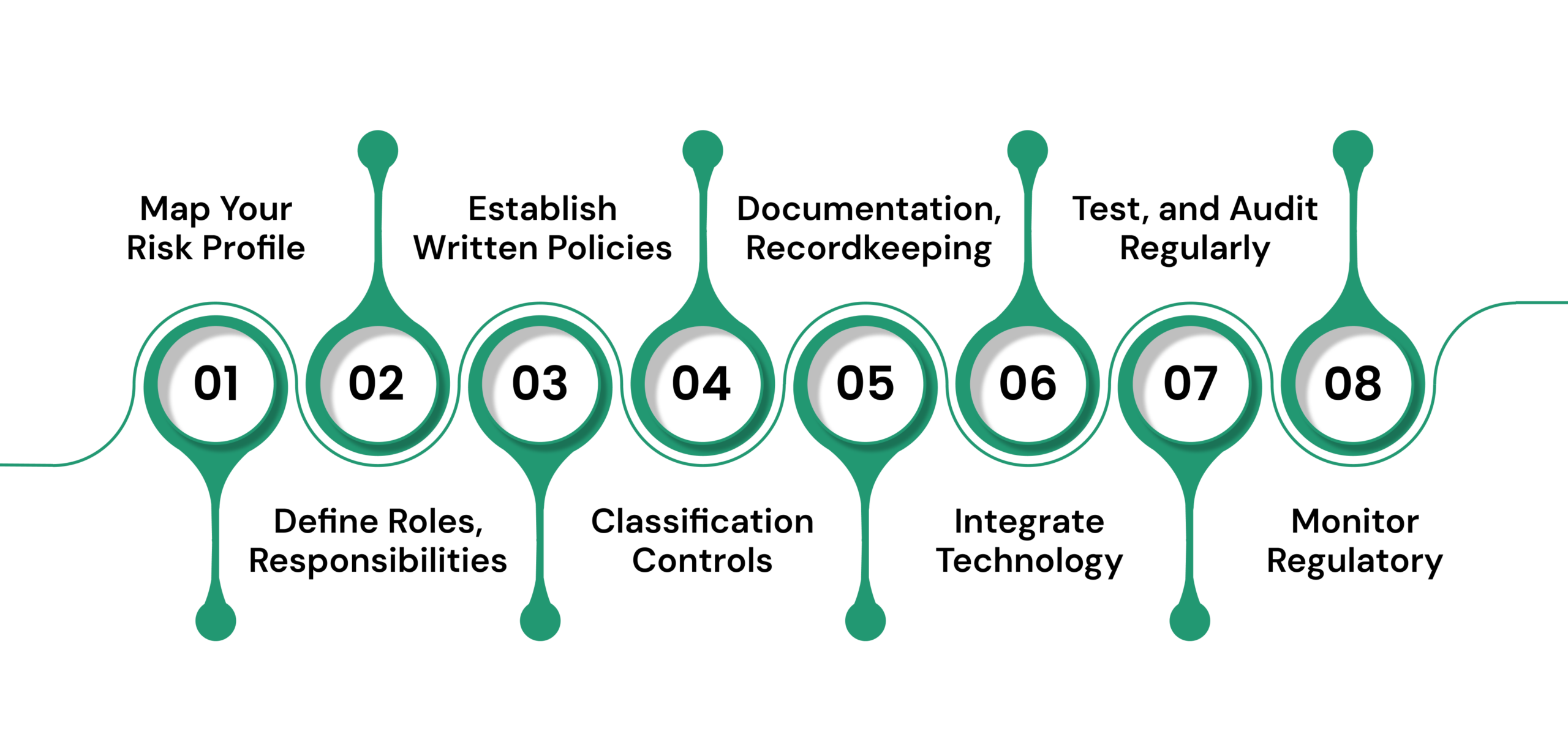
A strong trade compliance program is a structured system that combines policy, process, technology, and accountability. The steps below reflect what US regulators (including BIS and OFAC) look for when evaluating whether your program is effective and credible.
Here’s a step-by-step guide:
1. Map Your Risk Profile
Start by understanding where your real exposure lies.
- Identify products that may be dual‑use or defense‑related and determine whether they fall under EAR, ITAR, or EAR99.
- Map export and import flows by country, customer type, and channel (direct, distributor, online), then flag higher‑risk destinations, industries, and intermediaries.
2. Define Roles, Responsibilities, and Governance
Regulators expect named owners, not vague shared responsibilities.
- Assign a Trade Compliance Officer (or equivalent) with authority to stop shipments and escalate issues to senior management.
- Document role‑specific duties for sales, logistics, procurement, finance, and legal, including approval thresholds and escalation paths for complex classifications or high‑risk transactions.
3. Establish Written Policies and Procedures
Policies translate regulations into day‑to‑day instructions.
- Develop a trade compliance manual covering classification rules, licensing criteria, screening procedures, compliance documentation standards, and record retention.
- Include clear, simple decision trees for “Can we ship this?” based on product, destination, end‑user, and intended use, with examples relevant to your industry
4. Implement Systematic Screening and Classification Controls
Controls must be embedded in workflows, not left to memory.
- Integrate denied‑party and sanctions screening (OFAC, BIS lists, foreign lists) into order entry, onboarding, and payment processes so checks occur automatically.
- Standardize classification through controlled HTS/ECCN libraries, documented rationales, and change‑control procedures whenever products, specifications, or uses evolve.
5. Standardize Licensing, Documentation, and Recordkeeping
Licensing and documentation processes should be predictable and consistent.
- Create workflows for determining when licenses are required, preparing applications, and tracking conditions and expiration dates.
- Define document sets (e.g., invoices, packing lists, origin certificates, license numbers, AES/EEI filings) that must be present before release of goods, and implement retention rules aligned with US requirements (often at least five years).
6. Integrate Technology and Automation
Technology is now an expectation, not a bonus, in complex trade environments.
- Use compliance and GRC platforms to automate screening, classification checks, workflow approvals, and audit trails, reducing manual errors and improving consistency.
- Integrate these tools with ERP, order management, and logistics systems so data flows automatically and controls operate in real time across departments.
7. Train, Test, and Audit Regularly
A program is only as strong as how people apply it.
- Provide targeted training for each function, sales on red‑flag customers, engineering on tech data controls, logistics on documentation, finance on sanctions implications, at least annually or when rules change.
- Conduct internal audits and spot checks of classifications, licenses, and screening records, and document corrective actions; regulators often weigh this heavily when deciding penalties.
8. Monitor Regulatory Changes and Continually Improve
Trade rules change frequently, especially sanctions and export controls.
- Assign responsibility for monitoring regulatory updates from BIS, DDTC, OFAC, CBP, and relevant foreign authorities, and summarizing impacts for internal stakeholders.
- Update policies, templates, and system rules promptly when thresholds, country programs, or control lists change, and track these changes as part of your governance record.
Moreover, managing trade compliance across teams and regulations doesn’t have to be complex. VComply’s GRC Platform helps you centralize trade obligations, assign ownership, track controls, and maintain audit-ready evidence in one system, so compliance stays proactive, visible, and enforceable across the business.
Even with strong controls in place, most compliance failures don’t start with intent; they start with classification and documentation mistakes that quietly repeat across shipments.
Classification and Documentation Challenges in International Trade Compliance
Product classification and documentation are two of the most audited and most error-prone areas of international trade compliance. Small mistakes here scale quickly, leading to penalties, shipment delays, and long-term audit exposure.
The issues mentioned below usually don’t happen once; they repeat across shipments, systems, and regions, quietly increasing risk over time.
1. Incorrect or Inconsistent HS Classification
HS classification mistakes often happen when the same product is treated differently across teams or countries. Without a single, controlled decision, inconsistencies quickly spread across filings.
- Different HS codes used by brokers, regions, or systems
- No review after product changes or tariff updates
- Classification decisions made without formal approval
2. Lack of Supporting Classification Evidence
Many companies rely on “what was used last time” instead of documented reasoning. When auditors ask why a code was selected, there is often no defensible answer.
- No written classification rationale or technical analysis
- Missing reference to rulings or explanatory notes
- No audit trail showing who approved the classification
3. Poor Control Over Trade Master Data
Trade data is often scattered across ERP systems, spreadsheets, and broker platforms. When ownership is unclear, errors multiply, and corrections go unnoticed.
- HS codes, origin, and product descriptions are stored in multiple systems
- No controls over who can change trade data
- Updates are not synced across documents and filings
4. Incomplete or Inaccurate Shipping Documents
Documentation errors usually stem from weak templates and inconsistent data sources. Even small gaps can delay shipments or trigger inspections.
- Invoices missing full product descriptions or value elements
- Packing lists, licenses, or origin documents not aligned
- Different document formats used by different teams
5. Weak Recordkeeping and Retrieval
If records can’t be produced quickly, auditors assume compliance didn’t happen. Disorganized storage is one of the most avoidable compliance failures.
- Documents spread across emails, drives, and third-party portals
- No clear retention timelines by regulation
- Slow or incomplete responses during audits
Classification errors don’t stay theoretical; they cost millions daily. VComply eliminates them through automation tailored for US exporters facing EAR/ITAR realities.

Use VComply and Get Help with Your Global Trade Compliance Needs
VComply is a cloud GRC platform that automates compliance workflows for regulated industries. Its modular design centralizes classification, screening, licensing, and audit trails, reducing manual errors while delivering SOX-ready reports for finance exporters.
VComply Solutions for International Trade Compliance
- ComplianceOps: Automates compliance task scheduling, evidence collection, and audit tracking. Centralized dashboard shows real-time compliance status across frameworks.
- RiskOps: Centralizes risk identification, assessment, and mitigation with risk scoring. Real-time dashboards visualize enterprise risk posture and heatmaps.
- PolicyOps: Centralized policy repository with version control and automated review reminders. Digital approval workflows ensure policy adherence.
Ready for zero-classification errors? Start your ComplianceOps 21-day free trial, automate HTS/ECCN, OFAC screening, and AES filings today.
Final Thoughts
International trade compliance fails most often not because companies ignore the rules, but because classification decisions, documentation, ownership, and evidence are scattered across systems and teams.
As trade volumes grow and regulations tighten, manual controls and broker-dependent processes can no longer support audit-ready operations. A strong compliance program requires clear ownership, controlled data, documented decisions, and continuous monitoring, built into daily trade workflows, not added after errors occur.
To manage international trade compliance effectively, organizations should use VComply’s Compliance Ops platform.
Compliance Ops enables trade teams to map trade regulations to controls, assign ownership for classification and documentation, track evidence, manage audits, and close gaps, creating a fully audit-ready trade compliance program across global operations. Book a demo of VComply today!
FAQs
International trade compliance ensures that imports and exports follow all applicable laws, including export controls, sanctions, customs regulations, and recordkeeping requirements. It covers classification, valuation, screening, licensing, and documentation.
HS classification determines duties, licenses, and admissibility. An incorrect code can lead to underpaid duties, penalties, shipment delays, and failed audits across multiple countries.
Yes. Legal responsibility remains with the importer or exporter, even if brokers file on their behalf. Companies must review filings and maintain documented oversight.
Inconsistent HS codes, valuation discrepancies, missing documents, repeated amendments, or high-risk trade lanes and products commonly trigger audits.
By assigning ownership, controlling trade data, retaining documentation, and tracking compliance tasks in a centralized system like VComply’s Compliance Ops solution, rather than relying on spreadsheets.