

GRC Engineering: What It Is, Why It Matters, and How to Build a System That Actually Works
Regulatory expectations are shifting from periodic validation to continuous assurance, yet many organizations still rely on fragmented processes, manual evidence collection, and point-in-time audits that fail to reflect actual control performance.
Under frameworks such as NIST and SOC 2, audit findings increasingly point to gaps in execution, inconsistent control monitoring, and limited visibility into real-time risk exposure.
For compliance, risk, and security leaders, the challenge is not defining controls but ensuring they operate reliably within systems that can demonstrate accountability under scrutiny.
GRC engineering is emerging as a response to this shift, redefining how governance, risk, and compliance functions are designed and executed. It focuses on embedding controls into systems, automating evidence generation, and enabling continuous monitoring across workflows.
This article examines how GRC engineering works, how it differs from traditional models, and how organizations can build structured, system-driven approaches that improve visibility, consistency, and audit readiness.
Key Takeaways
- GRC engineering replaces periodic, audit-driven compliance with continuous, system-driven control execution and validation.
- Traditional GRC models fail due to fragmented tools, manual workflows, and a lack of real-time risk visibility.
- It shifts compliance from documentation to system-generated evidence, improving audit defensibility and reducing manual effort.
- Core principles include automation-first design, continuous monitoring, evidence by design, and integration into development workflows.
- Operationalizing GRC engineering requires mapping controls to workflows, aligning cross-functional ownership, and enabling real-time monitoring.
- Treating GRC engineering as a tool rather than a system leads to failed implementations and limited governance maturity.
- Effective adoption improves risk visibility, accelerates remediation, and ensures consistent control performance under regulatory scrutiny.
What Is GRC Engineering?
GRC engineering shifts governance, risk, and compliance from documentation-heavy functions to system-driven execution. It focuses on embedding controls into workflows, enabling continuous validation, and generating audit-ready evidence through operational systems rather than manual processes.
How It Differs from Traditional GRC
Traditional GRC models rely on periodic validation and manual coordination, while GRC engineering focuses on continuous, system-driven execution:
- Periodic audits → Continuous compliance: Real-time validation replaces point-in-time assessments
- Manual evidence → Automated evidence: Evidence is generated through workflows and systems
- Siloed workflows → Integrated systems: Cross-functional processes replace disconnected execution
Where GRC Engineering Sits in Modern GRC Architecture
GRC engineering operates at the intersection of governance, technology, and operational execution:
- Compliance: Maps regulatory requirements to executable controls
- Engineering: Embeds controls into systems, pipelines, and workflows
- Risk systems: Enable continuous visibility into control performance
- Cross-functional dependency: Requires coordination across IT, security, compliance, and business teams
Also read: What is Compliance? Definition, Core Elements, A Complete 2025 Guide for Organizations
Why Traditional GRC Models Are Breaking Down
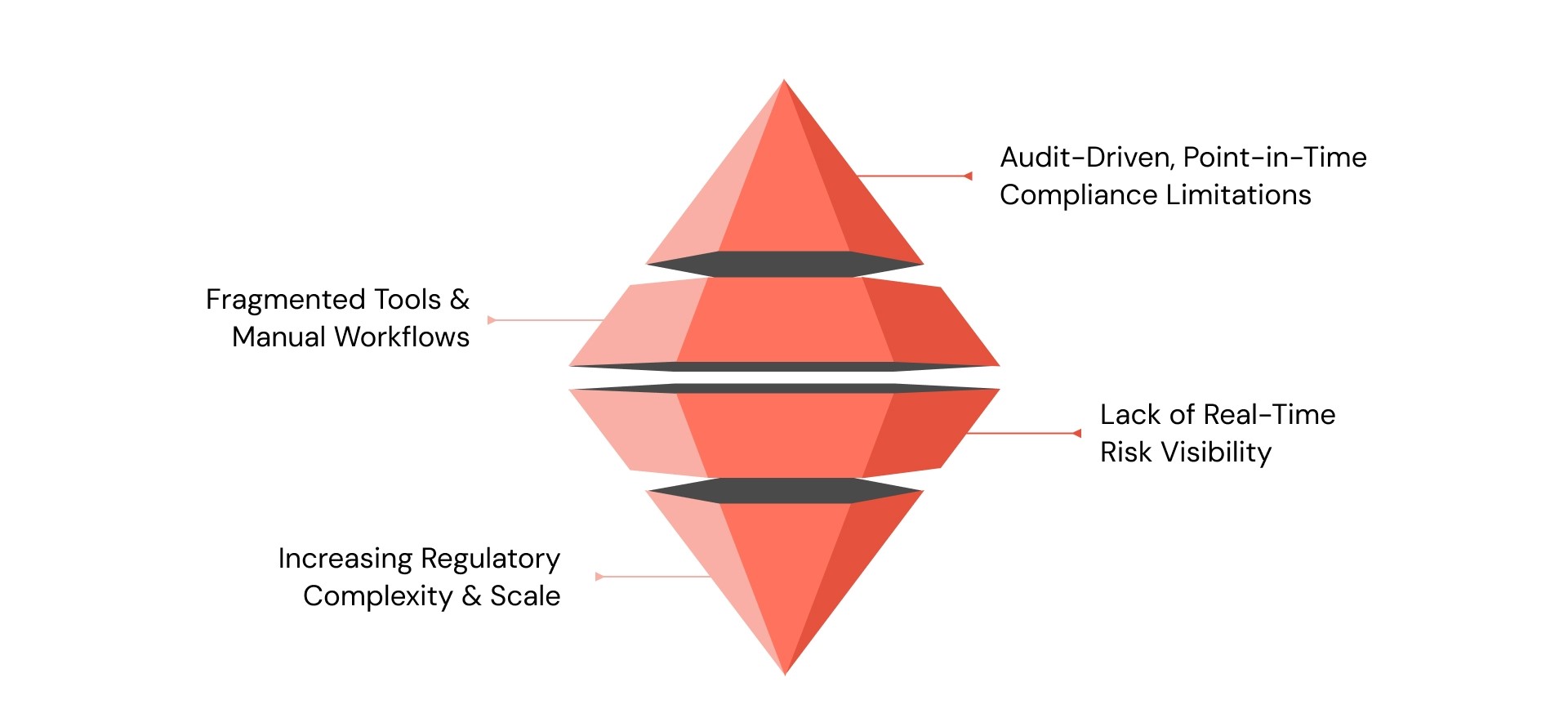
Traditional GRC models were designed for static environments, but regulatory expectations now require continuous validation and demonstrable control performance. As organizations scale, manual processes and fragmented systems fail to provide the visibility, consistency, and accountability required under modern audit and compliance frameworks:
1. Audit-Driven, Point-in-Time Compliance Limitations
Traditional GRC relies on periodic audits that capture a snapshot of compliance rather than ongoing performance. This approach creates gaps between actual control execution and what is documented, making it difficult to demonstrate consistency.
As a result, organizations often struggle to defend decisions or validate control effectiveness under continuous regulatory scrutiny.
2. Fragmented Tools and Manual Workflows
Compliance activities are frequently managed across spreadsheets, emails, and disconnected tools, leading to inconsistent execution. Without integration, workflows become difficult to track, and accountability is diluted.
This fragmentation increases operational overhead and makes it challenging to ensure that controls are applied consistently across teams and environments.
3. Lack of Real-Time Risk Visibility
Without continuous monitoring, organizations lack visibility into how controls perform in real time. This delay creates blind spots in risk detection and limits leadership’s ability to make informed decisions. By the time issues are identified, exposure may already have increased, reducing the effectiveness of response and remediation efforts.
4. Increasing Regulatory Complexity and Scale
Frameworks such as NIST, SOC 2, and HIPAA continue to evolve, requiring organizations to manage a growing number of controls across systems and jurisdictions. Traditional models cannot scale effectively to meet these demands, leading to gaps in execution and increased difficulty in maintaining compliance across distributed environments.
Also read: What is Governance? What’s It Involved?
How GRC Engineering Changes the Compliance Model
GRC engineering transforms compliance from a reactive, documentation-driven function into a continuous, system-enabled process. It redefines how controls are executed, monitored, and validated, enabling organizations to align compliance activities with real-time operations and risk conditions:
1. From Periodic Compliance to Continuous Assurance
GRC engineering replaces periodic validation with continuous monitoring, allowing organizations to assess control performance in real time. Event-driven validation ensures that deviations are detected as they occur, reducing the gap between execution and oversight and enabling faster, more informed responses to emerging risks.
2. From Documentation to System-Generated Evidence
Instead of manually collecting evidence during audits, GRC engineering embeds evidence generation into workflows. Logs, approvals, and system outputs become byproducts of execution, improving accuracy and traceability.
This approach strengthens audit defensibility by ensuring that evidence reflects actual control performance rather than reconstructed documentation.
3. From Siloed Teams to Integrated Workflows
GRC engineering aligns compliance, risk, and engineering teams within shared workflows. This integration reduces duplication, improves coordination, and ensures that controls are executed consistently across functions. Shared accountability enhances visibility and makes it easier to identify and address gaps in execution.
4. From Reactive Response to Proactive Risk Management
By enabling continuous monitoring and real-time insights, GRC engineering allows organizations to identify risks before they escalate. Predictive visibility supports proactive decision-making, reducing reliance on reactive remediation and improving overall resilience in dynamic regulatory environments.
Shifting to continuous assurance requires more than process changes; it demands systems that can enforce execution and generate evidence automatically. Schedule a demo with VComply to see how structured workflows can support real-time monitoring and improve audit defensibility across your operations.
Core Principles of GRC Engineering
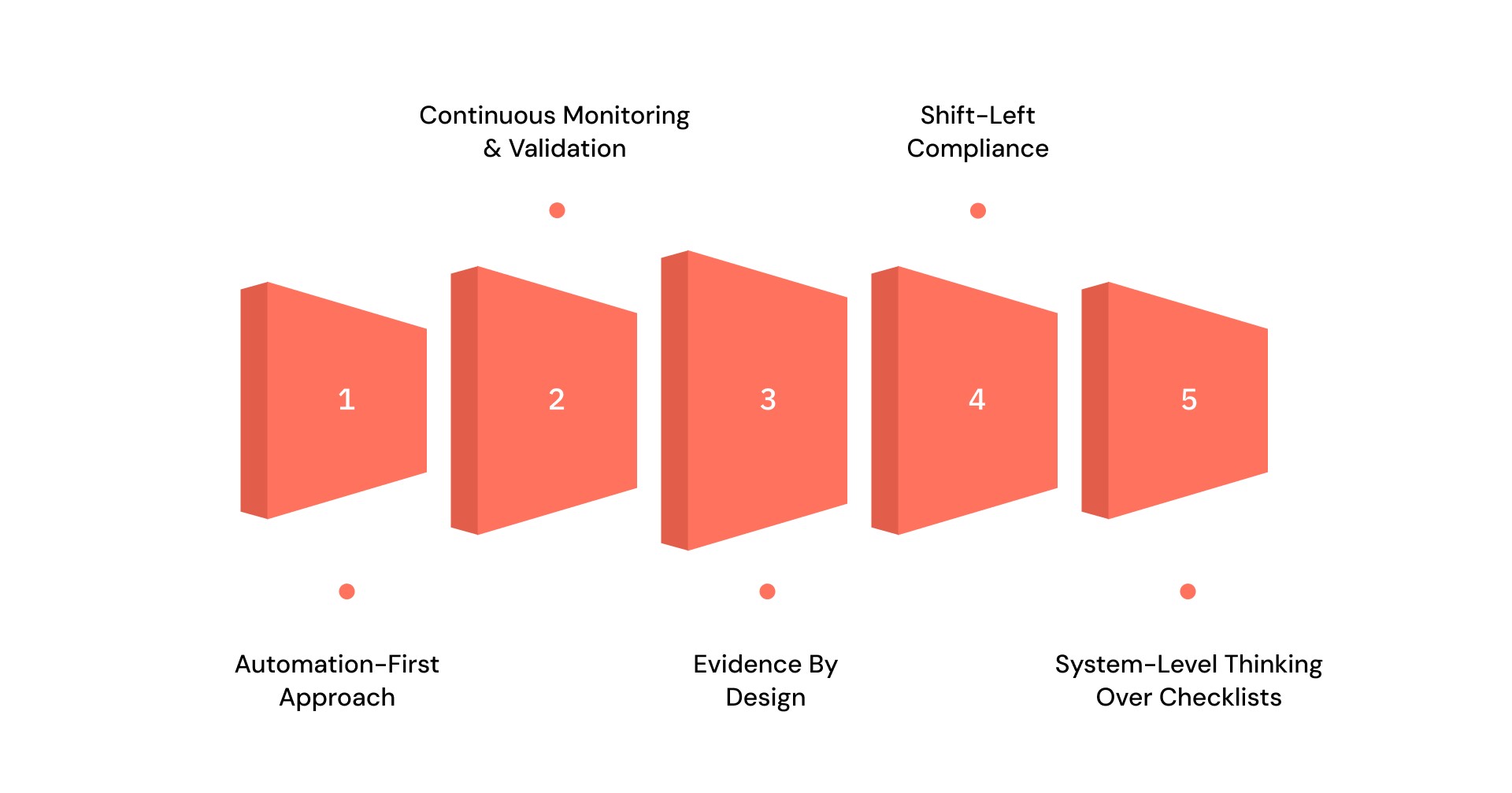
GRC engineering is built on principles that prioritize execution, visibility, and system integration over static documentation. These principles ensure that compliance processes remain scalable, consistent, and aligned with operational realities:
1. Automation-First Approach
Automation reduces reliance on manual processes, ensuring that controls are executed consistently across environments. By embedding automation into workflows, organizations can minimize human error, improve efficiency, and maintain uniform execution standards, particularly in high-volume or complex operational settings.
2. Continuous Monitoring and Validation
Continuous monitoring enables organizations to track and control performance in real time. This approach ensures that deviations are identified immediately, allowing for timely remediation. It also provides ongoing visibility into compliance status, supporting both operational oversight and audit readiness.
3. Evidence by Design
In GRC engineering, evidence is generated as part of execution rather than collected after the fact. Logs, approvals, and system outputs are automatically captured, creating a reliable audit trail. This design ensures that evidence is complete, accurate, and directly linked to control activities.
4. Shift-Left Compliance
Embedding compliance into the early stages of system and process design reduces the need for corrective actions later. By integrating controls into development pipelines and operational workflows, organizations can ensure that compliance requirements are addressed proactively rather than retroactively.
5. System-Level Thinking Over Checklists
GRC engineering moves beyond static checklists toward interconnected systems that manage control execution. This approach enables organizations to design control ecosystems that are adaptive, scalable, and capable of supporting continuous compliance across complex environments.
Also read: Risk Assessment
What GRC Engineering Looks Like in Practice
GRC engineering becomes tangible when controls are embedded into systems and workflows that operate continuously. Its effectiveness is reflected in how seamlessly compliance activities integrate with operational processes and how reliably they produce audit-ready outputs:
1. Automated Evidence Collection
Evidence is collected automatically through system integrations, reducing reliance on manual documentation. APIs, logs, and workflow outputs provide real-time records of control execution, improving accuracy and reducing audit preparation effort while ensuring that evidence reflects actual operational activity.
2. Policy-as-Code and Compliance-as-Code
Policies and controls are translated into machine-readable formats that can be enforced programmatically. This approach ensures consistent application across systems and reduces ambiguity in execution, enabling organizations to align compliance requirements with technical implementation.
3. Continuous Control Monitoring
Controls are monitored continuously to detect deviations and ensure consistent performance. Alerts and validation mechanisms provide immediate feedback, enabling organizations to address issues before they escalate and maintain alignment with compliance requirements.
4. Integrated Risk and Compliance Dashboards
Centralized dashboards provide visibility into control performance, risk exposure, and compliance status. These insights enable leadership to make informed decisions and prioritize remediation efforts based on real-time data rather than delayed reporting.
5. Event-Driven Remediation Workflows
When deviations occur, automated workflows trigger remediation actions, reducing response time and limiting risk exposure. This approach ensures that issues are addressed systematically and consistently, improving both operational efficiency and compliance outcomes.
GRC Engineering vs GRC Automation
GRC engineering is often misunderstood as an extension of automation, but the distinction is critical for effective implementation. While automation focuses on efficiency, GRC engineering emphasizes system design, execution integrity, and governance alignment:
1. Why Automation Alone Is Not GRC Engineering
Automation can streamline tasks, but without structured workflows and governance alignment, it does not ensure control effectiveness. Organizations that rely solely on automation often fail to address underlying process gaps, leading to inconsistent execution and limited audit defensibility.
2. GRC Engineering as a System, Not a Tool
GRC engineering requires designing systems that integrate workflows, ownership, and evidence capture. It goes beyond tools to establish how controls are executed, monitored, and validated across the organization, ensuring consistency and accountability at scale.
3. The Risk of Treating GRC Engineering as a Tool Purchase
Viewing GRC engineering as a tool acquisition rather than a system transformation leads to implementation failures. Without aligning processes, teams, and workflows, organizations may achieve partial automation but fail to improve control effectiveness or audit readiness.
Also read: Transforming Compliance Management: The Power of Automation with VComply
How to Build GRC Engineering Capabilities in Your Organization
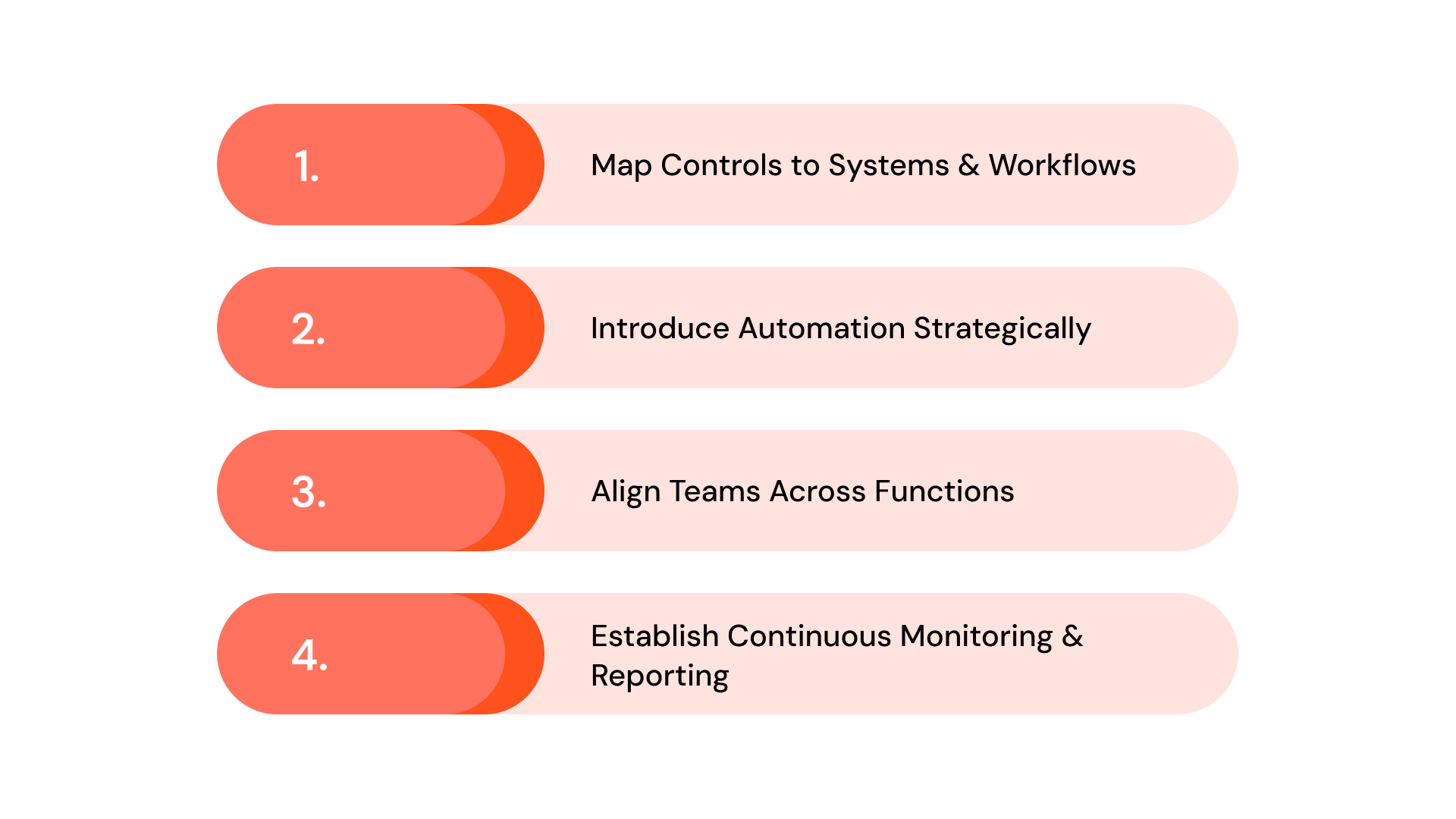
Building GRC engineering capabilities requires a structured approach that aligns controls with systems, workflows, and organizational processes. This transition involves rethinking how compliance is executed and monitored across the enterprise:
Step 1: Map Controls to Systems and Workflows
Controls must be translated from abstract requirements into executable actions within systems. This mapping ensures that compliance is embedded into daily operations and reduces reliance on manual interpretation.
Step 2: Introduce Automation Strategically
Automation should be applied to areas where it improves consistency and reduces manual effort without compromising oversight. A balanced approach ensures that critical decisions remain governed while repetitive tasks are streamlined.
Step 3: Align Teams Across Functions
Effective GRC engineering requires collaboration between IT, compliance, and risk teams. Shared workflows and responsibilities ensure consistent execution and reduce gaps caused by siloed operations.
Step 4: Establish Continuous Monitoring and Reporting
Continuous monitoring and structured reporting provide visibility into control performance. Metrics and dashboards enable organizations to track effectiveness, identify gaps, and support informed decision-making.
Mapping controls to workflows and aligning teams often exposes gaps in execution and ownership that are difficult to resolve with disconnected tools.
Start a 21-day free trial of VComply to explore how structured platforms can help standardize execution and maintain continuous oversight.
Common Pitfalls in GRC Engineering Adoption
Adopting GRC engineering without addressing structural and operational dependencies can lead to limited outcomes. These pitfalls often reduce effectiveness and create gaps that become visible during audits or incidents:
1. Over-Reliance on Tools Without Process Design
Focusing on tools without defining workflows leads to inconsistent execution and limited governance alignment, reducing the effectiveness of GRC initiatives.
2. Ignoring Human Workflow Dependencies
Failure to account for human involvement in workflows results in gaps in execution and coordination, affecting control reliability.

3. Incomplete Evidence Capture
Without structured evidence capture, organizations cannot validate control performance, weakening audit defensibility.
4. Lack of Ownership and Accountability
Unclear ownership leads to missed steps and inconsistent execution, increasing risk exposure and reducing oversight effectiveness.
Structuring GRC Engineering Execution for Consistent Governance
As organizations attempt to operationalize GRC engineering, execution often breaks down due to fragmented workflows, unclear ownership, and inconsistent evidence capture. Controls may be designed correctly, but without structured systems to enforce execution and track performance, organizations struggle to maintain consistency, demonstrate compliance, and sustain audit readiness at scale.
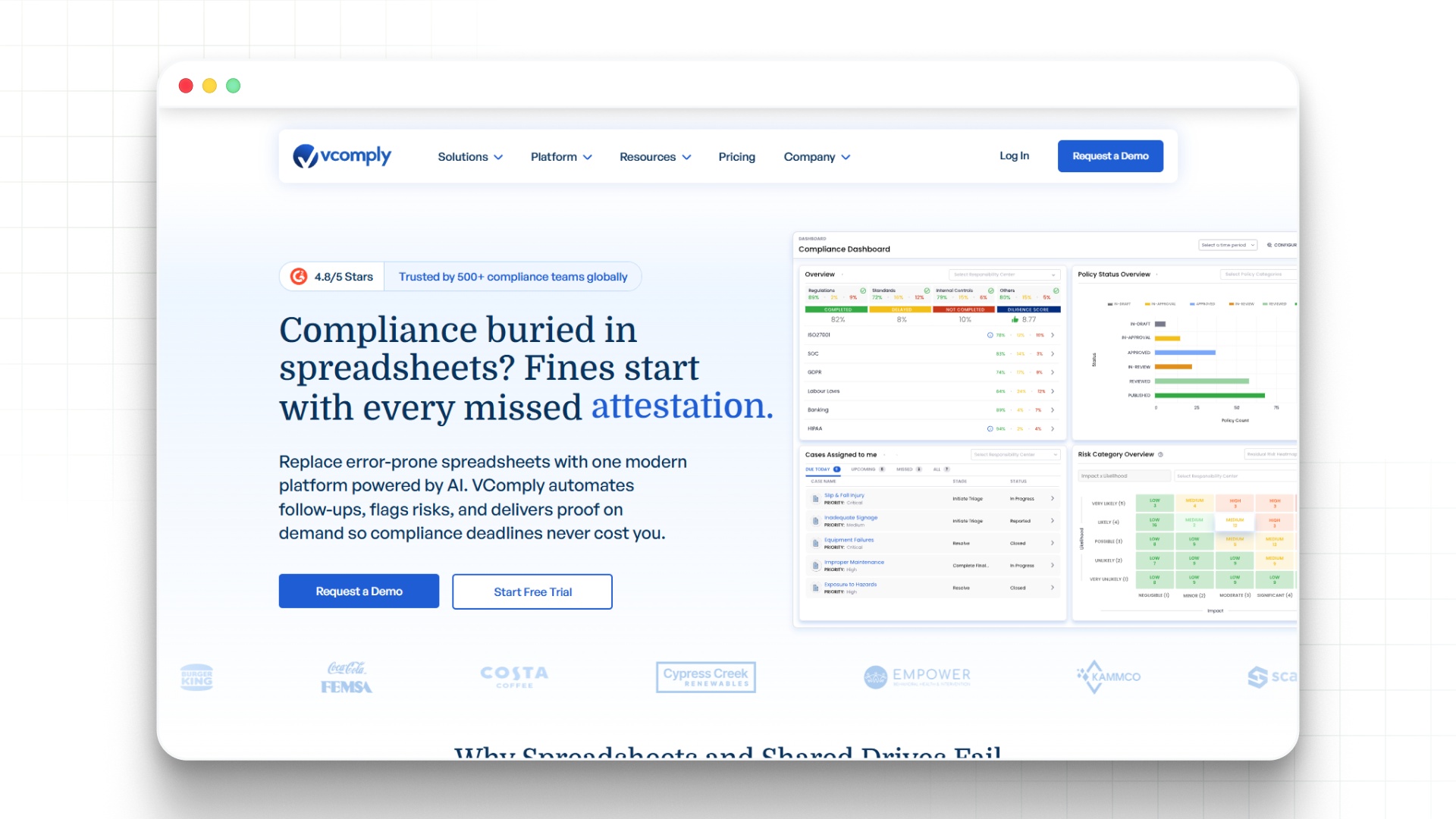
VComply’s GRCOps Suite enables this by integrating risk, compliance, and operational activities into a unified execution layer that supports continuous monitoring, accountability, and audit-ready evidence.
- Centralized control tracking with ownership mapping: Every control is assigned to a defined owner, with visibility into execution status, reducing ambiguity and missed responsibilities across teams
- Workflow-driven control execution: Step-by-step workflows ensure controls are performed consistently, with automated triggers, approvals, and escalations embedded into operational processes
- Real-time control performance visibility: Dashboards provide immediate insight into control status, exceptions, and completion rates, enabling faster decision-making and oversight
- Integrated evidence capture within workflows: Logs, approvals, and execution records are automatically captured and stored, creating a traceable audit trail without manual effort
- Alignment with regulatory frameworks and internal policies: Controls are mapped directly to regulatory requirements (e.g., NIST, SOC 2), ensuring that execution supports compliance objectives
Book a demo with VComply to evaluate how structured systems can standardize GRC engineering execution and strengthen governance visibility across your organization.
Conclusion
GRC engineering shifts governance from periodic validation to continuous, system-driven execution, where controls are embedded into workflows, and evidence is generated as a byproduct of operations.
Its value lies in closing the gap between defined requirements and actual performance, enabling organizations to maintain real-time visibility into risk, improve audit defensibility, and respond to regulatory expectations with consistency and clarity.
As control execution becomes more distributed and dependent on cross-functional coordination, manual processes and fragmented tools limit visibility and increase the risk of gaps under audit scrutiny.
VComply addresses this by structuring GRC engineering into integrated workflows that connect controls, ownership, and evidence in a single system, enabling consistent execution and continuous monitoring.
See how structured systems can help you operationalize GRC engineering and maintain audit-ready governance at scale. Start a 21-day free trial of VComply.
FAQs
GRC engineering is the practice of embedding governance, risk, and compliance controls into systems and workflows so that they are executed continuously rather than documented periodically.
It shifts compliance from manual tracking to system-driven execution, enabling organizations to maintain consistency, improve visibility into control performance, and generate audit-ready evidence as part of normal operations.
GRC automation focuses on streamlining individual tasks, while GRC engineering designs the entire system of control execution. It integrates workflows, ownership, and evidence generation into a cohesive structure.
Without this system-level approach, automation alone may improve efficiency but fail to ensure consistent execution, governance alignment, or audit defensibility across the organization.
GRC engineering requires a combination of compliance expertise, systems thinking, and technical understanding. Professionals must be able to map regulatory requirements to operational workflows, collaborate across engineering and compliance teams, and design processes that integrate automation, monitoring, and evidence capture.
This cross-functional capability ensures that controls are both executable and measurable.
While engineering support enhances scalability, organizations can begin implementing GRC engineering principles by structuring workflows, defining ownership, and improving evidence capture.
However, without technical integration, execution may remain partially manual, limiting the ability to achieve continuous monitoring, automated validation, and real-time visibility into control performance.
GRC engineering improves audit readiness by ensuring that evidence is generated continuously through workflows rather than collected retrospectively.
This approach provides complete, accurate, and traceable records of control execution, enabling organizations to demonstrate compliance more effectively and respond to audit requests without disruption or reliance on manual documentation.
VComply supports GRC engineering by structuring control execution within integrated workflows that connect risk, compliance, and operational activities.
It gives you centralized visibility, automated evidence capture, and clear accountability, so you can maintain consistent execution and show compliance with real-time, audit-ready outputs that align with governance requirements.