

How to Develop an Effective ESG Policy
In the United States, sustainability is now a core business and legal responsibility, not just an optional project. For leadership, the challenge is no longer just about making commitments; it is about proving those commitments through consistent, verifiable action.

Without a structured ESG policy, organizations often find that their sustainability goals remain disconnected from day-to-day operations. This misalignment can quickly lead to regulatory scrutiny and increased risk.
An effective policy bridges this gap. It provides the necessary governance framework to turn high-level strategy into measurable outcomes, ultimately helping you maintain institutional trust and secure long-term access to capital.
Key Takeaways
- Effective policies center on board accountability and internal controls, integrating environmental and social objectives directly into the enterprise risk framework.
- A successful policy avoids generic language, focusing instead on the specific material issues that impact the company’s financial performance.
- In 2026, regulators and investors prioritize verifiable data and third-party assurance over broad, qualitative statements.
- Static documents are insufficient. Modern ESG management requires real-time monitoring of key indicators to ensure continuous compliance.
What is an ESG Policy?
An ESG policy is a formal document that defines how an organization manages its impact on the environment, its social responsibilities, and its internal oversight. Rather than just a statement of intent, it serves as a central guide for managing non-financial risks and meeting regulatory expectations.
A clear policy sets specific standards across three areas:
- Environmental Standards: Defines the steps for tracking carbon emissions, managing waste, and using natural resources efficiently.
- Social Responsibility: Outlines rules for fair labor practices, workplace safety, and community engagement.
- Governance Rules: Sets requirements for executive accountability, internal audits, and transparency with shareholders.
When a company adopts this policy, it turns high-level goals into daily operating procedures. This ensures that every department, from procurement to legal, follows the same rules, which helps prevent compliance mistakes and protects the company’s reputation.

Why Every US Company Needs an ESG Policy in 2026
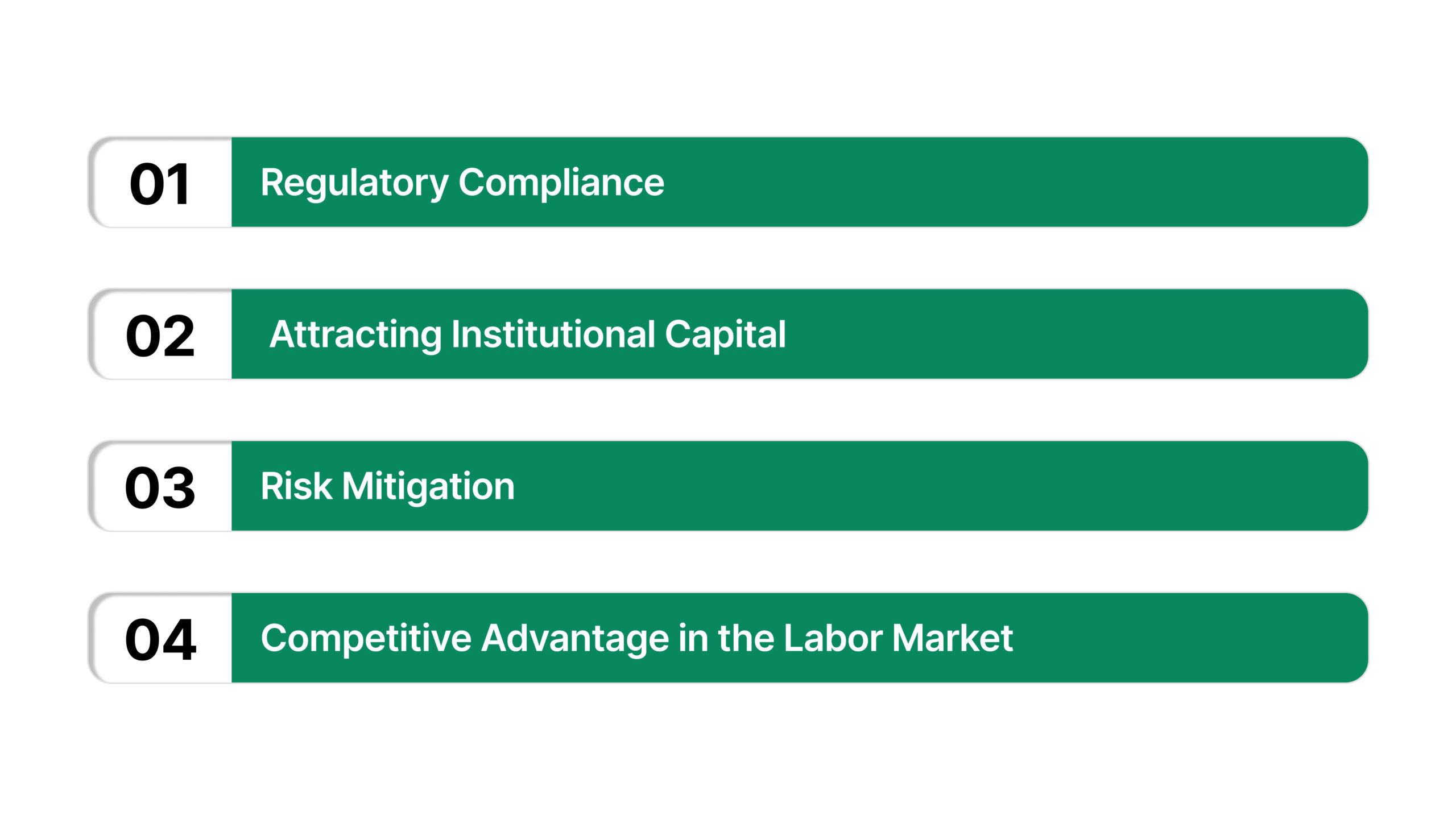
The shift toward formalized ESG oversight in the U.S. is driven by operational necessity rather than social preference. For leadership, a documented policy is now a tool for maintaining market access and managing hidden liabilities.
1. Regulatory Compliance
While the federal SEC climate disclosure rules have faced legal challenges, state-level regulations have filled the void. California’s Climate Corporate Data Accountability Act (SB 253) requires companies with over $1 billion in annual revenue that do business in the state to report their greenhouse gas emissions.
Additionally, SB 261 requires those with over $500 million in revenue to disclose climate-related financial risks. A documented ESG policy is the only way to ensure the data collection processes are in place to meet these deadlines.
2. Attracting Institutional Capital
Major asset managers now use ESG performance as a key indicator of management quality. Without a transparent policy, companies risk exclusion from significant investment portfolios. Investors increasingly view these disclosures as a way to gauge a company’s long-term resilience and risk profile.
3. Risk Mitigation
A policy uncovers risks that traditional financial statements often overlook. This includes supply chain vulnerabilities due to climate events, legal exposure from labor practices, and the reputational fallout of governance failures. Having a framework in place allows for proactive mitigation rather than reactive crisis management.
4. Competitive Advantage in the Labor Market
The current workforce prioritizes employers that demonstrate clear ethical standards and accountability. A documented commitment to social and governance goals helps attract specialized talent, which reduces long-term recruitment costs and supports a stable internal culture.
Also Read: The Role of Regulatory Audits in Different Sectors
Translating these drivers into a functional document requires a focus on specific, measurable components.
What Should Your ESG Policy Include?
An effective policy is structured around three primary pillars. To be useful for a business, each section must move beyond general statements and include specific goals and metrics.
The Environmental Pillar
This section outlines how the organization manages its physical footprint and climate-related risks.
- Greenhouse Gas (GHG) Emissions: Detailed plans for measuring and reducing Scope 1 (direct), Scope 2 (purchased energy), and Scope 3 (value chain) emissions.
- Energy Management: Commitments to transitioning to renewable energy sources and improving energy efficiency across facilities.
- Waste and Water Stewardship: Strategies for reducing physical waste, increasing recycling rates, and managing water consumption in high-stress areas.
- Climate Risk Adaptation: Procedures for assessing how extreme weather events might impact physical assets and operations.
The Social Pillar
This area focuses on the human element, ensuring the company maintains ethical relationships with employees, suppliers, and customers.
- Diversity, Equity, and Inclusion (DEI): Formal targets for representation at all levels of the organization and programs to ensure equitable pay.
- Labor Standards and Safety: Strict guidelines for workplace safety, fair wages, and the protection of human rights within the supply chain.
- Customer Privacy and Data Security: Rules for the ethical handling of customer data, which is now a critical social governance issue.
- Community Engagement: Programs that align the company’s philanthropic efforts with its core business values.
The Governance Pillar
This section establishes the internal controls that ensure the policy is actually followed.
- Board Composition and Oversight: Defining which committees are responsible for monitoring ESG risks and progress.
- Ethics and Anti-Corruption: A code of conduct that prohibits bribery, fraud, and unethical political lobbying.
- Executive Compensation: Linking bonuses and long-term incentives to the achievement of ESG targets.
- Transparency and Reporting: A commitment to using recognized frameworks like the GRI (Global Reporting Initiative) or the ISSB (International Sustainability Standards Board) for public disclosures.
Suggested Read: Understanding Policy Definition and the Difference Between Procedures and Guidelines
To move from documentation to implementation, follow this structured process to embed these ESG standards across your organization.
How to Develop an Effective ESG Policy?
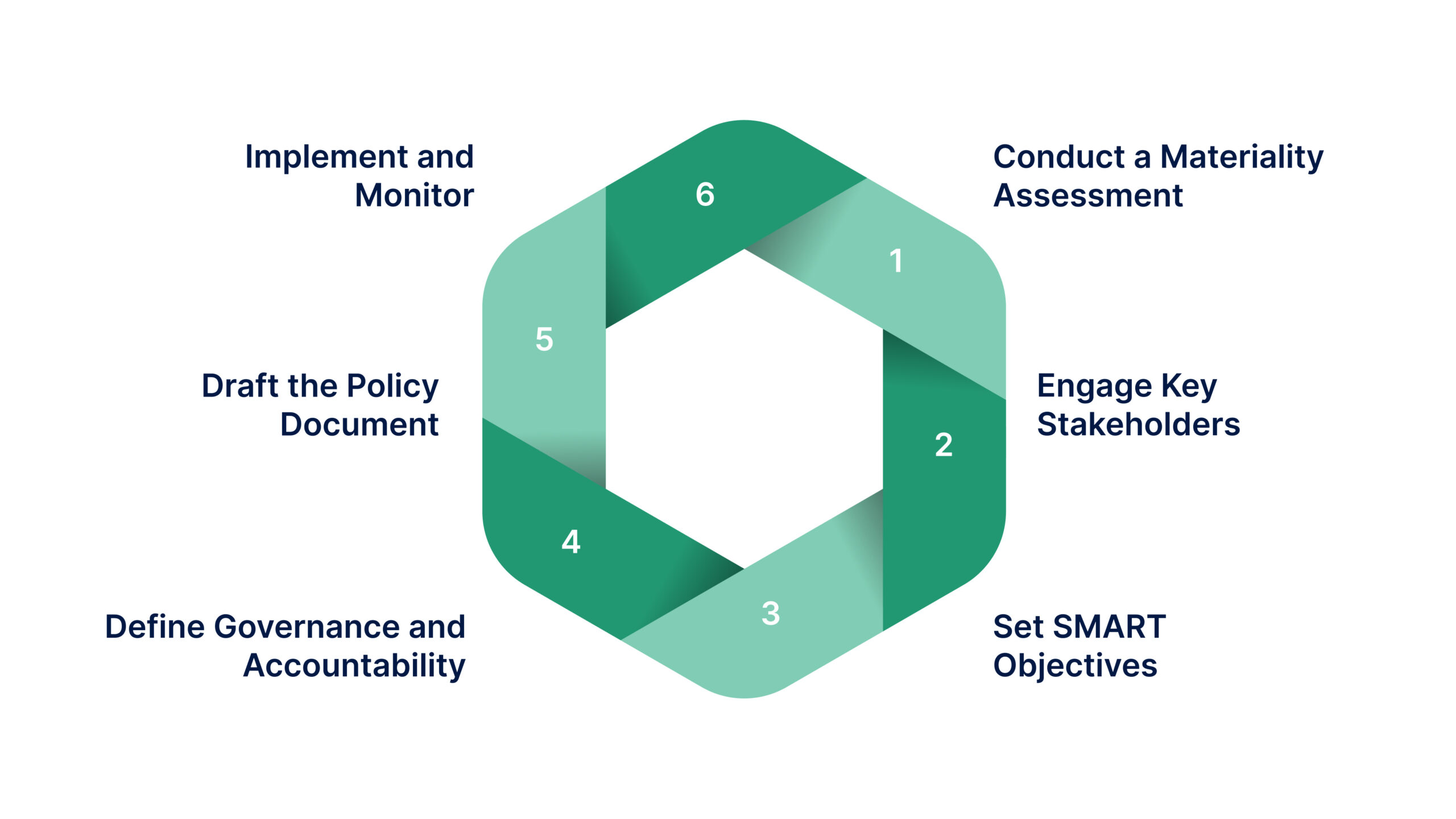
Developing an ESG policy is an iterative process. It requires aligning high-level goals with cross-functional operational capabilities. Follow these steps to build a document that is both strategically sound and executable.
Step 1: Conduct a Materiality Assessment
Focus your resources on the issues that directly impact your business’s financial performance and stakeholder decisions. For example, a software firm may prioritize data privacy and energy-efficient infrastructure, while a manufacturer must focus on waste management and supply chain safety.
Step 2: Engage Key Stakeholders
Gather input from the groups that drive your business to ensure the policy reflects operational reality:
- Investors: Identify which metrics influence their risk assessments.
- Customers: Determine which environmental or social standards impact their purchasing decisions.
- Suppliers: Evaluate their capacity to meet your proposed standards.
Step 3: Set SMART Objectives
Avoid vague language. Every commitment in your ESG policy should be Specific, Measurable, Achievable, Relevant, and Time-bound.
- Ineffective: “We aim to reduce our carbon footprint.”
- Effective: “We will reduce our Scope 1 and 2 emissions by 30% by 2030, compared to a 2024 baseline.”
Step 4: Define Governance and Accountability
Assign clear ownership for each part of the policy. If the “Social” pillar is the responsibility of HR, ensure they have the budget and authority to implement changes. Establish a direct reporting line to a specific board committee, such as the Nominating and Governance Committee, to ensure high-level oversight.
Step 5: Draft the Policy Document
Write the policy in clear, professional US English. Use tables to display metrics and KPIs for better scannability. Ensure the document explicitly mentions compliance with relevant laws like California’s SB 253 or federal EEOC standards.
Step 6: Implement and Monitor
A policy is only useful if it is executed. Integrate the policy into daily workflows through training and digital tools. Use a centralized platform to collect data and monitor progress against your KPIs in real-time.
Moving from manual tracking to a structured system helps maintain the integrity of your ESG data. Explore how PolicyOps provides the structure required to manage your policy lifecycle and evidence collection.
Even with a structured plan, specific operational hurdles can often slow the adoption of a new ESG policy.
What are the Common Challenges in ESG Policy Implementation?
The primary obstacle to a successful ESG policy is not the drafting process itself, but integrating the policy into a fragmented operational environment. Without addressing these structural gaps, organizations remain exposed to regulatory risk and internal inefficiencies.
- Fragmented Data Systems: ESG metrics often live in disconnected systems. Social data resides in HR, governance data in Finance, and environmental data in Facilities. This fragmentation prevents a unified view, making it difficult to produce accurate, auditable reports.
- Misleading Sustainability Claims: There is significant legal exposure when sustainability claims cannot be verified by hard data. Regulators now treat deceptive environmental promises as serious compliance failures rather than marketing oversights.
- Lack of Executive Buy-in: When leadership treats ESG as a secondary reporting task rather than a core strategic element, the policy lacks the necessary budget and authority to change daily operations.
- Supply Chain Complexity: Measuring value chain emissions (Scope 3) requires cooperation from third-party suppliers, many of whom lack their own tracking systems. Managing this complexity without standardized vendor reporting creates significant blind spots in climate risk assessments.
Closing these operational gaps requires moving beyond spreadsheets and fragmented reporting. Modern compliance software automates data collection across departments, transforming disconnected metrics into a unified, real-time reporting stream.
How Can PolicyOps Manage Your ESG Governance?
Building an ESG policy is only the first step. To ensure the policy actually works, you need a way to link your written goals to daily actions. VComply’s PolicyOps provides the structure required to turn high-level commitments into clear, trackable tasks.
- Centralized Policy Library: Keep all your ESG documents in one secure location. This ensures every team member works from the current, approved version rather than outdated drafts.
- Evidence Tracking: Link your policy goals directly to the proof required for audits. If you claim a 30% reduction in waste, the platform stores the specific data logs that prove you met that target.
- Clear Task Ownership: Assign policy responsibilities to specific departments, such as HR for diversity goals or Facilities for energy use. This removes confusion about who is responsible for each metric.
- Real-time Oversight: Use live dashboards to see how well the company follows the policy. You can quickly spot missing data or overdue tasks before they become a compliance risk.
By organizing your policy in a centralized system, you ensure that every sustainability goal is backed by the data and ownership required for true accountability.

Final Thoughts
An effective ESG policy is a central component of modern corporate strategy. By documenting how your organization meets its environmental and social obligations, you protect the business against regulatory shifts and ensure ongoing access to institutional capital.
Success in this area requires moving beyond general goals to focus on data collection and clear accountability. As the expectations of investors and regulators continue to rise, the organizations that succeed will be those that treat their ESG commitments with the same discipline as their financial reporting.
Integrating these standards into your daily operations ensures that your sustainability goals remain measurable, verifiable, and aligned with your broader business objectives.
Book a demo to see how PolicyOps helps you build a structured approach to your policy management.
Frequently Asked Questions (FAQs)
Technically, no federal law mandates a general ESG policy for all private companies. However, if a private company has a certain level of revenue and does business in California, it must comply with state climate disclosure laws.
Furthermore, many large public companies now require their private suppliers to have an ESG policy in place as a condition of doing business.
CSR is often seen as a qualitative, values-driven approach to social issues, focused on philanthropy and reputation. An ESG policy is a quantitative, risk-based framework that treats environmental and social issues as material financial factors. ESG is about data, governance, and integration into the core business strategy.
While all three pillars are critical, Governance is often considered the most important because it provides the structure for the other two. Without strong governance, meaning board oversight, internal controls, and accountability, the environmental and social commitments are unlikely to be achieved or accurately reported.
The best way to prevent deceptive claims is to ensure that every statement in your policy is backed by verifiable data. Use a platform like VComply to maintain an “audit-ready” trail of evidence for every KPI. Avoid using broad, superlative language and stick to measurable facts.
It should be a collaborative effort led by a cross-functional committee. This typically includes the Chief Sustainability Officer (CSO), Chief Financial Officer (CFO), General Counsel, and Head of HR, with ultimate oversight provided by the Board of Directors.