

Data Breach Trends in 2026: What They Reveal About Risk, Controls, and Oversight
Data breach trends are not useful because they add more incident headlines. They are useful when they show where breach pressure is repeatedly finding weak controls, exposed systems, and delayed accountability.
IBM’s 2026 X-Force Threat Intelligence Index reports a 44% year-over-year increase in the exploitation of public-facing applications, with vulnerability exploitation driving 56% of critical infrastructure incidents.
In regulated environments, those patterns should prompt security, compliance, and oversight teams to re-examine control assumptions, review priorities, and incident accountability before scrutiny forces the issue.
Before you can act on breach patterns, you need a practical view of what data breach trends actually refer to.
TL;DR
Data breach trends matter when they change what your teams review, escalate, and carry forward into oversight.
- The most important patterns are those that reveal recurring weaknesses in access, third-party exposure, response discipline, and accountability.
- Regulated teams should read breach trends as review signals, not just incident reporting, especially when the same weaknesses keep surfacing across environments.
- Not every trend deserves the same weight. The real question is which patterns intersect most directly with your regulated data, operational dependencies, and business exposure.
- Trend awareness has limited value if it does not lead to sharper control reassessment, clearer escalation, and stronger traceability across incidents and risks.
- When breach-related review, follow-up, and accountability begin to span multiple teams and workflows, a more connected oversight model becomes necessary.
What Are Data Breach Trends?
Data breach trends are recurring patterns you see in how breaches happen, where they occur, which data or systems are affected, and which weaknesses keep surfacing across incidents. The key point is that trends are not about one breach in isolation.
They are about what repeated breach activity shows over time. That can include common attack paths, the types of information being exposed, the sectors facing sustained pressure, or the breakdown points that keep appearing across different environments.

Why Trend Analysis Matters Beyond Headlines
That broader view matters because trend analysis helps you separate isolated incidents from recurring patterns that deserve closer attention. It gives you a better way to understand where exposure is clustering, what kinds of failures are repeating, and which parts of the environment may need closer review.
The next question is which breach patterns regulated teams should actually be watching now.
The Data Breach Trends Regulated Teams Should Watch in 2026
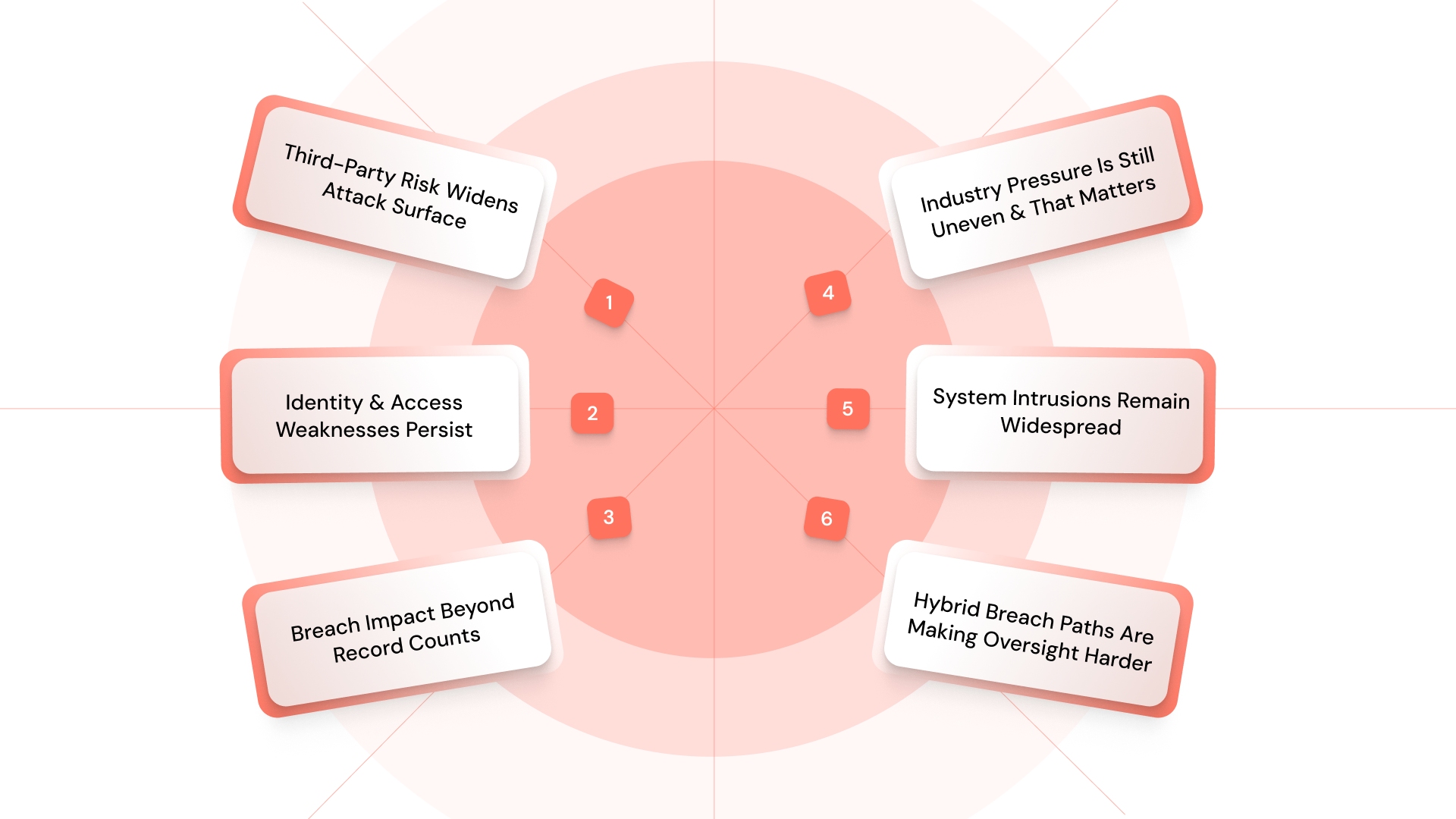
This is the part of the story that matters most: not just that breaches continue, but which patterns keep repeating, where exposure is clustering, and what those patterns say about weak points in oversight. The signals below matter because they are showing up across current reporting, not as isolated anomalies.
1. Third-Party Exposure Is Still Expanding the Breach Surface
Third-party relationships continue to widen breach exposure because critical workflows often depend on vendors, software providers, cloud services, and external platforms that sit outside direct day-to-day control.
That matters more in regulated environments, where the question is not only whether a third party was involved, but whether the organization can clearly validate what was exposed, who was responsible, and what oversight existed around that dependency.
The pattern is less about a single vendor failure and more about how quickly external dependencies become oversight blind spots.
2. Identity and Access Weaknesses Are Still Central
IBM X-Force 2026 reports a 44% year-over-year increase in attacks that began with the exploitation of public-facing applications, and says missing authentication controls were a major driver.
That keeps identity, access, and credential misuse close to the center of current breach narratives.
For regulated teams, this is a signal that breach pressure is still finding repeat weaknesses around access exposure, privileged permissions, and weak authentication discipline, not only exotic attack paths.
3. Breach Impact Is Being Measured Beyond Record Counts
IBM’s Cost of a Data Breach Report places the global average breach cost at USD 4.44 million. That number matters because it shifts the conversation away from breach counts alone and toward disruption, containment, recovery, and downstream business strain. In other words, the trend is not just more awareness of incidents.
There is a broader recognition that breach impact includes operational drag, leadership pressure, and follow-on governance consequences.
4. Industry Pressure Is Still Uneven and That Matters
Industry targeting still warrants close attention because breach pressure is not evenly distributed. In the Verizon DBIR Executive Summary, sector snapshots repeatedly show a concentration around a small set of attack patterns.
In financial services, system intrusions, social engineering, and basic web application attacks accounted for 74% of breaches.
In utilities, those same three patterns represented 92% of breaches. In transportation, they represented 91% of breaches.
That consistency matters because it shows that sector pressure is often tied to repeat operating conditions, data types, and dependency structures, not random chance.
5. System Intrusion Keeps Showing Up Across Sectors
One of the clearest takeaways from the Verizon DBIR is how often a small set of breach patterns keeps surfacing. Across multiple industries and regions, system intrusion, social engineering, and basic web application attacks continue to dominate the picture.
This matters because it suggests that, even as the threat environment evolves, many breach paths continue to exploit familiar weaknesses rather than entirely new categories of failure.
For leadership teams, that is a sign that recurring fundamentals still deserve more scrutiny than one-off incident narratives.
6. Hybrid Breach Paths Are Making Oversight Harder
Breach paths are becoming harder to separate neatly. A single event may involve exposed applications, weak authentication, third-party dependencies, and delayed response activity in the same chain.
That makes oversight more complex because the question is no longer just where the breach started, but how many weak points it moved through before anyone could contain it.
The more those paths converge, the harder it becomes to rely on siloed reviews or isolated incident explanations.
Watching the trends is only useful if they change how you assess risk and control priorities.
What These Data Breach Trends Mean for Risk and Control Decisions
The value of breach trends lies in how they change your review focus, not in how often they are discussed.
Breach Trends Should Change What You Review First
Once a pattern starts repeating across current breach reporting, it should influence your review focus. That does not mean reacting to every headline about an incident. It means looking harder at the areas under the most visible pressure.
In many regulated environments, that usually means closer attention to:
- Access controls
- Third-party oversight
- Detection gaps
- Response dependencies
What matters is whether those signals actually shift where scrutiny begins.
Not Every Trend Deserves the Same Weight
Not every breach pattern should carry the same level of concern. Its importance depends on:
- The kind of regulated data you hold
- How dependent operations are on certain systems
- Where outside parties sit in your environment
- What would the business impact be if that weakness were exploited
The same trend can mean very different things in different operating contexts. What matters is not how visible the trend is in the market, but how closely it intersects with your actual exposure.
Visibility Without Review Adjustment Creates False Confidence
This is where many teams stop too early. They track breach trends, discuss them, and circulate reporting, but do not let those patterns change review priorities or control assumptions.
That creates false confidence because:
- Visibility is not the same as preparedness
- Awareness does not reduce exposure by itself
- Trend reporting has little value if nothing changes afterward
A trend starts to matter when it changes what your teams no longer treat as routine.
Also read: What Are Security Controls? A Full Breakdown for Robust GRC.
Where Organizations Still Break Down in Breach Readiness
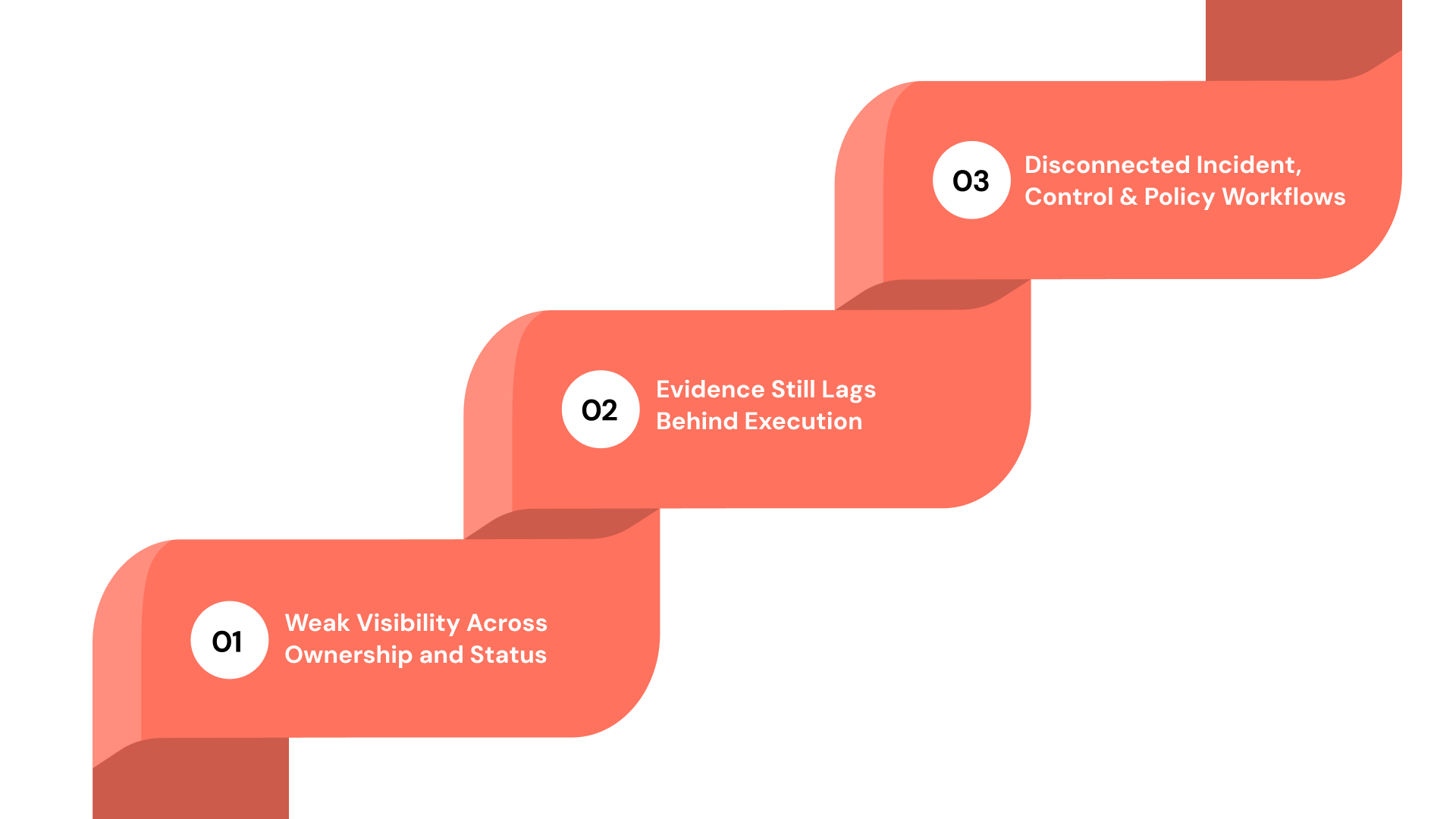
Many teams lose ground when the work has to move from discussion into execution. They can see the patterns, talk about the exposure, and even adjust priorities on paper, but breach readiness still weakens when execution stays fragmented.
Weak Visibility Across Ownership and Status
One of the most common breakdowns is simple but costly: nobody has a clean, current view of who owns what and where things stand. Responsibility may be assigned at a broad level, yet the status of specific actions still feels unclear.
That usually shows up as:
- Incomplete status visibility
- Overdue actions that sit too long
- Unresolved items that are harder to trace than they should be
- Leadership reporting that feels assembled rather than trusted
At that point, the problem is not only a delay. It is the lack of a status view that people can rely on. You may know that work is moving somewhere, but not whether the right actions are complete, pending, or quietly stuck.
Evidence Still Lags Behind Execution
Readiness also breaks down when teams cannot clearly show what happened, when it happened, and who carried it out. The work may have been done, but the proof often appears too late, in fragments, or only after someone asks for it.
That weakens readiness in three ways:
- Timelines become harder to verify
- Accountability becomes harder to trace
- Confidence in the response drops faster than it should
In breach-related scenarios, delayed evidence creates unnecessary friction because teams end up reconstructing activity after the fact rather than showing it as part of normal execution.
Incident, Control, and Policy Workflows Stay Too Disconnected
Another recurring issue is that incidents are handled in one lane, controls are reviewed in another, and policy implications are addressed elsewhere entirely. The immediate issue may get addressed, but the surrounding oversight does not always move with it.
That often means:
- Incident learnings do not feed back into the control review
- Control gaps do not always trigger policy attention
- Teams resolve the event without improving the discipline around it
This is where breach readiness becomes harder to trust. The response may look active in the moment, but the organization does not always carry the lesson forward into the wider control environment.
That is where breach trend analysis stops being a reporting exercise and becomes a response-design problem.
How Regulated Teams Should Respond to Data Breach Trends
When breach trends start affecting your priorities, the next step is turning that signal into a more disciplined response. Stronger teams do not stop at awareness. They use those patterns to tighten decision-making, clarify follow-through, and make sure incident activity leads to meaningful review.
Reassess Controls Linked to Current Breach Patterns
The first step is to revisit the controls most exposed by current breach pressure. That often includes areas tied to:
- Access review
- Vendor oversight
- Escalation readiness
- Evidence readiness
- Links between incidents and control review
The goal is not to reopen everything at once. It is to ensure the controls most exposed by current patterns are reviewed with sufficient structure and attention.
Also read: Performing a Cybersecurity Gap Analysis.
Tighten Incident Accountability and Escalation Paths
A stronger response also depends on clearer movement once an issue is recognized. Breach-related follow-through weakens quickly when action ownership is unclear or when escalation relies too heavily on informal coordination.
That is why stronger teams make sure:
- Actions are assigned clearly
- Escalation paths are defined in advance
- Follow-through does not stall between teams
The benefit is not only speed. It is a more consistent movement from issue recognition to accountable action.
Improve Traceability Between Risk, Controls, and Incidents
Response quality improves when incidents do not remain isolated from the wider control environment. Teams need a clearer line between what happened, what control area it affects, and what that means for current risk decisions.
In practice, that means treating traceability as part of the response:
- Incident outcomes should inform control review
- Control gaps should influence risk decisions
- Emerging risk signals should affect what gets reviewed next
That gives the organization a better chance of learning from the event rather than just closing it.
Also read: Understanding What Is Incident Response: Definition, Plan, and Process.

Anchor Response in Recognized Frameworks and Oversight Expectations
Response also needs a stable structure. If reassessment and follow-up vary too widely by team or situation, the quality of the response becomes harder to explain and sustain. Recognized structures such as NIST help create a more consistent basis for reassessment, incident handling, and oversight.
The value is consistency. Teams need a response structure that they can apply the same way across review cycles, incidents, and oversight discussions.
As breach-related oversight becomes more cross-functional, the next challenge is to keep that response connected across teams and workflows.
For teams formalizing breach response expectations, a data security breach reporting and response policy template can help turn incident handling into a clearer, more repeatable process.
Turn Breach Trend Response Into A More Structured Oversight Model With VComply
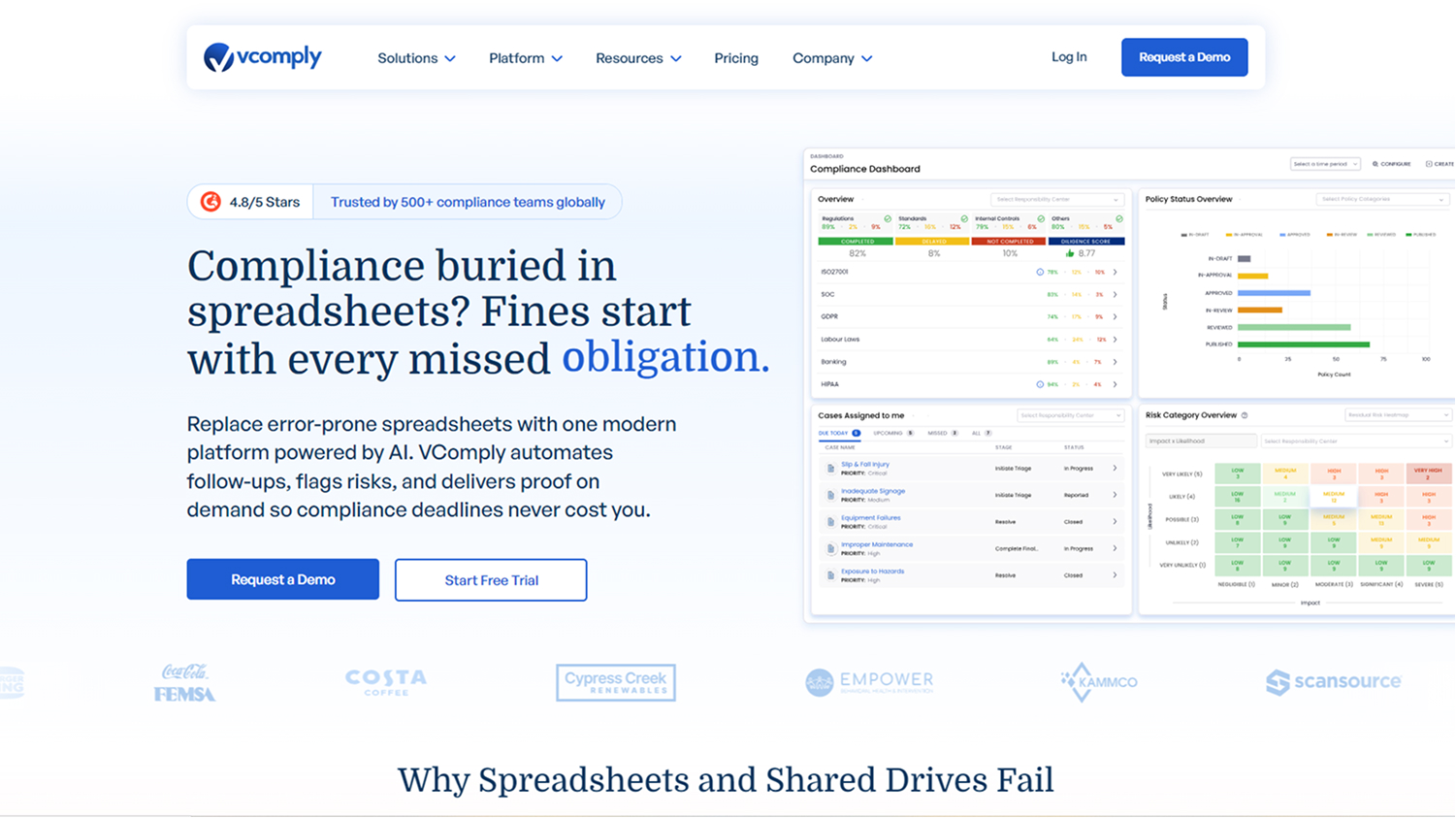
Once breach-related response starts moving across multiple teams, review layers, and follow-up paths, the harder problem is keeping that activity connected without losing status visibility or continuity. This is where VComply becomes useful.
Through its GRCOps Suite, VComply helps regulated teams consolidate breach-related oversight, follow-up, and governance review into a single connected structure.
Instead of tracking incident-related actions, control follow-up, accountability, and governance review across disconnected records, teams can work from a single view of how those activities connect.
In practice, that helps teams:
- Connect incident-related activity to broader governance workflows
- Keep accountability clearer as follow-up moves across teams
- Maintain better visibility into status, ownership, and related oversight actions
- Keep risk, compliance, and operational review aligned as issues move forward
- Carry breach-related follow-through forward instead of letting it end with the incident itself
That matters because breach trends rarely stay confined to one team or workflow. They affect incident oversight, control review, leadership visibility, and the quality of follow-through across the wider environment.
VComply helps keep those moving parts connected, making breach-related oversight easier to track, carry forward, and less likely to fragment as complexity grows.
Schedule a demo to see how VComply’s GRCOps Suite helps regulated teams keep breach-related oversight connected, review-ready, and easier to manage at scale.
Conclusion
Data breach trends matter most when they change what your organization reviews more closely and what it refuses to leave unaddressed. Regulated teams need more than awareness of what is happening in the market they need to decide what warrants closer review, what requires stronger follow-through, and where breach patterns should prompt sharper control action.
That is the real test of whether trend analysis is doing useful work. If the signal stays at the reporting level, very little changes. If it translates into clearer priorities, better-connected oversight, and more disciplined response, it becomes far more valuable.
Start a 21-day free trial and see how VComply’s GRCOps Suite brings more structure to breach-related oversight in practice.
FAQs
No. They overlap, but they are not identical. Cybersecurity trends cover the broader threat environment, while data breach trends focus more specifically on recurring patterns in unauthorized access, exposure, and breach impact.
Regulated and data-intensive sectors usually face greater pressure, especially when operations depend on sensitive information, critical systems, or multiple external relationships. The exact pattern varies by sector, but the pressure is rarely evenly distributed.
Many environments still share similar weak points around access exposure, external dependencies, operational complexity, and inconsistent follow-through. The methods may evolve, but the same structural weaknesses often remain exploitable.
That usually includes security, risk, compliance, audit, legal, and executive oversight where needed. Breach trends are more useful when reviewed across functions rather than left within a single team.
It becomes easier when review activity, ownership, incident follow-up, and related governance actions are tracked together. Platforms like VComply can help support that kind of connected oversight without relying on fragmented records.