

Corporate Risk Management: How Organizations Control Enterprise Risk
Have you ever been blindsided by something that should have been obvious, like a risky contract clause or a product recall that derails a quarter’s revenue? These moments are more common than leaders admit. Corporate life is full of hidden risks that go unnoticed until the damage is done.

That’s why corporate risk management matters. It shifts risk from a checkbox exercise to a practical lens you use to spot problems early and act before they escalate. This is especially critical as new threats emerge. In the U.S., 72% of S&P 500 companies now disclose AI-related risks in their annual filings, up from just 12% two years ago. The message is clear.
Even the biggest organizations can be caught off guard without active risk management. In this blog, you’ll see why corporate risk management is essential and how you can build strategies that protect value and strengthen resilience.
Key Takeaways
- Effective risk management anticipates and mitigates threats before they impact strategic goals.
- Strong governance and clear ownership ensure accountability and alignment across leadership, risk, and business teams.
- Integrating risk, compliance, and operational practices with VComply breaks down silos, enhances collaboration, and ensures consistent controls.
- Continuous monitoring and real-time visibility enable faster detection of emerging issues and more resilient responses.
- Scalable programs embed risk awareness, support ongoing improvement, and strengthen compliance, resilience, and stakeholder confidence.
Did you know?
Only about 11% of senior finance leaders say their organization’s risk management process delivers a strategic advantage, and just 32 % rate their overall risk oversight as “mature” or “strong”. This gap persists even as the volume and complexity of corporate risks continue to rise, underscoring why strong corporate risk management is mission-critical for modern organizations.
What Is Corporate Risk Management And Why Does It Matter for Modern Organizations
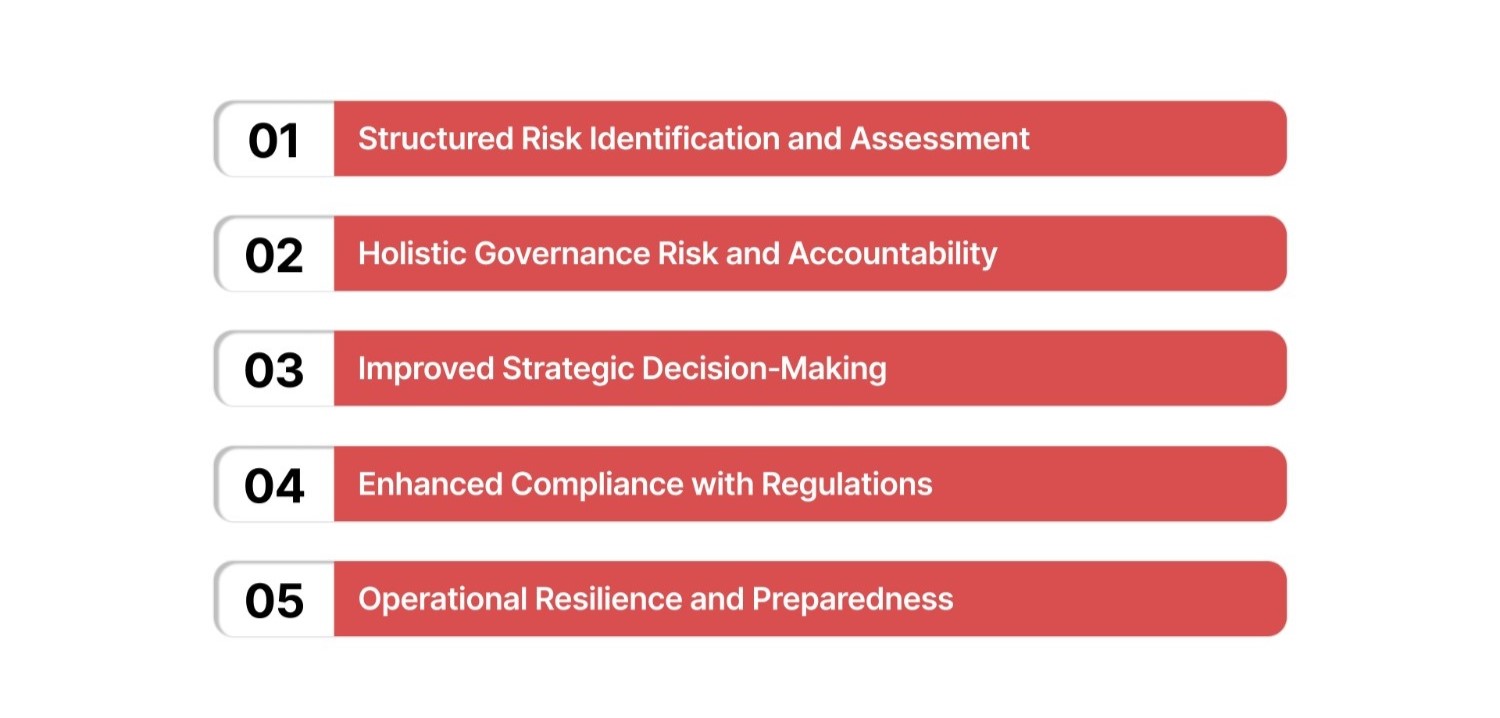
Corporate risk management is a structured, enterprise-wide approach to identifying, assessing, and mitigating risks that could affect business goals. Unlike ad-hoc methods, it embeds risk awareness into strategy, operations, and governance, enabling proactive protection of organizational value.
Below are the core elements that explain its importance for regulated and complex industries:
- Structured Risk Identification and Assessment: Enables you to methodically identify risks across all functions and evaluate their potential impact on objectives, from operational continuity to compliance obligations.
- Holistic Governance Risk and Accountability: Encourages alignment between leadership, risk teams, and departments so responsibilities are clearly defined, and oversight is consistent rather than fragmented.
- Improved Strategic Decision‑Making: By elevating risk insights into decision processes, executives can balance opportunity with exposure, making informed choices that support growth and resilience.
- Enhanced Compliance with Regulations: A formal risk management approach supports documentation and controls required by industry regulators, reducing legal exposure and penalties.
- Operational Resilience and Preparedness: With risks mapped and monitored, your organization can respond quickly to disruption, be it a supply chain issue, cyber threat, or regulatory change.
Also Read: How to Develop Corporate Governance Policies
Once the value of corporate risk management is established, the next step is understanding how it directly strengthens compliance efforts across the organization.

6 Ways To Improve Compliance Management Effectively Through Corporate Risk Management
A strong corporate risk program goes beyond identifying threats; it turns reactive controls into proactive safeguards. Integrating risk and compliance helps anticipate regulatory changes, reduce violations, and embed accountability into daily operations, improving resource use, reporting consistency, and governance effectiveness.
Below are six practical approaches that link corporate risk management with stronger compliance outcomes:
- Align Risk Assessments with Regulations: Incorporate industry rules into risk processes so compliance obligations are prioritized where non-compliance has the greatest impact.
- Standardize Controls Across Teams: Consistent frameworks prevent gaps across departments and locations, simplify audits, and support enterprise-wide compliance evidence.
- Assign Clear Ownership: Document accountability for each compliance obligation and mitigation task to reduce ambiguity and enable decisive action.
- Automate Monitoring and Evidence Collection: Continuously track regulatory changes, flag deviations, and capture audit trails to free teams for strategic insights.
- Enable Real-Time Leadership Visibility: Dashboards showing compliance status and risk trends help executives act before issues escalate.
- Continuously Review Controls: Regularly update risk controls as regulations and business environments change to maintain resilient, audit-ready compliance.
Below are the industry‑specific reasons risk management matters across regulated environments:
- Healthcare: Protects patient safety, data privacy, and clinical quality, supporting HIPAA compliance and proactive issue identification.
- Financial Services: Manages credit, market, and compliance risks, enabling regulatory reporting, fraud detection, and stability under strict financial standards.
- Manufacturing: Reduces supply chain, quality, and safety risks, preventing equipment failures, recalls, and operational disruptions.
- Energy and Utilities: Ensures environmental, safety, and operational compliance, preparing for outages or infrastructure failures.
- Higher Education: Safeguards student and research data, ensures grant and regulatory compliance, and reinforces transparency and accountability.
Many compliance programs fail not because controls don’t exist, but because they’re hard to track, update, and prove. VComply ComplianceOps automates regulatory tracking, control mapping, and evidence collection, so compliance teams spend less time chasing documentation and more time maintaining audit-ready confidence across the organization.
To manage risk effectively across these sectors, organizations must first recognize the different types of risks corporate risk management is designed to address.
The Main Types Of Corporate Risks Organizations Must Manage
Understanding the different categories of risk your organization faces is essential before you can build effective mitigation strategies. Corporate risk management programs typically group risks into broad types that influence decision‑making, performance, and resilience across functions.
The table below includes practical examples directly relevant to regulated U.S. industries:
| Risk Category | What It Is | Example (Regulated Industries) |
| Strategic Risk | Risks that affect long-term goals and business direction, including market shifts and competitive pressures. | Healthcare: Regulatory reimbursement model changes impact service expansion.
Energy & Utilities: Misjudging demand for renewable initiatives affects growth plans. |
| Operational Risk | Risk of loss from failed internal processes, people, systems, or external events that disrupt daily operations. | Manufacturing: Supply chain disruptions halt production.
Higher Education: Process errors cause federal compliance lapses. |
| Compliance & Regulatory Risk | Risk from failing to comply with laws, regulations, or industry standards, which can lead to fines or legal issues. | Financial Services: Weak anti-money-laundering controls lead to penalties.
Healthcare: Violating HIPAA privacy rules triggers sanctions. |
| Financial Risk | Risks tied to financial stability and performance, such as liquidity, market, or credit risk. | Manufacturing: Raw material price volatility affects budgeting.
Energy & Utilities: Rising debt costs strain cash flow. |
| Technology Risk | Risks relating to technology failures, data breaches, and cybersecurity threats that disrupt operations. | Financial Services: Ransomware halts transaction systems.
Higher Education: Data breaches expose sensitive student data. |
When risks live in disconnected tools, ownership blurs, and emerging threats go unnoticed. VComply RiskOps centralizes risk identification, scoring, and ownership across business units, giving you a single source of truth for enterprise risk. With standardized assessments and real-time dashboards, leadership can see what matters most and act before risks escalate into losses.
Identifying risks is only half the equation; corporate risk management also depends on clear ownership and accountability to ensure risks are actively managed.
Who Owns Corporate Risk, and How Accountability Should Be Structured
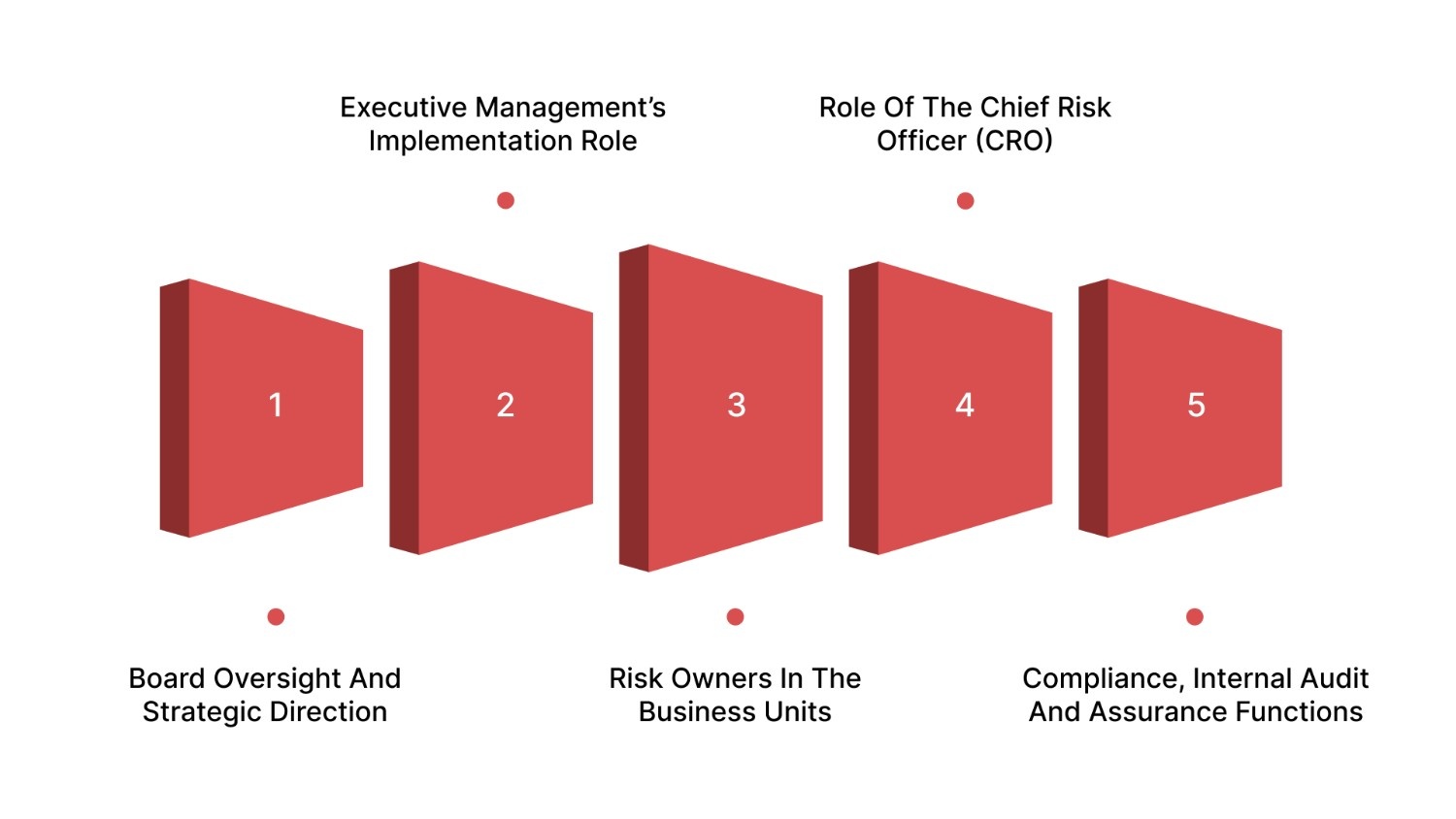
Without defined roles, risks slip through gaps, responses slow, and boards struggle to oversee effectively. Strong governance risk links leadership accountability to outcomes, from strategy to execution.
Below are the key accountability roles and how they fit together:
- Board Oversight and Strategic Direction: Sets risk appetite and ensures frameworks align with strategy; monitors effectiveness without managing daily risks.
- Executive Management’s Implementation Role: Led by the CEO, implements board strategy through policies, resources, and operational practices, embedding risk into culture and planning.
- Risk Owners in the Business Units: Identify, assess, and manage risks within their domains (e.g., operations, finance, IT), ensuring accountability and monitoring of controls.
- Role of the Chief Risk Officer (CRO): A designated CRO or equivalent risk leader coordinates enterprise‑wide risk activities, consolidates risk reporting, and acts as the central point of accountability for the risk framework between management and the board.
- Compliance, Internal Audit and Assurance Functions: Compliance functions monitor regulations, while internal audit independently verifies risk effectiveness. Together, they confirm risk practices are well-designed and operational, preventing blind spots and reinforcing governance.
Also Read: Understanding Regulatory Compliance Management in the U.S.
With accountability defined, organizations can rely on structured frameworks to embed corporate risk management into strategy and governance.
How Risk Management Frameworks Support Strategy And Governance
Risk management frameworks give organizations a structured yet flexible way to make consistent, informed risk decisions across functions. Frameworks like COSO ERM and ISO 31000 act as guiding structures, not rigid checklists, aligning risk practices with governance, strategy, and day-to-day operations while embedding risk-aware thinking into leadership and execution without adding unnecessary complexity.
Here’s how strong frameworks strengthen risk programs in practice:
- Align Risk with Strategic Goals: Frameworks connect risk activities directly to strategy and planning, ensuring that risk considerations influence decisions about growth, investments, and operational priorities rather than being an afterthought.
- Enhance Decision-Making Across the Enterprise: By providing a common, consistent approach to evaluating risk likelihood and impact, frameworks enable clearer and more data-informed choices about which risks to mitigate, transfer, accept, or avoid.
- Strengthen Regulatory Compliance and Documentation: Structured frameworks help standardize risk reporting and evidence gathering, supporting adherence to laws and regulations and making audits and reviews more transparent and defensible.
- Establish a Risk-Aware Culture and Operational Resilience: When risk processes are consistent and embedded, teams at all levels become more aware of potential threats and opportunities, enabling proactive responses and reducing reactive “firefighting.”
- Optimize Resource Allocation and Organizational Efficiency: Frameworks help you prioritize risk mitigation efforts where they deliver the most value, ensuring that time, budget, and talent are focused on the most significant risks instead of scattered across low-impact issues.
These frameworks provide the foundation, but practical corporate risk management comes to life through the strategies organizations use to respond to risk.
Basic And Advanced Risk Management Strategies Used By Corporations
Effective corporate risk management focuses on how organizations respond once risks are identified and assessed. Strategies vary by likelihood, impact, cost, and priorities, with common approaches including avoidance, mitigation, transfer, and acceptance, each providing a way to manage risk across compliance, operations, and technology.
Below are the core strategies leaders use, with relevant examples from regulated industries:
1. Risk Avoidance: Eliminating Exposure Before It Occurs
This strategy means choosing not to engage in activities that expose your organization to unacceptable risk. It’s often used when the potential impact or likelihood of a risk is high, and the cost of pursuing related activities outweighs the benefits.
2. Risk Mitigation: Reducing Likelihood Or Impact
Mitigation focuses on lowering the probability or severity of a risk through controls and safeguards. This is often the most widely used strategy when risks cannot be completely avoided but can be managed effectively.
3. Risk Transfer: Sharing Or Shifting Risk To Third Parties
Transferring risk doesn’t eliminate the risk; it moves the financial or operational burden to another party, often through contracts or insurance, allowing your organization to remain protected while focusing on core activities.
4. Risk Acceptance: A Conscious Decision To Proceed With Awareness
Acceptance means acknowledging a risk exists but electing not to invest in mitigation or transfer because its likelihood or impact is within your organizational tolerance, or the cost of treatment exceeds the benefit.
Also Read: Your Guide to Major Life Science Compliance Risks
To apply these strategies consistently, organizations need a formal corporate risk management plan that translates intent into action.
How To Develop And Implement A Corporate Risk Management Plan
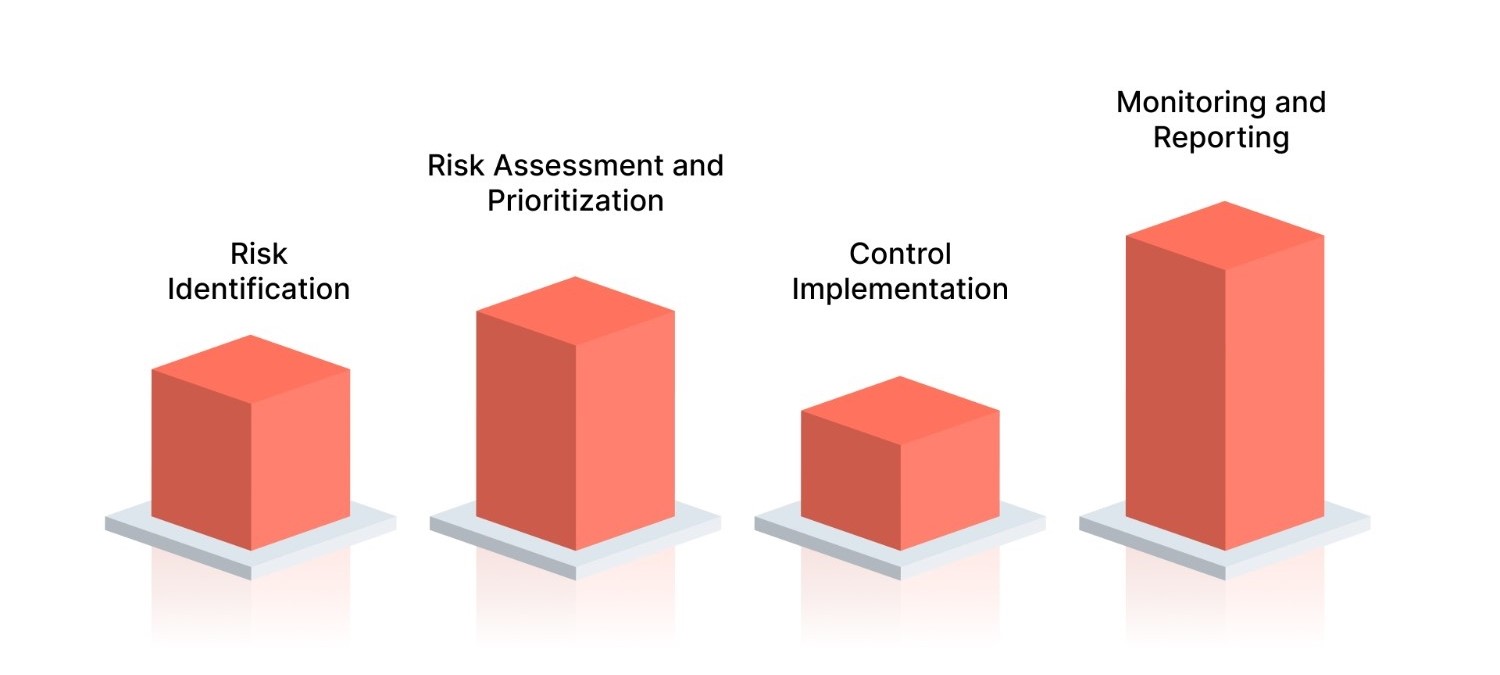
Building a corporate risk management plan turns strategy into action. It gives you a clear, repeatable roadmap that aligns risk activities with objectives, governance, and operational needs, which is essential if you want risks to be managed rather than merely documented.
Below is a practical, step‑by‑step roadmap for developing and implementing an effective corporate risk management plan:
- Risk Identification – Capture All Potential Threats: Document risks across strategic, operational, compliance, financial, and technology areas. Engage cross-functional teams to ensure a realistic, comprehensive view.
- Tips: Use risk registers, workshops, audits, and stakeholder interviews; consider both internal and external risk sources.
- Risk Assessment and Prioritization – Evaluate Likelihood and Impact: Assess how likely risks are to occur and their potential impact on business objectives. Prioritize based on severity, urgency, and potential disruption.
- Approaches: Use risk scoring models, heat maps, or weighted matrices for quantitative and qualitative ranking.
- Control Implementation – Plan and Execute Mitigation Actions: Select responses, mitigate, transfer, avoid, or accept, and assign clear owners. Embed treatments into existing workflows rather than as isolated projects.
- Best Practice: Integrate controls into operational processes so compliance, finance, and technical teams can reduce the impact or likelihood effectively.
- Monitoring and Reporting – Track Performance and Signals: Continuously monitor risk status and control effectiveness using KRIs, dashboards, and regular reports. Keep leadership informed for early detection of shifts.
- Outcome: Enhances transparency, accountability, and proactive decision-making.
Fragmented tools create blind spots between risk, compliance, policy, and incident management. VComply’s GRCOps model connects RiskOps, ComplianceOps, PolicyOps, and CaseOps in one platform, giving leaders end-to-end visibility and traceability. The result is fewer silos, clearer accountability, and faster, more defensible decisions across governance, risk, and compliance.
As organizations grow and change, many organizations encounter obstacles that limit the effectiveness of corporate risk management.
Overcoming Common Challenges In Corporate Risk Management
Below are the key challenges you must address and why they matter:
- Fragmented Oversight: Managing risk in isolated departments hides enterprise-wide exposure, creating blind spots and inconsistent prioritization.
- Siloed Teams: Independent workflows and data stores hinder collaboration, duplicate effort, and delay critical responses.
- Manual Processes: Spreadsheets and disconnected systems introduce errors, slow assessments, and limit scalability.
- Limited Executive Visibility: Without real-time insights, leadership decisions become reactive rather than strategic, weakening governance.
Addressing these challenges requires the right technology, which is where platforms like VComply help operationalize corporate risk management at scale.
How VComply Enables Effective Corporate Risk Management
VComply strengthens corporate risk programs with a governance-first, centralized platform that replaces spreadsheets and silos. Designed for leaders in regulated industries, it makes risk and compliance decisions strategic, auditable, and actionable, elevating risk management with a structured, benefits-driven approach.
Below is how VComply can help with effective corporate risk management:
- Centralized Risk Management (RiskOps): Capture, classify, and assess risks across departments in a single repository. Standardized scoring, documented ownership, and real-time dashboards reduce blind spots and enable transparent, defensible decisions.
- Governance-First Execution: Align risk activities with policies and escalation paths. Structured workflows, role-based responsibilities, and automation ensure risk processes follow organizational priorities and embed accountability into daily operations.
- Unified GRCOps Model: Integrate ComplianceOps, RiskOps, PolicyOps, and CaseOps to connect risk, compliance, policy, and incident management, shortening preparation cycles and strengthening oversight.
- Automated Assessments and Reporting: Collect evidence automatically, link it to controls, and provide dashboards showing risk posture and remediation progress, accelerating audit readiness and delivering decision-grade insights.
- Leadership Visibility: Configurable dashboards support executives, boards, and risk committees in tracking trends, compliance status, and control performance, guiding risk strategy with confidence.
Book a demo with VComply today and experience how a unified GRCOps platform can streamline risk, compliance, and governance execution for your organization.
Final Thoughts
Corporate risk management is a strategic capability that helps organizations anticipate threats, protect value, and make informed decisions aligned with operations and regulations. By embedding risk awareness into governance, processes, and culture, you reduce uncertainty, safeguard your reputation, and build resilience across functions.
VComply turns strategy into action by centralizing risk data, strengthening governance, automating evidence and reporting, and providing real-time leadership visibility. Its unified GRCOps model, integrating ComplianceOps, RiskOps, PolicyOps, and CaseOps, breaks down silos, reduces manual work, and ensures accountability and audit readiness enterprise-wide.
Ready to future‑proof your corporate risk management approach? Start a 21‑day free trial with VComply and experience how an integrated risk and compliance platform equips your organization to manage uncertainty strategically.
FAQs
Traditional risk management often operates within functions, responding to risks after they occur. ERM, by contrast, covers the entire organization, integrates risk with strategic planning, and proactively identifies and mitigates risks before they materialize. This broader scope improves alignment with objectives and decision‑making.
Risk appetite is the level and type of risk your organization is prepared to accept to achieve objectives. It guides decision‑making and resource allocation, ensuring teams understand which risks require treatment and which fall within acceptable boundaries. This consistency reduces ad‑hoc responses and misalignment.
Effective risk management involves regular and ongoing assessments rather than one‑time reviews. Continuous assessment, supported by periodic formal reviews, ensures emerging risks, changing environments, and control effectiveness are tracked and addressed consistently.
Continuous monitoring involves ongoing observation of risk indicators, controls, and performance to detect deviations early and support corrective actions. It enhances operational transparency, helps verify control effectiveness, and supports regulatory compliance in dynamic environments.
A strong risk culture promotes shared attitudes and behaviors toward risk awareness and decision‑making across your organization. It ensures employees understand their role in identifying, reporting, and responding to risks, strengthening governance, and minimizing blind spots.