

What Keeps Compliance & Risk Leaders Up at Night (2026) | Key Challenges
The role of compliance and risk leadership has fundamentally changed. Today, CCOs and CROs sit at the center of organizational resilience, responsible not just for policy oversight but for safeguarding business continuity.

In an environment shaped by stricter AI governance and heightened operational accountability, even a minor lapse, whether in third-party controls or automated decision systems, can trigger serious consequences. Legacy tools like spreadsheets and fragmented workflows are no longer adequate.
The real challenge now is preparedness: how quickly and confidently an organization can detect risk, respond under pressure, and maintain trust while meeting regulatory expectations.
Key Takeaways
- Regulations like SEC updates are holding individual Compliance & Risk leaders personally accountable for systemic governance failures.
- The transition from “experimenting” with AI to “auditing” AI is complete, with transparency and bias mitigation now mandatory.
- Operational resilience now requires visibility into fourth-party and fifth-party vendors to prevent cascading failures.
- CSRD mandates have turned ESG reporting into a rigorous, audit-grade requirement, leaving no room for “greenwashing.”
- Successful firms are moving toward an integrated “GRCOps” model, with automated, real-time execution of governance tasks.
The Shifting Landscape of Compliance & Risk in 2026
By 2026, compliance and risk management operate under constant regulatory visibility. Regulators increasingly expect ongoing access to operational data and rely on automated systems to identify control failures, policy breaches, and inconsistencies in real time rather than through periodic audits.
This shift leaves compliance and risk teams with little margin for error. At the same time, global instability and rapidly evolving fraud techniques, including identity manipulation and AI-driven impersonation, have significantly increased exposure across financial and operational systems.
Organizations are also dealing with unprecedented volumes of data spread across cloud platforms, third-party vendors, and internal tools. Each system introduces potential risks related to privacy, cybersecurity, and regulatory accountability.

As a result, compliance has expanded beyond meeting formal requirements. Stakeholders now expect organizations to demonstrate reliability by consistently executing across processes and technologies.
For many leaders, the greatest concern is artificial intelligence itself, systems that promise efficiency but demand far stronger governance, transparency, and oversight to avoid unintended risk.
Also read: How VComply Helps Organizations Stay Ahead of Regulatory Compliance Updates with AI
Identifying the Core Anxieties of GRC Leaders in 2026: A Deep Dive
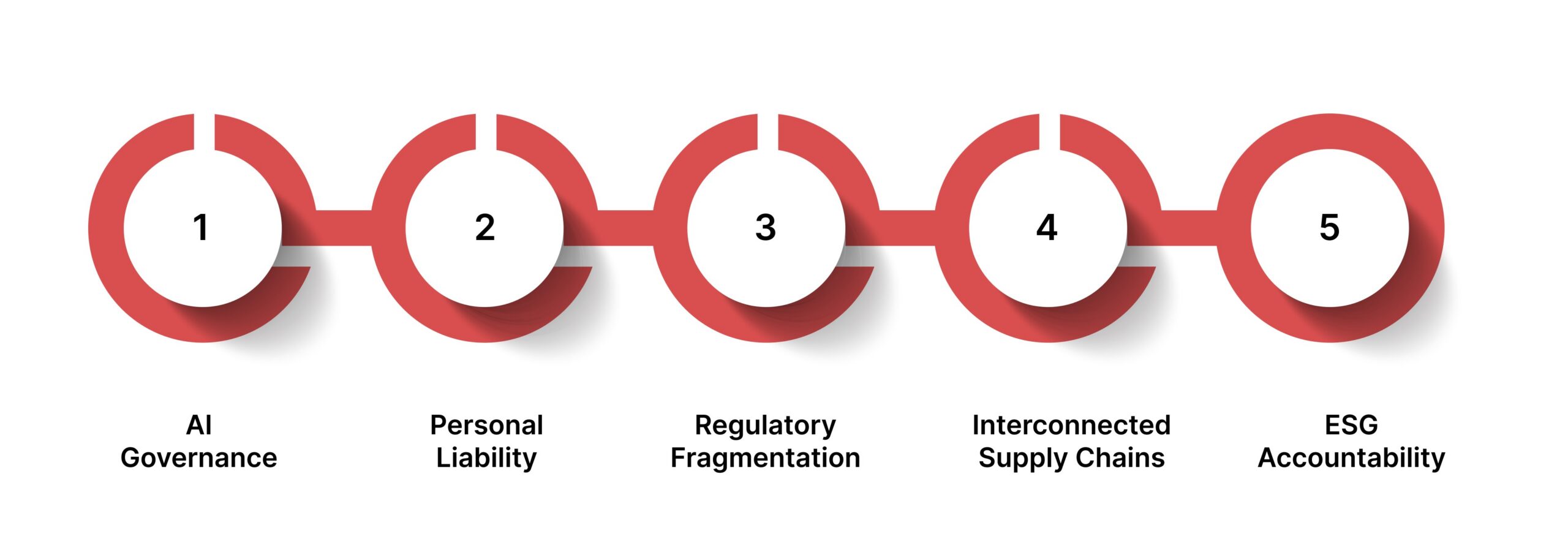
Managing the intersection of technological leapfrogging and aggressive regulatory enforcement has made the 2026 landscape more volatile than ever. For leaders responsible for oversight, emerging technologies like artificial intelligence and the growing expectation of executive accountability are no longer future concerns; they are active, operational risks.
This section explores the specific thematic pressures, ranging from algorithmic transparency to ESG data integrity, that are redefining the modern governance role.
1. AI Governance
By 2026, generative AI is widely embedded across business operations, but governance remains a major concern. In the U.S., regulators and enforcement agencies increasingly expect organizations to demonstrate control over how AI systems make decisions and handle data.
Leaders worry their teams lack the technical capability to detect model drift, bias, or unintended outcomes. Unmonitored employee use of third-party AI tools also raises the risk of unauthorized data processing, intellectual property leakage, and regulatory violations.
2. Personal Liability
Executive accountability has expanded significantly under U.S. privacy, cybersecurity, and consumer protection laws. Regulators now expect leaders to demonstrate active oversight, not just policy approval.
Without centralized records showing decisions, reviews, and corrective actions, leaders fear they may be unable to prove reasonable efforts were taken to prevent incidents or compliance failures.
3. Regulatory Fragmentation
Organizations operating across multiple states face a complex patchwork of privacy, data security, financial, and industry-specific regulations. Small regulatory changes in one jurisdiction can create compliance gaps elsewhere.
Managing overlapping obligations manually increases operational strain and raises the likelihood of missed updates and reporting errors.
4. Interconnected Supply Chains
Leaders are no longer just worried about their direct vendors; they are worried about their vendors’ vendors (fourth-party risk). In 2026, a breach in a niche cloud provider used by a minor software vendor can halt an entire supply chain.
Regulatory pressure now mandates “Concentration Risk” reporting, forcing Compliance & Risk leaders to map hidden dependencies across their entire ecosystem.
5. ESG Accountability
Environmental and social reporting expectations have tightened, particularly around supply chain transparency. Leaders face challenges in collecting reliable data from diverse vendors and partners.
Without verifiable, audit-ready sustainability data, organizations risk legal exposure, investor scrutiny, and reputational damage tied to inaccurate or unsupported claims.
Also Read: Why the Future of Compliance Management Lies in Operational Execution
To mitigate these anxieties, leaders are turning toward advanced technological solutions that provide clarity in the chaos.
The Operational Shift: From Compliance Defense to Organizational Resilience
Risk and compliance functions are no longer focused on reacting to issues after they occur. Organizations are now expected to maintain ongoing operational readiness, where risks are monitored continuously and addressed early. This requires embedding oversight into everyday workflows rather than relying on periodic audits.
When compliance and risk controls operate alongside business processes, teams gain faster visibility into gaps, reduce disruption, and prevent small issues from turning into larger regulatory or operational failures.
Automated Evidence Collection
One of the most common challenges for compliance teams is assembling documentation under tight timelines. Automated evidence collection solves this by continuously capturing logs, approvals, access records, and control data directly from enterprise systems.
This creates a consistent audit trail, reduces manual effort, and ensures organizations can demonstrate compliance at any time without last-minute scrambling.
Predictive Risk Scoring
Leaders are increasingly relying on AI-driven risk scoring to prioritize their efforts. In 2026, a static risk register is obsolete. Dynamic registers that update based on real-world events like a geopolitical shift or a new vulnerability disclosure allow teams to focus on the 5% of risks that pose the 95% of the threat.
Suggested Read: Understanding Policy Definition and the Difference Between Procedures and Guidelines
Scaling these capabilities across a global enterprise requires a unified technology stack that bridges the gap between policy and practice.
Solving 2026’s Greatest Fears with VComply
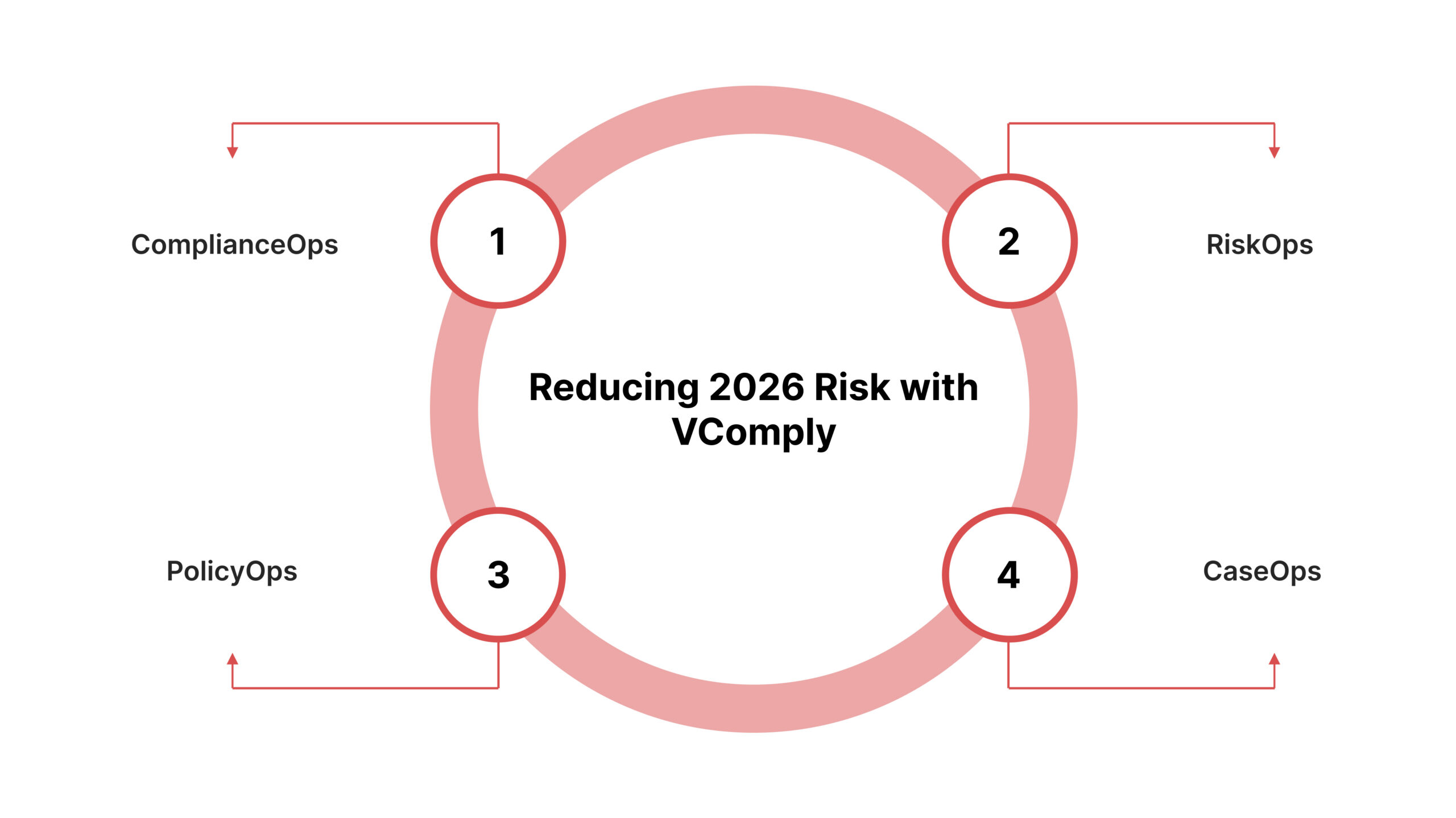
In the current landscape, manual governance is a gamble that no leader should take. VComply provides a comprehensive, cloud-native ecosystem designed specifically to silence the anxieties of 2026’s Compliance & Risk professionals.
By operationalizing every aspect of the GRC lifecycle, VComply ensures that your governance intent is backed by verifiable, real-time action.
VComply’s GRCOps suite is built on four pillars of operational excellence, ensuring you are always one step ahead of the regulator.
Transform Your GRC Strategy with VComply:
- ComplianceOps: Eliminate the fear of “missing a requirement.” ComplianceOps centralizes thousands of global regulations and maps them directly to your internal controls. With automated evidence collection, you are always audit-ready, providing a defensible shield against personal liability.
- RiskOps: Move from reactive to predictive. RiskOps offers live dashboards, AI-powered risk scoring, and heatmaps that reflect the actual, current state of your risk posture, helping you manage the complexities of third-party and AI risks.
- PolicyOps: Turn static documents into accountable actions. PolicyOps automates the distribution, acknowledgment, and attestation of policies across your entire workforce, ensuring that every employee understands their role in the company’s integrity.
- CaseOps: Manage incidents with transparency and speed. CaseOps streamlines whistleblowing and breach reporting, providing a structured workflow that ensures you meet strict regulatory reporting deadlines (like the 72-hour GDPR window) every time.
By unifying these functions into a single “Golden Thread” of accountability, VComply allows you to lead with confidence, knowing that your execution matches your corporate values.
Book a Live Demo to Explore the GRCOps Suite
Wrapping Up
The pressures facing compliance and risk leaders today stem from a business environment that demands constant visibility and accountability. Managing emerging technologies, complex vendor ecosystems, and evolving regulatory expectations can feel overwhelming, but it also creates an opportunity to lead with clarity and control.
When oversight is built on continuous, verifiable evidence, compliance stops being reactive and becomes part of how the organization operates with confidence. The most resilient organizations are not those that eliminate risk, but those that can see it early, respond decisively, and prove their actions when it matters.
Start a 21-day free trial to see how VComply helps teams track risks, enforce accountability, and stay audit-ready without relying on manual processes.
FAQs
Uncontrolled use of AI across business functions is a growing risk. Many teams deploy AI tools without formal approval or oversight, creating exposure around bias, data misuse, and regulatory scrutiny. Without visibility into how AI is used, organizations risk compliance failures and legal challenges.
Yes. Regulators and courts increasingly expect executives to demonstrate active oversight of risk and compliance programs. If leaders cannot show documented decision-making and control monitoring, they may face personal consequences after breaches or regulatory actions.
Modern supply chains are highly interconnected. A failure at a small vendor or cloud provider can disrupt operations or expose sensitive data. Organizations are expected to understand critical dependencies beyond just direct vendors.
Yes, but only with automation. Manual tracking does not scale. Centralized compliance tools help smaller teams manage controls, evidence, and audits without increasing headcount or operational burden.
ESG claims are now closely examined by regulators, investors, and consumers. Companies must support sustainability and workforce disclosures with accurate, verifiable data. Inconsistent or unsupported claims can quickly damage credibility and trust.