

Top Cloud Compliance Tools Guide in 2026
Cloud-based compliance tools are software solutions designed to streamline regulatory compliance management across industries. Hosted on cloud platforms, they provide secure, remote access to essential compliance functions, enabling businesses to manage regulatory requirements flexibly and efficiently. Their scalability and dynamic capabilities make them ideal for organizations with operations in multiple jurisdictions or dispersed teams.

Introduction
As businesses continue to shift their operations to the cloud, ensuring compliance becomes more critical than ever. In fact, 93 percent of leading enterprises across various industries are concerned about the potential risk of a massive data breach within their cloud environments. With the growing complexity of regulatory requirements, organizations need robust tools to protect their data and ensure adherence to industry standards.
Whether a healthcare provider handling patient records under HIPAA or a financial institution complying with PCI-DSS, organizations rely on cloud-based compliance software to automate compliance tasks, continuously monitor risks, and proactively address regulatory shifts. These tools empower businesses to achieve compliance without extensive manual oversight, simplifying the path to regulatory alignment.
This guide explores some of the most effective cloud compliance tools available in 2026. These solutions simplify compliance for diverse industry requirements, providing robust features to meet evolving regulatory standards. With the right tool, companies gain confidence in their security practices and strengthen relationships with clients and partners.

Key takeaways (TL;DR)
-
Explains what cloud compliance tools are and how they help businesses meet regulatory requirements.
-
Covers why cloud-based compliance software is important for reducing risk, avoiding fines, and building trust.
-
Reviews the top cloud compliance tools of 2026, including VComply, Drata, Vanta, and Sprinto.
-
Highlights benefits like scalability, cost-efficiency, accessibility, and enhanced security.
-
Shares tips for choosing the right tool, including integration, risk analysis, encryption, and automation.
What are Cloud Compliance Tools?
Compliance tools with cloud accessibility are software systems designed to facilitate the management of regulatory compliance across various industries. These tools are hosted on cloud platforms, enabling users to access critical compliance functions remotely and securely from any geographic location. The flexibility of cloud-hosted solutions allows for scalable and dynamic compliance management suitable for businesses operating in multiple jurisdictions or with dispersed teams.
They utilize advanced features such as automated compliance assessments, real-time reporting, and proactive alerts to inform stakeholders of potential non-compliance issues. This proactive approach ensures that organizations can quickly address any discrepancies or updates in regulatory requirements, significantly reducing the risk of penalties or legal challenges. They also feature dashboards and analytics, which improve visibility into an organization’s compliance status, helping swiftly identify and rectify compliance gaps. This makes cloud compliance tools a vital component of any enterprise’s risk management and regulatory compliance strategy.
Read: 5 Essential Compliance Management Tools For Teams
Importance of Cloud-Based AI-Powered Compliance Software
Fed up with messy spreadsheets, scattered audit files, and endless follow-ups for compliance tracking? In 2026, that approach is no longer sustainable. Organizations are dealing with faster regulatory change, more cloud systems, more third-party vendors, more cybersecurity pressure, and growing expectations around AI governance. Compliance teams need more than a digital filing cabinet. They need a cloud-based, AI-powered compliance platform that helps them manage obligations, risks, policies, controls, incidents, evidence, and reporting from one place.
Cloud-based AI-powered compliance software gives organizations a smarter way to manage compliance work across departments, locations, and regulatory frameworks. Instead of waiting until audit season to chase documents or manually check whether tasks were completed, teams can use automated workflows, real-time dashboards, AI-assisted insights, and centralized evidence repositories to stay continuously prepared. These platforms help compliance teams identify gaps earlier, assign clear ownership, monitor deadlines, and respond faster when regulations, risks, or business processes change.
The importance of these tools is not limited to convenience. In 2026, compliance software plays a direct role in protecting trust, reducing operational risk, and proving accountability. Regulators, auditors, customers, investors, and boards increasingly expect organizations to show that compliance is not just documented, but actively managed. A cloud-based AI-powered compliance system helps organizations demonstrate that policies are current, controls are monitored, evidence is complete, risks are reviewed, and corrective actions are tracked through closure.
Why Organizations Need Cloud-Based AI-Powered Compliance Software
1. Unified Compliance Management
Cloud-based AI-powered compliance software creates a single system for managing obligations, controls, policies, risks, audits, incidents, and evidence. This reduces the confusion caused by spreadsheets, email threads, shared folders, and disconnected tools.
A unified platform helps teams see:
- Which obligations apply
- Who owns each task
- Which controls are due for review
- Which policies need updates
- Which risks require action
- Which evidence is missing
- Which issues remain unresolved
This gives compliance, risk, audit, legal, IT, and business teams a shared source of truth.
2. Faster Adaptation to Regulatory Change
Regulations are changing quickly across data privacy, cybersecurity, financial services, healthcare, AI, environmental reporting, and third-party risk. AI and cloud services are also receiving more regulatory attention. For example, EU regulators have recently indicated that cloud and AI services are becoming part of the broader digital regulatory conversation under competition and technology rules.
Cloud-based compliance software helps organizations respond faster by turning regulatory changes into assigned tasks, policy updates, control reviews, training requirements, and evidence requests. AI-assisted capabilities can also help teams summarize new requirements, identify impacted policies, and highlight where follow-up may be needed.
3. AI-Assisted Compliance Intelligence
AI-powered compliance software can help reduce manual work by supporting tasks such as:
- Summarizing regulatory updates
- Drafting compliance tasks
- Searching policies and controls
- Identifying missing evidence
- Suggesting control mappings
- Flagging overdue actions
- Generating audit-ready summaries
- Helping employees find policy guidance faster
AI does not replace compliance judgment. It supports compliance teams by helping them process information faster, reduce repetitive work, and focus attention on higher-risk issues.
4. Better Collaboration Across Teams and Locations
Compliance work rarely sits with one department. It often involves legal, finance, HR, IT, security, operations, internal audit, procurement, and frontline business teams.
Cloud-based compliance software allows teams across locations to work from the same platform. Employees can access tasks, policies, training, evidence requests, and dashboards from anywhere. This is especially useful for organizations with remote teams, regional offices, multiple facilities, or global operations.
5. Centralized Evidence and Audit Readiness
One of the biggest compliance pain points is evidence collection. During audits or regulatory reviews, teams often spend hours searching for documents, approvals, screenshots, policy versions, training records, and control evidence.
Cloud-based compliance software centralizes this evidence as work happens. Instead of collecting proof after the fact, teams can attach evidence directly to obligations, controls, policies, audits, incidents, and corrective actions.
This helps organizations answer critical audit questions quickly:
- What was done?
- Who completed it?
- When was it reviewed?
- What evidence supports it?
- Was an exception found?
- Was remediation completed?
6. Proactive Risk and Compliance Monitoring
Traditional compliance management is often reactive. Teams find problems during audits, after incidents, or when regulators ask questions. Cloud-based AI-powered compliance software helps organizations take a more proactive approach.
Dashboards, alerts, workflows, and AI-assisted insights help teams spot warning signs earlier, such as overdue reviews, repeated control failures, open incidents, incomplete training, policy gaps, or missing evidence. This supports continuous monitoring rather than last-minute compliance preparation.
7. Lower Operational Burden
Cloud-based compliance tools reduce the need for physical infrastructure, manual tracking, and repetitive administrative work. They also reduce dependency on scattered spreadsheets and individual inboxes.
For compliance teams, this means less time spent chasing updates and more time spent improving controls, strengthening governance, and advising the business. For leadership, it means better visibility without waiting for manual reports.
8. Stronger Security and Access Control
Modern cloud-based compliance platforms are designed with security in mind. They support role-based access, encryption, audit trails, secure document storage, and controlled permissions. This is critical because compliance data often includes sensitive information such as audit findings, incidents, investigation records, financial controls, vendor documents, employee records, and risk assessments.
As cyber and data privacy enforcement continues to grow, organizations need tools that protect compliance information while also helping prove that safeguards are in place.
Importance of Avoiding Fines and Promoting Trust
Compliance is more than a regulatory requirement. It is a safeguard against financial, legal, operational, and reputational harm. When organizations fail to manage compliance properly, the consequences can include fines, lawsuits, breach notifications, failed audits, regulatory restrictions, customer loss, and long-term damage to trust.
Recent enforcement trends show why stronger compliance systems matter. GDPR enforcement remains active, with DLA Piper reporting that Ireland issued a EUR 530 million fine in April 2025 for GDPR international data transfer violations, one of the largest fines of the year. In healthcare, HHS OCR announced in April 2026 that it had settled four HIPAA Security Rule ransomware investigations, bringing its completed ransomware breach investigations to 19 and Risk Analysis Initiative investigations to 13. These examples show that regulators are paying close attention to data protection, risk analysis, cybersecurity safeguards, and evidence of compliance.
But the cost of non-compliance is not only financial. Trust is often harder to rebuild than money is to pay. Customers, patients, investors, employees, regulators, and business partners want to know that an organization can protect data, follow rules, respond to incidents, and prove accountability. Cloud-based AI-powered compliance software helps organizations build that trust by making compliance more visible, consistent, and defensible.
Now, Let’s take a closer look at the key features that enable cloud compliance solutions to streamline the process and ensure your business stays protected.
Also Read: What Is the Importance of Compliance Technology?
Key Features of cloud based Compliance Software
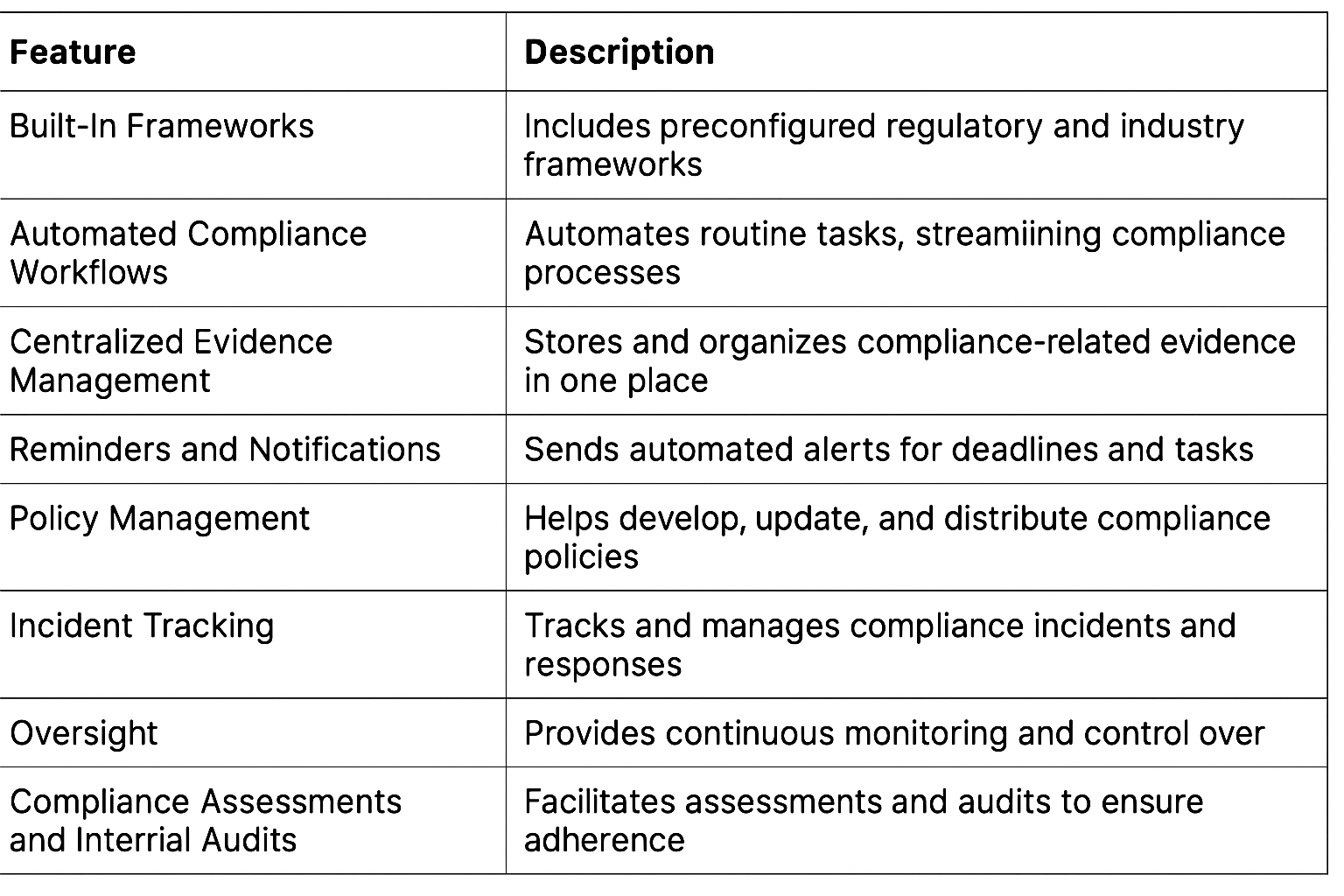
Cloud based compliance software enables organizations to adhere to security standards and regulations with ease and precision, which is crucial for meeting cloud based compliance software requirements. As businesses face increasing scrutiny from regulatory bodies, these tools have become indispensable for modern enterprises striving to maintain compliance in dynamic cloud environments. Below, we’ll explore the key features that make these tools essential for safeguarding operations and ensuring long-term compliance.
1. Real-Time Visibility
A critical feature of cloud compliance tools is real-time visibility into cloud environments. Continuous monitoring allows for the immediate detection of security risks and compliance issues, enabling swift action before minor problems escalate into serious violations. Comprehensive dashboards consolidate compliance status, ensuring organizations can monitor and address issues as they arise. This level of visibility helps identify risks promptly and ensures no compliance gaps are left undetected.
2. Remediation Capabilities
Identifying compliance issues is only the first step; having efficient means to resolve them is equally crucial. Modern tools offer real-time remediation guidance, allowing IT teams to address security threats or configuration issues promptly. Automated remediation processes reduce the risk of human error and enable continuous compliance without interrupting day-to-day operations. Additionally, customizable remediation plans offer flexibility, allowing teams to adapt their strategies to specific organizational needs.
3. Compliance Specifications
Cloud compliance tools support a wide range of standards and regulatory frameworks, which is vital for organizations operating across various industries and regions. These tools help simplify compliance management by auditing against multiple essential standards, such as PCI-DSS and ISO 27001. By enabling businesses to meet diverse requirements efficiently, these platforms eliminate the complexity of managing compliance across different regulations, ensuring seamless adherence to all necessary specifications.
4. Automation Capabilities
Automation is a cornerstone of cloud compliance tools, streamlining key processes and reducing the burden of manual compliance tasks. Automated features include monitoring, reporting, and configuration checks, all of which ensure continuous compliance with minimal human intervention. Seamless integration with existing workflows enhances operational efficiency, allowing IT teams to focus on strategic initiatives while maintaining regulatory standards. Automation minimizes errors and ensures that compliance tasks are consistently and efficiently executed.
5. Detailed Logs and Audit Trails
Maintaining transparency is crucial for compliance, especially during audits. Cloud compliance tools offer comprehensive logging and audit trail capabilities, recording every action within the system. These detailed logs provide a clear and reviewable record of activity, supporting regulatory requirements and proving compliance when needed. Automated logging ensures that no actions are missed, making audit preparations more manageable and reducing the time and effort required to demonstrate compliance. Additionally, logs help identify potential vulnerabilities by allowing organizations to review and analyze past activities thoroughly.
Now that we understand the key features that make cloud compliance tools effective, it’s time to explore the top tools available in 2026.
Also Read: Using Cloud Compliance Software to Improve Compliance Processes & Efficiency
Top 6 Cloud Compliance Tools
Choosing the right cloud based compliance software can significantly impact your organization’s ability to manage risk, maintain compliance, and improve efficiency. Below are some of the leading cloud compliance tools, each offering unique strengths to support your compliance efforts:
1. Vcomply
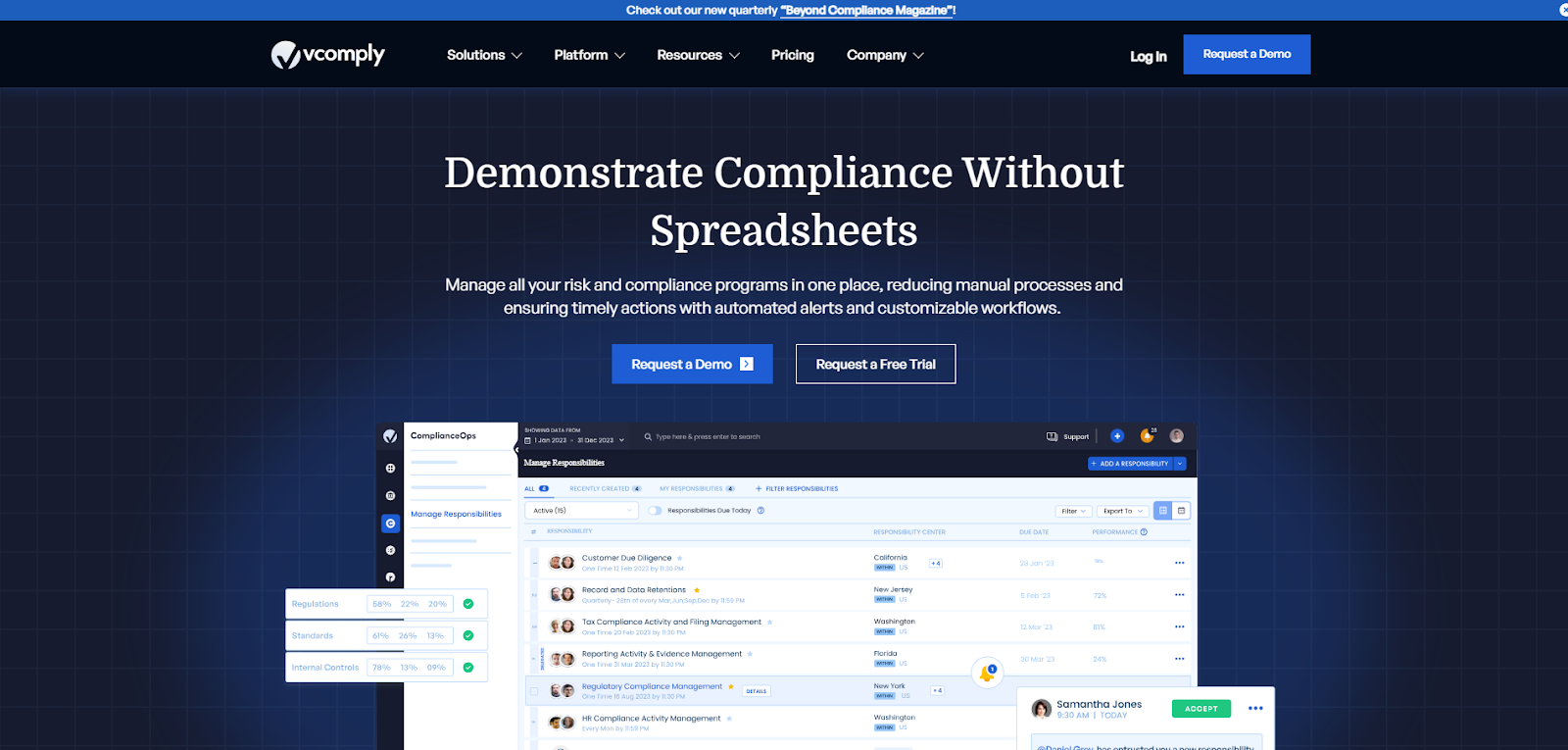
VComply is designed for organizations seeking to streamline their cloud compliance processes through automation, real-time monitoring, and robust security features. It is a modern, AI powered compliance software that emphasizes advanced security measures, including data encryption, secure access controls, and continuous risk assessment. VComply’s automated compliance checks help minimize manual errors, while its comprehensive reporting capabilities make audits smoother and less time-consuming. What sets VComply apart is its ability to seamlessly integrate with existing IT workflows, embedding compliance into everyday operations and development pipelines with cloud based compliance software.
Key Features:
- Automated Compliance Checks: Reduces manual effort and ensures continuous compliance monitoring.
- Real-Time Monitoring and Alerts: Provides instant updates on compliance status, enabling proactive risk management.
- Advanced Security Measures: Includes data encryption, secure access controls, and continuous risk assessment.
- Comprehensive Reporting: Generates detailed, audit-ready reports that simplify the audit process.
- Workflow Integration: Integrates easily with existing IT and development workflows to improve efficiency.
Pricing and Demo:
VComply offers flexible pricing plans tailored to different business needs. It provides a free demo for organizations interested in exploring the platform’s features and how it can enhance compliance management. Additionally, VComply offers a 21-day free trial, giving new users the opportunity to fully experience the platform and assess its impact on their compliance workflows. Paid plans start at $600 per year for small teams, while larger organizations can choose custom enterprise pricing that includes advanced compliance features and dedicated support.
2. Drata
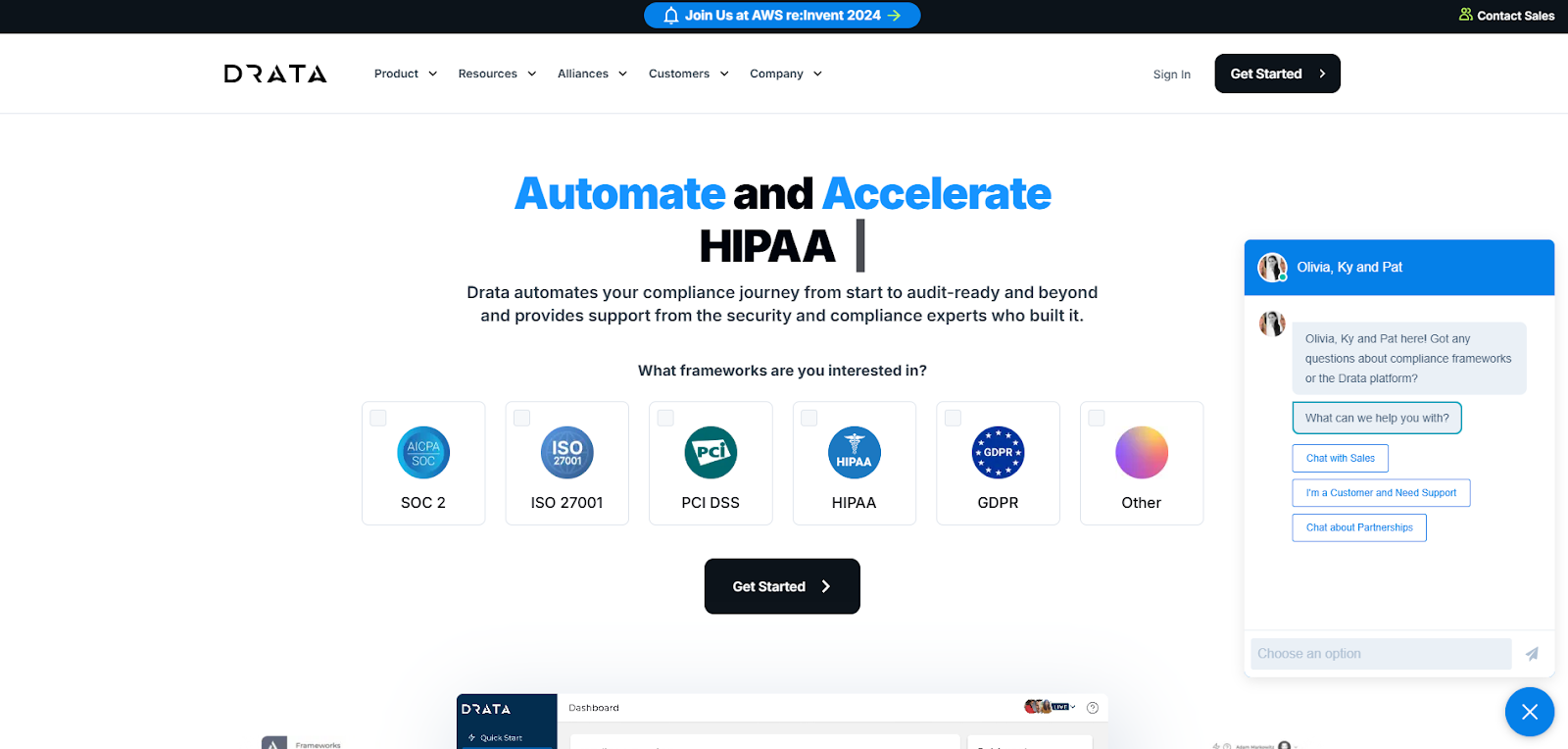
Drata excels with its wide-ranging support for compliance frameworks like SOC 2 and HIPAA. It offers continuous automated monitoring, giving businesses real-time insights into their compliance status. Drata’s intuitive interface and high level of customization make it easy for users to adapt the tool to their specific needs, earning praise for both flexibility and ease of use.
Key Features:
- Automated Monitoring: Ensures compliance status is continuously updated and easily accessible.
- Customizable Frameworks: Supports SOC 2, HIPAA, and more, adapting to your organization’s unique requirements.
- User-Friendly Interface: Simplifies compliance management with an easy-to-navigate platform.
- Data Security: Implements rigorous security measures to protect sensitive information.
Pricing and Demo:
Drata offers flexible pricing plans to support organizations from initial audits to advanced GRC programs. Options include the Essential plan for up to 50 FTEs, the Foundation plan with unlimited FTEs and custom controls, and the Advanced plan with enhanced risk management features. Drata also provides a demo to showcase its compliance automation capabilities. For exact pricing and details, contact Drata’s sales team.
3. Vanta
Vanta provides a robust solution for managing compliance, especially for SaaS companies. It offers pre-built templates and continuous monitoring, allowing organizations to maintain real-time visibility of risks. With extensive customization capabilities, businesses can tailor Vanta’s policies to meet their unique compliance requirements effectively.
Key Features:
- Pre-Built Templates: Helps organizations quickly set up and manage compliance requirements.
- Continuous Monitoring: Keeps teams informed of potential compliance risks as they arise.
- Customizable Policies: Allows for extensive customization to fit the unique needs of different organizations.
- Audit Support: Facilitates smoother audits with comprehensive compliance documentation.
Pricing and Demo:
Vanta provides three pricing plans: Core for basic compliance needs, Growth for scaling teams with enhanced automation, and Scale for complex security environments. Each plan offers features like continuous monitoring and custom reporting. Vanta also offers a demo to showcase its comprehensive compliance automation capabilities.
4. Sprinto
Sprinto stands out for its support of frameworks like SOC 2, GDPR, and HIPAA, increasing compliance through entity-level mapping and automatic checks. Its emphasis on visibility and auto-remediation makes compliance management smoother and more efficient, helping organizations stay ahead of regulatory changes.
Key Features:
- Entity-Level Mapping: Provides in-depth visibility into compliance structures.
- Automated Checks and Remediation: Reduces manual work by automating key compliance tasks.
- Scalable Compliance Solutions: Adapts to the needs of growing businesses and diverse compliance frameworks.
- Risk Assessment Tools: Proactively identifies and mitigates potential threats.
Pricing and Demo:
Sprinto offers tailored pricing plans to accommodate various compliance needs, supporting frameworks like SOC 2, GDPR, and HIPAA. Its features include automated compliance checks, real-time risk monitoring, and integration capabilities. Sprinto also provides a demo, allowing organizations to see the platform in action and understand how it simplifies compliance management. For detailed pricing information, contact Sprinto’s sales team.
Also Read: How to Assess Compliance: 6 Steps to Take Today
Benefits of Cloud Compliance Tools
Cloud compliance tools offer significant benefits that transform how organizations manage regulatory standards and security protocols in cloud environments. Below are the core benefits of using a cloud based compliance software:
- Scalability: Easily adjust resources as your organization’s needs change without significant upfront investments. This means you can grow or reduce your compliance capabilities in sync with your business scale, ensuring cost-effective compliance management.
- Accessibility: You can access compliance data and tools from any location, making it easier to manage multi-site operations or remote teams. This accessibility promotes uniform compliance practices across all branches of your organization, regardless of geographical location.
- Cost-efficiency: Cloud based solutions can reduce the overhead costs associated with traditional compliance systems. By minimizing the need for on-premise infrastructure, your organization can allocate resources more effectively to other critical areas.
- Real-time Operations: Implement real-time compliance checks and updates, allowing your organization to respond promptly to legislative changes. This immediate responsiveness is crucial in environments where regulatory conditions are constantly evolving.
- Enhanced Security: Benefit from advanced security protocols offered by cloud providers, which can be more robust than what an individual organization could afford independently. These advanced measures help protect sensitive data against cyber threats and breaches.
Also Read: Key Features of Governance, Risk and Compliance Management Software Solutions
Choosing the Right Cloud Compliance Software
Selecting appropriate cloud compliance software is crucial for organizations looking to maintain regulatory requirements and security standards. Consider the following key factors when evaluating compliance software solutions:
1. Active Regulation Monitoring: A key feature to look for is the tool’s ability to automatically monitor regulations such as HIPAA, PCI DSS, or GDPR. This ensures your business remains compliant without needing manual checks. Real-time monitoring keeps you informed about changing laws, helping you avoid penalties and stay compliant as standards evolve.
2. Unified Security Management: It is essential to have a tool that centralizes your security rules and procedures across your cloud environments. This feature ensures consistency in following high security and compliance standards across your entire organization, making it easier to ensure that everyone adheres to the same protocols.
3. Automated Activity Logging: Automated logging tracks every action and change made in your cloud systems, providing a detailed audit trail. This feature is crucial for preparing audits, as it ensures you have all the necessary records to prove compliance, reducing the effort required for audit preparation.
4. Proactive Risk Analysis: Risk analysis is vital in identifying and addressing potential threats to your data or compliance status before they become critical issues. Advanced risk analysis features allow you to act quickly to resolve vulnerabilities, minimizing the likelihood of compliance breaches and improving your overall security posture.
5. Data Security and Encryption: Cloud compliance tools should prioritize safeguarding sensitive data by encrypting it during storage and transfer. Ensuring data encryption across your cloud environments protects against unauthorized access and ensures compliance with privacy laws, keeping sensitive information secure and accessible only to authorized personnel.
6. Emergency Response and Remediation: Automated emergency response systems detect and respond to breaches or compliance issues quickly, helping you fix them before they escalate. These systems prevent minor issues from turning into significant problems, ensuring swift remediation to maintain compliance.
7. Integration with Existing Tech Stack: Your compliance tool should work seamlessly with your existing infrastructure. Seamless integration minimizes disruptions and ensures that compliance management becomes a natural extension of your current operations, streamlining processes.
8. Elimination of Manual Compliance Tasks: Automating repetitive tasks, such as policy enforcement and report generation, can save significant time and resources. Automation helps organizations avoid the burden of manual compliance management, ensuring that critical tasks are completed efficiently and accurately.
9. Contextual Security Statuses: An excellent cloud compliance tool will provide clear, easy-to-understand reports and dashboards showing your current compliance and security status. Visual dashboards that provide real-time and historical data give you an accurate picture of your compliance health.
10. Guided Compliance Prompts: Finally, consider tools that offer guided compliance prompts to educate your team on best practices and evolving regulations. These prompts help ensure that everyone understands their role in maintaining compliance and adhering to company policies. Tools that include educational prompts improve overall awareness and reduce the likelihood of compliance errors.
Conclusion
Compliance isn’t just a regulatory requirement. It’s a crucial aspect of safeguarding your organization’s data and reputation. Choosing the right cloud based compliance software ensures you stay ahead of ever-changing standards while reducing manual effort and enhancing security.
Tools that integrate seamlessly with your current infrastructure, offer customizable options, and scale, as your business grows, will future-proof your operations and reduce costly compliance errors.
Ready to simplify and strengthen your cloud compliance? With VComply’s 21-day free trial, you can experience its powerful features firsthand, including automated compliance checks, real-time monitoring, and detailed audit-ready reports. Seamlessly integrate VComply into your existing workflows and reduce manual efforts while ensuring robust compliance. Take control of your compliance management today and see how it can enhance your organization’s security and efficiency.
Frequently Asked Questions (FAQ) on Cloud Compliance Tools in 2026
Q1. What are cloud compliance tools?
Cloud compliance tools are software solutions that help organizations ensure their cloud environments meet regulatory, legal, and internal policy requirements. They support monitoring, evidence tracking, risk management, and automated reporting to maintain compliance efficiently.
Q2. Why are cloud compliance tools important in 2026?
With new and evolving regulations in data privacy, cybersecurity, and ESG reporting, organizations need tools to stay audit-ready and reduce risks. In 2026, regulatory complexity is higher than ever, making cloud compliance tools critical for operational integrity and trust.
Q3. What features should I look for in a cloud compliance tool?
Key features include:
-
Built-in regulatory frameworks
-
Automated compliance workflows
-
Centralized evidence/document management
-
Policy management
-
Risk assessment and reporting
-
Dashboards and analytics
-
Reminders and notifications
-
Audit trail and oversight tools
Q4. Who typically uses cloud compliance tools within an organization?
Compliance officers, auditors, IT and security teams, legal counsel, and risk managers are the primary users. Executives and department heads may also use dashboards for governance and oversight.
Q5. How do cloud compliance tools simplify audits?
They centralize compliance evidence, maintain clear audit trails, and generate audit-ready reports automatically. This reduces manual work, saves time, and ensures organizations can quickly demonstrate adherence to standards.
Q6. Do these tools integrate with existing business systems?
Yes. Modern cloud compliance tools integrate with day-to day tools to provide a single source of truth for compliance data.
Q7. How often should compliance be monitored?
Compliance monitoring should be continuous. Most tools in 2026 offer real-time monitoring, alerts, and reporting so risks can be addressed before they escalate.
Q8. What industries benefit the most from these tools?
Healthcare, finance, energy, manufacturing, and education—any industry with sensitive data or heavy regulations—benefits significantly.
Q9. How does VComply support managing compliance?
VComply is a cloud-based and AI powered GRC platform that helps organizations manage compliance, policies, risks, and audits in one place. With automated workflows, centralized evidence management, policy distribution, and audit-ready reporting, VComply enables compliance teams to save time, reduce risks, and stay ahead of regulatory changes.