

What is Policy? Everything You Need to Know in 2026
Policy failures often emerge before major incidents, manifesting as inconsistent decisions, undocumented exceptions, and control gaps that reflect poor operationalization. In the context of increasing regulatory scrutiny, this gap signals a broader issue: while organizations draft policies, they fail to embed them effectively into governance structures.

Regulatory bodies, like CISA, emphasize the need for executive-level responsibility and operationalized expectations at the core of governance. This highlights the necessity for organizations to move beyond simply documenting policies and to implement robust frameworks for consistent execution and accountability.
A well-structured policy is more than just a statement of intent. It serves as the foundation for decision-making, enforcement, and accountability under regulatory and operational pressures.
This blog explains what policy is, why it matters, how it functions in practice, and what organizations need to manage it effectively.
Key Takeaways
- What is a policy? A policy is a formal statement of intent that defines organizational expectations, accountability, and decision-making boundaries.
- Effective policies require clear ownership, communication, enforcement, and regular reviews.
- Most policy failures occur when documents are not integrated into workflows or operational controls.
- Policies must be clearly differentiated from procedures and standards to avoid governance confusion.
- A robust policy management framework enhances consistency, audit readiness, and regulatory compliance.
What Is Policy, and Why Does It Matter in Organizations?
A policy is a formal governance structure that outlines organizational expectations, decision boundaries, and risk management processes. It connects leadership directives to operational reality, creating clear boundaries within which teams must operate.
Policies are essential for more than simple documentation—they are critical governance tools that operationalize leadership intent, ensuring consistency in decision-making, accountability, and regulatory compliance. Without a policy framework designed to integrate with daily operations, organizations expose themselves to gaps in control and compliance risk.
In organizational settings, policy matters because it supports several critical outcomes:
- Consistency in decision-making: It reduces reliance on ad hoc judgment and helps teams respond to recurring situations in a structured way.
- Clear accountability: It defines who owns what, who approves what, and where responsibility sits when issues arise.
- Control alignment: It connects organizational expectations to procedures, standards, and internal controls.
- Audit defensibility: It provides evidence that expectations were formally established, communicated, and governed.
- Regulatory readiness: It helps demonstrate that compliance obligations are not informal, but operationalized.
- Operational discipline: It creates a more stable and repeatable way to manage risk, conduct, and oversight.
In regulated environments, this becomes especially important. Auditors and regulators rarely look at intent alone. They look for evidence that expectations were defined, assigned, communicated, and enforced in a way that the organization can stand behind.

What Does a Policy Actually Do?
A policy provides organizations with a structured, repeatable framework to govern decisions, behaviors, and expectations, particularly in risk-sensitive areas. It operationalizes leadership intent and ensures consistent execution, crucial for compliance and risk management.
Without clear policy guidance, organizations face inconsistent decisions and process breakdowns, resulting in avoidable compliance risks.
In practice, policies help organizations:
- Define Acceptable Behavior: Establish clear guidelines for employee and third-party conduct to ensure operational integrity.
- Set Control Expectations: Ensure teams follow defined procedures to reduce the risk of non-compliance and operational failure.
- Create Escalation Boundaries: Clarify escalation paths for critical issues, ensuring compliance and risk management processes are followed.
- Support Oversight and Enforcement: Establish a formal framework to monitor compliance and reduce the risk of unchecked deviations.
- Document for Audits and Investigations: Provide verifiable records to support audit and compliance reviews and demonstrate governance.
This is what makes policy operationally important. It does not just state intent. It gives the organization a defensible structure for how decisions should be made, how conduct should be governed, and how accountability should be applied when something goes wrong.
Also read: Best Policy Management Software for 2025
What Are the Common Types of Policies in Organizations?
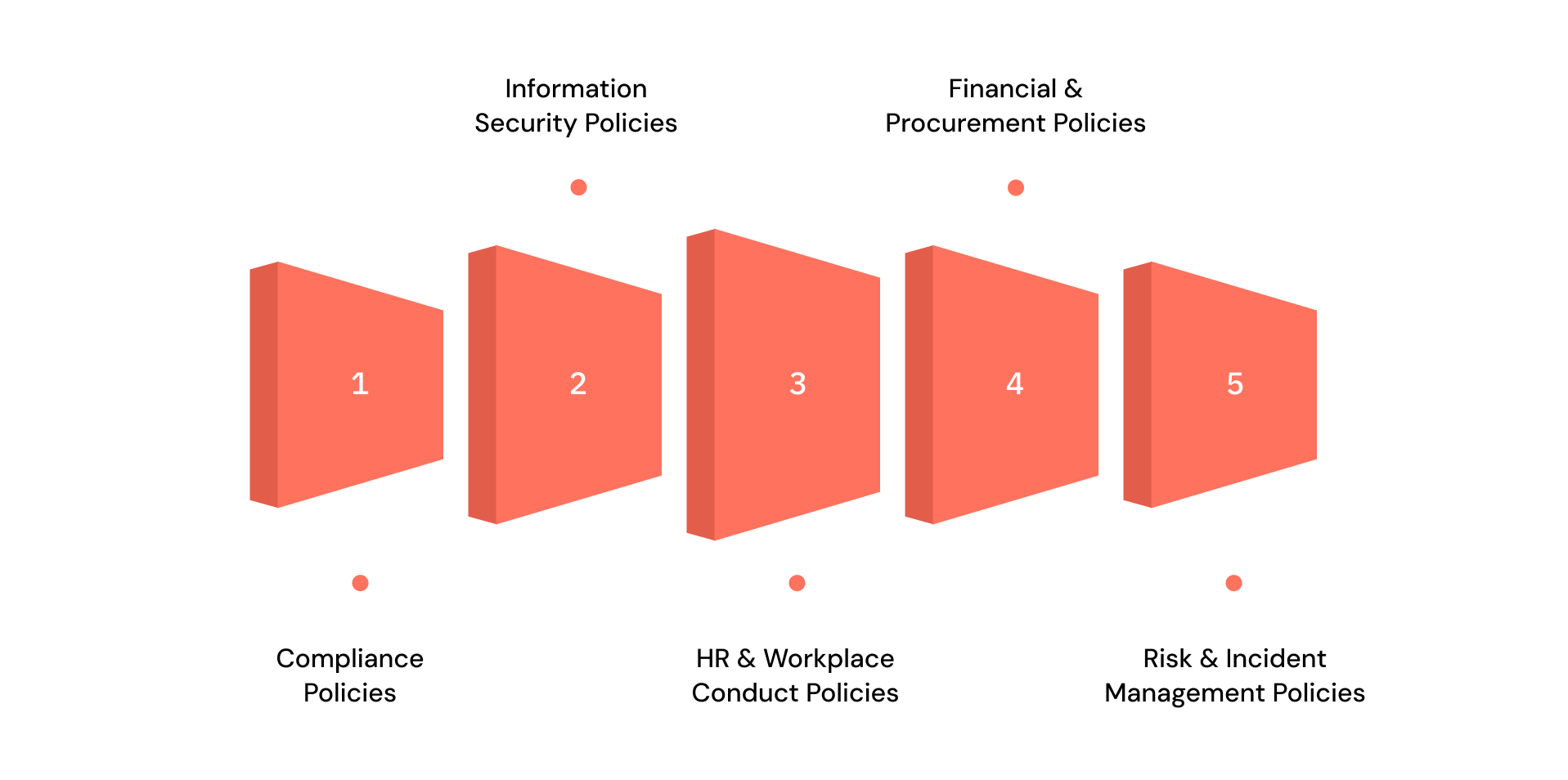
Organizations rarely operate under a single policy. They rely on a set of policies that govern different areas of risk, conduct, and decision-making.
While the mix varies by industry and regulatory exposure, most policies fall into a few core categories. Each category addresses a specific type of operational risk and defines how expectations are applied in practice.
The most common types include:
1. Compliance Policies
These define how the organization meets legal, regulatory, and industry obligations. They typically cover areas such as anti-bribery, data privacy, record retention, and conflict of interest.
Weaknesses often surface during audits or regulatory reviews, where expectations exist but cannot be demonstrated consistently.
2. Information Security Policies
These govern how systems, data, and access are controlled. They set expectations around authentication, access rights, device usage, incident response, and data handling.
When unclear or outdated, they increase exposure to breaches, unauthorized access, and inconsistent security practices across teams.
3. HR and Workplace Conduct Policies
These establish standards for employee behavior and workplace expectations. They typically include codes of conduct, anti-harassment policies, attendance, leave, and disciplinary frameworks.
Gaps in these policies often lead to inconsistent handling of employee issues and increased legal or reputational risk.
4. Financial and Procurement Policies
These guide how financial decisions are made and controlled. They define approval thresholds, expense handling, procurement processes, and delegation of authority.
Without clear policies, organizations often see approval inconsistencies, overspending, or weak financial oversight.
5. Risk and Incident Management Policies
These define how risks and incidents are identified, assessed, escalated, and documented. They are critical in ensuring that issues are handled consistently and that there is a clear record of response.
When absent or poorly defined, organizations struggle with delayed escalation and a lack of accountability during critical events.
Each category serves a distinct purpose, but together they create a structured environment where expectations are clear, and decisions are not left to interpretation.
The strength of a policy framework is not in how many policies exist, but in how well they define boundaries, assign ownership, and support consistent execution across the organization.
Note: Policy gaps often stay hidden until inconsistent decisions, audit findings, or control failures force them into view. To see how structured policy workflows can help your organization manage approvals, acknowledgments, reviews, and accountability more effectively, book a demo with VComply today.
Also Read: Free Downloadable Data Retention Policy Template
Policy vs Procedure vs Standard: What Is the Difference?
Policy, procedure, and standard are closely related, but they are not interchangeable. Each plays a different role in how organizations translate expectations into repeatable action. When these distinctions are unclear, teams often end up with fragmented documentation, inconsistent execution, and weak control alignment.
At a high level, a policy sets direction, a procedure explains execution, and a standard defines what must be met. The difference matters because governance becomes harder to maintain when organizations document only one layer and assume the rest will follow.
Here’s how they differ in practice:
| Criteria | Policy | Procedure | Standard |
| Primary Purpose | Establishes comprehensive organizational goals and governance boundaries, providing high-level direction. | Details the specific steps or processes required to implement the policy, ensuring consistent action across teams. | Defines measurable criteria or requirements that must be met for compliance, often used for regulatory adherence. |
| Focus | What the organization expects and why it matters | How something should be done in practice | What must be followed consistently across systems, teams, or processes |
| Level of Detail | Broad and directional | Detailed and action-oriented | Specific and prescriptive |
| Ownership | Usually owned by compliance, legal, risk, HR, IT, or leadership functions | Usually owned by operational or process teams | Usually owned by control, security, quality, or technical functions |
| Example | Employees must protect confidential business and customer information | Steps for handling, storing, and sharing confidential data | Confidential files must be encrypted and access-restricted at all times |
These documents are meant to work together, not exist in isolation.
- A policy creates the rule or expectation.
- A procedure explains how that expectation is carried out.
- A standard ensures it is implemented consistently and within defined control requirements.
For example, an Information Security Policy may state the need to protect sensitive data, while a corresponding Procedure details how employees should classify and store that data. A Standard would specify the encryption levels and access control required to ensure data protection.
When organizations treat these layers as interchangeable, clarity breaks down quickly. Teams may know the expectation but not the process, or they may follow a process without understanding the control requirement behind it. Clear separation helps strengthen accountability, simplify audits, and make governance easier to operationalize.
Also read: Top 5 Policy Management Software Solutions
Why Policies Fail in Practice (and How to Fix It)
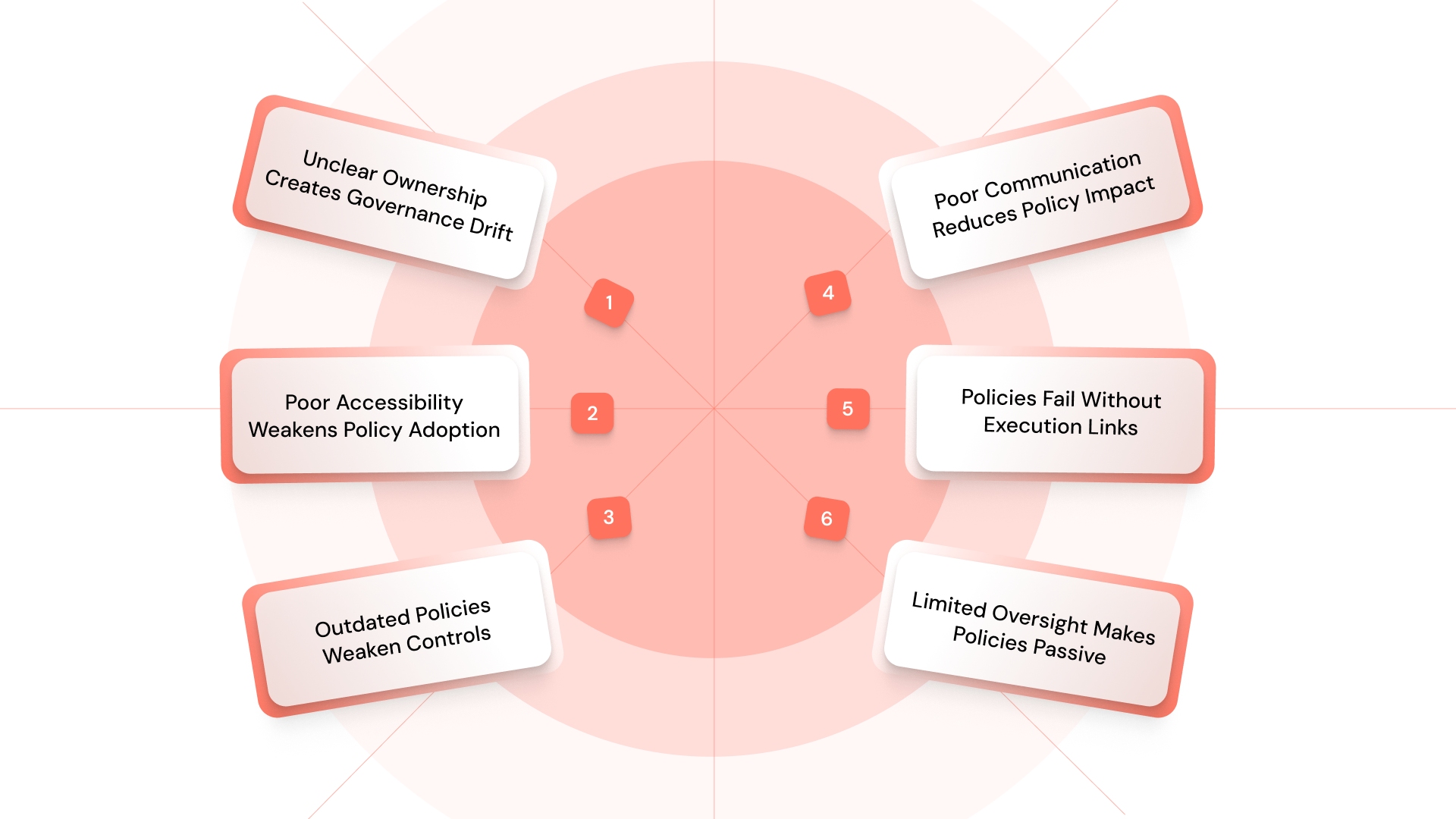
A policy may be approved, published, and archived, yet still fail to influence decisions in the moments where consistency and control matter most. That is usually where the real gap appears, not in whether a policy exists, but in whether it is operationally usable.
In practice, policy breakdowns tend to follow a familiar pattern. Expectations are documented, but ownership is weak, updates are inconsistent, access is fragmented, and enforcement depends too heavily on individual interpretation. Over time, this creates governance drift: the policy remains formally in place, but execution no longer reflects it.
Below are the most common reasons policies fail, and what organizations can do to correct them:
1. Unclear Ownership Creates Governance Drift
A policy without a clearly assigned owner rarely stays current for long. When responsibility is spread loosely across functions, no one is fully accountable for reviewing the policy, approving revisions, resolving overlaps, or ensuring it still reflects how the organization operates.
What Helps: Organizations are more effective when policy ownership is assigned to a defined role, not an individual. That ownership should include responsibility for periodic review, stakeholder coordination, approvals, and update tracking. Clear ownership also makes it easier to demonstrate accountability during audits and internal reviews.
2. Poor Accessibility Weakens Policy Adoption
A policy cannot guide behavior if employees cannot locate it, understand it, or tell whether it is the current version. This is a common issue in organizations where policies are scattered across shared drives, email threads, legacy portals, or department-specific folders.
What Helps: Policies should be centralized, searchable, and easy to access by the people expected to follow them. Accessibility also means usability. If a policy is overly dense, overly legalistic, or disconnected from real work scenarios, adoption tends to weaken even when the document is technically available.
3. Outdated Policies Undermine Control Reliability
A policy that no longer reflects current regulations, systems, or operational practices can create as much risk as having no policy at all. Teams may believe they are following approved guidance, while in reality they are relying on instructions that no longer align with current obligations or internal controls.
What Helps: Organizations need a defined review cadence tied to policy criticality, regulatory change, and business process updates. Strong policy governance also includes version control, documented revisions, and visibility into what changed and when. This helps maintain continuity while ensuring expectations stay current and defensible.
4. Weak Communication and Acknowledgment Limit Policy Effectiveness
Publishing a policy is not the same as embedding it into the organization. Many policies fail simply because they are issued once and then assumed to be understood. In reality, employees may not know a policy has changed, may not understand how it applies to their role, or may not realize they are expected to act differently because of it.
What Helps: Organizations should treat policy communication as part of policy governance, not as an administrative afterthought. That includes structured rollout, acknowledgment tracking, targeted communication for affected teams, and periodic reinforcement through onboarding, training, or control-related refreshers.
5. Policies Often Break Down When They Are Not Connected to Execution
One of the most common failure points is the disconnect between policy and operational reality. A policy may clearly state what should happen, but if it is not supported by procedures, workflows, systems, or approval structures, teams are left to interpret it on their own.
What Helps: Policies are more effective when they are linked to the procedures, standards, controls, and workflows that make them actionable. This is where policy management becomes operational rather than purely administrative. The stronger the connection between documented expectation and day-to-day execution, the more reliable the policy becomes.

6. Limited Oversight Turns Policy into a Passive Document
Even well-written policies can fail when there is no visibility into whether they are being followed. Without some form of monitoring, attestation, exception handling, or enforcement review, policies often become passive records rather than active control instruments.
What Helps: Organizations need ways to monitor whether policies are acknowledged, applied, reviewed, and enforced over time. That may include attestations, audit trails, exception workflows, review reminders, and reporting mechanisms that show where policy execution is strong and where it is beginning to weaken.
That is why effective policy management is not just about writing better documents. It is about building a structure around ownership, communication, review, execution, and oversight; so policies remain usable, current, and defensible long after they are published.
Structuring Policy Governance for Consistent Execution
As organizations grow, policy management often becomes fragmented across teams, documents, and systems. Policies may exist, but execution varies. Ownership is unclear, updates are inconsistent, and visibility into whether policies are acknowledged or followed remains limited.
These gaps reduce control reliability, weaken audit defensibility, and make it harder for leadership to assess whether governance expectations are actually being met.
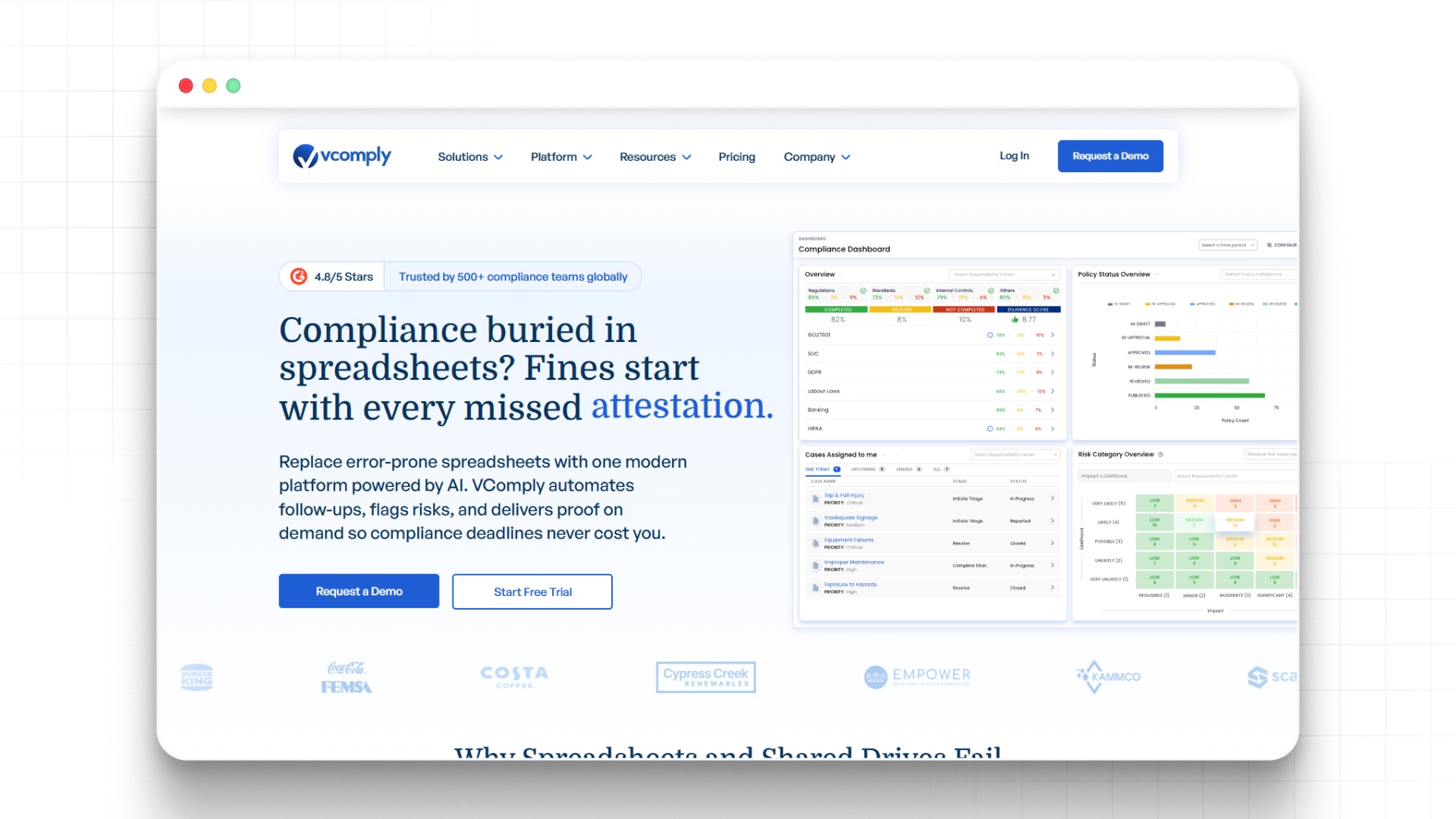
VComply addresses this by structuring policy governance into integrated workflows through PolicyOps and the broader GRC platform, ensuring that policies are not just documented but actively managed, tracked, and enforced across the organization.
- Workflow-driven policy lifecycle management: Policies move through defined stages, including drafting, review, approval, publication, and periodic updates, with clear accountability at each step
- Centralized policy repository and access control: All policies are stored in a single system with role-based access, reducing version confusion and improving accessibility
- Policy acknowledgment and tracking: Employees are required to review and acknowledge policies, creating verifiable records for compliance and audit purposes
- Ownership and accountability mapping: Each policy is assigned to a responsible owner, ensuring ongoing maintenance, updates, and enforcement
- Version control and audit trails: Every change is tracked, making it easier to demonstrate policy history, updates, and governance during audits
- Integrated compliance alignment: Policies are mapped to relevant controls and frameworks, helping organizations maintain consistency across compliance requirements
Schedule a demo with VComply to see how structured policy workflows can help your organization maintain clarity, accountability, and audit readiness at scale.
Conclusion
Policy governance depends on how consistently policies are maintained, communicated, acknowledged, and applied, not simply on whether they exist in documented form. As governance and regulatory expectations place greater emphasis on accountability and traceability, organizations need more than policy libraries. They need structured systems that support review cycles, ownership, version control, and evidence of execution.
Without that structure, outdated guidance, inconsistent enforcement, and fragmented oversight can weaken governance and reduce audit defensibility. As policy management becomes more closely tied to compliance, risk, and operational accountability, manual tracking and disconnected documentation make consistency harder to sustain at scale.
VComply addresses this by structuring policy governance into integrated workflows that connect policy lifecycle management, ownership, acknowledgments, and audit visibility within a unified system.
Start a 21-day free trial of VComply to see how your organization can bring greater control, clarity, and consistency to policy management.
FAQs
In an organizational context, a policy is a formal statement that defines expectations, boundaries, and decision-making principles for a specific area of business activity. It helps ensure consistency, accountability, and alignment across teams. Rather than serving as general guidance, a policy establishes what the organization expects to be followed.
Most organizations rely on several categories of policies, depending on their structure and risk exposure. Common examples include compliance policies, information security policies, HR and conduct policies, financial policies, and risk management policies. Each type governs a different area of responsibility and helps reduce ambiguity in decision-making.
Policy creation and management usually involve multiple stakeholders. Business leaders, compliance teams, HR, legal, IT, or risk functions may all contribute depending on the subject matter. In most organizations, effective policy governance also requires a clearly assigned owner responsible for review, updates, and oversight.
Policy development becomes difficult when organizations try to document expectations without aligning them to how work actually happens. Common challenges include unclear ownership, conflicting stakeholder input, outdated processes, and difficulty translating broad governance intent into practical guidance. Strong policies require both clarity and operational relevance.
Policies become easier to manage when they are centralized, version-controlled, regularly reviewed, and clearly assigned to responsible owners. Organizations also benefit from systems that support approvals, acknowledgments, and audit visibility. Platforms like VComply help structure policy governance more efficiently by connecting policy lifecycle activities into a more consistent and trackable process.