

Strategic Risk Management Framework: Complete 2026 Guide
Every executive knows this truth: you can have a bold strategy, a committed leadership team, and ambitious growth targets, yet still face unforeseen risks that reshape markets, regulators, or technology faster than expected. Strategic risk is more than a formality; it can change your business’s future overnight.

According to the 2025 Global Risks Report, decision-makers worldwide cite escalating geopolitical, technological, and climate threats as core strategic challenges, requiring new ways of thinking about risk and resilience. For US compliance officers, risk managers, CTOs, and CEOs, a framework is an operating model, encompassing defined roles, artifacts you produce, the cadence in which you act, and the decisions you make.
Too often, risk management is treated as a series of steps. A framework turns those steps into a reliable system that drives clarity and confidence. In this blog, we will break down what a strategic risk management framework is, why it matters, and how you can put one into action.
Key Takeaways
- A strategic risk framework aligns risks with business objectives, governance, and regulatory expectations.
- Defined ownership, risk appetite, and escalation rules ensure accountability and timely mitigation.
- Consistent scoring, KRIs, and dashboards provide decision-ready insights for leadership.
- Governance cadence, workflows, and evidence trails enhance audit readiness and compliance.
- VComply RiskOps centralizes risks, standardizes assessments, tracks treatments, and delivers leadership-ready reporting.
Did you know? Only 11% of senior finance leaders view their organization’s risk management process as a strategic tool that delivers competitive advantage, even as 61% say the volume and complexity of risks have changed significantly over the past five years. This shows how far many firms still have to go in strategic risk governance.
What A Strategic Risk Management Framework Actually Means
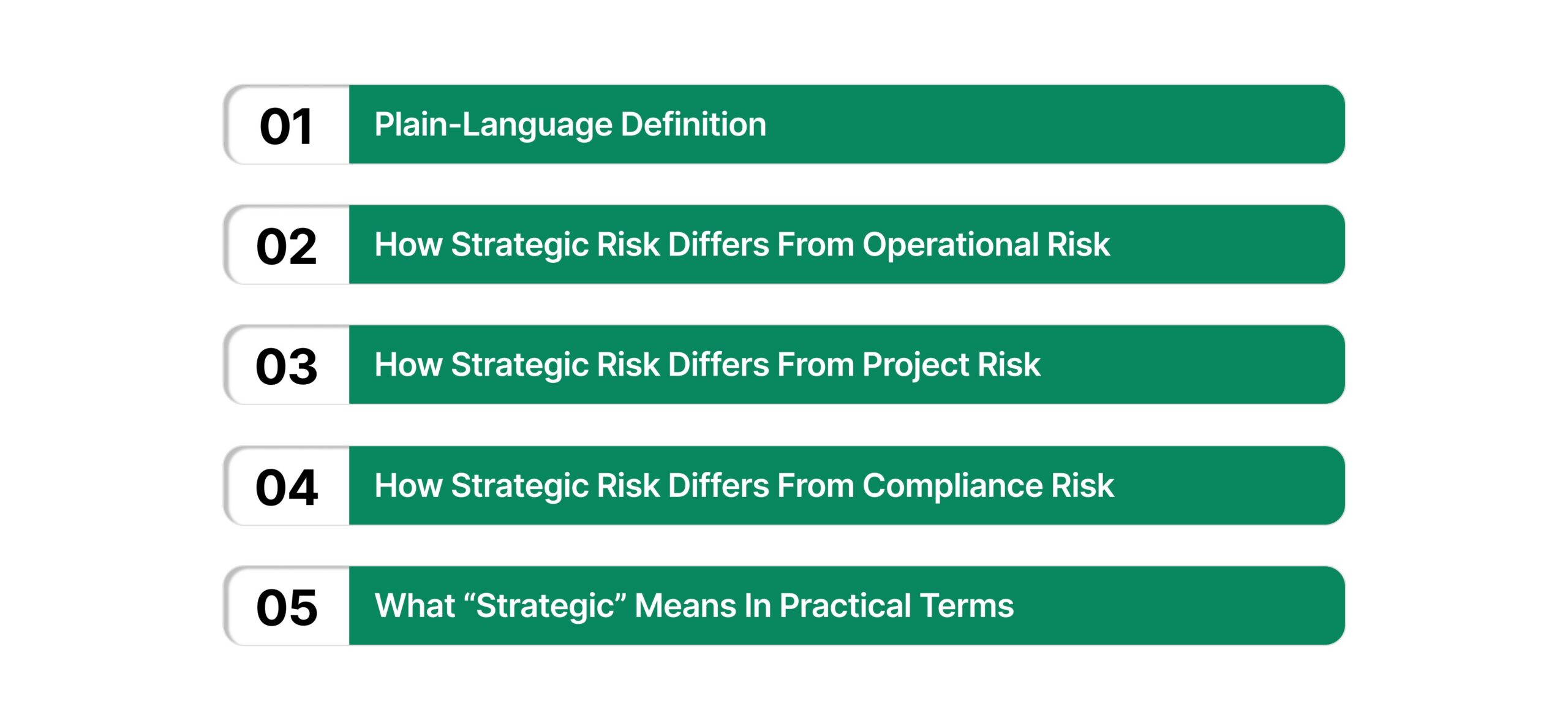
A strategic risk management framework gives you a disciplined way to govern uncertainty that can materially alter long-term outcomes. For compliance leaders, it connects enterprise strategy with regulatory exposure, financial resilience, and operational decision-making.
Below is what this framework truly encompasses in practice:
- Plain-Language Definition: A strategic risk management framework is a structured operating model that enables you to systematically identify, prioritize, treat, and monitor risks that could derail enterprise objectives, solvency expectations, or long-term competitiveness.
- How Strategic Risk Differs From Operational Risk: Operational risk focuses on day-to-day execution failures, such as process breakdowns or control lapses. Strategic risk, by contrast, examines whether core business decisions, market expansion, and technology adoption could undermine regulatory standing or capital adequacy over time.
- How Strategic Risk Differs From Project Risk: Project risk is confined to timelines, budgets, and deliverables. Strategic risk evaluates whether the initiative itself aligns with enterprise priorities, risk appetite, and regulatory expectations, especially under changing state-based regulations.
- How Strategic Risk Differs From Compliance Risk: Compliance risk addresses adherence to defined rules. Strategic risk looks upstream, assessing how regulatory change, enforcement trends, or supervisory focus areas may impact business viability before noncompliance occurs.
- What “Strategic” Means In Practical Terms: Strategic risks are tied directly to long-term goals, competitive positioning, policyholder trust, and material financial outcomes. They influence capital planning, governance decisions, and regulatory credibility, not just quarterly performance.
Also Read: Enterprise Risk Management Fundamentals Overview
Knowing what a strategic risk management framework should be is one thing; making it work in the real world is where most organizations stumble.
Why Strategic Risk Management Breaks In Real Organizations
Strategic risk programs rarely fail because leaders ignore risk. They fail because execution lacks structure, ownership, and rhythm. Leaders operating under state-based oversight, even well-designed strategies, can weaken when risk management does not function as a coordinated operating model across the enterprise.
Below are the most common failure modes that cause strategic risk management to break down:
- Fragmented Visibility Across Risk Artifacts: Strategy is documented in planning decks, risks are tracked in disconnected spreadsheets, and critical decisions occur in meetings without a unified record.
- Unclear Accountability and Risk Ownership: When ownership is distributed across functions without a formal assignment, risk responses stall. Accountability breaks next, making it difficult to demonstrate responsibility during exams or justify delayed mitigation actions.
- Misaligned Review Cadence With Risk Velocity: Many organizations review strategic risks annually, while regulatory expectations, market conditions, and technology threats evolve monthly. Cadence breaks, causing leadership to react too late to emerging supervisory concerns.
- Executive Reporting That Lacks Decision Readiness: Risk reports often summarize activity rather than implications. Evidence breaks down at this stage, leaving executives without clear insight into which risks require escalation, funding, or strategic adjustment.
Now, let us have a look at the differences between strategic and enterprise risk management.
Strategic Risk Management Vs Enterprise Risk Management
For compliance leaders, confusion often arises between strategic risk management and enterprise risk management. Both are essential, but they serve different purposes.
Below is a practical comparison that clarifies how strategic risk management fits within enterprise risk management:
| Dimension | Strategic Risk Management (SRM) | Enterprise Risk Management (ERM) |
| Scope | Focuses on risks that directly threaten long-term business objectives, market positioning, and regulatory credibility. | Encompasses all material risks across the organization, including strategic, operational, financial, and compliance risks. |
| Time Horizon | Forward-looking, typically aligned with multi-year business strategy and regulatory outlooks. | Covers both near-term and long-term risks, often aligned with annual planning and reporting cycles. |
| Owners | Executive leadership and business heads, with oversight from risk and compliance leadership. | Risk management and compliance functions, with defined roles across business units. |
| Typical Outputs | Prioritized strategic risk profiles, scenario impacts, and decision-ready insights for leadership. | Enterprise risk registers, control assessments, and consolidated risk reporting. |
| Meeting Cadence | Reviewed alongside strategic planning and leadership decision forums. | Reviewed through formal risk committees and governance meetings. |
Frameworks such as COSO ERM and ISO 31000 provide the foundation for ERM. Strategic risk management builds on that foundation by translating strategy into actionable, monitored risks, with execution supported through a unified operating layer.
With clarity on its role versus enterprise risk management, we can now break down the core building blocks that make a strategic risk framework actionable.
The Core Building Blocks Of A Strategic Risk Management Framework
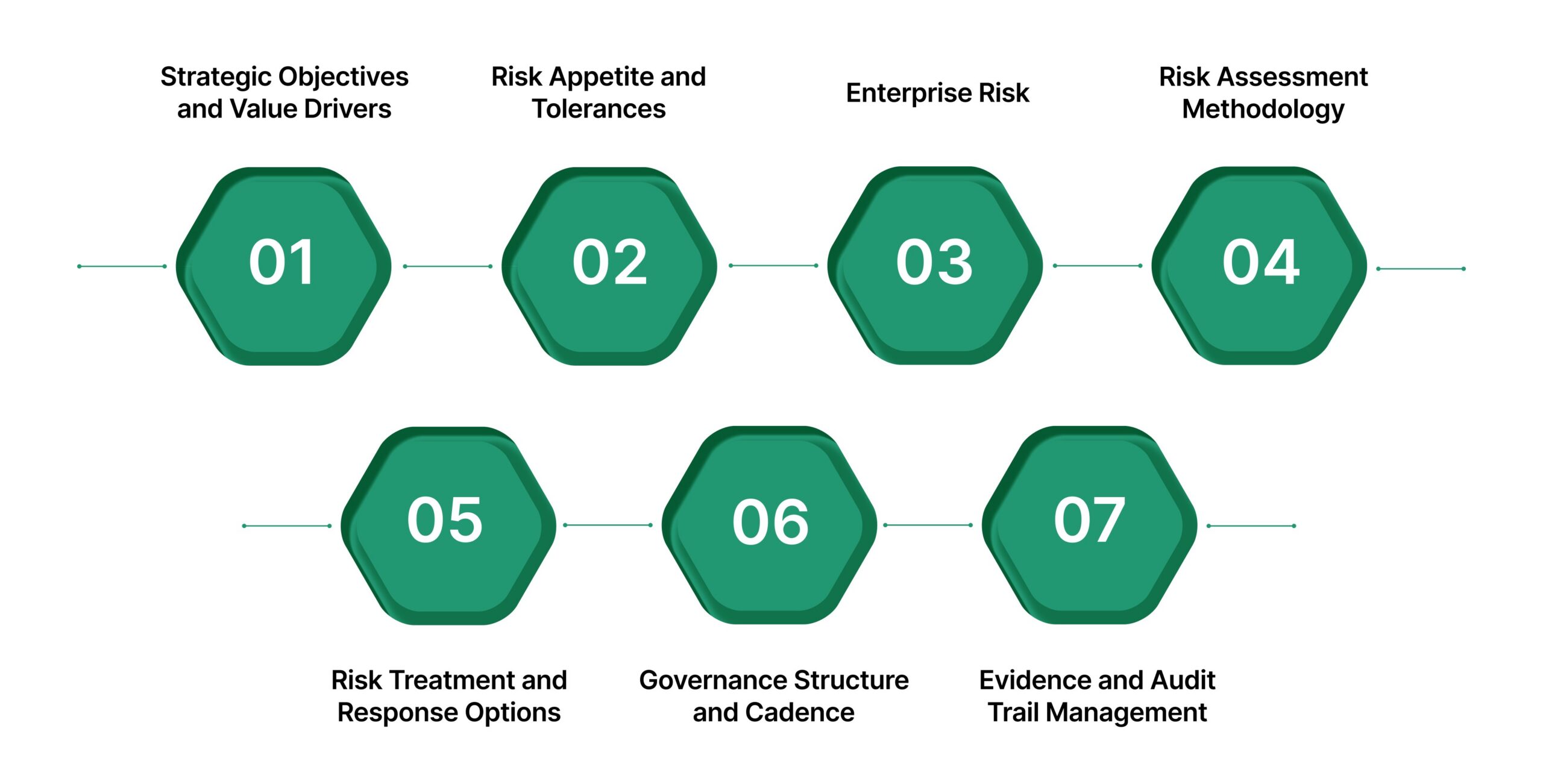
A strategic risk management framework succeeds only when its components are clearly defined and consistently applied. These building blocks ensure strategic risks are evaluated with discipline, governed with intent, and documented in a way that supports supervisory expectations and internal accountability.
Below are the essential building blocks that form a complete and executable framework:
- Strategic Objectives and Value Drivers: Clearly documented enterprise objectives and value drivers establish what must be protected. The primary artifact is a strategy-to-risk mapping document that links each objective to potential risk exposure and regulatory sensitivity.
- Risk Appetite and Tolerances: Risk appetite defines the level of uncertainty leadership is willing to accept, while tolerances set measurable boundaries. The core artifact is a formally approved risk appetite statement supported by tolerance thresholds tied to financial, operational, and regulatory outcomes.
- Enterprise Risk: A standardized risk taxonomy ensures consistency across business units and states. The artifact produced is a categorized risk library that enables aggregation, comparison, and enterprise-level reporting without reclassification during exams.
- Risk Assessment Methodology: A documented scoring approach defines how likelihood, impact, and velocity are evaluated. The resulting artifact is a calibrated risk scoring model with defined criteria that supports consistent assessment across functions.
- Risk Treatment and Response Options: Defined response pathways, avoid, reduce, transfer, or accept, guide action. Each response generates a risk treatment plan artifact outlining controls, timelines, owners, and target residual risk.
- Governance Structure and Cadence: Governance clarifies who reviews risks, how often, and for what purpose. Artifacts include a risk governance charter, committee calendar, and documented decision records.
- Evidence and Audit Trail Management: A complete evidence trail demonstrates oversight and follow-through. Artifacts include assessment records, treatment updates, approvals, and historical risk decisions, maintained to support examination and audit readiness.
Also Read: Operational Risk Management Examples and Strategies
Understanding the building blocks sets the stage for implementing your strategic risk framework step by step.
How To Build A Strategic Risk Management Framework Step By Step
Building a strategic risk management framework requires more than sequencing activities. It demands discipline, governance, and repeatability that align risk decisions with enterprise strategy.
The steps below outline how to operationalize a strategic risk management framework that moves from intent to execution:
Step 1: Anchor The Framework To Strategic Objectives
Strategic risk management begins by grounding risk discussions in clearly defined business objectives. Without this anchor, risk management becomes reactive and difficult to defend during examinations.
Below is how to effectively anchor the framework to strategic objectives:
- Translate Strategy Into Measurable Objectives: Convert high-level strategy into specific, measurable objectives that reflect regulatory, financial, and operational priorities. Each objective should be documented with clear success criteria to support consistent evaluation across state-regulated operations.
- Define Objective-Specific Failure Conditions: Establish what failure looks like for each objective by identifying conditions that would trigger regulatory concern, financial strain, or reputational impact. These failure definitions form the basis for identifying and prioritizing strategic risks.
- Engage Executive and Functional Leadership Early: Assign an executive sponsor accountable for each strategic objective and involve functional leaders who influence outcomes.
Step 2: Define Risk Appetite, Tolerances, and Escalation Triggers
Once objectives are established, you must clarify how much risk leadership is willing to accept while pursuing them. Below is how to formalize risk appetite and escalation in a way regulators and executives expect:
- Document A Plain-Language Risk Appetite Statement: Articulate leadership’s overall willingness to accept risk using clear, non-technical language. The statement should reference regulatory standing, capital protection, and policyholder obligations, making it understandable to both business leaders and examiners.
- Set Objective-Level Risk Tolerances: Define acceptable risk levels for each strategic objective using measurable limits. These tolerances establish boundaries for financial exposure, operational disruption, and regulatory impact, ensuring consistent decision-making across functions and jurisdictions.
- Establish Clear Escalation Triggers: Specify the conditions that require leadership review or intervention. Escalation rules remove ambiguity by defining when risks must move beyond operational management to formal governance channels.
- Apply A Standardized Escalation Template: Use a consistent rule, such as: If a risk score exceeds X or a key risk indicator crosses Y, escalate to the Z committee within a defined timeframe. This structure supports timely action and creates defensible evidence during regulatory examinations.
VComply Compliance Ops simplifies the creation, tracking, and enforcement of risk tolerances and escalation triggers. By embedding regulatory requirements into your workflows, Compliance Ops ensures consistent adherence across all operations and provides an audit-ready record of every decision and action.
Step 3: Identify Strategic Risks Using Structured Inputs
Identifying strategic risks requires discipline and multiple inputs, not informal brainstorming. This approach strengthens credibility with regulators by demonstrating that risks are identified systematically and not after issues surface.
Below are structured methods to identify strategic risks comprehensively:
- Environmental Scanning and PEST-Style Review: Assess external factors such as regulatory change, economic conditions, technological developments, and social trends. This review helps surface emerging risks tied to shifts in state oversight, data protection expectations, and market behavior.
- Objective-Specific SWOT Analysis: Apply SWOT analysis to each strategic objective to uncover internal vulnerabilities and external threats. This method ensures risks are directly connected to defined objectives rather than generalized enterprise concerns.
- Forward-Looking Scenario Planning: Develop three to five plausible scenarios over a 12–24 month horizon that reflect regulatory, financial, and operational stress conditions. Scenario outcomes reveal risks that may not appear in historical data but could materially impact solvency or compliance.
- Stakeholder Risk Input Collection: Gather structured input from key stakeholders, including business leaders, vendors, customers, and regulatory-facing teams. These perspectives help identify third-party dependencies and supervisory risks often missed by internal assessments.
- Strategic Risk Register As The Core Output: Document all identified risks in a centralized register that explicitly links each risk to its associated strategic objective, ensuring traceability, accountability, and exam-ready documentation.
Step 4: Assess and Prioritize Risks In A Way Leaders Can Use
Once strategic risks are identified, the assessment must translate complexity into clarity for leadership. Below is how to assess and prioritize strategic risks for executive and board-level use:
- Apply Likelihood and Impact With Business-Relevant Criteria: Evaluate each risk based on probability and impact, defining impact in terms that leaders recognize, including revenue implications, operational disruption, regulatory exposure, policyholder safety, and reputational damage.
- Incorporate Risk Velocity As A Priority Driver: Assess how quickly a risk could materialize once conditions change. High-velocity risks require earlier intervention, even when the likelihood appears moderate, especially in rapidly changing regulatory or market environments.
- Assess Data Confidence and Assumption Strength: Rate the confidence level of each assessment by evaluating data quality and underlying assumptions. This transparency helps leaders understand where judgment plays a larger role and where additional monitoring may be required.
- Produce Decision-Ready Risk Outputs: Document results in a visual heatmap, a ranked list of top strategic risks, and a concise explanation of why each risk matters.
Step 5: Decide Risk Responses and Build A Treatment Plan
Risk assessment has value only when it leads to disciplined action. Effective treatment connects intent, execution, and measurable outcomes across business, technology, and compliance functions.
Below is how to design risk responses and treatment plans that withstand leadership and examiner scrutiny:
- Select an Appropriate Risk Response Strategy: Determine whether to avoid, reduce, transfer, or accept each strategic risk based on its priority and alignment with risk appetite. This decision should be documented with a clear rationale to support future review.
- Map Controls to Risk Drivers: Identify existing and planned controls that directly address the root causes of each risk. Control mapping clarifies what will be implemented or strengthened to achieve the desired risk reduction.
- Assign Resources and Timeline Ownership: Define accountable owners for each treatment action, along with required resources and completion timelines. Clear ownership ensures progress tracking and prevents stalled mitigation efforts.
- Identify Critical Dependencies Early: Document dependencies on technology platforms, policy updates, third-party vendors, or regulatory approvals. Managing these dependencies reduces execution delays and supports coordinated risk reduction.
- Measure Treatment Effectiveness and Residual Risk: Structure each treatment plan with defined milestones and a target residual risk level.
Step 6: Operationalize Ownership, Governance, and Cadence
Strategic risk management becomes sustainable only when ownership, governance, and review cadence are formally embedded into enterprise operations. Below is how to operationalize ownership and governance with clarity and consistency:
- Define Clear Risk Ownership Roles: Assign a risk owner responsible for executing treatment actions, a risk sponsor accountable for resolving escalations and resource constraints, and a risk committee authorized to review, challenge, and approve strategic risk priorities.
- Establish A Structured Review Cadence: Conduct monthly operational risk reviews to track treatment progress, quarterly strategic risk reviews with leadership to reassess priorities, and scheduled board-level reporting where required by governance or regulatory expectations.
- Align Governance With State-Based Oversight: Ensure governance forums reflect the structure of state-regulated operations, allowing risks to be escalated appropriately across entities while maintaining enterprise-level visibility and control.
- Produce Governance and Reporting Artifacts: Maintain a documented governance map outlining roles and decision rights, along with a formal reporting calendar that demonstrates consistent oversight and supports examination readiness.
Step 7: Monitor With KRIs, Thresholds, and Decision-Ready Reporting
Ongoing monitoring transforms strategic risk management from a periodic review into a continuous discipline. Below is how to monitor strategic risks using meaningful indicators and executive-ready reporting:
- Differentiate Key Risk Indicators From Key Performance Indicators: KRIs signal potential risk exposure before objectives are impacted, while KPIs measure performance after outcomes occur.
- Define Thresholds and Escalation Triggers: Establish clear thresholds for each KRI that indicate when risk levels are approaching or exceeding tolerance. These triggers ensure risks are escalated according to governance rules rather than subjective judgment.
- Implement Structured Exception Management: Define what happens when thresholds are breached, including required actions, escalation timelines, and documentation standards. This process ensures deviations are addressed consistently and recorded for examination purposes.
- Create A One-Page Executive Dashboard Specification: Design a dashboard that presents top risks, KRI status, trend indicators, and required actions in a single view.
VComply Risk Ops centralizes your strategic risks, applies standardized scoring across likelihood, impact, and velocity, and automatically produces leadership-ready heatmaps and dashboards. Strengthen your risk posture with Risk Ops and ensure every risk is tracked, prioritized, and visible to leadership in real time.
Also Read: End-to-End Supply Chain Risk Management: Best Practices & Solutions
With your framework in place, it’s time to measure it in a way that’s clear, consistent, and actionable.
How To Measure Strategic Risk Without Overcomplicating It
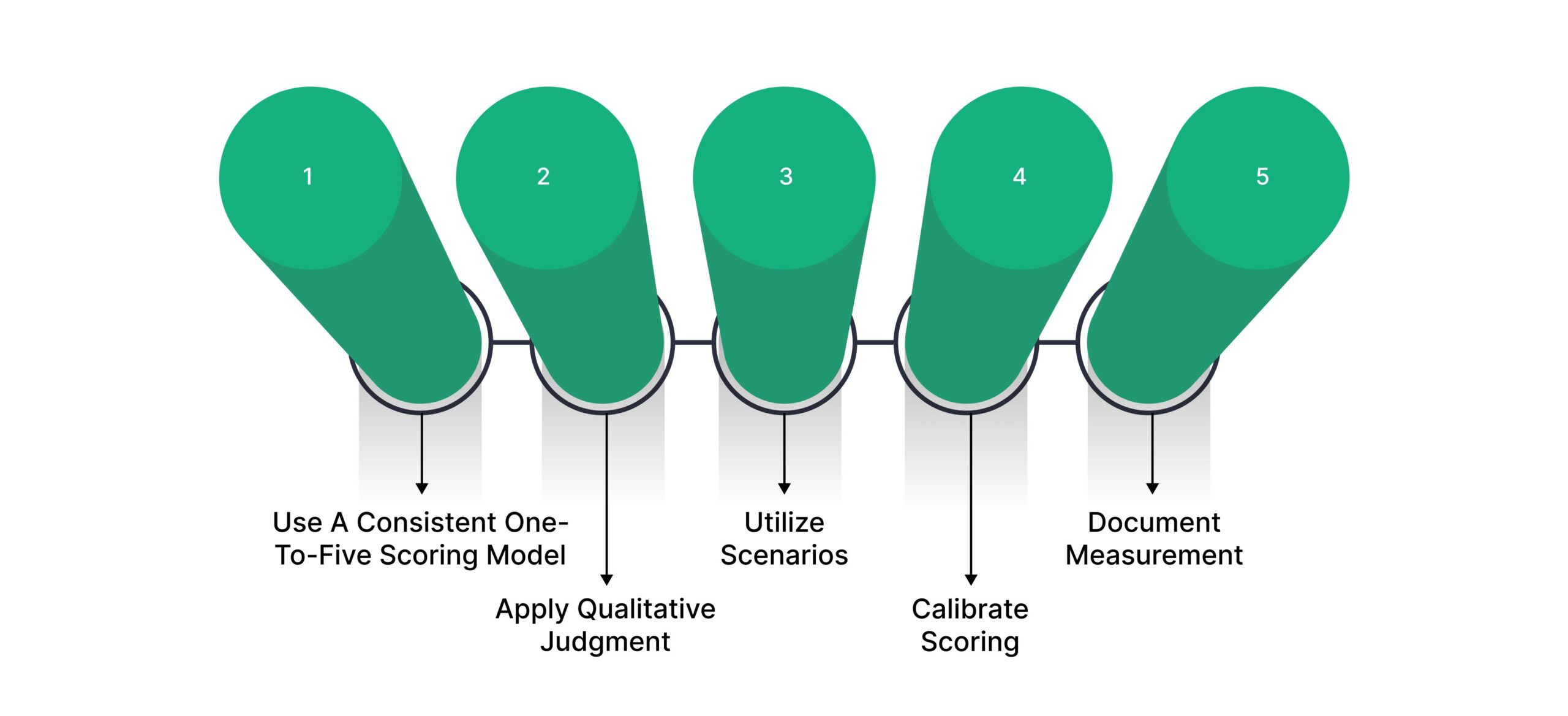
Measuring strategic risk does not require complex models or excessive data. A practical measurement approach enables comparability across state-regulated operations while remaining defensible during examinations and leadership reviews.
Below are proven methods to measure strategic risk with clarity and discipline:
- Use A Consistent One-To-Five Scoring Model: Apply a simple 1–5 scale for likelihood and impact across all strategic risks. Consistency matters more than precision, as it allows leadership to compare risks objectively and identify priorities without reinterpreting scoring logic.
- Apply Qualitative Judgment Where Data Is Limited: Use informed judgment when historical data is unavailable or emerging risks are involved. Document assumptions and rationale clearly to demonstrate thoughtful evaluation during regulatory or internal review.
- Utilize Scenarios For Forward-Looking Risks: Use scenario analysis when risks are driven by regulatory change, market disruption, or technology evolution. Historical data is more appropriate for stable, recurring risk patterns with established trends.
- Calibrate Scoring Across Teams and Entities: Conduct periodic calibration sessions to align scoring standards across departments and state-regulated entities. Calibration prevents score inflation or deflation and ensures enterprise-level comparability.
- Document Measurement Logic and Outcomes: Maintain clear records of scoring criteria, assumptions, and results. This documentation supports transparency, repeatability, and exam readiness while reinforcing governance discipline.
Now, let us have a look at how a mature program unfolds over the first 90 days.
What A Mature Strategic Risk Program Looks Like At 30, 60, and 90 Days
Implementing a strategic risk program requires a phased approach to ensure consistency, accountability, and actionable insights. A structured 30/60/90-day roadmap aligns risk oversight with strategic objectives, governance expectations, and regulatory readiness, while building a sustainable operating rhythm.
Below is what a mature strategic risk program achieves over the first three months:
- 30 Days: Establish Baseline Objectives and Initial Risk Register: Map strategic objectives to risks and create an initial risk register. Apply a consistent scoring methodology to assess likelihood, impact, and velocity, producing a defensible baseline for leadership and audit purposes.
- 60 Days: Define Appetite, Tolerances, and Governance Cadence: Finalize risk appetite and objective-level tolerances. Establish governance forums and reporting cadence, and prepare the first leadership report summarizing prioritized risks, treatment plans, and accountability assignments.
- 90 Days: Implement KRIs, Treatment Tracking, and Repeatable Review Cycle: Deploy key risk indicators, track mitigation actions, and formalize a recurring review cycle. This ensures ongoing monitoring, continuous improvement, and audit-ready evidence of structured risk management across state-regulated operations.
Seeing the first 90 days of a mature program highlights common pitfalls that can derail even the best-intended frameworks.
Common Mistakes That Make Strategic Risk Frameworks Useless

Even well-intentioned strategic risk programs can fail when execution flaws undermine their purpose. Below are the most frequent mistakes that render strategic risk frameworks ineffective:
- Treating the Framework As Documentation Only: Using the framework merely to document risks without linking them to decisions and mitigation actions diminishes its value and weakens leadership confidence.
- Absence of Thresholds, Triggers, and Urgency: Without defined thresholds and escalation triggers, risks go unaddressed until they materialize, undermining regulatory expectations and proactive management.
- Overloading With Unprioritized Risks: Including too many risks without ranking by impact, likelihood, and velocity dilutes focus, leading to ineffective monitoring and decision-making.
- Lack of Clear Ownership and Follow-Through: When no individual or function is accountable for mitigation, risk treatment stalls, and leadership cannot demonstrate control during examinations.
- No Single Source of Truth: Maintaining multiple registers or spreadsheets creates confusion, reduces visibility, and hinders consistent reporting for audits and leadership oversight.
VComply’s GRCOps Suite integrates risk, compliance, policy, and incident management into a single operating layer. From centralizing strategic objectives and risk owners to tracking mitigation and automating workflows, GRCOps gives US compliance leaders a unified, auditable system that simplifies oversight and enhances enterprise resilience.
Avoiding these common mistakes sets the stage for how VComply RiskOps can operationalize a truly effective strategic risk framework.
How VComply RiskOps Supports A Strategic Risk Management Framework
Implementing a strategic risk management framework requires an operational layer that ensures consistency, accountability, and transparency across all steps. VComply RiskOps provides a centralized system that supports alignment, assessment, treatment, and monitoring while enhancing governance, reporting, and audit readiness.
Below is how VComply RiskOps operationalizes each framework component and integrates the broader GRCOps suite:
- Centralized Risk, Objective, Ownership, and Evidence Management: RiskOps consolidates all strategic objectives, associated risks, assigned owners, and supporting documentation in a single system. ComplianceOps ensures regulatory obligations are embedded within risk activities, PolicyOps governs procedures and control requirements, and CaseOps tracks incidents and remediation actions, creating a unified GRC operating model.
- Standardized Scoring and Consistent Assessments: Risk scoring methodologies, including likelihood, impact, velocity, and confidence, are applied consistently across all risks.
- Automated Workflows For Assignments and Follow-Ups: Treatment actions are converted into automated workflows, assigning tasks to owners, notifying sponsors, and tracking completion.
- Leadership-Ready Reporting and Dashboards: RiskOps generates executive dashboards and reports that consolidate KRIs, treatment status, and top risks on a single page.
- Audit-Friendly Traceability: Every action, update, and approval is logged with time stamps and user details, creating a comprehensive evidence trail. This ensures all framework steps, alignment, assessment, treatment, and monitoring are transparent, defensible, and ready for audit or regulatory review, demonstrating structured, accountable, and repeatable risk management.
Also Read: Top NAVEX Alternative for Risk Management in 2026
With VComply RiskOps providing the operational core, your strategic risk framework moves from theory to actionable, audit-ready practice. See how it works in action and explore how VComply can strengthen your risk operations by booking a demo today.
Final Thoughts
A strong strategic risk management framework transforms how organizations anticipate, prioritize, and respond to risks that could threaten long-term objectives. By embedding structured assessment, treatment, and monitoring processes, US compliance leaders can enhance resilience and make informed, timely decisions across all operations.
VComply RiskOps and the broader GRCOps suite provide the operational core to implement this framework effectively. From centralizing risk data and assigning clear ownership to automating workflows and producing leadership-ready dashboards, VComply ensures that every step of your strategic risk program is measurable, traceable, and audit-ready.
Experience how VComply can streamline your strategic risk management program. Start your free trial today and gain immediate visibility and control over your enterprise risks.
FAQs
A strategic risk management framework includes clear strategic objectives, defined risk appetite and tolerances, an enterprise risk taxonomy, structured assessment methods, treatment strategies, key risk indicators, governance and cadence, and audit-ready documentation.
Integration involves linking identified strategic risks to enterprise objectives, planning cycles, and resource allocation. By embedding risk evaluation into budgeting, strategic initiatives, and operational planning, leaders ensure decisions are informed, mitigations are funded, and regulatory obligations are considered before executing business strategy.
Ownership should include executive sponsors accountable for strategic objectives, risk owners executing mitigation, functional leaders providing operational input, and a risk committee overseeing prioritization and approvals. Clear roles ensure accountability, timely actions, and evidence of governance for leadership and regulators.
Strategic risk assessments should occur regularly, typically quarterly or in alignment with significant business events. High-velocity or regulatory-sensitive risks may require more frequent evaluation. Continuous monitoring ensures timely detection, escalation, and corrective action, supporting leadership decision-making and regulatory compliance.
Strategic risk relates to decisions impacting long-term objectives, competitive position, and regulatory compliance. Financial risk focuses on capital, liquidity, and market exposure. While financial risk is quantifiable and often short-term, strategic risk encompasses broader enterprise implications that may indirectly affect financial stability and operational resilience.