

Master 2026 Compliance With Risk Management and Governance Practices
What if a company’s biggest blind spot isn’t hidden risk, but how it governs and manages it?
In 2026, compliance failures are less about missing policies and more about weak oversight, unclear accountability, and disconnected risk decisions.
A 2025 survey found that 61% of executives report rising risk complexity, yet only 32% believe their risk oversight is mature or robust, leaving the majority exposed to unexpected threats and regulatory enforcement.
In this blog, we’ll walk you through why risk management and governance practices are critical for 2026 compliance, how weak execution creates financial and operational fallout, and what high-performing organizations are doing differently to align oversight with real-world risk, before the next audit or regulatory challenge arrives.
Key Takeaways
- Risk governance and management are strategic necessities, not optional, for U.S.-regulated organizations in 2026.
- Traditional approaches fail due to manual tracking, disconnected tools, unclear accountability, and periodic assessments.
- Effective programs link risks, controls, and incidents, enable continuous monitoring, and embed governance into board reporting.
- Clear ownership and actionable risk appetite accelerate remediation and strengthen audit defensibility.
- Proactive risk practices transform compliance into a business advantage, improving decision-making, reducing exposure, and ensuring regulatory readiness.
What Governance and Risk Management Practices Actually Mean
Governance and risk management practices explain how an organization makes risk decisions, who is accountable for them, and how those decisions are carried out and monitored. Regulators and boards do not evaluate intent; they look for structure, consistency, and evidence.
Risk governance establishes who sets the rules and who is ultimately accountable for risk outcomes. It operates at the board and executive level and provides direction to the entire organization.
In practice, effective risk governance includes:
- A formally approved risk appetite statement
- Clear escalation rules when risks exceed tolerance
- Regular board-level visibility into top enterprise risks and trends
Without governance, risk decisions become inconsistent, undocumented, and difficult to defend during audits or enforcement actions.
Risk management is the day-to-day execution of governance decisions. It translates oversight into action across the organization.
Risk management focuses on:
- Identifying risks across operational, regulatory, cyber, financial, and third-party areas
- Assessing risks using consistent criteria for likelihood and impact
- Implementing controls and tracking their effectiveness
- Monitoring changes and responding to incidents or issues
How Governance and Risk Management Work Together
The two functions serve different purposes but must operate as one system.
| Risk Governance (Direction) | Risk Management (Execution) |
| Sets risk appetite | Scores and prioritizes risks |
| Assigns accountability | Implements controls |
| Reviews risk posture | Tracks issues and remediation |
| Escalates exceptions | Provides evidence and metrics |
With clear definitions in place, you might wonder why these practices aren’t optional anymore. They’re survival tools against exploding regulatory costs and boardroom pressures.
Why Risk Governance and Management Practices Are Now a Business Imperative
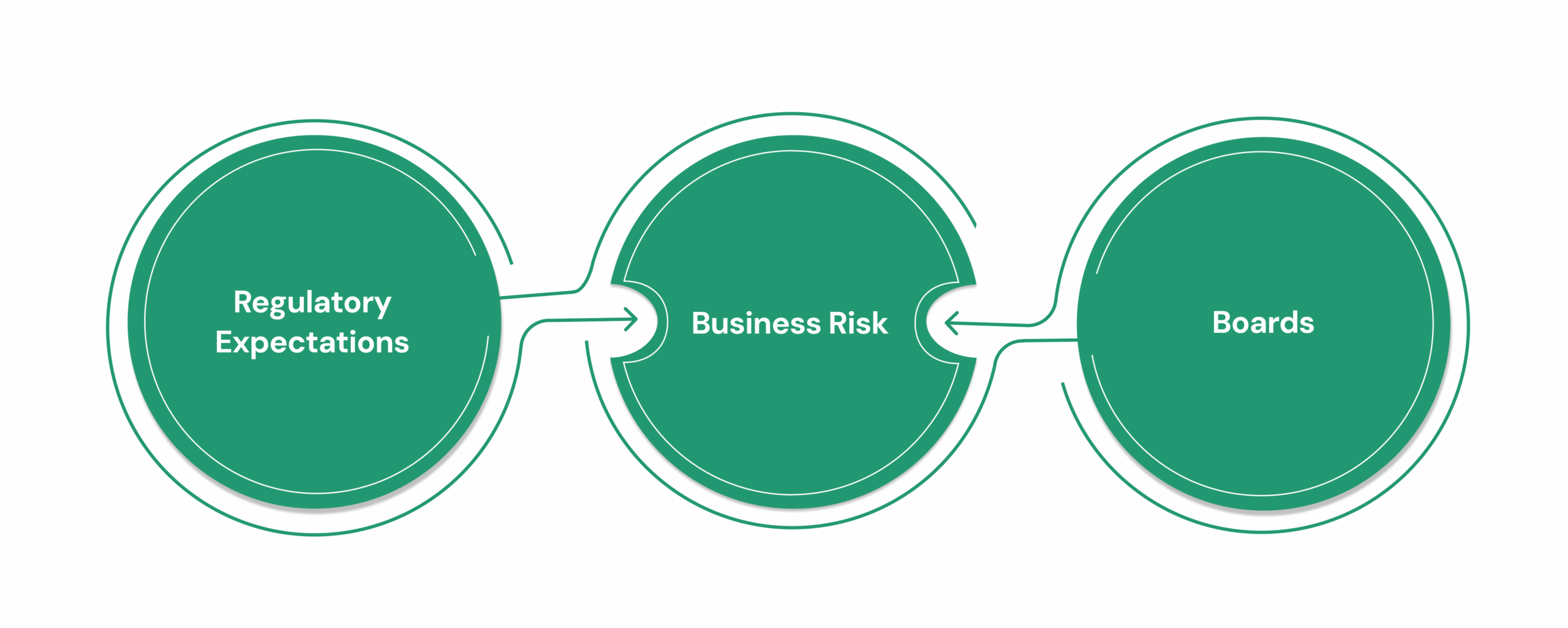
Risk governance and management practices are no longer about avoiding audit findings alone. They now directly influence financial stability, operational continuity, regulatory standing, and executive accountability. For regulated US organizations, weak risk practices translate into measurable business consequences.
1. Regulatory Expectations Have Shifted From Documentation to Execution
US regulators increasingly assess how risks are governed and managed in practice, not whether policies exist. They now expect evidence of:
- Defined ownership for material risks
- Continuous risk monitoring, not annual assessments
- Escalation and remediation when controls fail
- Board-level awareness and involvement
Organizations that cannot demonstrate this execution face higher scrutiny, longer audits, and enforcement risk, even if they are technically “compliant” on paper.
2. Business Risk Is No Longer Isolated; It Cascades Quickly
Operational, cyber, third-party, and compliance risks are now tightly connected. A breakdown in one area often triggers failures across others. Examples leaders recognize immediately:
- A vendor control gap becomes a data breach
- A policy exception becomes a regulatory finding
- An unresolved audit issue becomes a board concern
Without structured governance and coordinated risk management, these risks are identified too late and addressed too slowly.
3. Boards and Executives Are Personally Accountable
Risk oversight has become a board-level responsibility, not a back-office function. Leadership is now expected to:
- Approve risk appetite and tolerance
- Review risk trends and emerging threats
- Question unresolved issues and remediation delays
Poor risk governance exposes executives to reputational damage, regulatory questioning, and loss of stakeholder confidence.
If strong risk governance is now a business requirement, the uncomfortable truth is that most organizations are still operating with risk practices that were never designed for today’s regulatory and operational complexity.
The Reality Check: How Most Organizations Handle Risk Today and Why It Fails
Most US finance, healthcare, and energy firms still rely on spreadsheets and annual reviews for risk management, leaving compliance officers chasing manual updates while boards get outdated snapshots.
Teams track SOX controls in Excel files shared via email, assess HIPAA risks through quarterly meetings without real-time data, and monitor NERC CIP standards via paper checklists that pile up on desks.
This gap between intent and execution is where risk programs break down.
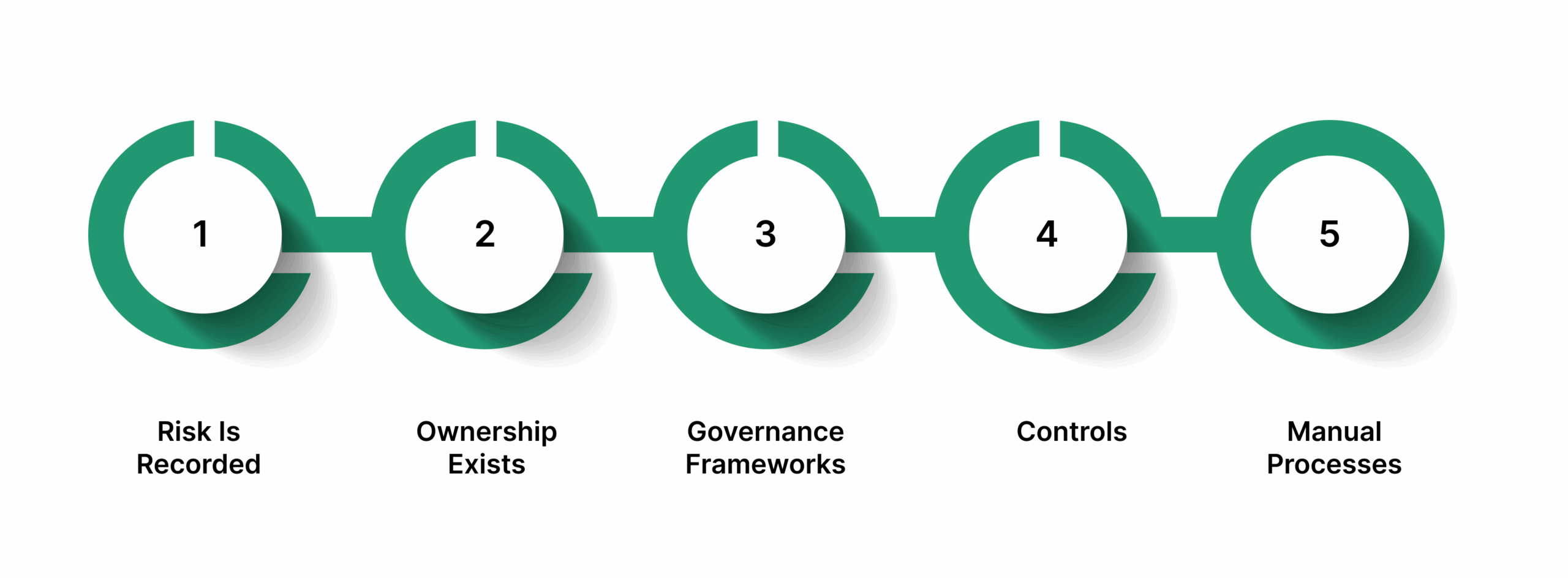
1. Risk Is Recorded, Not Actively Managed
In many organizations, risk management is limited to documenting risks in spreadsheets or static tools. These records are updated infrequently and rarely connected to controls, incidents, or audit findings.
As a result, risk data reflects past conditions rather than current exposure, causing emerging threats such as cyber incidents to surface only after impact has occurred.
2. Ownership Exists on Paper, Not in Execution
Risk ownership is often assigned but not enforced. Multiple teams may appear responsible for the same risk, escalation paths are unclear, and remediation actions stall without consequence.
This lack of accountability extends issue lifecycles and signals weak governance to regulators, who view unresolved risks as a failure of oversight rather than capacity.
3. Governance Frameworks Are Defined but Not Applied
Organizations frequently adopt COSO, NIST, or ISO frameworks but fail to embed them into daily decision-making. Risk appetite statements are approved but rarely referenced, board reports summarize risk without prompting action, and governance committees operate without timely data.
This gap between framework and execution limits leadership’s ability to intervene early.
4. Controls Are Audited Instead of Continuously Evaluated
Control testing is commonly confined to audit cycles rather than ongoing risk monitoring. Findings are tracked separately from risk assessments, and incidents are not used to strengthen control design.
This siloed approach allows the same weaknesses to reappear across audits, increasing regulatory scrutiny and remediation costs.
5. Manual Processes Introduce Hidden Operational Risk
Heavy reliance on spreadsheets, email, and disconnected tools creates data gaps, delays reporting, and weakens audit evidence. These manual processes increase operational risk while consuming time and resources that compliance and risk teams need for proactive oversight.
Once the limits of traditional risk programs are clear, the next step is knowing exactly what to put in place, practices that hold up under regulatory scrutiny and real operational pressure.
7 Proven Risk Governance and Management Practices for 2026
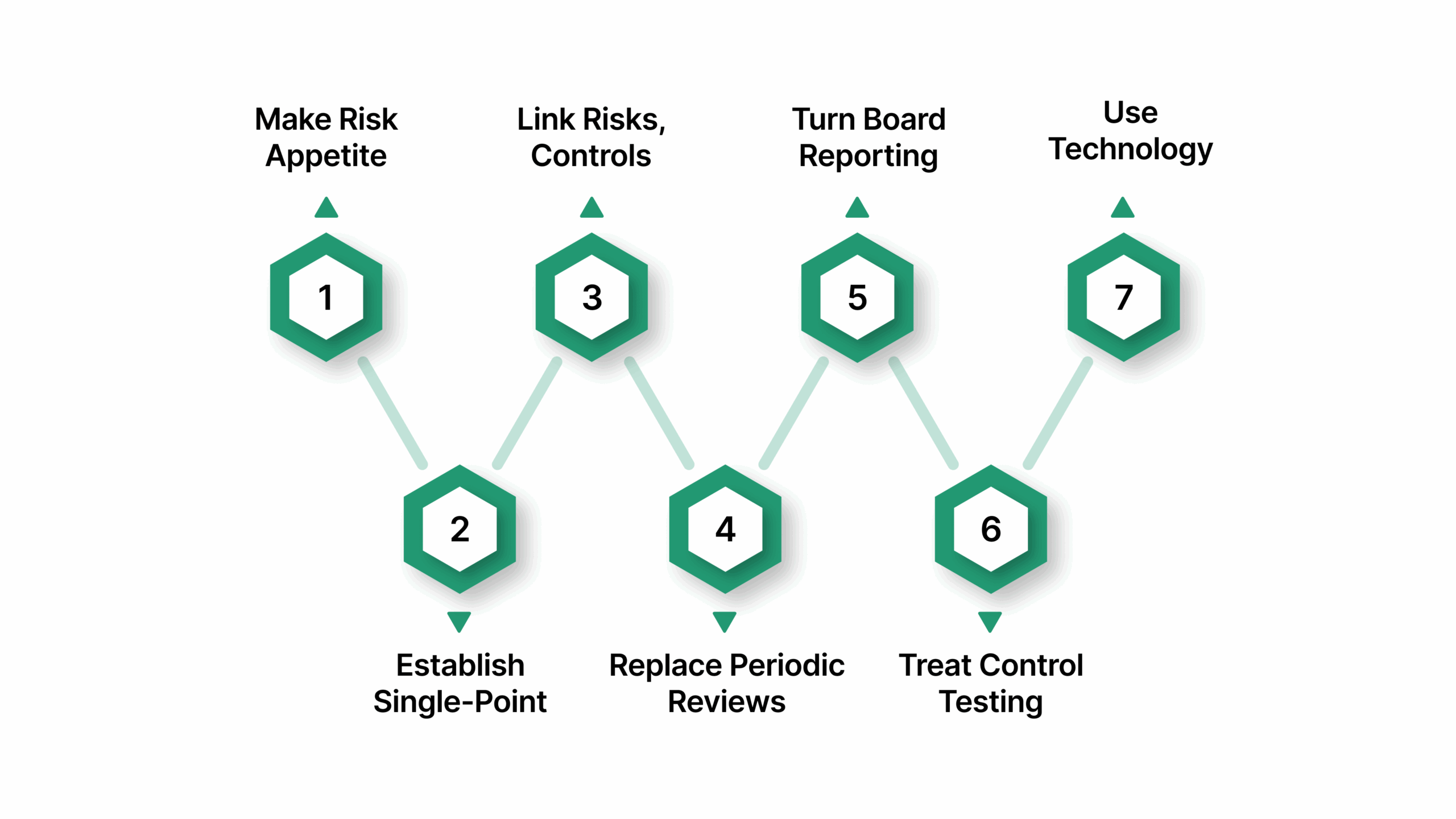
These practices reflect what regulators, boards, and high-performing organizations increasingly expect. Each one addresses a specific failure point seen in traditional risk programs and translates governance into measurable execution.
1. Make Risk Appetite an Operating Rule, Not a Policy Statement
Risk appetite should actively guide decisions across the organization. Leading teams define measurable tolerance thresholds and embed them into approvals, exception handling, and escalation workflows.
When a threshold is breached, predefined actions are triggered, including additional controls, executive review, or formal risk acceptance.
Risk limits directly influence business decisions and regulatory responses.
2. Establish Single-Point Accountability for Every Material Risk
Clear accountability requires one designated owner per risk with authority to act, supported by contributing teams. What effective ownership includes:
- Responsibility for risk assessment and scoring
- Authority to approve or escalate mitigation actions
- Accountability for remediation through closure
This model shortens issue resolution timelines and removes ambiguity during audits.
3. Link Risks, Controls, and Incidents Into One Continuous View
Risk governance breaks down when risks are tracked separately from controls, audits, and incidents. High-maturity programs connect these elements so that control failures or incidents immediately update risk exposure and trigger reassessment.
It prevents recurring findings and ensures risk posture reflects reality, not assumptions.
4. Replace Periodic Reviews With Continuous Risk Monitoring
Static reviews cannot keep pace with modern risk velocity. Leading organizations define key risk indicators and monitor them continuously, using automated alerts to flag deviations before they escalate. This approach:
- Improves response time
- Reduces surprise audit findings
- Supports real-time decision-making
5. Turn Board Reporting Into a Governance Tool
Board reporting should enable action, not just awareness. Effective reports focus on trend changes, tolerance breaches, unresolved issues, and decision points.
| Traditional Reporting | Effective Governance Reporting |
| Static summaries | Trend-based insights |
| Historical data | Threshold and exception alerts |
| Informational | Decision-driven |
6. Treat Control Testing as an Ongoing Discipline
Control effectiveness should be evaluated continuously, not only during audits. Findings must feed directly back into risk scoring and control redesign. When control testing is continuous:
- Weaknesses are addressed earlier
- Audit cycles become faster and less disruptive
- Repeat findings decline significantly
7. Use Technology to Enforce Governance at Scale
Manual tools cannot sustain modern risk governance. High-performing organizations use technology to enforce ownership, automate workflows, and maintain audit-ready evidence.
| Governance Need | Manual Approach | Modern Practice |
| Risk visibility | Spreadsheets | Central dashboards |
| Accountability | Email tracking | Automated ownership |
| Audit evidence | Ad hoc files | System-generated logs |
Technology ensures governance is executed consistently, not just documented.
Now that we understand the seven essential practices for effective risk governance and management, the next step is implementing them in a way that ensures compliance, accountability, and operational efficiency, exactly where VComply delivers measurable impact.
How VComply Supports Governance and Risk Management Practices End-to-End
VComply is a cloud-based GRC platform that centralizes governance, risk, and compliance processes, enabling organizations to track, manage, and mitigate risks effectively. It ensures accountability, continuous monitoring, and audit-ready evidence across the enterprise.
Key solutions for governance and risk management:
- RiskOps: Map risk appetite, score risks, and monitor exposure in real time.
- CaseOps: Assign clear ownership, track remediation, and escalate issues automatically.
- ComplianceOps: Link controls to risks and incidents, schedule audits, and evaluate effectiveness continuously.
- PolicyOps: Centralize policy management, enforce version control, and capture acknowledgments.
- GRCOps: Provide unified dashboards, board-level insights, and cross-functional oversight.
Take control of your risk governance and compliance workflows today. Start your 21-day free trial of VComply and ensure 2026-ready risk management practices.

Summing Up
Effective risk governance and management practices are no longer optional; they are a strategic necessity for US-based organizations operating in regulated industries. Traditional approaches that rely on spreadsheets, disconnected tools, or annual assessments leave gaps in accountability, visibility, and compliance readiness.
By defining clear risk appetite, assigning single-point accountability, linking risks to controls and incidents, enabling continuous monitoring, and embedding governance into board-level reporting, organizations can transform risk management from a reactive task into a proactive, measurable business discipline.
VComply provides an end-to-end solution that operationalizes these practices, ensuring real-time visibility, automated workflows, and audit-ready evidence.
With modules like RiskOps, ComplianceOps, CaseOps, and GRCOps, organizations can centralize governance, streamline risk management, and demonstrate compliance confidently across all regulatory frameworks.
Strengthen your enterprise risk posture, book a demo today!
FAQs
Risk governance defines accountability, decision rights, and oversight at the board or executive level, while risk management focuses on identifying, assessing, and mitigating risks operationally. Both must work together for effective risk control.
Effectiveness can be measured through timely remediation of issues, adherence to risk appetite, continuous monitoring metrics, reduction in repeat audit findings, and board-level visibility of actionable risk trends.
No. Manual registers and spreadsheets cannot provide real-time visibility, automated escalation, or audit-ready evidence, which regulators and boards increasingly require for enterprise risk programs.
When risks, controls, and incidents are connected, organizations can immediately see the impact of failures, prioritize remediation, prevent recurring issues, and provide actionable insight to leadership.
Technology enables automation, visibility, and traceability, but human judgment is still required for risk appetite decisions, escalation approvals, and strategic prioritization. The combination ensures proactive, defensible governance.