

Understanding Regulatory Compliance Management in the U.S.
Regulatory compliance management provides a structured approach for organizations to identify relevant laws, implement controls to meet those requirements, and continuously verify that those controls are working. By turning legal obligations into clear policies, procedures, and evidence-based practices, companies can operate ethically and reduce the risk of violations. In essence, it helps businesses stay compliant, transparent, and prepared to demonstrate accountability at any time.

Facing overlapping federal, state, and industry rules, compliance officers, legal teams, banks, fintechs, and multinational businesses find it hard to stay current and prove controls to auditors while working with limited staff and budgets. 2025 statistic (U.S. government): The SEC reported it filed 200 total enforcement actions in the first quarter of fiscal year 2025. By following the practical checklist and state-aware framework here, you will reduce fines, manage vendor risk, demonstrate regulatory readiness to auditors and investors, and preserve customer trust effectively as the business scales. This guide gives a prioritized roadmap so you can map obligations, implement risk-based controls, automate monitoring, and create audit-ready evidence without draining resources.
Key Takeaways
- U.S. compliance involves federal, state, and industry rules that shift often, making it necessary to track obligations with precision.
- Compliance failures trigger fines, investigations, shutdowns, and long-term trust issues for organizations of any size.
- Strong programs rely on clear policies, documented controls, employee training, monitoring, and state-aware governance.
- A practical roadmap and checklist help teams identify laws, close gaps, manage risks, and stay prepared for audits and regulatory changes.

What is Regulatory Compliance Management?

Regulatory compliance management is the framework an organization uses to understand which laws apply to its business, build systems to follow those laws, and monitor whether controls are working. In simple terms, it helps a company operate legally, ethically, and transparently while reducing risk.
At its core, compliance comes down to three basic pillars:
- Know The Rules: Every organization must identify the laws, regulations, and industry standards that apply to it. In the U.S., this can include federal regulations, state requirements, and sector-specific rules like HIPAA for healthcare or SEC oversight for financial services.
- Follow the Rules: Once the rules are known, companies must build policies and internal controls that employees can follow in day-to-day operations. This includes documented procedures, role responsibilities, approvals, access controls, reporting lines, and employee training.
- Prove You Are Following The Rules: Regulators expect evidence. Organizations should keep records, track activity, monitor compliance status, audit their programs, and report issues or incidents. This is what makes compliance defensible, not just in practice, but on paper.
External vs. Internal Obligations
Compliance has two sides: external requirements and internal controls.
- External obligations are the laws and regulations imposed by federal agencies, state authorities, and industry bodies such as OSHAsafety rules, SEC reporting standards, or HIPAA privacy requirements.
- Laws and regulations from government agencies (federal and state), industry standards, licenses, or certifications. These are mandatory and enforceable by regulators.
- Internal obligations are the policies and systems a company creates to meet those laws in practice, including codes of conduct, employee training, reporting channels, and documented procedures. External rules set the expectations; internal controls make sure the organization consistently follows them.
- Policies a company creates to make compliance operational. This includes codes of conduct, training programs, whistleblower channels, documentation processes, and internal controls that ensure employees follow the rules consistently.
With the difference between required rules and internal controls clarified, the next part explains why these obligations matter for long-term business health and stability.
Why Does Regulatory Compliance Matter?
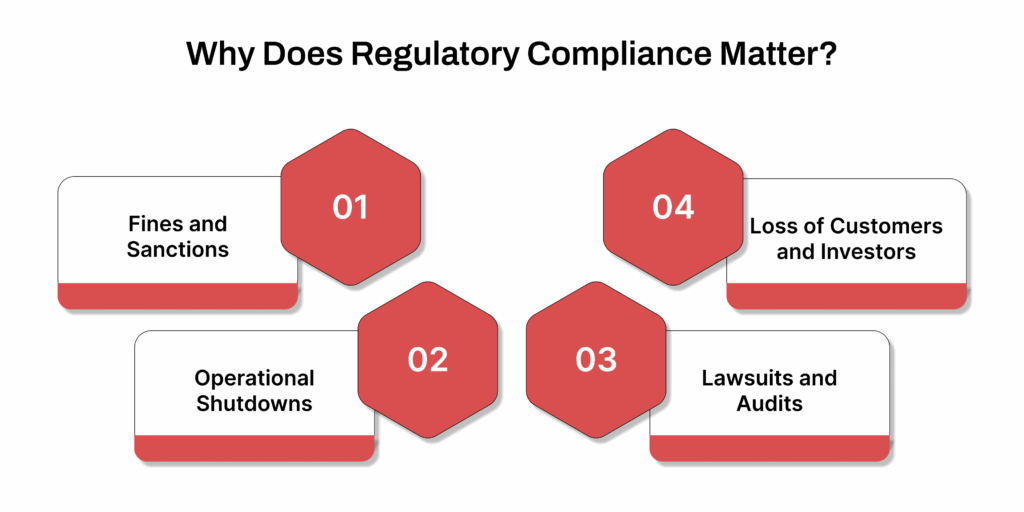
Compliance failures are costly; organizations that fall short can face fines, lawsuits, investigations, and even shutdowns, but the damage often goes further: customers lose trust, investors pull back, and reputations suffer. A strong compliance program helps prevent these risks by setting clear rules, monitoring behavior, and proving that the business operates responsibly.
Beyond avoiding penalties, good compliance protects employees and consumers, strengthens culture, and builds long-term credibility in the market.
- Fines and Sanctions: Regulators can issue financial penalties that range from thousands to billions of dollars. Some violations also come with criminal liability for executives or board members.
- Operational Shutdowns: In severe cases, regulators can suspend operations, revoke licenses, or halt products and services until issues are fixed. That means immediate revenue loss and business disruption.
- Lawsuits and Audits: Non-compliance can lead to lawsuits from customers, employees, shareholders, or government agencies. Investigations and audits drain time, money, and resources.
- Loss of Customers and Investors: Reputation damage is often long-lasting. Customers lose trust, investors pull back, and partners hesitate to work with a business that appears risky or unethical.
Also Read: Banking Regulatory Compliance Management – Best Practices and Checklist
The value becomes clearer once the risks and consequences are understood. The next section looks at how the U.S. regulatory environment creates added layers that companies must navigate.
The U.S. Complexity Factor
Unlike countries with a single regulatory system, the U.S. has overlapping layers of rules that make compliance more challenging. Companies must navigate federal laws that apply nationwide, state-specific regulations that differ by location, and industry mandates that add another layer of requirements.
For example, a financial institution may need to comply with SEC and FINRA rules plus state banking laws; a healthcare provider must follow HIPAA as well as state privacy standards; and a manufacturer must meet OSHA safety rules, EPA environmental standards, and labor regulations. Because the rules vary by industry and geography and change frequently, U.S. compliance is a moving target that requires structure and continuous monitoring.
- Federal regulations: These are national laws enforced by agencies like the SEC (financial markets), FTC (consumer protection), OSHA (workplace safety), and EPA (environmental standards). Any company operating in the U.S. is subject to federal law.
- State regulations: Every state has its own rules for data privacy, labor, taxes, safety, and business licensing. A business operating in multiple states cannot use a single compliance approach; it must adapt to each location.
- Industry-specific mandates: Some sectors require additional compliance frameworks.
Examples:
- Banks and financial services: SEC, FINRA, CFPB
- Healthcare: HIPAA and HHS privacy standards
- Manufacturing: OSHA safety rules, EPA environmental standards
- Education: FERPA and student data rules
Also read: What Regulators Expect in Incident Reporting and Investigations?
Seeing how different agencies shape the rules helps show the full picture. The next section walks through the regulatory landscape and who oversees what.
The Regulatory Landscape in the U.S.
There is no single authority for compliance in the United States. Instead, different regulators oversee different types of risk, which means businesses may answer to several agencies at once.
Financial institutions deal with bodies like the SEC, FINRA, and the CFPB; healthcare providers are regulated by HHS and must comply with HIPAA; manufacturers face OSHA for workplace safety and the EPA for environmental standards; and data-driven businesses must follow FTC consumer protection rules and state privacy laws.
This decentralized structure makes it critical for organizations to understand which regulators apply to them and how the rules change across states and industries.
Let’s look at the details:
| Area | Key U.S. Regulators | Focus |
| Financial Services | SEC, FINRA, CFPB | Consumer protection, market fairness, and reporting |
| Data & Privacy | FTC, state privacy laws (such as CCPA) | Consumer data rights, cybersecurity |
| Healthcare | HHS, CMS, HIPAA | Patient data, safety, and billing |
| Workplace Safety | OSHA | Workplace hazards, injury prevention |
| Environment | EPA | Emissions, pollution, sustainability |
State-Level Variation
In the U.S., compliance isn’t uniform; many obligations depend on where a business operates. Even if a company meets federal requirements, it can still fail state rules, which often introduce stricter or additional expectations. For organizations with employees, customers, or offices in multiple states, this creates a constantly shifting regulatory map that must be monitored.
How state differences create complexity:
- California privacy laws are stricter than many states. California’s Privacy Rights Act (CPRA) requires companies to give consumers more control over their data, such as the right to know, delete, or opt out of data sharing.
- New York and Massachusetts have specific cybersecurity requirements demanding encryption, written programs, and response plans.
- Employment and wage rules vary widely; minimum wage, overtime, paid leave, harassment training, and worker classification rules differ across states.
The takeaway: In the U.S., “compliant” in one state does not guarantee “compliant” in another, making continuous monitoring and state-by-state policy updates essential.
Consequences of Non-Compliance
When organizations fall short of regulatory requirements, the impact goes far beyond paperwork issues. Penalties can disrupt operations, damage credibility, and create long-term financial and reputational harm.
Key consequences include:
- Multi-million-dollar fines: Regulators regularly issue large penalties for violations, from data breaches to misleading consumers to workplace safety failures. These fines can erase profits and strain budgets, especially for smaller businesses.
- Criminal liability in extreme cases: When misconduct is intentional, fraudulent, or involves negligence that harms people, executives and employees can face criminal charges. This turns a compliance failure into a legal crisis.
- Forced operational shutdowns: Regulators can suspend operations, stop product sales, or shut down unsafe facilities until compliance issues are fixed. This creates revenue loss and damages customer relationships.
Also Read: 12 Leading Regulatory Compliance & Internal Controls Management Software
These risks show why companies need a structure in place. The following section highlights important principles and practices that shape a dependable compliance program.
Key Principles & Best Practices of Compliance Management

A modern compliance program is proactive, structured, and ongoing, not a one-time exercise or a reaction to problems. Strong programs create visibility, accountability, and evidence that the organization is operating responsibly. Core best practices include:
- Proactive, not reactive: Don’t wait for a regulator, whistleblower, or audit to uncover issues. Leading organizations identify risks early, test controls regularly, and address weaknesses before they become violations.
- Build a strong compliance culture: Compliance works only when people take it seriously. Leadership must set expectations, model ethical behavior, and make it clear that reporting concerns is safe and encouraged.
- Use a risk-based approach: Not all rules carry the same risk. Prioritize areas where non-compliance could cause financial loss, legal exposure, customer harm, or safety issues. This ensures resources go where they matter most.
- Document policies and roles clearly: If something isn’t documented, regulators assume it doesn’t exist. Clear policies, reporting channels, escalation paths, and ownership make compliance enforceable and auditable.
- Train and engage employees: Policies mean nothing if people don’t understand them. Practical training, especially scenario-based learning, helps employees recognize risks and respond correctly.
- Monitor, audit, and continuously improve: Compliance is never finished. Regular testing, internal audits, and issue tracking help organizations strengthen controls and adapt to new regulations or business changes.
- Use technology and automation: Manual tracking increases errors and slows response times. Compliance software such as VComply’s policy and control automation tools can centralize responsibilities, automate workflows, send reminders, track incidents, and create audit-ready reporting with less effort.
Once the foundation is clear, the next step is applying it. The next section provides a practical roadmap that organizations can follow to build a functioning compliance program.
A Step-by-Step Implementation Roadmap for U.S. Organizations
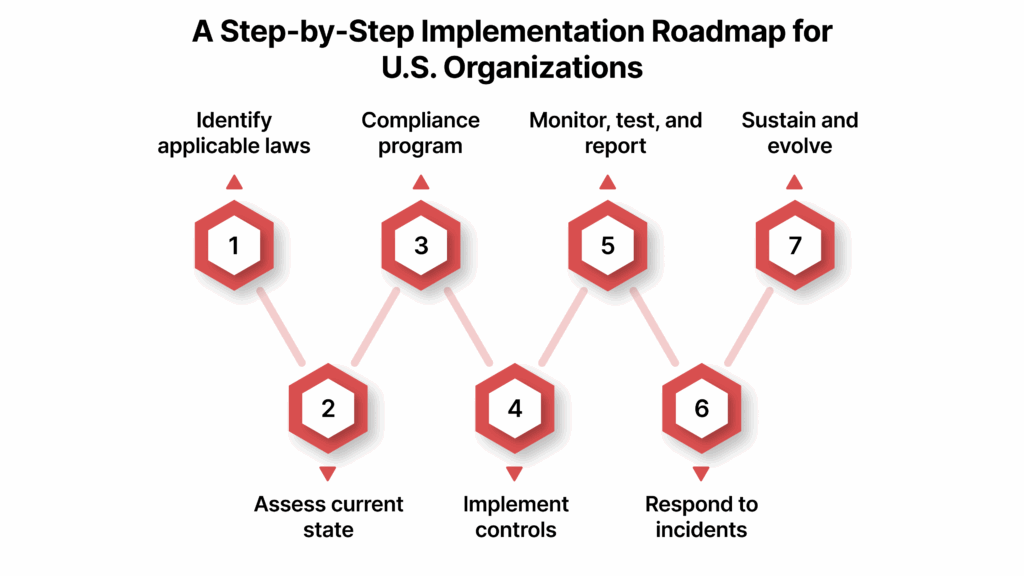
Building a compliance program can feel overwhelming, but the process becomes manageable when broken into structured steps. A strong program doesn’t just satisfy regulators, it creates consistency, reduces risk, and protects the business over time.
Here’s a straightforward roadmap any organization can follow:
- Identify applicable laws and regulations: Start by mapping every rule that applies to your organization: federal laws, state requirements, and industry-specific standards. This ensures you’re not missing obligations that regulators expect you to follow.
- Assess current state and gaps: Use internal audits, risk assessments, or maturity models to see where you stand today. Identify which policies are missing, where controls are weak, and what risks need immediate attention.
- Design and document your compliance program: Put structure in place. Define policies, outline responsibilities, and establish reporting lines. Documentation is critical; regulators expect written evidence, not verbal assurances.
- Implement controls and training: Roll out the policies and controls that help employees follow the rules. Communicate expectations clearly and train staff so they know how to handle real-world situations.
- Monitor, test, and report: Track compliance performance with KPIs, audits, dashboards, or scorecards. Visibility helps leaders see where the program is working and where fixes are needed.
- Respond to incidents and regulatory change: When something goes wrong, investigate quickly, fix the root cause, and update controls to prevent repeat issues. As regulations change, update policies and training so you remain compliant.
- Sustain and evolve: Compliance is continuous. Review policies regularly, manage third-party and vendor risks, adapt to new laws, and keep training employees. This is how companies stay ready for audits and future growth.
Even with a roadmap, challenges still crop up in real environments. The next section looks at the common hurdles teams face and how they can be handled.
Common Challenges and How to Overcome Them
Compliance is complicated even when organizations want to do the right thing. Rules evolve, systems change, and people make mistakes. The strongest programs acknowledge these challenges and build practical ways to overcome them.
- Keeping up with regulatory changes: Laws shift fast, especially in areas like privacy, cybersecurity, and financial reporting.
- Solution: Subscribe to regulatory update services, use automated alerts, and assign clear ownership so someone is always tracking what’s new and what must change internally.
- Overlapping jurisdictions: Federal, state, and industry requirements don’t always align. A rule that satisfies one agency may fail another.
- Solution: Maintain a centralized policy library and create a matrix comparing federal vs. state requirements so teams know which rule applies where.
- Third-party and vendor risk: Vendors can introduce compliance failures from data handling issues to safety violations. Regulators expect companies to manage this risk, not blame it on partners.
- Solution: Conduct due diligence, perform vendor assessments, and include compliance obligations in contracts and service agreements.
- Limited staff or budget: Smaller organizations often lack dedicated compliance teams, making manual work slow and error-prone.
- Solution: Automate wherever possible and focus on the highest-risk areas first instead of trying to fix everything at once.
- Cultural resistance: Policies don’t work if employees ignore them or see compliance as “extra work.”
- Solution: Leadership must set the tone, communicate why compliance matters, and provide simple, safe reporting channels for concerns.
- Data and technology issues: Missing logs, weak access controls, and disconnected systems create audit gaps and regulatory exposure.
- Solution: Use secure systems, enforce access controls, maintain audit trails, and integrate compliance data so nothing gets lost.
Understanding these obstacles helps leaders prepare for what comes next. The upcoming section highlights key trends shaping the future of U.S. compliance programs.
Future Trends U.S. Organizations Should Watch
The compliance world is changing quickly, driven by technology, consumer expectations, and global regulation. Companies that adapt early will avoid risk and gain a competitive edge.
Key trends shaping compliance:
- Rising data privacy expectations and new state privacy laws: States like California, Colorado, and Virginia continue to introduce stronger privacy rules, pushing businesses to improve data handling, consent practices, and customer transparency.
- ESG reporting and environmental compliance: Investors, regulators, and customers now expect clear reporting on environmental impact, sustainability, and ethical behavior, not just financial performance.
- AI and algorithm accountability: As businesses adopt AI, regulators are focusing on fairness, bias, explainability, and responsible use of automated decision-making.
- Increased use of compliance automation and RegTech: Manual compliance processes are giving way to automation platforms that centralize controls, track risks, and provide audit-ready reporting.
- Cross-border obligations for global businesses: U.S. companies operating internationally must navigate GDPR, international trade rules, and data transfer requirements, creating a more global compliance strategy.
- Growing emphasis on ethics, transparency, and whistleblower protection: Regulators are rewarding organizations that report issues early, demonstrate transparency, and encourage ethical behavior internally.
Compliance is shifting from a “regulatory burden” to a strategic advantage protecting brand trust, improving operations, and making organizations more resilient.
Practical Toolkit & Checklist for U.S. Compliance Programs
A strong compliance program is systematic, documented, and measurable. Use this simple checklist to assess your readiness:
Compliance Program Checklist
- Do we know every law and regulation that applies to us (federal, state, industry)?
- Are our policies written, accessible, and updated regularly?
- Are roles and responsibilities clearly assigned and documented?
- Are employees trained and retrained on key policies?
- Do we monitor and test compliance controls?
- Do we document incidents, risks, and remediation actions?
- Do we maintain an audit trail for regulators?
- Do we evaluate third-party and vendor compliance?
- Do we update policies and controls when laws or risks change?
A sample policy framework may include:
Code of Conduct, Whistleblower Policy, Reporting Procedures, Incident Response Plan, Disciplinary Standards, Monitoring and Audit Processes, Data Protection and Privacy Policies, Vendor Compliance Expectations.
This gives organizations a practical starting point on which they can build as they grow, expand into new states, or come under new regulations.
Streamline Your U.S. Compliance Program with VComply
Managing regulatory compliance in the U.S. is no small feat with overlapping federal, state, and industry rules; organizations need more than spreadsheets and scattered documentation to stay compliant. That’s where ComplianceOps helps modern businesses transform compliance from a manual process into a scalable, automated system.
VComply centralizes all aspects of regulatory compliance policies, controls, audits, and reporting into one intelligent platform.
Here’s how U.S. organizations can simplify compliance using VComply:
- Automate and Assign Controls: Automatically map, assign, and track compliance tasks across teams to ensure no regulation or deadline is missed.
- Centralize Policy and Document Management: Store, version, and distribute compliance policies in a secure, cloud-based environment always audit-ready.
- Gain Real-Time Visibility: Use customizable dashboards and analytics to track compliance performance, identify high-risk areas, and demonstrate readiness to regulators.
- Simplify Audits and Reporting: Generate reports and maintain digital audit trails with a few clicks, eliminating manual paperwork and errors.
Are you ready to modernize your compliance operations? Book a personalized demo to see VComply in action.

Wrapping Up
Regulatory compliance management has become a core business priority in the United States and for good reason. The landscape is complex, penalties are costly, and expectations from regulators, customers, and investors continue to rise. A strong program protects organizations from fines, lawsuits, operational disruption, and reputational damage while strengthening integrity and culture.
The regulatory environment is only getting more demanding, but compliance is more than a defensive shield. When it is structured, documented, and continuously improved, it becomes a business advantage driving trust, operational discipline, and long-term resilience. High-performing organizations treat compliance as a living system, not a one-time project.
Start Your Free Trial to see how VComply’s ComplianceOps platform can help your organization stay ahead of regulatory challenges with confidence.
Frequently Asked Questions (FAQs)
Key regulators include the SEC (financial reporting), FTC (consumer protection), OSHA (workplace safety), EPA (environmental standards), and HIPAA enforcers for healthcare privacy.
At least annually or whenever there are major regulatory updates, business expansions, or operational changes that could affect compliance obligations.
Data privacy violations, cybersecurity incidents, ESG reporting gaps, and vendor-related compliance failures are among the most common and costly risks.
By creating a centralized compliance framework, mapping overlapping state and federal laws, and using automation tools to track obligations and deadlines.
Leadership commitment, clear policies, continuous training, open reporting channels, and accountability at every level of the organization.