

ISO 27001 vs ISO 27002: What IT Compliance Teams Need to Know in 2026
For IT compliance managers in SaaS, fintech, and healthcare, ISO 27001 certification is no longer optional. Enterprise customers, regulators, and partners expect proof that information security controls are designed, implemented, and operating effectively.

Yet many teams stall during implementation. ISO 27001 defines what is required for certification, but ISO 27002 explains how controls should actually work in practice. Confusion between the two leads to inconsistent control mapping, spreadsheet-driven ISMS setup, and audit gaps that delay certification by months.
This guide explains the real difference between ISO 27001 and ISO 27002, how auditors use both standards together, and how compliance teams can operationalize them without burning time or resources.
Key Takeaways
- ISO 27001 is the only certifiable standard and defines how your ISMS, risk management, and governance must operate.
- ISO 27002 is the practical reference for implementing Annex A controls and is routinely used by auditors to assess control design and effectiveness.
- You are audited against ISO 27001, but judged on ISO 27002-aligned execution during control testing and evidence review.
- Most certification delays are operational, not interpretive; they stem from weak control-to-system mapping, unclear ownership, and fragmented evidence.
- Teams that automate control tracking and evidence collection move faster through certification and surveillance audits and reduce post-certification control drift.
What is ISO 27001?
ISO 27001 is the certifiable standard that governs how your information security program is run, not how individual security controls are implemented. For IT compliance managers, its role is to establish structure, accountability, and decision logic across the ISMS.
In practice, ISO 27001 helps teams answer three questions auditors care about first:
- How risks are identified, evaluated, and accepted across the organization
- Why specific security controls apply to your environment and others do not
- Who owns security decisions, approvals, and ongoing oversight
This is where scope definition, risk assessment methodology, leadership accountability, and the Statement of Applicability come into play. ISO 27001 ensures your ISMS is risk-based, consistently applied, and defensible during audits.
What ISO 27001 does not do is explain how controls should operate in real systems. It defines the what and the why, not the how. That distinction matters because auditors validate governance through ISO 27001, then evaluate control effectiveness using ISO 27002 guidance.
For fast-growing SaaS, fintech, and healthcare teams, ISO 27001 acts as the backbone of certification. It keeps security decisions consistent as systems scale, teams change, and audit expectations increase.
To understand this in detail, read The Ultimate Guide to ISO 27001.

What is ISO 27002?
ISO 27002 is the implementation reference auditors use to evaluate whether your Annex A controls actually work. While ISO 27001 defines which controls apply and why, ISO 27002 determines whether those controls are designed and operating in a way auditors consider effective.
For IT compliance managers, ISO 27002 answers the execution questions that surface during testing, not planning:
- How controls operate inside real systems, not just policies
- What “effective” looks like for access control, logging, monitoring, and incident response
- Which artifacts and system evidence demonstrate consistency over time
Although certification is not issued against ISO 27002, auditors routinely benchmark control operations against its guidance. Teams that treat ISO 27002 as optional often pass ISMS design reviews but struggle during walkthroughs, sampling, and evidence validation.
In practice, ISO 27002 is where audit outcomes are decided. It translates high-level intent into repeatable control behavior that auditors can observe, test, and trust.
Also read: ISO 27001 Certification Guide: Step-by-Step Process
ISO 27001 vs ISO 27002: Key Differences
ISO 27001 and ISO 27002 are not alternatives. ISO 27001 sets expectations. ISO 27002 explains how to meet them in a way auditors trust. Below are the key differences.
| Aspect | ISO 27001 | ISO 27002 |
| Primary Purpose | Defines ISMS requirements | Provides control implementation guidance |
| Certification | Yes, organizations can be certified | No certification available |
| Focus | Governance, risk assessment, and ISMS structure | Practical security control execution |
| Role in Audits | Primary audit standard | Reference standard auditors expect teams to follow |
| Control Coverage | High-level Annex A control list | Detailed guidance for all 93 Annex A controls |
| Risk Assessment | Mandatory | Assumed as an input |
| Level of Detail | What must be done | How controls should be implemented |
| Use Case | Certification and audit validation | Control design, consistency, and maturity |
Understanding this distinction is important, but what slows most teams down is applying it in real projects.
Also Read: List of ISO 27001 Policies
Why ISO 27001 Certification Gets Delayed for IT Teams
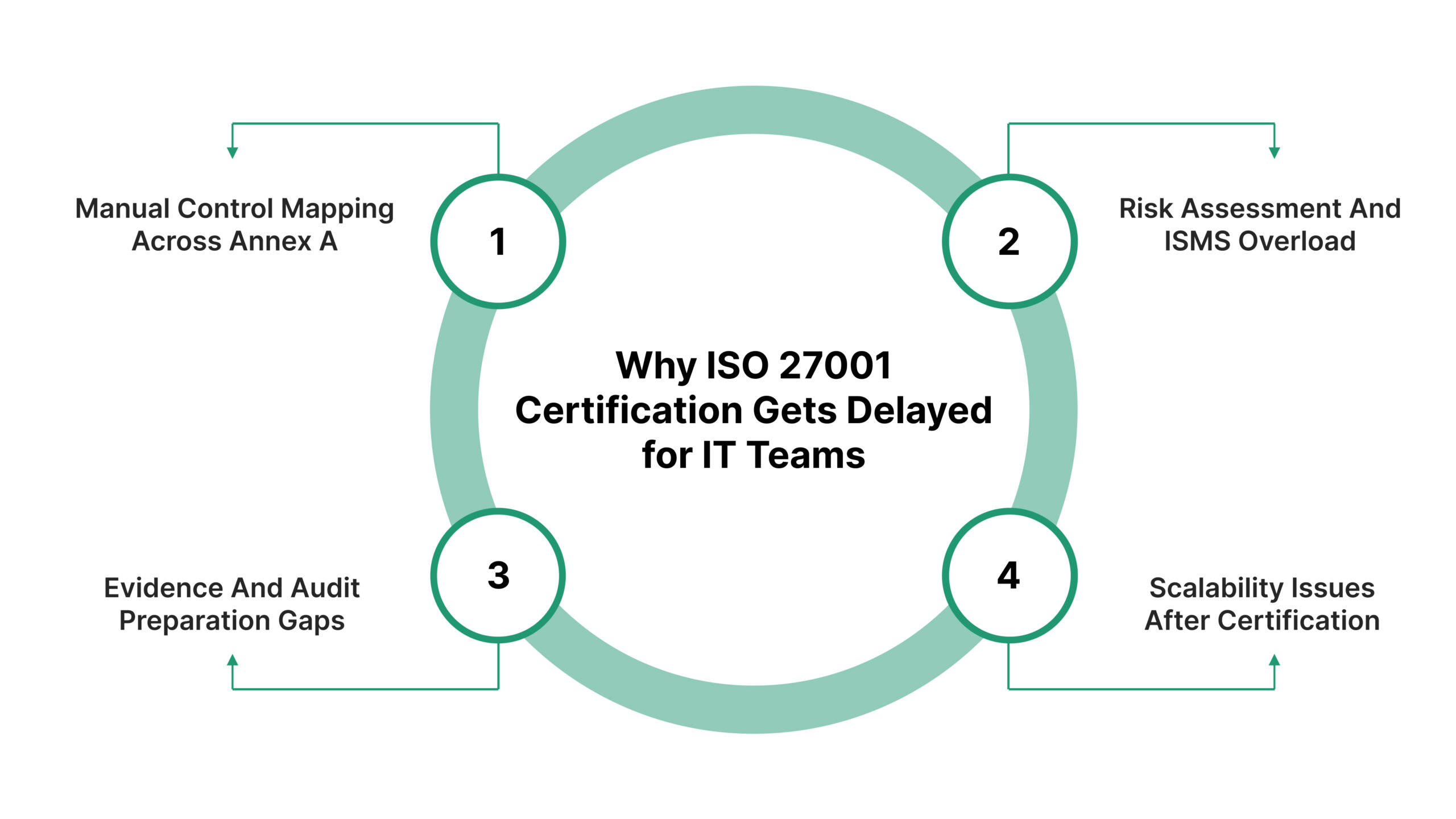
Most certification delays don’t come from misunderstanding ISO 27001. They happen when auditors test how controls operate and teams discover gaps in ownership, execution, or evidence. These breakdowns surface during audits and force rework that extends timelines.
The issues below are where ISO 27001 programs most often stall in practice.
1. Manual Control Mapping Across Annex A
ISO 27002 includes 93 controls. Mapping each control manually to systems, owners, and evidence often leads to inconsistent interpretation. Controls may exist but lack documented operation or ownership.
2. Risk Assessment And ISMS Overload
Early-stage ISMS setup often relies on spreadsheets. Stakeholder identification, risk scoring, and treatment plans become hard to maintain, slowing certification timelines by six to twelve months.
3. Evidence And Audit Preparation Gaps
Evidence for technical, organizational, and physical controls is usually stored across multiple tools. When audits begin, teams scramble to reconstruct timelines and approvals, increasing non-conformance risk.
4. Scalability Issues After Certification
Fast-growing teams struggle to maintain ISO 27001 post-certification. Without automation, controls drift, monitoring becomes inconsistent, and surveillance audits become stressful.
Also Read: Differences and Similarities between ISO 27001 and SOC 2
How ISO 27001 And ISO 27002 Work Together During Audits
Auditors evaluate ISO 27001 compliance, but they expect ISO 27002-aligned implementation.
The audit flow typically looks like this:
- ISO 27001 defines which controls apply based on risk
- The Statement of Applicability documents inclusion or exclusion
- ISO 27002 guides how selected controls should function
- Evidence demonstrates controls are operating continuously
If controls are documented but not implemented consistently, auditors flag gaps regardless of certification intent. Successful teams treat ISO 27001 as the framework and ISO 27002 as the execution standard.
Which ISO Standard To Use And When
ISO 27001 and ISO 27002 are used at different moments of the same workflow. Confusion happens when teams try to use one standard to solve the other’s job.
Use ISO 27001 when you are making decisions.
This includes scoping your ISMS, running risk assessments, deciding which Annex A controls apply, assigning accountability, and justifying inclusions or exclusions in the Statement of Applicability. ISO 27001 governs why a control exists and who is responsible.
Use ISO 27002 when you are implementing and proving controls.
This applies when configuring systems, defining operational procedures, setting monitoring expectations, and preparing evidence for audits. ISO 27002 defines how a control should operate and what auditors expect to see during testing.
In practice:
- Planning and governance phase → ISO 27001
- Control design and execution phase → ISO 27002
- Audit walkthroughs and evidence review → ISO 27002, validated against ISO 27001 scope and risk logic
Teams that separate these roles move faster through certification and reduce audit friction. Teams that treat them interchangeably often pass documentation reviews but fail during control testing.
How ComplianceOps Supports ISO 27001 And 27002 Execution
ComplianceOps helps IT compliance teams operationalize ISO 27001 and ISO 27002 together.
ComplianceOps supports teams by:
- Providing pre-mapped ISO 27001 and ISO 27002 control libraries
- Automating risk assessments and Statement of Applicability workflows
- Centralizing evidence for technical, organizational, and physical controls
- Enabling continuous monitoring through real-time dashboards
- Scaling compliance without adding manual overhead
This allows teams to focus on risk and control quality instead of administrative tracking.
Start a 21-day free trial of VComply ComplianceOps. See how ISO 27001 certification workflows run when controls, risks, and evidence live in one system.
Final Thoughts
ISO 27001 vs ISO 27002 is not a choice between standards. It is a distinction between governance and execution.
ISO 27001 defines what your ISMS must achieve to earn and retain certification. ISO 27002 determines whether your controls are implemented in a way auditors can trust. Most certification delays and non-conformances happen when teams treat these standards separately or rely on manual tracking to connect them.
For IT compliance managers in fast-growing organizations, the real challenge is not understanding the standards. It is operationalizing them at scale while maintaining audit readiness, evidence integrity, and continuous improvement.
Teams that succeed move away from spreadsheets and fragmented tools. They centralize controls, automate risk and evidence workflows, and maintain real-time visibility into control health.
If ISO 27001 certification is a growth requirement rather than a one-time checkbox, execution matters.
Book a demo with VComply to see how ISO 27001 and ISO 27002 controls can be managed, monitored, and proven from a single platform.
FAQs
You cannot certify against ISO 27002, but in practice, you need it. Auditors expect controls to align with ISO 27002 guidance when evaluating ISO 27001 compliance.
ISO 27002 defines accepted best practices for implementing Annex A controls. Auditors use it to assess whether controls are designed and operating effectively, not just documented.
No. ISO 27001 requires a risk-based approach. Controls are selected based on your risk assessment and documented in the Statement of Applicability. ISO 27002 helps implement only the controls you choose.
Common causes include inconsistent control implementation, missing or fragmented evidence, unclear ownership, and lack of continuous monitoring between audits.
By automating control tracking, risk assessments, and evidence collection in a centralized system. This reduces control drift, supports surveillance audits, and maintains trust with customers and auditors.