

How Does a Compliance Execution Platform Work? A Practical Guide
Managing compliance through scattered tools and manual tracking is no longer sustainable. As regulations grow more complex and enforcement becomes more technology-driven, even small gaps between policy and execution can expose organizations to serious risk.

This growing disconnect is often referred to as the compliance execution gap.
So, how does a compliance execution platform work? At its core, it acts as a single operational layer that turns regulatory requirements into actionable workflows.
By automating controls, mapping obligations, and offering real-time visibility, these platforms help teams move from reactive compliance to continuous, structured execution.
Key Takeaways
- From Manual to Automated: Shift from chasing evidence via email to automated workflows that capture proof at the source.
- Unified Control Environment: Use cross-framework mapping to satisfy multiple standards (SOC 2, ISO 27001, HIPAA) with a single action.
- Proactive Risk Management: Identify potential lapses through real-time compliance scoring before they become audit failures.
- Immutable Accountability: Maintain a timestamped, tamper-proof audit trail for every action taken across the enterprise.
How Does a Compliance Execution Platform Work?
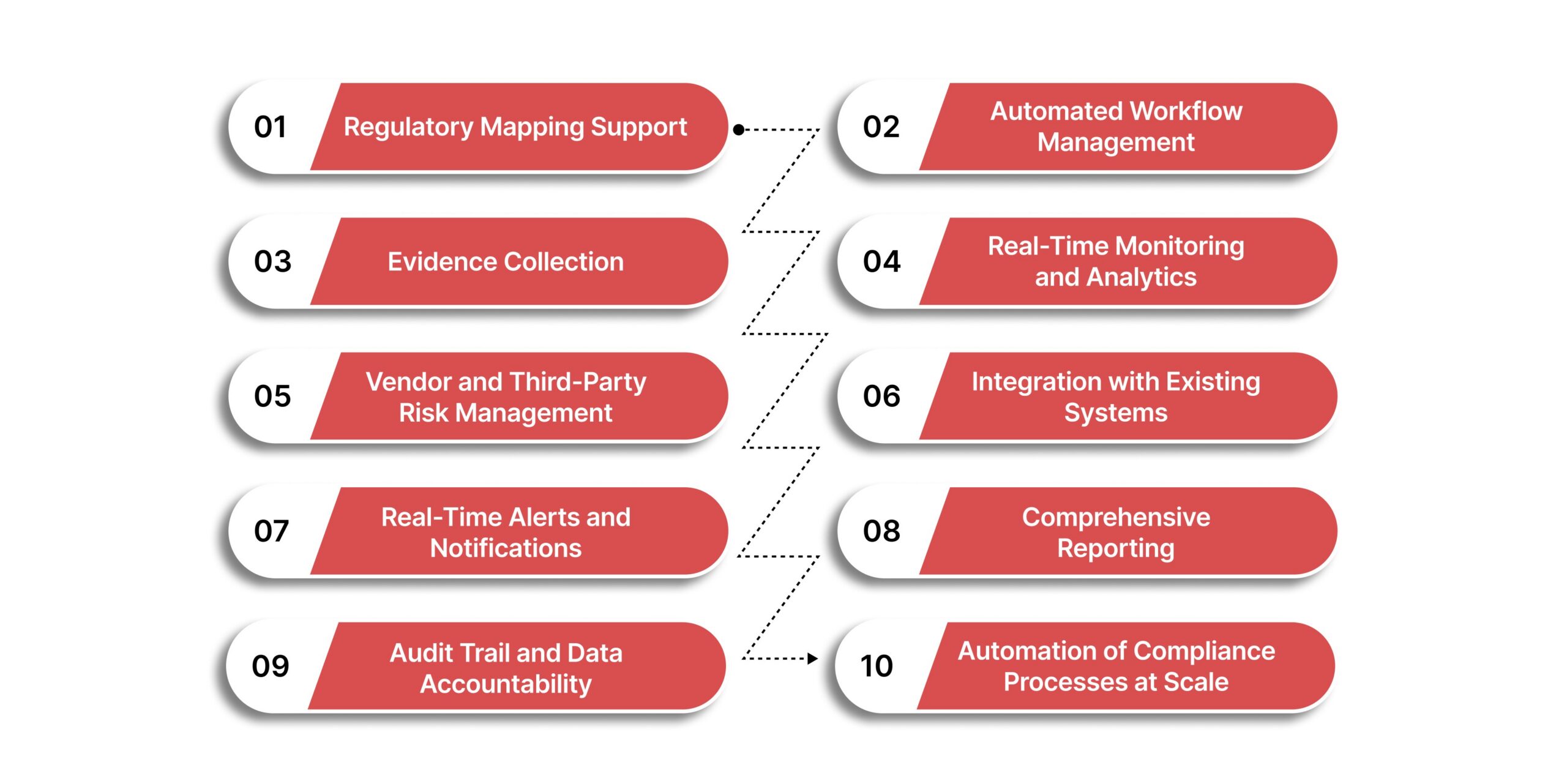
A Compliance execution platform functions as a centralized “operating system” for your organization’s regulatory obligations. It works by ingesting complex legal frameworks and breaking them down into small, manageable, and assignable tasks that are integrated into the daily routines of your employees.
By providing a single source of truth, it eliminates the confusion of version-controlled spreadsheets and ensures that every department, from IT to HR, is synchronized under a unified governance strategy.
Multi-Framework and Regulatory Mapping Support
The modern enterprise frequently operates across several jurisdictions, each with its own set of rules. Managing Sarbanes-Oxley (SOX) separately from HIPAA or NIST leads to massive redundancy and “compliance fatigue” among employees.
- Centralized Control Library: The platform hosts a comprehensive library of controls. Instead of creating a new control for every regulation, you create one robust control that satisfies multiple requirements.
- Automated Crosswalking: Using intelligent mapping, the system identifies overlaps between frameworks. If you fulfill a “Data Encryption” task for one standard, the platform automatically updates your status for all related standards.
- Impact Analysis: When a regulation changes (such as an update to ISO/IEC 27001), the platform highlights exactly which internal controls and policies need revision, preventing you from starting from scratch.
Suggested Read: The Role of Regulatory Audits in Different Sectors
Mapping the frameworks provides the blueprint; however, the actual “work” happens through the orchestration of people and processes.
Automated Workflow Management
The greatest risk to any compliance program is human error or simple forgetfulness. A Compliance execution platform eliminates this by converting your static policy documents into dynamic, automated workflows that drive accountability across the organization.
- Task Triggering & Ownership: The platform automatically creates tasks based on set frequencies (daily, monthly, annually). Each task is assigned to a specific “owner,” ensuring there is no ambiguity about who is responsible for execution.
- Escalation Logic: If a task owner fails to act, the system doesn’t just stay silent. It follows a pre-defined escalation path, notifying supervisors or the Chief Compliance Officer to prevent a gap in coverage.
- Standardized Procedures: Workflows can include step-by-step instructions and required templates, ensuring that a task performed in your US office is done to the same standard as one in your European branch.
Workflows generate activity, but in the eyes of an auditor, activity is meaningless without the proof that it actually occurred.
Evidence Collection and Repository Management
The most stressful part of an audit is the “scramble”, the weeks spent hunting for emails, PDFs, and screenshots to prove you followed your own rules. A Compliance execution platform works by making evidence collection a natural, real-time byproduct of the workflow.
- Proof at the Point of Action: When an employee completes a compliance task, the platform prompts them to upload evidence (logs, screenshots, approvals) immediately. This ensures the evidence is fresh, relevant, and accurate.
- Structured Document Storage: All proof is stored in a secure, centralized repository. It is automatically indexed against the specific control and regulatory requirement it supports, making retrieval instantaneous during an audit.
- Version Control & Integrity: The system ensures that only the latest, approved versions of evidence are presented to auditors. It maintains a history of all changes, providing a clear narrative of your compliance journey over time.
While individual tasks and evidence provide a micro-view, leadership requires a macro-view of the organization’s health.
Also Read: Difference Between Policy and Procedure Management?
Real-Time Monitoring and Analytics
Management cannot manage what it cannot measure. How does a Compliance execution platform work to provide this measurement? It aggregates thousands of data points from across your workflows into high-level, actionable analytics that reflect your current risk posture.
- Compliance Scoring: Most platforms provide a “Compliance Score”, a real-time numerical value representing your overall adherence to your frameworks. This allows for immediate benchmarking and progress tracking.
- Heat Maps & Risk Visualization: Dashboards use color-coded heat maps to highlight “red zones” where tasks are overdue, or controls are failing. This allows leadership to focus its resources on the areas of highest risk.
- Trend Analysis: By tracking performance over time, you can identify systemic issues. For example, if your IT department consistently misses security patch deadlines, the data can justify the need for more staff or better tools.
Suggested Read: Why the Future of Compliance Management Lies in Operational Execution
The modern business ecosystem is interconnected, meaning your compliance program must extend beyond your own four walls.
Vendor and Third-Party Risk Management
Your organization is responsible for the compliance of your partners. A breach at a third-party vendor can be just as damaging, legally and financially, as an internal failure. A Compliance execution platform extends your governance to your external ecosystem.
- Automated Due Diligence: The platform can automatically send out security questionnaires and compliance assessments to your vendors. Their responses are then mapped directly into your central risk register.
- Continuous Monitoring: Rather than a one-time assessment during onboarding, the platform tracks vendor compliance throughout the lifecycle of the contract, triggering alerts if their certifications (like SOC 2) expire.
- Collaborative Portals: Many platforms provide a dedicated portal where vendors can upload their own evidence and responses, streamlining the communication between your procurement team and external partners.
To truly scale, these processes must be integrated into the tools your employees use every single day.
Integration with Existing Systems
Compliance should not be a “destination” that employees have to visit; it should be integrated into their existing workspace. How does a Compliance execution platform work with your current tech stack?
It uses APIs and pre-built connectors to turn your everyday tools into compliance-capturing sensors.
- Seamless Tool Connectivity: Integration with platforms like Slack, Microsoft Teams, Jira, and AWS allows the system to pull evidence automatically. If a developer closes a ticket in Jira, the platform can capture that as proof of a corrective action.
- Automated Data Ingestion: By connecting to your cloud infrastructure, the platform can verify in real-time if a database is encrypted or if MFA is enabled, reducing the need for manual “check-ins.”
- Eliminating Friction: When compliance tasks appear in the tools employees already use, adoption rates skyrocket. It moves from being an “interruption” to being a standard part of the operational workflow.
As you integrate more data, the system’s ability to proactively warn you of trouble becomes your greatest asset.
Real-Time Alerts and Notifications
In the world of GRC, no news is not necessarily good news. An effective Compliance execution platform acts as an early warning system, using intelligent notifications to ensure that no obligation is ever forgotten or ignored.
- Proactive Reminders: The system sends automated alerts as deadlines approach. These can be customized to trigger weeks or days in advance, depending on the complexity of the task.
- Intelligent Escalations: If a critical security audit is missed, the notification can be automatically escalated to higher management or the Board of Directors, ensuring that high-stakes risks are addressed immediately.
- Multichannel Communication: Alerts can be sent via email, SMS, or directly into collaboration tools, ensuring that the right message reaches the right person, regardless of where they are working.
Reporting is the final act of the compliance cycle, where all the activity is translated into a language that regulators understand.
Comprehensive Reporting and Compliance Scoring
The ultimate goal of any GRC program is to demonstrate a state of control to stakeholders, be they auditors, board members, or regulators. A Compliance execution platform automates the creation of these complex reports, saving hundreds of manual hours.
- One-Click Audit Reports: Instead of spending weeks preparing for an audit, you can generate a comprehensive report that maps every requirement to its corresponding evidence and task owner with a single click.
- Executive Summaries: The platform can produce high-level reports for the C-suite that focus on the “Compliance Score” and strategic risk trends, rather than the granular details of every individual task.
- Customizable Dashboards: Different stakeholders need different data. A Compliance execution platform allows you to create custom views so that the CTO sees security metrics while the CFO sees financial compliance data.
Suggested Read: 5 Steps to Easy and Effective Policy Communication
While reports look forward, the audit trail looks back, providing the historical proof of your organization’s integrity.
Audit Trail and Data Accountability
In the legal world, transparency is synonymous with trust. If you are investigated, you must be able to prove “due diligence.” A Compliance execution platform provides an immutable audit trail that serves as your organization’s defense.
- Timestamped Activity Logs: Every action, from task assignment to document approval, is recorded with a timestamp and a user ID. This creates a “chain of custody” for every compliance decision.
- Version History: If a policy is updated, the platform keeps a record of the previous version and who authorized the change. This is critical for showing how your program has evolved in response to new risks.
- Anti-Tamper Protections: Because the audit trail is generated automatically by the system, it cannot be retroactively altered to hide lapses, providing a high degree of confidence to external auditors and regulators.
The true test of a platform is its ability to remain effective as your organization grows and enters new markets.
Automation of Compliance Processes at Scale
For a small business, compliance might be manageable with a few spreadsheets. For a global enterprise, it is impossible without automation. An execution platform allows you to scale your GRC operations without linearly increasing your headcount.
- Standardization Across Regions: You can create a “Master Compliance Template” and deploy it across dozens of global offices, ensuring that every branch follows the same high standards while allowing for local regulatory variations.
- Volume Handling: Automation allows a small compliance team to manage thousands of recurring tasks and hundreds of framework requirements without burning out or missing critical deadlines.
- Agility in Change Management: When a new global regulation like the EU AI Act is introduced, the platform allows you to push new controls and training modules to thousands of employees instantly.
Together, these capabilities transform compliance from a fragmented, reactive process into a structured operational discipline. Instead of chasing requirements, organizations gain the visibility and control needed to manage compliance continuously. The result is a program that scales with the business while remaining audit-ready at all times.
Signs Your Organization Has Outgrown Manual Compliance
Many organizations don’t realize they’ve reached a compliance tipping point until an audit exposes operational gaps. Recognizing these signals early helps prevent reactive decision-making and reduces regulatory risk.
- Audit preparation feels disruptive rather than routine: If teams scramble to gather documents, validate controls, and track approvals ahead of every audit, your compliance process is likely too manual.
- Compliance ownership is unclear: When responsibilities are spread across departments without structured accountability, critical tasks are more likely to be delayed or overlooked.
- Regulatory requirements keep expanding: Managing multiple frameworks through spreadsheets quickly creates duplication, inconsistent controls, and reporting fatigue.
- Leadership lacks real-time visibility: If executives rely on periodic updates instead of live compliance data, emerging risks can go unnoticed until they escalate.
- Evidence is difficult to trace: When proof of compliance sits across inboxes, shared drives, and disconnected systems, demonstrating due diligence becomes unnecessarily complex.
Reaching this stage doesn’t indicate failure; it signals organizational growth. A compliance execution platform provides the structure needed to support that scale without increasing operational strain.
Close the Compliance Execution Gap with VComply
In an era where regulatory change is the only constant, your organization needs a partner that turns compliance from a defensive hurdle into an offensive advantage. VComply is a leading cloud-based GRC management platform designed to help you bridge the execution gap with ease and precision.
Our suite of GRCOps solutions is built on the philosophy that compliance is an operational discipline. By centralizing your data and automating your workflows, VComply ensures that you are always in a state of “audit readiness.” We don’t just help you track your policies; we help you execute them.
Explore how our specialized modules can transform your organization:
- ComplianceOps: Master multi-framework mapping and automate evidence collection for SOC 2, HIPAA, ISO, and more.
- RiskOps: Strengthen your risk posture by identifying, assessing, and mitigating threats in real-time.
- PolicyOps: Streamline the entire policy lifecycle, from creation and communication to employee attestation.
- CaseOps: Simplify incident management and ensure that every case is handled with full traceability.
Experience a more productive, reliable way to manage your GRC needs. VComply removes the technical jargon and focuses on actionable insights, giving your team the clarity they need to succeed in 2026.
Schedule a free demo to see the platform in action.
Final Thoughts
The future of Governance, Risk, and Compliance is operational. As we navigate the complexities of 2026, the organizations that thrive will be those that treat compliance not as an annual event, but as a core business function.
By understanding how a Compliance execution platform work, you can move your organization away from the chaos of manual tracking and toward a future of clarity, accountability, and resilience.
Whether you are a CTO looking to secure your cloud infrastructure or a Compliance Officer aiming to streamline your next audit, an execution platform provides the transparency and automation needed to lead with confidence.
When you close the “Execution Gap,” you don’t just satisfy regulators, you build a foundation of trust that drives long-term business value.
FAQs
Spreadsheets are static, reactive, and prone to human error. They lack automated alerts, version control, and an immutable audit trail. A Compliance execution platform is a dynamic system that proactively assigns tasks, captures evidence automatically, and provides real-time analytics, ensuring that compliance is an active part of the business rather than a passive record.
Yes. This is one of the core strengths of a platform like VComply. Through “Multi-Framework Mapping,” you can map one internal control to several different standards (e.g., NIST, GDPR, and SOC 2).
When you complete a task related to that control, the system automatically updates your compliance status across all those frameworks.
While large enterprises benefit from the scalability, organizations of all sizes find value in automation. Small and medium businesses (SMBs) often have smaller compliance teams; for them, the platform acts as a “force multiplier,” allowing a single person to manage a complex compliance program that would normally require a full department.
The platform turns high-level policies into specific, assignable tasks with deadlines. Because the system tracks completion rates and requires evidence to close a task, there is a high level of accountability.
Furthermore, real-time alerts and escalation paths ensure that leadership is notified immediately if a policy is being ignored.
Most organizations see an immediate reduction in administrative burden within the first 30 days. By automating evidence collection and task reminders, you can reduce audit preparation time by up to 75%.
Over time, the data provided by the platform allows for more strategic risk management and better resource allocation.