

GRC Reports: Types, Examples, and How to Build Reports That Drive Real Decisions
Audit committees and regulators increasingly expect GRC reporting to reflect real-time control performance rather than periodic summaries, yet many organizations still rely on fragmented data sources, manual compilation, and static dashboards that fail to capture execution reality.

Under frameworks such as NIST and SOC 2, reporting gaps, missing evidence, inconsistent metrics, and unclear ownership often surface during reviews, limiting the ability to validate compliance or assess risk exposure with confidence.
GRC reports have become the primary mechanism through which organizations translate control execution into decision-ready insight, connecting operational activity with oversight expectations.
Their effectiveness determines whether leadership can act on accurate risk signals, whether audits can be supported with traceable evidence, and whether compliance remains consistent as complexity scales.
This guide examines how GRC reports function, the types that matter, and how to structure reporting systems that support visibility, accountability, and continuous governance.
Quick Look
- GRC reports translate control execution, risk exposure, and compliance status into actionable insights, not disconnected metrics.
- Effective reporting shifts from periodic snapshots to continuous, system-driven visibility into control performance.
- Core report types include risk exposure, compliance status, audit assurance, incident tracking, and third-party risk reporting.
- Decision value depends on clarity, real-time data, ownership accountability, and traceable evidence linkage.
- Different stakeholders rely on GRC reports for distinct needs, from board-level strategy to operational execution and audit validation.
- Common failures include fragmented data, lack of standardization, delayed reporting, and unclear ownership, reducing reliability.
- Building effective GRC reporting requires structured systems that integrate workflows, automate data flow, and align reporting with governance frameworks.
What Are GRC Reports?
GRC reports are structured outputs that translate governance, risk, and compliance performance into decision-ready insights rather than raw operational data. They connect control execution, risk exposure, and compliance status to oversight expectations, enabling leadership and auditors to evaluate performance, validate accountability, and support defensible decision-making.
What GRC Reports Are Not
- Not static documents: They must reflect ongoing control performance, not periodic snapshots
- Not audit-only artifacts: They support continuous oversight, not just audit preparation
- Not disconnected metrics: Data must be contextualized within risk and compliance objectives
- Not manual summaries: Effective reports are system-driven, reducing reconstruction effort
- Not siloed outputs: They integrate cross-functional execution into unified visibility

Why GRC Reporting Has Become a Decision System (Not Just Documentation)
GRC reporting has moved beyond summarization to become a core mechanism for operational oversight and decision-making. As regulatory expectations evolve, reporting must provide continuous, structured insight into control performance, risk exposure, and compliance alignment rather than retrospective summaries.
1. Shift from Periodic to Continuous Reporting
Regulatory expectations increasingly require organizations to demonstrate control performance continuously rather than at fixed intervals. Static reports fail to capture execution gaps between reporting cycles, creating blind spots.
Continuous reporting enables real-time validation of controls, ensuring that deviations are identified as they occur and that oversight reflects current operational conditions.
2. Increasing Demand for Risk Visibility at the Leadership Level
Boards and executive teams rely on GRC reports to assess exposure, allocate resources, and guide strategic decisions. Reports that provide excessive or unstructured data reduce clarity and delay decision-making.
Effective reporting prioritizes risk-relevant insights, enabling leadership to focus on material issues rather than navigating fragmented or incomplete information.
3. Regulatory Pressure for Demonstrable Evidence
Frameworks such as NIST and SOC 2 require organizations to demonstrate not only that controls exist but that they are consistently executed. GRC reports serve as the evidence layer, linking control activities to verifiable outputs.
Without this linkage, organizations struggle to defend compliance during audits or respond effectively to regulatory inquiries.
4. Business Impact Beyond Compliance
GRC reporting influences outcomes beyond regulatory adherence, including investor confidence, vendor trust, and operational resilience.
Inconsistent or incomplete reporting can affect due diligence processes, delay partnerships, and weaken organizational credibility. Structured reporting ensures that governance performance is visible, reliable, and aligned with broader business expectations.
Also Read: Your Guide to Major Life Science Compliance Risks
Types of GRC Reports with Examples
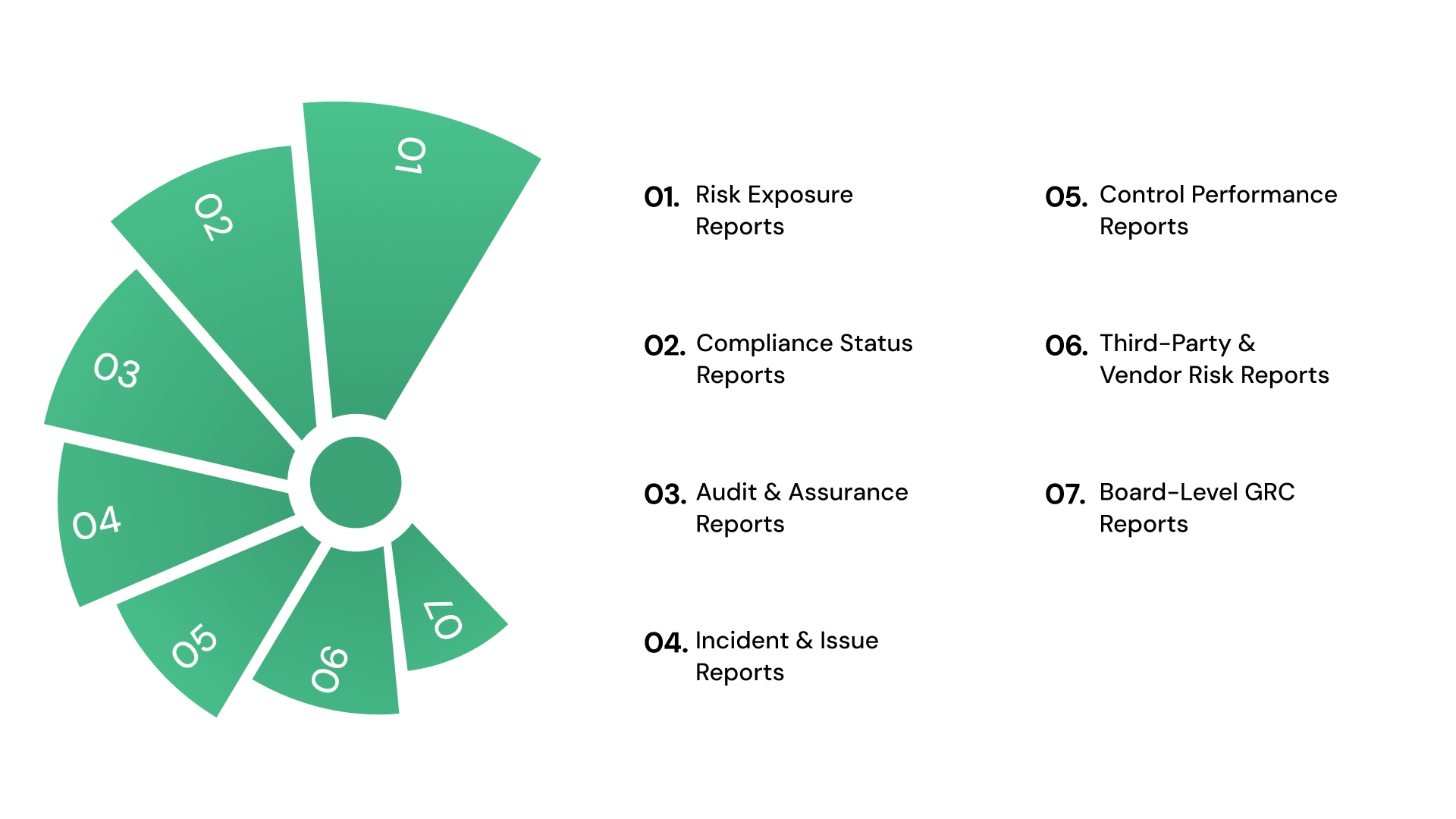
Different GRC reports serve distinct oversight, audit, and decision-making needs across the organization:
1. Risk Exposure Reports
Risk exposure reports provide visibility into current and emerging risks through structured analysis.
- Include risk heatmaps, trend analysis, and forward-looking indicators
- Example: Enterprise risk dashboard tracking top risks across business units
- Operational implication: Enables prioritization of mitigation efforts
- Risk impact: Reduces decision delays and unmanaged exposure
2. Compliance Status Reports
These reports track how controls align with regulatory frameworks such as SOC 2 and ISO 27001.
- Show control status, gaps, and mapping to requirements
- Highlight areas of non-compliance and remediation progress
- Operational implication: Provides a clear view of compliance posture
- Risk impact: Strengthens audit readiness and reduces last-minute remediation
3. Audit and Assurance Reports
Audit reports assess control effectiveness and document assurance outcomes.
- Include internal audit findings, remediation tracking, and validation results
- Example: SOC 2 report demonstrating control design and operating effectiveness
- Operational implication: Validates whether controls function as intended
- Risk impact: Supports defensible audit outcomes and reduces repeat findings
4. Incident and Issue Reports
Incident reports capture operational failures, response actions, and resolution timelines.
- Include root cause analysis, escalation paths, and closure status
- Operational implication: Improves accountability and response consistency
- Risk impact: Reduces recurrence and strengthens incident governance
5. Control Performance Reports
These reports evaluate how consistently controls are executed across workflows.
- Track execution rates, failures, and exceptions
- Identify breakdown points in control systems
- Operational implication: Highlights operational weaknesses
- Risk impact: Enables targeted remediation and improved reliability
6. Third-Party and Vendor Risk Reports
Vendor risk reports assess external exposure across suppliers and partners.
- Include compliance status, access reviews, and risk ratings
- Monitor ongoing third-party performance
- Operational implication: Ensures external accountability
- Risk impact: Reduces supply chain vulnerabilities
7. Board-Level GRC Reports
Board-level reports provide a consolidated, strategic view of governance performance.
- Summarize key risks, compliance posture, and decision triggers
- Use dashboards and visualizations for clarity
- Operational implication: Supports executive oversight
- Risk impact: Enables informed, timely strategic decisions
Defining report types is only effective when data flows consistently across systems and teams. Book a demo with VComply to see how integrated workflows can unify risk, compliance, and reporting outputs into a single, reliable view.
4 Things That Make a GRC Report Effective
The effectiveness of a GRC report is determined by how well it supports decisions, not how much data it contains:
1. Decision-Relevant Insights Over Raw Data
Effective GRC reports prioritize clarity and actionability over volume.
- Focus on material risks and control gaps
- Highlight priorities rather than listing all metrics
- Enable faster decision-making
Outcome: Reduces cognitive overload and improves response speed
2. Real-Time or Near Real-Time Data
Reporting lag creates blind spots that delay detection and response.
- Continuous or near real-time updates reflect actual conditions
- Reduce reliance on outdated snapshots
- Improve responsiveness to emerging risks
Outcome: Enhances situational awareness and operational agility
3. Clear Ownership and Accountability
Reports must indicate who is responsible for each risk, control, or issue.
- Assign ownership at every level
- Enable accountability for remediation
- Provide visibility into execution responsibility
Outcome: Ensures that insights translate into action
4. Traceability and Evidence Linkage
Each reported insight must be traceable to underlying evidence.
- Link metrics to logs, approvals, and workflows
- Support audit validation and investigation
- Enable drill-down into control execution
Outcome: Strengthens audit defensibility and transparency
Also Read: Understanding Regulatory Compliance Management in the U.S.
How GRC Reports Are Used Across Stakeholders
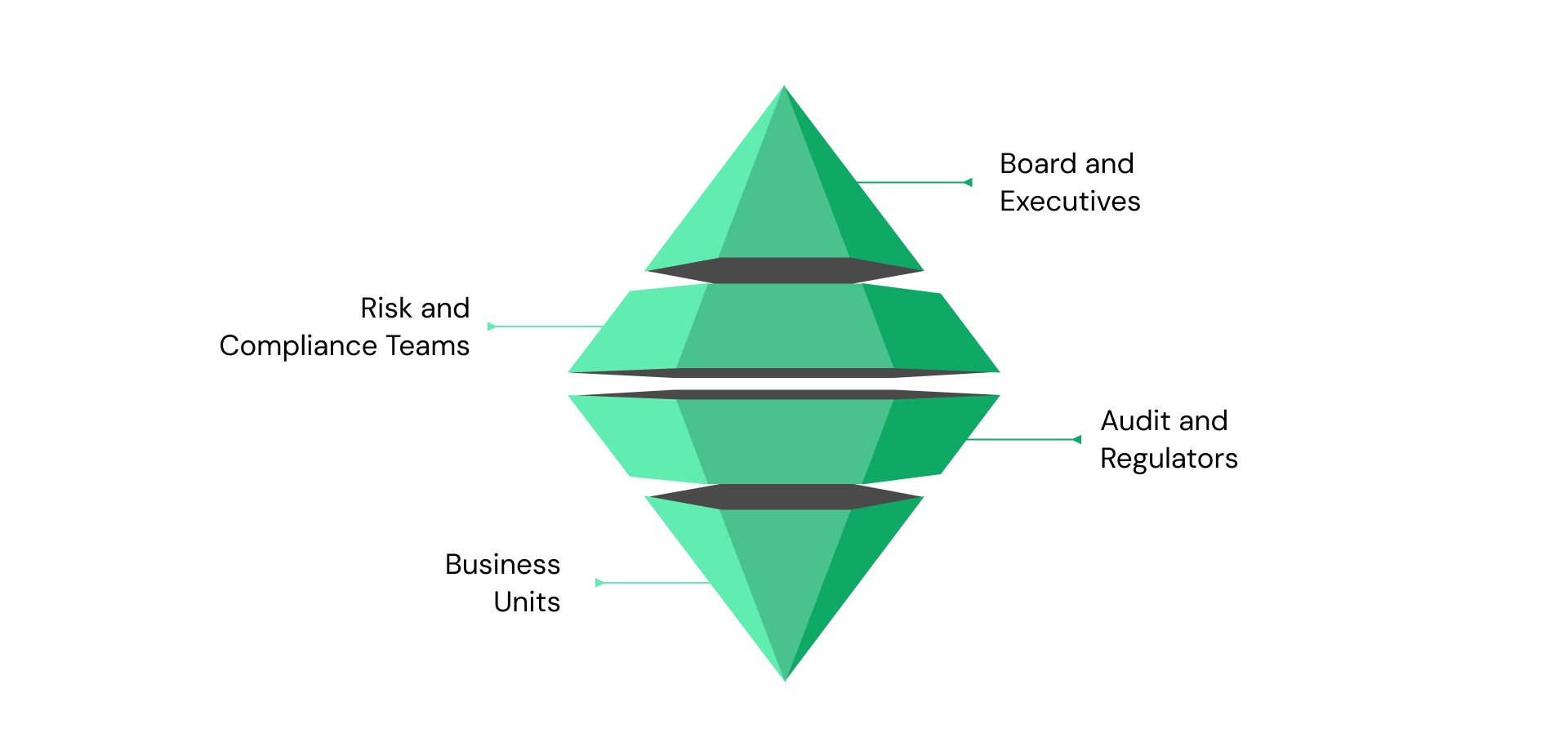
Different stakeholders rely on GRC reports for distinct oversight and decision-making needs:
1. Board and Executives
Board-level stakeholders use reports to assess strategic risk and guide resource allocation.
- Focus on aggregated risk exposure and trends
- Require concise, decision-oriented insights
- Outcome: Supports governance and strategic oversight
2. Risk and Compliance Teams
These teams rely on reports for monitoring and validation.
- Track control execution and compliance alignment
- Identify gaps and prioritize remediation
- Outcome: Ensures continuous compliance and control performance
3. Audit and Regulators
Auditors and regulators use reports as evidence of compliance.
- Validate control execution and documentation
- Assess consistency across reporting periods
- Outcome: Determines audit outcomes and regulatory standing
4. Business Units
Operational teams use reports to guide execution and accountability.
- Monitor task completion and control adherence
- Align daily operations with compliance requirements
- Outcome: Embeds governance into operational workflows
How to Build a GRC Reporting System That Works
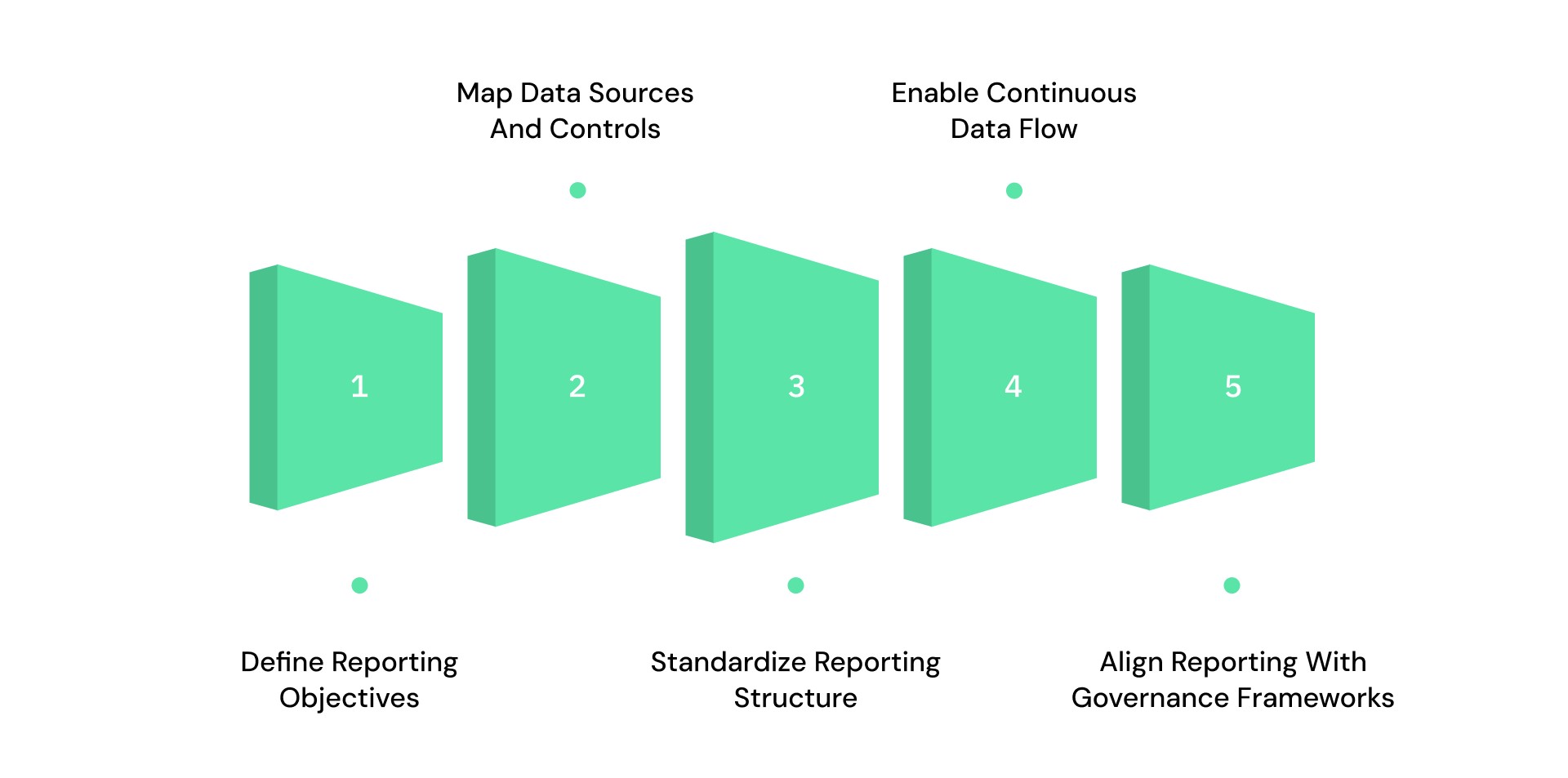
Building effective GRC reports requires designing systems, not just templates:
Step 1: Define Reporting Objectives
Reporting must align with decisions and stakeholder needs.
- Identify what decisions reports should support
- Define audience-specific requirements
Step 2: Map Data Sources and Controls
Reports depend on complete and accurate data integration.
- Connect systems, workflows, and control outputs
- Ensure data consistency across sources
Step 3: Standardize Reporting Structure
Consistency enables comparability across time and teams.
- Use standardized formats and metrics
- Align reporting across functions
Step 4: Enable Continuous Data Flow
Automation ensures timely and accurate reporting.
- Integrate real-time data feeds
- Reduce manual intervention
Step 5: Align Reporting with Governance Frameworks
Reports must map directly to frameworks such as NIST and SOC 2.
- Ensure alignment with regulatory requirements
- Support audit validation
Also Read: How to Develop Corporate Governance Policies
Building reporting frameworks is only the first step; sustaining them requires continuous data flow and accountability across workflows. Explore how VComply enables structured GRC reporting through integrated systems that connect controls, evidence, and ownership.
Common Gaps That Undermine GRC Reporting
Even well-designed reports fail when execution lacks structure and consistency:
1. Data Fragmentation Across Systems
Disconnected systems create inconsistent and incomplete data.
- Multiple tools with no integration
- Conflicting data sources
- Impact: Reduces reliability and trust in reporting
2. Lack of Standardization
Inconsistent formats limit comparability.
- Different metrics across teams
- No unified reporting framework
- Impact: Makes trend analysis and decision-making difficult
3. Delayed or Manual Reporting
Manual processes introduce delays and errors.
- Reports generated after events occur
- High dependency on manual compilation
- Impact: Leads to outdated insights and slower response

4. Missing Ownership and Accountability
Without ownership, insights do not translate into action.
- No clear responsibility for risks or controls
- Lack of follow-through on findings
- Impact: Weakens governance and increases exposure
Structuring GRC Reporting for Consistency and Visibility
GRC reporting often breaks down when data is fragmented, ownership is unclear, and reporting cycles lag behind actual control execution.
These gaps create inconsistent insights, limit traceability, and reduce confidence in decision-making, particularly when reports must support audit validation or regulatory scrutiny.
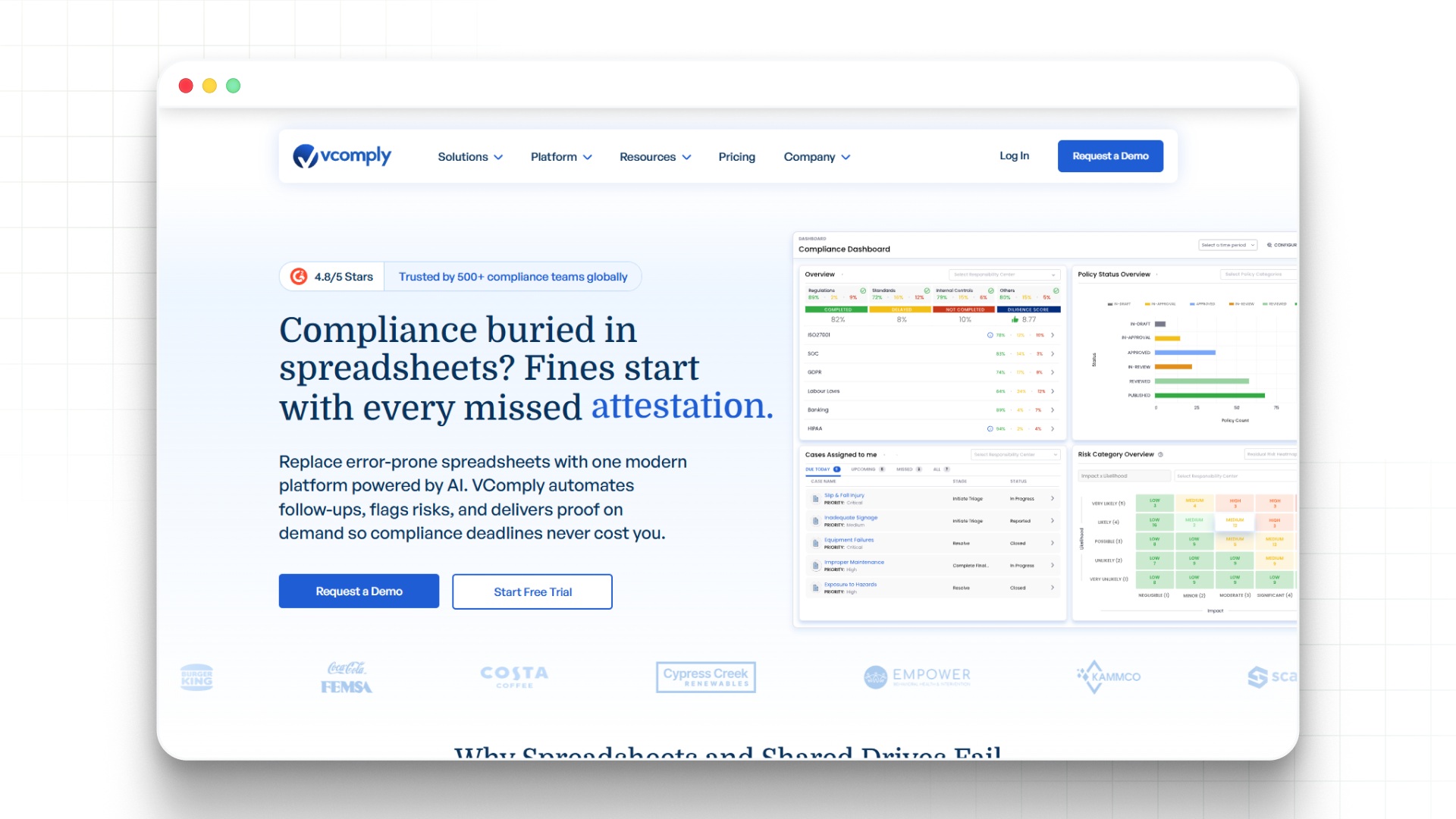
VComply addresses this by structuring GRC reporting within integrated workflows that connect control execution, evidence capture, and real-time visibility into a unified system across ComplianceOps, RiskOps, PolicyOps, and CaseOps.
- Centralized reporting tied to control execution: Reports are generated directly from workflows, ensuring accuracy and eliminating manual reconciliation
- Real-time dashboards with underlying evidence linkage: Every metric is traceable to logs, approvals, and execution records
- Standardized reporting across frameworks: Align reports with NIST, SOC 2, and internal policies for consistent oversight
- Ownership mapping within reports: Each risk, control, and issue is tied to a responsible owner for accountability
- Continuous data synchronization: Automated updates ensure reports reflect current operational conditions
Book a demo with VComply to evaluate how structured reporting systems can improve visibility, strengthen accountability, and support audit-ready governance.
Wrapping Up
GRC reports have evolved into a core governance mechanism that connects control execution, risk exposure, and compliance status into decision-ready insights. Their effectiveness depends on real-time data, clear ownership, and traceable evidence that reflects actual operational performance rather than reconstructed summaries.
When structured correctly, they enable leadership to assess risk with clarity, support audit defensibility, and maintain consistent oversight across increasingly complex regulatory environments.
However, fragmented data sources, delayed reporting cycles, and unclear accountability continue to limit the reliability of GRC reports, creating gaps in visibility and decision-making under scrutiny.
VComply addresses this by structuring reporting within integrated workflows that connect controls, evidence, and ownership into a unified system, ensuring consistency and audit-ready outputs.
Want to explore how structured GRC reporting systems can improve visibility, strengthen accountability, and support continuous oversight across your organization? Start a 21-day free trial of VComply.
FAQs
GRC reports are structured outputs that translate governance, risk, and compliance performance into decision-ready insights. They connect control execution, risk exposure, and compliance status to support oversight, audits, and strategic decision-making.
Key GRC reports include risk exposure reports, compliance status reports, audit and assurance reports, incident reports, control performance reports, and third-party risk reports, each addressing different oversight needs.
GRC reports should ideally be generated continuously or near real-time, supported by automated data flows, rather than relying solely on periodic reporting cycles.
An effective GRC report provides decision-relevant insights, real-time data, clear ownership, and traceable evidence, enabling both operational action and audit validation.
Organizations can improve GRC reporting by integrating data sources, standardizing structures, enabling continuous monitoring, and using systems like VComply to ensure consistent, audit-ready outputs.