

Reasons for Compliance Failure: 5 Root Causes & How Compliance Leaders Can Fix Them
Compliance leaders face rising pressure with more regulations, tighter deadlines, shrinking teams, and growing audit demands.

According to the 2025 PwC Global Compliance Survey, only 7% of companies consider their compliance program “leading”, while 31% consider it “mature.” That leaves a vast majority still lagging, one and exposed to compliance failures.
If you’re a Compliance Officer, Policy Manager, Internal Auditor, HR leader, or Legal team member, you probably recognize the signs: outdated policies, unclear ownership, scattered evidence, or inconsistent enforcement.
This blog will help you understand this problem from the root. Read the five core reasons for compliance failure, and see how to fix each one with a clear, actionable roadmap for stronger governance.
Key Takeaways
- Most compliance failures stem from leadership gaps, poor risk assessment, misaligned incentives, weak culture, or fragmented systems.
- Each failure has predictable warning signs, late attestations, unclear accountability, outdated controls, and inconsistent reporting.
- A structured fix plan (30/90/180 days) helps compliance teams regain control quickly.
- Modern compliance needs centralized governance, automated tracking, and audit-ready evidence.
- Strengthening compliance culture reduces risk and improves overall operational performance.
What Are Compliance Issues and Why They Matter
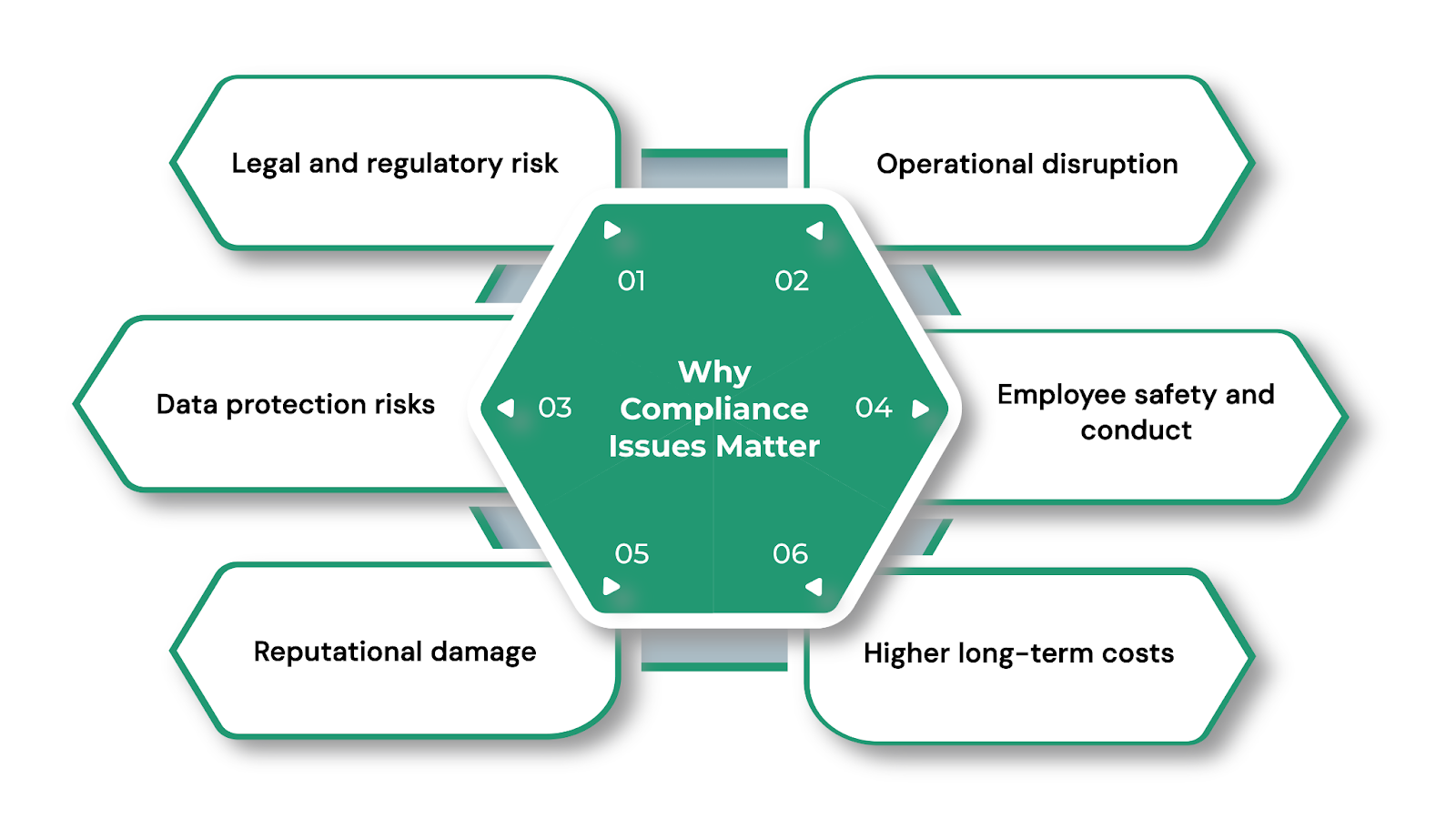
Compliance issues are gaps or failures that prevent an organization from meeting legal, regulatory, policy, or ethical requirements. These issues can arise from outdated policies, missing controls, inconsistent training, weak documentation, or employee behavior that doesn’t align with expectations. Even small issues can escalate quickly if they’re not detected, addressed, and monitored.
Why Compliance Issues Matter
- Legal and regulatory risk: Violations of HIPAA, SOX, OSHA, FERPA, or state laws lead to fines, investigations, and mandatory remediation.
- Operational disruption: Missed reviews, broken workflows, and control failures slow down everyday operations and audit cycles.
- Data protection risks: Weak access controls or incomplete audit trails increase the likelihood of breaches and privacy violations.
- Employee safety and conduct: Non-compliance with safety rules or conduct standards exposes employees to harm and the organization to liability.
- Reputational damage: Compliance failures erode trust among customers, partners, donors, students, and employees.
- Higher long-term costs: Remediation, legal fees, and insurance premiums increase and far outweigh the cost of doing things right upfront.
Let’s understand the reasons for compliance failure and how to fix them.
Read : Understanding Risk Management in Business in 2024

Five Reasons for Compliance Failure (and How to Fix Them)
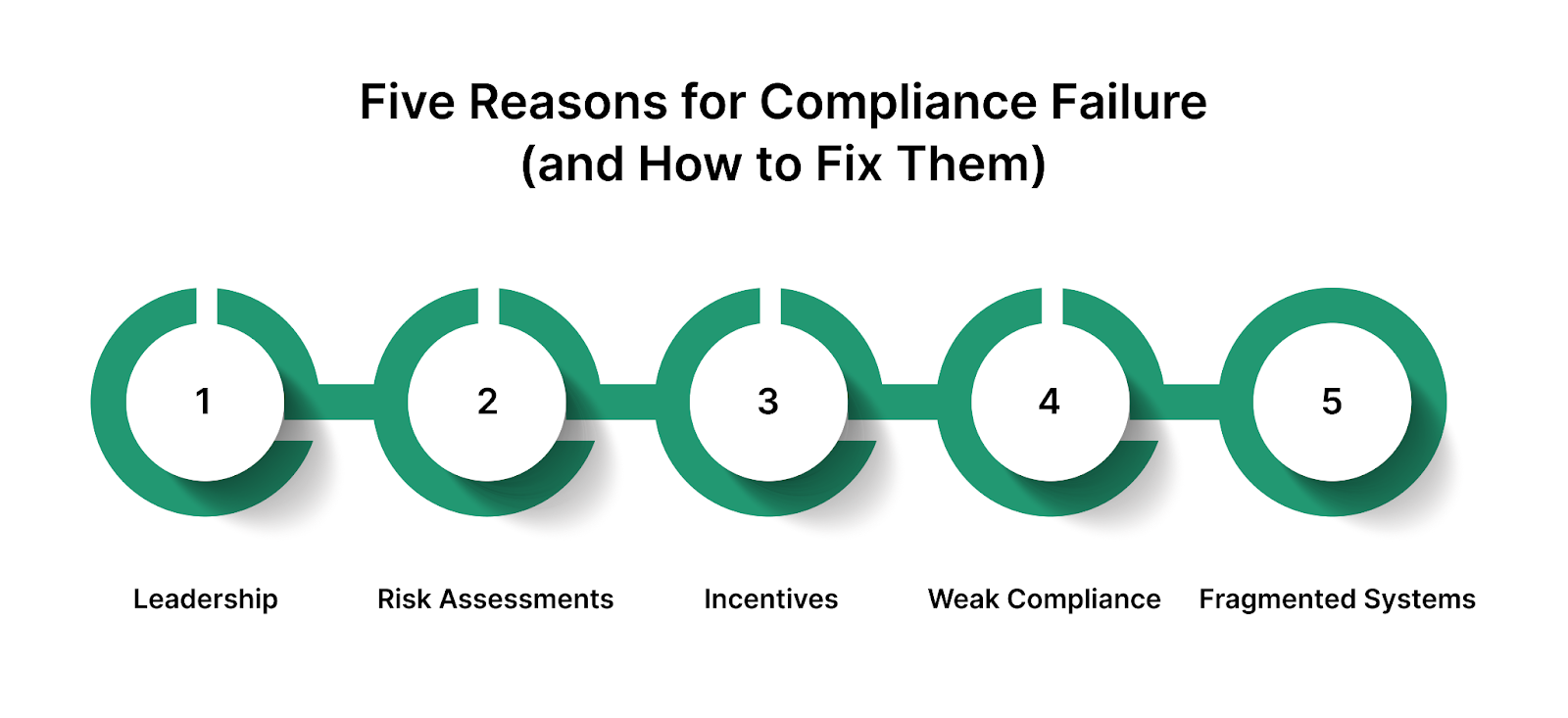
Compliance breakdowns stem from predictable, structural issues, gaps in leadership, outdated processes, unclear expectations, and systems that simply can’t keep up with modern regulatory demands. Understanding the reasons for compliance failure helps leaders respond proactively. Below are the five most common reasons compliance failures occur, along with practical steps to fix each one.
1. Leadership That Doesn’t Reinforce Compliance
Compliance culture starts with leadership. When executives miss training, delay policy approvals, or fail to reinforce compliance expectations, it sends a message: this isn’t a priority. Employees follow that tone, which leads to inconsistent behavior, weak reporting, and uneven enforcement.
How to fix it
- Make leadership visible in compliance efforts: Require leaders to launch key compliance initiatives and participate in training.
- Create clear accountability: Add compliance responsibilities to leadership scorecards and performance reviews.
- Communicate expectations often: Use town halls, internal memos, and quarterly updates to reinforce the importance of compliance.
2. Risk Assessments That Don’t Keep Up With Change
Regulatory expectations evolve quickly. New technology, third-party vendors, product changes, and operational shifts all introduce risks. When risk assessments aren’t updated regularly, 1or controls aren’t mapped to those risks, 1organizations operate blindly. That’s when violations, data exposures, and audit surprises occur.
How to fix it
- Refresh your risk register yearly or after major changes: New markets, new tools, and new processes all require reassessment.
- Map risks to controls and regulations: Link each risk to the relevant U.S. requirement (SOX, HIPAA, OSHA, FERPA, state laws).
- Implement ongoing monitoring: Use periodic reviews, automated reminders, and dashboard tracking to detect gaps early.
3. Incentives and Priorities That Encourage Shortcuts
If teams are rewarded primarily for speed, revenue, or volume, compliance steps can become afterthoughts. Employees may skip approvals, ignore policies, or delay reporting simply to hit performance targets. When incentives and compliance expectations compete, compliance usually loses.
How to fix it
- Review existing incentive structures: Identify places where productivity is rewarded more than accuracy or ethics.
- Tie performance to compliance behaviors: Include training completion, reporting quality, and documentation accuracy.
- Use balanced scorecards: Recognize employees who follow procedures, 1not only those who move quickly.
4. A Weak Compliance Culture Across Departments
Compliance isn’t just a policy, 1it’s a shared responsibility. But many employees only interact with compliance during onboarding or during an annual training video. Without ongoing communication, practical examples, and psychological safety around reporting, compliance becomes theoretical rather than lived.
How to fix it
- Improve communication: Simplify policies and share short updates about expectations and reporting options.
- Offer role-based training: Make training relevant to daily responsibilities, 1not generic or overly technical.
- Encourage reporting and remove fear: Reinforce non-retaliation, celebrate transparent behavior, and close feedback loops.
5. Fragmented Systems and Manual, Error-Prone Processes
Policies in shared drives. Evidence in email. Approvals in spreadsheets. Versions scattered across documents. When compliance lives in multiple disconnected places, it’s nearly impossible to maintain accuracy, consistency, or audit readiness. Manual processes also increase errors and slow down remediation.
How to fix it
- Centralize compliance documentation: Store policies, attestations, approvals, and evidence in one place.
- Standardize workflows: Assign owners, due dates, and version controls for all compliance tasks.
- Automate repetitive tasks: Use tools that send reminders, track deadlines, and generate audit-ready logs automatically.
Read: Compliance Audits: A Guide to Ensuring Regulatory Adherence
Get a Free Demo of VComply Compliance Management Platform
What These Compliance Failures Mean for Compliance Leaders
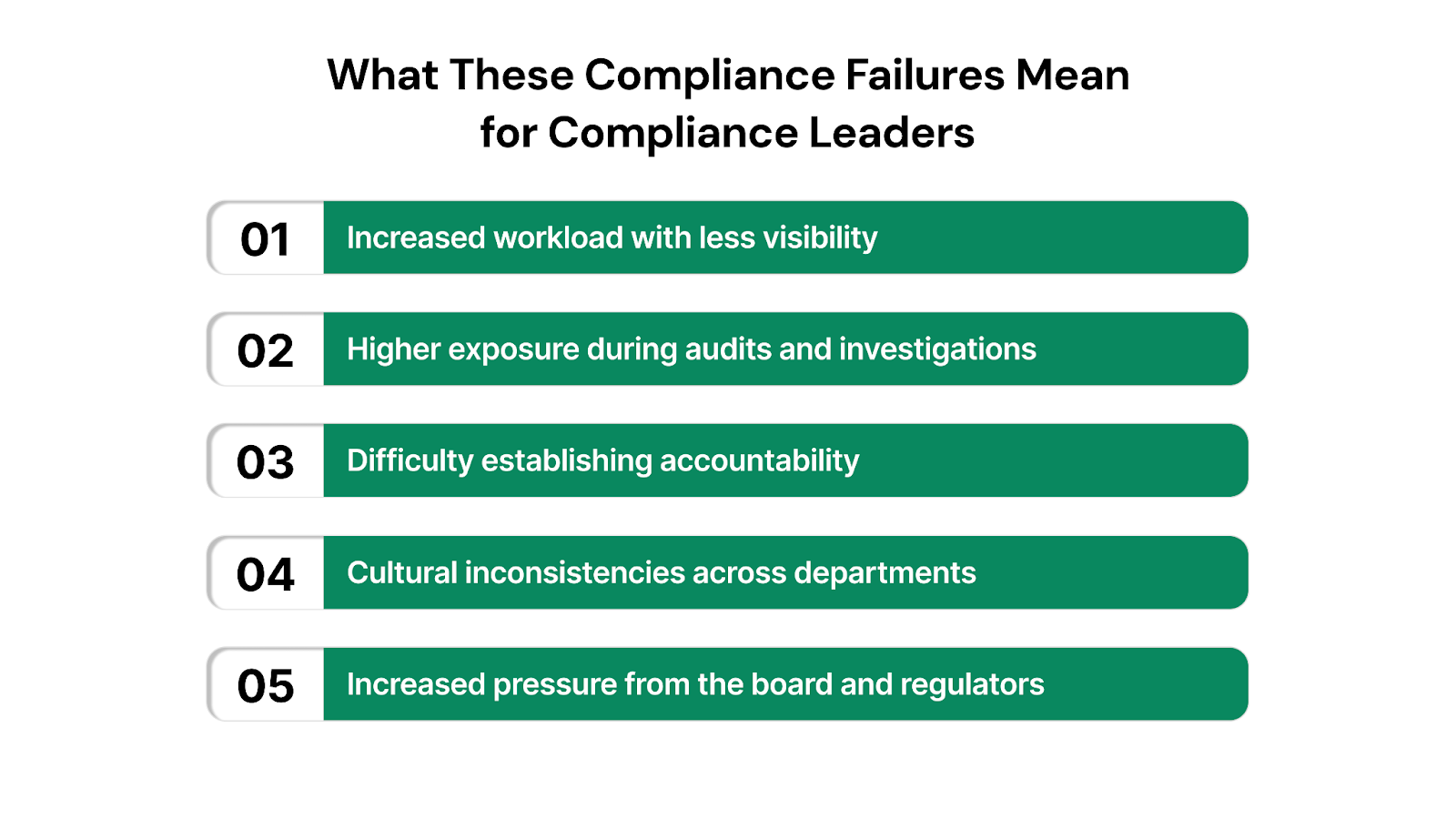
Each failure adds layers of manual work, increases audit pressure, and forces teams into reactive mode. Below is what these failures mean for compliance leadership:
1. Increased Workload With Less Visibility
When systems are fragmented or outdated, compliance teams spend most of their time tracking down documents, clarifying ownership, and chasing overdue tasks. This reduces time available for high-value work like risk strategy, training quality, and policy optimization.
2. Higher Exposure During Audits and Investigations
Compliance gaps often lead to incomplete evidence trails, missed approvals, and outdated policies, all things auditors notice immediately. This increases the likelihood of findings, corrective actions, and external scrutiny.
3. Difficulty Establishing Accountability
Without clear documentation and workflows, it becomes hard to determine who owns which control, who missed what task, and how remediation should proceed. Compliance leaders spend more time correcting mistakes than preventing them.
4. Cultural Inconsistencies Across Departments
When compliance expectations aren’t reinforced consistently across the organization, some departments follow the rules closely while others develop informal workarounds. This creates uneven risk exposure.
5. Increased Pressure from the Board And Regulators
Boards expect stronger compliance reporting and real-time insights. Regulators expect consistent controls and timely corrective actions. Compliance leaders are expected to deliver both, even with limited staffing and growing obligations.
Now let’s look at how technology helps close these gaps and prevent compliance failures before they occur.
How Technology Helps Prevent Compliance Failure
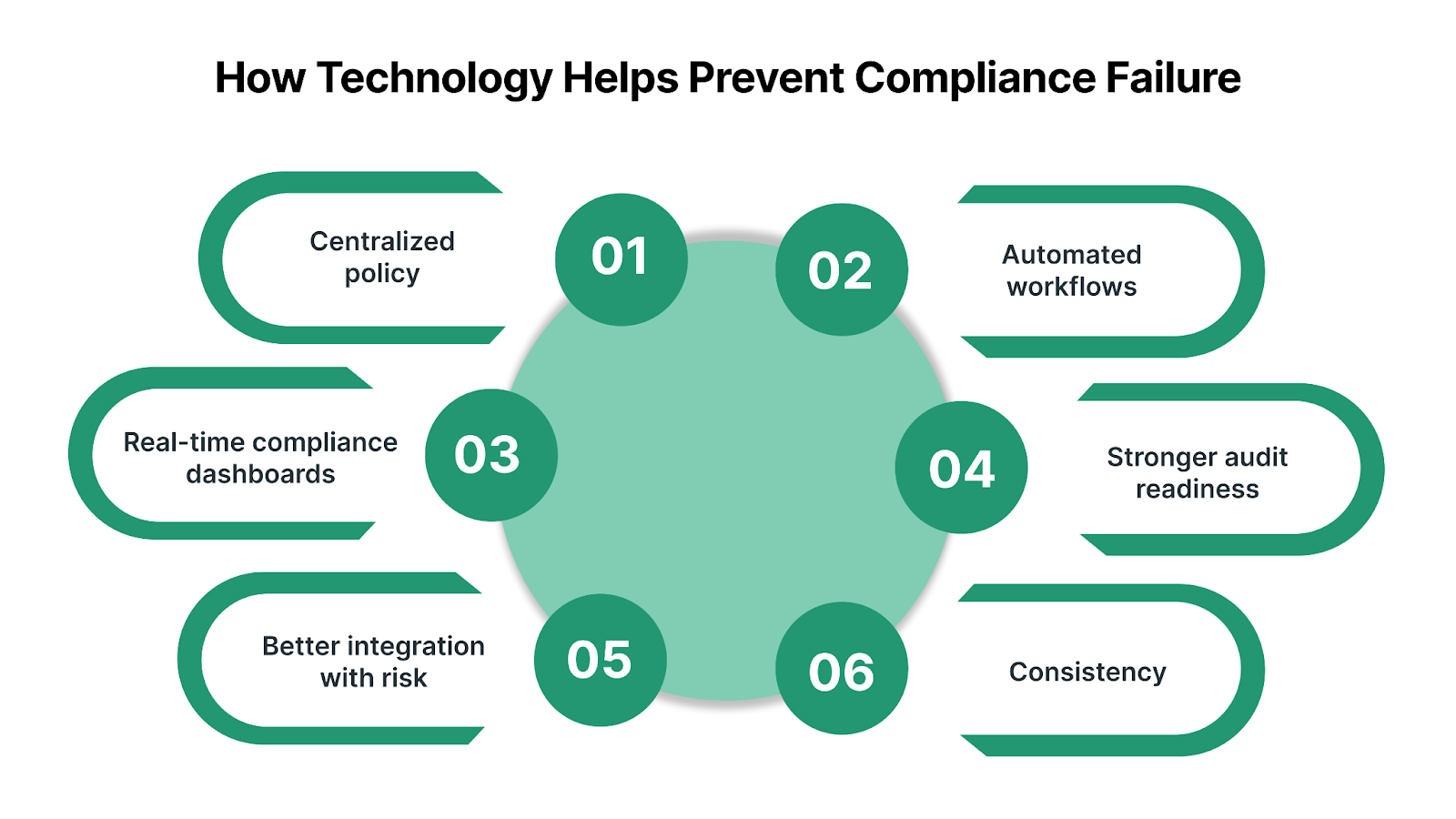
Modern compliance expectations simply cannot be met with spreadsheets, shared drives, and email chains. Technology gives compliance teams the visibility, automation, and consistency they need to prevent gaps rather than react to them.
Here’s how:
1. Centralized Policy and Control Management
A single platform gives teams one source of truth for policies, controls, owner assignments, review cycles, and evidence. This reduces confusion and ensures documents aren’t scattered across departments.
2. Automated Workflows and Reminders
Automation reduces human error by handling repetitive tasks, training reminders, review deadlines, attestations, policy distribution, follow-ups, and escalations. This ensures compliance cycles run on time without manual chasing.
3. Real-Time Compliance Dashboards
Dashboards help compliance leaders track control status, overdue tasks, evidence readiness, training completion, and exception trends, making it easier to communicate with executives and the board.
4. Stronger Audit Readiness
A technology platform maintains version history, timestamps, digital trails, approvals, and evidence logs automatically. When auditors ask for proof, it’s ready in minutes, not weeks.
5. Better Integration With Risk, Incidents, and Third-Party Management
Modern compliance doesn’t operate in isolation. Technology connects compliance tasks to risk assessments, case investigations, vendor compliance, and corrective actions, giving leaders a complete picture.
6. Consistency, Even as the Organization Grows
Technology prevents compliance from breaking as new teams, vendors, or locations are added. Processes scale consistently across departments without forcing leadership to rebuild workflows from scratch.
VComply’s GRPOps Suite helps organizations streamline policy governance, automate compliance workflows, track attestations, map controls to regulations, manage incidents, and produce audit-ready evidence with less manual work.
Strengthen Your Compliance Framework With ComplianceOps
When compliance failures happen, they rarely stem from a lack of effort; teams are simply stretched, systems are outdated, and expectations keep rising. VComply gives Compliance Officers, Policy Managers, Internal Auditors, HR leaders, and Legal teams the structure they need to prevent gaps before they occur.
With centralized policies, automated workflows, mapped controls, real-time dashboards, and audit-ready evidence, VComply helps organizations shift from reactive compliance to predictable, repeatable governance.
If your organization is feeling the pressure of growing obligations, shrinking bandwidth, or increasing regulatory scrutiny, Book A Demo with VComply to modernize your compliance approach.

Frequently Asked Questions
Leadership inconsistency is often the biggest driver. When leaders don’t model or reinforce compliance expectations, employees follow their example, weakening enforcement across departments.
At least once a year, or whenever significant changes occur (new vendors, new processes, new technology, mergers, or regulatory updates).
Centralize documentation, assign clear ownership, automate reminders for reviews and attestations, and ensure training is role-specific rather than generic.
Yes. Automation reduces manual errors, improves visibility, prevents missed deadlines, and maintains audit-ready evidence, areas where most compliance failures begin.
Key indicators include policy review completion rates, attestation rates, control testing results, incident resolution time, and audit findings over time.





Wrapping Up
Compliance failures don’t happen overnight; they build slowly through missed deadlines, unclear responsibilities, inconsistent enforcement, and systems that can’t keep up with modern regulatory expectations.
The good news is that each root cause is fixable. Strengthening leadership engagement, updating risk assessments, aligning incentives, reinforcing culture, and replacing manual processes with structured workflows all reduce exposure and build trust across the organization.
With the right processes and tools, compliance becomes predictable, repeatable, and easier to manage. VComply helps make that possible by giving compliance teams a centralized place to manage policies, controls, evidence, and incidents, so you can prevent issues before they escalate and stay audit-ready year-round.
Start your 21-day free trial with VComply, and now is the right time to modernize your approach.
