

AI-Driven Compliance in Real Estate: Benefits and Risks
The real estate industry is discovering a hard truth: manual compliance can’t keep up with automated risk.

As U.S. regulators intensify oversight of AML, fair housing, and data privacy, real estate firms are managing higher transaction volumes with thinner margins for error.
The stakes are high; according to the JLL Global Real Estate Technology Survey, 88% of investors, owners, and landlords in commercial real estate have begun AI pilots, often running five or more use cases simultaneously.
As regulators increase scrutiny and transaction volumes rise, AI-driven compliance is becoming a strategic advantage rather than an optional upgrade. In this blog, we will discuss how data intelligence, AI, automation, and GRC alignment are improving compliance operations across the real estate sector.
We will also explore the benefits, real-world use cases, risks, and responsible adoption of AI-driven compliance in real estate.
Key Takeaways
- Schedule a personalized VComply demo to see AI-driven compliance in real estate action.
- Simplify audits, automate policies, and maintain continuous visibility across all property compliance workflows.
- Strengthen risk management with predictive analytics and centralized ESG, AML, and data privacy controls.
- Empower teams to stay ahead of evolving real estate regulations with automated compliance alerts.
- Start your free VComply trial today and transform compliance into a competitive business advantage.
What Does AI-Driven Compliance Mean?
AI-driven compliance in real estate means utilizing artificial intelligence (AI) technologies to automate, optimize, and enhance an organization’s adherence to regulatory requirements, internal policies, and industry standards.
In the context of real estate, it involves deploying smart tools that can analyze vast amounts of data, detect anomalies, predict risks, and streamline compliance workflows to ensure firms operate within legal boundaries efficiently and proactively.
Here’s a quick overview of the core compliance tasks automated by AI:
| Task | How AI Optimizes |
| Regulatory tracking | Monitors changes and notifies teams |
| Document verification | Reviews contracts for legal accuracy |
| License/permit renewal | Schedules and automates renewals |
| Audit preparation | Flags gaps and assists with corrections |
| Site inspections | Schedules and tracks compliance |
Now that you know where AI fits in your real estate workflows, let’s understand what it actually does inside your compliance program.
Core AI Capabilities Used in Compliance
AI in real estate compliance is not one monolithic technology. It is a set of very specific capabilities that plug into different risk and control points. The most relevant for compliance, risk, and legal teams are explained below.
1. Natural Language Processing (NLP) for Documents, Leases, and Communications
NLP helps machines read and interpret unstructured text the way a human reviewer would, only at a much greater scale. It can identify missing clauses, prohibited language, and non-standard terms that often slip through manual review. It is particularly valuable for monitoring fair housing language in listings and for verifying that mandatory disclosures appear across every document set.
2. Machine Learning for Risk Scoring
Machine learning models learn from historical data to predict risk or classify behavior. These models help compliance teams prioritize which files require enhanced scrutiny while keeping decision authority with human reviewers.
3. Anomaly Detection for AML, Fraud, and Operational Red Flags
Anomaly detection algorithms look for behavior that deviates from established norms. This capability supports AML and fraud monitoring by flagging unusual patterns that may indicate synthetic identities, irregular funding sources, or collusive behavior. It shifts monitoring from periodic sample reviews to near real-time surveillance.
4. Intelligent Document Processing (IDP) for Evidence and Audit Readiness
IDP combines OCR (optical character recognition) with machine learning to turn messy documents into structured data. It can extract key information from IDs, bank statements, insurance certificates, inspection reports, and zoning documents, then map those fields to specific transactions or properties.
Also Read: EU AI Act: Essential Compliance Requirements
Understanding how AI shapes these systems provides the foundation for exploring its deeper operational role in modern real estate compliance.
The Role Of AI In Modern Real Estate Compliance Systems
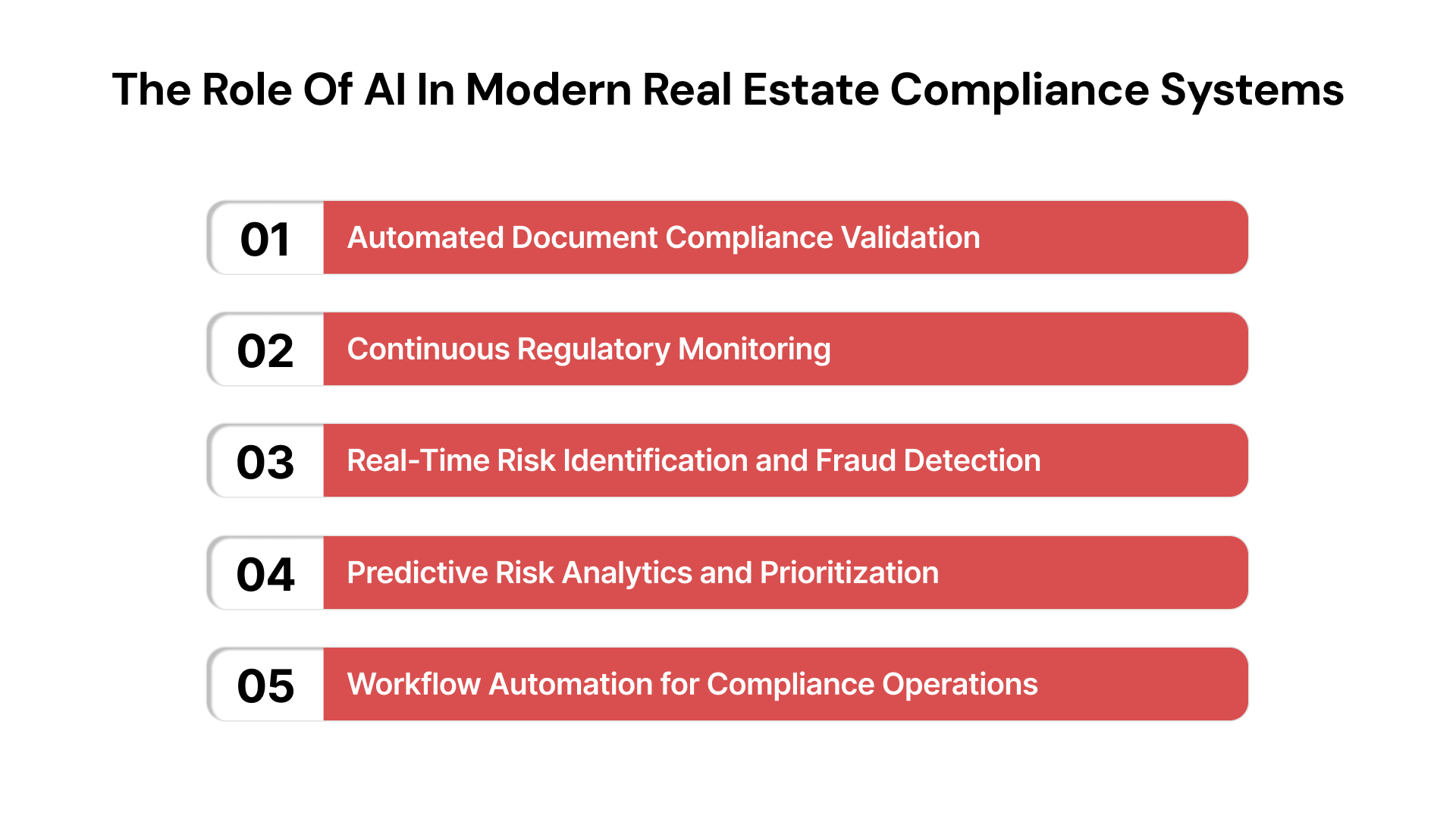
AI transforms real estate compliance from manual, error-prone efforts into automated, data-driven processes that enhance accuracy, speed, and risk mitigation. This fundamental shift equips firms to handle complex, evolving regulations more effectively and saves costs related to non-compliance.
Below are key roles AI plays within real estate compliance systems.
1. Automated Document Compliance Validation
AI analyzes legal documents like contracts and residential purchase agreements, verifying completeness, correct signatures, and adherence to California or other state regulations.
It uses Large Language Models integrated with cloud services for serverless processing, scalable across document types.
2. Continuous Regulatory Monitoring
AI continuously scans federal, state, and local law changes, automatically flagging updates relevant to specific properties or portfolios. This real-time awareness minimizes lag between regulatory updates and business compliance actions.
3. Real-Time Risk Identification and Fraud Detection
Machine learning models assess transaction data and property records, detecting anomalous patterns indicating fraud or non-compliance early, before costly penalties arise.
4. Predictive Risk Analytics and Prioritization
AI assigns risk scores based on historical violations, local regulation complexity, and transaction specifics. This prioritizes resources toward the highest-risk deals or properties.
5. Workflow Automation for Compliance Operations
Integrating AI into compliance workflows enables automated license renewals, audit scheduling, and task assignments. Teams reduce manual workflow bottlenecks and maintain audit readiness continuously.
VComply supports this approach by turning AI-generated insights into structured tasks, reminders, and evidence logs. Experience up to 40% quicker risk mitigation with automated scoring, real-time dashboards, and continuous compliance monitoring. Explore ComplianceOps to streamline your compliance workflows end to end.
As AI becomes embedded in compliance infrastructure, its real impact is measured through tangible outcomes. The next part highlights the key benefits that make AI-driven compliance indispensable across modern real estate operations.
Key Benefits Of AI-Driven Compliance In Real Estate

AI-driven compliance solutions deliver measurable improvements across accuracy, efficiency, risk management, and regulatory adherence. These benefits address the unique challenges faced by real estate firms operating in complex, multi-jurisdictional environments.
Below are core benefits that AI systems deliver when built for compliance in real estate:
1. Unmatched Accuracy in Compliance Verification
AI algorithms validate contracts, leases, and disclosures against jurisdiction-specific rules such as the Fair Housing Act and RESPA. This precision minimizes costly errors and overlooked compliance gaps that often occur with manual processes.
2. Accelerated Compliance Processes
AI enables rapid review of thousands of documents, lease agreements, and disclosures far faster than human teams. One case in Docugami reduced lease document review and extraction workload by over 80% in their real estate clients.
3. Proactive Risk Identification and Mitigation
Machine learning models detect anomalies, emerging regulatory trends, and potential fraud early, allowing firms to act before issues escalate. This predictive capability reduces costly legal exposures and business interruptions.
4. Continuous Regulatory Adaptation
AI platforms automatically track federal, state, and local regulatory changes, instantly integrating updates into compliance protocols. This ensures real estate firms maintain ongoing adherence without lagging behind regulatory shifts.
5. Improved Audit Readiness and Reporting
AI maintains comprehensive digital audit trails and generates tailored compliance reports. This capability reduces manual preparation time and increases transparency and trust during regulatory reviews or internal audits.
6. Cost Savings Through Operational Efficiency
Automating labor-intensive compliance tasks decreases headcount requirements and associated costs. Additionally, preventing penalties and legal issues avoids expensive remediation.
Also Read: How AI Automation Tools Improve Energy Compliance Reporting?
Before AI starts making recommendations in your business, you need a clear view of where it can quietly increase your exposure instead of reducing it.
What Real Estate Leaders Must Watch for Before Deploying AI
AI changes how you find risk, but it also introduces new types of risk that regulators, plaintiffs’ attorneys, and investors increasingly understand. Below are mentioned some risks that real estate businesses must know about:
1. Bias and Fair Housing Liability
AI can unintentionally reproduce discriminatory patterns by learning from historical data and geographic or language-based proxies rather than legal boundaries. This creates direct exposure under FHA, ECOA, and HUD, especially in screening, pricing, and marketing workflows. Even when demographic data is excluded, AI can still infer patterns that lead to unfair or inconsistent outcomes.
Required safeguards:
- Maintain a prohibited variable and proxy list.
- Run routine disparate impact and fairness tests.
- Document how biased models are identified, corrected, and revalidated.
2. Data Privacy and Model Training Risks
AI systems often require large volumes of sensitive tenant, borrower, and property data. If this data is misused, especially by third-party vendors, it can violate CPRA, GLBA, or contractual privacy obligations.
Required safeguards:
- Restrict which data categories can be used for AI training.
- Ensure vendor contracts prohibit data reuse and define strong security controls.
- Maintain detailed logs of all data sources feeding each model.
3. Lack of Explainability and Defensible Decisions
Regulators expect organizations to explain why a screening, pricing, or AML decision was made. Black-box AI models make this difficult, increasing exposure during HUD, CFPB, or state AG reviews.
Required safeguards:
- Set minimum explainability standards for any AI affecting housing or credit.
- Document all model inputs, thresholds, logic, and override rules.
- Train staff to understand when to rely on AI and when to challenge it.
4. Vendor and Model Governance Gaps
Most real estate firms rely on third-party AI vendors, but legal responsibility remains with the organization. Weak documentation, opaque model behavior, or unclear data handling practices can expose you to compliance findings, even when the issue originates with a vendor.
Required safeguards:
- Use an AI-specific vendor due diligence checklist.
- Maintain a central inventory of all AI models and tools.
- Include audit rights and assurance requirements in vendor contracts.
5. Data Quality and Over-Reliance on Automation
AI amplifies the quality of the data it receives. Inconsistent fields, outdated records, and fragmented systems lead to confident but incorrect outputs. When staff rely too heavily on these recommendations, compliance risks escalate quickly across regions and properties.
Required safeguards:
- Conduct a data quality assessment before deploying AI.
- Treat AI recommendations as advisory, requiring human verification.
- Monitor override patterns to detect improper reliance on automation.
With a clear understanding of AI-driven compliance benefits, it’s important to see how VComply’s specialized solutions empower real estate firms to implement these advantages effectively.
How VComply Supports AI-Driven Compliance in Real Estate
VComply strengthens AI-driven compliance in real estate by bringing automation, transparency, and audit-readiness under one secure GRC ecosystem. As property developers, REITs, and facility management companies adopt AI to manage leases, zoning approvals, sustainability audits, and AML checks.
Key features supporting AI-driven compliance in real estate:
- Compliance Ops: Automates monitoring of regulatory frameworks like AMLD6, GDPR, CCPA, and ISO 37301. Tracks evidence for audits, issues early alerts for regional law changes, and maintains proof of ongoing compliance across projects.
- Risk Ops: Continuously assesses property-level and organizational compliance risks through AI-integrated dashboards. Prioritizes remediation based on severity, helping executives address ESG, zoning, or financial exposure efficiently.
- Policy Ops: Streamlines creation, approval, and updates of compliance policies. Keeps lease terms, environmental clauses, and tenant data policies aligned with evolving legal mandates using version-controlled workflows.
- Case Ops: Centralizes incident handling, from suspected AML breaches to data privacy complaints. Assigns accountability, tracks remediation timelines, and ensures documented closure in accordance with internal and legal standards.
- Framework Management & Task Assignments: Maps controls to standards such as ISO 31000, COSO, and CSRD frameworks. Teams can assign compliance tasks to site managers, track ESG audit progress, and validate completion via automated reporting.
- Automated Reporting & Analytics: Generates live dashboards displaying property-wise compliance posture, risk trends, and audit trails. Provides regulators and executives with real-time, exportable reports to maintain complete transparency and operational confidence.
Get started today with a free demo of ComplianceOps and experience seamless audit readiness and proactive risk mitigation tailored for the real estate industry.
Take the first step toward transforming your compliance management. Request a Demo of VComply now.

Conclusion
AI-driven compliance in real estate has moved far beyond an innovation headline; it has become a structural necessity for sustainable growth and regulatory stability. As properties generate massive data streams from leases, sensors, and audits, automation ensures accuracy and consistency that human teams alone cannot match.
Yet, the future of compliance depends on balance: algorithms must work alongside human judgment to uphold fairness, transparency, and accountability. Enterprises that combine predictive analytics with ethical oversight are setting a new benchmark for compliance maturity.
Strengthen your real estate compliance operations with VComply. Start a free trial to see how the platform automates audits and simplifies regulatory workflows.
FAQs
AI automates document review, monitors regulatory changes, and detects anomalies in transactions, helping real estate firms maintain continuous compliance, reduce manual effort, and improve accuracy across lease management, AML screening, and ESG reporting workflows.
Popular tools include VComply for GRC automation, Resistant AI for fraud detection, Docugami for contract intelligence, and Lucinity for AML monitoring, all enabling real-time oversight, predictive risk scoring, and evidence-backed audit readiness across portfolios.
Yes, AI tracks financial flows, verifies identities, and flags suspicious ownership patterns across jurisdictions, allowing early identification of fraudulent transactions and compliance breaches under AMLD6 and FinCEN’s 2026 real estate reporting regime.
Overreliance may create blind spots, bias, or data privacy breaches. Without human oversight, models can misjudge local rules or ethical nuances, causing liability and audit challenges for developers, lenders, and regulators.
Start with a unified GRC platform, define governance protocols, and train models using diverse, high-quality data. Maintain human-in-the-loop oversight and regular audits to ensure transparency, accountability, and ethical compliance performance across assets.