

ADA Compliance Real Estate Guide To Avoid Penalties
ADA compliance ensures that your real estate website is accessible to people with disabilities, allowing every visitor to navigate, understand, and use your digital content without barriers. By meeting ADA requirements, you reduce legal risks, expand your audience, and create a more inclusive online experience. In today’s digital-first market, accessibility isn’t just a legal obligation—it’s a critical part of delivering fair, user-friendly service to all.

Every time a prospective tenant clicks on your property listing and finds it hard to navigate or access, your business isn’t just losing a visitor; it’s losing trust, credibility, and potential revenue.
By the end of 2024, ADA Title III lawsuits rose by 7% to 8,800, a clear sign that accessibility challenges persist. Despite greater awareness and clearer technical standards, digital accessibility lawsuits continue to climb, underscoring the urgent need for stronger compliance efforts.
The Americans with Disabilities Act (ADA) mandates accessible environments and digital spaces to prevent discrimination against individuals with disabilities. Understanding ADA compliance for real estate is essential not just for legal protection but also to promote inclusivity and broaden your market reach.
This blog guides you through common ADA compliance challenges specific to real estate websites, offering actionable steps to avoid penalties and secure your business’s future.
Key Takeaways
- Real estate websites are considered public accommodations under ADA Title III, requiring full digital accessibility for users with disabilities.
- Compliance means meeting WCAG 2.1/2.2 Level AA standards, addressing alt text, keyboard navigation, color contrast, form labels, and multimedia accessibility.
- Non-compliance exposes businesses to rising ADA lawsuits, monetary penalties, legal costs, and reputational damage.
- Operational actions like staff training, accessibility policies, regular audits, and vendor management are critical for sustained ADA compliance.
- Proactive remediation, thorough documentation, and prompt response to accessibility complaints significantly reduce legal risks.
What Is The ADA?
ADA stands for the Americans with Disability Act (ADA). It is a federal civil rights law enacted in 1990 to prevent discrimination against individuals with physical or mental disabilities across employment, education, transportation, public accommodations, and digital services.
Its impact reaches every business operating in the US, including real estate, requiring equal access for people with disabilities.
The purpose of ADA is to ensure that people with disabilities have the same opportunities as everyone else, covering employment, building access, website usability, and public services.
The law includes all private businesses with 15 or more employees and all places open to the public, now interpreted to include websites and digital platforms.
Now that we’ve established the legal foundation of the ADA, let’s explore what ADA compliance means practically for real estate websites and why it matters so much for your digital presence.

What Is ADA Compliance For Real Estate Websites?
ADA compliance for real estate websites means that your online platform, where property listings, virtual tours, contact forms, and other services are offered, is accessible to people with disabilities, just as your physical offices are required to be.
Under Title III of the ADA, real estate websites are considered places of public accommodation, subject to the same nondiscrimination rules as physical locations.
Some important titles under ADA are:
- Title I: Employment rights and workplace accommodations.
- Title II: Access to state and local government services.
- Title III: Public accommodations (e.g., real estate offices, websites).
- Title IV: Telecommunications accessibility.
- Title V: Miscellaneous provisions and guidance.
Also Read: SOC 2 Compliance in Real Estate Software
Let’s now have a look at the exact requirements your website must meet to stay fully compliant and avoid penalties.
6 Essential ADA Requirements for Real Estate Industry Websites
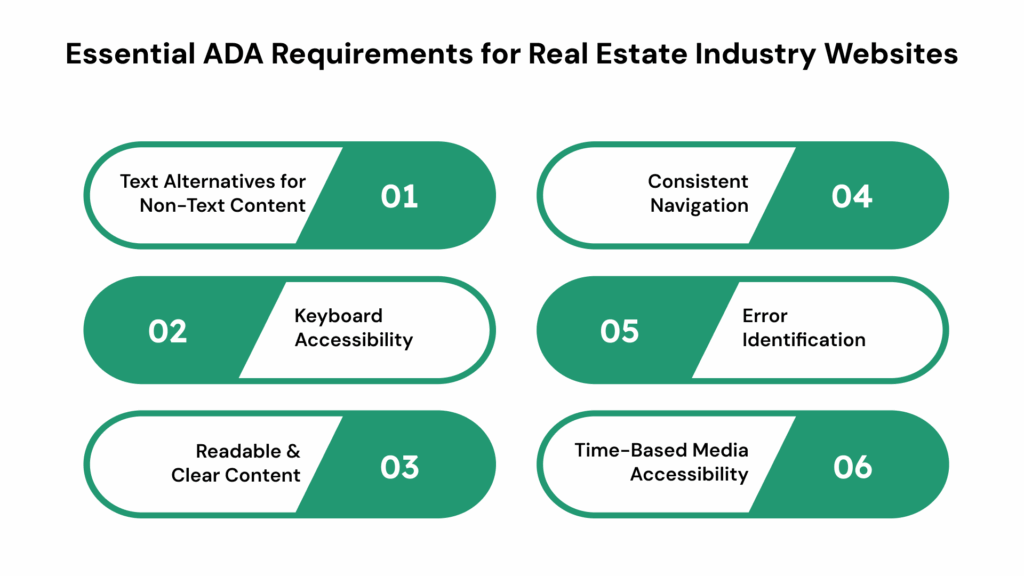
The ADA’s scope for real estate industry websites covers specific standards to ensure digital accessibility for people with disabilities, aligning closely with the Web Content Accessibility Guidelines (WCAG) 2.1 Level AA.
These requirements are not general recommendations but are increasingly enforced by courts and regulators.
Important ADA requirements for real estate websites:
1. Text Alternatives for Non-Text Content
All images, icons, buttons, and multimedia must have descriptive alt text or captions. For instance, property photos should describe key features (“3-bedroom house with large porch”) so screen readers can convey that information.
2. Keyboard Accessibility
Users must be able to navigate all website functions, such as menus, search filters, and contact forms, solely using a keyboard. This supports users with limited mobility who cannot operate a mouse.
3. Readable and Clear Content
Text on your site must have adequate colour contrast (typically a contrast ratio of at least 4.5:1 for normal text) to improve visibility for people with visual impairments. Fonts should be transparent and resizable without loss of content or functionality.
4. Consistent Navigation and Structure
Your site should follow clear and logical navigation patterns. Headings must be properly coded and hierarchical to help users understand page layout and skip to desired content quickly.
5. Form Labels and Error Identification
Every form field, such as those for property inquiries or mortgage calculators, needs programmatic labels. Clear, accessible error messages should guide users on how to fix input mistakes.
6. Time-Based Media Accessibility
Any videos or virtual tour content offered must include captions, transcripts, and audio descriptions, ensuring inclusivity for users with hearing or visual impairments.
Here’s a concise overview of the ADA requirements your real estate websites must have:
| ADA Requirement | Purpose | Example in a Real Estate Website |
| Alt text for images | Accessibility for visually impaired users | Descriptive property photos |
| Keyboard accessible menus | Navigation without a mouse | Search filters are accessible via keyboard |
| Color contrast | Visibility for users with vision limitations | Text color contrasts with the background |
| Clear structure and headings | Helps screen readers understand the layout | Logical heading hierarchy on listing pages |
| Form labels and errors | Assist users with form inputs | Proper labels on contact and application forms |
| Captions and transcripts | Access to video/audio content | Captions on neighborhood walkthrough videos |
Understanding the technical ADA requirements is vital, but many real estate businesses overlook the equally important operational and business actions that ensure effective, ongoing compliance.
Real-Estate Operational & Business Actions (The Non-Technical Work Many Miss)
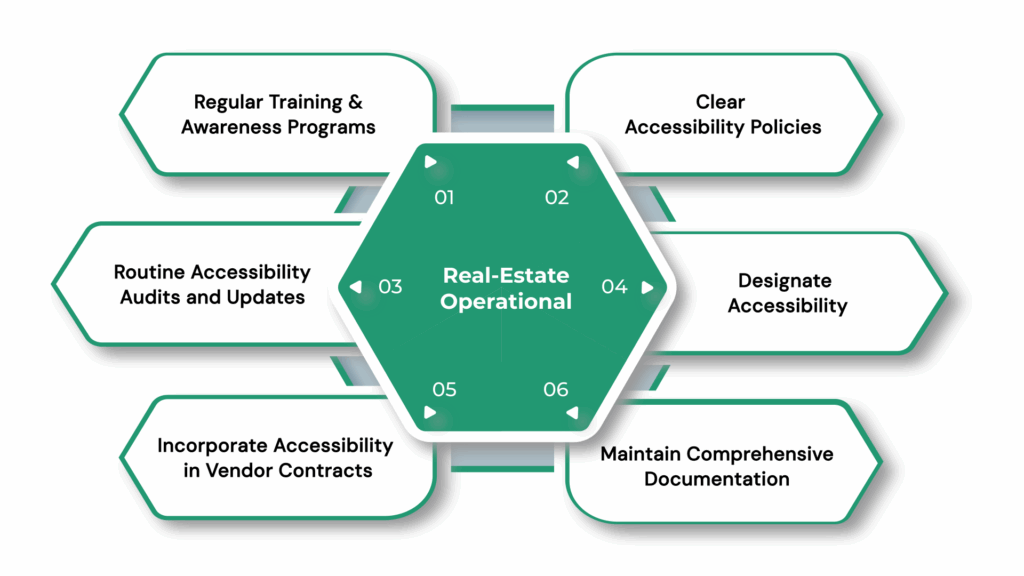
Beyond website coding and technical fixes, real estate firms must adopt several non-technical processes and policies to sustain ADA compliance and demonstrate good faith efforts if challenged legally.
Below are some key operational and business actions often overlooked:
1. Regular Training and Awareness Programs
Educate staff, marketing teams, property managers, and web developers about ADA obligations, accessibility best practices, and how to identify barriers. Consistent training helps embed compliance into everyday business culture.
2. Clear Accessibility Policies
Formalize policies stating your company’s commitment to ADA compliance. Outline procedures for reporting and resolving accessibility issues, both on websites and physical properties. This also includes accessibility statements on your website declaring your compliance status and contact info for accessibility support.
3. Routine Accessibility Audits and Updates
Schedule periodic manual and automated accessibility audits. Technology, content, and standards evolve, so continuous evaluation ensures that new listings, virtual tours, and site features remain compliant.
4. Designate Accessibility Responsibility
Assign a dedicated ADA compliance officer or team (may fall under legal, risk management, or IT departments) responsible for overseeing compliance efforts, handling complaints, and liaising with external consultants if needed.
5. Incorporate Accessibility in Vendor Contracts
When working with third parties, web designers, virtual tour providers, and content creators, ensure contracts include ADA compliance clauses and require deliverables to meet accessibility standards.
6. Maintain Comprehensive Documentation
Keep detailed records of all compliance activities, including audits, remediation steps, staff training, policy updates, and correspondence related to accessibility concerns. Proper documentation strengthens legal defense if complaints arise.
Having covered both technical and operational ADA compliance essentials, it’s critical to understand the legal consequences your real estate business could face if your website falls short.
Can You Be Sued for an ADA Non-Compliant Real Estate Website?
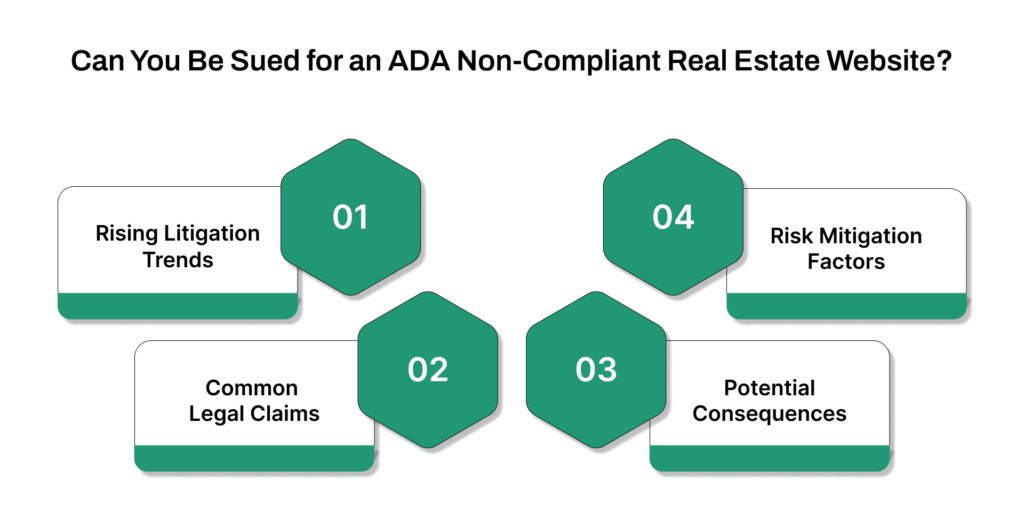
The simple and impactful answer is yes, real estate businesses face real legal risks if their websites are not ADA-compliant.
Courts and the Department of Justice (DOJ) have increasingly targeted websites under Title III of the ADA as places of public accommodation, meaning online services must be accessible to people with disabilities.
Below are some major insights on ADA website lawsuits:
1. Rising Litigation Trends
There has been a significant increase in ADA-related website lawsuits, including those targeting real estate firms. In 2024, over 70,000 ADA lawsuits were filed nationwide, with a growing share involving inaccessible digital interfaces.
2. Common Legal Claims
Plaintiffs often allege that inaccessible websites discriminate against disabled users by denying equal access to services such as property search, virtual tours, online applications, or customer support.
3. Potential Consequences
- Injunctive Relief: Courts may order immediate website fixes to achieve compliance.
- Monetary Damages: Though ADA itself does not provide for damages, plaintiffs may claim related damages under state laws.
- Legal Costs: Defending a lawsuit can be costly, with potential settlements or court fees ranging from tens to hundreds of thousands of dollars.
- Reputational Damage: Publicized lawsuits can harm brand trust and customer loyalty.
4. Risk Mitigation Factors
Businesses that proactively pursue accessibility audits, demonstrate ongoing remediation efforts, maintain documentation, and respond promptly to complaints can reduce legal exposure.
Also Read: How VComply Helps Organizations Stay Ahead of Regulatory Compliance Updates with AI
Having understood the legal risks of non-compliance, the next crucial question is how to protect your real estate website from costly ADA lawsuits proactively.
Use VComply ComplianceOps for ADA Compliance in Real Estate Management
VComply offers a tailored ComplianceOps solution designed specifically for governance, risk, and compliance challenges faced by real estate organizations, making ADA website compliance manageable, auditable, and sustainable.
Some key features of VComply ComplianceOps for ADA compliance are:
- Automated Compliance Workflow Management: VComply centralizes ADA compliance tasks into streamlined workflows, assigning responsibilities, tracking progress, and setting automated reminders to ensure no accessibility task, including website audits.
- Risk and Issue Tracking Specific to ADA Requirements: The platform allows compliance teams to document, classify, and monitor risks related to website accessibility gaps, from missing alt texts to keyboard navigation failures.
- Audit Readiness and Documentation: VComply maintains an audit trail of every compliance action, from initial testing results to remediation activities and staff training documentation. This continuous record helps defend against potential lawsuits by proving due diligence.
- PolicyOps for Accessible Policy Management: Easily centralize your company’s ADA-related accessibility policies and update them within the platform, ensuring all stakeholders have access to the latest guidelines and know their responsibilities.
- Collaboration and Reporting Tools: Cross-functional teams, compliance officers, legal, IT, and marketing, collaborate seamlessly within VComply. Automated, customizable reports summarize accessibility status for executive leadership or external audits.
Ready to simplify ADA compliance for your real estate website?
Start your free trial of VComply ComplianceOps today and safeguard your business from ADA compliance risks while promoting an inclusive online presence.
Final Thoughts,
Ensuring your real estate website’s ADA compliance is more than a legal obligation; it’s a vital step toward creating an inclusive, user-friendly experience that reaches all potential clients.
From understanding the detailed ADA standards to implementing technical fixes, operational strategies, and leveraging modern tools like VComply’s ComplianceOps, your business can confidently navigate the complexities of ADA compliance.
Being proactive not only reduces risk of costly lawsuits but also signals your commitment to accessibility, building trust and broadening your customer base in a competitive market. Accessibility is an ongoing commitment requiring regular audits, staff training, clear policies, and collaboration across teams.
Take decisive action today to protect your real estate website and enhance its accessibility.
Explore VComply’s ComplianceOps platform to automate, monitor, and document your ADA compliance efforts effortlessly.
Book a Demo and lead your business towards a compliant, inclusive, and sustainable digital future.
FAQs
Real estate websites should aim for WCAG 2.1 or 2.2 Level AA compliance, which covers major accessibility barriers, including text alternatives, keyboard access, and readable content, aligning with DOJ guidance.
Yes, virtual tours must be accessible through captions, audio descriptions, and keyboard navigation to comply with ADA digital accessibility rules for multimedia content.
Conduct comprehensive accessibility audits at least twice a year and after major website updates to ensure ongoing compliance with evolving standards and technology.
Yes, contracts should explicitly require vendors to deliver ADA-compliant solutions; however, ultimate responsibility lies with the website owner to enforce accessibility.
Some federal and state programs offer tax credits or deductions for accessibility improvements, but eligibility varies; consult with a tax advisor for specifics related to digital compliance investments.