

Develop an Effective GRC Implementation Strategy to Slash Penalty Exposure
GRC failures rarely announce themselves in advance. They surface as regulatory actions, audit escalations, and board-level crises that stall growth overnight.

What looks like a minor oversight can quickly become an enterprise-wide risk.
In 2024 alone, US financial institutions paid over $4.6 billion in fines and remediation costs and the average cost of a single non-compliance event reached nearly $14.8 million, often exceeding what organizations spend on prevention.
These penalties don’t just drain budgets; they erode board confidence and halt growth. What if your GRC Implementation strategy turned this vulnerability into a competitive edge?
Governance, Risk, and Compliance (GRC) brings policies, risk management, and regulatory compliance into one structured framework. When implemented correctly, it gives leadership visibility, enforces accountability, and prevents costly control failures before regulators find them.
In this blog, we will guide you through a proven framework to develop an effective GRC Implementation strategy that slashes penalty exposure. Read on if you want step-by-step actions that save money and make audits less painful.
Key Takeaway
- Penalties come from weak execution, not missing policies. Effective GRC focuses on control ownership, monitoring, and proof.
- GRC must operate daily, not just during audits. Continuous compliance reduces violations and audit stress.
- Clear accountability is non-negotiable. Named owners and escalation paths prevent repeat findings.
- Prioritization matters more than coverage. Start with high-risk regulations and scale in phases.
- Technology enables defensible compliance. Centralized workflows and evidence reduce penalty exposure.
- GRCOps platforms like VComply make GRC executable. They turn strategy into measurable, auditable action.
What is GRC Implementation?
GRC stands for Governance, Risk, and Compliance, three disciplines that ensure an organization is run responsibly, risks are proactively managed, and regulatory obligations are consistently met.
- Governance defines who is accountable and how decisions are made
- Risk identifies what could prevent business objectives from being achieved
- Compliance ensures laws, regulations, and internal policies are followed
On their own, these functions often operate in silos. That’s where problems begin.
GRC implementation is the structured process of operationalizing governance, risk, and compliance into day-to-day business activities. It turns policies into enforceable controls, risks into measurable data, and compliance into repeatable workflows.
A well-executed GRC implementation focuses on integration, not documentation. It typically includes:
- Clear ownership and accountability: Defined roles for boards, leadership, and control owners, so nothing falls through the cracks.
- Standardized risk and control framework: A single risk taxonomy and control library mapped across multiple regulations to avoid duplication.
- Centralized policy and compliance management: One source of truth for policies, obligations, evidence, and audit trails.
- Automated monitoring and reporting: Continuous tracking of control effectiveness, exceptions, and remediation status.
Also Read: What is GRC: Governance, Risk, and Compliance Explained
When you move from “what GRC implementation is” to “why it matters,” the conversation shifts from theory to real business impact on risk, cost, trust, and growth.

Why is GRC Implementation Important?
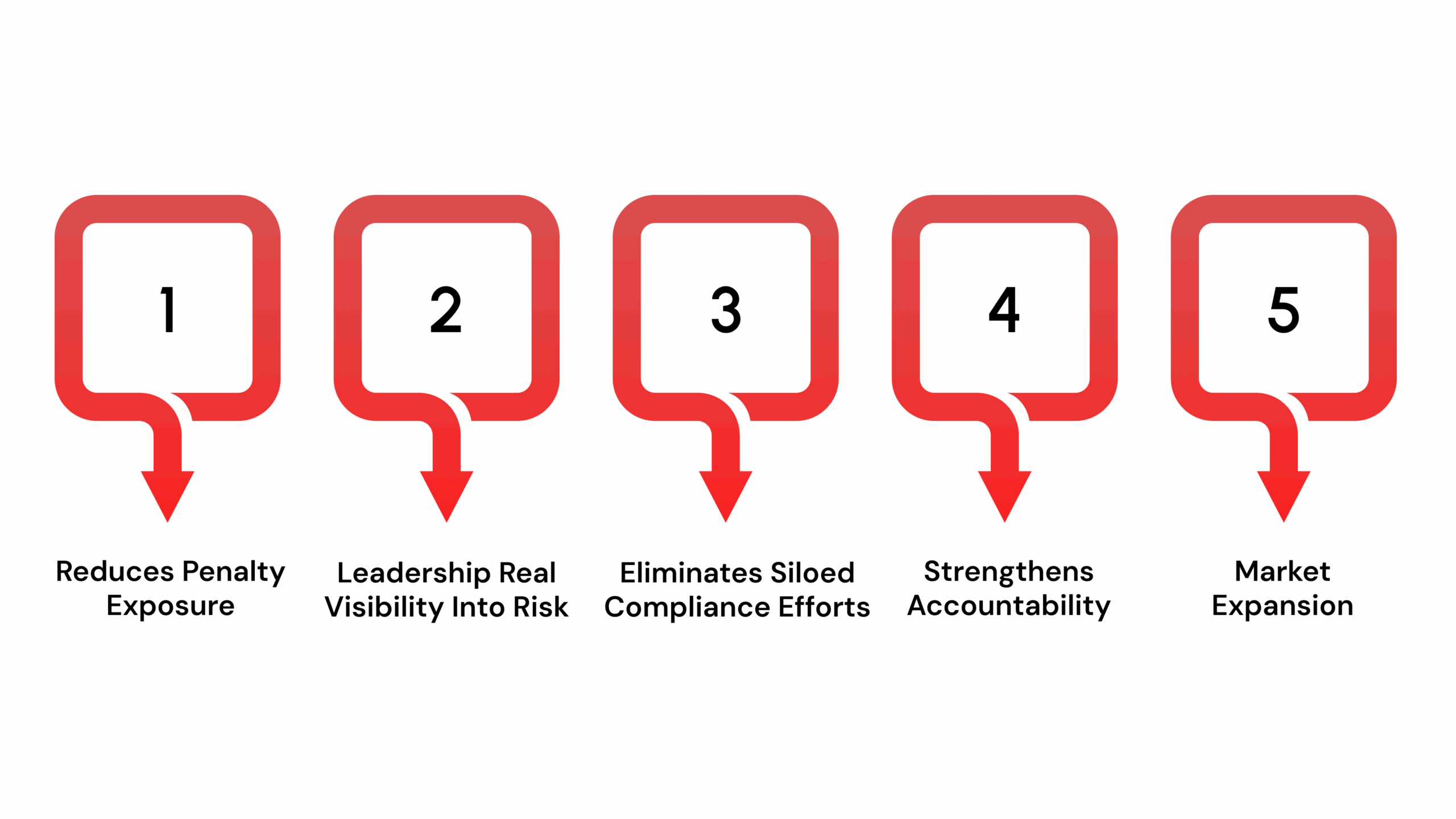
GRC implementation is important because it turns scattered governance, risk, and compliance activities into a single, coordinated system that supports better decisions and fewer surprises. Integrated GRC programs give leadership a unified view of risks and obligations, improving strategic planning and resource allocation.
Here’s what effective GRC implementation actually delivers:
1. It Reduces Penalty Exposure by Preventing Control Failures
Regulatory penalties usually stem from missed controls, inconsistent enforcement, or lack of evidence, not from ignorance of rules.
GRC implementation ensures:
- Controls are assigned to owners and monitored continuously
- Compliance tasks don’t depend on individual memory or manual follow-ups
- Evidence is captured as work happens—not recreated under audit pressure
Result: fewer violations, faster remediation, and defensible compliance during investigations.
2. It Gives Leadership Real Visibility Into Risk
Without implementation, risk reporting is delayed, subjective, and incomplete.
With GRC in place:
- Risks are scored using consistent criteria
- Leadership sees real-time exposure across departments and locations
- Emerging risks are flagged early, not after incidents occur
This visibility enables informed decisions, not reactive firefighting.
3. It Eliminates Siloed Compliance Efforts and Wasted Spend
Most organizations unknowingly duplicate controls across regulations and teams.
GRC implementation:
- Maps one control to multiple regulatory requirements
- Centralizes policies, obligations, and evidence
- Removes redundant assessments and documentation
Outcome: lower compliance costs and significantly less audit fatigue.
4. It Strengthens Accountability Across the Organization
When roles are unclear, risks are ignored. A structured GRC implementation:
- Clearly defines who owns each risk, control, and policy
- Establishes escalation paths when controls fail
- Aligns teams under a shared risk and compliance language
Accountability stops being assumed; it becomes enforced.
5. It Protects Growth, Reputation, and Market Expansion
New markets, acquisitions, and regulations increase risk exponentially.
GRC implementation makes growth safer by:
- Scaling controls consistently across geographies
- Identifying regulatory gaps before expansion
- Demonstrating maturity to regulators, investors, and partners
If GRC implementation protects the business, then weak or incomplete implementation quietly does the opposite. Let’s look at the real risks organizations face when GRC exists only on paper or is executed halfway.
Key Business Risks of Poor or Incomplete GRC Implementation
A fragmented or underpowered GRC implementation creates blind spots, duplicated work, and false confidence. Instead of a single integrated view of governance, risk, and compliance, you end up with siloed tools, manual processes, and inconsistent data, making it hard to see real exposure.
Below are the most critical risks businesses face, and how they actually show up.
1. Limited visibility into real risks
Incomplete GRC rollouts often mean different teams use different risk methods and tools, so leadership never gets a single, comparable view of threats.
This leads to underestimation of critical risks (e.g., cyber, third‑party, regulatory) and over‑investment in low‑impact issues.
2. Higher probability and cost of non‑compliance
Gaps in GRC coverage translate into missed controls, weak monitoring, and inconsistent reporting, which directly increase the odds of fines, consent orders, and lawsuits.
Non‑compliance can cost 2–3 times more than building strong programs, once penalties, remediation, and legal costs are included.
3. Operational inefficiency and duplicated effort
When GRC is only half‑implemented, business units keep their own spreadsheets and trackers, driving duplication, inconsistent data, and wasted hours reconciling reports.
This raises the total cost of compliance and slows response to new risks or regulatory changes.
4. Inability to manage third‑party and cyber risk effectively
Weak GRC implementations struggle to consolidate vendor, IT, and security risks, leaving organizations exposed to supplier failures and breaches.
Studies show that most high‑profile breaches and fines have roots in GRC weaknesses such as siloed data and manual controls.
5. Poor decision‑making and board oversight
Without reliable, enterprise‑wide GRC data, boards and executives lack the risk‑adjusted performance metrics they need for strategic decisions.
This can result in misaligned risk appetite, under‑ or over‑investment in controls, and slower reactions to emerging threats.
Knowing the risks is one thing. Building a system that actually prevents them is another. This is where GRC strategy either becomes a real safeguard or just more paperwork.
Step-by-Step Framework to Build a GRC Implementation Strategy
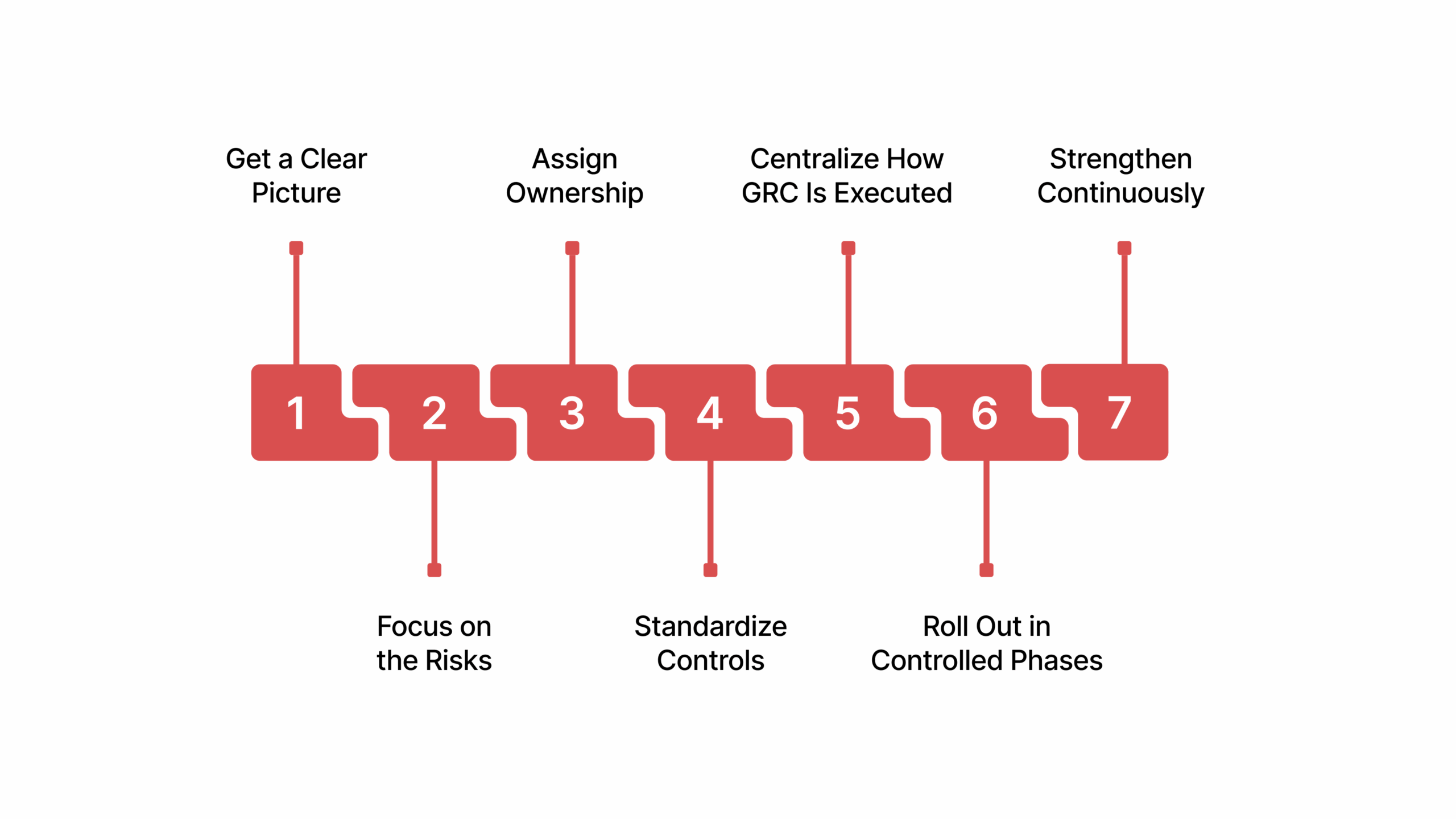
A solid GRC implementation strategy connects governance, risk, and compliance activities to business goals, with clear owners, timelines, and metrics. The steps below turn that into an actionable plan.
Step 1: Get a Clear Picture of Your Current Reality
Before fixing anything, you must understand what is actually happening, not what policies say. Look at:
- Where compliance activities are tracked today
- Which controls repeatedly fail or show up in audits
- How evidence is collected and how often it’s missing
You can’t reduce penalties if you don’t know where violations start.
Step 2: Focus on the Risks That Can Hurt You Most
Not all regulations carry the same financial or operational risk. Do this:
- Identify laws and standards with the highest penalties
- Pinpoint processes where violations are most likely
- Align risk tolerance with business priorities
Trying to cover everything at once weakens control where it matters most.
Step 3: Assign Ownership That Can’t Be Avoided
Controls fail when responsibility is shared or unclear. A strong GRC strategy ensures:
- Every risk and control has a named owner.
- Escalation rules are defined before failures occur
- Leadership oversight is visible and documented
Regulators look for accountability, not explanations.
Step 4: Simplify and Standardize Controls
More controls do not mean better compliance. Instead:
- Use one control to satisfy multiple regulations
- Apply consistent risk scoring across teams
- Remove duplicate or low-value controls
Fewer, stronger controls are easier to manage and defend.
Step 5: Centralize How GRC Is Executed and Proven
Spreadsheets break under pressure. Centralization allows you to:
- Track obligations and deadlines in one place
- Capture evidence as work happens
- Produce audit-ready proof instantly.
In investigations, proof matters more than intent.
Step 6: Roll Out in Controlled Phases
Large-scale launches create resistance and errors. Start with:
- High-risk areas or regulatory hot spots
- Small pilot teams
- Adjustments based on real usage
Adoption determines success, not design.
Step 7: Monitor, Test, and Strengthen Continuously
Compliance weakens when it’s treated as a one-time task. Track:
- Control effectiveness over time
- Repeat issues and root causes
- Audit outcomes and remediation speed
Continuous monitoring is what turns GRC into a defense system.
A solid GRC strategy isn’t judged by how well it’s designed but by what happens when regulators, auditors, or investigators step in. This is where the real payoff becomes visible.
How an Effective GRC Strategy Directly Reduces Penalty Exposure
An effective GRC strategy reduces penalty exposure by closing compliance gaps before regulators find them and by catching issues earlier, when they are cheaper to fix.
Organizations that invest in structured GRC programs and tooling typically find that the cost of staying compliant is less than half the cost of non‑compliance once fines, remediation, and disruption are included.
Here’s how that works in practice.
1. Turning ad‑hoc controls into a monitored system
GRC centralizes obligations (GDPR, HIPAA, SOX, PCI DSS, etc.) into mapped controls, owners, and testing schedules, so there are fewer blind spots regulators can exploit.
This systematic coverage directly lowers the chance of “unknown” violations that lead to surprise penalties.
2. Catching issues earlier and cheaper
Studies show non‑compliance events cost more than twice as much as maintaining compliance.
By using continuous monitoring, control testing, and automated alerts, a mature GRC program detects gaps before they trigger investigations or large enforcement actions.
3. Aligning documentation with regulator expectations
Effective GRC strategies enforce standardized evidence, audit trails, and policy attestations, making it easier to demonstrate “good‑faith” efforts and strong internal controls during reviews.
Well‑documented programs can reduce both the likelihood and severity of penalties because regulators see a controlled, responsive environment rather than negligence.
4. Reducing exposure to high‑value enforcement areas
Focused GRC strategies prioritize these high‑enforcement domains (financial crime, data protection, cyber, third‑party risk), helping organizations stay ahead of areas most likely to draw heavy sanctions.
Read: 7 Steps to Prioritize Important Goals in GRC
Even the best GRC strategy can fail if execution realities are ignored. Before we talk about optimization, it’s important to understand the obstacles that most organizations underestimate.
Challenges You May Face While Implementing the GRC Program
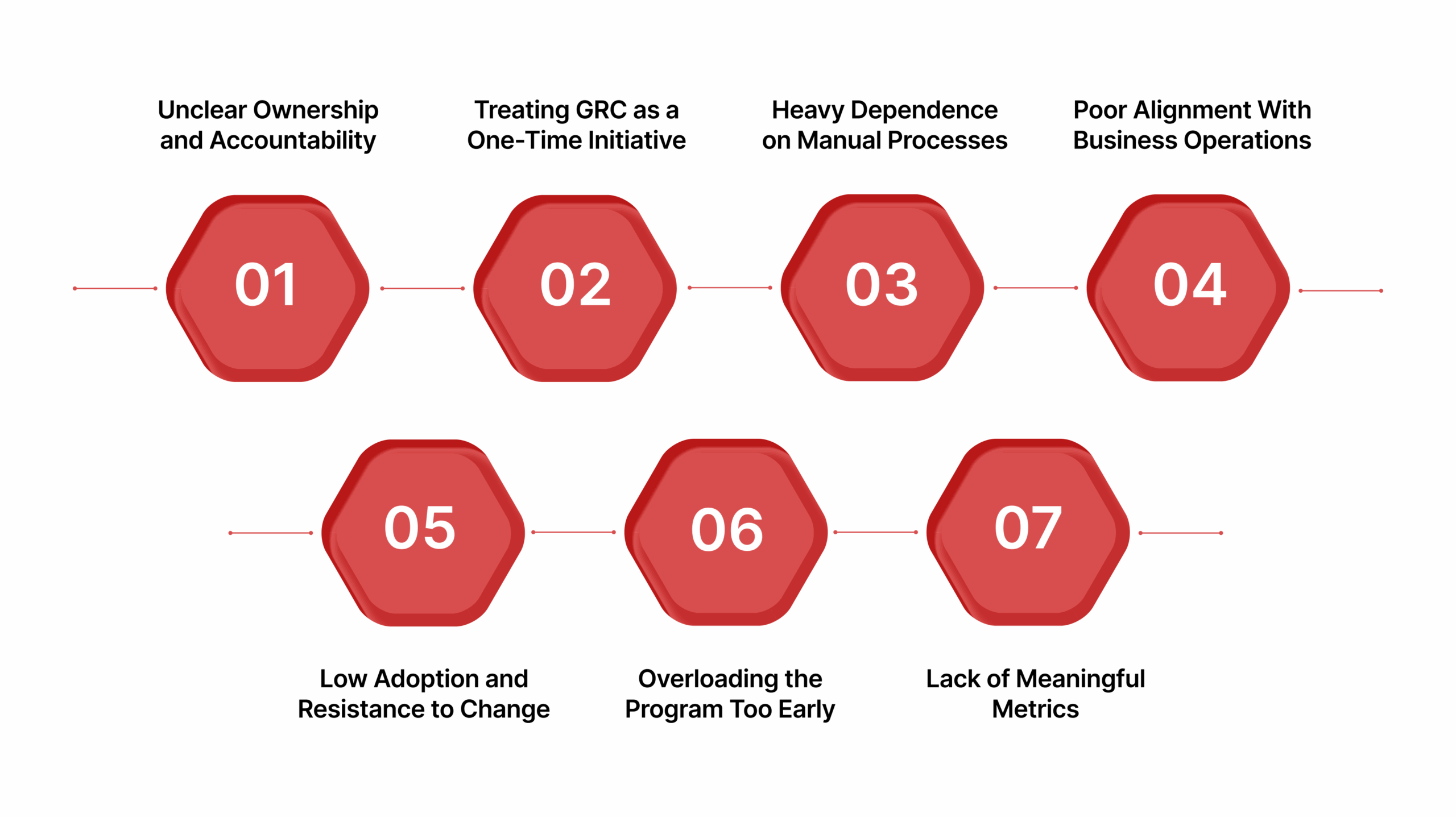
Implementing a GRC program isn’t difficult because the framework is unclear; it’s difficult because it cuts across people, processes, and systems. Below are the most common, high-impact challenges organizations face, explained plainly and practically.
1. Unclear Ownership and Accountability
When risks and controls don’t have named owners, issues stall, and remediation is delayed. Regulators view this lack of accountability as weak governance.
2. Treating GRC as a One-Time Initiative
GRC fails when it’s implemented once and forgotten. Regulations change, controls drift, and risk exposure grows without continuous monitoring.
3. Heavy Dependence on Manual Processes
Spreadsheets and emails increase errors, slow audits, and weaken evidence. Manual tracking doesn’t scale as compliance complexity grows.
4. Poor Alignment With Business Operations
GRC breaks down when it’s disconnected from daily workflows. Controls get bypassed under pressure, increasing violation risk.
5. Low Adoption and Resistance to Change
Teams resist GRC when it feels like extra work without clear value. Low adoption leads to incomplete data and unreliable reporting.
6. Overloading the Program Too Early
Trying to implement everything at once overwhelms teams. High-impact risks get lost among low-value controls.
7. Lack of Meaningful Metrics
Without tracking control effectiveness, issue recurrence, and remediation speed, leadership can’t measure success or prove compliance strength.
Even a well-built GRC program can lose effectiveness as the business evolves. The real risk isn’t starting wrong; it’s failing to adapt when conditions change.
When to Revisit or Redesign Your GRC Implementation Strategy
GRC is not a “set it and forget it” model. Certain business and regulatory events should immediately trigger a review of your GRC implementation. Ignoring these signals is one of the fastest ways for penalty exposure to creep back in.
- New or Stricter Regulations: When laws change or penalties increase, existing controls may no longer be sufficient. Outdated mappings quickly become non-compliant.
- Repeat Audit Findings: Recurring issues indicate weak control design or ownership gaps. Fixing findings without redesigning controls leads to repeated penalties.
- Business Expansion or Restructuring: Entering new markets, launching products, or acquiring entities introduces risks your current GRC model may not cover.
- Manual Overload and Audit Fatigue: If audits require excessive manual effort, your GRC framework isn’t scaling with complexity.
- Limited Risk Visibility for Leadership: Delayed or inconsistent risk reporting signals disconnected systems and poor oversight.
- Low Adoption or Process Bypass: When teams bypass controls, the problem is usually design, not discipline.
Knowing when to redesign your GRC strategy is only half the solution. The next step is choosing a platform that can actually execute it without adding complexity.
How VComply Can Help You Implement The GRC Framework?
VComply is a purpose-built GRCOps platform designed to operationalize Governance, Risk, and Compliance, not just document it. Unlike traditional GRC tools that focus on reporting, VComply helps teams execute controls, track accountability, and prove compliance continuously.
VComply’s GRCOps platform is purpose-built to solve the exact execution gaps that increase penalty exposure. Here’s why VComply’s GRCOps is the right solution for this problem:
- Built for execution, not just oversight: GRCOps focuses on daily compliance activities, tasks, controls, evidence, and remediation, where most failures occur.
- Clear accountability at every level: Every policy, risk, and control is assigned to a named owner, eliminating ambiguity that regulators penalize.
- Continuous compliance, not audit-driven effort: Controls are monitored in real time, reducing last-minute audit scrambles and missed obligations.
- Centralized evidence and audit readiness: Evidence is captured as work happens, creating a defensible audit trail at all times.
- Scales with regulatory and business complexity: Supports multiple regulations, entities, and geographies without duplicating controls or effort.
- Designed for adoption, not resistance: Simple workflows fit into existing operations, increasing usage and data reliability.
VComply’s GRCOps doesn’t just support your GRC framework; it runs it, closing the execution gaps that lead to penalties.
Get a 21-day free trial to see how VComply turns GRC from a compliance burden into a controlled, scalable operation.
Final Thoughts
Regulatory penalties are rarely the result of missing rules; they come from weak execution, unclear ownership, and the inability to prove compliance when it matters most.
As this blog has shown, an effective GRC implementation strategy focuses on operational control, continuous monitoring, and accountability across the business.
When GRC is implemented as an operating model, not a one-time project, it reduces penalty exposure, strengthens leadership confidence, and supports safe growth.
The difference lies in execution. Platforms built for daily GRC operations make that execution consistent, scalable, and defensible.
Book a demo with VComply to see how its GRCOps platform helps you implement GRC the right way.
FAQs
A focused GRC implementation usually takes 8–16 weeks, depending on regulatory scope and risk complexity. Phased rollouts allow high-risk areas to go live faster while scaling gradually.
Yes. Smaller organizations benefit the most because GRC helps prevent early compliance failures, reduces manual effort, and builds scalable controls before regulatory pressure increases.
Key metrics include control effectiveness, issue recurrence rates, remediation time, and audit findings per cycle. These directly indicate penalty exposure.
Not always. A GRC platform can centralize and integrate existing tools, reducing duplication while improving visibility and control over execution.
At a minimum, review it annually, and immediately after major regulatory changes, audits with repeat findings, or business expansion into new markets.