

Chemical Manufacturing Regulations: A Practical Compliance Guide
Regulatory complexity, unexpected inspections, and costly compliance missteps make managing chemical manufacturing regulations feel overwhelming, especially when you’re juggling production, safety, and documentation all at once.

With over 4 million U.S. jobs supported by the chemical manufacturing sector in 2025, and the industry contributing roughly 25 % of U.S. GDP, the stakes for meeting regulatory demands are higher than ever. Understanding how to navigate that landscape helps you protect your workforce, avoid penalties, and maintain smooth operations. By getting clear on key rules and building an efficient compliance workflow, you position your organization for audit-readiness and long-term success.
Key Takeaways
- Chemical manufacturing regulations in the U.S. require careful control of how chemicals are stored, handled, transported, and documented across your facility.
- Several agencies shape your responsibilities, including OSHA, EPA, TSCA, RCRA, CFATS, and state regulators, each influencing different parts of daily operations.
- Compliance hinges on clear procedures, accurate records, proper labeling, updated SDS files, routine training, and consistent waste-handling practices.
- Audits focus on permits, inventories, training logs, incident documentation, and storage conditions, so maintaining organized, up-to-date evidence keeps your facility inspection-ready.
What Is Chemical Compliance?
Chemical compliance refers to the process of following all rules that govern how chemicals are produced, stored, used, transported, and disposed of in the United States. It covers everything from worker safety to environmental protection, and even the security of high-risk chemicals. You follow compliance standards to prevent accidents, reduce liability, and maintain operational integrity in chemical manufacturing. By treating chemical manufacturing compliance as a daily operational discipline, you strengthen control across your entire facility.
Once you understand what compliance involves, it becomes easier to see why every industry that works with chemicals depends on it.
Why Chemical Compliance Matters Across Industries?
Chemical compliance affects every sector that handles or transforms chemicals, shaping how safely and legally those operations run.
Here are the core reasons it matters:
- Prevents hazardous exposures by ensuring safe handling, labeling, and segregation of chemicals, which directly protects your workers and the surrounding communities.
- Reduces regulatory penalties by keeping your permits, waste logs, and environmental records audit-ready year-round.
- Supports uninterrupted operations because compliant processes lower the risk of shutdowns, surprise inspections, and production delays.
- Strengthens brand trust when your organization demonstrates responsible chemical use, disposal, and environmental stewardship.
Several U.S. agencies shape these responsibilities, each influencing a different part of your operations, which brings us to the next point.

The Regulatory Agencies Governing Chemicals
Multiple U.S. agencies regulate different parts of chemical manufacturing, and together they define what chemical manufacturing compliance must look like.
Here are the main bodies that shape your obligations:
- OSHA oversees worker protections, exposure limits, hazard communication, and chemical handling safety in manufacturing environments.
- EPA regulates air emissions, wastewater discharge, waste disposal, emergency planning, and environmental impacts tied to chemicals.
- TSCA (EPA) controls the review, approval, and lifecycle management of chemical substances manufactured or imported into the U.S.
- DHS CFATS secures high-risk chemicals that could be misused, requiring vulnerability assessments and protective measures.
- DOT regulates the packaging, labeling, and transport of hazardous materials on U.S. highways.
- State & Local Agencies issue operational permits, conduct inspections, and enforce facility-specific chemical rules.
Also read: Chemical Compliance and Management Software Solutions
Knowing who oversees your operations makes it easier to break down what they actually expect from your facility day to day.
Core Requirements Chemical Manufacturers Must Meet
Every chemical manufacturer must follow essential requirements to maintain safety, environmental responsibility, and regulatory integrity.
Here are the major expectations:
- Maintain a fully compliant Hazard Communication Program that covers labeling, chemical lists, SDS access, and employee awareness.
- Keep all Safety Data Sheets updated and accessible, ensuring your workforce always has accurate hazard details.
- Secure the right environmental permits for air emissions, wastewater, and hazardous waste treatment or storage.
- Implement proper chemical storage and segregation protocols to prevent reactions, leaks, and fire hazards.
- Train employees on PPE use, emergency response, spill control, and equipment handling at defined intervals.
- Maintain strong waste management practices, including manifest tracking, storage limits, and disposal timing.
To make these requirements easier to act on, it helps to understand the major regulations behind them in plain language.
Key Regulations Explained
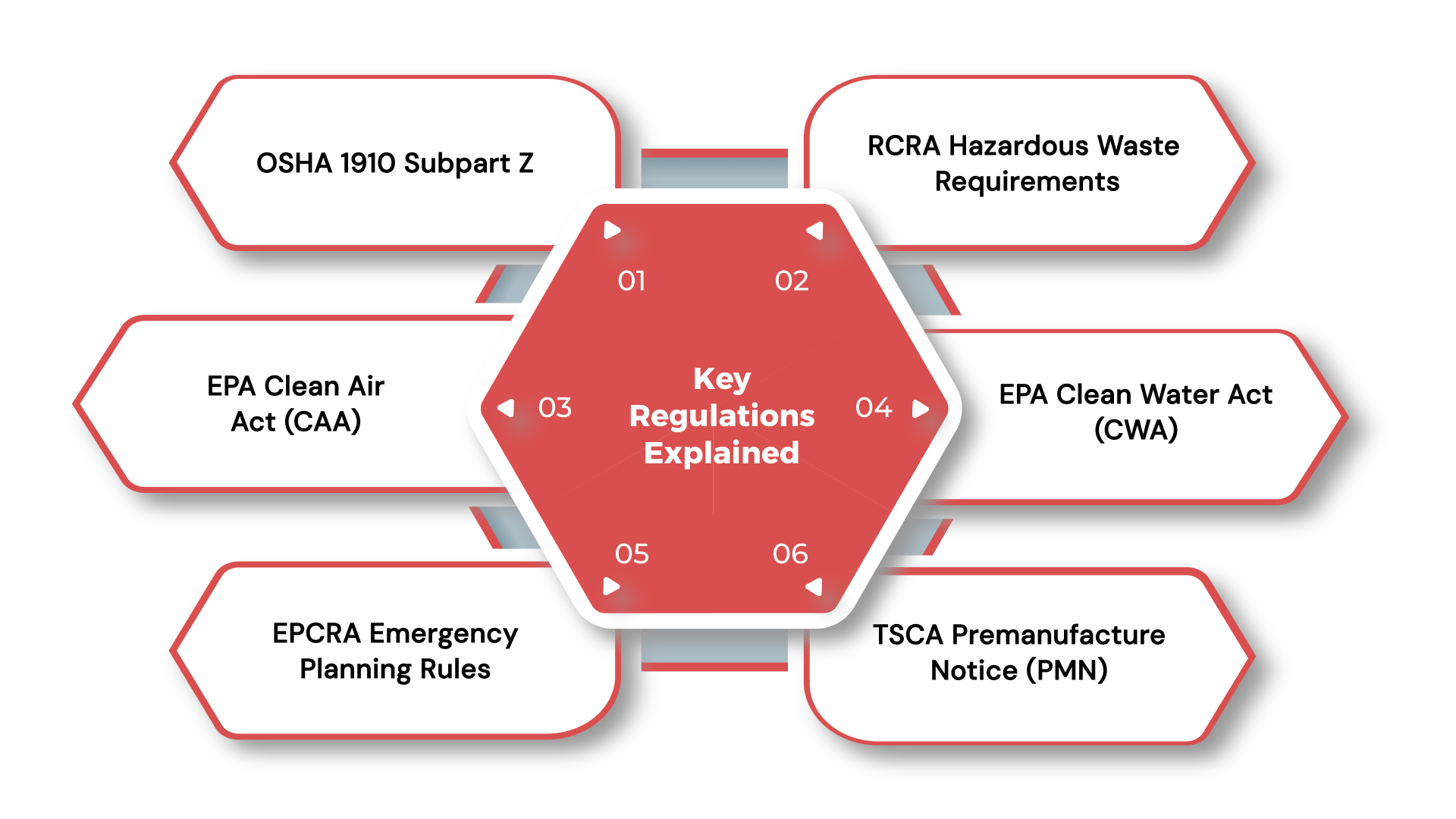
These major U.S. regulations define the core obligations you must meet under chemical manufacturing compliance.
Here are the primary rules, explained clearly:
1.OSHA 1910 Subpart Z
This regulation sets exposure limits for toxic and hazardous substances you work with daily. It guides how to monitor air quality, protect workers, and control chemical hazards. Following it reduces the risk of injuries, illnesses, and safety violations.
2. RCRA Hazardous Waste Requirements
RCRA governs the cradle-to-grave handling of hazardous waste generated during manufacturing. You manage waste classification, storage, manifests, and disposal timelines under this rule. Compliance helps you avoid spills, fines, and unsafe waste accumulation.
3. EPA Clean Air Act (CAA)
The CAA regulates emissions from chemical manufacturing operations that affect air quality. You must monitor pollutants, maintain control equipment, and meet reporting schedules. These steps help you operate responsibly while avoiding penalties tied to emissions limits.
4. EPA Clean Water Act (CWA)
The CWA oversees wastewater discharge and contamination prevention. You track effluent quality, maintain permits, and document every discharge point. Consistent compliance prevents water pollution and protects nearby waterways.
5. EPCRA Emergency Planning Rules
EPCRA requires you to report chemical inventories, storage amounts, and emergency hazards. Local planners and responders use this data to protect communities during incidents. You meet these rules by submitting Tier II reports and maintaining accurate chemical data.
6. TSCA Premanufacture Notice (PMN)
TSCA governs how new chemical substances are reviewed before production. You must evaluate risks, analyze hazards, and file PMNs for chemicals not previously listed. This ensures your innovations meet safety standards before entering the market.
Also read: Manufacturing Compliance Training: A Comprehensive Guide
Once the rules are clear, the next step is turning them into a workable process your team can follow consistently.
A Workflow for Achieving Chemical Compliance
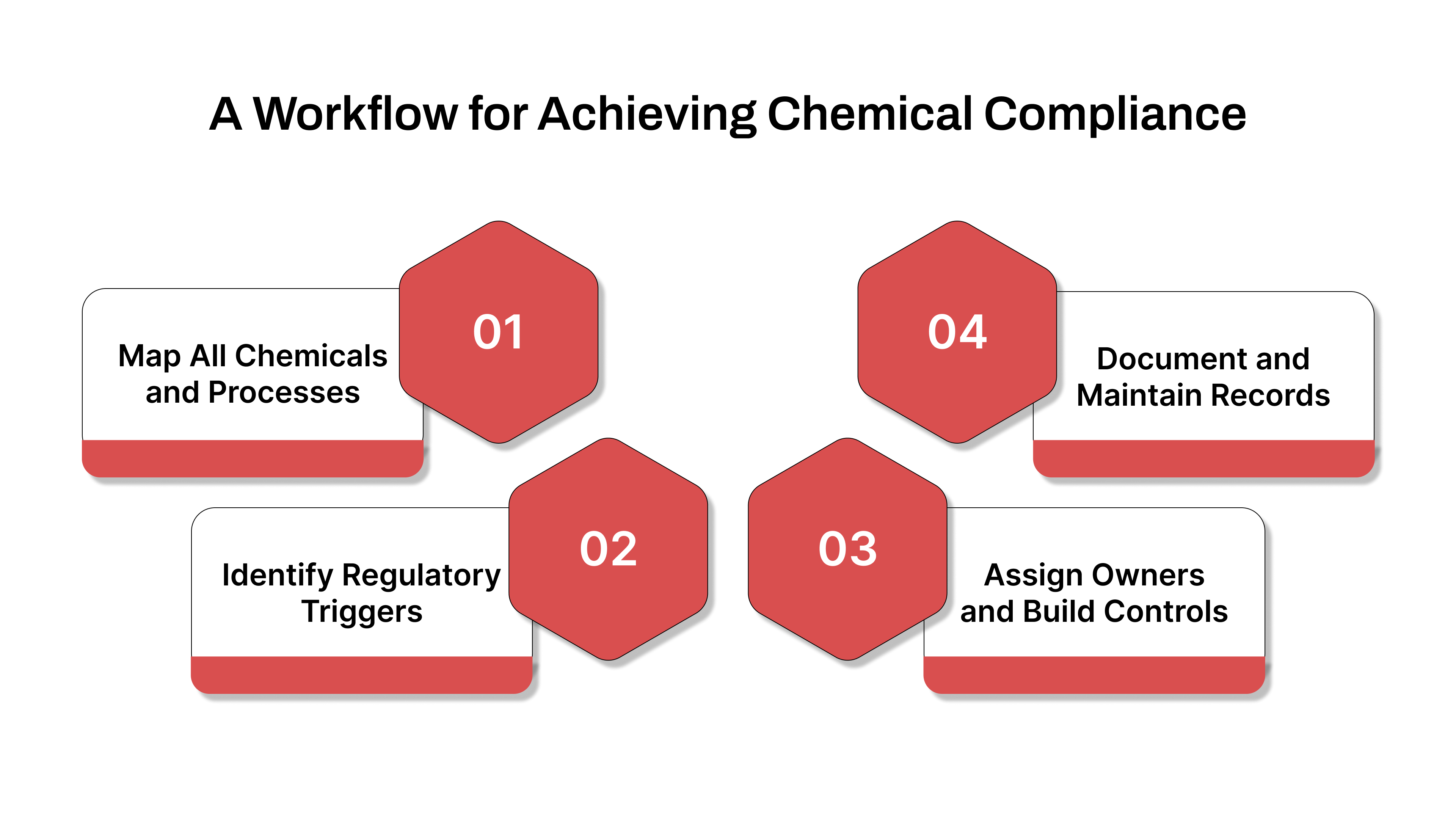
A structured workflow helps you streamline chemical manufacturing compliance and avoid disorganized, last-minute fixes. Here are the essential stages:
1. Map All Chemicals and Processes
You begin by documenting every chemical, supplier, use case, and storage location across your facility. This detailed mapping helps you spot regulatory thresholds, hazard classifications, and reporting triggers early. By maintaining visibility into every substance, you prevent compliance blind spots during audits and routine inspections.
2. Identify Regulatory Triggers
Each chemical activates specific OSHA, EPA, TSCA, or CFATS requirements that affect how you manage and monitor it. You review threshold quantities, environmental impacts, exposure limits, and approval needs tied to every substance. This process helps you prioritize which chemicals pose the highest compliance risk and must be controlled first.
3. Assign Owners and Build Controls
Compliance tasks need clearly defined owners across EHS, operations, quality, and shift leadership to prevent gaps. You then create routine procedures, engineering controls, and monitoring steps that reduce risk at its source. When everyone understands their role, your chemical manufacturing compliance program becomes consistent across every shift.
4. Document and Maintain Records
Your compliance strength depends on detailed documentation, including permits, SDS files, waste manifests, inspection logs, and training records. You keep these documents current, accurate, and version-controlled so regulators can verify your processes instantly. Strong recordkeeping supports faster audits and prevents delays when agencies request evidence.
Even with a solid workflow, audits will still test how reliable your processes are, so knowing what inspectors focus on is essential.
What Inspectors Look for During Audits?
Auditors focus on operational proof that your chemical manufacturing compliance system actually works.
Here’s what they check most often:
- Inspectors review every environmental permit to confirm you haven’t missed renewal deadlines or changed processes without updating permit conditions.
- They compare your documented chemical inventory against what’s physically stored on racks, production lines, and transfer stations to check for inconsistencies.
- Auditors verify that each substance on-site has a complete and accessible SDS so workers always have accurate hazard information at hand.
- They evaluate your training records to confirm employees actually understand hazard controls, exposure risks, and emergency procedures.
- Spill logs, leak reports, and corrective action records are examined to ensure incidents are documented and followed through systematically.
- Waste labels, accumulation timelines, and manifest documentation are checked to validate that hazardous waste is stored, tracked, and removed according to federal rules.
The issues inspectors flag most often tend to appear in the same areas, which makes awareness a strong advantage.
Common Failures in Chemical Manufacturing Compliance
Most compliance issues come from daily gaps in processes, communication, and upkeep rather than from major structural failures. Here are the issues inspectors frequently uncover:
- SDS libraries often fall behind, leaving workers to rely on outdated hazard data that no longer reflects the chemicals actually used in production.
- Labels fade, peel, or get replaced incorrectly, which causes serious risks during transfers, storage, and line changeovers.
- Waste segregation mistakes occur when incompatible materials are stored together or when containers exceed acceptable accumulation timelines.
- Emergency response plans go unpracticed, making teams slower and less coordinated when real incidents occur on the floor.
- PPE compliance drops when training isn’t reinforced regularly or when employees aren’t sure which gear applies to specific chemicals or tasks.
Also Read: Manufacturing Compliance: A Practical Guide for 2025
Avoiding these gaps becomes easier when your operations follow a predictable rhythm, which is where the next section comes in.
How to Ensure Chemical Compliance Efficiently?
Efficient chemical manufacturing compliance requires structured processes that reduce manual oversight and eliminate inconsistencies. Here are the best ways to streamline compliance work:
- Standardizing handling, storage, and waste management procedures ensures every shift follows the same rules, reducing the chance of inconsistencies or skipped steps.
- Setting a recurring schedule for inspections, training updates, documentation refreshes, and permit reviews helps you stay ahead of regulators instead of reacting to issues.
- Using centralized logs and unified reporting templates makes it easier for your team to document hazards, near misses, and incidents consistently across all departments.
- Tracking chemical quantities, threshold limits, and regulatory triggers in real time allows you to intervene before you accidentally cross a compliance boundary.
- Maintaining strong cross-team communication through briefings, visual boards, and digital dashboards ensures everyone stays aware of new requirements and operational changes.
Once the operational habits are in place, the right support system can help your team maintain them without added pressure.
Take Control of Chemical Compliance Before Regulators Do
Managing chemical manufacturing compliance becomes far easier when your processes, documentation, and risk controls run through a system built for high-regulation environments. VComply gives you a unified platform that automates your compliance operations and keeps OSHA, EPA, TSCA, RCRA, and CFATS requirements fully aligned with your daily workflows.
Here’s how VComply helps you stay compliant without slowing down production:
- Workflow Automation assigns, tracks, and reminds your team about recurring tasks like SDS updates, waste audits, spill checks, training cycles, and permit renewals, eliminating the manual follow-ups that often cause violations.
- Centralized Document Management stores SDS files, manifests, permits, CAPA reports, inspection logs, and compliance evidence in one secure, version-controlled library so you can produce proof instantly during audits.
- Real-Time Dashboards & Compliance Status Tracking show where your chemical manufacturing compliance is on track, behind schedule, or at risk, helping you correct gaps long before regulators find them.
- Audit-Ready Trails automatically record actions, approvals, changes, and evidence submissions so you never scramble for documentation during OSHA, EPA, or environmental inspections.
- Risk Management Tools highlight high-risk chemicals, processes, and tasks so you can prioritize controls based on actual exposure, regulatory thresholds, and incident trends.
- Incident & Case Management standardizes spill reporting, leak investigations, corrective actions, and root-cause workflows, giving regulators clear proof of your response discipline.
- Policy Builder & Version Control helps you draft, update, and distribute chemical-handling SOPs, storage rules, waste protocols, and emergency plans with automatic acknowledgment tracking.
- Integrations with HR, ERP, and Production Systems make training records, shift logs, and inventory data flow automatically into your compliance workflow, reducing errors and duplicated work.
- Customizable Checklists let you build OSHA HazCom tasks, storage inspections, emergency equipment checks, and waste-handling routines aligned with facility-specific operations.
- Role-Based Access & Accountability assigns clear ownership for tasks across EHS, operations, supervisors, quality, and leadership, eliminating ambiguity that leads to compliance breakdowns.
Wrapping Up
Staying compliant in chemical manufacturing becomes far more manageable when you fully understand the regulations, the operational expectations, and the gaps that typically trigger violations. With the right structure, clarity, and workflows, you can protect your teams, maintain operational continuity, and stay ahead of inspections with confidence. VComply brings all your compliance tasks, documentation, and regulatory controls into one organized system so nothing gets missed in the chaos of daily operations.
Book a personalized demo today to see how VComply can strengthen your chemical compliance program end-to-end.
FAQ
Chemical manufacturers must follow OSHA’s Hazard Communication Standard, EPA rules under the Clean Air Act, Clean Water Act, and RCRA, plus TSCA and EPCRA reporting. These laws govern how chemicals are stored, handled, processed, documented, and disposed of across operations.
SDS files must be updated whenever suppliers issue new versions, internal processes change, or new hazard information is released. OSHA requires that the latest SDS remain easily accessible to employees at all times.
Inspections occur through routine scheduling, incident reports, community complaints, or discrepancies in environmental filings. OSHA and EPA also conduct targeted visits for facilities handling high-risk chemicals or hazardous waste.
Most violations come from outdated documentation, poor labeling, storage issues, or incomplete training records. Small operational oversights often escalate quickly into fines or corrective actions.
Clear procedures, defined ownership, and simplified documentation reduce confusion and skipped steps. Short, frequent trainings help reinforce expectations across all shifts.
Facilities should organize permits, SDS files, waste manifests, training logs, chemical inventories, and incident records. Inspectors compare written procedures to real operations, so accuracy and consistency are essential.