


Share



How Elie Aoun Is Strengthening Governance at CFI
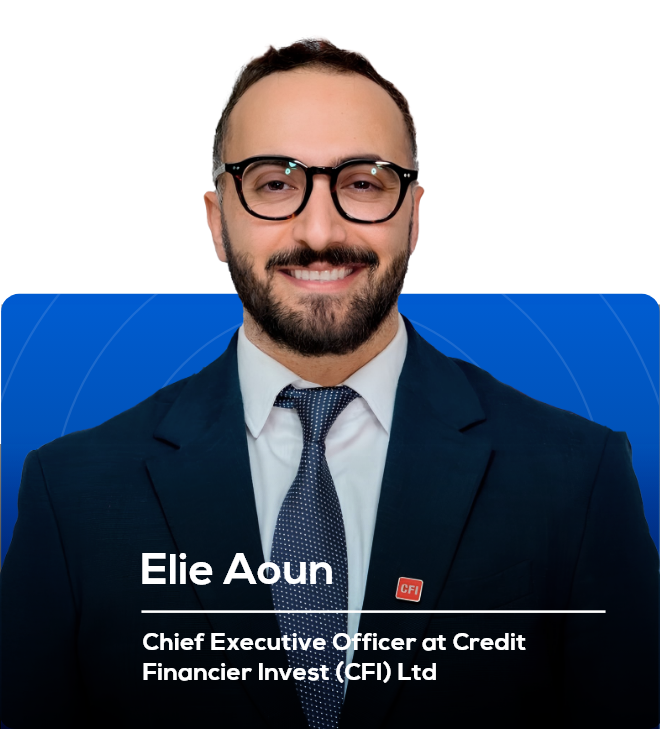
When Elie Aoun speaks about compliance, there’s no jargon, just a calm insistence that it’s what keeps a company credible when everything else moves too fast. As CEO of CFI Ltd, he straddles two worlds: the regulatory rigor of European finance and the entrepreneurial drive of the Middle East.
“Compliance used to be a formality,” he says. “Now it’s the foundation of credibility. You can’t build a sustainable business without it.”
That conviction didn’t come from a boardroom. It came from the trading desk, the place where Elie first learned that one misstep could erase years of trust.
From the Dealing Desk to the Boardroom
Elie’s story in finance began long before compliance became a buzzword. While studying finance, he spent nights working as a dealer, following live markets while his classmates slept. “I was supposed to be a doctor,” he says with a laugh, “but I fell in love with Bloomberg screens.”

Those early years rotating between operations, risk, and onboarding gave him what few compliance officers have: an insider’s view of how things actually move. “Most compliance people only see AML or audit,” he explains. “But I understand the whole cycle from client onboarding to execution to settlement.”
That understanding became critical when he relocated to Cyprus in 2012. “Europe taught me discipline,” he says. “In this market, one missed deadline or report can become a headline. You don’t get second chances.” It was an environment that fostered rigor, and it shaped his philosophy: compliance isn’t just bureaucracy, but survival.
Balancing Ambition with Accountability
Today, CFI operates under twelve different regulators — including the FCA in the UK, CySEC in Cyprus, the SCA in Dubai , and the CMA in Lebanon. Managing that spread means translating rules across time zones and cultures. “Every regulator has a different flavor,” Elie says. “Europe is stricter on documentation and timing. The Middle East is catching up fast, but it adds its own operational demands.”
He doesn’t see that complexity as a burden. “Compliance is expensive,” he admits, “but it builds credibility. It’s what makes global clients choose us over others.”
For Elie, the job isn’t about avoiding mistakes; it’s about building systems that prevent them from happening. “You have to move from control to consistency,” he says. “It’s not enough to follow the rules; you have to show you live by them every day, in every office.”
“Whenever you meet regulators, be transparent. The big players survive because they invest in discipline.”
Technology as the Enabler
The scale of CFI’s regulatory footprint makes manual compliance impossible. “Without automation, I couldn’t do my job,” Elie says bluntly.
CFI relies on VComply as part of its global governance infrastructure. The platform tracks regulatory tasks, renewal cycles, and risk ownership across all regulated entities. “Technology alerts us before there’s a problem,” he says. “It doesn’t replace judgment, but it keeps us from being surprised.”

The tool’s bilingual design and region-specific hosting options also help CFI meets growing data-sovereignty laws—a critical point for regulators in the Middle East. But Elie insists that software is only part of the equation. “Governance isn’t digital by nature,” he says. “It’s behavioral. Technology is proof, not purpose.”
He has seen companies purchase the most sophisticated tools only to fail audits. “If the human discipline isn’t there,” he says, “the system can’t save you.”
Culture as Compliance
Elie measures success not by the number of documents filed, but by the habits formed. Every CFI entity runs quarterly KPIs that include compliance and ethics scores along set goals.
That structure makes compliance measurable. Each quarter, management reviews not just business growth but completion rates, training hours, and internal audit findings. “Performance is not just revenue,” Elie says. “It’s how responsibly you achieve it.”
“You can’t scale responsibly unless people understand why compliance exists. It’s not about punishment, it’s about protecting the brand we all built.”
He believes that incentives drive behavior more effectively than penalties.
“People don’t fear rules,” he says. “They fear losing the opportunity that comes from doing things right.”
CFI at a Glance

AI, Automation, and What Comes Next
Elie is candid about the pace of change. “AI will reshape compliance completely,” he says. “Any company not adapting will be out of the market within five years.”
He sees automation not as a threat but as a strategic ally. “AI can help us scan data, flag anomalies, and even predict compliance breaches before they happen,” he explains. “But interpretation will always stay with people. AI should highlight the problem, not decide the action.”

He draws a comparison to the early days of crypto. “When Bitcoin came out, regulators ignored it,” he says. “Then they understood it, and regulation caught up. The same will happen with AI — first chaos, then control.”
CFI is already experimenting with data analytics to identify behavioral red flags in transactions. “It’s about prevention, not reaction,” he says. “If you wait for failure, you’ve already lost credibility.”
Redefining Governance
Under Elie’s leadership, CFI also extends into ESG and ethical governance. Clients increasingly expect transparency beyond finance. “Investors want to know if their broker is responsible,” he says. “They care where their money is stored, how it’s used, and whether it aligns with their values.”
CFI has begun aligning internal frameworks with international sustainability and social responsibility standards. “The same logic applies,” he says. “The same discipline that governs financial compliance applies to sustainability. It’s about accountability.”
“If clients trust us with their money, they should be able to trust us with their information.”
He also emphasizes the rising importance of data ethics. “Data is the new asset,” he says. “Protecting it is no different from protecting cash.”
Tone from the Top
One reason compliance holds steady at CFI is visible leadership. Elie attends governance meetings personally — not to micromanage, but to signal priority. “If people see that compliance matters to leadership, it becomes part of how they think,” he says.
He describes his leadership style as participatory rather than directive. “When leaders treat compliance as paperwork, so will everyone else,” he says. “When they treat it as identity, it lasts.”
That philosophy extends to regulators. CFI’s cross-border transparency has built trust over years of dialogue. “Regulators need to know that when we say something, we mean it,” he says. “That’s credibility and that’s the real moat.”
Building Permanence
Elie’s current mission is to build compliance frameworks that outlast individual leaders. “The systems should work without me,” he says plainly. “That’s when governance becomes real.”
He views compliance as the architecture of resilience, the quiet structure that holds up the organization when the market shakes. “When volatility hits, you need calm,” he says. “Compliance gives you that calm.”
That belief underpins how CFI operates today: deliberate, disciplined, and globally aligned. For Elie, compliance is not the cost of doing business, it’s the strategy for staying in it.
“Markets reward performance. But they remember integrity longer.”