

What Is Trust Management? A Strategic Signal for Leaders in 2026
Compliance and risk teams manage constant signals, policy updates, risk assessments, and incident follow-ups across multiple teams. The real risk often comes from small gaps, an untracked vendor risk, a missed policy update, or an incident that was never logged.
These gaps weaken trust with regulators, partners, and internal teams long before a major issue appears. Trust management focuses on identifying and addressing these small failures before they escalate.
In this blog, we explain what trust management is, why it matters, and how to strengthen it step by step.
Key Takeaways
- Trust management builds consistent, transparent practices that strengthen stakeholder confidence.
- It relies on governance, risk oversight, accountability, and clear feedback.
- Benefits include faster audits, fewer compliance violations, and better decision-making.
- Operational success requires ownership, compliance automation, and KPI-driven dashboards.
- VComply’s GRCOps suite centralizes compliance, risk, policy, and incident management.
Did you know?
Nearly 40% of organizations experienced security or compliance incidents directly linked to governance gaps during cloud migrations. This highlights how even digital transformation can erode trust without structured oversight and proactive controls. It makes structured trust management crucial in 2026, preventing governance gaps from turning into costly compliance or operational failures.
What Is Trust Management and Why Does It Matter
Trust management is the structured practice of intentionally building, maintaining, and demonstrating your organization’s reliability and integrity to stakeholders such as customers, partners, and regulators.
Unlike basic compliance activities that focus on checklists, trust management ensures consistent, transparent behavior so your organization earns confidence continually rather than only at audit points.
Below are the key aspects that explain its relevance in a business context:
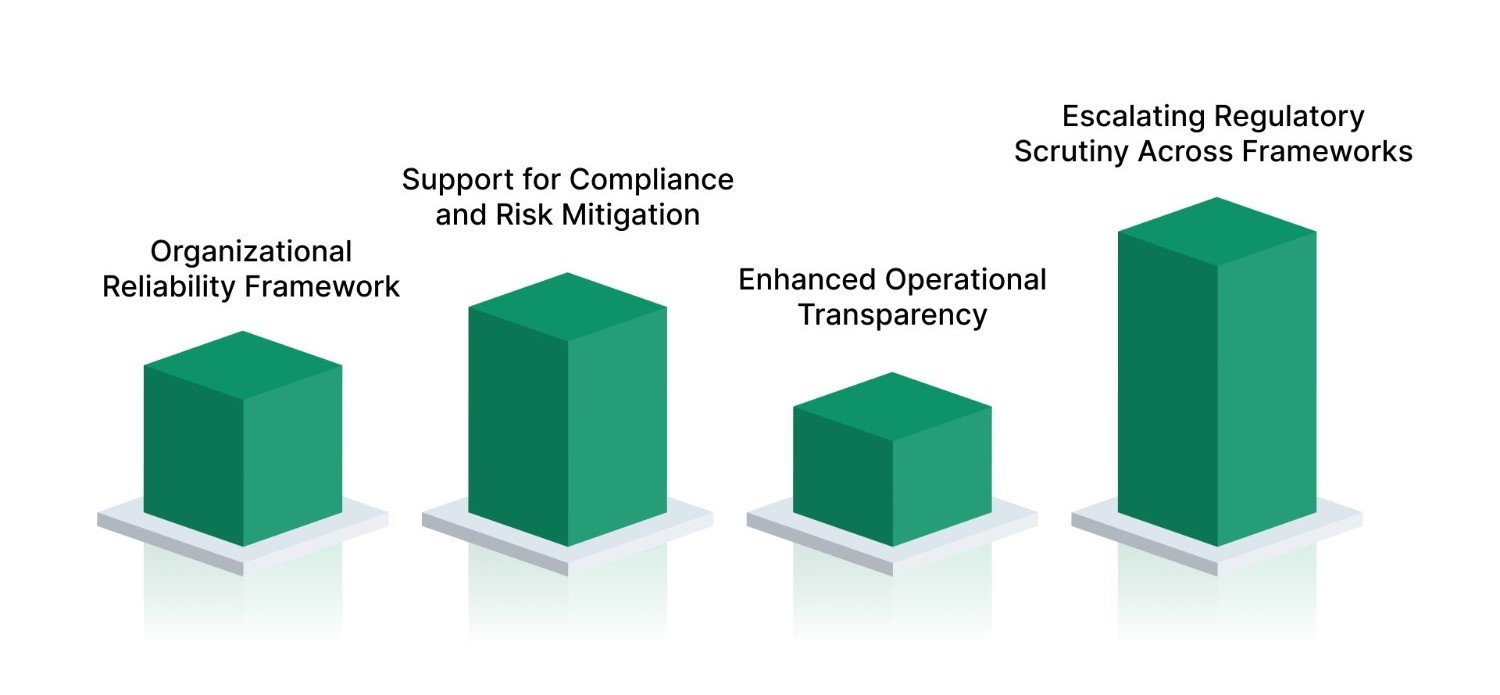
- Organizational Reliability Framework: Trust management creates systems and practices that show your company consistently behaves in reliable and transparent ways, reinforcing confidence among internal teams and external stakeholders.
- Support for Compliance and Risk Mitigation: It integrates with core governance, risk, and compliance efforts to go beyond meeting regulatory requirements; it demonstrates that your compliance and risk programs function as intended, not just on paper.
- Enhanced Operational Transparency: By centralizing processes and reporting, trust management makes it easier for regulators and partners to see how controls are enforced and risks are managed in everyday operations.
- Escalating Regulatory Scrutiny Across Frameworks: Regulations like the Sarbanes‑Oxley Act (SOX), the Health Insurance Portability and Accountability Act (HIPAA), and the General Data Protection Regulation (GDPR) impose complex, overlapping requirements that demand continuous adherence rather than periodic checks.
Example: In a US‑based healthcare provider, trust management practices streamline documentation and reporting so clinical, IT, and compliance teams present cohesive evidence to HIPAA auditors, reducing audit cycle time and reinforcing regulator confidence.
Also Read: Top 5 Policy Management Software in 2026 (Best Picks Ranked with Features & Pricing)
Understanding what is trust management provides the foundation, but to make it actionable, organizations must grasp the key concepts that turn trust from an abstract goal into measurable, everyday practices.

Key Concepts Behind Effective Trust Management
Trust management is built on concrete organizational practices that ensure reliable actions, accountability, and ongoing confidence among stakeholders. Below are the foundational concepts that make trust management actionable and effective in your organization:
- Governance and Policy Frameworks: A governance framework defines clear rules, roles, and decision‑making processes that guide organizational behavior, clarify responsibilities, and ensure policies align with strategic objectives and regulatory expectations.
- Risk Oversight and Monitoring: Effective trust management embeds risk oversight into everyday operations through continuous identification, risk assessment, and mitigation of risks across functions.
- Stakeholder Accountability: Accountability frameworks assign and clarify ownership for decisions, outcomes, and controls, ensuring individuals and teams are responsible for ensuring trust‑related commitments are fulfilled.
- Continuous Feedback and Transparency: Transparent processes and open channels for feedback allow stakeholders, from employees to partners to regulators, to understand performance, raise concerns, and see responses.
Example: In financial services, assessing vendor trust involves evaluating third‑party controls, compliance history, and ongoing performance metrics to ensure outsourcing partners meet risk and transparency standards, safeguarding internal operations and customer confidence.
Also Read: Understanding Regulatory Compliance Management in the U.S.
Once these key concepts are in place, organizations need concrete strategies to strengthen trust management across daily operations.
How Organizations Can Improve Trust Management
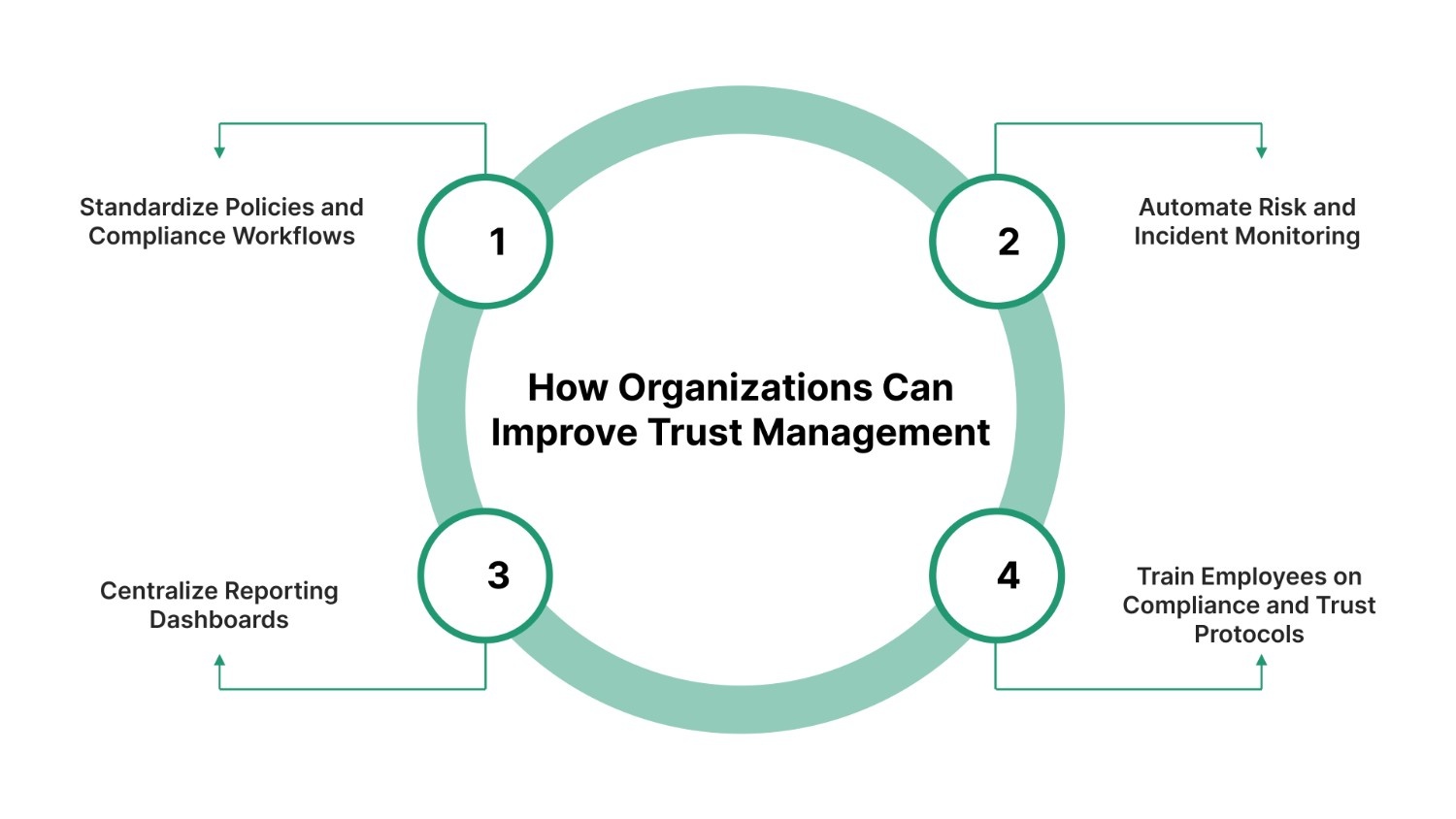
Organizations strengthen trust management when they move from reactive, manual processes to structured, proactive practices that make compliance, risk oversight, and transparency a part of everyday operations.
Below are practical steps you can implement to enhance trust across your governance, risk, and compliance efforts:
- Standardize Policies and Compliance Workflows: Establish a single, consistent set of policies and procedures that apply across teams and systems. This reduces confusion, eliminates conflicting interpretations, and ensures everyone follows the same standards. It also supports easier alignment with regulatory expectations such as HIPAA and SOX.
- Automate Risk and Incident Monitoring: Use automated tools to continuously monitor risk indicators and compliance signals. Automation reduces manual blind spots, identifies issues in real time, and allows your team to act on threats before they escalate. Continuous monitoring also supports a proactive compliance posture rather than reactive firefighting.
- Centralize Reporting Dashboards: Consolidate data into unified dashboards to give your leadership clear, real‑time visibility into compliance and risk status. Centralized reporting accelerates decision‑making, improves transparency, and makes it easier to demonstrate control effectiveness during audits.
- Train Employees on Compliance and Trust Protocols: Regular training ensures that employees understand not just what policies are, but why they matter. Education establishes a culture of accountability, reduces accidental non‑compliance, and reinforces trust‑centric behaviors throughout your organization.
VComply’s Compliance Ops helps you centralize policies and automate regulatory adherence across teams, reducing manual gaps and ensuring every compliance requirement is consistently met. Explore how this integration makes audits faster and strengthens internal accountability.
To operationalize these improvements efficiently, many organizations turn to a trust management platform that centralizes governance, risk, and compliance activities.
What Is a Trust Management Platform and How Does It Help Organizations?
A trust management platform is a centralized system that helps organizations manage, monitor, and demonstrate trust‑related activities across governance, risk, and compliance disciplines.
Below are the core elements that define what a trust management platform does and how it helps organizations build and maintain trust:
- Centralized Policy and Compliance Management: This function allows you to store, organize, and automate the enforcement of policies and regulatory requirements in a single system. It ensures your governance documents are current, aligned, and applied consistently across teams, helping eliminate gaps and conflicting controls.
- Holistic Risk Assessment and Prioritization: The platform continuously assesses risks across your environment, including internal processes and third‑party interactions, and provides a unified view of risk posture. Prioritization tools help you allocate teams and resources to the highest‑impact areas first.
- Incident Tracking and Remediation Workflows: Automated tracking of compliance issues and risks ensures incidents are logged, assigned, and resolved systematically. Built-in workflows and alerts reduce manual follow‑ups and support faster issue resolution.
- Real‑Time Reporting and Transparency: The platform consolidates data into meaningful dashboards and reports, giving you visibility into compliance status, risk trends, and remediation planning progress. This transparency supports better decision‑making and simplifies evidence presentation during audits.
With the right platform in place, integrating Governance, Risk, and Compliance (GRC) practices can amplify trust management across every team and process.
4 Ways GRC Enhances Trust Management
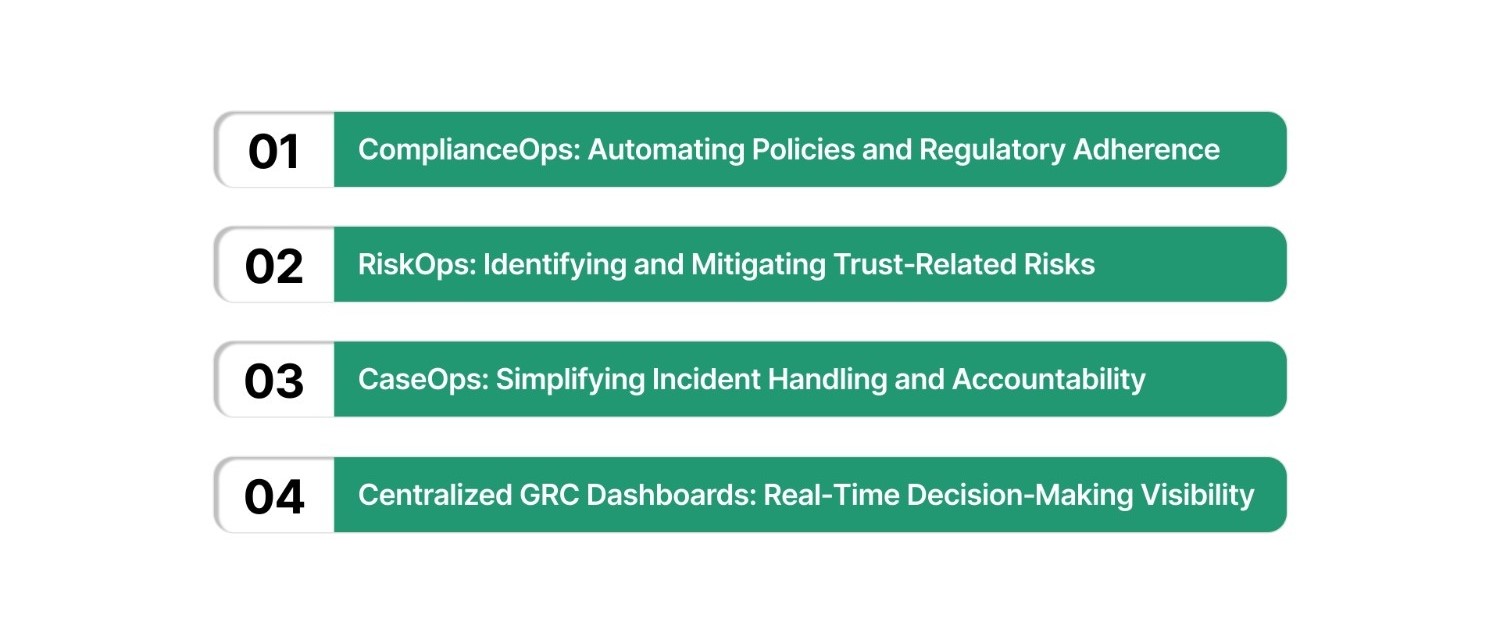
A strong Governance, Risk, and Compliance (GRC) approach strengthens organizational trust by integrating key operational disciplines into a unified framework.
Below are four concrete ways a strong GRC strategy, as the one enabled through VComply’s GRCOps suite, enhances trust management across your organization:
- ComplianceOps: Automating Policies and Regulatory Adherence: ComplianceOps centralizes governance and policy enforcement, ensuring that regulatory obligations and internal standards are consistently applied. By automating reminders, control checks, and documentation, you reduce manual gaps and demonstrate compliance on demand.
- RiskOps: Identifying and Mitigating Trust‑Related Risks: RiskOps continuously assesses and prioritizes risks across business units, helping you pinpoint areas that could erode trust, such as third‑party vulnerabilities or internal control weaknesses, and act before they escalate.
- CaseOps: Simplifying Incident Handling and Accountability: Incident or case management tools log issues transparently, assign owners, and track resolution progress. This structured handling establishes accountability and ensures that follow‑ups are timely, documented, and audit‑ready, reinforcing credibility internally and externally.
- Centralized GRC Dashboards: Real‑Time Decision‑Making Visibility: Unified dashboards bring together compliance status, risk metrics, and incident trends in one view, giving executives and teams the insights needed to make informed decisions quickly and confidently.
VComply’s GRCOps Suite unifies ComplianceOps, RiskOps, PolicyOps, and CaseOps into one centralized system, giving leadership real-time visibility into compliance, risk, and incident trends. This holistic approach ensures trust management is measurable, auditable, and consistently operationalized across your organization.
Also Read: Top 10 Real Estate Compliance Management Software in Dubai for 2025
Even with strong GRC systems, organizations face practical challenges that can undermine consistency and visibility, making it critical to identify and address them proactively.
Common Challenges in Managing Trust Effectively
Even organizations that prioritize trust struggle with practical obstacles that undermine consistency, visibility, and responsiveness. These challenges often stem from fragmented practices, outdated processes, and resistance to structured change, all of which make it harder to sustain confidence among regulators, partners, and internal teams.
Below are key challenges that can impede trust management success:
- Fragmented Policy Enforcement: When governance policies are managed in silos or across disconnected systems, enforcing them consistently becomes difficult. Fragmented enforcement drives gaps between expected controls and actual execution, increasing the risk of compliance failures.
- Lack of Centralized Data and Dashboards: Without a unified view of compliance, risk, and incident data, leaders struggle to assess trust‑related performance in real time. Disparate data sources lead to conflicting reports, slower decision‑making, and reduced visibility into risks.
- Manual Reporting Causing Delays: Reliance on spreadsheets, emails, and manual tracking slows down reporting and obscures issues until they escalate. Manual processes also increase the likelihood of errors and make it harder to demonstrate control effectiveness during reviews.
- Resistance to Change and Digital Adoption: Transitioning from informal or legacy practices to structured trust management approaches often meets cultural resistance. Teams may be reluctant to adopt new tools and workflows, limiting the benefits of compliance automation and integrated GRC capabilities.
These challenges highlight why many organizations struggle to maintain consistent trust outcomes and why modern platforms and processes that centralize and automate GRC activities are increasingly essential.
Now, it’s crucial to choose a trust management platform with the right capabilities that enable automation, visibility, and scalability.
Critical Capabilities to Look for in a Trust Management Platform
When evaluating technology to support trust management, it’s essential to prioritize capabilities that help you centralize control, automate evidence and incident workflows, report clearly to stakeholders, and scale as your organization grows.
Here are the critical platform capabilities decision‑makers should prioritize:
- Centralized Framework and Policy Management: The platform should unify governance, risk, and compliance functions in a single hub that eliminates silos and ensures consistent policy enforcement across the organization. A centralized policy repository helps standardize processes, map controls to multiple frameworks, and reduce gaps caused by disconnected systems.
- Audit‑Ready Reporting and Dashboards: Look for real‑time dashboards and automated reporting tools that make it easy to visualize compliance status, risk performance, and control health. These features support faster, evidence‑based decision‑making and simplify regulator or auditor reviews.
- Automated Incident Management: Incident tracking, escalation workflows, and remediation logging help you respond consistently to compliance and risk events. Automation reduces manual oversight, accelerates issue resolution, and maintains a documented trail of actions taken.
- Seamless Integration with Existing GRC Workflows: The platform should integrate with your current data sources, security tools, and GRC systems to ensure operations are synchronized across departments. System integrations improve data accuracy and reduce redundant data entry.
Also Read: Expert Guidelines for ISO Audit Management and Preparation
With these capabilities in mind, platforms like VComply provide a unified solution to streamline trust management, making it actionable, measurable, and audit-ready.
How VComply Can Help You Build and Sustain Organizational Trust
VComply is a cloud‑based Governance, Risk, and Compliance (GRC) platform that brings all of your compliance, risk, policy, and incident management needs into a single, integrated system, eliminating silos, manual tracking, and fragmented oversight.
Its modular architecture, ComplianceOps, RiskOps, PolicyOps, and CaseOps, is designed not just to manage trust components but to operationalize them so you consistently demonstrate reliability, transparency, and accountability across your organization.
Below is how VComply strengthens trust management in real terms:
- End‑to‑End Trust Enablement with GRCOps: VComply’s suite, including ComplianceOps (centralized regulatory and policy compliance), RiskOps (dynamic risk assessment and control), PolicyOps (policy creation, approval, and distribution), and CaseOps (incident reporting and remediation), works together to provide a cohesive, auditable ecosystem.
- Audit‑Ready Reporting and Real‑Time Insights: With centralized dashboards and automated evidence collection, VComply reduces the time spent preparing for audits and increases your ability to demonstrate control effectiveness across departments. Timely, accurate reporting builds confidence with auditors, regulators, and internal stakeholders alike.
- Reduced Compliance Risk and Operational Gaps: By automating compliance tracking and risk monitoring, VComply minimizes manual errors, ensures consistent enforcement of policies, and highlights emerging issues before they escalate. This proactive approach directly supports stronger trust outcomes.
- Streamlined Incident Management with Accountability: Through structured case workflows, incidents are logged, assigned, investigated, and resolved with full traceability, enabling you to respond to events transparently and quickly. This level of accountability reinforces confidence among partners, regulators, and internal teams.
- Improved Visibility Across Teams and Functions: Customizable dashboards and unified views strengthen decision‑makers’ ability to see risk and compliance status in real time, supporting faster, evidence‑based decisions that strengthen stakeholder confidence.
Book a demo with VComply today to see firsthand how its GRCOps suite simplifies trust management and enhances your organization’s compliance and risk posture.

Final Thoughts
Building and maintaining organizational trust is a strategic necessity. Organizations that systematically manage policies, risks, incidents, and compliance workflows not only reduce the chance of regulatory penalties but also strengthen stakeholder confidence and operational resilience.
VComply makes this process simpler, faster, and measurable. With its integrated GRCOps suite, ComplianceOps, RiskOps, PolicyOps, and CaseOps, VComply centralizes policies, automates risk monitoring, streamlines incident handling, and provides real‑time dashboards.
Experience the benefits firsthand by starting your 21-day free trial with VComply. Explore how its GRCOps capabilities can strengthen trust management and make compliance a seamless part of your organization’s everyday operations.
FAQs
Trust management goes beyond checklist compliance. While compliance ensures rules are followed, trust management embeds consistent, transparent, and accountable practices across operations. It focuses on building stakeholder confidence, mitigating risk proactively, and demonstrating integrity in everyday activities, rather than only at audit or reporting checkpoints.
Yes, trust management is measurable through KPIs such as policy adherence rates, incident response times, risk mitigation effectiveness, audit findings, and stakeholder satisfaction scores. Tracking these metrics on dashboards enables organizations to monitor improvements, identify gaps, and continuously reinforce trust across teams, partners, and regulators.
Practical examples include centralized vendor risk assessments, automated policy enforcement, real-time incident tracking, and transparent reporting dashboards. For instance, a healthcare organization monitoring patient data compliance across departments demonstrates trust through visible, auditable processes that protect both regulatory compliance and stakeholder confidence.
Organizations that consistently demonstrate transparent and reliable governance earn customer trust. Clear processes, timely incident resolution, and secure handling of data reassure clients and partners. Strong trust management improves loyalty, reduces churn, and positions the organization as dependable in both regulatory and operational contexts.
Best practices include centralizing policies, automating compliance and risk workflows, integrating GRC tools with digital systems, and training employees on updated procedures. These steps ensure that as technology adoption increases, trust and accountability remain consistent, preventing compliance gaps and operational inconsistencies during transformation.