

Why Spreadsheets Fail Audit Readiness (And What Works Instead)
Audit requests keep arriving unexpectedly, documents feel scattered, and spreadsheets demand constant updates while deadlines tighten and confidence steadily erodes. You spend late hours reconciling versions, chasing approvals, and hoping nothing critical was missed before auditors ask their next question.

The stress rarely comes from the audit itself, but from uncertainty about readiness, ownership, and whether evidence truly reflects daily operations. When preparation lives inside spreadsheets, small gaps multiply quickly, creating last-minute scrambles that distract teams from their actual responsibilities.
In this blog, we’ll explore why audit readiness must be continuous, why spreadsheets fall short, and what staying prepared all year truly requires. You will learn how auditors define readiness, which practices reduce friction, and how daily habits can prevent recurring audit disruptions.
Key Takeaways:
1. Audit readiness works best as a daily operating habit, not a last-minute activity triggered by audit notifications or external deadlines.
2. Spreadsheets struggle with accountability, traceability, and consistency, which creates avoidable audit risk and repeated preparation effort.
3. Auditors focus on evidence, control execution, issue resolution, and leadership oversight across the entire review period.
4. Always audit-ready organizations capture evidence during work, assign clear ownership, and track issues through documented closure.
5. Replacing spreadsheets with structured practices reduces audit fatigue and turns audits into predictable reviews rather than disruptive events.
Why Spreadsheets Fail Modern Audit Readiness?

Spreadsheets feel familiar, flexible, and accessible, which explains why many compliance teams still rely on them for audit preparation. That familiarity masks growing weaknesses as regulatory expectations demand consistency, traceability, and proof of control performance throughout the year.
Modern audits no longer review isolated moments or static files. Auditors expect clear evidence trails, accountable ownership, and timely remediation that spreadsheets struggle to support under sustained operational pressure.
Common failure points appear repeatedly across spreadsheet-based audit programs and create avoidable audit friction:
- Version control: Multiple copies circulate through email or shared drives, making it difficult to confirm which file reflects approved, current, and complete audit evidence.
- Compliance evidence gaps: Supporting documents are often missed, misplaced, or uploaded late because spreadsheets depend on memory, reminders, and manual follow-ups.
- Manual follow-ups: Compliance teams spend hours chasing updates, confirmations, and attachments instead of reviewing risks, controls, and audit findings.
- Ownership and audit trails: Spreadsheets rarely show who changed what, when changes occurred, or why decisions were approved or deferred.
From an auditor’s perspective, these gaps undermine confidence in both the data and the process that generated them. When evidence lacks traceability or accountability, auditors question whether controls truly operate as described throughout the audit period.
Once spreadsheet gaps become clear, the next step is understanding what auditors actually expect when they assess readiness.
Also Read: Why Spreadsheets Fall Short for Managing Compliance?
What Auditors Actually Look For When They Say “Audit-Ready”
Audit readiness is not measured by how quickly documents appear when requests arrive. Auditors evaluate whether daily operations consistently produce clear evidence, accountable actions, and visible oversight across the whole audit period.
Their reviews focus on execution, evidence quality, and governance discipline rather than intent, policy language, or last-minute preparation efforts. Gaps appear when organizations prepare for audits episodically instead of maintaining readiness through everyday processes and controls.
Here are the most common auditor expectations compared with what auditors often encounter during reviews:
| Auditor Expectation | Reality in Many Organizations |
| Evidence traceability that clearly links controls to supporting documentation | Files remain scattered across folders, emails, and spreadsheets with missing links and unclear context |
| Consistent control execution supported by repeatable records | Control activity is tracked manually, leading to inconsistent updates and incomplete proof |
| Timely remediation of identified issues with documented closure | Issues remain open longer than expected, with follow-ups delayed or responsibility unclear |
| Ongoing management oversight supported by regular review and reporting | Leadership visibility remains limited, with reports lacking actionable detail or frequency |
Audit readiness means aligning operations with these expectations every day, not only during audit fieldwork. When evidence, execution, and oversight operate consistently, audits shift from disruption toward predictable verification.
Also Read: What Is Audit Readiness Assessment?
What “Always Audit-Ready” Actually Looks Like in Practice
Staying audit-ready all year is not about working harder during audits or maintaining longer preparation checklists. It reflects a structured operating approach where evidence, controls, and accountability function consistently during regular business activity.
Audit readiness works best when compliance expectations are embedded into routine tasks rather than treated as separate audit projects. Here are the defining characteristics of organizations that remain audit-ready at any point in the year:
- Centralized evidence repositories support consistency and visibility.
All supporting documents live in a single location, reducing confusion and ensuring auditors can trace evidence without manual searching. - Live control status updates reflect actual performance.
Control results update as activities occur, providing an accurate view of effectiveness rather than retrospective summaries. - Clear ownership and accountability exist at all times.
Each control, task, and issue has an assigned owner responsible for updates, follow-ups, and documented resolution. - Continuous monitoring connects compliance to daily workflows.
Monitoring occurs alongside normal operations, allowing issues to surface early instead of appearing during audit reviews.
This operating model embeds compliance into everyday work and removes the pressure of last-minute audit preparation. When readiness becomes part of operations, audits confirm performance rather than exposing gaps.
Also Read: SOC2 Audit Assessment Readiness And GRC Platform’s Contribution
How Audit Readiness Fits Into Daily Work Without Extra Effort?

Audit readiness becomes exhausting only when it sits outside everyday responsibilities and surfaces during audit season as urgent extra work. When policies, controls, and evidence are embedded into routine activity, teams stay prepared without expanding workloads or creating parallel processes.
The focus shifts from collecting proof later to producing it naturally as work progresses.
Here are practical ways organizations build audit readiness directly into daily operations:
- Policies and controls as ongoing workflows: Policies and controls are reviewed, updated, and followed as part of regular work, reflecting current requirements rather than remaining static reference documents.
- Evidence captured as work happens: Approvals, reviews, and task records are saved as actions occur, eliminating the need for retroactive document collection.
- Issues tracked to clear closure: Every gap or incident is logged, assigned to an owner, monitored through resolution, and closed with documented outcomes.
- Ownership embedded into responsibilities: Control and issue ownership aligns with existing roles, ensuring accountability without adding separate audit-specific assignments.
- Routine check-ins replace large review cycles: Short, recurring reviews maintain visibility and reduce pressure compared to infrequent, high-effort audit preparation meetings.
This approach reduces audit fatigue by integrating readiness into normal operations rather than treating it as an additional obligation. When compliance activities mirror everyday work, audits become predictable checkpoints instead of disruptive events.
To sustain daily readiness, organizations rely on clear operational pillars rather than informal processes and personal reminders.
Also Read: Compliance Audits: A Guide to Ensuring Regulatory Adherence
The Core Pillars of Audit Readiness Beyond Spreadsheets
Spreadsheets fail because they were never designed to support continuous oversight, accountability, or evidence consistency across the entire year. Organizations that move past spreadsheet dependence rely on a defined set of operational pillars that support audit readiness as an ongoing condition.
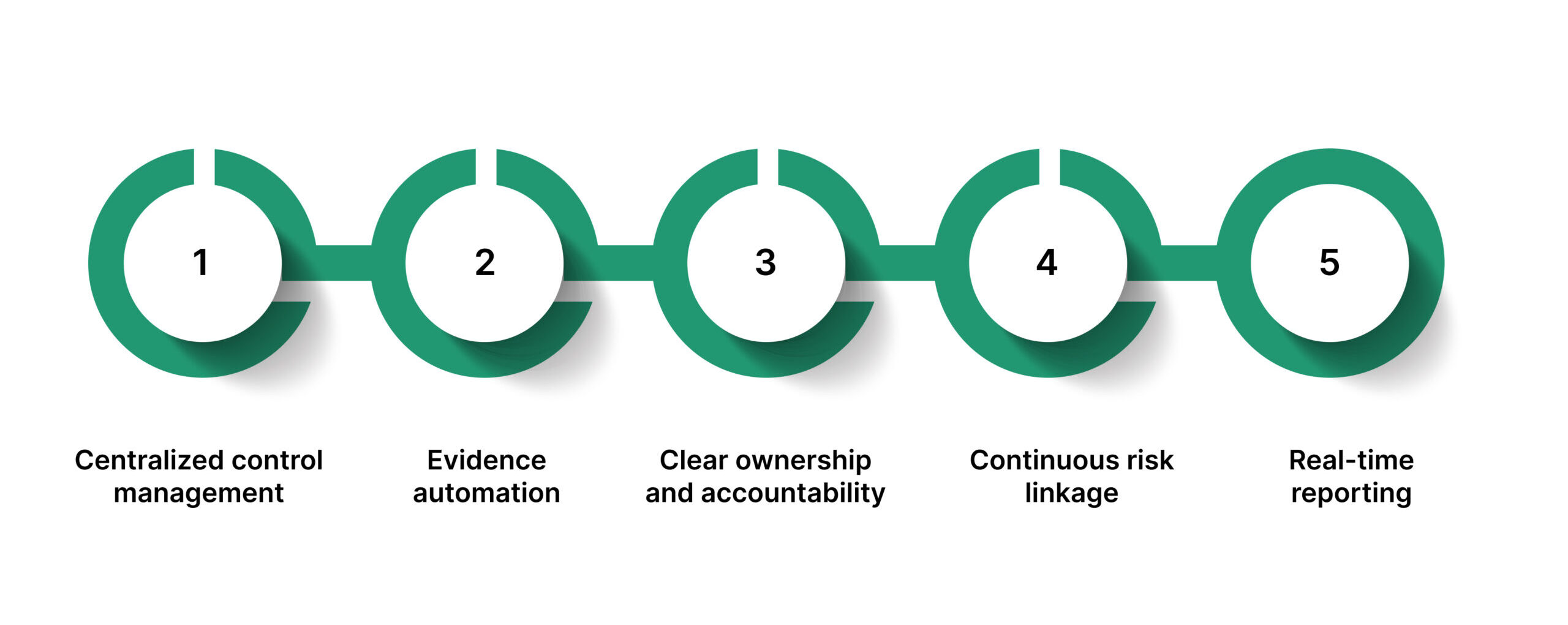
These pillars replace manual tracking with structured practices that support visibility, ownership, and consistency across controls and risks. Here are the core audit readiness pillars that remove the need for spreadsheets:
- Centralized control management: All controls are documented, reviewed, and maintained in one location, reducing confusion and preventing gaps caused by scattered files.
- Evidence automation: Proof of control activity is captured during routine work, reducing reliance on memory and eliminating the need for retroactive evidence collection.
- Clear ownership and accountability: Each control and issue has a named owner responsible for updates, follow-ups, and documented resolution.
- Continuous risk linkage: Risks remain connected to related controls, issues, and activities, keeping exposure visible as conditions change.
- Real-time reporting: Leadership and auditors can view the current status without waiting for manual summaries or periodic compilation efforts.
The contrast between spreadsheet-based preparation and modern audit readiness practices becomes clear when compared directly:
| Spreadsheet Approach | Modern Audit Readiness Approach |
| Manual updates were entered inconsistently | Ongoing updates captured during routine work |
| Limited visibility across teams | Current status visible through shared reporting |
| No clear accountability tracking | Assigned ownership for controls and issues |
| Reactive remediation after findings | Ongoing monitoring that flags gaps earlier |
Putting these pillars into practice requires a system that supports accountability, evidence tracking, and visibility across teams.
Also Read: Compliance Audit Basics: A Quick Guide
How VComply Enables Year-Round Audit Readiness Without Spreadsheets?
Sustained audit readiness requires more than good intentions or better spreadsheet discipline across compliance teams. It depends on a shared system that supports accountability, evidence consistency, and visibility across controls, risks, policies, and issues.
VComply provides the operational foundation needed to maintain audit readiness as a continuous state rather than a seasonal effort. Here is how each part of the platform supports audit readiness without reliance on spreadsheets:
- ComplianceOps for control execution and evidence tracking: ComplianceOps manages controls as ongoing activities, assigns responsibility, captures supporting evidence, and maintains complete records across audit periods.
- RiskOps for direct linkage between risks and audits: RiskOps connects risks to related controls and issues, ensuring audit priorities reflect current exposure rather than outdated assessments.
- PolicyOps for policy acknowledgment and proof: PolicyOps tracks policy distribution, acknowledgment, and version history, providing clear records that demonstrate awareness and compliance.
- CaseOps for issue handling and remediation tracking: CaseOps records incidents, assigns owners, tracks corrective actions, and documents closure with accountability and clear timelines.
- GRCOps for leadership and auditor visibility: GRCOps consolidates controls, risks, policies, and cases into a unified report that supports oversight without manual status consolidation.
Together, these capabilities replace spreadsheet-based preparation with structured, repeatable practices across the audit lifecycle. Audit readiness becomes a consistent outcome of daily operations rather than a last-minute response to audit requests.

Wrapping Up
Audit readiness no longer depends on last-minute preparation or heroic efforts during audit season. Organizations that treat readiness as daily work reduce uncertainty, improve accountability, and approach audits with confidence rather than concern.
Spreadsheets struggle because they record information without enforcing ownership, consistency, or follow-through. When controls, evidence, and issues operate within structured processes, audit readiness becomes predictable and repeatable across the year.
Book a demo now to understand how year-round audit readiness can work within your existing compliance responsibilities, without adding extra burden.
FAQs
Stay audit-ready by documenting decisions and approvals as work happens. Clear roles and regular reviews reduce surprises and show that controls run consistently.
The five C’s commonly refer to criteria, condition, cause, consequence, and corrective action used to explain audit findings clearly. They help auditors describe what was expected, what occurred, why it happened, and the resulting impact.
Operational and internal control audits often span the entire year because controls must function consistently across all reporting periods. Auditors review evidence over time to confirm processes operated as described rather than only at a single point.
Smaller teams can remain audit-ready by standardizing documentation practices and scheduling brief, recurring reviews instead of extensive preparation efforts. Limited headcount makes clarity around responsibility and deadlines more critical than complex processes or frequent meetings.
External audits provide independent verification, while internal reviews support management by identifying gaps earlier and tracking corrective actions. Both rely on accurate records, though timing, scope, and reporting expectations often differ.