

Differences between Policy and Code of Conduct
Policies and a Code of Conduct are often treated as similar documents, but they serve very different purposes inside an organization. A policy tells employees what must be done in specific situations. A Code of Conduct explains how people are expected to behave, make decisions, and represent the organization’s values.

This difference matters more in 2026 because compliance teams are under pressure to prove that policies are current, employees understand expectations, acknowledgments are tracked, and misconduct concerns are handled properly. When policies and the Code of Conduct overlap, contradict each other, or sit in disconnected folders, organizations face more than document confusion. They face audit gaps, inconsistent enforcement, training failures, investigation challenges, and higher conduct risk. For workplace conduct specifically, the EEOC emphasizes that employers should clearly communicate unacceptable conduct, provide reporting channels, train employees, and take prompt corrective action when complaints arise.
Key Takeaways
- Policies = rules; Code of Conduct = values. Policies tell employees what to do, while a Code of Conduct defines how to behave ethically.
- Clarity reduces risk. Blurred lines between the two create audit gaps, inconsistent enforcement, and higher misconduct exposure.
- Regulations shape policies. HIPAA, SOX, OSHA, and EEOC guidelines drive policy requirements, while the Code of Conduct anchors culture and integrity.
- Lifecycle discipline matters. Version control, reviews, training, and attestations are essential for defensible compliance.
- PolicyOps strengthens governance. VComply centralizes documents, automates workflows, and delivers audit-ready visibility across policies and conduct expectations.
What Is a Policy vs Code of Conduct vs Code of Ethics?
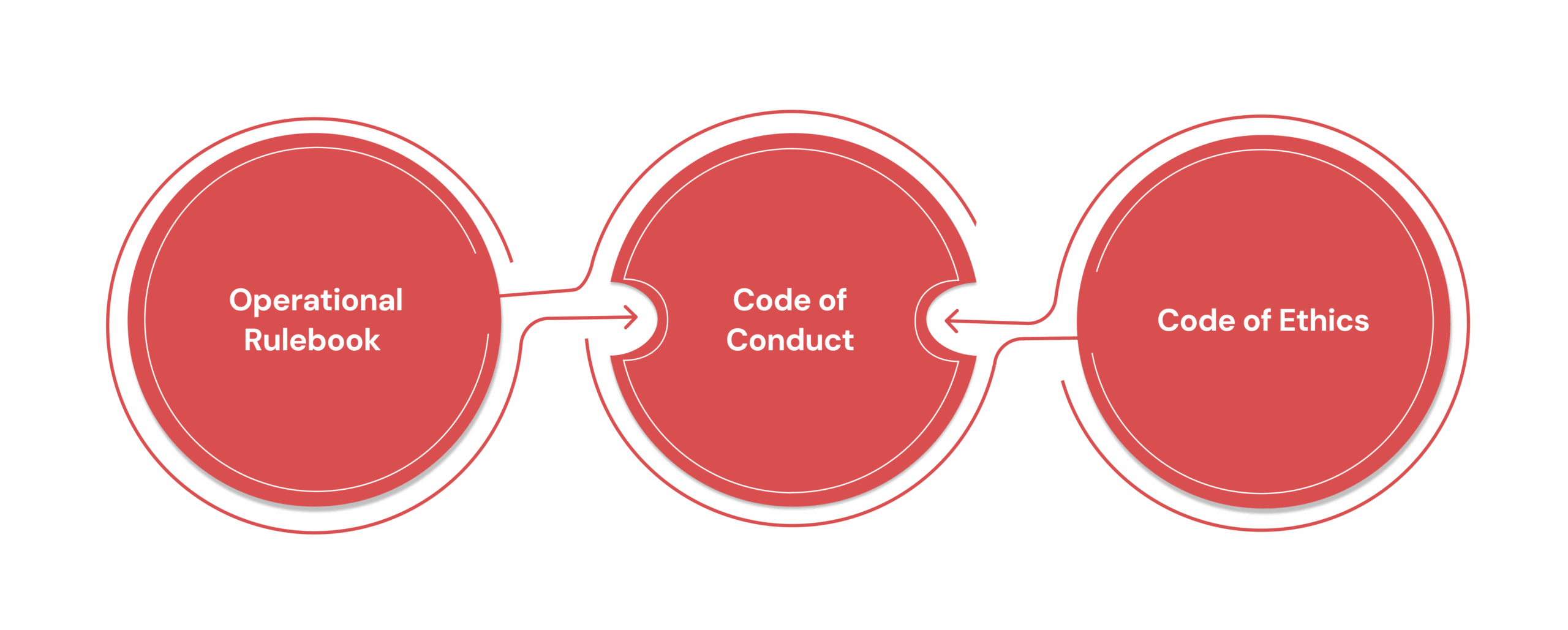
Before we compare policy vs code of conduct, it’s important to define each clearly, because confusion at this stage is one of the most common sources of governance breakdowns.
-
Policy (Operational Rulebook)
A policy is a formal, enforceable rule that tells employees exactly what must be done in specific situations. It outlines required actions, prohibited actions, responsibilities, controls, and procedures. Policies often exist to meet regulatory requirements, for example, HIPAA privacy rules, OSHA safety standards, SOX internal controls, or EEOC anti-harassment guidelines.
Key Features of an Effective Policy
- Regulatory Alignment: Maps directly to laws and frameworks such as HIPAA, SOX, OSHA, FERPA, EEOC, NIST, or internal controls.
- Procedural Specificity: Outlines required actions, prohibited actions, roles, timelines, and escalation paths.
- Operational Consistency: Standardizes how work is performed across locations, departments, or roles.
- Risk Mitigation: Identifies high-risk areas and defines controls to reduce exposure.
- Enforcement Mechanisms: Includes consequences for non-compliance and documents supervisory responsibilities.
- Lifecycle & Review Cadence: Requires version control, ownership, and periodic review to remain compliant.
In short: Policies operationalize compliance. They are precise, directive, and enforceable.
-
Code of Conduct (Ethical Compass)
A Code of Conduct (CoC) is a values-driven document that explains how employees are expected to behave across all situations. It reinforces principles like honesty, fairness, respect, integrity, and accountability. Instead of prescribing step-by-step actions, it guides decision-making and sets the tone for ethical culture.
Key Features of a Strong Code of Conduct
- Ethical Anchors: Defines expectations around honesty, respect, fairness, integrity, and responsible decision-making.
- Behavioral Guidance: Clarifies how employees should act toward colleagues, customers, partners, and the public.
- Professional Conduct Expectations: Addresses communication, workplace interactions, confidentiality, and proper use of company resources.
- Misconduct Prevention: Sets explicit expectations around harassment, discrimination, retaliation, conflicts of interest, and fraud.
- Cultural Reinforcement: Embeds organizational values and supports a positive, trustworthy, and inclusive environment.
- Universal Applicability: Applies to leadership, employees, contractors, and sometimes vendors.
In short: The CoC shapes behavior and culture. It guides judgment, not procedures.
-
Code of Ethics (Principle Framework)
A Code of Ethics sits even higher than the CoC. It outlines the broad ethical principles and moral commitments the organization stands for, such as transparency, fairness, and social responsibility. While some companies combine it with the CoC, others maintain it as a separate, overarching principles document.
Key Features of a Code of Ethics
- Principle-Based Guidance: Sets the tone for ethical reasoning and choices.
- Leadership Accountability: Establishes expectations for executives and supervisors.
- Integrity Commitments: Highlights honesty, conflict-free decision-making, and ethical stewardship of resources.
- Public Trust Orientation: Communicates the organization’s ethical posture to employees, shareholders, and external stakeholders.
- Support for CoC & Policies: Serves as the philosophical foundation for all governance documents.
In short: It defines the “why” behind the organization’s ethical expectations.
With these definitions in mind, we can now compare the differences of a policy vs code of conduct more clearly and practically.
Check out the Top 5 Compliance and Policy Management Software Solutions
Key Differences Between a Policy Vs Code of Conduct
For Compliance Officers and Policy Managers, clarity here directly affects audit defensibility, employee adherence, training alignment, and cultural integrity. While the two documents often work together, they serve distinct purposes, use different language, and require different enforcement strategies.
Below is a practical, side-by-side comparison tailored for compliance-led organizations.
Policy vs Code of Conduct: Differences
| Aspect | Policy | Code of Conduct |
| Core Purpose | Defines enforceable rules, controls, and procedures that employees must follow. | Establishes ethical expectations and behavioral standards for all employees. |
| Primary Focus | Operational compliance — the what and how. | Ethical culture — the why behind decisions. |
| Regulatory Tie-In | Directly mapped to laws, frameworks, and audits (HIPAA, SOX, OSHA, EEOC, FERPA, NIST). | Supports overall governance posture; reinforces integrity and accountability. |
| Level of Detail | Highly specific, procedural, step-by-step. | High-level, principle-based, scenario-guiding. |
| Scope | Role-, process-, or department-specific. | Applies universally across all levels and roles. |
| Tone & Language | Precise, directive, instructional (“must,” “required,” “prohibited”). | Values-centered, cultural, advisory (“act with integrity,” “demonstrate respect”). |
| Enforcement | Includes defined consequences for non-compliance (disciplinary actions, corrective steps). | Supports accountability but influences culture more than procedural enforcement. |
| Update Cadence | Regular, driven by regulatory changes, audits, and operational shifts. | Periodic, driven by cultural evolution or major organizational changes. |
| Training Alignment | Mapped to mandatory compliance training and documented attestation. | Reinforced through onboarding, annual refreshers, ethical decision-making modules. |
| Evidence for Audits | Version records, approval workflows, attestation logs, incident correlation. | Signed acknowledgments, training completions, leadership endorsements. |
| Examples | Data security policy, anti-fraud policy, incident response policy, leave policy. | Anti-harassment expectations, integrity commitment, confidentiality expectations, fairness and respect principles. |
Here’s why understanding these differences matters for you.
Why This Distinction Matters for Compliance Officers in the US
For mid-to-large US organizations, especially in financial services, healthcare, manufacturing, and higher education, the line between policies and a Code of Conduct affects:
- Audit readiness and regulatory defensibility
- Employee adherence
- Culture and ethical behavior
- Risk exposure
- Ability to prove training and attestation
For example, the SEC expects public companies to maintain an ethical foundation through a Code of Conduct, which supports internal controls and risk oversight. Meanwhile, policies must reflect federal requirements such as EEOC anti-harassment guidance and HIPAA rules for handling protected data.
Let’s look at how these distinctions play out in real operational and regulatory scenarios.
Read: Overview of Policies and Procedures in HealthCare
Implementation Checklist for Compliance & Policy Teams
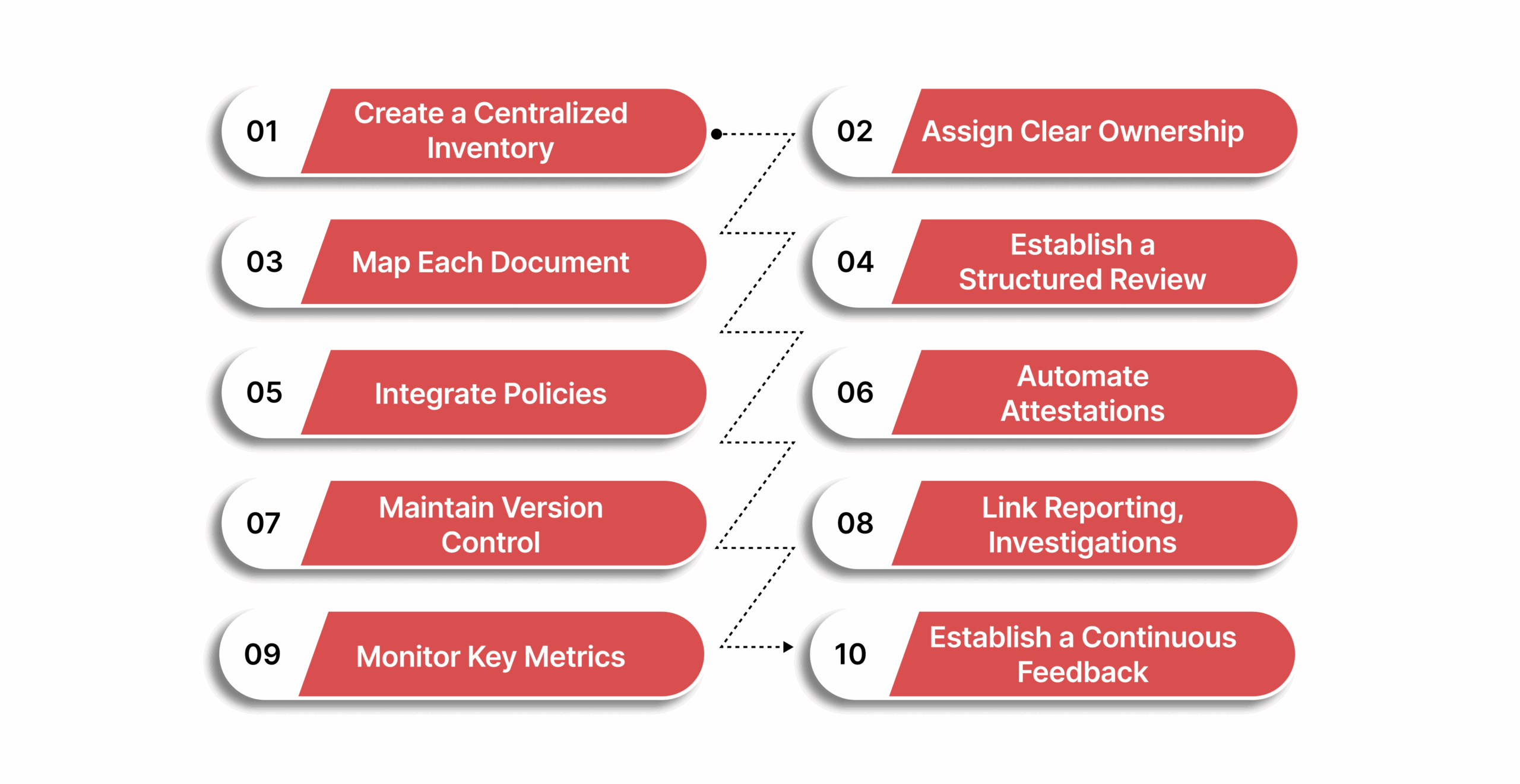
Strong governance depends not only on well-written content, but on how effectively you manage, update, distribute, and track it. The checklist below gives a practical implementation roadmap.
1. Create a Centralized Inventory of All Policies and the Code of Conduct
Start by centralizing every policy, standard, and Code of Conduct into a single, searchable repository. Fragmented storage creates outdated versions, conflicting instructions, and audit risk.
What to capture:
- Document owner
- Version number
- Regulatory mapping
- Review cycle
- Active vs. archived status
A centralized structure is far easier to maintain using a platform that supports a unified policy library and metadata tagging.
2. Assign Clear Ownership and Accountability
Every policy and the CoC must have an assigned owner responsible for drafting, reviews, approvals, and updates.
Common owners include:
- Privacy Officer (HIPAA)
- HR Director (conduct, harassment, DEI)
- IT Security Lead (access controls, cybersecurity)
- Finance/Accounting (SOX-related policies)
Tools that enable role assignment and permission-based access help ensure accountability is transparent and traceable.
3. Map Each Document to Relevant Regulations
To meet audit expectations, map policies and CoC themes to regulatory sources or frameworks.
Examples:
- HIPAA → PHI privacy & security policies
- SOX → controls around financial reporting
- OSHA → safety standards and hazard communication
- EEOC → anti-harassment and anti-discrimination language
Modern compliance platforms let teams link policies directly to regulatory requirements or controls for easier audits.
4. Establish a Structured Review & Approval Workflow
Review cycles prevent documents from becoming outdated or non-compliant.
Recommended cadence:
- High-risk policies: annually
- Moderate-risk: every 18–24 months
- Code of Conduct: yearly or after cultural or organizational changes
A workflow tool with automated reminders, approval routing, and version control ensures no review is missed.
5. Integrate Policies and the CoC Into Employee Training Programs
Policies only work when employees understand them.
Training essentials:
- Mandatory onboarding modules
- Annual refreshers
- Scenario-based ethics training tied to the CoC
- Department-specific compliance modules
Integrated training and acknowledgment workflows make it easier to ensure employees complete the right modules on time.
6. Automate Attestations and Acknowledgements
Tracking attestations manually is risky. Automation ensures completion, consistency, and audit reliability.
Best practices:
- Assign attestations to all relevant roles
- Send automated reminders
- Track non-responders for follow-up
- Produce attestation reports instantly
Platforms like VComply streamline distribution, tracking, and reporting so compliance teams can easily demonstrate adherence.
7. Maintain Version Control & an Immutable Audit Trail
Every update needs to be documented, including who changed what and when. This protects the organization during audits or investigations.
Capture:
- Redlines
- Reviewer comments
- Previous versions
- Approval records
Version control and audit logs in governance platforms remove the risk of errors or missing records.
8. Link Reporting, Investigations, & Corrective Actions
Policies and the CoC should tie directly into how incidents, concerns, and violations are reported and managed.
Enhance by:
- Enabling confidential/anonymous reporting
- Creating clear escalation paths
- Documenting corrective actions
- Linking incidents back to violated policies
Solutions like CaseOps unify reporting with policy enforcement so issues can be tracked end-to-end.
9. Monitor Key Metrics & Compliance KPIs
Compliance effectiveness depends on measurable data.
Track:
- Attestation completion rates
- Policy review status
- Incident trends by policy category
- Overdue training
- Policy exception patterns
Dashboards in GRC platforms help leaders monitor trends and allocate resources proactively.
10. Establish a Continuous Feedback & Improvement Loop
Strong governance evolves with the organization.
Collect feedback from:
- Employees
- Supervisors
- Audit findings
- Regulatory updates
- Incident patterns
Continuous improvement becomes easier when all documents, comments, and historical data live in one system.
Here’s why these two frameworks are important.
The Importance of Both Frameworks
Policies and the Code of Conduct serve different purposes, but together they form the backbone of an organization’s governance ecosystem. Policies ensure the organization meets regulatory obligations and operates consistently.
The Code of Conduct ensures employees uphold ethical standards even in situations that policies can’t fully predict. When combined, they reduce compliance risk, strengthen culture, and create a unified understanding of “what we do” and “how we do it.”
For regulated industries, both frameworks play critical roles:
- Policies provide the specific rules required under HIPAA, SOX, OSHA, EEOC, FERPA, NIST, and other standards.
- The Code of Conduct provides the ethical lens that regulators increasingly expect organizations to demonstrate, not just procedural compliance but cultural commitment.
A strong governance structure requires both documents working in harmony, fully aligned and consistently enforced.
With this foundation, you can begin measuring effectiveness through the right compliance KPIs.
Read: Best Practices for Developing a Code of Conduct
KPIs Compliance Leaders Should Track
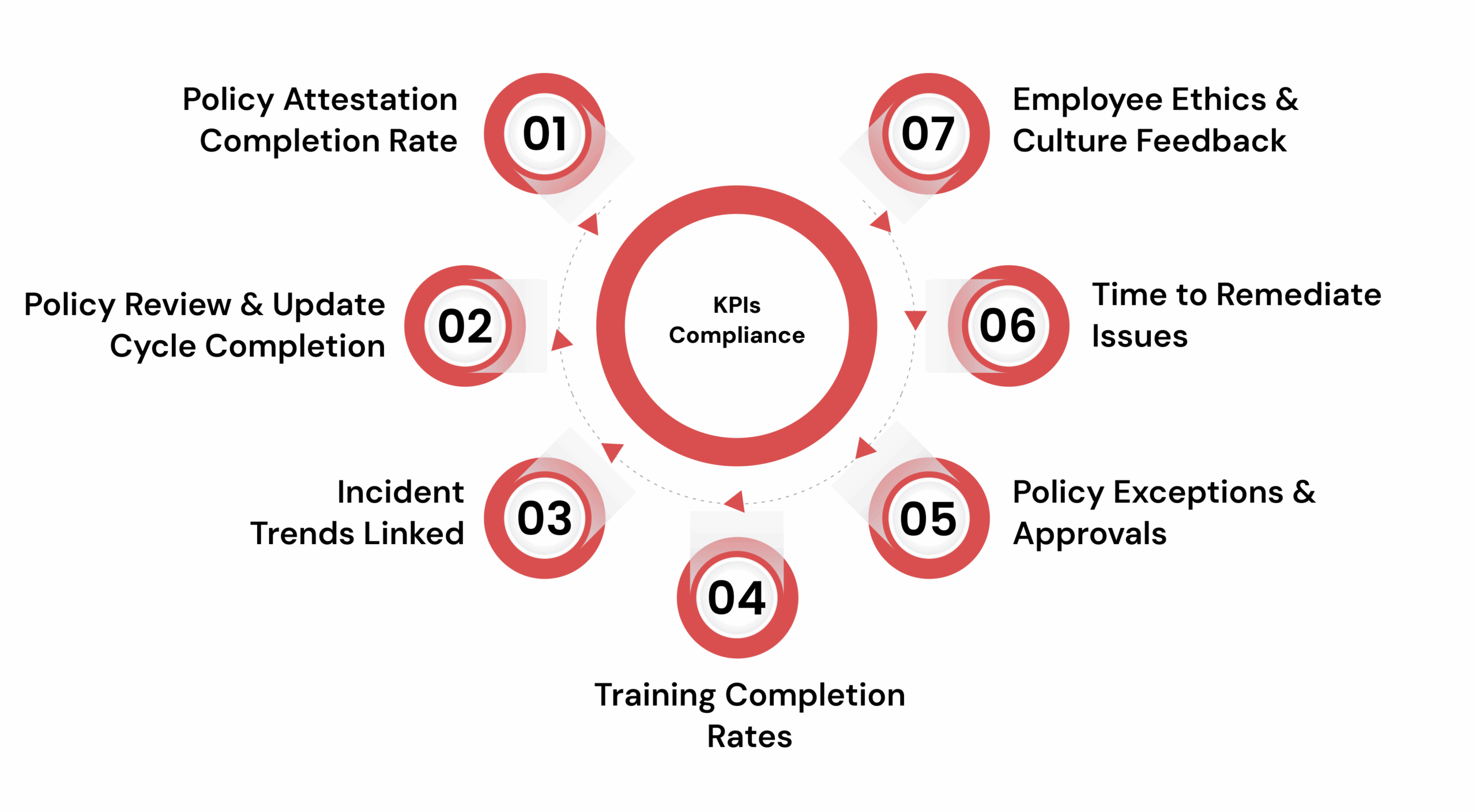
To understand whether your policies and Code of Conduct are functioning as intended, you need measurable indicators of compliance performance. The following KPIs help evaluate effectiveness, highlight risks, and demonstrate governance maturity to auditors and executives:
1. Policy Attestation Completion Rate
Percentage of employees who have acknowledged required policies and the Code of Conduct.
2. Policy Review & Update Cycle Completion
Number of policies reviewed on time versus overdue, categorized by risk level.
3. Incident Trends Linked to Policy Violations
Which policies are most frequently involved in incidents or reports? This helps pinpoint unclear or outdated content.
4. Training Completion Rates
Completion of required compliance training aligned with policy and CoC refresh cycles.
5. Policy Exceptions & Approvals
Frequency and rationale for exceptions, a strong indicator of control effectiveness or operational gaps.
6. Time to Remediate Issues
How quickly the organization responds to violations, CoC concerns, or audit findings.
7. Employee Ethics & Culture Feedback
Surveys, hotline themes, or reporting trends that indicate whether employees understand expectations.
Once your metrics are defined, the next step is developing a Code of Conduct that employees actually understand and follow.
Read: Exploring the Importance and Examples of a Code of Conduct
Key Steps to Develop a High-Impact Code of Conduct
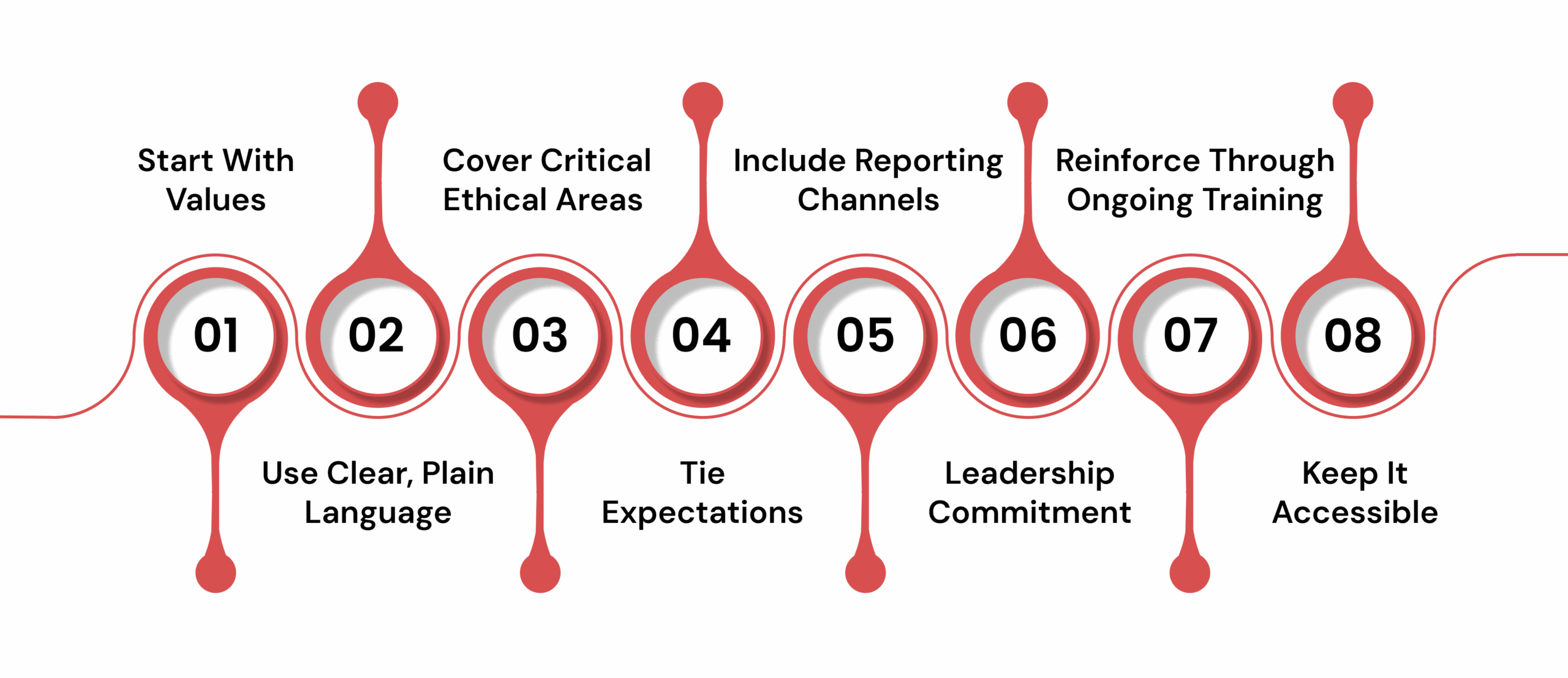
A Code of Conduct sets the tone for an ethical and inclusive workplace. But many organizations struggle to create one that is modern, clear, and actionable. An effective Code of Conduct should be simple to understand, culturally aligned, and backed by strong leadership endorsement.
1. Start With Values That Reflect Organizational Culture
Define the core values that guide your business: integrity, respect, fairness, transparency, accountability. These values should appear early and consistently throughout the CoC.
2. Use Clear, Plain Language
Employees should immediately understand expectations. Avoid legal jargon; prioritize clarity and real-world examples.
3. Cover Critical Ethical Areas
Include guidance on:
- Harassment & discrimination
- Conflicts of interest
- Confidentiality
- Anti-retaliation
- Data privacy
- Anti-bribery & corruption
- Workplace respect & professionalism
4. Tie Expectations to Real Scenarios
Contextual examples help employees apply the CoC in everyday decisions, especially in gray areas.
5. Include Reporting Channels & Protections
Clearly describe how employees can raise concerns confidentially or anonymously — and emphasize anti-retaliation.
6. Require Leadership Commitment
Executives should visibly endorse the CoC and model the behaviors it outlines.
7. Reinforce Through Ongoing Training
Annual refreshers and scenario-based learning help the CoC stay relevant and top of mind.
8. Keep It Accessible & Updated
A Code of Conduct should be easy to access, easy to navigate, and reviewed at least annually.
A well-designed CoC becomes a living document that strengthens culture and guides employee judgment in ways policies cannot.
But even the strongest frameworks can fail when certain common pitfalls go unaddressed, so let’s look at how to avoid them.
Read: Key Features and Benefits of Policy Center Software
Common Pitfalls and How to Fix Them
Even organizations with robust governance frameworks fall into avoidable traps. Recognizing and addressing these pitfalls helps strengthen both policies and your Code of Conduct.
Pitfall 1: Documents Stored in Silos
Scattered files across shared drives create version confusion and compliance gaps.
Fix: Use a centralized, access-controlled repository with version history and ownership.
Pitfall 2: Policies and the CoC Are Not Aligned
Contradictory or overlapping language confuses employees.
Fix: Conduct a governance alignment review during every policy cycle.
Pitfall 3: Overly Complex or Legalistic Language
Employees cannot follow what they don’t understand.
Fix: Write in plain language; include examples, visuals, or scenarios.
Pitfall 4: Missing Review Cycles
Static documents quickly fall out of compliance with changing laws.
Fix: Automate review schedules and require owner approval.
Pitfall 5: No Attestation or Documentation
Without formal acknowledgment, enforcement and audit defense are weakened.
Fix: Use digital attestation workflows with trackable completion rates.
Pitfall 6: Lack of Integration With Incident Reporting
If violations are not tied back to policies or the CoC, trends go unnoticed.
Fix: Connect governance documents with case management workflows.
Pitfall 7: Leadership Doesn’t Reinforce the CoC
Ethics frameworks fail when leaders do not model expected behaviors.
Fix: Require leadership training, endorsements, and visible reinforcement.
Avoiding these pitfalls helps ensure that your governance framework is consistent, defensible, and employee-friendly.
If you want to operationalize these improvements with modern tools, here’s where VComply can help.
Strengthen Your Governance With VComply ComplianceOps
Strong governance requires more than well-written documents; it requires the systems, workflows, and visibility to manage policies, controls, assessments, and compliance programs end-to-end.
VComply ComplianceOps helps organizations:
- Map policies to regulations and controls
- Manage compliance frameworks in a unified platform
- Automate monitoring, evidence collection, and corrective actions
- Track compliance tasks and deadlines across teams
- Build audit-ready, risk-aware governance programs
- Ensure continuous alignment with regulatory change
If your compliance processes feel fragmented, manual, or difficult to scale, the right platform can make an immediate impact. Start a 21-day free trial to see it in action.

Conclusion
Compliance teams today face the same recurring pain: scattered policies, unclear expectations, outdated documents, inconsistent training, and audits that demand evidence no one can quickly produce. These issues blur the line between policy vs code of conduct, create organizational friction, and increase compliance risk.
But the ideal state is within reach, a governance environment where every policy is current, every employee understands expectations, and every review, attestation, and update happens automatically. A workplace where compliance feels organized, predictable, and embedded into daily operations.
VComply helps make that vision real. By centralizing policies, automating workflows, and strengthening accountability, PolicyOps ensures your governance framework is not only clear but consistently followed. See how VComply can work for you. Schedule your Free Demo today to enhance your policy and Code of Conduct management.
Stronger governance starts with clarity and thrives with the right system behind it.
FAQs
A policy defines specific rules, procedures, and required actions. A Code of Conduct defines how employees are expected to behave ethically and professionally. Policies guide compliance; the CoC guides behavior and culture.
Many industries and regulators (e.g., SEC for public companies, federal grant bodies, healthcare systems) expect organizations to have a Code of Conduct, even if not always explicitly mandated. It is a core element of effective governance programs.
Every employee, contractor, senior leader, and board member should acknowledge the CoC. Many organizations also require vendors or temporary workers to sign depending on risk exposure.
High-risk policies should be reviewed annually. Others may follow an 18–24-month cycle. Most organizations review their Code of Conduct every year or after major regulatory, cultural, or organizational changes.
It’s possible, but not recommended. Combining them can create confusion because policies require detailed, procedural instructions, while the CoC sets broad behavioral expectations. Separating them leads to clearer communication and stronger compliance.