

Your Guide to Major Life Science Compliance Risks
Life science organizations face rapidly evolving compliance pressures as enforcement around quality, privacy, and cybersecurity intensifies. With rising data breaches and stricter federal expectations, compliance is no longer a siloed function but a board-level priority that directly affects approvals, partnerships, and long-term growth. Understanding these shifts is essential for building resilient, future-ready compliance programs.

A single compliance lapse can shut down a production line, delay a clinical program, or trigger an FDA investigation, and the data proves it.
In 2023 alone, the FDA issued 6,000+ Form 483 observations, with data-integrity failures continuing to rank among the most cited violations across life science manufacturers and research organizations.
For businesses operating in a tightly regulated environment, understanding these risks is a prerequisite for protecting product safety, safeguarding patient outcomes, and preserving market access.
This blog breaks down the most significant Life Science Compliance risks shaping 2025, examines why traditional oversight leaves gaps in audit readiness, and highlights the controls that compliance you must strengthen to stay ahead of regulations.
Key Takeaways
- Life science compliance risk has intensified due to systemic FDA findings, rising FCPA scrutiny, decentralized trials, and large-scale PHI breaches.
- The highest-risk areas in 2025 cluster around data integrity, hybrid clinical models, HCP interactions, third-party oversight, and digital health ecosystems.
- Traditional programs fail because they rely on manual workflows, static risk assessments, uncontrolled policy sprawl, fragmented reporting, and disconnected tools.
- A modern approach requires risk-based governance, cross-functional alignment, automated workflows, integrated evidence, and continuous monitoring.
Why Life Science Compliance Risks Matter Now
Life science organizations operate in one of the most heavily regulated environments in the United States. Over the past three years, enforcement intensity has increased across quality, anti-corruption, and data privacy, creating a multidimensional risk profile that traditional compliance programs struggle to manage.
In 2023, healthcare and related entities experienced a record wave of hacking and ransomware incidents, affecting more than 160 million Americans and prompting the US Department of Health and Human Services to propose stricter cybersecurity requirements under HIPAA.
For life science organizations that handle clinical, safety, and patient-support data, these trends move cybersecurity and privacy from “IT problems” to board-level compliance risks.
For a US-based life science business, this matters because:
- You operate in one of the most scrutinized industries, where a single warning letter or data breach can delay approvals, trigger loss of payer confidence, and erode physician trust.
- Compliance failures increasingly span multiple domains at once, GxP, anti-bribery, privacy, and cybersecurity, making siloed controls ineffective.
- Investors, partners, and acquirers now treat compliance maturity as a proxy for execution discipline and long-term value creation, not just a cost center.
Also Read: Complete Guide to FDA Guidance Rules and Compliance
For compliance leaders, the real inflection point is not just how big the risks are, but how fast the regulatory ground has shifted in just a few years.

A “Rising Tide” of Risk: What Has Changed in the Last 3–5 Years
Over the last three to five years, life sciences has moved from a high-risk environment to a continuous-pressure environment, where regulators, attackers, and technologies are all evolving faster than traditional compliance programs.
Regulators are no longer citing isolated errors. They’re uncovering organizational weaknesses across manufacturing, quality, and governance.
What’s changed:
- FDA warning letters increasingly highlight data integrity failures, incomplete batch records, poor CAPA management, and weak cleaning validation, issues that point to deeper system gaps, not one-off deviations.
- DOJ and SEC continue to prioritize life sciences in FCPA, Anti-Kickback Statute, and False Claims Act actions, with settlements frequently reaching hundreds of millions of dollars.
- Contract manufacturers and global supplier networks face greater scrutiny, prompting regulators to examine entire quality systems, not just the final product.
Companies face higher remediation costs, longer reinspection cycles, and greater risk of delayed approvals.
Before you can assess whether your program is effective, you need a clear, shared definition of what “Life Science Compliance” actually includes across the product and data lifecycle.
What “Life Science Compliance” Actually Covers in Practice
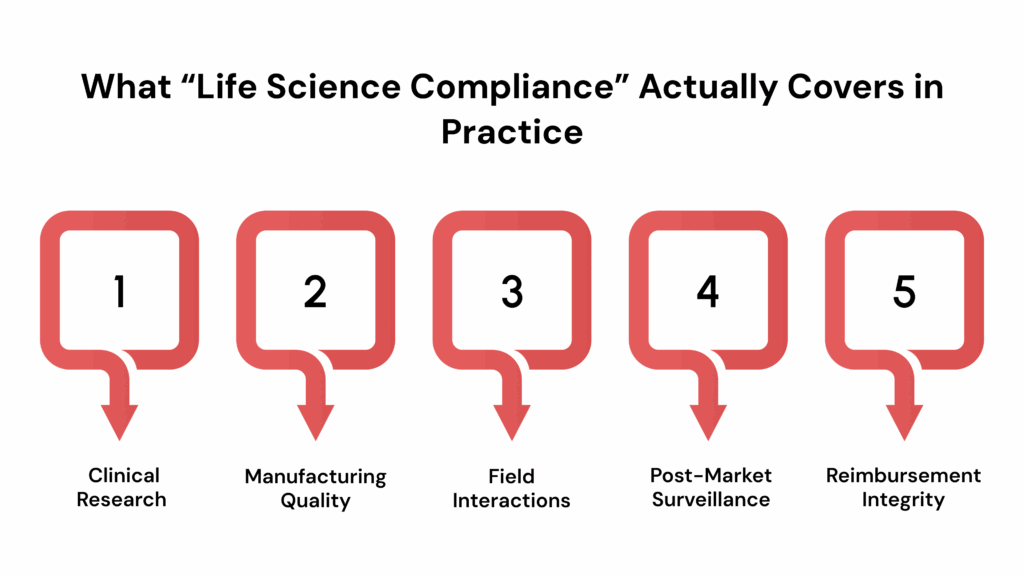
In practice, Life Science Compliance is not a single function; it is a web of obligations that span the development, manufacture, promotion, monitoring, and protection of data for drugs, biologics, and devices.
Life science compliance actually covers the following domains:
1. Clinical Research & Trial Conduct
This domain governs how studies are designed, executed, monitored, and documented.
Core Responsibilities:
- Protocol adherence, informed consent, and investigator oversight
- Compliance with GCP and 21 CFR Parts 50, 54, 56, and 312
- IRB/IEC approvals and ongoing ethical review
- Safety event capture, reporting, and documentation
- Oversight of CROs, central labs, eClinical platforms, and decentralized trial technologies
2. Manufacturing Quality & GxP Operations
Ensures products are consistently produced, controlled, and released according to regulatory expectations.
Core Responsibilities:
- GMP/GLP compliance across drug, biologic, and device operations
- Process validation and equipment qualification
- Batch record accuracy, deviation documentation, investigations, and CAPA
- Data integrity aligned with ALCOA+ principles
- Computerized system validation (CSV) and controlled change management
3. Labeling, Promotion & Field Interactions
Covers all communications related to product claims, scientific exchange, and customer engagement.
Core Responsibilities:
- Ensuring on-label promotion, fair balance, and appropriate risk disclosures
- Distinguishing scientific exchange from commercial messaging
- Monitoring conduct of sales reps, MSLs, speaker programs, advisory boards, and training events
4. Safety, Pharmacovigilance & Post-Market Surveillance
Protects patient safety by tracking adverse events and evaluating product performance after launch.
Core Responsibilities:
- Adverse event intake, triage, case processing, and regulatory submission
- Signal detection, risk evaluation, and ongoing safety monitoring
- Device malfunction reports, trend analysis, and corrective actions
5. Anti-Bribery, Fraud & Reimbursement Integrity
Addresses legal and financial risks tied to improper influence, payments, and market access activities.
Core Responsibilities:
- Compliance with the FCPA, Anti-Kickback Statute, and False Claims Act
- Governance of HCP/HCO engagements, grants, donations, and sponsorships
- Oversight of patient support programs, copay assistance, hubs, and reimbursement services
Also Read: Healthcare Compliance Program: Understanding the Purpose and Creation
With the scope of Life Science Compliance defined, the next question for any CCO or risk leader is simple: Where, exactly, are you most likely to fail in 2025 if you do nothing differently?
The Major Life Science Compliance Risks You Must Monitor in 2025
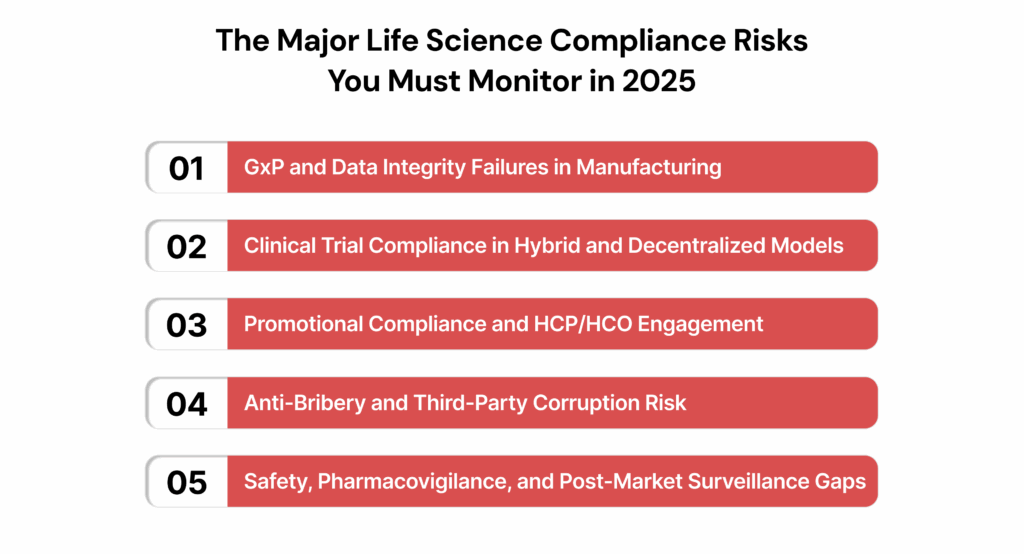
In 2025, risk does not sit in one department. It concentrates on where regulation, complexity, and data intersect. Below are the domains that require continuous attention, not annual review.
1. GxP and Data Integrity Failures in Manufacturing
GxP failures remain among the most reliable predictors of FDA scrutiny because they expose weaknesses in how a product is manufactured, controlled, and documented. Below are the points where the risk concentrates:
- Unreliable batch records: Records that are incomplete, contradictory, or impossible to reconstruct during inspections remain a top trigger for Form 483 observations.
- Ineffective CAPA: Corrective actions that fix immediate errors but ignore systemic causes lead to recurring deviations, an issue FDA views as a breakdown in quality oversight.
- ALCOA+ violations: Gaps in data that should be attributable, contemporaneous, or accurate, whether in paper logbooks or digital systems—signal that basic quality principles are not being followed.
- Weak validation and change control: Inadequate validation of equipment, laboratory instruments, and core systems (MES, LIMS, ERP) creates blind spots and introduces unapproved changes into regulated workflows.
2. Clinical Trial Compliance in Hybrid and Decentralized Models
As trials become more decentralized, compliance risk shifts from single sites to complex networks. Major risk drivers are:
- Protocol adherence issues when activities move to home settings, telehealth, or local providers.
- Gaps in informed consent documentation occur when eConsent or remote processes are poorly controlled.
- Investigator oversight is diluted across multiple vendors, platforms, and geographies.
- Fragmented safety data collection from wearables, apps, and remote monitoring tools.
3. Promotional Compliance and HCP/HCO Engagement
Commercial and medical activities remain a high-enforcement area. High-risk activities include:
- Off-label or non-compliant promotion by sales reps, MSLs, or digital channels.
- Speaker programs, advisory boards, and educational events have inadequate documentation of fair market value, selection criteria, or content.
- Co-pay support, patient services, and reimbursement hubs that may be perceived as inducements if poorly structured.
4. Anti-Bribery and Third-Party Corruption Risk
Third parties remain one of the most critical vectors for enforcement. Primary risk points:
- Distributors and agents in high-risk markets with limited transparency on sub-distributors.
- Consultants and local partners engaged for “market access” or “regulatory facilitation” without a clear scope or deliverables.
- Inadequate due diligence, risk-based onboarding, and ongoing monitoring of third parties.
5. Safety, Pharmacovigilance, and Post-Market Surveillance Gaps
Post-approval does not reduce compliance risk; it changes its form. Critical vulnerabilities:
- Under-reporting or delayed reporting of adverse events from affiliates, partners, or patient programs.
- Weak signal detection processes that fail to identify patterns across geographies or data sources.
- Incomplete follow-up and documentation when device malfunctions or product complaints surface.
Also Read: Best Healthcare Compliance Software for 2025
The obvious question for any compliance leader is: if these risks are well understood and repeatedly cited by regulators, why do they keep showing up in the same organizations year after year?
Why Traditional Life Science Compliance Programs Struggle?
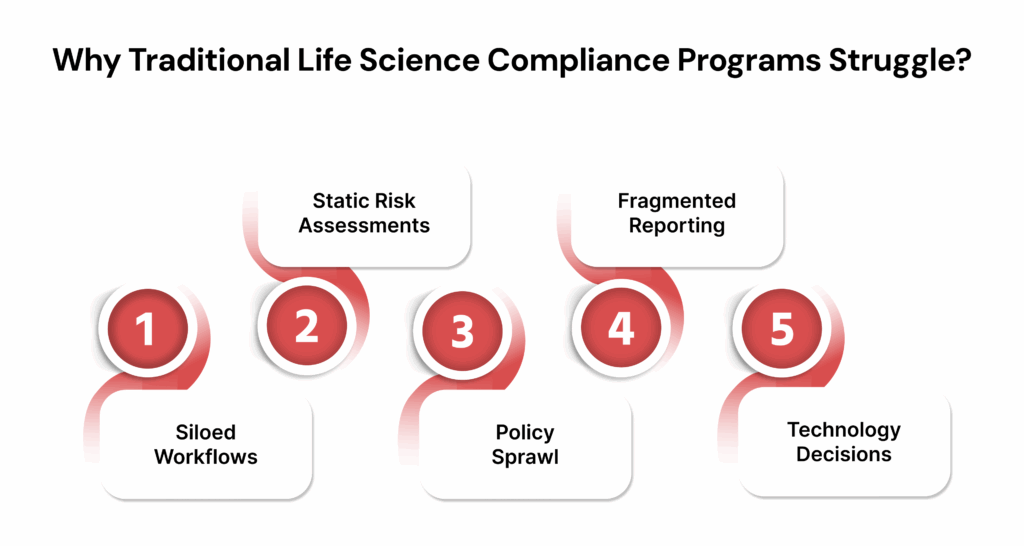
Many life science companies are not failing because they lack policies or training. They are failing because their compliance architecture was built for a slower, paper-heavy world and has not kept pace with global, digital, and data-driven operations.
1. Manual, Siloed Workflows That Cannot Scale
Many life science compliance programs still rely on spreadsheets, email threads, and shared drives to manage core workflows like CAPA, audits, deviations, and SOP access. These disconnected tools make it nearly impossible to identify cross-functional patterns across Clinical, Quality, IT, and Commercial teams.
2. Static Risk Assessments in a Dynamic Risk Environment
Risk assessments are often annual slide decks that quickly become outdated. They rarely influence real monitoring plans, allowing emerging risks, AI models, decentralized trials, cloud deployments, and new markets to be recognized long after exposure has increased.
3. Policy Sprawl Without Real Governance
Most organizations accumulate years of SOPs, policies, and guidance documents that lack consistent templates, clear ownership, or controlled distribution. With limited attestation tracking, frontline teams follow local habits rather than updated procedures.
4. Weak Metrics, Fragmented Reporting, and Limited Board Visibility
Compliance reporting often focuses on activity counts, trainings delivered, audits completed, and hotline cases opened, rather than indicators of risk reduction or control effectiveness.
5. Technology Decisions Made Outside a GRC Strategy
Many life science companies deploy point solutions for audits, quality events, learning, or hotline management without a unifying architecture. As a result, data remains fragmented across multiple systems, controls cannot be mapped consistently, and end-to-end traceability becomes nearly impossible.
VComply’s GRCOps gives life science teams a single source of truth for compliance. It unifies controls, workflows, and evidence across Quality, Clinical, IT, and Commercial functions, delivering real-time visibility and audit-ready documentation.
If you recognize these gaps in your own program, the next step is to get a structured, time-bound plan that turns insight into visible change.
90-Day Action Plan for Life Science Compliance Leaders
This 90-day plan is designed for US-based life science organizations that need to strengthen compliance without disrupting ongoing operations. It focuses on focus, sequencing, and ownership, not abstract maturity models.
Days 1–30: Establish a Clear Baseline and Risk-Weighted Priorities
Use the first month to understand your true exposure and align leadership on where to act first.
- Identify core regulatory drivers, FDA GxP, HIPAA/HITECH, FCPA/AKS, False Claims Act, Sunshine/Open Payments.
- Link each obligation to the processes it governs: clinical execution, manufacturing, safety, commercial operations, IT/data systems.
- Highlight shared obligations that require coordinated ownership, such as data integrity, which spans Quality, IT, Manufacturing, and external partners.
- Analyze the last 12–24 months of inspections, audits, deviations, CAPA, hotline cases, PV findings, and data incidents.
- Select 3–5 high-impact domains (e.g., data integrity, decentralized trials, HCP engagements, PHI handling, third-party risk) as near-term priorities.
- Align executives on measurable outcomes (e.g., fewer repeat findings, faster CAPA closure, clearer third-party documentation).
Days 31–60: Redesign Critical Workflows and Build Governance Structures
The second month is about translating priorities into concrete, repeatable ways of working.
- For each priority domain, document the “current state” workflow (who does what, where data lives, how approvals happen).
- Define a “target state” that removes manual steps, clarifies ownership, and embeds control points, for example:
- Standardized deviation and CAPA routing across all sites.
- A consistent, risk-based process for HCP/HCO engagement approvals.
- A single intake and triage path for adverse events or data incidents.
- Ensure every critical step in the redesigned workflow is tied to a specific policy/SOP clause, a control owner, and evidence of performance.
Days 61–90: Operationalize, Automate, and Embed Continuous Monitoring
The final 30 days are about moving from paper designs to operational reality.
- Pilot redesigned workflows in a defined scope (e.g., one plant, one study portfolio, one region).
- Train process owners and high-risk roles (manufacturing supervisors, study leads, sales leaders, field medical, IT security) with scenario-based examples rather than generic modules.
- Configure GRC workflows so that tasks, approvals, evidence capture, and escalations are driven by the system, not by memory or inboxes.
- At day 90, document what worked, where friction remains, and which domains should be next (e.g., broader third-party risk, additional plants, more studies).
- Use this to build a realistic roadmap for the next 6–12 months, rather than a one-off “transformation project.”
Once you have a clear 90-day agenda, the question becomes practical: how do you execute this consistently across sites, functions, and third parties without adding more spreadsheets and manual work? That’s where VComply comes in use.
How VComply Strengthens Life Science Compliance Programs?
VComply provides an integrated suite of GRC modules that help life science organizations convert regulatory obligations into structured, traceable, and audit-ready workflows.
Here’s what VComply delivers:
- ComplianceOps: Maps FDA GxP, HIPAA, FCPA/AKS, and Open Payments requirements to controls; automates inspections, validations, and readiness tasks; centralizes evidence for rapid audit response.
- RiskOps: Maintains a single enterprise risk register; links risks to controls and remediation; provides CXO-ready heatmaps across clinical, manufacturing, commercial, and vendor ecosystems.
- PolicyOps: Centralizes SOPs and policies with full version control; manages targeted distribution and attestations for high-risk roles; ensures staff follow the right version every time.
- CaseOps: Standardizes incident, investigation, and CAPA management; captures root cause and corrective actions; tracks closure rates and repeat issues across sites and functions.
- GRCOps: Unifies metrics across all modules; offers real-time dashboards for executives and boards; drives consistent governance, oversight, and accountability.
Strengthen your compliance posture with VComply, unify controls, evidence, and oversight, and respond to regulators with confidence. Book a demo today!
Wrapping Up
Life science organizations operate in an environment where regulatory expectations, digital complexity, and cross-functional dependencies continue to accelerate.
The companies that succeed are those that treat compliance not as documentation work, but as an operational discipline, supported by clear ownership, risk-based oversight, and audit-ready systems.
By modernizing workflows and unifying controls, you strengthen product integrity, protect patient trust, and reduce the cost and uncertainty of regulatory intervention.
Partner with VComply to build a stronger, more unified compliance foundation, one that supports your teams, simplifies oversight, and keeps your organization ready for whatever regulators expect next. Start a free trial!
FAQs
Life science compliance is tied directly to product safety, patient outcomes, and FDA-regulated processes, which require documented evidence for every critical activity. Unlike general corporate compliance, failures here can halt manufacturing, delay approvals, or trigger enforcement actions that impact market access.
Most breaches stem from behaviors, late entries, undocumented changes, or incomplete records, not system failures. Regulators view these patterns as signs of weak quality culture and insufficient oversight.
DCTs involve more data sources, home-based procedures, and multiple vendors, creating higher variability and oversight challenges. Any breakdown in consent, safety reporting, or protocol execution directly impacts data reliability.
Vendors often manage regulated activities, manufacturing, clinical tasks, HCP interactions on your behalf. When they fail, your organization inherits the regulatory liability, penalties, and reputational damage.
If evidence, risks, policies, and incidents sit in separate systems and require manual assembly for inspections, the program is outdated. Modern compliance demands integrated, real-time visibility.