

ISO 27001 Risk Assessment: How to Identify, Score, and Manage Risks
ISO 27001 certification does not fail on missing policies; it fails when organizations cannot demonstrate how risks were identified, evaluated, and tied to implemented controls. During audits, assessors look for clear risk logic: why a control exists, what risk it addresses, and whether that risk is actively monitored.
For compliance leaders, CTOs, and security teams, this turns risk assessment into more than a preparatory step. It becomes the foundation of the ISMS, driving control selection, shaping the Statement of Applicability (SoA), and determining whether the program holds up under audit scrutiny.
The challenge is operational. Risks must be consistently identified, scored using defined criteria, mapped to Annex A controls, and supported with documentation that is current and defensible. Without a structured approach, organizations struggle to justify control decisions and maintain audit readiness.
A well-executed ISO 27001 risk assessment provides that structure, linking risks, controls, and evidence into a system that supports both certification and ongoing compliance.
Key Takeaways
- ISO 27001 risk assessments ensure security controls are implemented based on documented risk exposure rather than generic best practices.
- Risk assessments provide the evidence auditors rely on to confirm that an organization’s Information Security Management System (ISMS) operates based on structured risk evaluation.
- Organizations must analyze risks based on likelihood and potential business impact.
- A disciplined assessment process allows security teams to map risks directly to Annex A controls, strengthening both security posture and audit defensibility.
- Continuous monitoring ensures risks remain manageable as systems and threats evolve.
What Is an ISO 27001 Risk Assessment?
An ISO 27001 risk assessment is a structured process for identifying, analyzing, and prioritizing risks to your organization’s information assets. It helps determine which security threats could compromise data confidentiality, integrity, or availability.
Under the ISO 27001 standard, organizations must assess risks before implementing security controls. This ensures controls are aligned with actual threats rather than applied arbitrarily.
The goal of the assessment is to understand:
- What information assets does your organization rely on
- What threats or vulnerabilities could impact them
- The likelihood of those risks occurring
- The potential impact on the business
By systematically evaluating these risks, organizations can prioritize the controls that matter most and maintain a resilient security posture.
Why ISO 27001 Risk Assessments Matter for Security and Compliance Leaders
Modern organizations operate in complex digital environments with cloud infrastructure, third-party integrations, and distributed workforces. This complexity increases exposure to cyber threats and compliance risks.
ISO 27001 risk assessments help security and compliance teams address these challenges by providing a structured framework to identify and manage risks across systems, processes, and people.
Without a formal risk assessment process, organizations often struggle with:
- Limited visibility into critical information assets
- Unclear prioritization of security risks
- Difficulty demonstrating compliance during certification audits
- Reactive responses to security incidents
A well-implemented assessment helps organizations move from reactive security management to proactive risk governance.
Step-by-Step Process for Conducting an ISO 27001 Risk Assessment
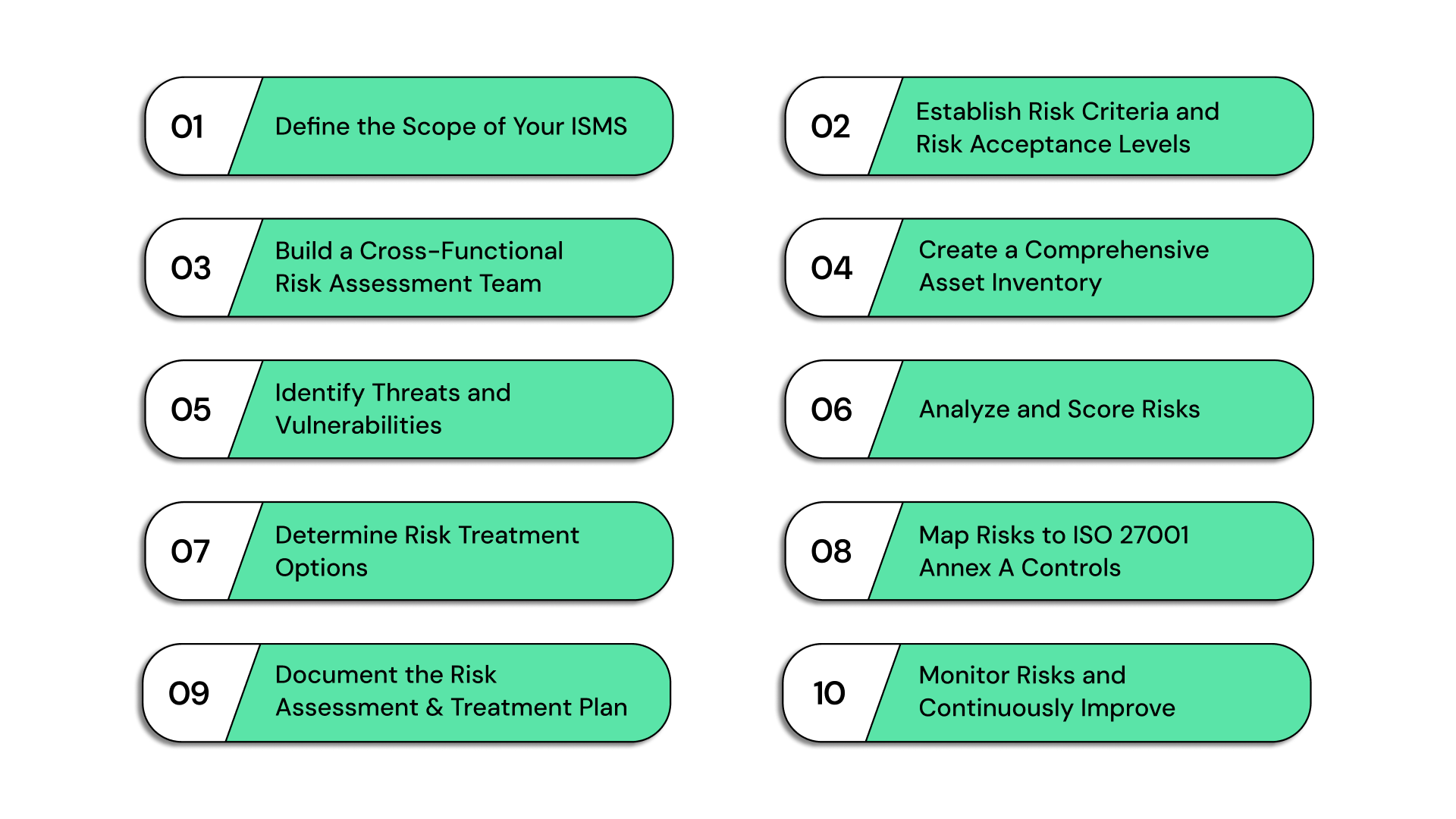
Although organizations may customize their methodology, most ISO 27001 risk assessments follow a structured sequence.
1. Define the Scope of Your ISMS
Before identifying risks, you must determine what parts of the organization fall within the scope of your ISMS. The scope defines which systems, processes, and data your risk assessment will evaluate.
A clearly defined scope helps prevent two common issues: assessing too many assets or overlooking critical systems that store sensitive information.
Your scope should consider:
- Business processes that handle sensitive data
- Applications, infrastructure, and networks
- Cloud environments and third-party vendors
- Legal, regulatory, and contractual requirements
- Stakeholder expectations and security objectives
Documenting these boundaries ensures your risk assessment remains focused and aligned with business priorities.
2. Establish Risk Criteria and Risk Acceptance Levels
Next, you must define how risks will be evaluated and prioritized. ISO 27001 requires organizations to establish risk assessment criteria that produce consistent and comparable results.
This step defines how you measure risk across the organization.
Your risk criteria should include:
- Likelihood scale: probability that a threat will occur
- Impact scale: potential business, operational, or reputational damage
- Risk scoring methodology: how likelihood and impact combine into a risk level
- Risk acceptance criteria: the level of risk your organization is willing to tolerate
Establishing these criteria ensures every risk is evaluated using the same methodology.
3. Build a Cross-Functional Risk Assessment Team
Information security risks rarely exist within a single department. Effective risk assessments require input from multiple stakeholders who understand different aspects of the organization.
Your risk assessment team may include:
- IT and security teams
- Compliance and risk managers
- Business unit leaders
- Legal and regulatory teams
- Internal audit professionals
Involving cross-functional stakeholders improves risk visibility and ensures the organization accurately evaluates business impact.
4. Create a Comprehensive Asset Inventory
You cannot protect assets you have not identified. Creating a detailed asset inventory helps you understand where sensitive information resides and which systems support critical business processes.
Your asset inventory may include:
- Customer and employee data
- Databases and applications
- Cloud services and infrastructure
- Physical devices and endpoints
- Intellectual property and proprietary information
This inventory becomes the foundation for identifying threats and vulnerabilities.
5. Identify Threats and Vulnerabilities
Once assets are identified, the next step is determining what could compromise them. A threat is a potential event that could harm an asset, while a vulnerability is a weakness that allows that threat to occur.
Common examples include:
- Phishing attacks targeting employee credentials
- Misconfigured cloud infrastructure
- Unpatched software vulnerabilities
- Insider threats or human error
- Third-party vendor risks
Documenting these risks helps build a centralized risk register that captures possible security incidents before they occur.
6. Analyze and Score Risks
After identifying threats, you must evaluate the level of risk they pose to the organization. Risk analysis typically measures two factors: likelihood and impact.
When evaluating impact, organizations often consider the CIA triad, which assesses how risks affect:
- Confidentiality: unauthorized access to sensitive data
- Integrity: unauthorized modification of information
- Availability: disruption of systems or services
Combining these factors allows teams to classify risks as low, medium, or high priority.
7. Determine Risk Treatment Options
Not all risks can be eliminated, so the next step is deciding how to address them. ISO 27001 defines four common risk treatment options.
These include:
- Mitigation: implementing security controls to reduce risk
- Acceptance: acknowledging risk when it falls within acceptable thresholds
- Avoidance: changing processes or technology to eliminate the risk
- Transfer: shifting risk through insurance or third-party agreements
Selecting the appropriate treatment option ensures your organization focuses resources on the most critical risks.
8. Map Risks to ISO 27001 Annex A Controls
When mitigating risks, organizations typically implement controls from ISO 27001 Annex A.
These controls are grouped into four categories:
- Organizational controls
- People controls
- Physical security controls
- Technological controls
Each control should directly address a specific risk identified during the assessment rather than being implemented as a checklist exercise.
9. Document the Risk Assessment and Treatment Plan
ISO 27001 places strong emphasis on documentation. Your risk assessment must produce clear records that demonstrate how risks were evaluated and addressed.
Common documents include:
- Risk Register: A centralized list of identified risks, including assets, threats, vulnerabilities, and risk scores.
- Risk Assessment Methodology: Documentation explaining how risks are evaluated, including scoring criteria and risk acceptance thresholds.
- Risk Treatment Plan: A plan outlining how each identified risk will be mitigated, accepted, transferred, or avoided.
- Statement of Applicability (SoA): A document that lists the Annex A controls implemented by your organization and justifies any exclusions.
These records become critical evidence during ISO 27001 certification audits.
RiskOps centralizes this process, linking identified risks directly to Annex A controls with automated scoring, ownership assignment, and evidence tracking, eliminating spreadsheet chaos and ensuring audit-ready documentation.
10. Monitor Risks and Continuously Improve
Risk assessments should never remain static. New technologies, evolving threats, and changing business processes constantly introduce new risks.
Organizations should regularly review their risk register and monitor whether implemented controls remain effective.
Continuous monitoring may include:
- vulnerability scans and patch management
- security monitoring tools
- control testing and internal audits
- reporting risk posture to leadership
By treating risk assessment as an ongoing process rather than a one-time activity, you strengthen your security posture and maintain compliance with ISO 27001 requirements.
Key Components of an ISO 27001 Risk Assessment

An effective ISO 27001 risk assessment evaluates several core elements of an organization’s information security environment.
1. Information Asset Identification
The process begins by identifying the information assets your organization must protect. These may include:
- Sensitive data and databases
- Applications and software systems
- Cloud infrastructure and networks
- Physical devices and storage systems
Maintaining a detailed asset inventory is essential because you cannot protect assets you have not identified.
2. Threat and Vulnerability Identification
Once assets are identified, organizations analyze potential threats and vulnerabilities that could compromise them.
Examples include:
- Cyberattacks such as ransomware or phishing
- Insider threats or human error
- System misconfigurations
- Third-party vendor vulnerabilities
Identifying these risks allows teams to understand where security gaps exist.
3. Risk Analysis and Scoring
Each identified risk is evaluated based on two key factors:
- Likelihood — the probability that the threat will occur
- Impact — the potential damage to the organization
Organizations often use a risk matrix to classify risks as high, medium, or low priority.
4. Risk Treatment and Control Selection
Once risks are prioritized, organizations determine how to address them.
Possible treatment options include:
- Implementing security controls
- Reducing exposure through technical safeguards
- Transferring risk through insurance or contracts
- Accepting risk when the impact is minimal
These treatment decisions inform the Statement of Applicability (SoA) used during ISO audits.
Common Challenges When Performing ISO 27001 Assessments

Despite its importance, many organizations struggle to perform effective ISO 27001 risk assessments.
Common operational challenges include:
- Incomplete asset inventories: Teams often overlook shadow IT, cloud assets, or third-party systems.
- Manual risk tracking: Spreadsheets and fragmented documentation make it difficult to maintain accurate risk registers.
- Inconsistent risk scoring: Without a standardized methodology, different teams evaluate risks differently.
- Limited visibility across departments: Security, compliance, and IT teams may lack a centralized view of risks and mitigation efforts.
These challenges can delay ISO certification efforts and weaken an organization’s security posture. ComplianceOps bridges these gaps by unifying risk registers, control mappings, and evidence in one platform, enabling real-time visibility and standardized workflows across security, compliance, and audit teams.
Structuring ISO 27001 Risk Assessments Across Risk and Compliance Functions
ISO 27001 risk assessments often break down after initial evaluation. Risks are identified but not consistently tracked, scoring varies across teams, and mitigation actions are disconnected from control implementation. As audits approach, teams are left reconciling risk registers, control mappings, and documentation across multiple systems.
This creates a gap between risk assessment and audit evidence, where risks, controls, and documentation are not fully aligned.
VComply’s RiskOps and ComplianceOps modules address this by bringing risk and compliance into a single operational framework. RiskOps structures risk identification and tracking, while ComplianceOps connects those risks to controls, documentation, and audit readiness.
This allows teams to:
- Centralize risk registers and standardize scoring
- Link risks directly to Annex A controls
- Track mitigation with clear ownership
- Maintain audit-ready documentation
The result is a risk assessment process that supports continuous compliance, not just audit preparation.
Book a 21-day free trial to explore how we support ISO 27001 audit readiness.

Conclusion
ISO 27001 risk assessments are not just a certification requirement—they determine whether your ISMS can withstand audit scrutiny. When risks are inconsistently scored, poorly documented, or disconnected from controls, organizations struggle to justify decisions and demonstrate compliance during audits.
The objective is to move from one-time assessments to a structured system where risks are continuously identified, tracked, and aligned with implemented controls. This ensures decisions are defensible, evidence remains current, and audit readiness is maintained without last-minute effort.
VComply provides this structure by connecting risk assessments, control implementation, and documentation within a single operational framework—helping teams maintain consistency, visibility, and accountability across their ISMS.
Book a demo to see how VComply helps structure ISO 27001 risk assessments and maintain continuous audit readiness.
FAQs
Auditors look for clear traceability between risks, controls, and decisions. This includes a defined risk assessment methodology, consistent risk scoring, a complete risk register, and documented linkage to Annex A controls through the Statement of Applicability (SoA).
ISO 27001 does not prescribe a single method, but it requires organizations to define a consistent approach for identifying, analyzing, and evaluating risks based on likelihood and impact. The methodology must be documented and applied consistently across the ISMS.
The SoA is directly derived from the risk assessment. It documents which Annex A controls are implemented and why, based on identified risks. If a control is excluded, the organization must justify that decision using risk assessment results.
Risk assessments should be reviewed regularly and updated whenever there are significant changes—such as new systems, vendors, threats, or business processes. Many organizations perform formal reviews annually alongside continuous monitoring.
A risk register typically includes identified assets, associated threats and vulnerabilities, risk scores (likelihood and impact), treatment decisions, control mappings, and current status. It serves as the central record for managing risk within the ISMS.