

Information Security Compliance: What It Is and How to Operationalize It at Scale in 2026
Audit reviews increasingly show that while organizations can map controls to frameworks like NIST and ISO 27001, they struggle to demonstrate consistent execution and real-time visibility into control performance.

Gaps in monitoring, incomplete evidence, and unclear ownership limit audit defensibility and create decision uncertainty for compliance and risk leaders. The challenge is no longer defining requirements, but ensuring controls operate reliably across systems and workflows.
Information security compliance is shifting from policy alignment to system-driven execution that enables continuous monitoring and traceable evidence. Its effectiveness now depends on how well organizations embed controls into operations and maintain visibility into risk.
This article examines how information security compliance works in practice and how to structure it for consistent, audit-ready execution.
Quick Look
- Compliance failures stem from execution gaps, not missing policies, particularly across workflows, ownership, and monitoring.
- Effective compliance requires continuous control validation, replacing periodic audits with real-time visibility into performance.
- Framework alignment (NIST, SOC 2, ISO 27001) is necessary but insufficient without system-driven enforcement and evidence generation.
- Operational controls determine outcomes, as inconsistent execution and manual processes create audit and risk exposure.
- Audit readiness depends on traceable, system-generated evidence, not retrospective documentation.
What Is Information Security Compliance?
Information security compliance ensures that security controls are not only defined but consistently executed in alignment with frameworks such as NIST, SOC 2, and ISO 27001.
It centers on control performance, audit validation, and accountability, requiring organizations to demonstrate that safeguards operate reliably across systems, workflows, and teams, not just exist as documented policies.
Core Objective
- Translate data protection requirements into executable control actions, not policy statements
- Ensure controls function consistently across systems, users, and workflows
- Validate that safeguards produce measurable outcomes and audit evidence
- Reduce reliance on manual interpretation through structured enforcement mechanisms
- Maintain continuous alignment between risk exposure and control performance
Where It Sits in the GRC Ecosystem
- Risk management: Identifies threats and prioritizes controls based on exposure
- Policy governance: Defines requirements, but does not ensure execution
- Control execution: Operationalizes compliance through workflows and systems
- Cross-functional dependency: Requires coordination across IT, security, and compliance
- Operational layer: Connects governance intent with real-world enforcement and evidence generation
Also read: Maintaining Regulatory and Compliance Adherence as a Money Transmitter
Why Information Security Compliance Has Become an Execution Problem
Compliance failures are rarely driven by missing policies; they emerge when controls fail to operate consistently within real-world systems. As regulatory scrutiny increases, organizations must demonstrate not just intent, but verifiable execution across distributed environments.
Modern compliance breakdowns are driven by systemic gaps that limit visibility, consistency, and accountability:
1. Control Design vs Control Execution Gap
Documented controls often fail when translated into operational workflows.
- Controls defined at a policy level lack clear execution pathways
- Dependencies across teams introduce delays and missed steps
- Manual interpretation leads to variability in execution
- Audit reviews highlight disconnects between intent and performance
- Result: Controls exist formally but fail under real-world conditions
2. Fragmented Systems and Manual Processes
Execution is often spread across disconnected tools and communication channels.
- Reliance on spreadsheets, emails, and siloed platforms
- No unified system to track control execution end-to-end
- Increased risk of missed approvals and inconsistent enforcement
- Limited coordination across IT, compliance, and business teams
- Result: Reduced reliability and lack of centralized oversight
3. Lack of Continuous Monitoring
Periodic validation cannot reflect real-time control performance.
- Audits capture snapshots, not ongoing execution
- Delayed detection of control failures and deviations
- Limited visibility into current compliance posture
- Inability to respond proactively to emerging risks
- Result: Compliance becomes reactive rather than controlled
4. Increasing Regulatory Expectations
Frameworks now require demonstrable, continuous control performance.
- NIST emphasizes continuous monitoring and risk-based controls
- SOC 2 requires evidence of ongoing control effectiveness
- ISO 27001 mandates systematic control validation within ISMS
- Regulators expect traceable, audit-ready evidence, not summaries
- Result: Organizations must prove execution, not just alignment
Also read: US State-by-State Data Privacy Laws: What Compliance Teams Must Track
Key Information Security Compliance Frameworks
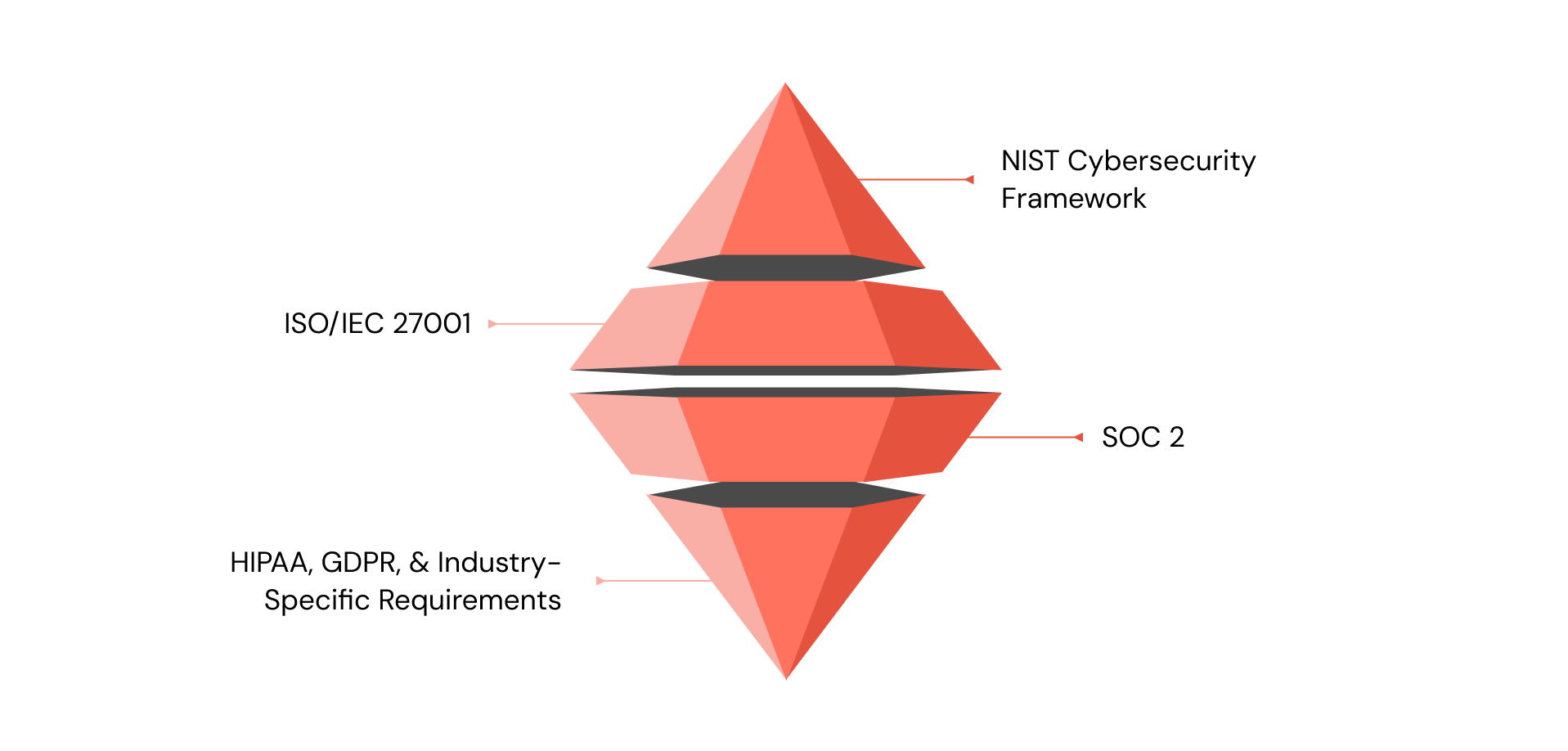
Frameworks provide the structure for compliance, but their effectiveness depends on how well controls are operationalized within systems and workflows. Alignment alone does not ensure execution.
Different frameworks define requirements, but organizations must translate them into enforceable control systems:
1. NIST Cybersecurity Framework (CSF)
- Structured around Identify, Protect, Detect, Respond, Recover
- Emphasizes risk-based decision-making and continuous monitoring
- Requires integration of controls into operational workflows
- Supports alignment across technical and governance functions
- Operational implication: Enables structured, repeatable control execution
2. ISO/IEC 27001
- Establishes an Information Security Management System (ISMS)
- Standardizes control implementation across organizational processes
- Requires continuous review, monitoring, and improvement cycles
- Focuses on documentation + execution alignment
- Operational implication: Ensures consistency and governance discipline
3. SOC 2
- Based on Trust Services Criteria (security, availability, confidentiality, etc.)
- Validates both control design and operating effectiveness
- Requires auditable evidence of execution over time
- Aligns compliance with customer and stakeholder expectations
- Operational implication: Strengthens audit assurance and credibility
4. HIPAA, GDPR, and Industry-Specific Requirements
- HIPAA: Protects healthcare data under U.S. regulatory requirements
- GDPR: Applies to U.S. organizations handling EU data (cross-border context)
- Industry mandates define sector-specific control obligations
- Require data protection, access control, and audit traceability
- Operational implication: Expands compliance scope across jurisdictions
Why Framework Alignment Alone Is Not Enough
- Mapping controls to frameworks does not ensure execution discipline
- Policies and documentation fail without workflow integration
- Evidence gaps emerge when controls are not continuously monitored
- Organizations may appear compliant but lack operational defensibility
- Conclusion: Framework alignment is necessary, but execution determines outcomes
Execution gaps often remain invisible until audits expose them, by which point remediation becomes reactive and resource-intensive. To see how structured workflows can help you standardize control execution, book a demo with VComply today.
Core Components of Information Security Compliance
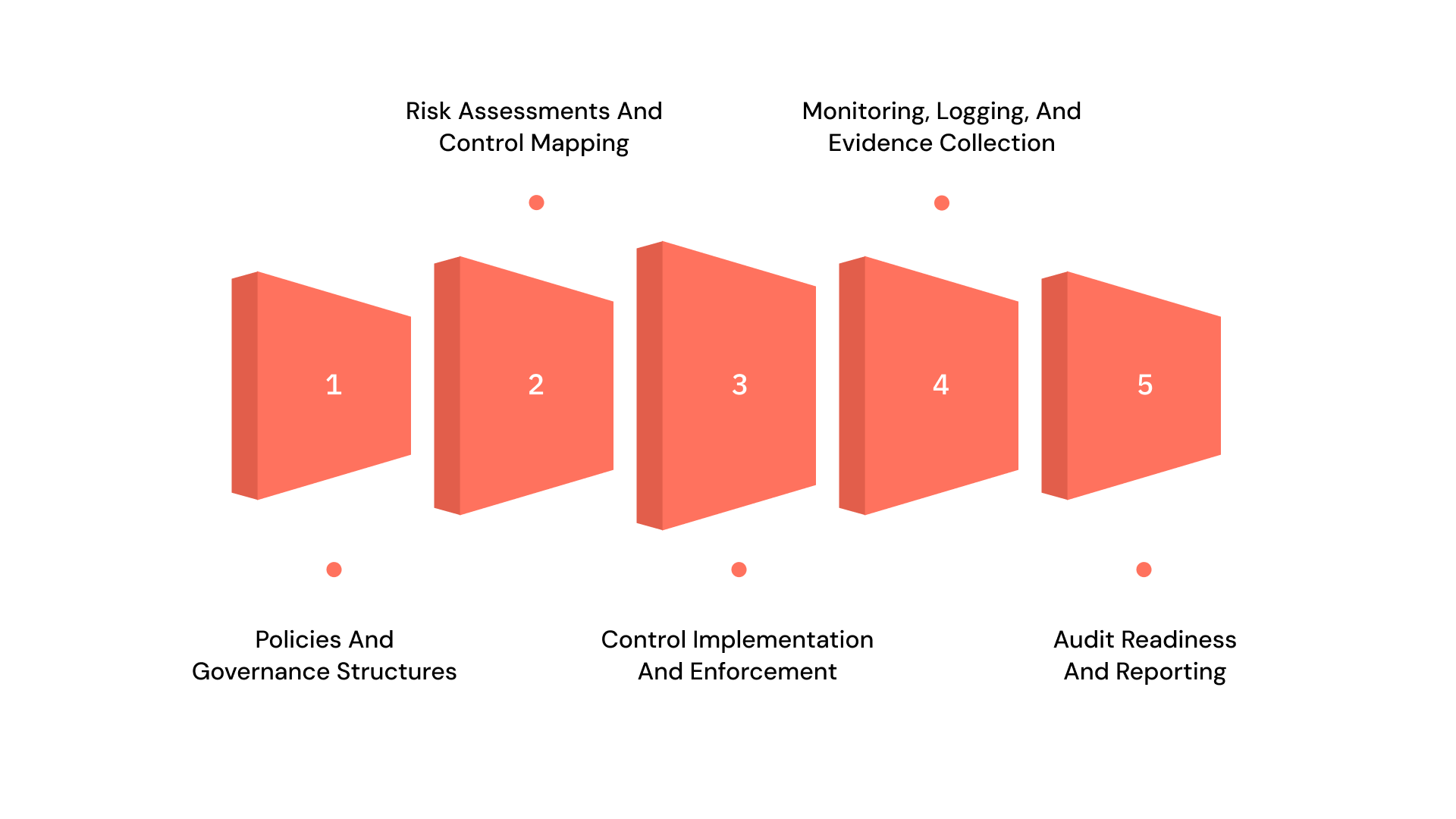
Effective information security compliance depends on how well governance, risk, and execution layers are integrated into operational systems. Each component must function cohesively to ensure control reliability and audit readiness.
These components form the foundation of a structured compliance system:
1. Policies and Governance Structures
- Define security requirements and control expectations
- Establish roles, responsibilities, and escalation paths
- Provide a baseline for regulatory alignment
- Limitation: Do not ensure actual execution or enforcement
- Operational insight: Policies must be embedded into workflows to be effective
2. Risk Assessments and Control Mapping
- Identify threats, vulnerabilities, and impact levels
- Map risks to specific controls and framework requirements
- Prioritize controls based on risk exposure and business impact
- Enable alignment between compliance and risk strategy
- Operational insight: Drives where controls must be enforced
3. Control Implementation and Enforcement
- Translate controls into executable workflows and system actions
- Define approval processes, validation steps, and checkpoints
- Ensure consistent execution across teams and environments
- Reduce variability through structured processes
- Operational insight: Determines whether compliance holds in practice
4. Monitoring, Logging, and Evidence Collection
- Capture logs, approvals, and system outputs automatically
- Enable continuous visibility into control performance
- Provide traceable records for audit and investigation
- Reduce reliance on manual evidence collection
- Operational insight: Converts execution into audit-ready proof
5. Audit Readiness and Reporting
- Validate control performance through structured reporting
- Ensure evidence supports audit and regulatory inquiries
- Identify gaps through internal reviews and assurance processes
- Maintain consistency across audit cycles
- Operational insight: Determines defensibility under scrutiny
Types of Information Security Controls
Information security compliance depends on how different control layers function together within operational systems, not just how they are defined. While administrative and technical controls establish intent and enforcement, execution reliability is determined by how consistently controls are applied across workflows, teams, and environments.
Different control types contribute to compliance, but their effectiveness varies based on execution discipline:
1. Administrative Controls
Administrative controls define governance intent through policies, standards, and procedures that establish compliance expectations and align with frameworks such as NIST and ISO 27001.
They clarify roles, responsibilities, and escalation structures, providing a foundation for regulatory alignment. However, they do not ensure execution on their own and depend entirely on how effectively they are translated into operational workflows.
2. Technical Controls
Technical controls enforce security requirements through system-level mechanisms such as firewalls, identity and access management, and encryption. They enable automated enforcement of predefined rules, reduce reliance on manual intervention, and support detection and response capabilities.
However, without alignment to governance structures and ownership, they often lack context, limiting visibility into whether controls are functioning as intended from a compliance perspective.
3. Operational Controls
Operational controls translate governance intent and technical enforcement into consistent execution across systems and teams. These include activities such as access reviews, approvals, monitoring, and validations, all of which require coordination across functions.
This layer ensures that controls are actually performed as designed and generates evidence through execution, making it central to maintaining compliance in real-world environments.
Also read: Common HIPAA Violations to Avoid
How Information Security Compliance Works in Practice
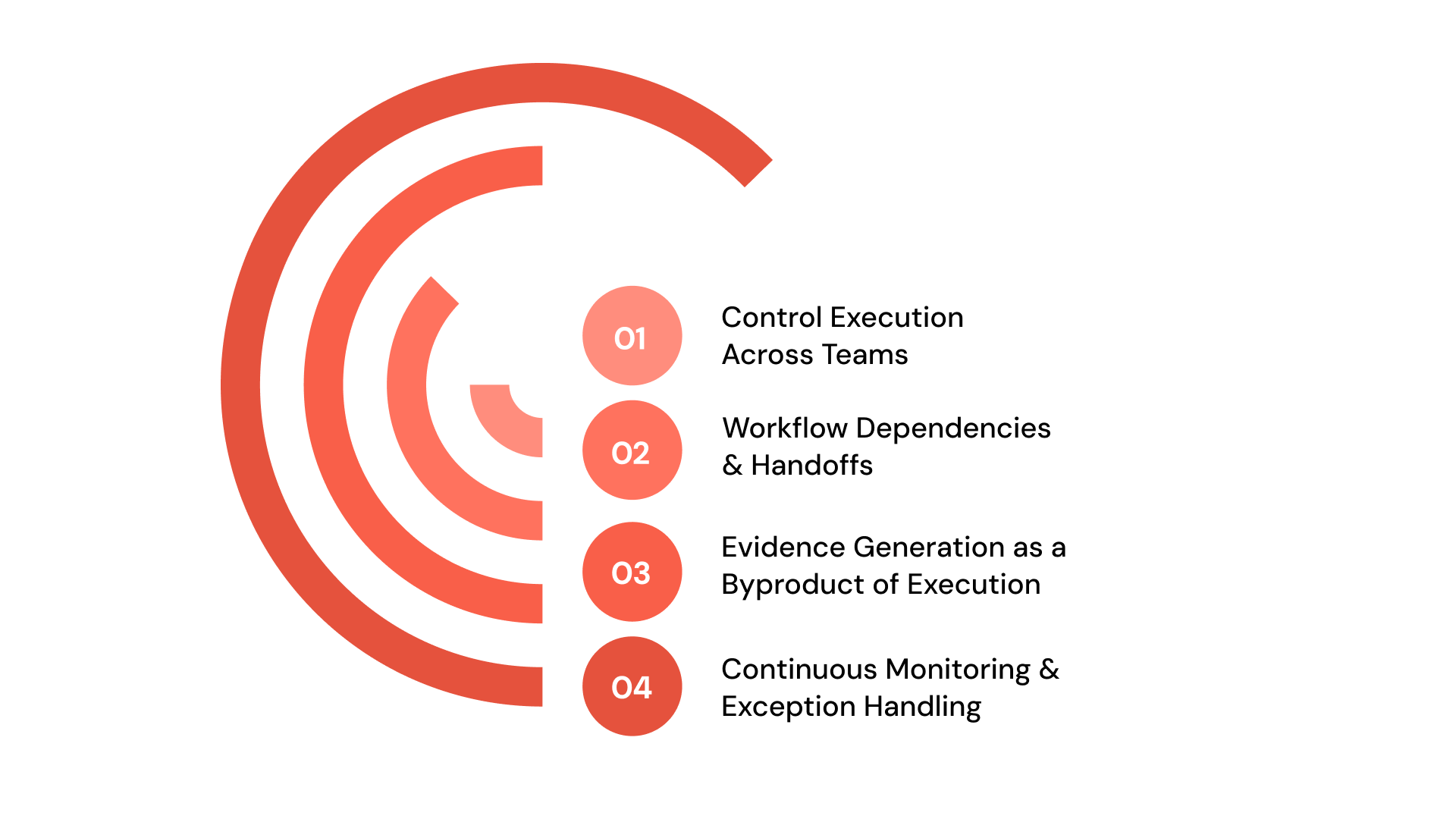
Information security compliance is realized through coordinated execution across systems, teams, and workflows. Its effectiveness depends on how consistently controls are applied and how reliably evidence is generated as part of normal operations rather than reconstructed later.
In practice, compliance performance is shaped by execution dynamics:
1. Control Execution Across Teams
Control execution typically spans multiple functions, including IT, security, compliance, and business units, each responsible for specific steps within a control workflow. This shared ownership introduces dependencies that must be managed carefully to avoid gaps or delays.
Without clear coordination and visibility, even well-designed controls can fail due to breakdowns in cross-functional execution.
2. Workflow Dependencies and Handoffs
Many controls require sequential execution across systems and teams, where delays or missed handoffs can disrupt the entire process. Manual coordination increases the risk of inconsistency, particularly when responsibilities are not clearly defined or tracked.
Without structured workflows, organizations struggle to maintain reliability and visibility into whether controls are executed as intended.
3. Evidence Generation as a Byproduct of Execution
Effective compliance requires that evidence be generated during control execution rather than collected retrospectively. Logs, approvals, and system outputs serve as real-time audit trails that reflect actual performance.
This approach improves accuracy, reduces manual effort, and ensures that evidence is directly tied to execution, strengthening audit defensibility.
4. Continuous Monitoring and Exception Handling
Continuous monitoring enables organizations to detect deviations in control performance as they occur, rather than relying on periodic validation. Alerts and escalation mechanisms support timely response and remediation, maintaining alignment with compliance requirements.
This shift from reactive to proactive oversight ensures that organizations retain visibility into compliance status at all times.
As control execution spans teams and systems, visibility and coordination become critical for maintaining consistency. Evaluate how centralized workflows can reduce dependency risks and improve real-time compliance tracking. Book a demo with VComply now.
Compliance vs Security vs Risk
Information security compliance operates alongside security and risk management but serves a distinct function. Misalignment between these areas often leads to gaps in execution and oversight.
Understanding their roles is critical for decision-making:
Why Compliance ≠ Security
- Compliance validates whether controls are defined and executed
- Security focuses on protecting systems and preventing threats
- Compliance may be achieved without fully mitigating risk
- Security may exist without audit-ready evidence
- Insight: They overlap but serve different objectives
Why Security Alone Does Not Ensure Compliance
- Technical controls lack traceability and documentation
- Security measures may not align with regulatory requirements
- Absence of evidence weakens audit defensibility
- Controls must be measurable and verifiable
- Insight: Security without governance fails compliance validation
Where Risk Management Fits
- Identifies and prioritizes organizational risks
- Determines which controls are critical for mitigation
- Aligns compliance efforts with business impact
- Supports informed decision-making at the leadership level
- Insight: Risk defines priorities; compliance validates execution
Why This Distinction Matters for Leadership
- Misalignment creates false confidence in control effectiveness
- Leads to audit failures despite a strong security posture
- Results in inefficient allocation of resources
- Limits visibility into actual risk exposure
- Outcome: Leadership decisions depend on an integrated understanding
Common Gaps That Cause Compliance Failures
Even well-designed compliance programs fail when execution lacks structure, consistency, and visibility. These gaps typically surface during audits or incidents when organizations must demonstrate control performance.
Common failure points include:
1. Controls Defined but Not Executed
- Controls exist in documentation but lack workflow integration
- Dependence on manual execution leads to missed steps
- Inconsistent application across teams
- Limited enforcement mechanisms
- Impact: Weakens reliability and audit defensibility
2. Inconsistent Application Across Teams
- Variability in how controls are interpreted and applied
- Lack of standardized workflows across environments
- Differences in execution across regions or units
- Limited cross-functional alignment
- Impact: Reduces consistency and increases risk exposure
3. Lack of Evidence and Traceability
- Missing logs, approvals, or execution records
- Evidence stored across disconnected systems
- No clear linkage between controls and outputs
- Difficulty responding to audit requests
- Impact: Inability to prove compliance
4. Fragmented Tools and Systems
- Multiple tools with no centralized coordination
- Limited visibility into end-to-end execution
- Increased risk of data inconsistency
- Inefficient reporting and monitoring
- Impact: Breaks oversight and reduces control effectiveness
Also read: Achieve seamless compliance – Compliance software for law firms
How to Operationalize Information Security Compliance

Operationalizing compliance requires designing systems that ensure consistent execution, accountability, and visibility. This transition moves compliance from static documentation to continuous, measurable processes.
A structured approach includes:
Step 1: Map Controls to Workflows
- Translate controls into specific, executable actions
- Embed controls within systems and operational processes
- Eliminate ambiguity in execution
- Ensure alignment with real-world workflows
- Outcome: Improves consistency and reliability
Step 2: Define Ownership and Accountability
- Assign clear responsibility for each control and workflow step
- Establish escalation paths for failures and exceptions
- Track ownership across systems
- Enable accountability at all levels
- Outcome: Ensures execution translates into action
Step 3: Enable Continuous Monitoring
- Implement real-time monitoring of control performance
- Detect deviations immediately
- Reduce reliance on periodic audits
- Maintain visibility into current compliance status
- Outcome: Enables proactive risk management
Step 4: Integrate Evidence Capture into Execution
- Capture logs, approvals, and outputs automatically
- Ensure evidence is linked directly to control activities
- Eliminate manual documentation efforts
- Improve audit readiness and traceability
- Outcome: Strengthens defensibility
Step 5: Align with Frameworks and Business Risk
- Map controls to NIST, SOC 2, and ISO 27001 requirements
- Align execution with risk priorities and business objectives
- Ensure reporting supports decision-making
- Maintain consistency across frameworks
- Outcome: Connects compliance to strategy
Also read: Stark Law Compliance: How to Avoid Violations?
Structuring Information Security Compliance for Scale
As organizations scale, compliance execution often breaks down due to fragmented systems, manual coordination, and limited visibility into control performance. These gaps create inconsistencies in execution, weaken audit defensibility, and reduce leadership confidence in reported compliance posture, particularly under regulatory scrutiny.
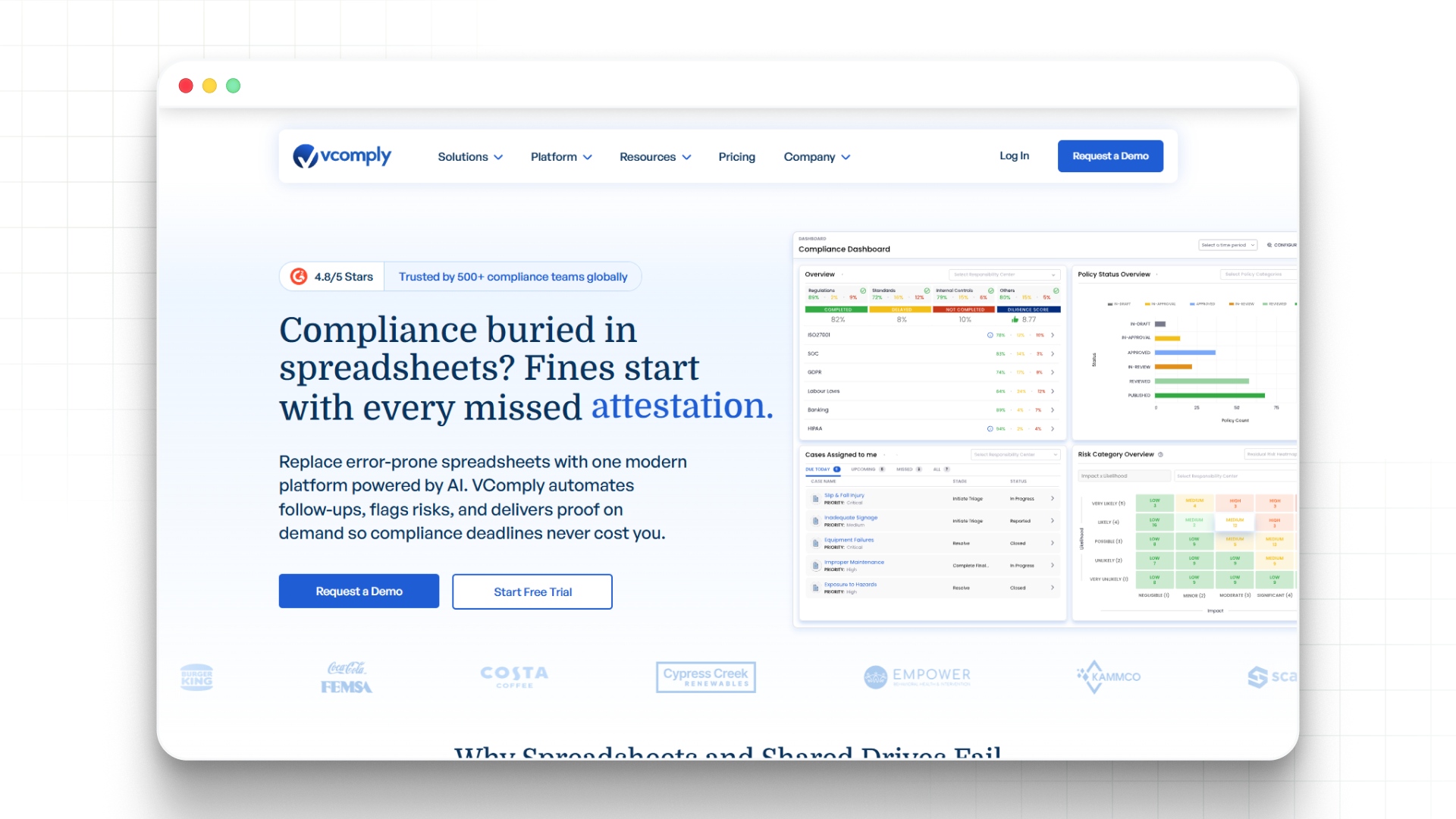
VComply addresses this by structuring information security compliance into integrated workflows across ComplianceOps and the broader GRCOps suite, ensuring that controls are executed consistently, evidence is captured in real time, and visibility is maintained across systems and teams.
- Workflow-driven control execution: Controls are embedded into structured workflows with defined steps, approvals, and escalation paths
- Real-time compliance visibility: Dashboards provide immediate insight into control status, exceptions, and performance trends
- Integrated evidence capture: Logs, approvals, and execution records are automatically linked to controls for audit readiness
- Ownership mapping across controls: Every control is assigned to a responsible owner, ensuring accountability and follow-through
- Framework-aligned reporting: Controls and outputs are mapped to NIST, SOC 2, and ISO 27001 for consistent validation
Schedule a demo with VComply to evaluate how structured systems can standardize information security compliance execution and strengthen governance visibility across your organization.
Wrapping Up
Information security compliance ultimately depends on how effectively controls are executed, monitored, and validated across systems rather than how well they are documented.
As regulatory expectations from frameworks such as NIST, SOC 2, and ISO 27001 continue to emphasize continuous assurance, organizations must move beyond policy alignment toward structured execution that provides real-time visibility, traceable evidence, and consistent control performance.
Without this shift, gaps in monitoring, fragmented workflows, and unclear accountability will continue to limit audit defensibility and decision confidence.
As compliance becomes increasingly dependent on coordinated execution across teams and systems, manual processes and disconnected tools create structural gaps that are difficult to manage at scale.
VComply addresses this by structuring information security compliance within integrated workflows that connect controls, ownership, and evidence into a unified system, enabling continuous monitoring and audit-ready outputs.
Start a 21-day free trial of VComply to learn how we can help you standardize control execution, improve visibility into compliance performance, and maintain consistent, defensible governance across your organization.
FAQs
Information security compliance ensures that security controls are not only defined but consistently executed, monitored, and evidenced in alignment with regulatory frameworks. It focuses on control performance and audit validation rather than policy documentation alone.
Common frameworks include NIST Cybersecurity Framework, ISO/IEC 27001, SOC 2, and industry-specific regulations such as HIPAA. These frameworks define control requirements but must be operationalized through workflows and systems.
Failures typically result from gaps in execution, inconsistent control performance, and a lack of traceable evidence. Even well-documented controls fail when they are not embedded into workflows or continuously monitored.
Organizations can improve effectiveness by mapping controls to workflows, defining ownership, enabling continuous monitoring, and integrating evidence capture into execution. Structured systems such as VComply help ensure consistency, visibility, and audit-ready outputs across compliance processes.